Proceedings of the 2019 Conference on Empirical Methods in Natural Language Processing 2662
Representation Learning with Ordered Relation Paths
for Knowledge Graph Completion
Yao Zhu1, Hongzhi Liu2∗, Zhonghai Wu3,4, Yang Song5 and Tao Zhang5 1 Center for Data Science, Peking University, Beijing, China
2 School of Software and Microelectronics, Peking University, Beijing, China 3National Engineering Center of Software Engineering, Peking University, Beijing, China 4 Key Lab of High Confidence Software Technologies (MOE), Peking University, Beijing, China
5BossZhipin NLP Center @Kanzhun.com, Beijing, China
{yao.zhu,liuhz,wuzh}@pku.edu.cn, {songyang,kylen.zhang}@kanzhun.com
Abstract
Incompleteness is a common problem for ex-isting knowledge graphs (KGs), and the com-pletion of KG which aims to predict links be-tween entities is challenging. Most existing KG completion methods only consider the di-rect relation between nodes and ignore the re-lation paths which contain useful information for link prediction. Recently, a few methods take relation paths into consideration but pay less attention to the order of relations in paths which is important for reasoning. In addition, these path-based models always ignore non-linear contributions of path features for link prediction. To solve these problems, we pro-pose a novel KG completion method named OPTransE. Instead of embedding both entities of a relation into the same latent space as in previous methods, we project the head entity and the tail entity of each relation into differ-ent spaces to guarantee the order of relations in the path. Meanwhile, we adopt a pooling strategy to extract nonlinear and complex fea-tures of different paths to further improve the performance of link prediction. Experimental results on two benchmark datasets show that the proposed model OPTransE performs bet-ter than state-of-the-art methods.
1 Introduction
Knowledge graphs (KGs) are built to store struc-tured facts which are encoded as triples, e.g., (Beijing, CapitalOf, China) (Lehmann et al.,
2015). Each triple(h, r, t)consists of two entities
h,tand a relationr, indicating there is a relationr
betweenhandt. Large-scale KGs such as YAGO (Suchanek et al.,2007), Freebase (Bollacker et al.,
2008) and WordNet (Miller,1995) contain billions of triples and have been widely applied in vari-ous fields (Riedel et al.,2013;Dong et al.,2015). However, a common problem with these KGs is
∗
Corresponding author
that they are far from complete, which has limited the development of KG’s applications. Thus, KG completion with the goal of filling in missing parts of the KG has become an urgent issue. Specifi-cally, KG completion aims to predict whether a re-lationship between two entities is likely to be true, which is defined as the link prediction in KGs.
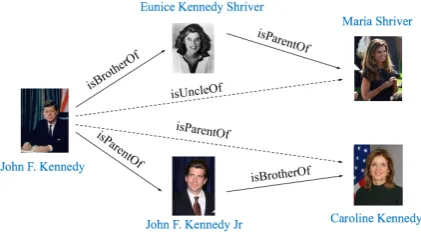
Most existing KG completion methods are based on representation learning, which embed both entities and relations into continuous low-dimension spaces. TransE (Bordes et al.,2013) is one of the most classical KG completion models, which embeds entities and relations into the same latent space. To better deal with complex relations like 1-to-N, N-to-1 and N-to-N, TransH (Wang et al.,2014) and TransR (Lin et al.,2015b) employ relation-specific hyperplanes and relation-specific spaces respectively to separate triples according their corresponding relation. Unfortunately, these models ignore the relation paths between entities which are helpful for reasoning. For example, if we know A is B’s brother, and B is C’s parent, then we can infer that A is C’s uncle.
re-Figure 1: Example of the meaning change when the order of relations is altered.
lation inference linearly and ignore other complex interactions between them.
To address these issues, we propose a novel KG completion model named OPTransE. In the model, we project the head entity and the tail entity of each relation into different spaces and introduce sequence matrices to keep the order of relations in the path. Moreover, a pooling strategy is adopted to extract nonlinear features of different paths for relation inferences. Experimental results on two benchmark datasets WN18 and FB15K show that OPTransE significantly outperforms state-of-the-art methods.
The remainder of this paper is organized as fol-lows. Section 2 discusses related work. Section 3 presents the proposed model and algorithm in detail. Empirical evaluation of the proposed al-gorithm and comparison with other state-of-the-art algorithms are presented in Section 4. Finally, Section 5 summarises the whole paper and points out some future work.
2 Related Work
2.1 Translation-based Models
In recent years, there has been a great deal of work on representation learning for KG comple-tion, and most studies concentrate on translation-based models. This kind of models propose to em-bed both entities and relations into a continuous low-dimensional vector space according to some distance-based scoring functions.
TransE (Bordes et al.,2013) is one of the most fundamental and representative translation-based models. For the entities and relations in KGs, TransE encodes them as vectors in the same space. For each fact(h, r, t), TransE believes thath+r≈
twhen (h, r, t)holds. Thus, the scoring function
is defined as
fr(h, t) =kh+r−tk1/2 . (1)
whereh,randtrepresent the vectors of head en-tityh, relation r and tail entityt, respectively. If the fact(h, r, t)is true, its scorefr(h, t)tends to be close to zero.
TransE is a simple and efficient method for KG completion. However, its simple structure has flaws in dealing with complicated relations like 1-to-N, N-to-1 and N-to-N. In order to address this problem, TransH (Wang et al., 2014) introduces relation-specific hyperplanes and projects entities as vectors onto the given hyperplanes. Similar to TransH, TransR (Lin et al., 2015b) also aims to cope with complicated relations. Instead of employing the hyperplane like TransH, TransR proposes a matrix Wr∈Rm×n to project entity
vectors into a relation-specific space. Moreover, STransE (Nguyen et al.,2016) extends TransR by introducing two projection matrices for the head entity and the tail entity, respectively. Therefore, the head and tail entities in a triple will be pro-jected differently into the corresponding relation space.
2.2 Incorporating Relation Paths
The models introduced so far only exploit facts ob-served in KGs to conduct representation learning. In fact, there is a large amount of useful infor-mation in relation paths that can be incorporated into translation-based models to improve the per-formance of link prediction.
[image:2.595.77.288.65.181.2]ex-Figure 2: Architecture of OPTransE.
tends the TransR model by incorporating the path-specific projection for paths between entity pairs.
These methods try to incorporate information of relation paths to get better performance. How-ever, they pay less attention to the order of rela-tions in a path when learning representarela-tions of the path. In fact, changes in the relation order of paths will alter the meanings of paths to a great ex-tent (as shown in Figure1). Moreover, the meth-ods stated above assume information from differ-ent paths between an differ-entity pair only contributes to the relation inference linearly. Unfortunately, they ignore the complex nonlinear features of dif-ferent paths. In order to solve these problems, we propose OPTransE, a novel KG completion model, which learns representations of ordered re-lation paths and designs a pooling method to bet-ter extract nonlinear features from various relation paths.
3 Our Model
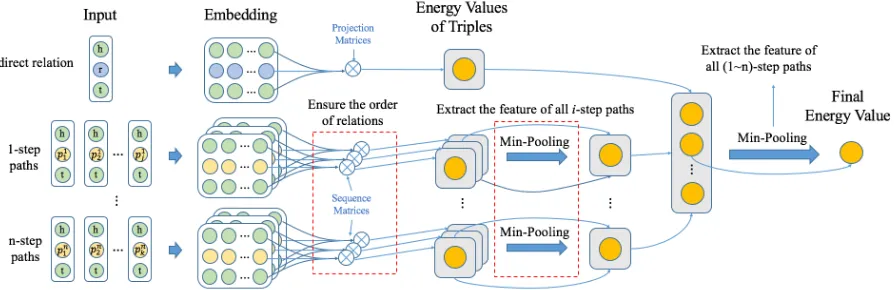
To infer the missing parts of KGs, we propose a KG completion model called OPTransE, whose ar-chitecture is shown in Figure 2. We first embed the entities and relations of KG into latent spaces with the consideration of the order of relations in paths. Then, we try to infer the missing relations using these latent representations. Different from previous methods which embed the head and tail of a relation into the same latent space, we project them into different spaces. Therefore, we can dis-tinguish the order of relations in the path. To ex-tract the complex and nonlinear path information for relation reasoning, we design a two layer pool-ing strategy to fuse the information from different paths.
In this section, we will first introduce the
em-bedding representations of ordered relation paths. After that, we utilize a two layer pooling strategy to construct the total energy function of triples and then the objective function is presented. Finally, we will describe the detail of model implementa-tion and analyze the complexity of the model.
3.1 Ordered Relation Paths Representation
For each triple(h, r, t)in KG, we employ vectors to represent the entity pair and the relation. Specif-ically,h∈Rddenotes the head entityh,t∈
Rd
de-notes the tail entitytandr∈Rdindicates the rela-tionr.
We assume the paths connecting two entities contain indicative information for the direct rela-tion between these two entities. To measure these kinds of indicative effects while guarantee the or-der of relations in a path, we define an energy function in Equation (2). Letps=ndenote one of then-step path fromhtot, i.e.,h −→ · · ·r1 −→rn t. If the relation path is reasonable fromhtot, it will obtain a lower energy value.
E(h, ps=n, t) =khp+ n
X
i=1
Sipri−tp k1/2, (2)
where
hp =f(p,h), tp =g(p,t), (3)
Sip =W(p, i). (4)
hp and tp denote the representations of the head entityhand the tail entitytin the ordered re-lation pathp, respectively. Si
[image:3.595.77.524.65.210.2]Figure 3: The representation of path p(h −→r1 t0 −→r2 t). The top part of the figure depicts the process of space transition oft0andt, while the bottom part illustrates the generated continuous path fromhptotpafter the
transition.
Note that a triple(h, r, t)in the KG can be seen as a one-step path betweenhandt. Thus, the value ofE(h, r, t)is able to be obtained by substituting direct relationrasps=1into Equation (2).
From Equation (2) we could observe that the se-quence matrix Sip before each relation ri is dif-ferent. If the order of several relations in a path is altered, the value of energy function will also change at the same time. Therefore, paths with the same relation set but different relation order will infer out distinct direct relations in our model. The specific representation of the ordered relation path will be demonstrated in the following contents.
To keep the order information of relations in paths, we project the head and tail entities of a relation into different spaces by introducing two matrices for each relation. Let Wr,1∈Rd×d and Wr,2∈Rd×ddenote the projection matrices of the
head entity and the tail entity for relationr, respec-tively. With these two matrices, we will project the head and tail entities into distinct spaces with re-spect to the same relation. Suppose there is a path
r1, r2, . . . , rn from h to t, ideally, we define the following equations
Wr1,1h+r1 =Wr1,2t
(1)
Wr2,1t
(1)+r
2 =Wr2,2t
(2)
.. .
Wrn,1t
(n−1)+r
n =Wrn,2t
, (5)
where t(i) indicates thei-th passing node on the path.
For the entity pair with a relation path, we get their representations after eliminating the passing nodes from Equation (5). Thus, the concrete forms of the variables in Equation (2) are shown as fol-lows,
hp=Wr1,1h, tp=Wps=nt, (6)
Sip=
i
Y
k=1
Tk, (7)
where
Wps=n =SnpWr
n,2, (8)
Tk=
(
I k= 1
M(rk, rk−1) k >1
. (9)
Wps=n∈Rd×d indicates the projection matrix
for path ps=n, which aims to project the tail en-tity in a path to the space of ps=n. Moreover,
I in Equation (9) denotes the identity matrix and
M(rk, rk−1)∈Rd×d means the space transition
matrix from the head entity space ofrkto the tail entity space ofrk−1, i.e., M(rk, rk−1)Wrk,1 =
Wrk−1,2.
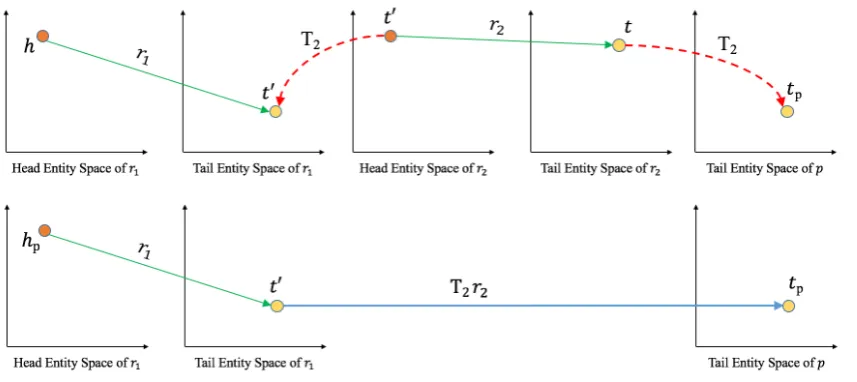
Figure3illustrates the representation of the re-lation path in our model. Suppose there is a 2-step path fromhtotpassingt0, i.e.,h−→r1 t0 −→r2 t. It is obvious thatt0 acts as the tail entity of relation
[image:4.595.319.527.404.554.2]unify the passing node in the path into the same space. As defined in Equation (9), T2 is utilized
to transfer the passing nodet0from the head entity space of r2 to the tail entity space of r1.
More-over,T2 is also assigned to the relationr2and the
tail entityt. Note that the tail entitytwill be pro-jected into the space of pathpwhich is defined in Equation (6). Finally, the path fromhp totp will pass throughr1 andT2r2 as shown on the bottom
part of Figure3.
3.2 Pooling Strategy
We design a two layer pooling strategy to fuse the information from different paths. First, we utilize a minimum pooling method to extract feature in-formation from paths with i steps and define an energy function as follows,
E h, Prs=i, t
=Min[E h, ps=i, t
|ps=i∈Prs=i],
(10) where Prs=i indicates the set of all i-step paths which are relevant to the relationrfrom the head entity h to the tail entity t. To obtainPrs=i, we introduce a conditional probabilityPr(r|ps=i) to represent the reliability of a path ps=i associated with the given relationr,
Pr rps=i
= Pr(r, ps=i)/ Pr(ps=i)
= N(r, p
s=i)/N(p)
N(ps=i)/N(p)
= N(r, p
s=i)
N(ps=i) ,
(11)
wherePr(r, ps=i)denotes the joint probability of
r andps=i,Pr(ps=i)denotes the marginal proba-bility ofps=i. In addition,N(r, ps=i)denotes the number of cases wherer andps=i link the same entity pair in the KG,N(ps=i) denotes the num-ber of the pathps=i in the KG andN(p)denotes the total number of paths in the KG. Since N(p)
can be removed from both the numerator and de-nominator of the fractional expression, we finally convert the probability into frequency for compu-tation.
We filter the paths by choosing allps=ifromh
to t whosePr rps=i
> 0. Thus, Prs=i is the set of all filtered ps=i. Sometimes we could in-fer the fact not from the direct relationr but from the path, which means the value ofE h, Prs=i, t
could possibly be less than that ofE(h, r, t). Furthermore, we utilize a minimum pooling method to fuse information from paths with
dif-ferent lengths and define an energy function as fol-lows,
Ef inal(h, r, t) =Min[E(h, r, t), E h, Prs=1, t
,
E h, Prs=2, t, . . . , E(h, Prs=n, t)],
(12)
whereE(h, r, t)indicates the energy value of di-rect relationr and it is calculated by substituting
rasps=1into Equation (2). E h, Prs=i, t
is ini-tialized as infinite, thus it will not influence the outcome of final energy function if there is noi -step path betweenhandt.
In summary, we adopt the min-pooling strat-egy twice in our model. ForE h, Prs=i, t, min-pooling aims to choose the most matched path withramong alli-step paths. And for the final en-ergy function, min-pooling tries to extract nonlin-ear features from paths of various lengths. In addi-tion, the min-pooling method addresses the prob-lem that there may be no relation paths betweenh
andt.
3.3 Objective Function
The objective function for the proposed model OPTransE is formalized as
L(S) = X
(h,r,t)∈S
(
L(h, r, t) +λ·X
i
1
Zi
· X
ps=i∈Ps=i r
Prps=i h, t
·Prr p
s=i
·Lh, ps=i, t
)
,
(13)
where L(h, r, t) indicates the loss function for the triple(h, r, t), andL h, ps=i, trepresents the loss value with respect to the relation path ps=i. The probability Pr ps=ih, t
indicates the reli-ability of the relation path ps=i given the entity pair (h, t), and Pr(r|ps=i) denotes the reliabil-ity of a pathps=i associated with the given rela-tion r. The details of Pr ps=ih, t
are shown in (Lin et al., 2015a), which is computed by a path-constraint resource allocation algorithm.
Zi = Pps=i∈Ps=i r Pr p
s=i h, t
Pr rps=i
is a normalization factor, and λis utilized to balance the triple loss and paths losses.
We adopt the margin-based loss in our model, i.e.,
L(h, r, t) = X
(h0,r,t0)∈S0
[γ+E(h, r, t)−E(h0, r, t0)]+,
L h, ps=i, t
= P
(h0,r,t0)∈S0
[γi+E(h, p, t)−E(h0, p, t0)]+,
(15)
where p is the simple form of ps=i. [x]
+ = max(x,0)returns the higher one between x and 0.γiis the margin to separating positive and nega-tive samples. It is noteworthy that we employ dif-ferent marginγifor paths with different step num-ber because the noise of energy function will be magnified as the number of steps increases. The corrupted triple set S0 for (h, r, t) is denoted as follows:
S0 ={(h0, r, t)∪(h, r, t0)}. (16)
We replace the head entity or the tail entity in the triple randomly and guarantee that the new triple is not an existing valid triple.
Our goal is to minimize the total loss. Valid re-lation paths will obtain lower energy value after the optimization, so that paths can sometimes re-place directed relations when performing the pre-diction.
3.4 Parameter Learning
We utilize stochastic gradient descent (SGD) to optimize the objective function in Equation (13) and learn parameters of the model. To ensure the convergence of the model, we impose limitations to the norm of vectors, i.e., ||h||2 ≤ 1, ||r||2 ≤
1,||t||2 ≤ 1,||Wr,1h||2 ≤ 1,||Wr,2t||2 ≤ 1. Moreover, we note that the objective function de-fined in Equation (13) has two parts. The first part is for the basic triple and the second part is for the relation paths. To focus on the representation of ordered relation paths in the second part, we only update the parameters of relation vectors in the path when conducting the optimization of the model.
In addition, we follow PTransE (Lin et al.,
2015a) to generate reverse relationr-1 to enlarge the training set, and the inference in KGs can be through the reverse paths. For instance, for the fact (Honolulu,CapitalOf,Hawaii), we will also add a fact with the reverse relation to the KG, i.e., (Hawaii,CapitalOf−1,Honolulu).
3.5 Complexity Analysis
Let d denote the dimension of entities and rela-tions,NeandNrdenote the number of entities and
relations, respectively. The number of model pa-rameters for OPTransE is (Ned + Nrd + 2Nrd2),
which is the same as that of STransE.
Moreover, let Np denote the expected number
of relation paths between the entity pair, Nt
de-note the number of triples for training,kdenote the maximum length of relation paths. According to the objective function shown in Equation (13) and details of parameter learning stated in Section 3.4, the time complexity of OPTransE for optimization isO(k2d3NpNt), which is on the same magnitude
as that of RPE(MCOM) (Lin et al.,2018).
4 Experiments
4.1 Datasets
To evaluate the proposed model OPTransE, we use two benchmark datasets: WN18 and FB15K as ex-perimental data. They are subsets of the knowl-edge graph WordNet (Miller, 1995) and Free-base (Bollacker et al.,2008), respectively (Bordes et al.,2013). These two datasets have been widely employed by researchers for KG completion (Jia et al.,2018;Lin et al.,2018). The statistic details of the two datasets are shown in Table 1. In our ex-periments, as we add triples of reverse relations to the datasets, the number of relations and training triples are doubled.
Table 1: Statistics of datasets
Dataset #Rel #Ent #Train #Valid #Test WN18 18 40,943 141,442 5,000 5,000 FB15K 1345 14,951 483,142 50,000 59,071
4.2 Experimental Settings
We adopt the idea from TransR (Lin et al.,2015b) and initialize the vectors and matrices of OP-TransE by an existing method SOP-TransE (Nguyen et al., 2016). Following TransH (Wang et al.,
2014), Bernoulli method is applied for generat-ing head or tail entities when samplgenerat-ing corrupted triples.
Table 2: Evaluation results on link prediction
Model
WN18 FB15K
Mean Rank Hits@10(%) Mean Rank Hits@10(%)
Raw Filtered Raw Filtered Raw Filtered Raw Filtered
SE 1011 985 68.5 80.5 273 162 28.8 39.8
SME 545 533 65.1 74.1 274 154 30.7 40.8
TransE 263 251 75.4 89.2 243 125 34.9 47.1
TransH 318 303 75.4 86.7 212 87 45.7 64.4
TransR 238 225 79.8 92.0 198 77 48.2 68.7
TranSparse 223 211 80.1 93.2 187 82 53.5 79.5
STransE 217 206 80.9 93.4 219 69 51.6 79.7
ITransF - 205 - 94.2 - 65 - 81.0
HolE - - - 94.9 - - - 73.9
ComplEx - - - 94.7 - - - 84.0
ANALOGY - - - 94.7 - - - 85.4
ProjE 277 260 79.4 94.9 124 34 54.7 88.4
RTransE - - - 50 - 76.2
PTransE (ADD, 2-step) 235 221 81.3 92.7 200 54 51.8 83.4
PTransE (MUL, 2-step) 243 230 79.5 90.9 216 67 47.4 77.7
PTransE (ADD, 3-step) 238 219 81.1 94.2 207 58 51.4 84.6
PaSKoGE - - 81.3 95.0 - - 53.1 88.0
RPE (ACOM) - - - - 171 41 52.0 85.5
RPE (MCOM) - - - - 183 43 52.2 81.7
RotatE - 309 - 95.9 - 40 - 88.4
OPTransE 211 199 83.2 95.7 136 33 58.0 89.9
to enumerate longer paths. Therefore, considering the computational efficiency, we limit the maxi-mum length of relation paths as 2 steps.
In our experiments, we utilize the grid search to choose the best parameters for the two datasets, re-spectively. The best configurations for OPTransE are as follows: the dimension of entity and rela-tion vectorsd= 50, the learning rateα= 0.0001, the marginγ = 5.0,γ1 = 5.0, γ2 = 5.5, the
bal-ance factor λ = 0.01 on WN18; and d = 100,
α = 0.0005, γ = 4.0, γ1 = 4.5, γ2 = 5.0, λ = 0.01 on FB15K. In addition, L1 norm is employed for scoring and we run SGD for 2000 epochs in the training procedure.
4.3 Evaluation Metrics and Baselines
The same as in previous work (Bordes et al.,2013;
Nguyen et al., 2016), we evaluate the proposed model OPTransE on the link prediction task. This task aims to predict the missing entity in a triple
(h, r, t), i.e., predictinghwhenrandtare given, or predictingtgivenhandr. When testing a fact
(h, r, t), we replace either head or tail entity with all entities in the dataset and calculate scores of
generated triples according to Equation (12). And then we sort the entities with their scores in as-cending order to locate the rank of the target en-tity.
For specific evaluation metrics, we employ the widely used mean rank (MR) and Hits@10 in the experiments. Mean rank indicates the aver-age rank of correct entities and Hits@10 means the proportion of correct entities ranked in top 10. Higher Hits@10 or lower value of mean rank im-plies the better performance of the model on the link prediction task. Moreover, it is noted that the generated triple for test may exist in the dataset as a fact, thus such triples will affect the final rank of the target entity to some extent. Hence, we could filter out these generated triples which are facts in the dataset before ranking. If we have performed filtering, the result will be denoted as ”Filtered”, otherwise it will be denoted as ”Raw”.
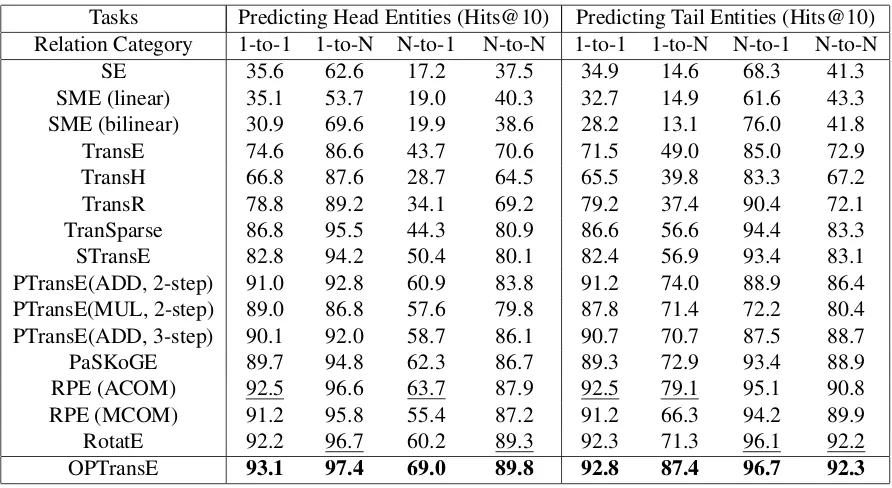
Table 3: Filtered evaluation results on FB15K by mapping properties of relations(%)
Tasks Predicting Head Entities (Hits@10) Predicting Tail Entities (Hits@10) Relation Category 1-to-1 1-to-N N-to-1 N-to-N 1-to-1 1-to-N N-to-1 N-to-N
SE 35.6 62.6 17.2 37.5 34.9 14.6 68.3 41.3
SME (linear) 35.1 53.7 19.0 40.3 32.7 14.9 61.6 43.3
SME (bilinear) 30.9 69.6 19.9 38.6 28.2 13.1 76.0 41.8
TransE 74.6 86.6 43.7 70.6 71.5 49.0 85.0 72.9
TransH 66.8 87.6 28.7 64.5 65.5 39.8 83.3 67.2
TransR 78.8 89.2 34.1 69.2 79.2 37.4 90.4 72.1
TranSparse 86.8 95.5 44.3 80.9 86.6 56.6 94.4 83.3
STransE 82.8 94.2 50.4 80.1 82.4 56.9 93.4 83.1
PTransE(ADD, 2-step) 91.0 92.8 60.9 83.8 91.2 74.0 88.9 86.4
PTransE(MUL, 2-step) 89.0 86.8 57.6 79.8 87.8 71.4 72.2 80.4
PTransE(ADD, 3-step) 90.1 92.0 58.7 86.1 90.7 70.7 87.5 88.7
PaSKoGE 89.7 94.8 62.3 86.7 89.3 72.9 93.4 88.9
RPE (ACOM) 92.5 96.6 63.7 87.9 92.5 79.1 95.1 90.8
RPE (MCOM) 91.2 95.8 55.4 87.2 91.2 66.3 94.2 89.9
RotatE 92.2 96.7 60.2 89.3 92.3 71.3 96.1 92.2
OPTransE 93.1 97.4 69.0 89.8 92.8 87.4 96.7 92.3
recorded for comparison.
In the link prediction task, several competitive KG completion methods are utilized as baselines, including SE (Bordes et al., 2011), SME ( Bor-des et al., 2014), TransE (Bordes et al., 2013), TransH (Wang et al., 2014), TransR (Lin et al.,
2015b), TranSparse (Ji et al., 2016), STransE (Nguyen et al., 2016), ITransF (Xie et al.,2017), HolE (Nickel et al., 2016), ComplEx (Trouillon et al.,2016), ANALOGY (Liu et al.,2017), ProjE (Shi and Weninger, 2017), RTransE ( Garc´ıa-Dur´an et al., 2015), PTransE (Lin et al., 2015a), PaSKoGE (Jia et al.,2018), RPE (Lin et al.,2018) and RotatE (Sun et al., 2019). Among them, RTransE, PTransE, PaSKoGE and RPE exploit the information of paths between entity pairs.
4.4 Results
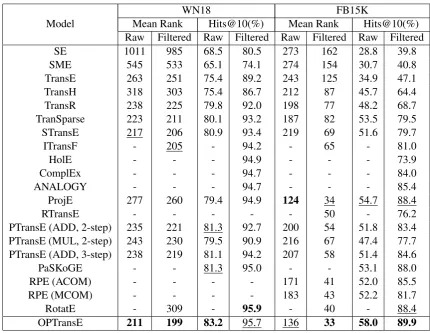
Table 2 shows the performances of different meth-ods on the link prediction task according to vari-ous metrics. Numbers inbold mean the best re-sults among all methods and the underlined ones mean the second best. The evaluation results of baselines are from their original work, and ”-” in the table means there is no reported results in prior work. Note that we implement ProjE and PTransE on WN18 using the public codes.
From Table 2 we could observe that: (1) PTransE performs better than its basic model TransE, and RPE outperforms its original method TransR. This indicates that additional
informa-tion from relainforma-tion paths between entity pairs is helpful for link prediction. Note that OPTransE outperforms baselines which do not take relation paths into consideration in most cases. These re-sults demonstrate the effectiveness of OPTransE to take advantage of the path features in the KG. (2) OPTransE performs better than previous path-based models like RTransE, PTransE, PaSKoGE and RPE on all metrics. This implies that the order of relations in paths is of great importance for rea-soning, and learning representations of ordered re-lation paths can significantly improve the accuracy of link prediction. Moreover, the proposed pool-ing strategy which aims to extract nonlinear fea-tures from different relation paths also contributes to the improvements of performance.
baselines. Meanwhile, since the average predic-tion accuracy for N-to-N relapredic-tions of OPTransE on the two datasets has reached 91.1%, we can also infer that our model has strong ability to deal with N-to-N relations. OPTransE projects the head and tail entities of a triple into different relation-specific spaces, thus, it is able to better discrimi-nate the relevant entities. Furthermore, these re-sults also confirm that ordered relation paths be-tween entity pairs which are exploited by OP-TransE contain useful information and can help to perform more accurate inference when facing complex relations.
5 Conclusion and Future Work
In this paper, we propose a novel KG completion model named OPTransE, which aims to address the issue of relation orders in paths. In our model, we project the head entity and the tail entity of each relation into different spaces to guarantee the order of the path. In addition, a pooling method is applied to extract complex and nonlinear fea-tures from numerous relation paths. Finally, we evaluate our proposed model on two benchmark datasets and experimental results demonstrate the effectiveness of OPTransE.
In the future, we will explore the following re-search directions: (1) we will study the appli-cations of the proposed models in various do-mains, like personalized recommendation (Liu et al.,2018); (2) we will explore other techniques to fuse the ordered relation information from dif-ferent paths (Liu et al.,2019).
Acknowledgments
This work was partially sponsored by Na-tional Key R&D Program of China (grant no. 2017YFB1002000).
References
Kurt Bollacker, Colin Evans, Praveen Paritosh, Tim Sturge, and Jamie Taylor. 2008. Freebase: a collab-oratively created graph database for structuring hu-man knowledge. In Proceedings of the 2008 ACM SIGMOD international conference on Management of data, SIGMOD’08, pages 1247–1250. ACM.
Antoine Bordes, Xavier Glorot, Jason Weston, and Yoshua Bengio. 2014. A semantic matching energy function for learning with multi-relational data. Ma-chine Learning, 94(2):233–259.
Antoine Bordes, Nicolas Usunier, Alberto Garcia-Duran, Jason Weston, and Oksana Yakhnenko. 2013. Translating embeddings for modeling multi-relational data. In Advances in neural information processing systems, NIPS’13, pages 2787–2795.
Antoine Bordes, Jason Weston, Ronan Collobert, and Yoshua Bengio. 2011. Learning structured embed-dings of knowledge bases. In Twenty-Fifth AAAI Conference on Artificial Intelligence, AAAI’11, pages 301–306.
Li Dong, Furu Wei, Ming Zhou, and Ke Xu. 2015. Question answering over freebase with multi-column convolutional neural networks. In Proceed-ings of the 53rd Annual Meeting of the Association for Computational Linguistics and the 7th Interna-tional Joint Conference on Natural Language Pro-cessing (Volume 1: Long Papers), volume 1 of ACL-IJCNLP’15, pages 260–269.
Alberto Garc´ıa-Dur´an, Antoine Bordes, and Nicolas Usunier. 2015. Composing relationships with trans-lations. InProceedings of the 2015 Conference on Empirical Methods in Natural Language Process-ing, EMNLP’15, pages 286–290.
Kelvin Guu, John Miller, and Percy Liang. 2015. Traversing knowledge graphs in vector space. In Proceedings of the 2015 Conference on Empir-ical Methods in Natural Language Processing, EMNLP’15, pages 318–327.
Guoliang Ji, Kang Liu, Shizhu He, and Jun Zhao. 2016. Knowledge graph completion with adap-tive sparse transfer matrix. In Proceedings of the Thirtieth AAAI Conference on Artificial Intelligence, AAAI’16, pages 985–991.
Yantao Jia, Yuanzhuo Wang, Xiaolong Jin, and Xueqi Cheng. 2018. Path-specific knowledge graph em-bedding. Knowledge-Based Systems, 151:37–44.
Jens Lehmann, Robert Isele, Max Jakob, Anja Jentzsch, Dimitris Kontokostas, Pablo N Mendes, Sebastian Hellmann, Mohamed Morsey, Patrick Van Kleef, S¨oren Auer, et al. 2015. Dbpedia–a large-scale, multilingual knowledge base extracted from wikipedia. Semantic Web, 6(2):167–195.
Xixun Lin, Yanchun Liang, Fausto Giunchiglia, Xi-aoyue Feng, and Renchu Guan. 2018. Relation path embedding in knowledge graphs. Neural Comput-ing and Applications, pages 1–11.
Yankai Lin, Zhiyuan Liu, Huanbo Luan, Maosong Sun, Siwei Rao, and Song Liu. 2015a. Modeling rela-tion paths for representarela-tion learning of knowledge bases. In Proceedings of the 2015 Conference on Empirical Methods in Natural Language Process-ing, EMNLP’15, pages 705–714.
Hanxiao Liu, Yuexin Wu, and Yiming Yang. 2017. Analogical inference for multi-relational embed-dings. InProceedings of the 34th International Con-ference on Machine Learning-Volume 70, ICML’17, pages 2168–2178. JMLR. org.
Hongzhi Liu, Yingpeng Du, and Zhonghai Wu. 2019. Aem: Attentional ensemble model for personal-ized classifier weight learning.Pattern Recognition, 96:106976.
Hongzhi Liu, Zhonghai Wu, and Xing Zhang. 2018. Cplr: Collaborative pairwise learning to rank for personalized recommendation. Knowledge-Based Systems, 148:31–40.
George A Miller. 1995. Wordnet: a lexical database for english. Communications of the ACM, 38(11):39– 41.
Dat Quoc Nguyen, Kairit Sirts, Lizhen Qu, and Mark Johnson. 2016. Stranse: a novel embedding model of entities and relationships in knowledge bases. In Proceedings of the 2016 Conference of the North American Chapter of the Association for Computa-tional Linguistics: Human Language Technologies, HLT-NAACL’16, pages 460–466.
Maximilian Nickel, Lorenzo Rosasco, and Tomaso Poggio. 2016. Holographic embeddings of knowl-edge graphs. InProceedings of the Thirtieth AAAI Conference on Artificial Intelligence, AAAI’16, pages 1955–1961.
Sebastian Riedel, Limin Yao, Andrew McCallum, and Benjamin M Marlin. 2013. Relation extraction with matrix factorization and universal schemas. In Pro-ceedings of the 2013 Conference of the North Amer-ican Chapter of the Association for Computational Linguistics: Human Language Technologies, HLT-NAACL’13, pages 74–84.
Baoxu Shi and Tim Weninger. 2017. Proje: embed-ding projection for knowledge graph completion. In Proceedings of the Thirty-First AAAI Conference on Artificial Intelligence, AAAI’17, pages 1236–1242.
Fabian M Suchanek, Gjergji Kasneci, and Gerhard Weikum. 2007. Yago: a core of semantic knowl-edge. InProceedings of the 16th international con-ference on World Wide Web, WWW’07, pages 697– 706. ACM.
Zhiqing Sun, Zhi-Hong Deng, Jian-Yun Nie, and Jian Tang. 2019. Rotate: Knowledge graph embedding by relational rotation in complex space. ICLR’19.
Kristina Toutanova, Victoria Lin, Wen-tau Yih, Hoi-fung Poon, and Chris Quirk. 2016. Compositional learning of embeddings for relation paths in knowl-edge base and text. InProceedings of the 54th An-nual Meeting of the Association for Computational Linguistics (Volume 1: Long Papers), volume 1 of ACL’16, pages 1434–1444.
Th´eo Trouillon, Johannes Welbl, Sebastian Riedel, ´Eric Gaussier, and Guillaume Bouchard. 2016. Complex embeddings for simple link prediction. In Interna-tional Conference on Machine Learning, ICML’16, pages 2071–2080.
Zhen Wang, Jianwen Zhang, Jianlin Feng, and Zheng Chen. 2014. Knowledge graph embedding by trans-lating on hyperplanes. InProceedings of the Twenty-Eighth AAAI Conference on Artificial Intelligence, AAAI’14, pages 1112–1119.