Linguistic Knowledge can Improve Information Retrieval
W i l l i a m A . W o o d s a n d L a w r e n c e A . B o o k m a n * a n d A n n H o u s t o n a n d R o b e r t J . K u h n s a n d P a u l M a r t i n a n d S t e p h e n G r e e n
S u n M i c r o s y s t e m s L a b o r a t o r i e s 1 N e t w o r k Drive
B u r l i n g t o n , M A 01803
{ W i l l i a m . W o o d s , A n n . H o u s t o n , R o b e r t . K u h n s , P a u l . M a r t i n , S t e p h e n . G r e e n } @ e a s t . s u n . c o m
Abstract
This paper describes the results of some experiments using a new approach to information access that combines techniques from natural language process- ing and knowledge representation with a penalty- based technique for relevance estimation and passage retrieval. Unlike many attempts to combine natural language processing with information retrieval, these results show substantial benefit from using linguistic knowledge.
1 I n t r o d u c t i o n
An online information seeker often fails to find what is wanted because the words used in the request are different from the words used in the relevant mate- rial. Moreover, the searcher usually spends a signifi- cant amount of time reading retrieved material in or- der to determine whether it contains the information sought. To address these problems, a system has been developed at Sun Microsystems Laboratories (Ambroziak and Woods, 1998) that uses techniques from natural language processing and knowledge representation, with a technique for dynamic pas- sage selection and scoring, to significantly improve retrieval performance. This system is able to locate specific passages in the indexed material where the requested information appears to be, and to score those passages with a penalty-based score that is highly correlated with the likelihood that they con- tain relevant information. This ability, which we call "Precision Content Retrieval" is achieved by com- bining a system for Conceptual Indexing with an algorithm for Relaxation-Ranking Specific Passage Retrieval.
In this paper, we show how linguistic knowledge is used to improve search effectiveness in this system. This is of particular interest, since many previous at- tempts to use linguistic knowledge to improve infor- mation retrieval have met with little or mixed suc- cess (Fagan, 1989; Lewis and Sparck Jones, 1996; Sparck Jones, 1998; Varile and Zampolli, 1997; Voorhees, 1993; Mandala et al., 1999) (but see the latter for some successes as well).
* L a w r e n c e B o o k m a n is n o w a t T o r r e n t S y s t e m s , I n c .
2 C o n c e p t u a l
Indexing
The conceptual indexing and retrieval system used for these experiments automatically extracts words and phrases from unrestricted text and organizes them into a semantic network that integrates syn- tactic, semantic, and morphological relationships. The resulting conceptual taxonomy (Woods, 1997) is used by a specific passage-retrieval algorithm to deal with many paraphrase relationships and to find spe- cific passages of text where the information sought is likely to occur. It uses a lexicon containing syntac- tic, semantic, and morphological information about words, word senses, and phrases to provide a base source of semantic and morphological relationships that are used to organize the taxonomy. In addi- tion, it uses an extensive system of knowledge-based morphological rules and functions to analyze words that are not already in its lexicon, in order to con- struct new lexical entries for previously unknown words (Woods, 2000). In addition to rules for han- dling derived and inflected forms of known words, the system includes rules for lexical compounds and rules that are capable of making reasonable guesses for totally unknown words.
A pilot version of this indexing and retrieval system, implemented in Lisp, uses a collection of approximately 1200 knowledge-based morphologi- cal rules to extend a core lexicon of approximately 39,000 words to give coverage that exceeds that of an English lexicon of more than 80,000 base forms (or 150,000 base plus inflected forms). Later versions of the conceptual indexing and retrieval system, im- plemented in C + + , use a lexicon of approximately 150,000 word forms that is automatically generated by the Lisp-based morphological analysis from its core lexicon and an input word list. The base lexicon is extended further by an extensive name dictionary and by further morphological analysis of unknown words at indexing time. This paper will describe some experiments using several versions of this sys- tem. In particular, it will focus on the role that the linguistic knowledge sources play in its operation.
for the analysis of phrases, as well as morphologi- cal and semantic information t h a t is used to relate more specific concepts to more general concepts in the conceptual taxonomy. This information is inte- grated into the conceptual t a x o n o m y by considering base forms of words to subsume their derived and inflected forms ("root subsumption") and more gen- eral terms to subsume more specific terms. The sys- tem uses these relationships as the basis for infer- ring subsumption relationships between more gen- eral phrases and more specific phrases according to the intensional subsumption logic of Woods (Woods, 1991).
The largest base lexicon used by this system cur- rently contains semantic subsumption information for something in excess of 15,000 words. This infor- mation consists of basic "kind of" and "instance of" information such as the fact t h a t book is a kind of document and washing is a kind of cleaning. The lexicon also records morphological roots and affixes for words that are derived or inflected forms of other words, and information a b o u t different word senses and their interrelationships. For example, the con- ceptual indexing system is able to categorize becomes black as a kind of color change because becomes is an inflected form of become, become is a kind of change, and black is a color. Similarly, color disruption is recognized as a kind of color change, because the system recognizes disruption as a derived form of disrupt, which is known in the lexicon to be a kind of damage, which is known to be a kind of change.
When using root subsumption as a technique for information retrieval, it is i m p o r t a n t to have a core lexicon t h a t knows correct morphological analyses for words that the rules would otherwise analyze in- correctly. For example, the following are some ex- amples of words that could be analyzed incorrectly if the correct interpretations were not specified in the lexicon:
d e l e g a t e (de4.1eg4.ate) take the legs from c a r e s s (car + ess) female car
c a s h i e r (cashy 4. er) more wealthy d a r e d e v i l (dared + evil) serious risk lacerate (lace 4. rate) speed of t a t t i n g p a n t r y (pant + ry) heavy breathing p i g e o n (pig + eon) the age of peccaries ratify (rat 4- ify) infest with rodents i n f a n t r y (infant + ry) childish behavior
Although they are not always as humorous as the above examples, there are over 3,000 words in the core lexicon of 39,000 English words t h a t would re- ceive false morphological analyses like the above ex- amples, if the words were not already in the lexicon.
3 R e l a x a t i o n R a n k i n g a n d S p e c i f i c P a s s a g e R e t r i e v a l
T h e system we are evaluating uses a technique called "relaxation ranking" to find specific passages where as many as possible of the different elements of a query occur near each other, preferably in the same form and word order and preferably closer together. Such passages are ranked by a penalty score t h a t measures the degree of deviation from an exact match of the requested phrase, with smaller penalties being preferred. Differences in morpholog- ical form and formal subsumption of index terms by query terms introduce small penalties, while in- tervening words, unexplained permutations of word order, and crossing sentence boundaries introduce more significant penalties. Elements of a query t h a t cannot be found nearby introduce substantial penal- ties t h a t depend on the syntactic categories of the missing words.
When the conceptual indexing system is presented with a query, the relaxation-ranking retrieval algo- rithm searches through the conceptual t a x o n o m y for appropriately related concepts and uses the posi- tions of those concepts in the indexed material to find specific passages t h a t are likely to address the information needs of the request. This search can find relationships from base forms of words to de- rived forms and from more general terms to more specific terms, by following paths in the conceptual taxonomy.
For example, the following is a passage retrieved by this system, when applied to the UNIX ® operat- ing system online documentation (the "man pages"):
Query: print a message from the mail tool 6. -2.84 print mail mail m a i l t o o l
P r i n t sends copies of all the selected mail items to your default printer. If there are no selected items, mailtool sends copies of those items you axe c u r r e n t l y . . .
T h e indicated passage is ranked 6th in a returned list of found passages, indicated by the 6 in the above display. T h e number -2.84 is the penalty score as- signed to the passage, and the subsequent words print, mail, mail, and mailtool indicate the words in the t e x t t h a t are matched to the corresponding content words in the input query. In this case, print is matched to print, message to mail, mail to mail, and tool to mailtool, respectively. This is followed by the content of the actual passage located. T h e information provided in these hit displays gives the information seeker a clear idea of why the passage was retrieved and enables the searcher to quickly skip down the hit list with little time spent looking at irrelevant passages. In this case, it was easy to
identify that the 6th ranked hit was the best one and contained the relevant information.
The retrieval of this passage involved use of a se- mantic subsumption relationship to match message to mail, because the lexical entry for mail recorded that it was a kind of message. It used a morpho- logical root subsumption to match tool to mailtool because the morphological analyzer analyzed the un- known word mailtool as a compound of mail and tool and recorded that its root was tool and that it was a kind of tool modified by mail. Taking away the ability to morphologically analyze unknown words would have blocked the retrieval of this passage, as would eliminating the lexical subsumption entry that recorded mail as a kind of message.
Like other approaches to passage retrieval (Kaszkiel and Zobel, 1997; Salton et al., 1993; Callan, 1994), the relaxation-ranking retrieval algo- rithm identifies relevant passages rather than simply identifying whole documents. However, unlike ap- proaches that involve segmenting the material into paragraphs or other small passages before indexing, this algorithm dynamically constructs relevant pas- sages in response to requests. When responding to a request, it uses information in the index about po- sitions of concepts in the text to identify relevant passages. In response to a single request, identified passages may range in size from a single word or phrase to several sentences or paragraphs, depend- ing on how much context is required to capture the various elements of the request.
In a user interface to the specific passage retrieval system, retrieved passages are reported to the user in increasing order of penalty, together with the rank number, penalty score, information about which tar- get terms match the corresponding query terms, and the content of the identified passage with some sur- rounding context as illustrated above. In one version of this technology, results are presented in a hyper- text interface that allows the user to click on any of the presented items to see that passage in its en- tire context in the source document. In addition, the user can be presented with a display of portions of the conceptual taxonomy related to the terms in the request. This frequently reveals useful gener- alizations of the request that would find additional relevant information, and it also conveys an under- standing of what concepts have been found in the material that will be matched by the query terms. For example, in one experiment, searching the on- line documentation for the Emacs text editor, the request jump to end of file resulted in feedback show- ing that jump was classified as a kind of move in the conceptual taxonomy. This led to a reformulated request, move to end of file, which successfully re- trieved the passage 9o to end of buffer.
4 Experimental
E v a l u a t i o nIn order to evaluate the effectiveness of the above techniques, a set of 90 queries was collected from a naive user of the UNIX operating system, 84 of which could be answered from the online documen- tation known as the man pages. A set of "correct" answers for each of these 84 queries was manually de- termined by an independent UNIX operating system expert, and a snapshot of the man pages collection was captured and indexed for retrieval. In order to compare this methodology with classical docu- ment retrieval techniques, we assign a ranking score to each document equal to the ra~king score of the best ranked passage that it contains.
In rating the performance of a given method, we compute average recall and precision values at 10 retrieved documents, and we also compute a "suc- cess rate" which is simply the percentage of queries for which an acceptable answer occurs in the top ten hits. The success rate is the principal factor on which we base our evaluations, since for this ap- plication, the user is not interested in subsequent answers once an acceptable answer has been found, and finding one answer for each of two requests is a substantially better result than finding two answers to one request and none for another.
These experiments were conducted using an ex- perimental retrieval system that combined a Lisp- based language processing stage with a C + + im- plementation of a conceptual indexer. The linguis- tic knowledge sources used in these experiments in- cluded a core lexicon of approximately 18,000 words, a substantial set of morphological rules, and spe- cialized morphological algorithms covering inflec- tions, prefixes, suffixes, lexical compounding, and a variety of special forms, including numbers, ordi- nals, Roman numerals, dates, phone numbers, and acronyms. In addition, they made use of a lexical subsumption taxonomy of approximately 3000 lex- ical subsumption relations, and a small set of se- mantic entailment axioms (e.g., display entails see, but is not a kind of see). This system is described in (Woods, 1997). The database was a snapshot of the local man pages (frozen at the time of the ex- periment so that it wouldn't change during the ex- periment), consisting of approximately 1800 files of varying lengths and constituting a total of approxi- mately 10 megabytes of text.
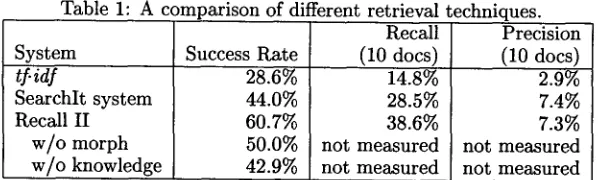
Table 1: A comparison of different retrieval techniques. System
tfidf
SearchIt system Recall II
w/o morph w/o knowledge
Success Rate 28.6% 44.0% 60.7% 50.0% 42.9%
Recall
(10 docs)
14.8% 28.5%
38.6%
not measured not measured
Precision (10 docs) 2.9% 7.4% 7.3% not measured not measured
simple morphological query expansion with a state- of-the-art commercial search engine. In the table, Recall II refers to the full conceptual indexing and search system with all of its knowledge sources and rules. The line labeled "w/o morph" refers to this system with its dynamic morphological rules turned off, and the line labeled "w/o knowledge" refers to this system with all of its knowledge sources and rules turned off. The table presents the success rate and the measured recall and precision values for 10 retrieved documents. We measured recall and precision at the 10 document level because inter- nal studies of searching behavior had shown that users tended to give up if an answer was not found in the first ten ranked hits. We measured success rate, rather than recall and precision, for our ab- lation studies, because standard recall and precision measures are not sensitive to the distinction between finding multiple answers to a single request versus finding at least one answer for more requests. 5 D i s c u s s i o n
Table 1 shows that for this task, the relaxation- ranking passage retrieval algorithm without its sup- plementary knowledge sources (Recall II w/o knowl- edge) is roughly comparable in performance (42.9% versus 44.0% success rate) to a state-of-the-art com- mercial search engine (SearchIt) at the pure docu- ment retrieval task (neglecting the added benefit of locating the specific passages). Adding the knowl- edge in the core lexicon (which includes morpho- logical relationships, semantic subsumption axioms, and entailment relationships), but without morpho- logical analysis of unknown words (Recall II w/o morph), significantly improves these results (from 42.9% to 50.0%). Further adding the morphologi- cal analysis capability that automatically analyzes unknown words (deriving additional morphological relationships and some semantic subsumption rela- tionships) significantly improves that result (from 50.0% to 60.7%). In contrast, we found that adding the same semantic subsumption relationships to the commercial search engine, using its provided the- saurus capability degraded its results, and results were still degraded when we added only those facts that we knew would help find relevant documents.
It turned out that the additional relevant documents found were more than offset by additional irrelevant documents that were also ranked more highly.
6 A n e c d o t a l E v a l u a t i o n o f S p e c i f i c P a s s a g e R e t r i e v a l B e n e f i t s
As mentioned above, comparing the relaxation- ranking algorithm with document retrieval systems measures only a part of the benefit of the specific passage retrieval methodology. Fully evaluating the quality and ranking of the retrieved passages in- volves a great many subtleties. However, two in- formal evaluations have been conducted that :shed some light on the benefits.
The first of these was a pilot study of the tech- nology at a telecommunications company. In that study, one user found that she could use a single query to the conceptual indexing system to find both of the items of information necessary to complete a task that formerly required searching two separate databases. The conclusion of that study was that the concept retrieval technology performs well enough to be useful to a person talking live with a customer. It was observed that the returned hits can be com- pared with one another easily and quickly by eye, and attention is taken directly to the relevant con- tent of a large document: The automatic indexing was considered a plus compared with manual meth- ods of content indexing. It was observed that an area of great potential may be in a form of knowledge management that involves organizing and providing intelligent access to small, unrelated "nuggets" of textual knowledge that are not amenable to conven- tional database archival or categorization.
A second experiment was conducted by the Hu- man Resources Webmaster of a high-tech company, an experienced user of search engines who used this technology to index his company's internal HR web site. He then measured the time it took him to pro- cess 15 typical HR requests, first using conventional search tools that he had available, and then using the Conceptual Indexing technology. In both cases, he measured the time it took him to either find the answer or to conclude that the answer wasn't in the indexed material. His measured times for the total suite were 55 minutes using the conventional
[image:4.612.151.450.96.186.2]tools and 11 minutes using the conceptual index- ing technology. Of course, this was an uncontrolled experiment, and there is some potential that infor- mation learned from searching with the traditional tools (which were apparently used first) might have provided some benefit when using the conceptual in- dexing technology. However, the fact that he found things with the latter that he did not find with the former and the magnitude of the time difference sug- gests that there is an effect, albeit perhaps not as great as the measurements. As a result of this ex- perience, he concluded that he would expect many users to take much longer to find materials or give up, when using the traditional tools. He anticipated that after finding some initial materials, more time would be required, as users would end up having to call people for additional information. He esti- mated that users could spend up to an hour trying to get the information they needed...having to call someone, wait to make contact and finally get the information they needed. Using the conceptual in- dexing search engine, he expected that these times would be at least halved.
7
C o n c l u s i o n
We have described some experiments using lin- guistic knowledge in an information retrieval sys- tem in which passages within texts are dynami- cally found in response to a query and are scored and ranked based on a relaxation of constraints. This is a different approach from previous meth- ods of passage retrieval and from previous attempts to use linguistic knowledge in information retrieval. These experiments show that linguistic knowledge can significantly improve information retrieval per- formance when incorporated into a knowledge-based relaxation-ranking algorithm for specific passage re- trieval.
The linguistic knowledge considered here includes the use of morphological relationships between words, taxonomic relationships between concepts, and general semantic entailment relationships be- tween words and concepts. We have shown that the combination of these three knowledge sources can significantly improve performance in finding appro- priate answers to specific queries when incorporated into a relaxation-ranking algorithm. It appears that the penalty-based relaxation-ranking algorithm fig- ures crucially in this success, since the addition of such linguistic knowledge to traditional information retrieval models typically degrades retrieval perfor- mance rather than improving it, a pattern that was borne out in our own experiments.
A c k n o w l e d g m e n t s
Many other people have been involved in creating the conceptual indexing and retrieval system de-
scribed here. These include: Gary Adams, Jacek Ambroziak, Cookie Callahan, Chris Colby, Jim Flowers, Ellen Hays, Patrick Martin, Peter Norvig, Tony Passera, Philip Resnik, Robert Sproull, and Mark Torrance.
Sun, Sun Microsystems, and SearchIt are trade- marks or registered trademarks of Sun Microsys- tems, Inc. in the U.S. and other countries.
UNIX is a registered trademark in the United States and other countries, exclusively licensed through X/Open Company, Ltd. UNIX est une marque enregistree aux Etats-Unis et dans d'autres pays et licenci~e exclusivement par X/Open Com- pany Ltd.
R e f e r e n c e s
Jacek Ambroziak and William A. Woods. 1998. Natural language technology in precision content retrieval. In International Conference on Natural Language Processing and Industrial Applications, Moncton, New Brunswick, Canada, August. www.stm.com/research/techrep/1998/abstract- 69.html.
Jamie P. Callan. 1994. Passage-level evidgnce in document retrieval. SIGIR, pages 302-309. J. L. Fagan. 1989. The effectiveness of a nonsyntac-
tic approach to automatic phrase indexing for doc- ument retrieval. Journal of the American Society for Information Science, 40(2):115-132, March. Martin Kaszkiel and Justin Zobel. 1997. Passage
retrieval revisited. SIGIR, pages 302-309. David D. Lewis and Karen Sparck Jones. 1996. Nat-
ural language processing for information retrieval. CACM, 39(1):92-101.
Rila Mandala, Takenobu Tokunaga, and Hozumi Tanaka. 1999. Combining multiple evidence from different types of thesaurus for query expansion. In Proceedings on the 22nd annual international A CM SIGIR conference on Research and develop- ment in information retrieval. ACM-SIGIR. Gerald Salton, James Allan, and Chris Buckley.
1993. Approaches to passage retrieval in full text information systems. SIGIR, pages 49-58. Gerard Salton. 1989. Automatic Text Processing.
Addison Wesley, Reading, MA.
Karen Sparck Jones. 1998. A look back and a look forward. SIGIR, pages 13-29.
Giovanni Varile and Antonio Zampolli, editors. 1997. Survey of the State of the Art in Human Language Technology. Cambridge Univ. Press. Ellen M. Voorhees. 1993. Using wordnet to disam-
biguate word senses for text retrieval. In Pro- ceedings of 16th ACM SIGIR Conference. ACM- SIG1R.
Networks: Explorations in the Representation o/
Knowledge, pages 45-94. Morgan Kaufmann, San
Mateo, CA.William A. Woods. 1997. Conceptual indexing: A better way to organize knowledge. Technical Report SMLI TR-97-61, Sun Microsystems Laboratories, Mountain V i e w , CA, April. www.sun.com/research/techrep/1997/abstract- 61.html.
William A. Woods. 2000. Aggressive morphology for robust ]exical coverage. In