Proceedings of the 51st Annual Meeting of the Association for Computational Linguistics, pages 684–689, Sofia, Bulgaria, August 4-9 2013. c2013 Association for Computational Linguistics
Mapping Source to Target Strings without Alignment by Analogical
Learning: A Case Study with Transliteration
Philippe Langlais RALI / DIRO Universit´e de Montr´eal Montr´eal, Canada, H3C 3J7
Abstract
Analogical learning over strings is a holis-tic model that has been investigated by a few authors as a means to map forms of a source language to forms of a target lan-guage. In this study, we revisit this learn-ing paradigm and apply it to the translit-eration task. We show that alone, it per-forms worse than a statistical phrase-based machine translation engine, but the com-bination of both approaches outperforms each one taken separately, demonstrating the usefulness of the information captured by a so-called formal analogy.
1 Introduction
A proportional analogy is a relationship between four objects, noted [x:y :: z :t], which reads as
“xis toyaszis tot”. While some strategies have been proposed for handling semantic relationships (Turney and Littman, 2005; Duc et al., 2011), we focus in this study on formal proportional analogies (hereafter formal analogies or simply analogies), that is, proportional analogies involv-ing relationships at the graphemic level, such as [atomkraftwerken : atomkriegen :: kraftwerks : kriegs] in German.
Analogical learning over strings has been in-vestigated by several authors. Yvon (1997) ad-dressed the task of grapheme-to-phoneme conver-sion, a problem which continues to be studied ac-tively, see for instance (Bhargava and Kondrak, 2011). Stroppa and Yvon (2005) applied analog-ical learning to computing morphosyntactic fea-tures to be associated with a form (lemma, part-of-speech, and additional features such as number, gender, case, tense, mood, etc.). The performance of the analogical engine on the Dutch language was as good as or better than the one reported in (van den Bosch and Daelemans, 1993). Lepage
and Denoual (2005) pioneered the application of analogical learning to Machine Translation. Dif-ferent variants of the system they proposed have been tested in a number of evaluation campaigns, see for instance (Lepage et al., 2009). Langlais and Patry (2007) investigated the more specific task of translating unknown words, a problem si-multaneously studied in (Denoual, 2007).
Analogical learning has been applied to various other purposes, among which query expansion in information retrieval (Moreau et al., 2007), clas-sification of nominal and binary data, and hand-written character recognition (Miclet et al., 2008). Formal analogy has also been used for solving Raven IQ tests (Correa et al., 2012).
In this study, we investigate the relevance of analogical learning for English proper name transliteration into Chinese. We compare it to the statistical phrase-based machine translation approach (Koehn et al., 2003) initially proposed for transliteration by Finch and Sumita (2010). We show that alone, analogical learning underper-forms the phrase-based approach, but that a com-bination of both outperforms individual systems.
We describe in section 2 the principle of ana-logical learning. In section 3, we report on ex-periments we conducted in applying analogical learning on the NEWS 2009 English-to-Chinese transliteration task. Related works are discussed in section 4. We conclude in section 5 and identify avenues we believe deserve investigations.
2 Analogical Learning 2.1 Formal Analogy
In this study, we use the most general definition of formal analogy we found, initially described in (Yvon et al., 2004). It handles a large variety of relations, including but not limited to affixa-tion operaaffixa-tions (i.e. [capital : anticapitalisme :: commun :anticommuniste] in French), stem
tations (i.e. [lang :l¨ange ::stark :st¨arke] in
Ger-man), and even templatic relations (i.e [KaaTiB : KuTaaB ::QaaRi’ :QuRaa’] in Arabic).
Informally,1 this definition states that 4 forms
x, y, z andt are in analogical relation iff we can find a d-factorization (a factorization into d fac-tors) of each form, such that the ith factors (i ∈
[1, d]) ofxandzequal (in ensemble terms) theith factors ofyandt.
For instance, [this guy drinks : this boat sinks :: these guys drank : these boats sank] holds be-cause of the following 4-uple of 5-factorizations, whose factors are aligned column-wise for clarity, and where spaces (underlined) are treated as regu-lar characters (designates the empty factor):
fx ≡ ( this guy dr inks )
fy ≡ ( this boat s inks )
fz ≡ ( these guy s dr ank )
ft ≡ ( these boat s s ank )
This analogy “captures” among other things that in English, changing this forthese implies a plural mark (s) to the corresponding noun. Note that analogies can relate arbitrarily distant sub-strings. For instance the 3rd-person singular mark of the verbs relates to the first substringthis.
2.2 Analogical Learning
We now clarify the process of analogical learning. Let L = {(i(xk), o(xk))k} be a training set (or memory) gathering pairs of input i(xk) and out-put o(xk)representations of elements xk. In this study, the elements we consider are pairs of En-glish / Chinese proper names in a transliteration relation. Given an element t for which we only knowi(t), analogical learning works by:
1. building Ei(t) = {(x, y, z) ∈ L3 |[i(x) : i(y) :: i(z) : i(t)]}, the set of triples in the training set that stand in analogical propor-tion withtin the input space,
2. building Eo(t) = {[o(x) : o(y) :: o(z) :
?] |(x, y, z) ∈ Ei(t)}, the set of solutions to the output analogical equations obtained,
3. selecting o(t) among the solutions
aggre-gated intoEo(t).
In this description, we define an analogical equationas an analogy with one form missing, and
1We refer the reader to (Stroppa and Yvon, 2005) for a more technical exposition.
we note [x :y ::z :?] the set of its solutions (i.e. undoable ∈[reader :doer ::unreadable :?]).2
L = { (Schell,谢尔), (Zemens,泽门斯), (Zell,泽尔),
(Schemansky,谢曼斯基), (Clise,克莱斯), (Rovine,罗文), (Rovensky,罗文 斯基), . . .}
.[Schell:Zell::Schemansky:Zemansky]
↓ ↓ ↓ ↓
[谢尔 :泽尔::谢曼斯基: ?] [4 sols] : 曼斯泽基 泽曼斯基 曼斯基泽. . .
.[Rovine:Rovensky::Zieman:Zemansky]
↓ ↓ ↓ ↓
[罗文:罗文 斯基::齐曼: ?] [6 sols] : 斯基齐曼 斯齐曼基 斯齐基曼. . .
.[Stephens:Stephansky::Zemens:Zemansky]
↓ ↓ ↓ ↓
[斯蒂芬斯:斯蒂芬斯基::泽门斯: ?] [9 sols] :
斯泽基门 泽基门斯 泽斯门基. . .
.. .
[image:2.595.298.522.121.348.2]31 solutions: 泽曼斯基(77) 泽门斯基(59) 曼泽斯基(29) 兹梅斯卡尼(20) . . .
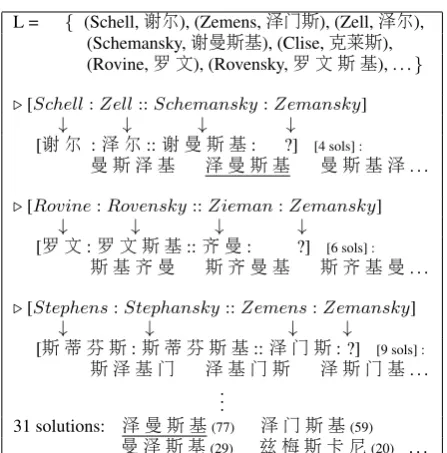
[image:2.595.72.276.300.352.2]Figure 1: Excerpt of a transliteration session for the English proper nameZemansky. 31 solutions have been identified in total (4 by the first equation reported); the one underlined (actually the most frequently generated) is the sanctioned one.
Figure 1 illustrates this process on a translit-eration session for the English proper name
Zemansky. The training corpus L is a set of pairs of English proper names and their Chi-nese Transliteration(s). Step 1 identifies analogies among English proper names: 7 such analogies are identified, 3 of which are reported (marked with a .sign). Step 2 projects the English forms in ana-logical proportion into their known transliteration (illustrated by a↓sign) in order to solve Chinese analogical equations. Step 3 aggregates the solu-tions produced during the second step. In the ex-ample, it consists in sorting the solutions in de-creasing order of the number of time they have been generated during step 2 (see next section for a better strategy).
There are several important points to consider when deploying the learning procedure shown above. First, the search stage (step 1) has a time complexity that can be prohibitive in some appli-cations of interest. We refer the reader to (Langlais and Yvon, 2008) for a practical solution to this. Second, we need a way to solve an analogical
2Analogical equation solvers typically produce several so-lutions to an equation.
equation. We applied the finite-state machine pro-cedure described in (Yvon et al., 2004). Suffice it to say that typically, this solver produces several solutions to an equation, most of them spurious,3
reinforcing the need for an efficient aggregation step (step 3). Last, it might happen that the over-all approach fails at producing a solution, because no input analogy is identified during step 1, or be-cause the input analogies identified do not lead to analogies in the output space. Thissilenceissue is analyzed in section 3. A detailed account of those problems and possible solutions are discussed in (Somers et al., 2009).
We underline that analogies in both source and target languages are consideredindependently: the approach does not attempt to align source and tar-get substrings, but relies instead on the inductive bias that input analogies (often) imply output ones.
3 Experiments 3.1 Setting
The task we study is part of the NEWS evalua-tion campaign conducted in 2009 (Li et al., 2009). The dataset consists of 31 961 English-Chinese transliteration examples for training the system (TRAIN), 2 896 ones for tuning it (DEV), and 2 896 for testing them (TEST).
We compare two different approaches to transliteration: a statistical phrase-based machine translation engine — which according to Li et al. (2009) was popular among participating sys-tems to NEWS — as well as differently flavored analogical systems.
We trained (onTRAIN) a phrase-based transla-tion device with the Moses toolkit (Koehn et al., 2007), very similarly to (Finch and Sumita, 2010), that is, considering each character as a word. The coefficients of the log-linear function optimized by Moses’ decoder were tuned (with MERT) onDEV. For the analogical system, we investigated the use of classifiers trained in a supervised way to recognize the good solutions generated during step 2. For this, we first transliterated the DEV dataset using TRAIN as a memory. Then, we trained a classifier, taking advantage of the DEV corpus for the supervision. We tried two types of learners — support vector machines (Cortes and Vapnik, 1995) and voted perceptrons (Freund
3A spurious solution is a string that does not belong to the language under consideration. See Figure 1 for examples.
and Schapire, 1999)4 — and found the former to
slightly outperform the latter. Finally, we translit-erated theTESTcorpus using both theTRAINand DEVcorpora as a memory,5 and applied our clas-sifiers on the solutions generated.
The lack of space prevents us to describe the 61 features we used for characterizing a solution. We initially considered a set of features which charac-terizes a solution (frequency, rank in the candidate list, language model likelihood, etc.), and the pro-cess that generated the solution (i.e. number of analogies involved), but no feature that would use scored pairs of substrings (such as mutual infor-mation of substrings).6 Thus, we also considered
in a second stage a set of features that we collected thanks to a n-best list of solutions computed by Moses (Moses’ score given to a solution, its rank in then-best list, etc.).
3.2 Results
We ran the NEWS 2009 official evaluation script7
in order to compute ACC (the accuracy of the first solution), F1 (the F-measure which gives
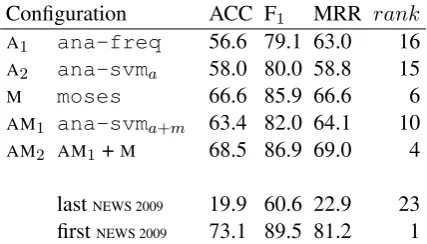
partial credits proportional to the longest subse-quence between the reference transliteration and the first candidate), and the Mean Reciprocal Rank (MRR), where 100/MRR roughly indicates the av-erage rank of the correct solution over the session. Table 1 reports the results of several transliter-ation configurtransliter-ations we tested. The first two sys-tems are pure analogical devices, (M) is the Moses configuration, (AM1) is a variant discussed further,
(AM2) is the best configuration we tested (a
com-bination of Moses and analogical learning), and the last two lines show the lowest and highest per-forming systems among the 18 standard runs reg-istered at NEWS 2009 (Li et al., 2009). Several observations have to be made.
First, none of the variants tested outperformed the best system reported at NEWS 2009. This is not surprising since we conducted only prelimi-nary experiments with analogy. Still, we were pleased to observe that the best configuration we devised (AM2) would have ranked fourth on this
task.
4We used libSVM (Chang and Lin, 2011) for training svms, and an in-house package for training voted perceptrons. 5This is fair since there is no training involved. Many participants to the NEWS campaign did this as well.
6We avoided this in order to keep the classifiers simple to train.
7http://translit.i2r.a-star.edu.sg/ news2009/evaluation/.
Theana-freqsystem is an analogical device where the aggregation step consists in sorting so-lutions in decreasing order of frequency. It is clearly outperformed by the Moses system. The
ana-svma system is an analogical device where the solutions are selected by the SVM trained on analogical features only. Learning to recognize good solutions from spurious ones improves accu-racy (overA1). Still, we are far from the accuracy
we would observe by using an oracle classifier (ACC = 81.5). Clearly, further experiments with better feature engineering must be conducted. It is noteworthy that the pure analogical devices we tested (A1 andA2) did not return any solution for
3.7% of the test forms, which explains some loss in performance compared to the SMT approach, which always delivers a solution.8
System ana-svma+m (AM1) is an analogical
device where the classifier makes uses of the tures extracted by Moses. Obviously, those fea-tures drastically improve accuracy of the classifier. Configuration (AM2) is a combination which
cas-cades the hybrid device (AM1) with the SMT
en-gine (M). This means that the former system is trusted whenever it produces a solution, and the latter one is used as a backup. This configuration outperforms Moses, which demonstrates the com-plementarity of the analogical information.
Configuration ACC F1 MRR rank A1 ana-freq 56.6 79.1 63.0 16 A2 ana-svma 58.0 80.0 58.8 15 M moses 66.6 85.9 66.6 6 AM1 ana-svma+m 63.4 82.0 64.1 10 AM2 AM1 +M 68.5 86.9 69.0 4
lastNEWS 2009 19.9 60.6 22.9 23
[image:4.595.66.280.478.600.2]firstNEWS 2009 73.1 89.5 81.2 1
Table 1: Evaluation of different configurations with the metrics used at NEWS. The last column indicates the rank of systems as if we had submit-ted the top 5 configurations to NEWS 2009.
4 Related Work
Most approaches to transliteration we know rely on some form of substring alignment. This align-ment can be learnt explicitly as in (Knight and
8Removing the solutions produced by the SMT engine for the 3.7% test forms that receive no solution from the analog-ical devices would result in an accuracy score of 65.0.
Graehl, 1998; Li et al., 2004; Jiampojamarn et al., 2007), or it can be indirectly modeled as in (Oh et al., 2009) where transliteration is seen as a tagging task (that is, labeling each source grapheme with a target one), and where the model learns correspon-dences at the substring level. See also the semi-supervised approach of (Sajjad et al., 2012). Ana-logical inference differs drastically from those ap-proaches, since it finds relations in the source ma-terial and solves target equations independently. Therefore, no alignment whatsoever is required.
Transliteration by analogical learning has been attempted by Dandapat et al. (2010) for an English-to-Hindi transliteration task. They com-pared various heuristics to speed up analogical learning, and several combinations of phrase-based SMT and analogical learning. Our results confirm the observation they made that combining an analogical device with SMT leads to gains over individual systems. Still, their work differs from the present one in the fact that they considered the top frequency aggregator (similar toA1), which we
showed to be suboptimal. Also, they used the def-inition of formal analogy of Lepage (1998), which is provably less general than the one we used. The impact of this choice for different language pairs remains to be investigated.
Aggregating solutions produced by analogical inference with the help of a classifier has been re-ported in (Langlais et al., 2009). The authors in-vestigated an arguably more specific task: translat-ing medical terms. Another difference is that we classifysolutionsproduced by analogical learning (roughly 100 solutions per test form), while they classified pairs of input/target analogies, whose number can be rather high, leading to huge and highly unbalanced learning tasks. The authors re-port training experiments with millions of exam-ples and only a few positive ones. In fact, we initially attempted to recognize fruitful analogical pairs, but found it especially slow and disappoint-ing.
5 Conclusion
livering decent performance. By combining both approaches, we obtained a system which outper-forms the individual ones we tested.
We believe analogical inference over strings has not delivered all his potential yet. In particular, we have observed that there is a huge room for improvements in the aggregation step. We have tested a simple classifier approach, mining a tiny subset of the features that could be put at use. More research on this issue is warranted, notably looking at machine-learned ranking algorithms.
Also, the silence issue we faced could be tack-led by the notion ofanalogical dissimilarity intro-duced by Miclet et al. (2008). The idea of using near analogies in analogical learning has been suc-cessfully investigated by the authors on a number of standard classification testbeds.
Acknowledgments
This work has been founded by the Natural Sciences and Engineering Research Council of Canada. We are grateful to Fabrizio Gotti for his contribution to this work, and to the anonymous reviewers for their useful comments. We are also indebted to Min Zhang and Haizhou Li who pro-vided us with the NEWS 2009 English-Chinese datasets.
References
Aditya Bhargava and Grzegorz Kondrak. 2011. How do you pronounce your name? Improving G2P with transliterations. In49th ACL/HLT, pages 399–408, Portland, USA.
Chih-Chung Chang and Chih-Jen Lin. 2011. LIB-SVM: A Library for Support Vector Machines. ACM Trans. Intell. Syst. Technol., 2(3):1–27, May.
William Fernando Correa, Henri Prade, and Gilles Richard. 2012. When intelligence is just a matter of copying. In20th ECAI, pages 276–281, Mont-pellier, France.
Corinna Cortes and Vladimir Vapnik. 1995. Support-Vector Networks. Mach. Learn., 20(3):273–297.
Sandipan Dandapat, Sara Morrissey, Sudip Ku-mar Naskar, and Harold Somers. 2010. Mitigat-ing Problems in Analogy-based EBMT with SMT and vice versa: a Case Study with Named En-tity Transliteration. In 24th Pacific Asia Confer-ence on Language Information and Computation (PACLIC’10), pages 365–372, Sendai, Japan. ´Etienne Denoual. 2007. Analogical translation of
unknown words in a statistical machine translation
framework. In MT Summit XI, pages 135–141, Copenhagen, Denmark.
Nguyen Tuan Duc, Danushka Bollegala, and Mitsuru Ishizuka. 2011. Cross-Language Latent Relational Search: Mapping Knowledge across Languages. In 25th AAAI, pages 1237 – 1242, San Francisco, USA.
Andrew Finch and Eiichiro Sumita. 2010. Translit-eration Using a Phrase-based Statistical Machine Translation System to Re-score the Output of a Joint Multigram Model. In2nd Named Entities Workshop (NEWS’10), pages 48–52, Uppsala, Sweden.
Y. Freund and R. E. Schapire. 1999. Large Mar-gin Classification Using the Perceptron Algorithm. Mach. Learn., 37(3):277–296.
Sittichai Jiampojamarn, Grzegorz Kondrak, and Tarek Sherif. 2007. Applying Many-to-Many Alignments and Hidden Markov Models to Letter-to-Phoneme Conversion. InNAACL/HLT’07, pages 372–379.
Kevin Knight and Jonathan Graehl. 1998. Machine Transliteration.Comput. Linguist., 24(4):599–612.
Philipp Koehn, Franz Josef Och, and Daniel Marcu. 2003. Statistical Phrase-Based Translation. In NAACL/HLT’03, pages 48–54, Edmonton, Canada.
Philipp Koehn, Hieu Hoang, Alexandra Birch, Chris Callison-Burch, Marcello Federico, Nicola Bertoldi, Brooke Cowan, Wade Shen, Christine Moran, Richard Zens, Chris Dyer, Ondˇrej Bojar, Alexandra Constantin, and Evan Herbst. 2007. Moses: Open Source Toolkit for Statistical Machine Translation. In45th ACL, pages 177–180. Interactive Poster and Demonstration Sessions.
Philippe Langlais and Alexandre Patry. 2007. Trans-lating Unknown Words by Analogical Learning. In EMNLP/CoNLL’07, pages 877–886, Prague, Czech Republic.
Philippe Langlais and Franc¸ois Yvon. 2008. Scaling up Analogical Learning. In22nd COLING, pages 51–54, Manchester, United Kingdom. Poster.
Philippe Langlais, Franc¸ois Yvon, and Pierre Zweigen-baum. 2009. Improvements in Analogical Learn-ing: Application to Translating multi-Terms of the Medical Domain. In 12th EACL, pages 487–495, Athens, Greece.
Yves Lepage and ´Etienne Denoual. 2005. Purest ever example-based machine translation: Detailed pre-sentation and assesment. Mach. Translat, 19:25– 252.
Yves Lepage, Adrien Lardilleux, and Julien Gosme. 2009. The GREYC Translation Memory for the IWSLT 2009 Evaluation Campaign: one step be-yond translation memory. In6th IWSLT, pages 45– 49, Tokyo, Japan.
Yves Lepage. 1998. Solving Analogies on Words: an Algorithm. InCOLING/ACL, pages 728–733, Mon-treal, Canada.
Haizhou Li, Min Zhang, and Jian Su. 2004. A Joint Source-Channel Model for Machine Transliteration. In42nd ACL, pages 159–166, Barcelona, Spain. Haizhou Li, A. Kumaran, Vladimir Pervouchine, and
Min Zhang. 2009. Report of NEWS 2009 Machine Transliteration Shared Task. In1st Named Entities Workshop (NEWS’09): Shared Task on Translitera-tion, pages 1–18, Singapore.
Laurent Miclet, Sabri Bayroudh, and Arnaud Delhay. 2008. Analogical Dissimilarity: Definitions, Algo-rithms and two experiments in Machine Learning. Journal of Artificial Intelligence Research, pages 793–824.
Fabienne Moreau, Vincent Claveau, and Pascale S´ebillot. 2007. Automatic Morphological Query Expansion Using Analogy-based Machine Learn-ing. In29th European Conference on IR research (ECIR’07), pages 222–233, Rome, Italy.
Jong-hoon Oh, Kiyotaka Uchimoto, and Kentaro Tori-sawa. 2009. Machine Transliteration using Target-Language Grapheme and Phoneme: Multi-engine Transliteration Approach. In 1st Named Entities Workshop (NEWS’09): Shared Task on Transliter-ation, pages 36–39, Singapore.
Hassan Sajjad, Alexander Fraser, and Helmut Schmid. 2012. A Statistical Model for Unsupervised and Semi-supervised Transliteration Mining. In 50th ACL, pages 469–477, Jeju Island, Korea.
Harold Somers, Sandipan Sandapat, and Sudip Kumar Naskar. 2009. A Review of EBMT Using Pro-portional Analogies. In3rd Workshop on Example-based Machine Translation, pages 53–60, Dublin, Ireland.
Nicolas Stroppa and Franc¸ois Yvon. 2005. An Ana-logical Learner for MorphoAna-logical Analysis. In9th CoNLL, pages 120–127, Ann Arbor, USA.
P.D. Turney and M.L. Littman. 2005. Corpus-based Learning of Analogies and Semantic Relations. In Machine Learning, volume 60, pages 251–278.
Antal van den Bosch and Walter Daelemans. 1993. Data-Oriented Methods for Grapheme-to-Phoneme Conversion. In 6th EACL, pages 45–53, Utrecht, Netherlands.
Franc¸ois Yvon, Nicolas Stroppa, Arnaud Delhay, and Laurent Miclet. 2004. Solving Analogies on Words. Technical Report D005, ´Ecole Nationale Sup´erieure des T´el´ecommuncations, Paris, France.
Franc¸ois Yvon. 1997. Paradigmatic Cascades: a Lin-guistically Sound Model of Pronunciation by Anal-ogy. In35th ACL, pages 429–435, Madrid, Spain.