Original citation:
Král', Daniel, Liu, Chun-Hung, Sereni, Jean-Sébastien, Whalen, Peter and Yilma, Zelealem B.. (2013) A new bound for the 2/3 conjecture. Combinatorics, Probability and Computing, Volume 22 (Number 03). pp. 384-393. ISSN 0963-5483
Permanent WRAP url:
http://wrap.warwick.ac.uk/56910
Copyright and reuse:
The Warwick Research Archive Portal (WRAP) makes this work of researchers of the University of Warwick available open access under the following conditions. Copyright © and all moral rights to the version of the paper presented here belong to the individual author(s) and/or other copyright owners. To the extent reasonable and practicable the material made available in WRAP has been checked for eligibility before being made available.
Copies of full items can be used for personal research or study, educational, or not-for-profit purposes without prior permission or charge. Provided that the authors, title and full bibliographic details are credited, a hyperlink and/or URL is given for the original metadata page and the content is not changed in any way.
Publisher’s statement:
This article has been accepted for publication appears in a revised form, subsequent to peer review and/or editorial input by Cambridge University Press, in Combinatorics, Probability and Computing published by Cambridge University Press ©. Volume 22 (Number 03). pp. 384-393
http://dx.doi.org/10.1017/S0963548312000612
A note on versions:
The version presented here may differ from the published version or, version of record, if you wish to cite this item you are advised to consult the publisher’s version. Please see the ‘permanent WRAP url’ above for details on accessing the published version and note that access may require a subscription.
A new bound for the 2
/
3 conjecture
∗
Daniel Kr´al’
†Chun-Hung Liu
‡Jean-S´ebastien Sereni
§Peter Whalen
¶Zelealem B. Yilma
kAbstract
We show that any n-vertex complete graph with edges colored with three colors contains a set of at most four vertices such that the number of the neighbors of these vertices in one of the colors is at least 2n/3. The previous best value, proved by Erd˝os, Faudree, Gould, Gy´arf´as, Rousseau and Schelp in 1989, is 22. It is conjectured that three vertices suffice.
1
Introduction
Erd˝os and Hajnal [9] made the observation that for a fixed positive integer t, a positive real
ǫ, and a graph G on n > n0 vertices, there is a set of t vertices that have a neighborhood of size at least (1−(1+ ǫ)(2/3)t)n in either G or its complement. They further inquired whether 2/3 may be replaced by 1/2. This was answered in the affirmative by Erd˝os,
∗This work was done in the framework of LEA STRUCO.
†Institute of Mathematics, DIMAP and Department of Computer Science, University of Warwick,
Coven-try CV4 7AL, United Kingdom. Previous affiliation: Institute of Computer Science (IUUK), Faculty of Mathematics and Physics, Charles University, Malostransk´e n´amˇest´ı 25, 118 00 Prague 1, Czech Repub-lic. E-mail: [email protected]. The work of this author leading to this invention has received funding from the European Research Council under the European Union’s Seventh Framework Programme (FP7/2007-2013)/ERC grant agreement no. 259385.
‡School of Mathematics, Georgia Institute of Technology, Atlanta, GA 30332, USA. E-mail:
§CNRS (LORIA), Nancy, France. E-mail: [email protected]. This author’s work was
par-tially supported by the French Agence Nationale de la Recherche under referenceanr10jcjc0204 01.
¶School of Mathematics, Georgia Institute of Technology, Atlanta, GA 30332-0160, USA. E-mail:
kLIAFA (Universit´e Denis Diderot), Paris, France. E-mail: [email protected].
Faudree, Gy´arf´as and Schelp [7], who not only proved the result but also dispensed with the (1+ǫ) factor. They also phrased the question as a problem of vertex domination in a multicolored graph.
Given a color c in an r-coloring of the edges of the complete graph, a subset A of the vertex set c-dominates another subset B if, for every y ∈B\A, there exists a vertex x ∈A
such that the edge xy is colored c. The subset A strongly c-dominates B if, in addition, for every y ∈ B∩A, there exists a vertex x ∈ A such that xy is colored c. (Thus, the two
notions coincide when A∩ B = ∅.) The result of Erd˝os et al. [7] may then be stated as follows.
Theorem 1. For any fixed positive integer t and any 2-coloring of the edges of the complete
graph Kn on n vertices, there exist a color c and a subset X of size at most t such that all
but at most n/2tvertices of K
nare c-dominated by X.
In a more general form, they asked: Given positive integers r, t, and n along with an
r-coloring of the edges of the complete graph Knon n vertices, what is the largest subset B
of the vertices of Kn necessarily monochromatically dominated by some t-element subset
of Kn? However, in the same paper [7], the authors presented a 3-coloring of the edges of Kn — attributed to Kierstead — which shows that if r > 3, then it is not possible to monochromatically dominate all but a small fraction of the vertices with any fixed number
t of vertices. This 3-coloring is defined as follows: the vertices of Kn are partitioned into three sets V1,V2,V3 of equal sizes and an edge xy with x ∈ Vi and y ∈ Vj is colored i if 16 i6 j6 3 and j−i6 1 while edges between V1and V3 are colored 3. Observe that, if
t is fixed, then at most 2n/3 vertices may be monochromatically dominated.
In the other direction, it was shown in the follow-up paper of Erd˝os, Faudree, Gould, Gy´arf´as, Rousseau and Schelp [8], that if t > 22, then, indeed, at least 2n/3 vertices are monochromatically dominated in any 3-coloring of the edges of Kn. The authors then ask if 22 may be replaced by a smaller number (specifically, 3). We prove here that t > 4 is sufficient.
Theorem 2. For any 3-coloring of the edges of Kn, where n> 2, there exist a color c and
a subset A of at most four vertices of Kn such that A strongly c-dominates at least 2n/3
vertices of Kn.
In Kierstead’s coloring, the number of colors appearing on the edges incident with any given vertex is precisely 2. As we shall see later on, this property plays a central role in our arguments. In this regard, our proof seems to suggest that Kierstead’s coloring is somehow extremal, giving more credence to the conjecture that three vertices would suffice to monochromatically dominate a set of size 2n/3 in any 3-coloring of the edges of
We note that there exist 3-colorings of the edges of Kn such that no pair of vertices monochromatically dominate 2n/3+O(1) vertices. This can be seen by realizing that in
a random 3-coloring, the probability that an arbitrary pair of vertices monochromatically dominate more than 5n/9+o(n) vertices is o(1) by Chernoff’s bound.
Our proof of Theorem 2 utilizes the flag algebra theory introduced by Razborov, which has recently led to numerous results in extremal graph and hypergraph theory. In the following section, we present a brief introduction to the flag algebra framework. The proof of Theorem 2 is presented in Section 3.
We end this introduction by pointing out another interesting question: what happens when one increases r, the number of colors? Constructions in the vein of that of Kierstead — for example, partitioning Kn into s parts and using r =
s
2
colors — show that the size of dominated sets decreases with increasing r. While it may be difficult to determine the minimum value of t dominating a certain proportion of the vertices, it would be interesting to find out whether such constructions do, in fact, give the correct bounds.
2
Flag Algebras
Flag algebras were introduced by Razborov [23] as a tool based on the graph limit theory of Lov´asz and Szegedy [20] and Borgs et al. [5] to approach problems pertaining to extremal graph theory. This tool has been successfully applied to various topics, such as Tur´an-type problems [25], super-saturation questions [24], jumps in hypergraphs [2], the Caccetta-H¨aggkvist conjecture [17], the chromatic number of common graphs [14] and the number of pentagons in triangle-free graphs [12, 15]. This list is far from being exhaustive and results keep coming [1, 3, 4, 6, 11, 10, 13, 16, 18, 19, 21, 22].
Let us now introduce the terminology related to flag algebras needed in this paper. Since we deal with 3-colorings of the edges of complete graphs, we restrict our attention to this particular case. Let us define a tricolored graph to be a complete graph whose edges are colored with 3 colors. If G is a tricolored graph, then V(G) is its vertex-set and |G|is the number of vertices of G. LetFℓ be the set of non-isomorphic tricolored graphs
withℓvertices, where two tricolored graphs are considered to be isomorphic if they differ by a permutation of the vertices and a permutation of the edge colors. (Therefore, which specific color is used for each edge is irrelevant: what matters is whether or not pairs of edges are assigned the same color.) The elements of F3 are shown in Figure 1. We set F ≔ ∪ℓ∈NFℓ. Given a tricolored graphσ, we define Fσ
ℓ to be the set of tricolored graphs
F onℓ vertices with a fixed embedding ofσ, that is, an injective mappingνfrom V(σ) to
V(F) such that Im(ν) induces in F a subgraph that differs from σ only by a permutation of the edge colors. The elements ofFσ
σA
1 2
3
σB
1 2
3
σC
1 2
[image:5.612.205.408.92.158.2]3
Figure 1: The elements of F3. The edges of color 1, 2 and 3 are represented by solid,
dashed and dotted lines, respectively.
framework. We setFσ ≔∪ℓ∈NFσ
ℓ.
The central notions are factor algebras ofFandFσ equipped with addition and
multi-plication. Let us start with the simpler case ofF. If H ∈Fand H′ ∈ F|H|+1, then p(H,H′)
is the probability that a randomly chosen subset of|H|vertices of H′ induces a subgraph
isomorphic to H. For a set F, we define RF to be the set of all formal linear combinations of elements of F with real coefficients. Let A ≔ RFand let F be Afactorised by the
subspace of RFgenerated by all combinations of the form
H− X
H′∈F|H|+1
p(H,H′)H′.
Next, we define the multiplication on A based on the elements of F as follows. If
H1 and H2 are two elements of Fand H ∈ F|H1|+|H2|, then p(H1,H2; H) is the probability
that two randomly chosen disjoint subsets of vertices of H with sizes|H1|and|H2|induce subgraphs isomorphic to H1and H2, respectively. We set
H1·H2 ≔
X
H∈F|
H1|+|H2|
p(H1,H2; H)H.
The multiplication is linearly extended to RF. Standard elementary probability
compu-tations [23, Lemma 2.4] show that this multiplication in RF gives rise to a well-defined
multiplication in the factor algebraA.
The definition ofAσfollows the same lines. Let H and H′
be two tricolored graphs in
Fσ with embeddingsν andν′ ofσ. Informally, we consider the copy of σin H′ and we
extend it into an element ofFσ
|H| by randomly choosing additional vertices in H ′
. We are interested in the probability that this random extension is isomorphic to H and the isomor-phism preserves the embeddings of σ. Formally, we let p(H,H′) be the probability that
ν′(V(σ)) together with a randomly chosen subset of|H| − |σ|vertices in V(H′)\ν′(V(σ)) induce a subgraph that is isomorphic to H through an isomorphism f that preserves the embeddings, that is,ν′ = f ◦ν. The setAσis composed of all formal real linear
of the form
H− X
H′∈Fσ
|H|+1
p(H,H′)H′.
Similarly, p(H1,H2; H) is the probability thatν(V(σ)) together with two randomly chosen disjoint subsets of |H1| − |σ|and |H2| − |σ| vertices in V(H)\ν(V(σ)) induce subgraphs isomorphic to H1and H2, respectively, with the isomorphisms preserving the embeddings ofσ. The definition of the product is then analogous to that inA.
Consider an infinite sequence (Gi)i∈N of tricolored graphs with an increasing number of vertices. Recall that if H ∈ F, then p(H,Gi) is the probability that a randomly chosen
subset of|H|vertices of Gi induces a subgraph isomorphic to H. The sequence (Gi)i∈Nis
convergent if p(H,Gi) has a limit for every H ∈F. A standard argument (using Tychonoff’s theorem [26]) yields that every infinite sequence of tricolored graphs has a convergent (infinite) subsequence.
The results presented in this and the next paragraph were established by Razborov [23]. Fix now a convergent sequence (Gi)i∈Nof tricolored graphs. We set q(H)≔limi→∞p(H,Gi) for every H ∈ F, and we linearly extend q to A. The obtained mapping q is a
homo-morphism from A to R. Moreover, for σ ∈ F and an embeddingν of σ in Gi, define
pν
i(H) ≔ p(H,Gi). Picking ν at random thus gives rise to a random distribution of map-pings from Aσ to R, for each i ∈ N. Since p(H,G
i) converges (as i tends to infinity) for every H ∈ F, the sequence of these distributions must also converge. In fact, q itself
fully determines the random distributions of qσ for allσ. In what follows, qσ will be a
randomly chosen mapping fromAσto R based on the limit distribution. Any mapping qσ
from support of the limit distribution is a homomorphism fromAσ to R.
Let us now have a closer look at the relation between q and qσ. The “averaging”
operator~·σ : Aσ → Ais a linear operator defined on the elements of Fσ by ~H σ ≔
p· H′, where H′ is the (unlabeled) tricolored graph in Fcorresponding to H and p is the
probability that a random injective mapping from V(σ) to V(H′) is an embedding ofσin
H′yielding H. The key relation between q and qσ is the following:
∀H ∈ Aσ, q(~Hσ)=
Z
qσ(H), (1)
where the integration is over the probability space given by the limit random distribution of qσ. We immediately conclude that if qσ(H) > 0 almost surely, then q(~H
σ) > 0. In
particular,
∀H ∈ Aσ, q(H2
σ1
1 2
3 4
σ2
1 2
3 4
σ3
1 2
3 4
σ4
1 2
3 4
σ5
1 2
3 4
σ6
1 2
3 4
σ7
1 2
[image:7.612.102.511.92.167.2]3 4
Figure 2: The elementsσ1, . . . , σ7ofF4. The edges of color 1, 2 and 3 are represented by solid, dashed and dotted lines, respectively.
2.1
Particular Notation Used in our Proof
Before presenting the proof of Theorem 2, we need to introduce some notation and several lemmas. Recall thatσA, σB and σC, the elements of F3, are given in Figure 1. For i ∈ {A,B,C}and a triple t∈ {1,2,3}3, let Fi
tbe the element ofF σi
4 in which the unlabeled vertex of Fti is joined by an edge of color tj to the image of the j-th vertex ofσi for j ∈ {1,2,3}. Two elements ofAσB and two ofAσC will be of interest in our further considerations:
wB ≔165F113B +165F B
333−279F B
123−44F B
131+328F B
133+10F B
233+421F B 323,
w′B ≔−580F113B −580FB333+668F123B −264F131B +10F133B +725F233B +632F323B ,
wC ≔100FC112+100F C
312−100F C
113−100F C
133+162F C
122+163F C
221, and
wC′ ≔−10FC112−10F312C +10F113C +10FC133−77FC122+89FC221.
We make use of seven elements σ1, . . . , σ7 out of the 15 elements of F4. They are depicted in Figure 2. For i∈ {1, . . . ,7}and a quadruple d ∈ {1,2,3}4, let Fi
dbe the element ofFσi
5 such that the unlabeled vertex of F i
dis joined by an edge of color djto the j-th vertex ofσi for j ∈ {1,2,3,4}. If i ∈ {1, . . . ,7}and c ∈ {1,2,3}, then Fi(c) is the element of Aσi that is the sum of all the five-vertexσi-flags Fidsuch that the unlabeled vertex is joined by an edge of color c to at least one of the vertices ofσi, i.e., at least one of the entries of d is
c.
Finally, we define H1, . . . ,H142 to be the elements of F5 in the way depicted in Ap-pendix A.
3
Proof of Theorem 2
i=1 i=2 i=3 i=4 i=5 i=6 i=7
c=1 -1/3 0 -1/3 -1/3 0 0 0
c=2 1/2 0 1/6 -1/3 -1/3 -1/3 0
[image:8.612.180.434.96.167.2]c=3 1/2 1/2 1/2 1/2 1/2 0 0
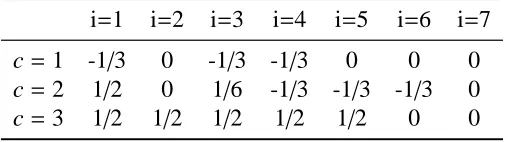
Table 1: The valuesεc(σi) for i∈ {1, . . . ,7}and c ∈ {1,2,3}.
by hand and then we combine them with appropriate coefficients to obtain a contradiction. The coefficients are found with the help of a computer.
Let G be a tricolored complete graph. For a vertex v of G, let Av be the set of colors of the edges incident with v. Consider a sequence of graphs (Gk)k∈N, obtained from G by replacing each vertex v of G with a complete graph of order k with edges colored uniformly at random with colors in Av; the colors of the edges between the complete graphs corresponding to the vertices v and v′ of G are assigned the color of the edge vv′. This sequence of graphs converges asymptotically almost surely; let qG be the corresponding homomorphism fromAto R.
Let n > 2. We define a counterexample to be a tricolored graph with n vertices such that for every color c ∈ {1,2,3}, each set W of at most four vertices strongly c-dominates less than 2n/3 vertices of G. A counterexample readily satisfies the following property.
Observation 3. If G is a counterexample, then every vertex is incident with edges of at
least two different colors.
In the next lemma, we establish an inequality that qGsatisfies if G is a counterexample. To do so, define the quantityεc(σi) for i∈ {1, . . . ,7}and c ∈ {1,2,3}to be 1/2 ifσicontains a single edge with color c,−1/3 if each vertex ofσi is incident with an edge colored c, 1/6 if σi contains at least two edges with color c and a vertex incident with edges of a single color different from c, and 0, otherwise. These values are gathered in Table 1. Let us underline that, unlike in most of the previous applications of flag algebras, we do need to deal with second-order terms (specifically, O(1/n) terms) in our flag inequalities
to establish Theorem 2.
Lemma 4. Let G be a counterexample with n vertices. For every i ∈ {1, . . . ,7}and c ∈
{1,2,3}, a homomorphism qσi
G fromA
σi to R almost surely satisfies the inequality
qσi
G(F
i (c))6
2 3+
εc(σi)
Proof. Fix i ∈ {1, . . . ,7} and c ∈ {1,2,3}. Consider the graph Gk for sufficiently large
k. Let (w1,w2,w3,w4) be a randomly selected quadruple of vertices of Gk inducing a subgraph isomorphic toσi. Further, let W be the set of vertices strongly c-dominated by {w1, . . . ,w4}. We show that|W|6 2nk3 +εc(σi)k+o(k) with probability tending to one as k tends to infinity. This will establish the inequality stated in the lemma. Indeed, it implies that for everyη >0, there exists kη such that if k> kη, then qGkσi(F
i (c))6
2 3 +
εc(σi)
n +ηwith
probability at least 1−η. As qσi
Gk(F
i
(c)) tends to q σi
G(F
i
(c)) as k tends to infinity, we obtain the stated inequality with probability 1.
For i ∈ {1,2,3,4}, let vi be the vertex of G corresponding to the clique Wi of Gk containing wi. Let V be the set of vertices of G that are strongly c-dominated by{v1, . . . ,v4}. Since G is a counterexample,|V|< 2n/3, and hence,|V|6 2n/3−1/3. If wj and wj′ are
joined by an edge of color c and, furthermore, vj = vj′, then vjis added to V as well. Since
V is still strongly c-dominated by a quadruple of vertices in G (replace vj′ by any of its
c-neighbors), it follows that|V|6 2n/3−1/3.
The set W can contain the |V|k vertices of the cliques corresponding to the vertices
in V, and, potentially, it also contains some additional vertices if wi has no c-neighbors among w1, . . . ,w4. In this case, the additional vertices in W are the c-neighbors of wi in
Wi. With high probability, there are at most k/3+o(k) such vertices if vi is incident with edges of all three colors in G, and at most k/2+o(k) if vi is incident with edges of only two colors in G.
Ifεc(σi)= −1/3, then all the vertices w1, . . . ,w4have a c-neighbor among w1, . . . ,w4 and thus W contains only vertices of the cliques corresponding to the vertices V. We conclude that|W|6 (2n−1)k
3 +o(k), as required.
If εc(σi) = 0, then all but one of the vertices w1, . . . ,w4 have a c-neighbor among
w1, . . . ,w4 and the vertex wj that has none is incident inσi with edges of the two colors different from c. In particular, either wjhas no c-neighbors inside Wjor vjis incident with edges of three distinct colors in G. This implies that|W|6 (2n−1)k
3 +o(k) in the former case and|W|6 2nk
3 +o(k) in the latter case. So, the bound holds.
If εc(σi) = 1/6, then all but one of the vertices among w1, . . . ,w4 have a c-neighbor among w1, . . . ,w4. Let wj be the exceptional vertex. Since wj has at most k/2+ o(k)
c-neighbors in Wj, it follows that|W|6 2nk3 + k6 +o(k).
Finally, if εc(σi) = 1/2, then two vertices wj and wj′ among w1, . . . ,w4 have no
c-neighbors in{w1, . . . ,w4}. The vertices wj and wj′ have at most k/2+o(k) c-neighbors
each in Wj and Wj′, respectively. Moreover, since σi contains edges of all three colors,
one of wj and wj′ is incident in σi with edges of the two colors different from c. Hence,
this vertex has at most k/3+o(k) c-neighbors in Wj. We conclude that the set W contains at most|V|k+5k/6+o(k)6 2nk
3 + k
As a consequence of (1), we have the following corollary of Lemma 4.
Lemma 5. Let G be a counterexample with n vertices. For every i ∈ {1, . . . ,7}and c ∈
{1,2,3}such thatεc(σi)6 0, it holds that
qG(
2σi/3−F(c)i
σi )> 0.
We now prove that in a counterexample, at most two colors are used to color the edges incident with any given vertex. As we shall see, this structural property of counterexamples directly implies their nonexistence, thereby proving Theorem 2.
Lemma 6. No counterexample contains a vertex incident with edges of all three colors.
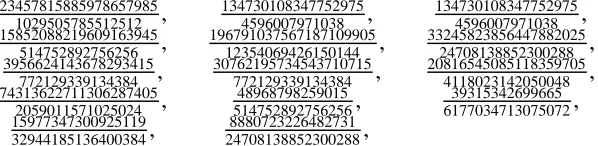
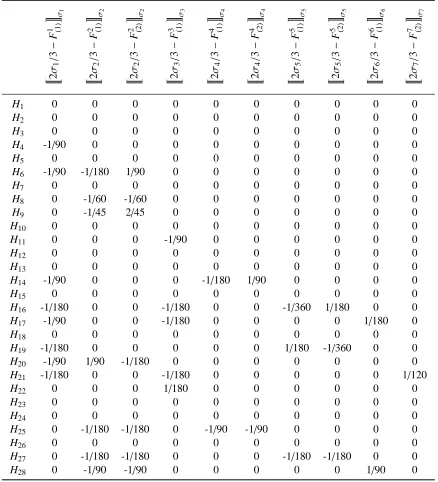
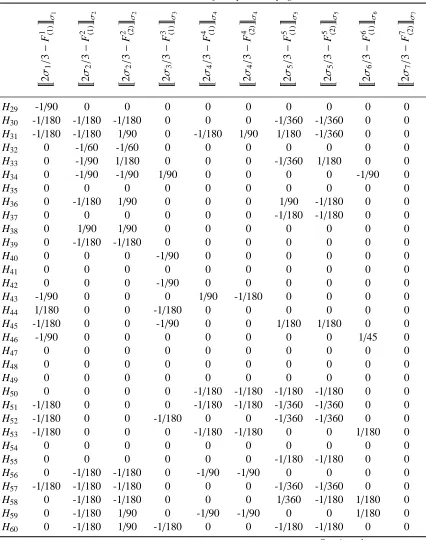
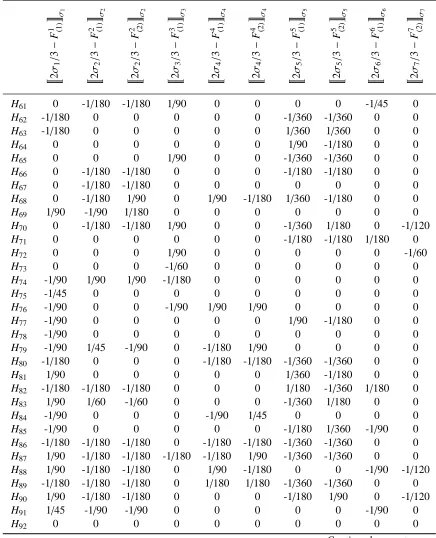
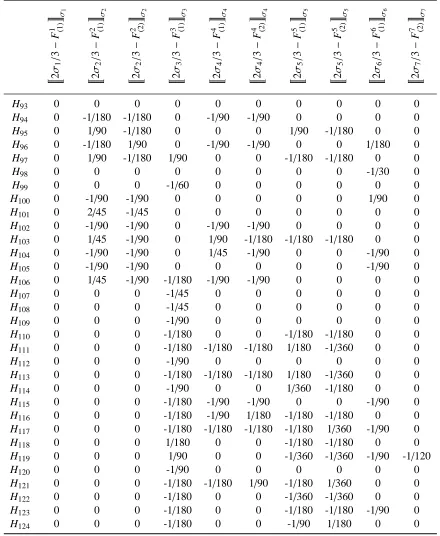
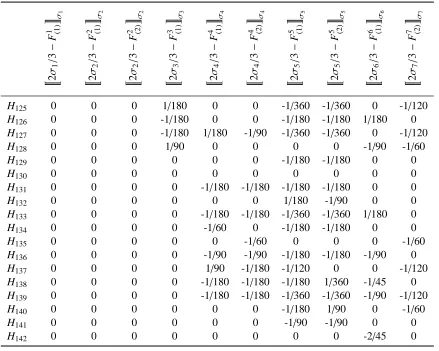
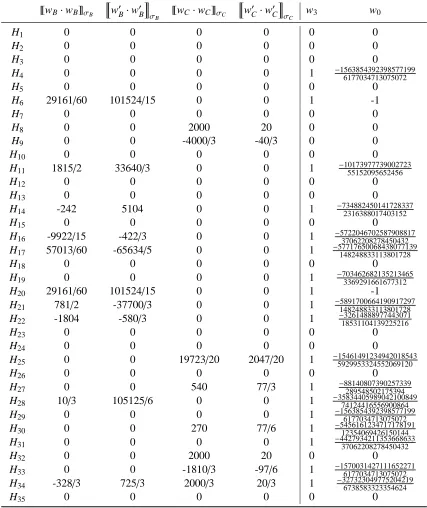
Proof. Let G be a counterexample and w3 ∈ RF5 be the sum of all elements of F5 that contain a vertex incident with at least three colors. By the definition of qG, the graph G has a vertex incident with edges of all three colors if and only if qG(w3)> 0. Lemma 5 implies that qG(H) is non-negative for each element H of A corresponding to any column of Table 2 (in Appendix B). In addition, (2) ensures that qG(H) is also non-negative for each element H ofAcorresponding to any of the first four columns of Table 3 (in Appendix B). Note that these elements can be expressed as elements of RF5. Summing these columns
with coefficients
23457815885978657985 1029505785512512 ,
134730108347752975 4596007971038 ,
134730108347752975 4596007971038 , 15852088219609163945
514752892756256 ,
196791037567187109905 12354069426150144 ,
33245823856447882025 24708138852300288 , 3956624143678293415
772129339134384 ,
30762195734543710715 772129339134384 ,
20816545085118359705 4118023142050048 , 74313622711306287405
2059011571025024 ,
48968798259015 514752892756256,
39315342699665 6177034713075072, 15977347300925119
32944185136400384,
8880723226482731 24708138852300288,
respectively, yields an element w0 ofAgiven in the very last column of Table 3. Notice that for every H ∈ F5, the coefficient of H in −w0 is at least the coefficient of H in w3.
In particular, the sum w3+w0, which belongs to RF5, has only non-positive coefficients. We now view both w0 and w3as elements ofAand use that qGis a homomorphism from Ato R. First of all, qG(w3 +w0) 6 0. So, we derive that qG(w3) 6 −qG(w0). As noted earlier, qG(H) > 0 for each element H used to define w0. Hence, since none of the above (displayed) coefficients is negative, we deduce that qG(w0)> 0. Consequently, qG(w3)60, which therefore implies that qG(w3) = 0. This means that G has no vertex incident with
edges of all three colors.
We are now in a position to prove Theorem 2, whose statement is recalled below.
Theorem 2. Let n> 2. Every tricolored graph with n vertices contains a subset of at most
[image:10.612.158.457.382.455.2]Proof. Suppose, on the contrary, that there exists a counterexample G. Recall that Av is the set of colors that appear on the edges incident to the vertex v. Now, by Observation 3 and Lemma 6, it holds that|Av|=2 for every vertex v of G. Hence, V(G) can be partitioned into three sets V1, V2and V3, where v∈Viif and only if i<Av. Without loss of generality, assume that|V1|>|V2|> |V3|. Pick u ∈V1and v∈V2. As Au∩Aw = {3}for all w∈V2, we observe that V2 is 3-dominated by{u}. Similarly, V1is 3-dominated by{v}. Therefore, the set{u,v}strongly 3-dominates V1∪V2, which has size at least 2n/3.
4
Concluding remarks
It is natural to ask what bound can be proven for domination with three vertices. Here, it does not seem that the trick we used in this paper helps. We can prove only that every tricolored graph with n vertices contains a subset of at most three vertices that c-dominates at least 0.66117n vertices for some color c.
We believe the difficulty we face is caused by the following phenomenon. The average number of vertices dominated by a triple isomorphic toσAorσB(see Figure 1 for notation) is bounded away from 2/3 in the graphs (Gk)k∈N, which are described at the beginning of
Section 3, for G being the rainbow triangle. So, if any of these two configurations is used, a tight bound cannot be proven since the inequalities analogous to that in Lemma 5 are not tight and no triple of vertices dominates more than 2/3 of the vertices in (Gk)k∈N to compensate this deficiency.
We see that if we aimed to prove a tight result, we can only average over rainbow triangles (which are isomorphic toσC). Now consider the following graph G: start from the disjoint union of a large clique of order 2m with all edges colored 1 and a rainbow triangle. For i ∈ {1,2}, join exactly m vertices of the clique to all three vertices of the rainbow triangle by edges colored i. The obtained simple complete graph has exactly one rainbow triangle, which dominates about half of the vertices. Thus, the average proportion of vertices dominated by triples isomorphic to σC in the graphs (Gk)k∈N is close to 1/2. This phenomenon does not occur for quadruples of vertices.
References
[1] R. Baber, Tur´an densities of hypercubes. Submitted for publication.
[2] R. Baber andJ. Talbot, Hypergraphs do jump, Combin. Probab. Comput., 20 (2011),
[3] R. Baber andJ. Talbot, New Tur´an densities for 3-graphs, Electron. J. Combin., 19
(2012). Research Paper 22.
[4] J. Balogh, P. Hu, B. Lidicky´,andH. Liu, Upper bounds on the size of 4- and
6-cycle-free subgraphs of the hypercube. Submitted for publication.
[5] C. Borgs, J. T. Chayes, L. Lovasz´ , V. T. S´os, and K. Vesztergombi, Convergent
sequences of dense graphs. I. Subgraph frequencies, metric properties and testing,
Adv. Math., 219 (2008), pp. 1801–1851.
[6] J. Cummings, D. Kral´ ’, F. Pfender, K. Sperfeld, A. Treglown, and M. Young,
Monochromatic triangles in three-coloured graphs. Submitted for publication.
[7] P. Erdos˝ , R. Faudree, A. Gyarf´ as´ ,andR. H. Schelp, Domination in colored complete
graphs, J. Graph Theory, 13 (1989), pp. 713–718.
[8] P. Erdos˝ , R. J. Faudree, R. J. Gould, A. Gyarf´ as´ , C. Rousseau, and R. H. Schelp,
Monochromatic coverings in colored complete graphs, in Proceedings of the
Twen-tieth Southeastern Conference on Combinatorics, Graph Theory, and Computing (Boca Raton, FL, 1989), vol. 71 of Congr. Numer., 1990, pp. 29–38.
[9] P. Erdos and˝ A. Hajnal, Ramsey-type theorems, Discrete Appl. Math., 25 (1989),
pp. 37–52. Combinatorics and complexity (Chicago, IL, 1987).
[10] V. Falgas-Ravry and E. R. Vaughan, On applications of Razborov’s flag algebra
calculus to extremal 3-graph theory. Submitted for publication.
[11] , Tur´an H-densities for 3-graphs. Submitted for publication.
[12] A. Grzesik, On the maximum number of five-cycles in a triangle-free graph, J. Comb.
Theory Ser. B, 102 (2012), pp. 1061–1066.
[13] H. Hatami, J. Hirst, andS. Norine, The inducibility of blow-up graphs. Submitted
for publication.
[14] H. Hatami, J. Hladky´, D. Kral´ ’, S. Norine, andA. Razborov, Non-three-colorable
common graphs exist, Combin. Probab. Comput., 21 (2012), pp. 734–742.
[15] , On the number of pentagons in triangle-free graphs, J. Combin. Theory Ser. A, (forthcoming).
[17] J. Hladky´, D. Kral´ ’,and S. Norine, Counting flags in triangle-free digraphs.
Sub-mitted for publication.
[18] D. Kral´ ’, L. Mach,andJ.-S. Sereni, A new lower bound based on Gromov’s method
of selecting heavily covered points, Discrete Comput. Geom., 48 (2012), pp. 487–
498.
[19] L. Kramer, R. R. Martin,andM. Young, On diamond-free subposets of the Boolean
lattice, J. Combin. Theory Ser. A, 120 (2013), pp. 545–560.
[20] L. Lovasz and´ B. Szegedy, Limits of dense graph sequences, J. Combin. Theory Ser.
B, 96 (2006), pp. 933–957.
[21] O. Pikhurko, Minimum number of k-cliques in graphs with bounded independence
number. Submitted for publication.
[22] O. Pikhurko and A. Razborov, Asymptotic structure of graphs with the minimum
number of triangles. Submitted for publication.
[23] A. Razborov, Flag algebras, J. Symbolic Logic, 72 (2007), pp. 1239–1282.
[24] , On the minimal density of triangles in graphs, Combin. Probab. Comput., 17 (2008), pp. 603–618.
[25] , On 3-hypergraphs with forbidden 4-vertex configurations, SIAM J. Discrete Math., 24 (2010), pp. 946–963.
[26] A. Tychonoff, ¨Uber die topologische erweiterung von r¨aumen, Mathematische
A
The Elements of
F
5H1 H2 H3 H4 H5 H6 H7 H8 H9
H10 H11 H12 H13 H14 H15 H16 H17 H18
H19 H20 H21 H22 H23 H24 H25 H26 H27
H28 H29 H30 H31 H32 H33 H34 H35 H36
H37 H38 H39 H40 H41 H42 H43 H44 H45
H46 H47 H48 H49 H50 H51 H52 H53 H54
H55 H56 H57 H58 H59 H60 H61 H62 H63
H64 H65 H66 H67 H68 H69 H70 H71 H72
H73 H74 H75 H76 H77 H78 H79 H80 H81
H91 H92 H93 H94 H95 H96 H97 H98 H99
H100 H101 H102 H103 H104 H105 H106 H107 H108
H109 H110 H111 H112 H113 H114 H115 H116 H117
H118 H119 H120 H121 H122 H123 H124 H125 H126
H127 H128 H129 H130 H131 H132 H133 H134 H135
B
Vectors Used in the Proof of Lemma 6
Table 2: The first ten vectors
2 σ1 / 3 − F
1 (1)
σ1 2 σ2 / 3 − F
2 (1)
σ2 2 σ2 / 3 − F
2 (2)
σ2 2 σ3 / 3 − F
3 (1)
σ3 2 σ4 / 3 − F
4 (1)
σ4 2 σ4 / 3 − F
4 (2)
σ4 2 σ5 / 3 − F
5 (1)
σ5 2 σ5 / 3 − F
5 (2)
σ5 2 σ6 / 3 − F
6 (1)
σ6 2 σ7 / 3 − F
7 (2)
σ7
H1 0 0 0 0 0 0 0 0 0 0
H2 0 0 0 0 0 0 0 0 0 0
H3 0 0 0 0 0 0 0 0 0 0
H4 -1/90 0 0 0 0 0 0 0 0 0
H5 0 0 0 0 0 0 0 0 0 0
H6 -1/90 -1/180 1/90 0 0 0 0 0 0 0
H7 0 0 0 0 0 0 0 0 0 0
H8 0 -1/60 -1/60 0 0 0 0 0 0 0
H9 0 -1/45 2/45 0 0 0 0 0 0 0
H10 0 0 0 0 0 0 0 0 0 0
H11 0 0 0 -1/90 0 0 0 0 0 0
H12 0 0 0 0 0 0 0 0 0 0
H13 0 0 0 0 0 0 0 0 0 0
H14 -1/90 0 0 0 -1/180 1/90 0 0 0 0
H15 0 0 0 0 0 0 0 0 0 0
H16 -1/180 0 0 -1/180 0 0 -1/360 1/180 0 0
H17 -1/90 0 0 -1/180 0 0 0 0 1/180 0
H18 0 0 0 0 0 0 0 0 0 0
H19 -1/180 0 0 0 0 0 1/180 -1/360 0 0
H20 -1/90 1/90 -1/180 0 0 0 0 0 0 0
H21 -1/180 0 0 -1/180 0 0 0 0 0 1/120
H22 0 0 0 1/180 0 0 0 0 0 0
H23 0 0 0 0 0 0 0 0 0 0
H24 0 0 0 0 0 0 0 0 0 0
H25 0 -1/180 -1/180 0 -1/90 -1/90 0 0 0 0
H26 0 0 0 0 0 0 0 0 0 0
H27 0 -1/180 -1/180 0 0 0 -1/180 -1/180 0 0
H28 0 -1/90 -1/90 0 0 0 0 0 1/90 0
Table 2 – Continued from previous page 2 σ1 / 3 − F
1 (1)
σ1 2 σ2 / 3 − F
2 (1)
σ2 2 σ2 / 3 − F
2 (2)
σ2 2 σ3 / 3 − F
3 (1)
σ3 2 σ4 / 3 − F
4 (1)
σ4 2 σ4 / 3 − F
4 (2)
σ4 2 σ5 / 3 − F
5 (1)
σ5 2 σ5 / 3 − F
5 (2)
σ5 2 σ6 / 3 − F
6 (1)
σ6 2 σ7 / 3 − F
7 (2)
σ7
H29 -1/90 0 0 0 0 0 0 0 0 0
H30 -1/180 -1/180 -1/180 0 0 0 -1/360 -1/360 0 0
H31 -1/180 -1/180 1/90 0 -1/180 1/90 1/180 -1/360 0 0
H32 0 -1/60 -1/60 0 0 0 0 0 0 0
H33 0 -1/90 1/180 0 0 0 -1/360 1/180 0 0
H34 0 -1/90 -1/90 1/90 0 0 0 0 -1/90 0
H35 0 0 0 0 0 0 0 0 0 0
H36 0 -1/180 1/90 0 0 0 1/90 -1/180 0 0
H37 0 0 0 0 0 0 -1/180 -1/180 0 0
H38 0 1/90 1/90 0 0 0 0 0 0 0
H39 0 -1/180 -1/180 0 0 0 0 0 0 0
H40 0 0 0 -1/90 0 0 0 0 0 0
H41 0 0 0 0 0 0 0 0 0 0
H42 0 0 0 -1/90 0 0 0 0 0 0
H43 -1/90 0 0 0 1/90 -1/180 0 0 0 0
H44 1/180 0 0 -1/180 0 0 0 0 0 0
H45 -1/180 0 0 -1/90 0 0 1/180 1/180 0 0
H46 -1/90 0 0 0 0 0 0 0 1/45 0
H47 0 0 0 0 0 0 0 0 0 0
H48 0 0 0 0 0 0 0 0 0 0
H49 0 0 0 0 0 0 0 0 0 0
H50 0 0 0 0 -1/180 -1/180 -1/180 -1/180 0 0
H51 -1/180 0 0 0 -1/180 -1/180 -1/360 -1/360 0 0
H52 -1/180 0 0 -1/180 0 0 -1/360 -1/360 0 0
H53 -1/180 0 0 0 -1/180 -1/180 0 0 1/180 0
H54 0 0 0 0 0 0 0 0 0 0
H55 0 0 0 0 0 0 -1/180 -1/180 0 0
H56 0 -1/180 -1/180 0 -1/90 -1/90 0 0 0 0
H57 -1/180 -1/180 -1/180 0 0 0 -1/360 -1/360 0 0
H58 0 -1/180 -1/180 0 0 0 1/360 -1/180 1/180 0
H59 0 -1/180 1/90 0 -1/90 -1/90 0 0 1/180 0
H60 0 -1/180 1/90 -1/180 0 0 -1/180 -1/180 0 0
Table 2 – Continued from previous page 2 σ1 / 3 − F
1 (1)
σ1 2 σ2 / 3 − F
2 (1)
σ2 2 σ2 / 3 − F
2 (2)
σ2 2 σ3 / 3 − F
3 (1)
σ3 2 σ4 / 3 − F
4 (1)
σ4 2 σ4 / 3 − F
4 (2)
σ4 2 σ5 / 3 − F
5 (1)
σ5 2 σ5 / 3 − F
5 (2)
σ5 2 σ6 / 3 − F
6 (1)
σ6 2 σ7 / 3 − F
7 (2)
σ7
H61 0 -1/180 -1/180 1/90 0 0 0 0 -1/45 0
H62 -1/180 0 0 0 0 0 -1/360 -1/360 0 0
H63 -1/180 0 0 0 0 0 1/360 1/360 0 0
H64 0 0 0 0 0 0 1/90 -1/180 0 0
H65 0 0 0 1/90 0 0 -1/360 -1/360 0 0
H66 0 -1/180 -1/180 0 0 0 -1/180 -1/180 0 0
H67 0 -1/180 -1/180 0 0 0 0 0 0 0
H68 0 -1/180 1/90 0 1/90 -1/180 1/360 -1/180 0 0
H69 1/90 -1/90 1/180 0 0 0 0 0 0 0
H70 0 -1/180 -1/180 1/90 0 0 -1/360 1/180 0 -1/120
H71 0 0 0 0 0 0 -1/180 -1/180 1/180 0
H72 0 0 0 1/90 0 0 0 0 0 -1/60
H73 0 0 0 -1/60 0 0 0 0 0 0
H74 -1/90 1/90 1/90 -1/180 0 0 0 0 0 0
H75 -1/45 0 0 0 0 0 0 0 0 0
H76 -1/90 0 0 -1/90 1/90 1/90 0 0 0 0
H77 -1/90 0 0 0 0 0 1/90 -1/180 0 0
H78 -1/90 0 0 0 0 0 0 0 0 0
H79 -1/90 1/45 -1/90 0 -1/180 1/90 0 0 0 0
H80 -1/180 0 0 0 -1/180 -1/180 -1/360 -1/360 0 0
H81 1/90 0 0 0 0 0 1/360 -1/180 0 0
H82 -1/180 -1/180 -1/180 0 0 0 1/180 -1/360 1/180 0
H83 1/90 1/60 -1/60 0 0 0 -1/360 1/180 0 0
H84 -1/90 0 0 0 -1/90 1/45 0 0 0 0
H85 -1/90 0 0 0 0 0 -1/180 1/360 -1/90 0
H86 -1/180 -1/180 -1/180 0 -1/180 -1/180 -1/360 -1/360 0 0
H87 1/90 -1/180 -1/180 -1/180 -1/180 1/90 -1/360 -1/360 0 0
H88 1/90 -1/180 -1/180 0 1/90 -1/180 0 0 -1/90 -1/120
H89 -1/180 -1/180 -1/180 0 1/180 1/180 -1/360 -1/360 0 0
H90 1/90 -1/180 -1/180 0 0 0 -1/180 1/90 0 -1/120
H91 1/45 -1/90 -1/90 0 0 0 0 0 -1/90 0
H92 0 0 0 0 0 0 0 0 0 0
Table 2 – Continued from previous page 2 σ1 / 3 − F
1 (1)
σ1 2 σ2 / 3 − F
2 (1)
σ2 2 σ2 / 3 − F
2 (2)
σ2 2 σ3 / 3 − F
3 (1)
σ3 2 σ4 / 3 − F
4 (1)
σ4 2 σ4 / 3 − F
4 (2)
σ4 2 σ5 / 3 − F
5 (1)
σ5 2 σ5 / 3 − F
5 (2)
σ5 2 σ6 / 3 − F
6 (1)
σ6 2 σ7 / 3 − F
7 (2)
σ7
H93 0 0 0 0 0 0 0 0 0 0
H94 0 -1/180 -1/180 0 -1/90 -1/90 0 0 0 0
H95 0 1/90 -1/180 0 0 0 1/90 -1/180 0 0
H96 0 -1/180 1/90 0 -1/90 -1/90 0 0 1/180 0
H97 0 1/90 -1/180 1/90 0 0 -1/180 -1/180 0 0
H98 0 0 0 0 0 0 0 0 -1/30 0
H99 0 0 0 -1/60 0 0 0 0 0 0
H100 0 -1/90 -1/90 0 0 0 0 0 1/90 0
H101 0 2/45 -1/45 0 0 0 0 0 0 0
H102 0 -1/90 -1/90 0 -1/90 -1/90 0 0 0 0
H103 0 1/45 -1/90 0 1/90 -1/180 -1/180 -1/180 0 0
H104 0 -1/90 -1/90 0 1/45 -1/90 0 0 -1/90 0
H105 0 -1/90 -1/90 0 0 0 0 0 -1/90 0
H106 0 1/45 -1/90 -1/180 -1/90 -1/90 0 0 0 0
H107 0 0 0 -1/45 0 0 0 0 0 0
H108 0 0 0 -1/45 0 0 0 0 0 0
H109 0 0 0 -1/90 0 0 0 0 0 0
H110 0 0 0 -1/180 0 0 -1/180 -1/180 0 0
H111 0 0 0 -1/180 -1/180 -1/180 1/180 -1/360 0 0
H112 0 0 0 -1/90 0 0 0 0 0 0
H113 0 0 0 -1/180 -1/180 -1/180 1/180 -1/360 0 0
H114 0 0 0 -1/90 0 0 1/360 -1/180 0 0
H115 0 0 0 -1/180 -1/90 -1/90 0 0 -1/90 0
H116 0 0 0 -1/180 -1/90 1/180 -1/180 -1/180 0 0
H117 0 0 0 -1/180 -1/180 -1/180 -1/180 1/360 -1/90 0
H118 0 0 0 1/180 0 0 -1/180 -1/180 0 0
H119 0 0 0 1/90 0 0 -1/360 -1/360 -1/90 -1/120
H120 0 0 0 -1/90 0 0 0 0 0 0
H121 0 0 0 -1/180 -1/180 1/90 -1/180 1/360 0 0
H122 0 0 0 -1/180 0 0 -1/360 -1/360 0 0
H123 0 0 0 -1/180 0 0 -1/180 -1/180 -1/90 0
H124 0 0 0 -1/180 0 0 -1/90 1/180 0 0
Table 2 – Continued from previous page 2 σ1 / 3 − F
1 (1)
σ1 2 σ2 / 3 − F
2 (1)
σ2 2 σ2 / 3 − F
2 (2)
σ2 2 σ3 / 3 − F
3 (1)
σ3 2 σ4 / 3 − F
4 (1)
σ4 2 σ4 / 3 − F
4 (2)
σ4 2 σ5 / 3 − F
5 (1)
σ5 2 σ5 / 3 − F
5 (2)
σ5 2 σ6 / 3 − F
6 (1)
σ6 2 σ7 / 3 − F
7 (2)
σ7
H125 0 0 0 1/180 0 0 -1/360 -1/360 0 -1/120
H126 0 0 0 -1/180 0 0 -1/180 -1/180 1/180 0
H127 0 0 0 -1/180 1/180 -1/90 -1/360 -1/360 0 -1/120
H128 0 0 0 1/90 0 0 0 0 -1/90 -1/60
H129 0 0 0 0 0 0 -1/180 -1/180 0 0
H130 0 0 0 0 0 0 0 0 0 0
H131 0 0 0 0 -1/180 -1/180 -1/180 -1/180 0 0
H132 0 0 0 0 0 0 1/180 -1/90 0 0
H133 0 0 0 0 -1/180 -1/180 -1/360 -1/360 1/180 0
H134 0 0 0 0 -1/60 0 -1/180 -1/180 0 0
H135 0 0 0 0 0 -1/60 0 0 0 -1/60
H136 0 0 0 0 -1/90 -1/90 -1/180 -1/180 -1/90 0
H137 0 0 0 0 1/90 -1/180 -1/120 0 0 -1/120
H138 0 0 0 0 -1/180 -1/180 -1/180 1/360 -1/45 0
H139 0 0 0 0 -1/180 -1/180 -1/360 -1/360 -1/90 -1/120
H140 0 0 0 0 0 0 -1/180 1/90 0 -1/60
H141 0 0 0 0 0 0 -1/90 -1/90 0 0
Table 3: The last six vectors
~wB·wBσB
w′B·w′B
σB
~wC·wCσC
w′C·w′C
σC w3 w0
H1 0 0 0 0 0 0
H2 0 0 0 0 0 0
H3 0 0 0 0 0 0
H4 0 0 0 0 1 −15638543923985771996177034713075072
H5 0 0 0 0 0 0
H6 29161/60 101524/15 0 0 1 -1
H7 0 0 0 0 0 0
H8 0 0 2000 20 0 0
H9 0 0 -4000/3 -40/3 0 0
H10 0 0 0 0 0 0
H11 1815/2 33640/3 0 0 1 −1017397773900272355152095652456
H12 0 0 0 0 0 0
H13 0 0 0 0 0 0
H14 -242 5104 0 0 1 −7348824501417283372316388017403152
H15 0 0 0 0 0 0
H16 -9922/15 -422/3 0 0 1 −572204670258790881737062208278450432
H17 57013/60 -65634/5 0 0 1 −57717650068438077139148248833113801728
H18 0 0 0 0 0 0
H19 0 0 0 0 1 −7034626821352134653369291661677312
H20 29161/60 101524/15 0 0 1 -1
H21 781/2 -37700/3 0 0 1 −1482488331138017285891700664190917297
H22 -1804 -580/3 0 0 1 −1853110413922521632614888977443071
H23 0 0 0 0 0 0
H24 0 0 0 0 0 0
H25 0 0 19723/20 2047/20 1 −592995332455206912015461491234942018543
H26 0 0 0 0 0 0
H27 0 0 540 77/3 1 −88140807390257339289548502175394
H28 10/3 105125/6 0 0 1 −3583440598904210084974124416556900864
H29 0 0 0 0 1 −15638543923985771996177034713075072 H30 0 0 270 77/6 1 −545616123471717819112354069426150144 H31 0 0 0 0 1 −442793421135366863337062208278450432
H32 0 0 2000 20 0 0
H33 0 0 -1810/3 -97/6 1 −15700314271116522716177034713075072
H34 -328/3 725/3 2000/3 20/3 1 −3273230497752042196738583323354624
H35 0 0 0 0 0 0
Table 3 – Continued from previous page
~wB·wBσB
w′B·w′B
σB
~wC·wCσC
w′C·w′C
σC w3 w0
H36 0 0 0 0 1 −13236502956589442040849950139277
H37 0 0 2187/5 5929/60 1 −150414806324880324486989357699
H38 0 0 -4000/3 -40/3 0 0
H39 177241/60 99856/15 0 0 1 −617703471307507214389006173379021
H40 53792/15 10/3 0 0 1 -1
H41 0 0 0 0 0 0
H42 53792/15 10/3 0 0 1 -1
H43 -242 5104 0 0 1 −244418926250621773132944185136400384
H44 -19723/60 8018 0 0 1 −1309805048182162255294601182635776
H45 19251/20 -46426/5 0 0 1 −7679414109492555314118023142050048
H46 0 0 0 0 1 −521981733736779125337062208278450432
H47 -4743/20 -27388/5 0 0 1 −3547091272571898916177034713075072
H48 0 0 0 0 0 0
H49 0 0 0 0 0 0
H50 0 0 0 0 1 −102522009006261748933296497666227603456
H51 0 0 4401/10 -6853/60 1 −103816701767414115797592995332455206912
H52 1331/4 24476/3 0 0 1 −17948307606112640875294601182635776
H53 -7157/30 72838/15 0 0 1 −55226415700070668835296497666227603456
H54 0 0 0 0 0 0
H55 0 0 2187/5 5929/60 1 −150414806324880324486989357699
H56 0 0 1630/3 -89/3 1 −148706888944854103561548610279552
H57 0 0 270 77/6 1 −545616123471717819112354069426150144 H58 0 0 0 0 1 −74826771055029195907148248833113801728
H59 0 0 0 0 1 -1
H60 0 0 -540 -77/3 1 −127346913837154513240663690119808
H61 -93 48430/3 0 0 1 −529460118263577610466732649688555
H62 0 0 0 0 1 −932073916095866548137062208278450432 H63 0 0 0 0 1 −3706220827845043262387193432797713 H64 0 0 0 0 1 −2176090233065440371323650295658944
H65 -34522/15 316/3 0 0 1 -1
H66 0 0 540 77/3 1 −88140807390257339289548502175394
H67 177241/60 99856/15 0 0 1 −617703471307507214389006173379021
H68 0 0 -815/3 89/6 1 −3706220827845043242621413028711205
H69 4631/4 -18328/3 -1000/3 -10/3 1 −10295057855125121330374174754201
H70 -39153/20 105544/15 -270 -77/6 1 −583464589838574219516472092568200192
Table 3 – Continued from previous page
~wB·wBσB
w′B·w′B
σB
~wC·wCσC
w′C·w′C
σC w3 w0
H72 -39153/10 211088/15 0 0 1 −4019439998616668756374124416556900864
H73 17391/4 114896/15 0 0 1 −132365029565894467376462435613401
H74 -3069/2 -38744/3 0 0 1 -1
H75 -968 20416 0 0 1 −206704879201250857441216765219648
H76 -13706/15 -92396/15 0 0 1 −872250188893292338716472092568200192
H77 0 0 0 0 1 −7034626821352134651684645830838656
H78 4631/2 -36656/3 0 0 1 −205076529391967946718531104139225216
H79 0 0 0 0 1 -1
H80 0 0 0 0 1 −3434036885124137687998832555409201152
H81 -4631/15 -13904/5 0 0 1 -1
H82 0 0 0 0 1 −1072518854696576953721178404730543104
H83 0 0 -2810/3 -39/2 1 -1
H84 0 0 0 0 1 −741731673904138539518531104139225216
H85 121/6 -30595/3 0 0 1 −2150571532266418843374124416556900864
H86 0 0 815/3 -89/6 1 −1005157507446338518384031884152
H87 1331/4 24476/3 270 77/6 1 −20656559744325441779265552069612608
H88 -8657/30 -194687/15 -815/3 89/6 1 −1051388948746528647121178404730543104
H89 0 0 270 77/6 1 −102492676367157469795296497666227603456
H90 4631/4 -18328/3 -270 -77/6 1 −1482488331138017283470421686575164043
H91 121/3 -61190/3 2000/3 20/3 1 −823604628410009612539057139644285
H92 0 0 0 0 0 0
H93 0 0 0 0 0 0
H94 0 0 19723/20 2047/20 1 −592995332455206912015461491234942018543
H95 0 0 0 0 1 −13236502956589442040849950139277
H96 0 0 -1630/3 89/3 1 −37632094249561791565148248833113801728
H97 0 0 -540 -77/3 1 −1472297168476995679265552069612608
H98 0 0 0 0 1 −416330901702367194124708138852300288
H99 77841/20 111556/5 0 0 1 -1
H100 10/3 105125/6 0 0 1 −3583440598904210084974124416556900864
H101 0 0 -4000/3 -40/3 0 0
H102 0 0 1630/3 -89/3 1 −1094323618915951867918531104139225216
H103 0 0 -1630/3 89/3 1 −32944185136400384244304794290394685
H104 0 0 -1630/3 89/3 1 −658027023952461635910589202365271552
H105 0 0 0 0 1 −1748352661628611272724708138852300288
H106 0 0 -1630/3 89/3 1 −23897282778912662618236046284100096
H107 107584/15 20/3 0 0 1 -2
Table 3 – Continued from previous page
~wB·wBσB
w′B·w′B
σB
~wC·wCσC
w′C·w′C
σC w3 w0
H108 30504/5 1336/3 0 0 1 −66935245670393753661825147829472
H109 1815/2 33640/3 0 0 1 −1017397773900272355152095652456
H110 0 0 0 0 1 −8666215141871962972059011571025024
H111 4631/4 -18328/3 0 0 1 −749342755572078604726954333293418496
H112 -1804 -580/3 0 0 1 −47719339103714707199265552069612608
H113 -34522/15 316/3 0 0 1 −5609018019358661506398832555409201152
H114 -3069/4 -19372/3 0 0 1 −61464352191805522379265552069612608
H115 55 -42050/3 26569/60 7921/60 1 −4763078209420451820611976651108184023040
H116 0 0 0 0 1 −1945052442264181154932944185136400384
H117 -93/2 24215/3 0 0 1 −822030642051101959942356809461086208
H118 -1804 -580/3 2187/5 5929/60 1 −92655520696126080362958430331557939
H119 -70439/30 8177 0 0 1 −1536755415081684771149416277704600576
H120 1815/2 33640/3 0 0 1 −1017397773900272355152095652456
H121 0 0 0 0 1 −10033437538996171436177034713075072
H122 4631/4 -18328/3 0 0 1 −20823033470826368339265552069612608
H123 -328/3 725/3 0 0 1 −1200621126457454743124708138852300288
H124 0 0 0 0 1 −205901157102502413765701958912919
H125 -27249/10 8684/15 0 0 1 −75624575885139732659148248833113801728
H126 55 -42050/3 0 0 1 −70683455524198969843148248833113801728
H127 0 0 0 0 1 −1108074349511822215721178404730543104
H128 170681/60 103481/15 0 0 1 -1
H129 0 0 0 0 1 −11572939959407334714632776034806304
H130 0 0 0 0 0 0
H131 0 0 4401/5 -6853/30 1 -1
H132 0 0 0 0 1 −4264279061141416891029505785512512
H133 421/6 22910/3 0 0 1 −12354978221722842838984777764472832
H134 0 0 4401/5 -6853/30 1 −561752438078307118132944185136400384
H135 0 0 0 0 1 −2642883703977495231142356809461086208 H136 0 0 0 0 1 −73815219170205621743148248833113801728 H137 0 0 0 0 1 −51576322752518046641296497666227603456 H138 0 0 0 0 1 −37389454791911250173296497666227603456
H139 421/6 22910/3 0 0 1 −1721418105415499531932944185136400384
H140 0 0 0 0 1 −15428182651739523158236046284100096 H141 0 0 0 0 1 −11572939959407334712316388017403152