November, 1964
CD
4 WAYS TO IMPROVE COMPUTER TAPE
Exercise greater quality control.
The Memorex-designed Vibrating-Sample Magnetom-eter (VSM) tests basic characteristics of oxide raw material and precise concentration of oxide particles in the tape coating. Extra tests of this kind guaran-tee the improved performance and reel-to-reel uni-formity cif Memorex computer tape.
Use a superior production facility.
A conspicuous aspect of the Memorex plant is the complex system of air filtration, humidification, dehumidification, heating and cooling. The unusual high-purity system, equal to that used in pharma-ceutical processing, provides a contaminant-free environment - prerequisite to production of ini-proved error-free tape.
Memorex tape is premium tape. No need to pre-check it. You can place Memorex computer tape directly in service-reel after service-reel.
Memorex certification means what it says: Memorex com-puter tape ~ error-free. Extra care, extra steps and scrupu-lous attention to every detail make it that way. We know the importance to you of having a tape you can depend on.
2
Circle No. 6 on Readers Service CardEmploy advanced production techniques.
Specially constructed equipment - used to slit Memorex computer tape from jumbo rolls - pro-auces tape with clean, straight edges free from rip-ples and ridges. A new slitting technique is but one of seventeen manufacturing improvements made to insure superior performance of Memorex tape.
Apply research in depth.
Research in oxide, coating materials, and tape-making processes has equipped Memorex with a fund of new technology. Combined with manufac-turing competence, this fundamental knowledge is manifest in Memorex computer tape by freedom from dropouts, longer life, and improved uniformity and reliability of performance.
Are you on our mailing list to receive the Memorex Monograph Series of informative technical literature? Write 1176 Shulman Avenue, Santa Clara, California.
MEMOREX
PRECISION MAGNETIC TAPECOMPUTERS and AUTOMATION for November, 1964
when you have a mountain
reduced to a molehill ...
do you wrap it ...
or phone it?
Modern data processing achieves miracles in reducing mountains of paperwork to compact "molehills" of cards or tapes.
But what then? How do you move that com-pressed data across town or across country?
If you're practical (and time-and-cost-con-scious), you telephone it.
Bell System DATA-PHONE service can
trans-mit it over regular telephone lines at great speed-and at regular phone-call rates.
DATA-PHONE service is a natural extension of your regular phone service, giving you integrated information handling that pays off in important time savings, better control of costs and greater all-round efficiency.
Talk with our Communications Consultant about it. Just call your Bell Telephone Business Office and ask for his services.
@
~e~!nl Tel~r.e~~e~~
Co. and Aswcialed Companies
4
AN OFF-BIT HISTORY OF MAGNETIC TAPE ... #3 of a series
by
Computape
It's about time somebody told the truth about that Mark Antony and Cleopatra bit. Truth of the matter is, Antony did not commit suicide. He was simply surfeited with the perfumed pleasures of Cleopatra's court. It got so there was hardly anything she could do to please him.
"Mark, doll", she'd coo at him, "Didn't I go and make you a Director of the Banks of the Nile 7 And have you join the Tuthmosis II Pyramid Club 7 And don't you like throwing peasants to the lions any more 7 We used to do such fun things together - and now you spend all your time at that silly computer centerl"
"Cleo", he would say, "You just don't understand. They've got this crazy new heavy duty computer tape down there, certified to deliver 1,000 bits per inch, with no dropoutl I tell you it's incredible!"
Cleopatra's green eyes flashed dangerously. "I warn you, Mark. You go down to that computer place ONCE more and ... "
"See you later", Mark Antony said. "They promised me they'd let me change the reels this time."
When Octavius Caesar broke into Cleopatra's camp the next day, Antony was nowhere to be seen; there was only the sullen queen and her pet lion, Amenhotep III.
"Where's Antony 7" Caesar demanded.
"Ask Amenhotep, why don't you 7" muttered Cleo-patra.
The lion rubbed his mane against Cleopatra's gown and opened his cavernous jaws in a huge, contented yawn.
From somewhere in the depths came the faint, muffled sound of a voice,
"Friends, Romans, countrymen ... HAAAAAAALP!" This fascinating bit of tape history, incidentally, is presented for your edification by Computape, and the moral of the whole bit is crystal clear:
Computape is heavy-duty tape so carefully made that it delivers 556, or 800, or ( if you want) 1,000 bits per inch - with no dropout.
Now - if Computape can write that kind of computer tape history - shouldn't you be using it 7
(+)
COMPUTRON INC.
~]!1
122 CALVARY STREET, WALTHAM, MASSACHUSETTSCOMPUTAPE - product of the first company to manufacture magnetic tape for computers and instrumentation, exclusively.
Circle No. 8 on Readers Service Card
Command and control systems utilizing an intelligence center such as Jet Propulsion Laboratory's shown on ottr front cover are greatly increasing operating effectiveness and fast response for complex organizations. The require-ments of such a system for the Field Army are described by David Weisberg beginning on page 26.
CDrn~uters
and automation
NOVEMBER, 1964 Vol. XIII, No. 11
editor and publisher
EDMUND
c.
BERKELEYassistant editors
MOSES M. BERLIN NEIL D. MACDONALD LINDA LADD LOVETT
contributing editors
ANDREW D. BOOTH NED CHAPIN JOHN W. CARR, III ALSTON S. HOUSEHOLDER PETER KUGEL
advisory committee
T. E. CHEATHAM, JR. GEORGE E. FORSYTHE RICHARD W. HAMMING ALSTON S. HOUSEHOLDER HERBERT F. MITCHELL, JR.
associate publisher
PATRICK J. MCGOVERN
production manager
ANN B. BAKER
art director
RAY W. HASS
circttlation manager
VIRGINIA A. NELSON, 815 Washington St. Newtonville, Mass. 02160, 617-DEcatur 2-5453
advertising representatives
New York 18, BERNARD LANE 37 West 39 St., 212-BRyant 9-7281
Chicago 11, COLE, MASON AND DEMING 737 N. Michigan Ave., 312-SU 7-6558
Los Angeles 5, WENTWORTH F. GREEN 300 S. Kenmore Ave., 213-DUnkirk 7-8135
San Francisco 5, A. S. BABCOCK 605 Market St., 415-YUkon 2-3954
Elsewhere, THE PUBLISHER 815 Washington St., 617-DEcatur 2-5453 Newtonville, Mass. 021GO
computers and data processors: the design, applications, and implications of
information processing systems.
In This Issue
14 A LOOK AT HIGH-SPEED PRINTERS
by Norman Stat land
20 DERIVING MAXIMUM UTILIZATION FROM COMPUTER TAPE
by George Armes
26 A COMMAND-CONTROL INFORMATION SYSTEM FOR THE ARMY
by David E. Weisberg
32 THE STANDARDIZATION OF PROGRAMMING LANGUAGES
by Franz L. Alt
In Every Issue
across the editor's desk
37 COMPUTING AND DATA PROCESSING NEWSLETTER
editorial
6 Automatic Documentation
FIELD
forum on the social implications of computers
and automation
9 Social Implications of Automation and Computers 10 Data Processing Management Association
reference information
50 Monthly Computer Census53 Calendar of Coming Events 54 New Patents, by Raymond R. Skolnick
58
36
index of notices
Advertising IndexStatement of Ownership, Management and Circulation
COMPUTERS AND AUTOMATION IS PUBLISHED MONTHLY AT B15 WASHINGTON ST., NEWTONVILLE 60, MASS., BY BERKELEY ENTERPRISES, INC. PRINTED IN U.S.A. SUBSCRIPTION RATES: UNITED STATES, $15.00 FOR 1 YEAR, $29.00 FOR 2 YFARS, INCLUDING THE JUNE DIRECTORY ISSUE; CANADA. ADD SOc A YEAR FOR POSTAGE; FOREIGN, ADD $1.50 A YEAR FOR POSTAGE. ADDRESS ALL EDITORIAL AND SUBSCRIPTION MAIL TO BERKELEY ENTERPRISES, INC., 815 WASHINGTON ST., NEWTONVILLE, MASS., 02160. SECOND CLASS POSTAGE PAID AT BOSTON, MASS.
POSTMASTER: PLEASE SEND ALL FORMS 3579 TO BERKELEY ENTERPRISES, INC., 815 WASHINGTON ST., NEWTONVILL£. MASS., 02160. Ii:' COPYRIGHT, 1964, BY BERKElEY ENTERPRISES, INC. CtiANGE OF ADDRESS: IF YOUR ADDRESS CHANGES, PLEASE SEND US BOTH YOUR NEW ADDRESS AND YOUR OLD ADDRESS lAS II APPEARS ON "THE MAGAZINE ADDRESS IMPRINT), AND ALLOW THREE W[[KS FOR THE CHANGE TO BE MADE.
Automatic
One of the big sources of difficulties in using large com-puter programs after they have been cre~ted, .use~ for some time, and modified from time to tIme IS mcomplete documentation.
Unlike a computer or a clock, a program is not a p~ys~cal object that can be examined and dissected. Instead It IS a symbolic object-a long list of hundreds or thousands of computer instructions interlinked in complex paths:
If a human being new to the computer program IS to use it well and with understanding, he needs an accurate, com-plete, and understandable description of all t~e program's features and properties-adequate documentatIon.
But the documentation is regularly inadequate. The documentation regularly is produced by and depends on people and what they de>---the rules actually obeyed in com-puter installations, the supervision exercised, th.e r~cords kept by human beings. All such systems are mevItably subject to increase of variation, disorder, and error .. ~uman beings are often careless and often neglectful; and It IS very easy for a human being to modify a program and make either no record or a very inadequate one.
Besides, it is naturally difficult for the facile leaping minds of the creators of a big and complex computer program to have the patience to write out good explanations of what they have done. They have little sympathy for the slower minds coming along behind them. In fact, there may be a basic contradiction in human character between the brilliance needed to develop a large computer program, and the patience needed to write a good explanation of it, good documentation.
Every now and then you meet somebody who says "You don't have to understand the computer program, any more than you have to understand the telepho~e~just use it:" For some purposes this may be true, but It IS not true m general. A computer program may misbehave on the computer; then to aid the maintenance man, you need to understand the part of the program which is failing. Or a computer program may not behave properly for so~e unusual cases; in fact they might not have been covered III
the original program due to oversight. Or what the program is required to do may be altered to some minor extent; obviously, you would then like to know how to modify the program slightly so that you do not have to work it out all over again. And more reasons besides.
A computer program is much more like a car than a telephone. If your motor car starts to behave badly, it. is well worthwhile to know whether the trouble you notIce is likely to be in the ignition, the battery, the fuel line, or
6
Documentation
c&a
EDITORIAL
some other part of the system. And if you bou~h~ your car at sea level, and later intend to do some dnvmg ~t an altitude of 5000 feet or higher, it is well worthwhIle to know that part of your car (the carburetor) should be adjusted.
It is difficult for human beings to produce good documen-tation for large computer programs. But it is desirable to have it. Therefore, the task should be given to a computer, and the computer should automatically produce good documentation.
Is this possible? Yes ..
It is possible because from time to time good ~ocument~ tion is produced by the intellect of a human bemg, and If a human intellect can do this, so can a computer. Human brains are not supernatural.
Is it feasible? Yes.
First, there is always at least some documentation to start with. The creating programmer puts key words, key abbreviations, key comments, into his symbolic program. This provides one of the beginnings. Second, nearly all programs must be modular: segments of them ~re .wo~ked out and tested as subroutines; and each subroutme IS gIven sample inputs and required to produ.ce proJ?er outputs, until it is acceptable. And the subroutme by Itself can be translated into a unit of good documentation. Third, there exist analyzing programs; one kind, for example, can, for any program given to it, produce, given each register, a list of all the registers which contain a jump to that register. In this way the actually existing flow diagram of a program can be largely revealed. And so forth. Finally, the process of developing automatic documentation does not have to spring at once like Minerva fully-formed from the brow of Zeus; instead it can grow little by little from small programs to larger and larger programs.
It seems evident that another of the big strides forward in programming will come with automatic documentation. Then a human being coming into a new programming situation can be instructed by the computer itself in under-standing whatever he wishes to know about a program.
~c:,~
EDITOR
NEW BURROUGHS B 200
MPA ,
Are you one of those who have rejected COBOL because
it required too much hardware, took too long
to
compile,
or was too slow in execution? If so, this streamlined
new version may be just the ticket.
Since its creation in 1959, the value of COBOL
(COmmon Business Oriented Language) has
never been questioned. But while it worked
fine in some large-scale computers, smaller
systems simply didn't have the capacity to
use it efficiently.
ENTER BURROUGHS B 200
COMPACT COBOL
Developed by Burroughs Corporation
expressly for its medium-scale B 200 computer
series, this new compiler provides virtually all
the benefits of COBOL. As the name implies,
it is a trimmer, easier-to-use language. Gone
are the redundancies and complications. What's
left is a highly efficient, widely applicable
program language.
LESS EQUIPMENT,
SHORTER COMPILE TIME
Where once memory sizes on the order of
10,000 to 30,000 positions were needed,
Burroughs B 200 COMPACT COBOL
re-quires only 4,800. Where generally six
mag-netic tapes were needed, now only four are
required. And where the use of COBOL often
resulted in a compile time measured in hours,
the average time with this new version is well
under 10 minutes.
EFFICIENT OBJECT PROGRAMS,
MAXIMUM THROUGHPUT
The B 200 speeds implementation of Burroughs
B 200 COMPACT COBOL with a
three-address logic which corresponds closely to the
syntax of COBOL. For example: ADD A TO
B GIVING C corresponds to the A
+
B
=C
logic of the B 200. This, together with the
B 200's buffering and demand feeding, helps
provide outstanding object program efficiency.
WHAT THIS MEANS
No longer do you need a large-scale computer
to reap the benefits of COBOL. Not with the
low-cost Burroughs B 200 series computer
and new Burroughs B 200 COMPACT
COBOL on the scene. We supply both. Write
us at Detroit, Michigan 48232.
Burroughs-TMBurroughs B 200 Series Computer
Burroughs Corporation
Circle No. 9 on Readers Service Card
pre-publication offer
TELETYPEWRITER
FUNDAMENTALS
HAN DBOOK
By Wm. D. Rexroad
... IN HANDY POCKET-SIZE BOOKLET FORM PUBLISHED
BY COMPUTER DESIGN PUBLISHING CORPORATION
The Handbook is based on an article that appeared in the November issue of COMPUTER DESIGN. The demand for
re-prints of the article was so overwhelming that it has now been expanded, giving more details on some of the topics previously-covered, and adding up-to-date information on 8-level codes, the standard code adopted by the ASCII, frequency shift keying systems, radio teletypewriter tech-niques, and descriptions of the latest in teletypewriter machinery.
IDEAL FOR: REFERENCE BOOK • TRAINING PROGRAMS • SALES AIDS FOR SWITCHING COMPUTER MFGRS. • LIBRARIES • EMPLOYEE EDUCATION • CUSTOMER INDOCTRINATION
MAJOR TOPICS: BASIC PRINCIPLES OF TELETYPEWRITERS
HOW THEY OPERATE • Signal Generation & Reception • Baudot Code & Eight Level Codes • Teletypewriter Distortion HOW THEY ARE USED • Simplex, Half-Duplex, Full Duplex •
Neutral & Polar Circuits • FSK & RTTY GLOSSARY OF TELETYPEWRITER TERMINOLOGY
DESCRIPTIONS & PHOTOS OF TELETYPEWRITER MACHINES
PRE-PUBLICA T/ON PRICE only $1.00 per copy Quantity prices available on request
To order your copy at this pre-publication price, simply fill out coupon below, enclose $1.00 per copy, and mail to: COMPUTER DESIGN PUBLISHING CORPORATION, BAKER AVE., W. CONCORD, MASS. 01781
-.---.~---
COMPUTER DESIGN PUBLISHING CORP. BAKER AVE., W. CONCORD, MASS. 01781GENTLEMEN:
Enclosed is $... . ... for ... copy(ies) of TELETYPEWRITER FUNDAMENTALS HANDBOOK.
SEND HANDBOOK(S) TO: NAME
COMPANY ... . ADDRESS ... . CITY ... STATE ... .
---Circle No. 15 on Readers Service Card
FORUM ON THE SOCIAL IMPLICATIONS
OF COMPUTERS AND AUTOMATION
SOCIAL IMPLICATIONS OF AUTOMATION AND COMPUTERS
Professor Victor Paschkis
Heat and Mass Flow Analyzer Laboratory Columbia University
New York, N.Y. 10027
I am writing with regard to the Forum on the Social Implications of Computers and Auto-mation and particularly in reply to the articles in the July and August issues. It seems to me that both authors present too easy denials of the dangers of automation. I will first deal with the danger of unemployment, which is the only one which the authors recognize, and only as a second point, with additional dangers which they do not even mention.
With regard to unemployment, I will list what I consider the erroneous simplifications of the two authors.
0) "Automation is just a further labor saving device." However, the magnitude of labor saving is so much larger than, for example, that pre-sented by the first industrial revolution, that a ratio automation/first-industrial-revolution, equals nuclear-weapons/machine-gun.
(2) "Automation is destined to cut the work week. Thus, ultimately, man has to choose between 'more
things' or 'more leisure'." Reference to the poverty stricken segments of our own population and of the world is misleading as will be explained below. Outside the two groups men-tioned before, we have already an abundance of "things," and the only way out would be a train-ing for creative use of leisure time. Such training is hardly being mentioned and would, within a relatively short time, require training for use of the major part of the day for most people.
(3) Even duri ng the "period of grace," duri ng which the poverty stricken parts of our own country and the world might obtain the necessary material goods, automation does present the danger of unemploymenti those laid off due to automation can not be retrained for jobs which have not gone out of existence, in part because of age, in part because of limited natural in-telligence, and in part because it is hard to predict which jobs will exist at the end of the training period.
(4) Because of past sins, an undue portion of the unskilled people hit first by automation belong to minority races. Thus, automation contributes to the difficulties originating from the Civil Rights struggle.
COMPUTERS and AUTOMATION for November, 1961
(5) During the continuous progress of automation, employment possibilities in different industries will be so vastly different that additional social difficulties may arise; for example, a recent report speaks of an automatic ticket collection machine for transportation enterprises. It does not help ticket collectors who will be thrown out of work that there might be jobs in the
construction industry. The suggestion to provide multiple training may be theoretically correct, but requires study and research; and while such study and research may be going on, displacement of workers proceeds at a rapid rate.
Computers present additional dangers:
(1) Inherently, computers can give only yes-no answers. There are problems which have no "yes" or "no" answer.
(2) In order to achieve answers to such questions, values may be hidden in the computer program, while the public is told that the output is an "obj ec ti ve" answer.
(3) The computer tends to shift the government more and more to a government by experts, which, as history shows, is easier prey to totalitarian management than a government not relying on experts to the extreme which computers make possible.
(4) The ease with which computers can assemble information on an individual makes it possible to have a "dossier" for each citizen, again leading to a police state.
(5) The ease of compilation presents a big temp-tation to use computers for a large-scale polling of the population. It is known how easily one can get different answers, depending on the formulation of the question. Of course, loaded questions can be asked also without the existence of computers. But the ease of evaluation by computers makes the temptation to ask questions more frequenti it is reasonable to assume that the percent of loaded questions in a certain number of questions asked will not decrease by the existence of computers, and, therefore, more loaded questions will be asked.
(6) The great advantage of speed of computation can turn to a danger: the machine cannot have a
"second thought"--the term, second thought, refers really not to a thinking process but to an intui-tive process, which is beyond the capability of machines. A machine with "second thought" would produce a different result from that of the first thought, and is ready for the scrap heap.
(7) Still connected with speed is the danger, that under certain circumstances, the result of compu-tation may be directly fed into a decision, for
example, in connection with weapons.
Decisions
over the lives of millions or tens of millions
of people should not be automatic, even
assum-ing that the machine is technically beyond
doubt.
Decisions which would be programmed
in-to the machine would certainly not be
under-stood by the people involved before the
pro-gram is formulated. Thus, the use of such
automatic decisions is thoroughly undemocratic.
DATA PROCESSING MANAGEMENT ASSOCIATION
I. From:
Donald Vogel
Huntsville, Ala.
Could you give me information concerning
the Data Processing Management Association
(DPMA)?
Of particular interest is (1) purpose of
DPMA and how widespread is it, (2) the
effect-iveness and suitability of the DPMA
examina-tion for programmers, and (3) the percentage
of programmers in the U.S. who have taken the
DPMA exam.
II. From:
The Editor
Some of your questions can be answered
easily by the Data Processing Management
Asso-ciation itself. Their address is: DPMA
Inter-national Headquarters, 524 Busse Highway, Park
Ridge, Illinois.
In answer to your other questions:" in my
opinion the Data Processing Management
Associ-ation is doing a good job in developing
exam-inations and trained Data Processing persons;
I think what they will accomplish will steadily
improve as the years pass.
I am all in favor
of the examinations and course of study which
they have begun.
At their request, we have given them an
advertisement in this issue of "Computers and
Automation" to announce their next examination.
One of the most important activities for
dealing with the social problems arising from
computers and automation is increased
educa-tion such as the DPMA is systematically
pro-viding.
The Data Processing Management Association Announces the Fourth Annual Examination
for the
Certificate
In
•
Data Processing
Saturday, February 13, 1965
at 96 Test Sites Throughout the U. S. and Canada
The three-hour examination encompasses a wide
range of subjects which are considered
import-ant for professional competence in the field of
data processing and management information
systems.
Subject categories include computer and unit
record concepts and equipment; analysis and
de-sign of data systems -- manual,
electrn-mechani-cal, and electronic principles of accounting,
mathematics and statistics.
Applicants need not be members of DPMA.
The
examination is open to anyone of high character
who has at least three years of experience in
full time work in data processing. Specific
academic requirements will be waived this year
for the last time.
Applications are available from the Data
Proc-essing Management Association International
Headquarters, 524 Busse Highway, Park Ridge,
Illinois. The deadline for filing applications
is December 1, 1964.
A revised study guide for the COP examination
has been designed as an outline for individual
10
and group study. For a copy of the study guide,
a descriptive brochure, a list of the test
sites and an application form, please write
to DPMA International Headquarters. The coupon
below may be used.
To:
DPMA International Headquarters
524 Busse Hwy., Park Ridge, Illinois
Please forward information on 1965
COP Examination to:
Name ____________________________________ _
Tit1e __________________________________ __
Company ________________________________ __
Address _________________________________ ___
City __________________ __
State ___________________ -Zip Code ________ __
Circle No. 19 on Readers Service Card
•
•
•
•
•
More than a calculator-Almost a computer
... and now with automatic input-$4350
THE WYLE
SCIENTIFIC
IS THE FIRST DESK-TOP COMPUTATIONAL CENTER designed specifically for the solutionof complex scientific and engineering problems. Almost as simple to operate as an adding machine, it provides arithmetic capability, efficiency and speed never before available in a calculator.
WITH AUTOMATED DATA ENTRY, it eliminates all the tedious, wasted time of multi-step repetitive arithmetic problem solving. You enter only the variables manually. All the repetitive procedures are run off automatically from a prepared program library of simple punchcards fed into the calculator reader. And you don't have to be a programmer or need additional equipment to prepare your own input library. You simply punch in your instruc-tions by hand on a Wyle stored-program card, which has the calculator keyboard reproduced on it. With this
auto-mated input added to the Wyle
Scientific
versatility, you will solve complex problems at speed approaching thatof a computer.
NEVER BEFORE CAPABILITIES LIKE THESE The contents of all registers are displayed, on an eight-inch cathode ray tube, as indi-cated in the following diagram.
Multiplier-Quotient Register Entry Register Accumulator Register Storage Register 1 Storage Register 2 Storage Register 3
All parts of a problem are visible. The contents not only of the three active arith-metic registers, but also of the three stor-age registers are displayed at all times. Numbers entered from the keyboard are
seen as they are entered and can be veri-fied before use.
Transcription errors are eliminated through complete versatility of transfer from any register to any other without loss of desired data.
All registers handle 24-digit numbers. Decimal points are entered the same as digits, using an eleventh key, and all input and answers are correctly aligned with decimal point on the output display. Automatic square root is provided, as is single entry squaring and multiple sub-totals.
The calculator has plug-in compatibility with auxiliary input-output devices includ-ing printers, paper tape equipment, and other EDP equipment.
See it at FJCC, Booths 509-10-11
COMPUTERS and AUTOMATION for November, 19Gtj
Its operation can be learned in minutes, and it functions with the speed, quiet, and reliability of its solid state design.
These capabilities, combined with automatic entry, for the first time fill the technical and economic gap between cal-culators and computers.
$3950 for basic calculator (You can add automatic input later)
$4350 complete with automatic input For further information, write Dept. N, Products Division, Wyle Laboratories, EI Segundo, California. Or telephone (213) ORegon 8-4251.
WYLE LABORATORIES
Circle No. 11 on Readers Service Card
Many of the outstanding achievements in science
and technology during the past 10 years have been
recorded, analyzed and preserved on tapes of"M ylai:'
When reliability counts, count on "Mylar:'
·g~i~o~~,;:.~~~~fitm~<ad,ma'k
<®
P06J)
n1,1f..upo~
•••. " ... t.Of'·MYLAR®
POLYESTER FILM
BETTER THINGS FOR BETTER LIVING ... THROUGH CHEMISTRY Circle No. 12 on Readers Service Card
YOUR COMPUTER
Input: 8 bits. Output: anyone ot 255 voice messages.
Why bother with coded output during crisis
conditions? The TEL-A-DEX voice-alarm
annunciator system simplifies
man-machine communications, improves system
efficiency, eliminates operator error, adds
a margin of safety, and does not interfere
with normal operation.
ON DISPLAY AT FJCC ... BOOTH 434
TEL-A-CEX CORPORATION
600 East Bonita Avenue· Pomona, California 91767
TEL-A-DEX CORPORATION IS A WHOLLY-OWNED SUBSIDIARY OF CONSOLIDATED SYSTEMS CORPORATION, AN ASSOCIATE COMPANY OF ALLIS-CHALMERS AND BELL & HOWELL
A LOOK AT HIGH-SPEED PRINTERS
The initial, general-purpose, electronic digital computers produced over a decade ago were designed primarily for mathematical and scientific applications, in which the volume of output data was relatively low. As long as the computer's use was generally limited to those applications, single-action character printers operating on-line were adequate. The situation changed, however, as the use of computers for commercial applications became more widespread. During the first phase of commercial com-puter usage, printed forms and documents for distribution outside the organization became an important output prod-uct. During the current second phase, emphasis has shifted to management control information, and the computer is called upon to produce an increasing number and diversity of management reports. The result of this is a sharp in-crease in output volume, and rapid change in both the methodology and hardware associated with output printer systems. These changes have occurred where the high-speed printer unit was the limiting factor on system throughput
(measured in units processed per time period).
One change in methodology has been the practice of operating magnetic-tape units off-line under the control of a special electronic unit that transmits data to the line printer. This type of arrangement eliminates the speed limitation imposed by the slowest component when attached on-line, e.g., the line printer.
The use of off-line printer systems, however, is generally limited to large installations where the added expense of the off-line control unit can be justified by the large work-load. The best current example of this situation is in the batteries of IBM 1401s now in use as output data con-verters at many 7090 and 7094 installations. Recent
l11is article is based on a special report published in Auerbach Standard EDP Reports and is used with permission. Copyright © 1963 by Auer-hach/Info, Inc., Philadelphia, Pa. AU rights reserved.
14
Norman Statland
Auerbach Corporation
Philadelphia 3
~Pa.
practice in small- and medium-size installations favors the use of high-speed, on-line printers controlled by the sys-tem's central processor. It is anticipated that, with the increasing number of small- to medium-size computer systems that are expected to be sold in the next five years, this trend will become dominan t.
The trend toward high-speed on-line printers is also helped by the parallel processing equipment features, which are frequently used to reduc~ the amount of time the central processor spends in controlling the printing operations. The parallel processing concept of on-line print operations uses the program-interrupt logic of the system to enable the central processor to control the printer while carrying out internal processing tasks. The interrupt originates either from the printer or from a control program that periodically examines the print buffer to see if data is needed.
Types of High-S,peed Printers
Two basic types of high-speed printers, impact and non-impact, have been developed to solve the problem of high volume output. Non-impact printers generally form images on a paper medium through use of electric charges. The character is transferred via a cathode ray tube or a special process such as Xerography. The image is then fixed by the use of heat or other means. These printers generally pro-duce only one copy on-line-and that one is of question-able printing quality* for distribution outside the organi-zation. Consequently, most of the high-speed printers presently in use are impact printers. As can be seen from the accompanying chart, most of them have printing speeds rated at 600 to 1200 lines per minute.
*Printing quality is subjectively measured by users in terms of smudging, character alignment, and embossment (consistent distribution of ink).
Impact printers use some form of mechanically-driven type wheel or slug, which means a type slug or metal print face is used to imprint the character upon the. paper. The paper is then pressed against the print face and inked ribbon by the force of electronically-actuated hammers. In principle, this operation is similar to that of a typewriter, except that high-speed line printers print an entire line at a time. This capability to print a line at a time, rather than just individual characters, eliminates the need for a moving carriage and provides for much greater speeds than were possible with earlier single-character or stick printers. Line printers use continuous-feed paper, which is fed past the print head by a sprocket mechanism engaged through positionable 'traction clamps. Vertical spacing and skipping of the paper is generally controlled by a paper-tape loop in which the positioning of the page is determined by holes in the specific channels (8- and 12-channel tape being the most popular today). When this control is not provided, the program within the central processor must control the line spacing on the page.
All line printers incorporate some form of high-speed paper skipping which permits the paper to be advanced more than the normal line' spacing and at several times the normal speed. Portions of preprinted forms that are not to' be printed on can be skipped at speeds up to 35 times faster than normal paper-movement speeds. In the accompanying chart, a comparison between the "Peak Speed" and "I-Inch Spacing" columns shows what effect the spacing of forms can have on over-all, high-speed printer efficiency. Furthermore, it should serve to remind forms designers to consider the particular properties of their high-speed printer when constructing their forms layouts.
All of the printers shown on the accompanying chart are known as "on-the-fly" printers, which usc one of three basic types of print heads: a solid drum with the print faces engraved into the drum; multiple wheels locked together to form a print drum; variations of a chain or train of print slugs. Each of these types is a variation of the same basic principle, the use of extremely rapid hammer action to press ribbon and paper against the type face.
Print Characteristics
The sequence of action in a print cycle starts with the computer loading data into the print buffer. The contents of the print buffer are decoded (under control of com-mutator-like logic) to select the particular characters to be printed at each print position. A rapid-action hammer presses the paper and ribbon against the type face at the exact moment the selected character is in position. The print cycle is completed when the paper movement mech-anism advances the paper to the next line position and an independent drive mechanism moves the ribbon to a new print area. During this last phase of the print cycle, the hammer recoils and the type wheel completes one revolution.
Length of time of the total printing cycle is determined by the number of lines printed per minute. This interval is divided into discrete timing units for each available character, with several units allocated for paper advance. Because of this system, in some drum printers, the firing of all hammers at one specified time-say, the third discrete timing unit, would result in having a
"e"
printed in every position across the page.Printers can be either synchronous or asyilchronous, depending upon the hardware facility built into them at the time of manufacture. Those having a synchronous mode of printing have a specific cycle which commences
COMPUTERS and AUTOMATION for November, 1964
at a specific point. Printing begins only at the assigned interval.
In asynchronous printing, however, the cycle is flexible and printing can begin at any point on the print head at any time. Firing begins whenever a signal is received indicating that line spacing has been completed and print buffer loading is finished. Firing terminates when a counter indicates that the drum has made a complete revolution past the hammers, or when an indication has been received that all the characters in the buffer have been printed. A special control tape, or the central processor, controls skipping in this case. The Anelex 4-1000 is an example of an "on-the-fly" printer using the asynchronous mode of operation.
In chain printers each hammer is timed individually (e.g., the IBM 1403 and 2201 printers) because each character travels horizontally across many printing posi-tions during the entire print cycle. The chain, holding five identical sets of 48 characters, assembled serially, moves horizontally across the paper. The solenoid-acti-vated hammer at a selected position forces the paper into contact with the ribbon against the chain, each hammer firing independently as the appropriate character on the chain passes the printing position. A train mechanism has now replaced the chain in the IBM 1403 Model 3, and type slugs move in the same horizontal plane as in the chain but at more than twice the speed.
In those cases in which all-numeric printing is necessary, some printers can be equipped with drums or chains on which numeric type faces are repeated several times, fre-quently with blank print segments utilized as spacers. This arrangement provides access to a specific character at any of several positions, thereby allowing each drum or train revolution to print in less time. This increases the over-all speed and effectiveness of the printer.
The hammer action of "on-the-fly" printers is either "flight" ("ballistic") or "controlled-flight." The free-flight hammer stops moving when it contacts the paper and the drum. An important advantage of the controlled-flight hammer (which has fixed spatial movement) is that its depth of penetration can be readily limited; it can be adjusted to various paper thicknesses and number of carbon copies. When such a printer is operating without paper in the tractor feed, the hammers are prevented from striking the print drum by "end-of-paper" safety switches.
General characteristics of "on-the-fly" printers are: • High speeds (600 to 1200 lines per minute). • Absence of a platen.
• Ribbon movement parallel with paper motion; ribbon width at least equal to maximum line width. • Hammers which strike from behind the paper. • Printing often characterized by a light box framing
the characters (chain printers) or lack of horizontal alignment (drum printers).
The detailed physical and operating characteristics of modern, high-speed printers are shown in the accompany-ing chart; individual entries have been verified by their respective manufacturers.
The Future
Dramatic changes in line printers will not occur in the foreseeable future. Variations of models presently in use and some new models are anticipated, to be sure, but radical improvements in speed are unlikely. A two-fold increase in speed can be anticipated, but speed increases of significantly greater magnitudes seem most unlikely. Primarily, the problems associated with paper-handling and mechanical movement, in the printing action, as well as those problems caused by stresses on the paper itself (particularly multi-part forms), when it
is
beillg lJlovedCOMPARISON CHART: HIGH-SPEED IMPACT PRINTERS
Part 1: PHYSICAL FEATURES AND WHERE USED
Vertical
Paper Feed Print Head Plug- Spacing Pri ntable Print
MANUFACTURER & MODEL Mechani Sill Storage Board Control Tape Characters Positions Use
Anelex Corp.
/
5-300 Sprocket Drum No 12 channels 48-128 72 to 160 RCA 301, 3301 Anelex Corp. / 5-600 Sprocket Drum No 12 channels 48-128 72 to 160 GE 210, 225Anelex Corp. / 5-1250 Sprocket Drum No 12 channels 48-128 72 to 160 CDC 160, 1604
Anelex Corp. / 4-300 Sprocket Drum No 8 channels 48 120 to 160 Philco 2000
Anelex Corp. / 4-1000 Sprocket Drum No 8 channels 48-96 120 to 160 DEC PDP-4, PDP-6
Burroughs Corp. / B-320 Sprocket Drum No 12 channels 64 120 Burroughs B100 Series
Burroughs Corp. / B-321 Sprocket Drum No 12 channels 64 120 or 132 Burroughs B200 Series
Control Data Corp. Sprocket Drum No 8 channels 64 120 CDC 160-A, 8090 / 166
Control Data Corp. Sprocket Drum No 8 channels 64 136 CDC 3000 Series / 501
Data Products Corp. Sprocket Drum No 8 channels 64 132 SDS 900/9000 Series / P-3300
Data Products Corp. Sprocket Drum No 8 channels 64 132 / P-4100
Da ta Produc ts Corp. Sprocket Drum No 8 channels 64 132 / P-4200
General Electric Co. Sprocket Drum No 8 channels 64 136 GE 400 Series / PR-20
Honeywell EDP / 206 Sprocket Drum No 2 channels 56 120 or 132 Honeywell 200, 300, 220
o
Honeywell EDP Sprocket Drum No 8 channels 63/66 96 to 132 Honeywell 200, 300, 220o
/ 222-1, 2, 3
Honeywell EDP / 222-4 Sprocket Drum . No 8 channels 63/66 120 or 132 Honeywell 200, 300, 220
o
Honeywell EDP/
422, Sprocket Drum Yes 2 channels 56 120 or 160 Honeywell 400, 800822
IBM Corp. / 1403 Sprocket Horizontal No 12 channels 48 100 or 132 IBM 360, 1400 Series
Mod 1, 2 chain
IBM Corp.
/
1403 Mod 3 Sprocket Horizonta 1 No 12 channels 48 132 IBM 360, 1410, 1460 "tra i n"IBM Corp.
/
1403 Sprocket Horizontal No 12 channels 48 100 or 132 IBM 1401-GMod 4, 5 chain
IBM Corp.
/
1443 Sprocket Horizontal No 12 channels 13-63 120 IBM 360, 1440, 1620 barIBM Corp. / 2201 Mod 3 Sprocket Horizontal No 12 channels 48 132 IBM 360 "train"
National Cash Register Sprocket Drum No 6 channels 56 120 NCR 315 Co. / 340-3
Potter Instrument Co. , Sprocket Drum No 8 channels 64 48 to 132 Inc. / LP1200
Shepard Laboratories, Sprocket Drum Yes 6 channels 64 120 NCR 304, 315; RCA 501 Inc. / 190
UNIVAC Division, Sperry Sprocket Drum No No 64 132 UNIVAC 1050 Rand Corp. / 0755-01
UNIVAC Division, Sperry Sprocket Drum No No 64 132 UNIVAC 1050 Rand Corp. /·0755-02
UNIVAC Division, Sperry Sprocket Drum No No 51 100 to 130 UNIVAC SS-80, SS-90, 49
o
!land Cor . p / 7912MANUFACTURER
&
MODEL Anelex Corp./
5-300 Anelex Corp. / 5-600Anelex Corp. / 5-1250
Anelex Corp. / 4-300
Anelex Corp. / 4-1000
Burroughs Corp. / B-320
Burroughs Corp. / B-321
Control Data Corp. / 166
Control Data Corp. / 501
Data Products Corp. / P-3300
Da ta Produc ts Corp. / P-4100
Da ta Produc ts Corp. / P-4200
General Electric Co. / PR-20
Honeywell EDP / 206
Honeywell EDP / 222-1, 2, 3
Honeywell EDP / 222-4
Honeywell EDP / 422, 822
IBM Corp. / 1403 Mod 1, 2
IBM Corp. / 1403 Mod 3
IBM Corp. / 1403 Mod 4, 5
IBM Corp. / 1443
IBM Corp. / 2201 Mod 3
National Cash Register Co. / 340-3
Potter Instrument Co., Inc. / LP1200
Shepard Laboratories, Inc. / 190
UNIVAC Division, Sperry Rand Corp. / 0755-01
UNIVAC Division, Sperry Rand Corp. / 0755-02
UNIVAC Division, Sperry Rand Corp. / 7912
COMPARISON CHART: HIGH-SPEED IMPACT PRINTERS
Part 2. PRINTING AND PERFORMANCE CHARACTERISTICS
Form Width Speed in alphanumeric
(inches) lines/min.
Hor z. Vert.
j
M;n,I
At
Spac ng Spac i ng Max. one-inch
(char / nch) (lines/inch) Max. Copies Peak Spacing
10 6/8 26 3 6 300 257
10 6/8 26 3 6 600 514
10 6/8 26 3 6 1250 712
10 6/8 19 3 6 300 257
10 6 19 3 6 1000 643
10 6/8 20 5 6 475 385
10 6/8 20 5 6 700 518
10 6 18.75 3.50 6 150 133
10 6 18.75 3.50 6 1000 643
10 6 17.50 3.50 6 360(720~" ) 250 10 6 19 3.50 6 360(720~") 250
10 6 19 3.50 6 600(l200~') 360
10 6/8 19 3 6 1200 720
10 6/8 22 3.50 10 900(l260~') 580
10 6/8 18.75 4 6 650 490
10 6/8 18.75 4 6 950 610
10 6/8 22 3.50 10 900 560
10 6/8 18.75 3.50 6 600(l285~') 480
10 6/8 18.75 3.50 6 1l00(l400~') 750
10 6/8 18.75 3.50 6 465 395
10 6/8 16.75 4 6 150 or 240 132 or 196 (430 or 600*)
10 6/8 18.75 3.50 6 1l00(l400~' ) 750 10 6 22 4 6 680(900~") 407
10 6/8 17.78 4.19 6 1000 650
10 6 22 3 6 680(900*) 407
10 6/8 22 4 6 922 475
10 6/8 22 4 6 750 425
10 6/8 21 4 6 600 430
.~ Peak speed for all-numeric data (this type of data may require a special character set).
COMPUTERS and AUTOMATION for November, 1%·1
Skipping Speed (i nches/sec)
18
27.5
27.5
25
25
25/40
25/40
19
25
20
20
20
27.5
23
35
35 min.
20
33/75
33/75
33/75
15
33/75
14
25/90
14
20
20
20
and imprinted at high speeds, dictate the speed at which mechanical printers can operate.
Changes appearing in future models will, in large part, be improvements in accuracy of regi~tration and reduced price. The present price range of high-speed printers ($30,000 to more than $70,000, exclusive of associated buffer storage and controllers) , can be expected to decrease slightly because of improved production methods, if for no other reason. While a downward trend has been in effect over the past few years and is expected to continue, the changes will be comparatively small.
Since mechanical printers appear to be almost as well-developed as possible, any significant improvements in printer performance will, no doubt, come from non-impact printers. Improvement and development of non-impact printers during the last five years have resulted in models designed to produce copy at rates of 5,000 or more lines per minute while employing various chemical and electrical processes to imprint the paper copy. A continuing prob-lem, however, is that of perfecting a convenient method for producing simultaneous multiple copies of sufficiently high print quality to serve as routine business documents, such as bills, checks, and receipts. The non-impact print-ers, are at present, considerably more costly than impact types, and they do not usually produce printed documents of very high quality. Progress being made in the develop-ment of new chemical and physical processes and the use of improved, treated paper should greatly accelerate future advances in this area.
We can anticipate only specialized and limited com-mercial use of non-impact printers during the next two or three years. General penetration of the commercial market can be expected only after the printers have proved to be practical and economical. In future utilization of
high-speed printers associated with computer systems, the follow-ing trends may be expected:
• Flexibility and versatility of the computer-printer combination are expected to become as important as increased printing speed. As the concepts of management-by-exception and integrated systems are more widely accepted, there will be a greater variety of reports produced. Although more reports will be produced, less detail will be turned out for each report; therefore the total line volume of these reports should remain static. As management techniques that are more and more scientific are applied to business, the high speed printer will become increasingly important for the production of reports in graph form. This too, will demand increased versatility from the printer.
• In all likelihood there will be increased demands on horizontal and vertical character placement facili-ties. This is because the volume of billing and other externally-used documents will, no doubt, be in approximate relation to the increase in population and the rise in the standard of living, and probably will be comprised of pre-printed forms. We can also expect an improvement in the ability to print on a wider variety of surfaces (lighter weight and lower quality paper-possibly kraft papers, etc.). Then too, there should be a greater demand for cheaper and more versatile production of forms.
• Printing registration requirements will become more stringent as more re-entry documents and optical reading devices are utilized in commercial systems. The help of Mr. John Hillegass for his compiling of the accompanying chart is gratefully acknowledged.
A reliable high speed punched card input mechanism for
building into customers' own card read stations.
IH
The mechanism is also available in an attractively styled
con-sole with or without column identification logic and which
incorporates a special card receiver.
*
400 CARDS PER MINUTE*
PHOTO-ELECTRIC SERIAL READING*
MAGAZINE HOLDS 1500 CARDS*
MECHANISM INCLUDES CLOCK SYSTEM AND SPECIAL SENSORS FROM WHICH COLUMN IDENTIFICATION SIGNALS CAN BE DERIVEDE-A INDUSTRIAL CORPORATION
2326 S. COTNER AVENUE, LOS ANGELES 64, CALIFORNIA Circle No. 14 on Readers Service Card
,
NEW DDP-1l6 COMPUTER
16-BIT WORD
/17
/JJSECS CYCLE /4096 MEMORY
Standard features: Keyboard and paper tape I/O unit, comprehensive
instruction repertoire,
pow~.rful
I/O bus structure, multi-level
1n-direct addressing, indexing,
package, diagnostic routines.
pr10r1ty interrupt, extensive software
Add time is 3.4 usecs. Options include
high-speed arithmetic option, memory expans10n to 32,768, direct
memory interrupt, real tilTle clock, full line of peripherals.
3C DISTRICT SALES OFFICES: NEEDHAM, MASS.; SYRACUSE/.N.Y.; COM.
COM
P UTER CO NTR OLe OM PANV INC
~~~K'D~sl·'p~TtiEs~n;tr.~WtRJ':Db, C~~~;LA:rBugtl~'WQJJ~Y~~M~PR~:LGd . , . ALTO, CALIF.; LOS ANGELES, CALIF.; HOUSTON, TEX.; HUNTSVILLE, ALA. OLD CONNECTICUT PATH, FRAMINGHAM, MASS • • 2217 PURDUE AVE., LOS ANGELES 64, CALIF.
DDP-224/$96,OOO
24-bit word, 1..9 p.secs, 4096 word memory. 260,000 com-pu.tations per second.
DDP·24,/$79,OOO
24-bit word, 5 JLsecs, 4096 word memory. 100,000 com-putations per second.
DDP.24A/$69,OOO
Same mainframe features as DDP.24 with modified I/O package.
DDP.24VM/$87,OOO
Functionally identical to the DDP-24. Rugged, compact, van mounted.
Circle No. 10 'on Readers Service Card
.'.1
COMPUTERS and AUTOMATION for November, 1')()1
DDP-24P /Quqtes on Request
Ultra compact modular con-figuration for submarine in-stallation.
+
~
o
- 0
o
1
1
o
1
Fig. 1 RB - Return to Bias
+
0
o
- 0
o
1
1
o
1
Fig. 2 R Z - Return to Zero
+
¢
o
- 0
o
1
1
o
1
1
1
1
1
I
1
1
DERIVING
MAXIMUM
UTILIZATION
FROM
COMPUTER
TAPE
George Armes,
AMPEX Corporation
Magnetic Tape Division
Redwood City, Calif.
Fig. 3
NR Z - Non-Return to Zero - Mark
To the average computer operator or supervisor, com-puter tape is probably the most familiar component in the entire system. Yet, proper understanding of the exact na-ture and operational principles of precision magnetic tape for computers is held by very few. Computer tape is the only functional computer component handled by an op-erator on a daily basis. Its reliability and performance are directly dependent upon the operator's knowledge of tape, and his ability to apply this knowledge to develop proper application and handling techniques.
This article will discuss the functional aspects of com-puter tape: how it works; performance and reliability; proper handling; care and storage; and a look into the future of the magnetic medium.
20
A few detailed facts and impressive dimensions will be presented but not to overwhelm anyone with the precision workings of tape. Computer tape is very fragile, and may become damaged very easily, and since many of these dam-ages are not visible or apparent to the naked eye, I will discuss these critical areas to provide a proper understand-ing and appreciation of computer tape; and desire to point out and explain the idiosyncrasies affecting performance of tape.
The function of computer tape is to store the great masses of information processed by a computer. This must be done in a convenient manner that makes the
[image:20.621.42.526.27.634.2] [image:20.621.45.414.42.165.2]1 1 1
+
~o
-
-- 0
I
CORRESPONDING RECORDING PULSE PATTERNS
I
OXIDE COATING
TAPE BASE
LONGITUDINAL CROSS SECTION OF COMPUTER TAPE
Fig. 4
tion readily accessible to the computing electronics. Digi-tal computers are two-state systems. Basic input consists of data in one state or the other, or combinations of the two. The computer electronics can perform functions only when a "1" or a "0" is presented, and binary codes are established to express all numbers in combinations of "1" and "0." Alphanumeric codes are used to express symbols, letters and numbers.
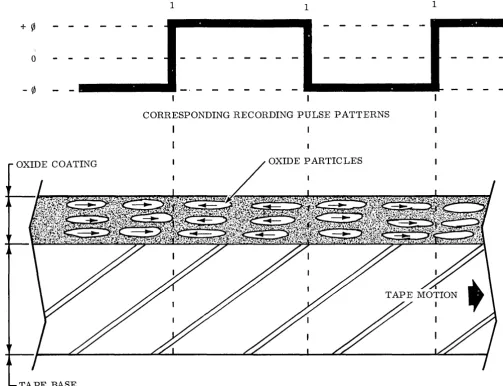
Using a coding system, any number, letter, symbol, or combination thereof may be presented to the computer in the form of various combinations of "1" and "0." Magnetic tape lends itself nicely to this method of input (and out-put), since a small unit of magnetic energy (bit) recorded on the tape may represent a "1" and the absence of a
COMPUTERS and AUTOMATION for November, 19(j-1
recorded bit may represent a "0." This is the simplest form. Actually, various techniques may be used to express the change of state on magnetic tapes; three of the more popular methods are these:
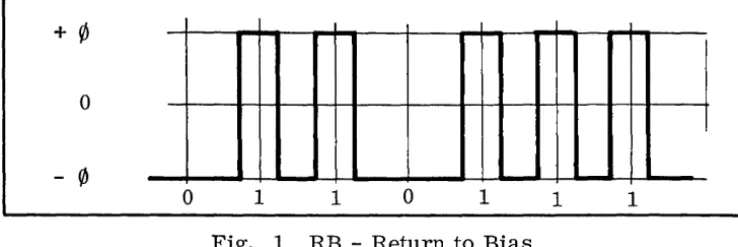
Return to Bias (J{.B) It is possible to record bits on
magnetic tape by considering magnetic saturation in one direction as "0." Magnetic saturation in the opposite di-rection (See Fig. 1) represents a '''I.'' This figure repre-sents a train of bits or pulses for 0 1 1 0 1 1 I. RB must be compared against a clock system to be read prop-erly.
Return to Zero (RZ) This type of recording is
illus-trated in Fig. 2. With this technique a pulse is recorded for each and every bit, both zeroes and ones. In the
[image:21.615.69.573.50.436.2]