© 2019, IRJET | Impact Factor value: 7.211 | ISO 9001:2008 Certified Journal
| Page 6762
Explicit Dynamic Behaviour of Textile Reinforced Concrete Retrofitted
RC Column under Blast Loading
Aksa V Xavier
1, Deepthy Varkey
2, Jerry Paul Varghese
31
Student, Department of Civil Engineering,
Mar Baselios Institute of technology & science Nellimattom, India
2
Assistant Professor, Department of Civil Engineering,
Mar Baselios Institute of technology & science Nellimattom, India
3
M.Tech Graduate, Department of Civil Engineering,
Mar Baselios Institute of technology & science Nellimattom, India
---***---Abstract
—
In the recent years, effects of blast load on buildingare serious matter because of the increase in the number of terrorist attack. Generally conventional structures are not designed for blast load due to the reason that magnitude of load caused by blast is huge and cost of design and construction is very high. Considering the fact that these attacks cause a catastrophic damage to the structure due to the limitations in the existing design methods, the usage of advanced engineering materials could resolve this issue. A finite element modelling methodology for the response of reinforced concrete (RC) columns strengthened with Textile Reinforced Concrete (TRC) were integrated to simulate the behaviour of retrofitted RC column. TRC comprises an innovative composite material consisting of fabric made of long fibre yarns and embedded in a cementatious fine- grained matrix. In light of the recent events, this paper showcases the behaviour of TRC retrofitted RC columns under blast loading. The nonlinear finite element analysis was carried out using ANSYS software. This paper aim to study the effect of blast load generated as a result of explosive charge on the existing exterior RC square columns of a multi-storied building and equivalent circular column was designed for the analysis. A parametric study of TNT has been performed to examine the effect of two sets of Jones-Wilkine-Lee (JWL) parameter.Further, Charge weight of 1000 kg equivalent weight of TNT at stand-off distance 4.5 m were considered for the study of dynamic explicit analysis of the different textile material. Besides, the effect of blast load at stand-off distances of 1.5 m, 3 m, and 4.5 m on un-retrofitted column and retrofitted column were studied. A procedure has been developed for evaluating the dynamic characteristics of the circular and square retrofitted column. Results described in this paper indicate that TRC strengthening could be an effective solution to limit the damage caused by moderate explosions. The result indicate that maximum deflection experienced by column decreased exponentially with the increase in the stand-off distance and also increased for the
columns strengthened with TRC, compared with the un-strengthened column.
Keywords: Textile Reinforced Concrete, Explicit analysis, Blast load, ANSYS
1. INTRODUCTION
One of the major challenges we are facing the present world is failure of structures due to explosions. Many countries are in fear of Terrorists attack. Accidentally or intentionally explosions are occurring and leads to a terrible disaster. Most of the structures are not designed to accommodate blast load due to high complexity in design as well as uneconomical construction cost. So, such structures may damage or collapse. Nowadays engineers and architects trying adopt new methods to retrofit the structures economically against blast damage.
2. Methodology
Modelling of reinforced concrete column and TRC column.
Non-linear finite element analysis carried out using ANSYS Workbench.
Parametric study of TNT
Select elements to be used in the modelling of TRC and identify the material properties.
Blast Load and support conditions are being applied on to the model.
Analysis different types of TRC and find the best model.
Comparison of un-retrofitted column and retrofitted column under blast load.
Comparison of square retrofitted column and circular retrofitted column.
© 2019, IRJET | Impact Factor value: 7.211 | ISO 9001:2008 Certified Journal
| Page 6763
coefficient
and a constants specific heat.
ω is the
Gruneisen
coefficient and A, B, R1, R2 are parameters.
The parameters A and B have dimensions of pressure,
while R1, R2 and ω are dimensionless.
3.2 Dynamic Explicit Analysis of the Different
Textile Material
The geometry of the model is prepared using
workbench platform of ANSYS finite element analysis
software. Blast analysis predicts the strength of textile
reinforced concrete columns of different types of
textile materials. Four models made with different
textile materials. Models have same size of 500 mm x
500 mm and length of 3 m. M35 grade concrete is used.
Analysis is done by 1000 kg equivalent weight of TNT
at stand- off distances of 4.5 m were considered.
TNT equivalent is a convention for expressing energy,
typically used to describe the energy released in an
explosion. The primary reason for choosing TNT as the
referent explosive is that most of the available
experimental data regarding the characteristics of blast
waves were collected using TNT. Several methods exist
for determining the explosive characteristics of
different explosives, but they do not yield the same
values for the TNT equivalent. These values depend on
the characteristic parameter of the blast wave, the
geometry of the load, and the distance from the
explosive charge. The TNT equivalence of
terrorist-manufactured explosive material is difficult to define
precisely because of the variability of its formulation
and the quality control of its manufacture.
Charge
weight of 1000 kg equivalent weight of TNT is used for
the analysis.
Detonation point is at the center of TNT
[image:2.595.331.530.121.270.2]
The input needed for the application of blast load are charge weight in terms of equivalent mass of TNT and Stand-off distance. In this analysis the Explosive is at various stand-off distance of 1.5 m, 3 m and 4.5 m are considered. Chargeweight of 1000 Kg are applied to the both un retrofitted and retrofitted column. And the blast load is applied as a Dynamic/Explicit load in ANSYS.
Table 3.1: Properties of Materials
Input Parameters Value
Concrete: Young’s Modulus (MPa)
Poisson’s ratio
29500 0.2 Fine grained concrete:
Young’s Modulus (MPa) Poisson’s ratio
27500 0.2 Steel:
Modulus of elasticity (MPa)
Poisson’s ratio Yield stress (MPa)
2x10⁵
0.3 415
Textile: Modulus of elasticity
(GPa) Poisson’s ratio Maximum tensile stress in
yarn(MPa)
Maximum tensile strain in yarn
© 2019, IRJET | Impact Factor value: 7.211 | ISO 9001:2008 Certified Journal
| Page 6764
Figure 3.3 Boundary Condition
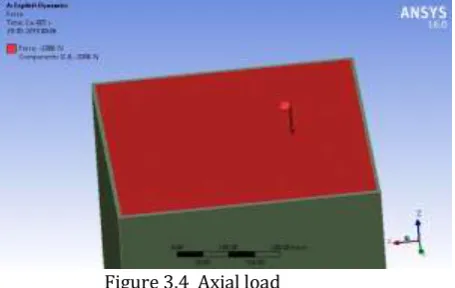
Figure 3.4 Axial load 3.3.1 Model of Reinforced Concrete
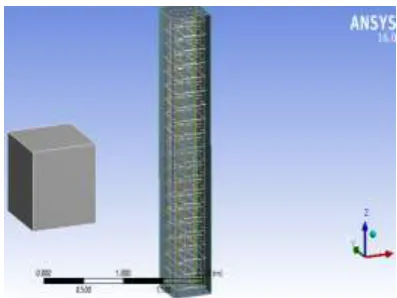
A reinforced Concrete Column of size 500 mm X 500 mm and Height 3.0 m with both ends fixed is considered for the analysis. The axial load on column is 2000 KN, which also included in the analysis. 12 number of 20mm diameter bars at 130 mm c/c and 8 mm diameter bars at 300 mm c/c is considered as Longitudinal and Transverse reinforcements respectively. The effective cover for main reinforcement is taken as 45 mm.
3.3.2 Model of Textile Reinforced Concrete
[image:3.595.51.279.285.429.2]The textile material used for the retrofitting model is boron textile of 5 mm thickness is considered . The Young’s Modulas of boron Textile is taken as 400 GPa, Poisson’s Ratio of 0.2 and yield stress of 2200 MPa at zero plastic Strain.A textile reinforced Concrete Column of size 500 mm X 500 mm and Height 3.0 m with both ends fixed is considered for the analysis. The axial load on column is 2000 KN, which also included in the analysis. 12 number of 20 mm diameter bars at 130 mm c/c and 8 mm diameter bars at 300mm c/c is considered as Longitudinal and Transverse reinforcements respectively. The effective cover for main reinforcement is taken as 45 mm.
Figure 3.5 Reinforcement in RC column
3.4 Effect of Blast Load on Circular and Square Retrofitted Column
3.4.1 Model of Circular Retrofitted Column
A reinforced Concrete Cicular Column of 636 mm diameter and Height 3.0 m with both ends fixed is considered for the analysis. The axial load on column is 2000 KN, which also included in the analysis. 12 number of 20 mm diameter bars at equal spaceing and 8 mm diameter bars at 300mm c/c is considered as Longitudinal and Transverse reinforcements respectively. The effective cover for main reinforcement is taken as 45 mm. The textile material used for the retrofitting model is boron textile of 5 mm thickness is considered .
The input needed for the application of blast load are charge weight in terms of equivalent mass of TNT and Stand-off distance. In this analysis the Explosive is at various stand- off distance of 1.5 m. Charge weight of 1000 Kg are applied to the both un-retrofitted and retrofitted column. And the blast load is applied as a Dynamic/Explicit load in ANSYS.
© 2019, IRJET | Impact Factor value: 7.211 | ISO 9001:2008 Certified Journal
| Page 6765
4. Results and Discussion
4.1 Results and Discussion of Parametric Studies
[image:4.595.307.559.54.241.2]Two sets of TNT was analyzed and can concluded
that TNT 1 is more effective. Thus for the further
study TNT 1 was used
Table 4.1 Un-Retrofitted column at 1.5 m stand-off
Table 4.2 Retrofitted column at 1.5 m stand-off
distance
4.2 Results and Discussion of Dynamic Explicit
Analysis of the Different Textile Materials
From this blast analysis, we can say that boron textile
fiber is better when campared to others textile
fiber.Displacement should be minimum for a good
textile fiber.Blast effect can be reduce by using these
textile material.
Figure 4.1 Textile Material Vs Displacement graph 4.3 Results and Discussion of Effect of Blast Load on Un-Retrofitted and Un-Retrofitted Column
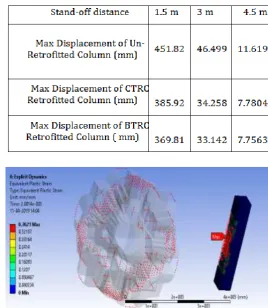
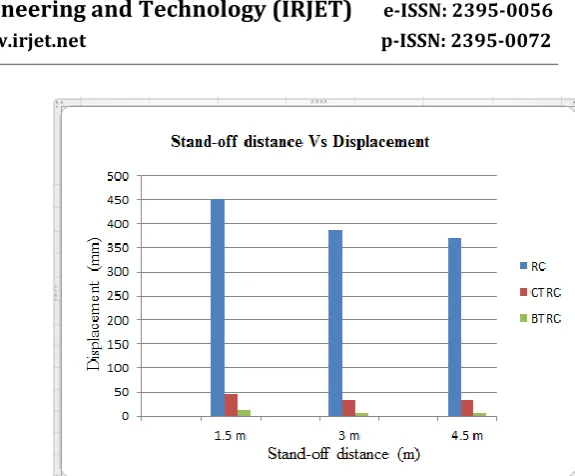
[image:4.595.65.265.92.247.2]The maximum displacement in the un-retrofitted and retrofitted column under 1.5 m, 3 m, 4.5 m stand-off distance were studied. The retrofitting of column reduces the displacement considerably. Pressure of TNT in BTRC is higher then retrofitted column .Equivalent plastic strain of un-retrofitted column is greater then un-retrofitted column. The stand-off distance plays a very important role in mitigating the adverse effects of a blast. Figure 4.2 to 4.7 shows the Displacement, Pressure of TNT and Equivalent plastic strain of un-retrofitted column and retrofitted column at 4.5 m stand-off distance.
Table 4.4 Max Displacement at 1000 kg charge weight
[image:4.595.303.572.448.757.2]© 2019, IRJET | Impact Factor value: 7.211 | ISO 9001:2008 Certified Journal
| Page 6766
Figure 4.7 Equivalent plastic strain of BTRCTable 4.5 Pressure at 1000 kg charge weight
[image:5.595.53.284.96.275.2]Table 4.6 Equivalent plastic strain at 1000 kg charge weight
Figure 4.8 Stand-off distance Vs. Displacement graph
4.4 Results and Discussion of Effect of Blast Load
on Circular Retrofitted Column and Square
Retrofitted Column
Effect of blast load on square retrofitted column and
equivalent circular retrofitted column were studied.
When compared with square retrofitted column the
displacement of circular retrofitted column is lesser.
5. Conclusions
Textile reinforcement structures produced from fibers
represent an excellent alternative for existing
reinforcement materials made from steel.
It is found
that textile reinforced concrete has better performance
compared to conventional concrete. Blast analysis was
carried out to evaluate the structural response under
blast load.
© 2019, IRJET | Impact Factor value: 7.211 | ISO 9001:2008 Certified Journal
| Page 6767
The retrofitting of column reduces the
displacement considerably.
Pressure of TNT in BTRC is higher compared to
un-retrofitted column.
Equivalent plastic strain of un-retrofitted
column is greater than retrofitted column.
Compared with square retrofitted column the
displacement of circular retrofitted column is
lesser.
References
[1]Tsesarsky, Michael ,Peled, Alva, Katz, Amnon and Anteby Ido 2013.Strengthening concrete elements by confinement within textile reinforced concrete (TRC) shells .Static and impact properties Construction and Building Materials , Vol.44. Pg No. 514–523.
[2]Gopinath, Smitha , Iyer, Nagesh and Gettu, Ravindra 2017.Finite element analysis of RC beams strengthened with textile reinforced concrete. Journal of Structural Engineering (Madras), Vol.43, Pg No. 454-460.
[3]Volkova, Anna, Paykov, Alexey, Semenov, Sergey , Stolyarov, Oleg , Melnikov and Boris 2016.Flexural Behavior of Textile-Reinforced Concrete.MATEC Web of Conferences, Vol.53.
[4]Regine Ortlepp, Sebastian Ortlepp2017.Textile Reinforced concrete for strengthening of RC Columns : A contribution to resource conservation through the preservation of structures. Construction and Building Materials ,Vol. 132, pg No. 150–160. [5]Alrshoudi and Fahed Abdullah S 2015.Textile Reinforced Concrete: Design Methodology and Novel Reinforcement. PhD thesis, University of Leeds.
Helen Santhi.M 2013. Dynamic response of a space framed structure subjected to blast load, International Journal of Civil and Structural Engineering, Vol.4.