Understanding Differences in Perceived Peer-Review Helpfulness using
Natural Language Processing
Wenting Xiong
University of Pittsburgh Department of Computer Science
Pittsburgh, PA, 15260
Diane Litman
University of Pittsburgh Department of Computer Science & Learning Research and Development Center
Pittsburgh, PA, 15260
Abstract
Identifying peer-review helpfulness is an im-portant task for improving the quality of feed-back received by students, as well as for help-ing students write better reviews. As we tailor standard product review analysis techniques to our review domain, we notice that peer-review helpfulness differs not only between students and experts but also between types of experts. In this paper, we investigate how different types of perceived helpfulness might influence the utility of features for automatic prediction. Our feature selection results show that certain low-level linguistic features are more useful for predicting student perceived helpfulness, while high-level cognitive con-structs are more effective in modeling experts’ perceived helpfulness.
1 Introduction
Peer review of writing is a commonly recommended technique to include in good writing instruction. It not only provides more feedback compared to what students might get from their instructors, but also provides opportunities for students to practice writ-ing helpful reviews. While existwrit-ing web-based peer-review systems facilitate peer peer-review from the logis-tic aspect (e.g. collecting papers from authors, as-signing reviewers, and sending reviews back), there still remains the problem that the quality of peer reviews varies, and potentially good feedback is not written in a helpful way. To address this is-sue, we propose to add a peer-review helpfulness model to current peer-review systems, to
automat-ically predict peer-review helpfulness based on fea-tures mined from textual reviews using Natural Lan-guage Processing (NLP) techniques. Such an intel-ligent component could enable peer-review systems to 1) control the quality of peer reviews that are sent back to authors, so authors can focus on the help-ful ones; and 2) provide feedback to reviewers with respect to their reviewing performance, so students can learn to write better reviews.
In our prior work (Xiong and Litman, 2011), we examined whether techniques used for predicting the helpfulness of product reviews (Kim et al., 2006) could be tailored to our peer-review domain, where the definition of helpfulness is largely influenced by the educational context of peer review. While previ-ously we used the average of two expert-provided ratings as our gold standard of peer-review help-fulness1, there are other types of helpfulness rating (e.g. author perceived helpfulness) that could be the gold standard, and that could potentially impact the features used to build the helpfulness model. In fact, we observe that peer-review helpfulness seems to differ not only between students and experts (exam-ple 1), but also between types of experts (exam(exam-ple 2).
In the following examples, students judge helpful-ness with discrete ratings from one to seven; experts judge it using a one to five scale. Higher ratings on both scales correspond to the most helpful reviews.
Example 1:
Student rating = 7, Average expert rating = 2 The
1Averaged ratings are considered more reliable since they
are less noisy.
author also has great logic in this paper. How can we consider the United States a great democracy when everyone is not treated equal. All of the main points were indeed supported in this piece.
Student rating = 3, Average expert rating = 5 I thought there were some good opportunities to provide further data to strengthen your argument. For example the statement “These methods of intimidation, and the lack of military force offered by the government to stop the KKK, led to the rescinding of African American democracy.” Maybe here include data about how . . . (126 words)
Example 2:
Writing-expert rating = 2, Content-expert rating = 5
Your over all arguements were organized in some order but was unclear due to the lack of thesis in the paper. Inside each arguement, there was no order to the ideas presented, they went back and forth between ideas. There was good support to the arguements but yet some of it didnt not fit your arguement.
Writing-expert rating = 5, Content-expert rating = 2
First off, it seems that you have difficulty writing transitions between paragraphs. It seems that you end your paragraphs with the main idea of each paragraph. That being said, . . . (173 words) As a final comment, try to continually move your paper, that is, have in your mind a logical flow with every paragraph having a purpose.
To better understand such differences and inves-tigate their impact on automatically assessing peer-review helpfulness, in this paper, we compare help-fulness predictions using our many different pos-sibilities for gold standard ratings. In particular, we compare the predictive ability of features across gold standard ratings by examining the most use-ful features and feature ranks using standard feature selection techniques. We show that paper ratings and lexicon categories that suggest clear transitions and opinions are most useful in predicting helpful-ness as perceived bystudents, while review length is generally effective in predicting expert helpful-ness. While the presence of praise and summary comments are more effective in modeling
writing-experthelpfulness, providing solutions is more
use-ful in predictingcontent-experthelpfulness.
2 Related Work
To our knowledge, no prior work on peer review from the NLP community has attempted to auto-matically predict peer-review helpfulness. Instead, the NLP community has focused on issues such as highlighting key sentences in papers (Sandor and Vorndran, 2009), detecting important feedback fea-tures in reviews (Cho, 2008; Xiong and Litman, 2010), and adapting peer-review assignment (Gar-cia, 2010). However, many NLP studies have been done on the helpfulness of other types of reviews, such as product reviews (Kim et al., 2006; Ghose and Ipeirotis, 2010), movie reviews (Liu et al., 2008), book reviews (Tsur and Rappoport, 2009), etc. Kim et al. (2006) used regression to predict the helpfulness ranking of product reviews based on var-ious classes of linguistic features. Ghose and Ipeiro-tis (2010) further examined the socio-economic im-pact of product reviews using a similar approach and suggested the usefulness of subjectivity analy-sis. Another study (Liu et al., 2008) of movie re-views showed that helpfulness depends on review-ers’ expertise, their writing style, and the timeliness of the review. Tsur and Rappoport (2009) proposed RevRank to select the most helpful book reviews in an unsupervised fashion based on review lexicons.
produce, such work sheds light on our study of stu-dents’ and experts’ helpfulness ratings of the same student comments (i.e. what students and experts value).
Our work in peer-review helpfulness prediction integrates the NLP techniques and cognitive-science approaches mentioned above. We will particularly focus on examining the utility of features motivated by related work from both areas, with respect to dif-ferent types of gold standard ratings of peer-review helpfulness for automatic prediction.
3 Data
In this study, we use a previously annotated peer-review corpus (Nelson and Schunn, 2009; Patchan et al., 2009) that was collected in an introduc-tory college hisintroduc-tory class using the freely available web-based peer-review SWoRD (Scaffolded Writ-ing and RewritWrit-ing in the Discipline) system (Cho and Schunn, 2007). The corpus consists of 16 pa-pers (about six pages each) and 189 reviews (vary-ing from twenty words to about two hundred words) accompanied by numeric ratings of the papers. Each review was manually segmented into idea units (de-fined as contiguous feedback referring to a single topic) (Nelson and Schunn, 2009), and these idea units were then annotated by two independent an-notators for various coding categories, such as feed-back type (praise, problem, and summary),problem localization, solution, etc. For example, the sec-ond case in Example 1, which only has one idea unit, was annotated asf eedbackT ype= problem,
problemlocalization = T rue, and solution =
T rue. The agreement (Kappa) between the two an-notators is 0.92 for FeedbackType, 0.69 for localiza-tion, and 0.89 for solution.2
Our corpus also contains author provided back evaluations. At the end of the peer-review assign-ment, students were asked to provide back evalu-ation on each review that they received by rating review helpfulness using a discrete scale from one to seven. After the corpus was collected, one
writ-2For Kappa value interpretation, Landis and Koch (1977)
propose the following agreement standard: 0.21-0.40 = “Fair”; 0.41-0.60 = “Moderate”; 0.61-0.80 = “Substantial”; 0.81-1.00 = “Almost Perfect”. Thus, while localization signals are more difficult to annotate, the inter-annotator agreement is still sub-stantial.
ing expert and one content expert were also asked to rate review helpfulness with a slightly different scale from one to five. For our study, we will also com-pute the average ratings given by the two experts, yielding four types of possible gold-standard ratings of peer-review helpfulness for each review. Figure 1 shows the rating distribution of each type. Interest-ingly, we observed that expert ratings roughly follow a normal distribution, while students are more likely to give higher ratings (as illustrated in Figure 1).
4 Features
Our features are motivated by the prior work in-troduced in Section 2, in particular, NLP work on predicting product-review helpfulness (Kim et al., 2006), as well as work on automatically learning cognitive-science constructs (Nelson and Schunn, 2009) using NLP (Cho, 2008; Xiong and Litman, 2010). The complete list of features is shown in Ta-ble 3 and described below. Thecomputational
lin-guistic features are automatically extracted based
on the output of syntactic analysis of reviews and papers3. These features represent structural, lexi-cal, syntactic and semantic information of the tex-tual content, and also include information for identi-fying certain important cognitive constructs:
• Structural featuresconsider the general
struc-ture of reviews, which includes review length in terms of tokens (reviewLength), number of sen-tences (sentNum), the average sentence length (sentLengthAve), percentage of sentences that end with question marks (question%), and number of exclamatory sentences (exclams).
• Lexical featuresare counts of ten lexical
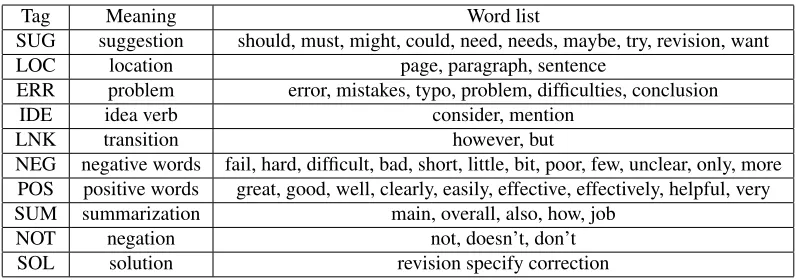
cat-egories (Table 1), where the catcat-egories were learned in a semi-supervised way from review lexicons in a pilot study. We first manually cre-ated a list of words that were specified as signal words for annotating feedbackType and prob-lem localization in the coding manual; then we supplemented the list with words selected by a decision tree model learned using a Bag-of-Words representation of the peer reviews.
3We used MSTParser (McDonald et al., 2005) for syntactic
Figure 1: Distribution of peer-review helpfulness when rated by students and experts
Tag Meaning Word list
SUG suggestion should, must, might, could, need, needs, maybe, try, revision, want
LOC location page, paragraph, sentence
ERR problem error, mistakes, typo, problem, difficulties, conclusion
IDE idea verb consider, mention
LNK transition however, but
NEG negative words fail, hard, difficult, bad, short, little, bit, poor, few, unclear, only, more POS positive words great, good, well, clearly, easily, effective, effectively, helpful, very SUM summarization main, overall, also, how, job
NOT negation not, doesn’t, don’t
SOL solution revision specify correction
Table 1: Ten lexical categories
Compared with commonly used lexical uni-grams and biuni-grams (Kim et al., 2006), these lexical categories are equally useful in model-ing peer-review helpfulness, and significantly reduce the feature space.4
• Syntactic featuresmainly focus on nouns and
verbs, and include percentage of tokens that are nouns, verbs, verbs conjugated in the first per-son (1stPVerb%), adjectives/adverbs, and open classes, respectively.
• Semantic featurescapture two important
peer-4Lexical categories help avoid the risk of over-fitting, given
only 189 peer reviews in our case compared to more than ten thousand Amazon.com reviews used for predicting product re-view helpfulness (Kim et al., 2006).
review properties: their relevance to the main topics in students’ papers, and their opinion sentiment polarities. Kim et al. (2006) ex-tracted product property keywords from exter-nal resources based on their hypothesis that helpful product reviews refer frequently to cer-tain product properties. Similarly, we hypothe-size that helpful peer reviews are closely related to domain topics that are shared by all students papers in an assignment. Our domain topic set contains 288 words extracted from the collec-tion of student papers using topic-lexicon ex-traction software5; our feature (domainWord)
5
[image:4.612.107.510.300.440.2]Feature Description
regTag% The percentage of problems in reviews that could be matched with a localization pattern. soDomain% The percentage of sentences where any domain word appears between the subject and the object. dDeterminer The number of demonstrative determiners.
windowSize For each review sentence, we search for the most likely referred window of words in the related paper, and windowSize is the average number of words of all windows.
Table 2: Localization features
counts how many words of a given review be-long to the extracted set. For sentiment po-larities, we extract positive and negative sen-timent words from the General Inquirer Dictio-naries6, and count their appearance in reviews in terms of their sentiment polarity (posWord, negWord).
• Localization features are motivated by
lin-guistic features that are used for automatically predicting problem localization (an important cognitive construct for feedback understand-ing and implementation) (Nelson and Schunn, 2009), and are presented in Table 2. To illus-trate how these features are computed, consider the following critique:
The section of the essay on African Americans needs more careful at-tention to the timing and reasons for the federal governments decision to stop protecting African American civil and political rights.
The review has only one sentence, in which one regular expression is matched with “the section of” thusregT ag% = 1; no demonstrative de-terminer, thusdDeterminer = 0; “African” and “Americans” are domain words appearing between the subject “section” and the object “attention”, so soDomain is true for this sen-tence and thussoDomain% = 1for the given review.
In addition to the low-level linguistic features pre-sented above, we also examinednon-linguistic
fea-tures that are derived from the ratings and prior
manual annotations of the corpus, described in Sec-tion 3.
6
http://www.wjh.harvard.edu/ inquirer/homecat.htm
• Cognitive-science features are motivated by
an empirical study (Nelson and Schunn, 2009) which suggests significant correlation between certain cognitive constructs (e.g.feedbackType, problem localization,solution) and review im-plementation likelihood. Intuitively, helpful reviews are more likely to get implemented, thus we introduced these features to capture desirable high-level characteristics of peer re-views. Note that in our corpus these cogni-tive constructs are manually coded at the idea-unit level (Nelson and Schunn, 2009), how-ever, peer-review helpfulness is rated at the re-view level.7 Our cognitive-science features ag-gregate the annotations up to the review-level by reporting the percentage of idea-units in a review that exhibit each characteristic: the distribution of review types (praise%, prob-lem%,summary%), the percentage of problem-localized critiques (localization%), as well as the percentage of solution-provided ones ( solu-tion%).
• Social-science featuresintroduce elements
re-flecting interactions between students in a peer-review assignment. As suggested in related work on product review helpfulness (Kim et al., 2006; Danescu-Niculescu-Mizil et al., 2009), some social dimensions (e.g. customer opinion on related product quality) are of great influence in the perceived helpfulness of prod-uct reviews. Similarly, in our case, we intro-duced related paper ratings (pRating) — to con-sider whether and how helpfulness ratings are affected by the rating that the paper receives8 — and the absolute difference between the
rat-7
Details of different granularity levels of annotation can be found in (Nelson and Schunn, 2009).
8That is, to examine whether students give higher ratings to
ing and the average score given by all review-ers (pRatingDiff) — to measure the variation in perceived helpfulness of a given review.
5 Experiments
We take a machine learning approach to model dif-ferent types of perceived helpfulness (student help-fulness, writing-expert helphelp-fulness, content-expert helpfulness, average-expert helpfulness) based on combinations of linguistic and non-linguistic fea-tures extracted from our peer-review corpus. Then we compare the different helpfulness types in terms of the predictive power of features used in their cor-responding models. For comparison purpose, we consider the linguistic and non-linguistic features both separately and in combination, which generates three set of features: 1) linguistic features, 2) non-linguistic features, and 3) all features. For each set of features, we train four models, each correspond-ing to a different kind of helpfulness ratcorrespond-ing. For each learning task (three by four), we use two standard feature selection algorithms to find the most useful features based on 10-fold cross validation. First, we perform Linear Regression with Greedy Stepwise search (stepwise LR) to select the most useful fea-tures when testing in each of the ten folds, and count how many times each features is selected in the ten trials. Second, we use Relief Feature Evaluation9 with Ranker (Relief) (Kira and Rendell, 1992; Wit-ten and Frank, 2005) to rank all used features based on their average merits (the ability of the given fea-ture to differentiate between two example pairs) of ten trials.10
Although both methods are supervised, the wrap-per is “more aggressive” because its feature evalu-ation is based on the performance of the regression model and thus the resulting feature set is tailored to the learning algorithm. In contrast, Relief does not optimize feature sets directly for classifier per-formance, thus it takes into account class informa-tion in a “less aggressive” manner than the Wrapper method. We use both methods in our experiment to
9
Relief evaluates the worth of an attribute by repeatedly sampling an instance and changing the value of the given at-tribute based on the nearest instance of the same and different class.
10Both algorithms are provided by Weka
(http://www.cs.waikato.ac.nz/ml/weka/).
provide complementary perspectives. While the for-mer can directly tell us what features are most use-ful, the latter gives feature ranks which provide more detailed information about differences between fea-tures. To compare the feature selection results, we examine the four kind of helpfulness models for each of the three feature sets separately, as presented below. Note that the focus of this paper is compar-ing feature utilities in different helpfulness models rather than predicting those types of helpfulness rat-ings. (Details of how the average-expert model per-forms can be found in our prior work (Xiong and Litman, 2011).)
5.1 Feature Selection of Linguistic Features
Table 4 presents the feature selection results of com-putational linguistic features used in modeling the four different types of peer-review helpfulness. The first row lists the four sources of helpfulness ratings, and each column represents a corresponding model. The second row presents the most useful features in each model selected by stepwise LR, where “# of folds” refers to the number of trials in which the given feature appears in the resulting feature set dur-ing the 10-fold cross validation. Here we only report features that are selected by no less than five folds (half the time). The third row presents feature ranks computed using Relief, where we only report the top six features due to the space limit. Features are or-dered in descending ranks, and the average merit and its standard deviation is reported for each one of the features.
Type Features
Structural reviewLength, sentNum, sentLengthAve, question%, exclams Lexical SUG, LOC, ERR, IDE, LNK, NEG, POS, SUM, NOT, SOL (Table 1) Syntactic noun%, verb%, 1stPVerb%, adj+adv%, opClass%
Semantic domainWord, posWord, negWord
[image:7.612.119.495.55.157.2]Localization regTag%, soDomain%, dDeterminer, windowSize (Table 2) Cognitive-science praise%, problem%, summary%, localization%, solution% Social-science pRating, pRatingDiff
Table 3: Summary of features
Source Students Writing expert Content expert Expert average
Feature # of folds Feature # of folds Feature # of folds Feature # of folds
LNK 9 reviewLength 8 reviewLength 10 reviewLength 10
Stepwise posWord 8 question% 6 sentNum 8
LR NOT 6 sentNum 5 question% 8
windowSize 6 1stPVerb% 5
POS 5
Relief
Feature Merit Feature Merit Feature Merit Feature Merit
[image:7.612.88.526.86.326.2]question% .019±.002 exclams .010±.003 question% .010±.004 exclams .010±.003 SUG .015±.003 SUM .008±.004 ERR .009±.003 question% .011±.004 LNK .014±.003 NEG .006±.004 SUG .009±.004 windowSize .008±.002 sentLengthAve .012±.003 negWord .005±.002 posWord .007±.002 posWord .006±.002 POS .011±.002 windowSize .004±.002 exclams .006±.001 reviewLength .004±.001 posWord .010±.001 sentNum .003±.001 1stPVerb% .007±.004 sentLengthAve .004±.001
Table 4: Feature selection based on linguistic features
the percentage of questions (question%) and error cues (ERR) are ranked top for the content-expert. In addition, the percentage of words that are verbs con-jugated in the first person (1stPVerb%) is both se-lected and ranked high in the content-expert helpful-ness model. Out of the four models,SUGare ranked high for predicting both students and content-expert helpfulness. These observations indicate that both students and experts value questions (question%) and suggestions (SUG) in reviews, and students pticularly favor clear signs of logic flow in review ar-guments (LNK), positive words (posWord), as well as reference of their paper content which provides explicit context information (windowSize). In addi-tion, experts in general prefer longer reviews ( re-viewLength), and the writing expert thinks clear summary signs (SUM) are important indicators of helpful peer reviews.
5.2 Feature Selection of non-Linguistic
Features
When switching to the high-level non-linguistic fea-tures (Table 5), we find thatsolution%is always se-lected (in all ten trials) as a most useful feature for
predicting all four kind of helpfulness, and is also ranked high for content-expert and student helpful-ness. Especially for the content-expert, solution% has a much higher merit (0.013) compared to all the other features (≤ 0.03). This agrees with our ob-servation in section 5.1 that SUG are ranked high in both cases. localization%is selected as one of the most useful features in the content-expert helpful-ness model, which is also ranked top in the student model (though not selected frequently by stepwise LR). For modeling the writing-expert helpfulness, praise (praise%) is more important than problem and summary, and the paper rating (pRating) loses its predictive power compared to how it works in the other models. In contrast,pRating is both selected and ranked high for predicting students’ perceived helpfulness.
5.3 Feature Selection of All Features
Source Students Writing expert Content expert Expert average Feature # of folds Feature # of folds Feature # of folds Feature # of folds
Stepwise pRating 10 solution% 10 localization% 10 solution% 10
LR solution% 10 solution% 10 pRating 10
problem% 9 pRating 10 localization% 9
Relief
Feature Merit Feature Merit Feature Merit Feature Merit
[image:8.612.84.528.56.176.2]localization% .012±.003 praise% .008±.002 solution% .013±.005 problem% .004±.002 pRatingDiff .010±.002 problem% .007±.002 pRating .003±.002 localization% .004±.006 pRating .007±.002 summary% .001±.004 praise% .001±.002 praise% .003±.003 solution% .006±.005 localization% .001±.005 localization% .001±.004 solution% .002±.004 problem% .004±.002 pRating .004±.004 problem% .001±.002 pRating .005±.003 summary% .004±.003 pRatingDiff .007±.002 pRating .002±.003 pRatingDiff .006±.005
Table 5: Feature selection based on non-linguistic features
Source Students Writing expert Content expert Expert average Feature # of folds Feature # of folds Feature # of folds Feature # of folds Stepwise pRating 10 reviewLength 10 reviewLength 10 reviewLength 10
LR dDeterminer 7 problem% 8 problem% 6
pRatingDiff 5
sentNum 5
Relief
Feature Merit Feature Merit Feature Merit Feature Merit
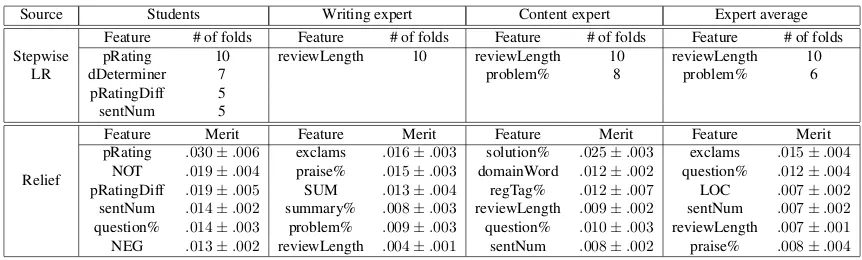
pRating .030±.006 exclams .016±.003 solution% .025±.003 exclams .015±.004 NOT .019±.004 praise% .015±.003 domainWord .012±.002 question% .012±.004 pRatingDiff .019±.005 SUM .013±.004 regTag% .012±.007 LOC .007±.002 sentNum .014±.002 summary% .008±.003 reviewLength .009±.002 sentNum .007±.002 question% .014±.003 problem% .009±.003 question% .010±.003 reviewLength .007±.001 NEG .013±.002 reviewLength .004±.001 sentNum .008±.002 praise% .008±.004
Table 6: Feature selection based on all features
reviewLength stands out from all other features in both the writing-expert and the content-expert mod-els. Interestingly, it is the number of sentences ( sent-Num) rather than review length of structure features that is useful in the student-helpfulness model. And demonstrative determiners (dDeterminer) is also se-lected, which indicates that having a clear sign of comment targets is considered important from the students’ perspective. When examining the model’s ranking result, we find that more lexicon categories are ranked high for students compared to other kind of helpfulness. Specifically, NOT appears high again, suggesting clear expression of opinion is im-portant in predicting student-helpfulness. Across four types of helpfulness, again, we observed that the writing expert tends to value praise and summary (indicated by bothSUMandsummary%) in reviews while the content-expert favors critiques, especially solution provided critiques.
5.4 Discussion
Based on our observations from the above three comparisons, we summarize our findings with re-spect to different feature types and provide
[image:8.612.90.521.211.341.2]from the content expert’s point of view. Although students assign less importance to the problem them-selves, solution provided peer reviews could be help-ful for them with respect to the learning goal of peer-review assignments. 4) Paper rating is a very ef-fective feature for predicting review helpfulness per-ceived by students, which is not the case for either expert. This supports the argument of social aspects in people’s perception of review helpfulness, and it also reflects the fact that students tend to be nice to each other in such peer-review interactions. How-ever, this dimension might not correspond with the real helpfulness of the reviews, at least from the per-spective of both the writing expert and content ex-pert.
6 Conclusion and Future Work
We have shown that the type of helpfulness to be predicted does indeed influence the utility of dif-ferent feature types for automatic prediction. Low-level general linguistic features are more predic-tive when modeling students’ perceived helpfulness; high-level theory supported constructs are more use-ful in experts’ models. However, in the related area of automated essay scoring (Attali and Burstein, 2006), others have suggested the need for the use of validated features related to meaningful dimen-sions of writing, rather than low-level (but easy to automate) features. In this perspective, our work similarly poses challenge to the NLP community in terms of how to take into account the education-oriented dimensions of helpfulness when applying traditional NLP techniques of automatically pred-icating review helpfulness. In addition, it is im-portant to note that predictive features of perceived helpfulness are not guaranteed to capture the nature of “truly” helpful peer reviews (in contrast to the perceived ones).
In the future, we would like to investigate how to integrate useful dimensions of helpfulness per-ceived by different audiences in order to come up with a “true” helpfulness gold standard. We would also like to explore more sophisticated features and other NLP techniques to improve our model of peer-review helpfulness. As we have already built models to automatically predict certain cognitive constructs (problem localization and solution), we will replace
the annotated cognitive-science features used here with their automatic predictions, so that we can build our helpfulness model fully automatically. Finally, we would like to integrate our helpfulness model into a real peer-review system and evaluate its per-formance extrinsically in terms of improving stu-dents’ learning and reviewing performance in future peer-review assignments.
Acknowledgments
This work was supported by the Learning Research and Development Center at the University of Pitts-burgh. We thank Melissa Patchan and Chris Schunn for generously providing the manually annotated peer-review corpus. We are also grateful to Michael Lipschultz and Chris Schunn for their feedback while writing this paper.
References
Yigal Attali and Jill Burstein. 2006. Automated essay scoring with e-rater v.2. The Journal of Technology, Learning and Assessment (JTLA), 4(3), February. Kwangsu Cho and Christian D. Schunn. 2007.
Scaf-folded writing and rewriting in the discipline: A web-based reciprocal peer review system. Computers and Education, 48:409–426.
Kwangsu Cho. 2008. Machine classification of peer comments in physics. InProceedings of the First In-ternational Conference on Educational Data Mining (EDM2008), pages 192–196.
Cristian Danescu-Niculescu-Mizil, Gueorgi Kossinets, Jon Kleinberg, and Lillian Lee. 2009. How opin-ions are received by online communities: A case study on Amazon.com helpfulness votes. InProceedings of WWW, pages 141–150.
Raquel M. Crespo Garcia. 2010. Exploring document clustering techniques for personalized peer assessment in exploratory courses. InProceedings of Computer-Supported Peer Review in Education (CSPRED) Work-shop in the Tenth International Conference on Intelli-gent Tutoring Systems (ITS 2010).
Anindya Ghose and Panagiotis G. Ipeirotis. 2010. Esti-mating the helpfunless and economic impact of prod-uct reviews: Mining text and reviewer characteristics.
IEEE Transactions on Knowledge and Data Engineer-ing, 99.
on Empirical Methods in Natural Language Process-ing (EMNLP2006), pages 423–430, Sydney, Australia, July.
Kenji Kira and Larry A. Rendell. 1992. A practical approach to feature selection. In Derek H. Sleeman and Peter Edwards, editors, ML92: Proceedings of the Ninth International Conference on Machine Learn-ing, pages 249–256, San Francisco, CA, USA. Morgan Kaufmann Publishers Inc.
J. R. Landis and G. G. Koch. 1977. The measurement of observer agreement for categorical data. Biometrics, 33:159–174.
Chin-Yew Lin and Eduard Hovy. 2000. The auto-mated acquisition of topic signatures for text summa-rization. In Proceedings of the 18th conference on Computational linguistics, volume 1 ofCOLING ’00, pages 495–501, Stroudsburg, PA, USA. Association for Computational Linguistics.
Yang Liu, Xiangji Guang, Aijun An, and Xiaohui Yu. 2008. Modeling and predicting the helpfulness of on-line reviews. InProceedings of the Eighth IEEE Inter-national Conference on Data Mining, pages 443–452, Los Alamitos, CA, USA.
Ryan McDonald, Koby Crammer, and Fernando Pereira. 2005. Online large-margin training of dependency parsers. InProceedings of the 43rd Annual Meeting on Association for Computational Linguistics, ACL ’05, pages 91–98, Stroudsburg, PA, USA. Association for Computational Linguistics.
Melissa M. Nelson and Christian D. Schunn. 2009. The nature of feedback: how different types of peer feed-back affect writing performance. Instructional Sci-ence, 37(4):375–401.
Melissa M. Patchan, Davida Charney, and Christian D. Schunn. 2009. A validation study of students’ end comments: Comparing comments by students, a writ-ing instructor, and a content instructor. Journal of Writing Research, 1(2):124–152.
Agnes Sandor and Angela Vorndran. 2009. Detect-ing key sentences for automatic assistance in peer-reviewing research articles in educational sciences. In
Proceedings of the 47th Annual Meeting of the Associ-ation for ComputAssoci-ational Linguistics and the 4th Inter-national Joint Conference on Natural Language Pro-cessing of the Asian Federation of Natural Language Processing (ACL-IJCNLP), pages 36–44.
Oren Tsur and Ari Rappoport. 2009. Revrank: A fully unsupervised algorithm for selecting the most helpful book reviews. In Proceedings of the Third Interna-tional AAAI Conference on Weblogs and Social Media (ICWSM2009), pages 36–44.
IH Witten and E. Frank. 2005. Data Mining: Practi-cal Machine Learning Tools and Techniques, Second Edition. Morgan Kaufmann, San Francisco, CA.
Wenting Xiong and Diane Litman. 2010. Identifying problem localization in peer-review feedback. In Pro-ceedings of Tenth International Conference on Intelli-gent Tutoring Systems (ITS2010), volume 6095, pages 429–431.