Synchronous Context-Free Tree Grammars
Mark-Jan Nederhof School of Computer Science
University of St Andrews KY16 9SX, UK
Heiko Vogler
Department of Computer Science Technische Universit¨at Dresden
D-01062 Dresden, Germany
Abstract
We consider pairs of context-free tree grammars combined through synchronous rewriting. The resulting formalism is at least as powerful as synchronous tree ad-joining grammars and linear, nondeleting macro tree transducers, while the parsing complexity remains polynomial. Its power is subsumed by context-free hypergraph grammars. The new formalism has an alter-native characterization in terms of bimor-phisms. An advantage over synchronous variants of linear context-free rewriting sys-tems is the ability to specify tree-to-tree transductions.
1 Introduction
Machine translation involves mappings between strings in two languages, formalized as string
transductions. Early models of string
transduc-tions include syntax-directed translation schemata (Lewis II and Stearns, 1968; Aho and Ullman, 1969b; Aho and Ullman, 1969a). These are precursors of more recent models of translation, such as inversion transduction grammars (Wu, 1997), and models in the Hiero system (Chiang, 2007). The underlying assumption in such mod-els is that source and target languages are context-free, which is often too restrictive for practical applications. Therefore, more powerful models have been investigated, such as synchronous tree adjoining grammars (STAGs) (Shieber and Sch-abes, 1990), which assume that the translation to be modelled is between two tree adjoining lan-guages. Such grammars offer an extended
do-main of locality, beyond the power of context-free
grammars.
All of the above models translate between string pairs via a hierarchical structure (i.e. a parse
tree) imposed on the source string and another such structure imposed on the target string. These formalisms therefore involve a mapping between parse trees, in addition to a mapping between strings. STAGs also involve derivation trees next to parse trees.
Translations between trees, formalized as tree
transductions, are the main focus of formalisms
such as top-down tree transducers (Rounds, 1970; Thatcher, 1970) and bottom-up tree transducers (Thatcher, 1973). These have attracted much in-terest in the area of statistical machine translation (SMT) (Knight and Graehl, 2005). Recent devel-opments include (Engelfriet et al., 2009; Maletti, 2011; Maletti, 2012).
The rationale for treating tree transductions as an isolated issue in machine translation is one of modularity: parsing a source sentence to produce a parse tree is challenging enough to be investi-gated as a separate task, next to the problem of transferring the source-language structure to the target-language structure.
The awareness that phrase structure may be discontinuous, and hence exceeds the power of context-free formalisms, has been growing steadily over the past few years, owing to tree-banks for many different languages. See for ex-ample (Kallmeyer et al., 2009) for evidence that synchronous rewriting cannot be avoided. The ‘gap degree’ found in some treebanks in fact even exceeds the power of tree adjoining grammars (G ´omez-Rodr´ıguez et al., 2011). This suggests that more powerful formalisms such as linear context-free rewriting systems (LCFRSs) (Vijay-Shanker et al., 1987) may be needed.
While LCFRSs induce derivation trees, they lack a natural notion of derived trees. As a consequence, transduction between strings via synchronous LCFRSs do not, in any obvious
way, involve source-language and target-language parse trees. This complicates modular design of machine translation systems, in which pars-ing/generation of the source/target languages is separated from transfer of structures across the two languages.
The purpose of the present paper is to rem-edy this by introducing a formalism that com-bines the flexibility of synchronous context-free and synchronous tree adjoining grammars, with some of the additional generative capacity offered by LCFRSs. The new formalism consists of pairs of simple context-free tree grammars (sCFTGs) (Rounds, 1970; Engelfriet and Schmidt, 1977; Engelfriet and Schmidt, 1978), which are cou-pled through synchronous rewriting. The rele-vance of sCFTG to natural language processing is suggested by recent findings involving lexical-ization of tree adjoining grammars (Maletti and Engelfriet, 2012).
Among the properties that make the new for-malism suitable for applications in machine trans-lation are the following. First, it is based on tree transductions, but indirectly also describes string transductions. It can therefore be used to translate strings to strings, but also trees to trees, allowing separate modules to handle pars-ing/generation. Second, its generative capacity contains that of synchronous tree adjoining gram-mars, offering the potential to handle some diffi-cult cases of non-projective linguistic structures. Third, parsing complexity is polynomial in the size of the input string or the input tree. Fourth, the formalism can be straightforwardly extended to assign probabilities to rules, whereby probabil-ity distributions can be defined, both on the set of pairs of trees, and on the set of pairs of strings.
2 Preliminaries
LetN={0,1,2, . . .}andN+=N\{0}. For each
n ∈ N, we let [n] stand for the set {1, . . . , n}, with[0] =∅.
A ranked alphabet is a finite setΣof symbols, associated with a rank function assigning a num-berrkΣ(σ) ∈Nto each symbolσ ∈Σ. We write
rkforrkΣwhen the alphabetΣis understood. We letΣ(k)denote{σ ∈Σ|rk
Σ(σ) =k}.
We fix an infinite listx1, x2, . . .of pairwise dis-tinct variables. We write X = {x1, x2, x3, . . .} and Xk = {x1, . . . , xk}. We denote the set of
all ordered, labelled trees over ranked alphabetΣ,
with variables in setY ⊆ X, by TΣ(Y)We de-fineTΣ to be TΣ(∅). If σ ∈ Σ(0), we may ab-breviate σ()to σ. Very often we will deal with sequences of variables such asx1, . . . , xk, which
we may then write in the abbreviated notation
x1,k. The same hold for sequences of trees; e.g. t1,k =t1, . . . , tk.
The yield of a treetis the string of symbols in
tthat have rank 0, that is, the leaves, read from left to right. Positions in trees are identified by Gorn addresses, represented as strings of natural numbers as usual. The set of all positions in a tree
tis denoted bypos(t). The label at positionpof a treet∈TΣ(Y)is denoted byt(p)and the subtree oftat pis denoted by t|p. The expression t[s]p
denotes the tree obtained fromtby replacing the subtree at positionpbys∈TΣ(Y).
The set of positions in a tree t labelled by a symbola ∈ Σ∪X is defined asposa(t) ={p | t(p) = a}. For finite Y, the subset of TΣ(Y) consisting of those trees in which every variable inY occurs precisely once is denoted byCΣ(Y). Ift ∈TΣ(Xk)and ti ∈TΣ (i ∈[k]), then the
first-order substitutiont[t1,k]denotes the treetin
which each occurrence of the variablexihas been
replaced by the corresponding treeti
Ift ∈ TΣ(Y),t(p) ∈ Σ(k) and s ∈ TΣ(Xk),
then the second-order substitution tJsKp denotes
the tree obtained from t in which the subtree at position p has been replaced by s, with the variables insreplaced by the corresponding im-mediate subtrees of t|p, or formally tJsKp = t[s[t|p1, . . . , t|pk]]p.
3 CFTGs
A context-free tree grammar (with states) (CFTG) is a tupleG= (Q, q0,Σ, R), where:
• Qis a ranked alphabet (of states),
• q0∈Q(0)(initial state),
• Σis a ranked alphabet (of terminals), such thatQ∩Σ =∅, and
• Ris a finite set (of rules), each of the form
q(x1,k) → τ, where q ∈ Q(k) and τ ∈ TQ∪Σ(Xk).
We write⇒p,rG for the ‘derives’ relation, using ruler=q(x1,k)→ τ at positionpof a tree.
and t′ = tJτKp. We write t ⇒G t′ ift ⇒p,rG t′
for somep and r, and⇒∗
G is the reflexive,
tran-sitive closure of⇒G. The tree language induced
by CFTGGisJGK= {t∈ TΣ |q0 ⇒∗G t}. The
string language induced byGis[G] ={yield(t)| t∈JGK}.
In the sequel we will focus our attention on CFTGs where every rule is linear and nondelet-ing. Formally, a simple CFTG (sCFTG) is a CFTG where τ ∈ CQ∪Σ(Xk) for each rule q(x1,k)→τ.
A CFTGGis a regular tree grammar (RTG) if
Q=Q(0). We assume a normal form for RTG in which right-hand side trees contain precisely one terminal. The tree languages induced by RTGs are called regular tree languages.
Example 1 Fig. 1 shows a sCFTG allowing
con-junctions, under the assumption that both parts share the same structure. The tree language con-tains:
S(NP(John),VP(loves,and,eats)), and
S(NP(John),VP(VP(loves,haggis),and,
VP(eats,it))),
but not for example:
S(NP(John),VP(VP(loves,haggis),and,
eats)), nor
S(NP(John),VP(loves,and,VP(eats,it))).
Note that if we modify the grammar to be re-cursive, for example by changing the first two oc-currences ofq3intoq2, then the string language is related to the copy language{ww|w∈ {a, b}∗}. It is well-known that the copy language is in-duced by a tree adjoining grammar. However, the structure of the corresponding trees would be very different from the trees induced by our example sCFTG, and the latter arguably have a more direct
linguistic interpretation. ✷
4 Synchronous CFTGs
We now take a pair of simple CFTGs and syn-chronize their derivations. For this, we need to represent bijections between occurrences of states in two trees. This is realized by annotating states with indices. More precisely, we define I(Q) = {qu
|q∈Q, u∈N+}. Fort∈C
I(Q)∪Σ(Y)and
u∈N+, we letpos
u(t)denote the set of positions
where u occurs as index of a state, or formally,
posu(t) ={p | ∃q[t(p) = qu
]}. Forn ∈N, we defineIn
Q,Σ(Y)to be the set of trees where each index from 1 to noccurs precisely once and no
q0→S(NP(John), q1(loves,eats))
q1(x1, x2)→q2(VP(x1,haggis),VP(x2,it))
q1(x1, x2)→q2(x1, x2)
q2(x1, x2)→
q3(VP(x1,dearly),VP(x2,often))
q2(x1, x2)→
q3(VP(x1,truly),VP(x2,seldom))
q2(x1, x2)→q3(x1, x2)
q3(x1, x2)→VP(x1,and, x2)
Figure 1: Rules of an example sCFTG modelling two parts of a conjunction being developed in tandem, whereQ={q0, q1, q2, q3},Σ ={S,NP,VP,John,
loves, . . .}.
other indices are present, or formally:
IQ,nΣ(Y) ={t∈CI(Q)∪Σ(Y)|
∀u[u≤n =⇒ |posu(t)|= 1, u > n =⇒ |posu(t)|= 0]}
We letIQ,nΣdenoteIQ,nΣ(∅).
A pair [t1, t2]of trees is called synchronous if each contains unique occurrences of all indices from 1 to n and no others, or formally, t1 ∈
IQ,nΣ(Y1) and t2 ∈ IQ,nΣ(Y2) for the same value of n. We call n the synchronization breadth of
[t1, t2].
A synchronous (simple) CFTG (SCFTG) is a tupleG = (Q, q0,Σ, R), whereQ,q0, andΣare as for CFTGs, andRis a set of synchronous rules, each of which is of the form:
[q(x1,k)→τ1, q′(x1,m)→τ2] (1)
whereq ∈ Q(k),q′ ∈ Q(m), andτ1 ∈ IQ,nΣ(Xk)
and τ2 ∈ IQ,nΣ(Xm) for some n. We note that [τ1, τ2]is a synchronous tree pair. The
synchro-nization breadth of a rule of the form (1) is the
synchronization breadth of[τ1, τ2].
In order to define the binary ‘derives’ relation
⇒u,rG between synchronous pairs of trees, we need
the additional notion of reindexing. This is an injective function that replaces each existing in-dex in the synchronous pair by another, making sure the new indices do not clash with those of a chosen ruler. More precisely, lett1 and t2 be two synchronous trees inIQ,n′Σ. Choose an index
u∈[n′]and determine the unique positionspand
someqandq′. Further, choose a synchronous rule
r of the form (1). Depending onu, we define the reindexing functionf as follows:
• f(v) =n′+vifv < u,
• f(v) =n′+v−1ifv > u,
• the value off(u)can be arbitrarily chosen (it will be ignored in the rewriting step).
For i = 1,2, let f(ti) be ti in which every
in-dexv is replaced byf(v). We can now formally define [t1, t2] ⇒Gu,r [t′1, t′2]to hold if and only if
t′1 = f(t1)Jτ1Kp andt′2 = f(t2)Jτ2Kp′. It is easy
to show that t′1, t′2 ∈ IQ,n+Σn′−1. In other words, one derivation step turns a synchronous tree pair
[t1, t2]into another.
For SCFTG G, we write [t1, t2] ⇒G [t′1, t′2] if [t1, t2] ⇒u,rG [t′1, t′2] for some u and r, and
⇒∗G is the reflexive, transitive closure of ⇒G.
The tree transduction induced by SCFTG G is JGK={[t1, t2]∈TΣ×TΣ|[q0, q0]⇒G∗ [t1, t2]}. The string transduction induced by G is [G] = {[yield(t1),yield(t2)]|[t1, t2]∈JGK}.
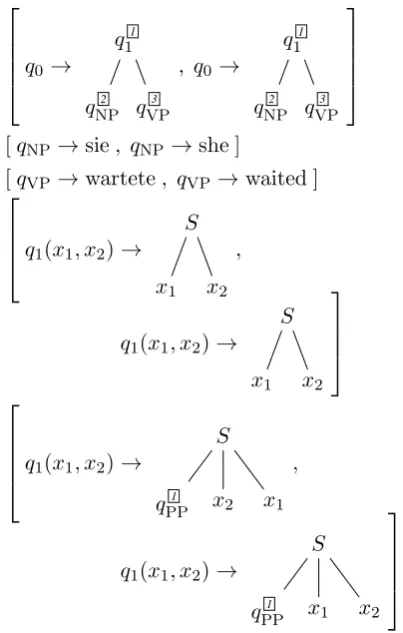
Example 2 Fig. 2 shows a SCFTG. On the input
side it models inversion of subject and main verb following an adverbial phrase in German. ✷
5 Bimorphism characterization
Next we investigate a characterization of SCFTG in terms of generalized bimorphisms (Arnold and Dauchet, 1976; Arnold and Dauchet, 1982). A
bitransformation (BT) is a tuple B = (g, L, h)
where:
• L ⊆ T∆ is a regular tree language (center
language), and
• g ⊆ T∆ ×TΣ (input transformation) and
h ⊆ T∆ ×TΣ (output transformation) are tree transformations.
The BT B computes the tree transformation JBK⊆TΣ×TΣ, which is defined by:
JBK=g−1; idL;h
whereidLis the binary identity relation onLand
the semicolon denotes (left to right) composition of binary relations.
If the input and output tree transformation are tree homomorphisms, then the BT is a bimor-phism in the sense of (Arnold and Dauchet, 1976;
q0 →
q1
1
q2
NP q
3
VP
, q0→
q1
1
q2
NP q
3
VP
[qNP→sie, qNP→she ]
[qVP→wartete, qVP→waited ]
q1(x1, x2)→
S
x1 x2
,
q1(x1, x2)→
S
x1 x2
q1(x1, x2)→
S
q1
PP x2 x1
,
q1(x1, x2)→
S
q1
PP x1 x2
[image:4.595.320.522.80.397.2][qPP→lange Zeit, qPP →a long time ]
Figure 2: Rules of an SCFTG.
Arnold and Dauchet, 1982) For our characteriza-tion of SCFTG in terms of bitransformacharacteriza-tions we need stronger input/output transformations how-ever. For this we recall the concept of macro tree transducer (Engelfriet, 1980; Courcelle and Franchi-Zannettacci, 1982). It can be seen as the combination of the concepts of top-down tree transducer and context-free tree grammar, and serves as formal model for syntax-directed se-mantics (Engelfriet, 1982) in which context can be handled.
Formally, a macro tree transducer (MAC) is a tupleN = (Q, q0,∆,Σ, R)whereQis a ranked alphabet (of states) with Q(0) = ∅, q0 ∈ Q(1) (initial state), ∆and Σare ranked alphabets (of
input symbols and output symbols, resp.) withQ∩ (∆∪Σ) =∅, andRis a finite set of rules of the form:
q(δ(y1,n), x1,k)→ζ (2)
where n, k ≥ 0, q ∈ Q(k+1), δ ∈ ∆(n), y 1,
vari-ables ranging over T∆ and TΣ, resp., and ζ ∈
RHS(n, k), whereRHS(n, k)is the smallest sub-setRHSsuch that (i)xi ∈RHSfor everyi∈[k],
(ii)σ(ζ1,m) ∈RHSfor everym ∈N,σ ∈Σ(m),
and ζ1, . . . , ζm ∈ RHS, and (iii) q′(yj, ζ1,m) ∈
RHS for every j ∈ [n], q′ ∈ Q(m+1), and
ζ1, . . . , ζm ∈RHS.
A MACMis linear and nondeleting if for each rule of the form (2),ζcontains exactly one occur-rence of each yj (j ∈ [n]) and one of each xi
(i ∈ [k]), and contains no other variables. It is
pure if|Q(m)| ≤1for everym∈N. It is monadic ifQ = Q(1)∪Q(2). It is total and deterministic if for eachq ∈ Qandδ ∈∆there is exactly one rule with q and δ in its left-hand side. A MAC
Mis called an enriched embedded tree transducer (eEMB) if it is linear and nondeleting, pure, and total and deterministic; an eEMBM is called an
embedded tree transducer (EMB) (Shieber, 2006)
if it is monadic.
Based on the concept of term rewriting, we can define the binary derivation relation ⇒N ofN in
the usual way. The tree transformation computed by N is the set JNK = {[t1, t2] ∈ T∆ ×TΣ |
q0(t1)⇒∗N t2}.
Theorem 1. LetT ⊆T∆×T∆. Then the
follow-ing are equivalent.
1. There is a SCFTGGsuch thatT =JGK.
2. There are eEMBs M1 and M2 and a
reg-ular tree language L such that T =
J(JM1K, L,JM2K)K.
Proof. 1 ⇒ 2. Let G = (Q, q0,Σ, R) be a SCFTG. We construct the RTG H = (Q × Q,(q0, q0), R, R′) where rkR(r) is the
synchro-nization breadth of r for each r ∈ R, and R′ is constructed as follows. Let G contain a rule r
of the form (1) with synchronization breadth n. Moreover, letq1
1 , . . . , q
n
n andq′11, . . . , q′
n n be all
the occurrences of indexed states in τ1 and τ2, resp. ThenR′contains the rule:
(q, q′)→r (q1, q′1), . . . ,(qn, qn′)
We construct the eEMB M1 = (Q1, ∗0, R,
Σ, R1) where Q1 = {∗j | Q(j) 6= ∅} and rkQ1(∗j) = j+ 1. LetGcontain a ruler of the form (1) as in the construction of H. Then R1 contains the rule:
∗k(r(y1,n), x1,k)→τ1′
where τ1′ is obtained from τ1 by recursively replacing every subtree of the form qi
i (t1,ℓ)
by ∗ℓ(yi, t′1,ℓ). In a similar way we can
de-fine the eEMB M2 using τ2 and m instead of
τ1 and k, resp. We can prove that JGK = J(JM1K, L(H),JM2K)K.
Conversely, letM1 = (Q1, q0,1,∆,Σ, R1)and
M2 = (Q2, q0,2,∆,Σ, R2) be two eEMBs and
H= (Q, q0,∆, R)be a RTG in normal form. We construct the SCFTGG = (Q′, q0′,Σ, R′) where
Q′ ={(q, i) |q ∈ Q, i∈ N+, Q(i)
1 ∪Q
(i)
2 6=∅}
andrkQ′((q, i)) =i. Now let:
q →δ(q1, . . . , qn)be a rule inR, q′(δ(y1,n), x1,k)→ζ1a rule inR1, and
q′′(δ(y1,n), x1,m)→ζ2a rule inR2. ThenR′contains the rule:
[(q, k)(x1,k)→ζ1′, (q, m)(x1,m)→ζ2′] where ζ1′ is obtained from ζ1 by recursively replacing every subtree of the form q¯(yj, t1,ℓ)
by (qj, ℓ)j(t′1,ℓ). In a similar way we
ob-tain ζ′
2 from ζ2. We can prove that JGK = J(JM1K,JHK,JM2K)K.
6 Parsing
In SMT it has become commonplace to use a combination of relatively powerful syntactic mod-els akin to context-free grammars, and weaker models of finite-state power. The theoretical foun-dation is the result by (Bar-Hillel et al., 1964), allowing the construction of a context-free gram-mar inducing the intersection of two languages, one induced by a given context-free grammar and another induced by a given finite automaton. The technique carries over to several other grammat-ical formalisms, and to tree languages next to string languages. In the realm of synchronous grammars, moreover, the technique generalizes to input products and output products.
The input product of a tree transformationT ⊆ TΣ ×TΣ and a tree language L ⊆ TΣ, denoted by L ✁T, is defined as the tree transformation
idL;T. Similarly, we define the output product as
T ✄L=T; idL.
In this section, we consider application of the technique to SCFTGs and RTGs.
Theorem 2. If Gis a SCFTG andH is a RTG, then there are SCFTGs G′ and G′′ such that
Proof. We prove closure under input
prod-uct; the proof for output product is sim-ilar. By Theorem 1 there are eEMBs
M1 and M2 and a regular tree language
L such that JGK = J(JM1K, L,JM2K)K = JM1K−1; idL;JM2K. Therefore:
JHK✁JGK
= idJHK;JM1K−1; idL;JM2K
= JM1K−1; idL∩JM1K−1(JHK);JM2K Since the class of regular tree languages is closed under intersection and under the inverse of macro tree transformations (cf. Thm. 7.4 of (Engelfriet and Vogler, 1985)), L′ = L ∩
JM1K−1(JHK) is a regular tree language. Hence JHK✁JGK=J(JM1K, L′,JM2K)Kis induced by a SCFTG, once more by Theorem 1.
In the following, we give a direct construc-tion of the SCFTG G′ mentioned in Theorem 2 The style of the construction is close to that by (B ¨uchse et al., 2011).
Let G = (Q, q0,Σ, R) be a SCFTG and H
= (QH, s0,Σ, RH) be a RTG. The constructed
SCFTG G′ is of the form (Q′,(q0, s0),Σ, R′), whereQ′ is defined bySk Q(k)×QkH+1 andR′
is defined below.
The intuition is that we explore all portions of trees that can be parsed simultaneously byH and by the CFTG that is composed of the input parts of the rules ofG. For this purpose, we construct the RTGH(r, s, θ) = (QH, s,Σ∪Q∪Xk, Rθ),
for each ruler ∈Rof the form (1), eachs∈QH
and each functionθthat maps:
• each indexed statequ
inτ1 to a sequence of
rk(q) + 1states fromQH, and
• each variablex∈Xkto a state fromQH.
The rules inRθ include all rules fromRH and in
addition:
• s′→qu
(s1· · ·srk(q))for each indexed state
qu
in τ1 such that θ(qu) = s′s1· · ·srk(q), and
• s′→xfor eachx∈Xksuch thatθ(x) =s′.
Ifτ1is in the tree language induced byH(r, s, θ), then we say that(s, θ)is input-consistent forr.
We can now defineR′ to contain one rule:
[q′1(x1,k)→τ1′, q2(x1,m)→τ2]
for each rulerfromRof the form:
[q1(x1,k)→τ1, q2(x1,m)→τ2] (3)
and each s and θ such that (s, θ) is input-consistent for r, where q′1 = (q1,
sθ(x1). . . θ(xk)) and τ1′ results from τ1 by replacing eachqu
byθ(qu )u
. Let q1
1 , . . . , q
n
n be all indexed states in τ1. Then there are up to |QH|C choices of (s, θ),
whereC= 1 +k+Pj∈[n]1 + rk(qj). LetCmax be the maximum value ofCover different rulesr. For checking whether a choice of(s, θ) is input-consistent for givenr, we need to match at most
|RH| rules at each position of H(r, s, θ) that is
labelled with a terminal. Summing over all rules
r, this means thatR′ can be constructed in time
O(|G|in·|RH|·|QH|Cmax), where|G|inis defined asPr∈R|pos(τ1(r))|, whereτ1(r)denotesτ1 as-suming r is of the form (3). Deciding whether the input product is empty amounts to deciding whether all rules are useless. As for context-free grammars (Sippu and Soisalon-Soininen, 1988), this can be decided in linear time in the size of the grammar.
The input product can be used to realize recog-nition of strings, as follows. Given ranked alpha-betΣ, one can construct a RTGH inducingTΣ. Given a stringw = a1· · ·an, withai ∈Σ(0) for i ∈ [n], one can construct the RTGHw fromH
such that JHwK= {t ∈ JHK | yield(t) = w},
by the usual technique of intersection (Bar-Hillel et al., 1964). The number of rules of Hw is O(|Σ| ·nD+1), whereDismax{rk(σ)|σ∈Σ}. Deciding whether(w, v)∈[G]for somevcan now be done by deciding whether the input prod-uct of Hw and G is non-empty. By the above
analysis, this can be done in polynomial time in
n, assuming G and thereby Σ are fixed. As a side-effect of recognition, one obtains a SCFTG
G′inducing the tree transduction{[t1, t2]∈JGK|
yield(t1) = w}. Appropriate output treest2 can subsequently be extracted fromG′.
7 Relation to other formalisms
We now relate SCFTG to other formalisms that are relevant for machine translation. First, we re-turn to macro tree transducers, which were dis-cussed before in Section 5.
Theorem 3. Linear, nondeleting macro tree
which rules have the form:
[q→σ(q1
1 , . . . , q
k
k), q′(x1,m)→τ] (4) Proof. Let M = (Q, q0,∆,Σ, R) be a linear, nondeleting MAC. We construct the SCFTGG= ( ¯Q, qin,∆∪Σ, R′)whereQ¯ = Q∪Q′ ∪ {qin},
Q′ = {q′ | q ∈ Q}, qin is a new state, and
rkQ¯(q) = rkQ(q)−1andrkQ¯(q′) = 0for each
q ∈ Q, and rkQ¯(qin) = 0. Letr ∈ R be of the form (2). For each j ∈ [k], let pj be the unique
position such thatζ(pj1) =yjand letqj =ζ(pj).
ThenR′contains the rule:
[q′ →δ(q′1
1 , . . . , q′
k
k ), q(x1,n)→ζ′]
where ζ′ is obtained from ζ by recursively re-placing every subtree of the form qj(yj, ζ1,m)by qjj(ζ1′,m). In addition,R′contains the initial rule
[qin → q0′, qin → q0]. It can be proven that JMK=JGK.
Conversely, letG= (Q, q0,Σ, R)be a SCFTG in which each rule has the form (4). We construct the MAC M = (Q′,(q0, q0),Σ,Σ, R′) where
Q′ = Q×Q and rkQ′((q, q′)) = rkQ(q′) + 1
for every(q, q′) ∈Q′, and ifRcontains a rule of the form (4), thenR′ contains the rule:
(q, q′)(σ(y1,k), x1,m)→τ′
where τ′ is obtained from τ by recursively re-placing every subtree of the form q′′j
(τ1,n) by (qj, q′′)(yj, τ1′,n). It can be proven that JGK =
JMK.
Synchronous tree-adjoining grammar (STAG)
(Shieber and Schabes, 1990) captures mildly context-sensitive phenomena in natural lan-guages. STAGs with states (B ¨uchse et al., 2011; B ¨uchse et al., 2012) are characterized by biformations in which the input and output trans-formations are EMBs (Shieber, 2006). Thus, in view of Theorem 1, every STAG with states can be simulated by a SCFTG.
Synchronous tree-substitution grammar
(STSG) (Schabes, 1990) is STAG without ad-joining. STSGs with states (F ¨ul¨op et al., 2010) are characterized by bitransformations in which the input and output transformations are linear, nondeleting tree homomorphisms (Shieber, 2004) (also cf. Thm. 4 of (F ¨ul¨op et al., 2010)).
Extended top-down tree transducers (XTOP)
(Rounds, 1970; Arnold and Dauchet, 1976) and
extended bottom-up tree transducers (XBOT)
(F ¨ul¨op et al., 2011) are top-down tree transducers and bottom-up tree transducers, resp., in which the input patterns occurring in the left-hand sides of rules may have arbitrary depth. XTOPs have been used to specify e.g. English-Arabic transla-tion (Maletti et al., 2009). The linear, nondelet-ing restrictions of XTOP and XBOT are denoted by ln-XTOP and ln-XBOT, respectively, and both classes are strongly equivalent (cf. Prop. 3.3 of (F ¨ul¨op et al., 2011)). Moreover, nl-XTOP (and hence, nl-XBOT) is strongly equivalent to STSG with states, because these classes have the same bimorphism characterization (Arnold and Dauchet, 1976) (also cf. Thm. 4.2 of (F ¨ul¨op et al., 2011)). Hence, the power of nl-XTOP and nl-XBOT is subsumed by SCFTG.
A linear context-free rewriting system
(LCFRS) (Vijay-Shanker et al., 1987) is a string-generating device that can be thought of a context-free grammar in which each nonterminal has a fixed number of parameter positions, each of which contains a string. Moreover, each rule specifies how to synthesize the strings contained in the parameters on its right-hand side to make up the strings for the parameters on its left-hand side. In fact, LCFRSs are attribute grammars with synthesized attributes only (Knuth, 1968) interpreted over the set of strings with concatena-tion. LCFRGs are weakly equivalent to multiple context-free grammars (MCFGs) (Seki et al., 1991).
The string languages induced by linear CFTGs are the same as those induced by well-nested linear context-free rewriting systems (cf. foot-note 3 of (Kanazawa, 2009)). A synchronous variant of well-nested LCFRSs can easily be de-fined in terms of generalized bimorphisms (see also (Bertsch and Nederhof, 2001)), but the con-nection to SCFTGs is yet to be clarified.
Context-free hypergraph grammars (CFHG)
q(x1, x2)→ σ
x1 q2
α q′1
x2
, q′(x′1)→ q1
q′2
x′1 γ
α
[image:8.595.326.498.75.342.2]
Figure 3: Rule of a SCFTG.
Every SCFTGGcan be simulated by a CFHG
H. Construction of H out of G is relatively straightforward, but available space does not al-low a formal definition. Instead we give an exam-ple.
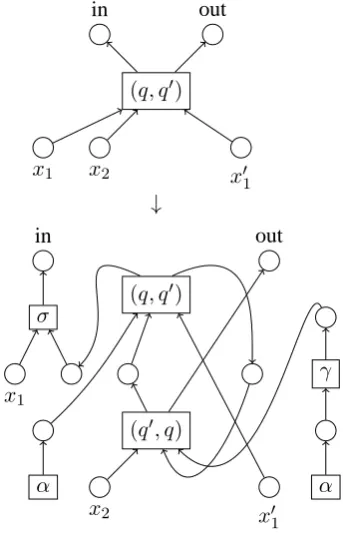
Example 3 Consider the SCFTG rule in Fig. 3,
with states q and q′ of rank 2 and 1, resp., and terminals σ, γ and α of rank 2, 1 and 0, resp.; the (only) variable in the output part is written
x′1 to distinguish it from x1 in the input part. Fig. 4 shows the corresponding CFHG rule. A pair of synchronized states together form one hy-peredge. Each pair of identically labelled nodes corresponds to a single node in the host graph to which this rule is applied, before and after the
ap-plication. ✷
References
A.V. Aho and J.D. Ullman. 1969a. Properties of syn-tax directed translations. Journal of Computer and System Sciences, 3:319–334.
A.V. Aho and J.D. Ullman. 1969b. Syntax directed translations and the pushdown assembler. Journal of Computer and System Sciences, 3:37–56. A. Arnold and M. Dauchet. 1976. Bi-transduction
de forˆets. In S. Michaelson and R. Milner, editors, Proc. 3rd International Colloquium on Automata, Languages and Programming, pages 74–86. Edin-burgh University Press.
A. Arnold and M. Dauchet. 1982. Morphismes et bimorphismes d’arbres. Theoretical Computer Sci-ence, 20:33–93.
Y. Bar-Hillel, M. Perles, and E. Shamir. 1964. On for-mal properties of simple phrase structure grammars. In Y. Bar-Hillel, editor, Language and Information: Selected Essays on their Theory and Application, chapter 9, pages 116–150. Addison-Wesley, Read-ing, Massachusetts.
(q, q′)
in out
x1 x2 x′
1
↓
in out
(q, q′)
(q′, q) σ
x1
α
x2 x′
1
γ
α
Figure 4: Rule of a CFHG.
M. Bauderon and B. Courcelle. 1987. Graph expres-sions and graph rewritings. Mathematical Systems Theory, 20:83–127.
E. Bertsch and M.-J. Nederhof. 2001. On the com-plexity of some extensions of RCG parsing. In Pro-ceedings of the Seventh International Workshop on Parsing Technologies, pages 66–77, Beijing, China, October.
M. B¨uchse, M.-J. Nederhof, and H. Vogler. 2011. Tree parsing with synchronous tree-adjoining grammars. In Proceedings of the 12th International Conference on Parsing Technologies, pages 14–25, Dublin, Ire-land, October.
M. B¨uchse, A. Maletti, and H. Vogler. 2012. Uni-directional derivation semantics for synchronous tree-adjoining grammars. In Developments in Lan-guage Theory, 16th International Conference, vol-ume 7410 of Lecture Notes in Computer Science, Taipei, Taiwan. Springer-Verlag.
D. Chiang. 2007. Hierarchical phrase-based transla-tion. Computational Linguistics, 33(2):201–228. B. Courcelle and P. Franchi-Zannettacci. 1982.
At-tribute grammars and recursive program schemes. Theoretical Computer Science, 17:163–191. J. Engelfriet and L. Heyker. 1991. The string
gener-ating power of context-free hypergraph grammars. Journal of Computer and System Sciences, 43:328– 360.
[image:8.595.75.289.82.197.2]J. Engelfriet and E.M. Schmidt. 1978. IO and OI. II. Journal of Computer and System Sciences, 16:67– 99.
J. Engelfriet and H. Vogler. 1985. Macro tree trans-ducers. Journal of Computer and System Sciences, 31:71–146.
J. Engelfriet, E. Lilin, and A. Maletti. 2009. Compo-sition and decompoCompo-sition of extended multi bottom-up tree transducers. Acta Informatica, 46:561–590. J. Engelfriet. 1980. Some open questions and recent results on tree transducers and tree languages. In R.V. Book, editor, Formal language theory: per-spectives and open problems, pages 241–286. Aca-demic Press, New York.
J. Engelfriet. 1982. Tree transducers and syntax-directed semantics. In Proc. of 7th Colloquium on Trees in Algebra and Programming, pages 82–107, Lille, France.
Z. F¨ul¨op, A. Maletti, and H. Vogler. 2010. Preser-vation of recognizability for synchronous tree sub-stitution grammars. In Workshop on Applications of Tree Automata in Natural Language Processing, pages 1–9, Uppsala, Sweden.
Z. F¨ul¨op, A. Maletti, and H. Vogler. 2011. Weighted extended tree transducers. Fundamenta Informati-cae, 111:163–202.
C. G´omez-Rodr´ıguez, J. Carroll, and D. Weir. 2011. Dependency parsing schemata and mildly non-projective dependency parsing. Computational Lin-guistics, 37(3):541–586.
A. Habel and H.-J. Kreowski. 1987. Some struc-tural aspects of hypergraph languages generated by hyperedge replacement. In Proceedings of the 4th Annual Symposium on Theoretical Aspects of puter Science, volume 247 of Lecture Notes in Com-puter Science, pages 207–219. Springer-Verlag. L. Kallmeyer, W. Maier, and G. Satta. 2009.
Syn-chronous rewriting in treebanks. In Proceedings of the 11th International Conference on Parsing Tech-nologies, pages 69–72, Paris, France, October. M. Kanazawa. 2009. The pumping lemma for
well-nested multiple context-free languages. In Devel-opments in Language Theory, volume 5583 of Lec-ture Notes in Computer Science, pages 312–325, Stuttgart, Germany. Springer-Verlag.
K. Knight and J. Graehl. 2005. An overview of prob-abilistic tree transducers for natural language pro-cessing. In A.F. Gelbukh, editor, Proceedings of the Sixth Conference on Intelligent Text Processing and Computational Linguistics, volume 3406 of Lecture Notes in Computer Science, Mexico City, Mexico. D.E. Knuth. 1968. Semantics of context-free
lan-guages. Mathematical Systems Theory, 2:127–145. Corrections in Math. Systems Theory 5 (1971), 95-96.
P.M. Lewis II and R.E. Stearns. 1968. Syntax-directed transduction. Journal of the ACM, 15(3):465–488, July.
A. Maletti and J. Engelfriet. 2012. Strong lexicaliza-tion of tree adjoining grammars. In 50th Annual Meeting of the ACL, pages 506–515, Jeju Island, Korea, July.
A. Maletti, J. Graehl, M. Hopkins, and K. Knight. 2009. The power of extended top-down tree trans-ducers. SIAM Journal on Computing, 39:410–430. A. Maletti. 2011. How to train your multi bottom-up
tree transducer. In 49th Annual Meeting of the ACL, pages 825–834, Portland, Oregon, June.
A. Maletti. 2012. Every sensible extended top-down tree transducer is a multi bottom-up tree transducer. In Conference of the North American Chapter of the ACL: Human Language Technologies, pages 263– 273, Montr´eal, Canada, June.
W.C. Rounds. 1970. Mappings and grammars on trees. Mathematical Systems Theory, 4:257–287. Yves Schabes. 1990. Mathematical and
Computa-tional Aspects of Lexicalized Grammars. Ph.D. the-sis, University of Pennsylvania.
H. Seki, T. Matsumura, M. Fujii, and T. Kasami. 1991. On multiple context-free grammars. Theoretical Computer Science, 88:191–229.
S.M. Shieber and Y. Schabes. 1990. Synchronous tree-adjoining grammars. In Papers presented to the 13th International Conference on Computa-tional Linguistics, volume 3, pages 253–258. S.M. Shieber. 2004. Synchronous grammars as tree
transducers. In Seventh International Workshop on Tree Adjoining Grammar and Related Formalisms, pages 88–95, May.
S.M. Shieber. 2006. Unifying synchronous tree ad-joining grammars and tree transducers via bimor-phisms. In Proceedings of the 11th Conference of the European Chapter of the ACL, pages 377–384, Trento, Italy.
S. Sippu and E. Soisalon-Soininen. 1988. Parsing Theory, Vol. I: Languages and Parsing, volume 15 of EATCS Monographs on Theoretical Computer Science. Springer-Verlag.
J.W. Thatcher. 1970. Generalized2 sequential ma-chine maps. Journal of Computer and System Sci-ences, 4:339–367.
J.W. Thatcher. 1973. Tree automata: an informal sur-vey. In A.V. Aho, editor, Currents in the Theory of Computing, pages 143–172. Prentice Hall, Engle-wood Cliffs.
K. Vijay-Shanker, D.J. Weir, and A.K. Joshi. 1987. Characterizing structural descriptions produced by various grammatical formalisms. In 25th Annual Meeting of the ACL, pages 104–111, Stanford, Cal-ifornia, USA, July.