Proceedings of NAACL-HLT 2018, pages 124–129
Reference-less Measure of Faithfulness for Grammatical Error Correction
Leshem Choshen
1and Omri Abend
21
School of Computer Science and Engineering,
2Department of Cognitive Sciences
The Hebrew University of Jerusalem
[email protected], [email protected]
Abstract
We propose USIM, a semantic measure for
Grammatical Error Correction (GEC) that measures the semantic faithfulness of the out-put to the source, thereby complementing existing reference-less measures (RLMs) for measuring the output’s grammaticality. USIM
operates by comparing the semantic sym-bolic structure of the source and the correc-tion, without relying on manually-curated ref-erences. Our experiments establish the validity of USIM, by showing that (1) semantic anno-tation can be consistently applied to ungram-matical text; (2) valid corrections obtain a high USIM similarity score to the source; and (3)
invalid corrections obtain a lower score.1
1 Introduction
Evaluation in Monolingual Translation, and particu-larly in Grammatical Error Correction (GEC) is a chal-lenging research field, much due to the difficulty in integrating different types of rewriting operations into a single measure, and the vast number of valid out-puts (Tetreault and Chodorow, 2008; Madnani et al.,
2011; Chodorow et al.,2012; Bryant and Ng, 2015). These difficulties have recently motivated a number of proposals for new, improved reference-based measures (RBMs) (Dahlmeier and Ng,2012;Felice and Briscoe,
2015;Napoles et al.,2015).
Nevertheless, the size and heterogeneity of the space of valid outputs per sentence often prohibits obtaining a reference set that covers this space well, thereby lim-iting the applicability of RBMs (Bryant and Ng,2015). To address this we propose a semantic RLM, USIM,
that operates by measuring the graph distance between the semantic representations of the source and the out-put. Reliable RLMs are appealing both in not relying on references, which are costly to collect, and in avoid-ing the biases incurred by selectavoid-ing references that nec-essarily cannot exhaust the vast space of valid correc-tions.
1Our code is available in https://github.com/
borgr/USim.
Our proposal complements the RLM proposed by
Napoles et al.(2016), which uses grammatical error de-tection techniques to assess the grammaticality of the output, and the work ofAsano et al.(2017), who advo-cate the use of RLMs for fluency, grammaticality and meaning preservation, but state that a meaning preser-vation measure for GEC is currently lacking. A similar decomposition of output quality to its adequacy (simi-lar to faithfulness) and fluency (related to grammatical-ity), has been used in machine translation (MT) evalu-ation (e.g.,Banchs et al.,2015).
As a test case, we use the UCCA semantic scheme (Abend and Rappoport,2013), motivated by its recent use in semantic evaluation of MT (Birch et al.,2016) and text simplification (Sulem et al., 2018) systems. Nevertheless, USIMcan be easily adapted to other
se-mantic schemes, such as AMR (Banarescu et al.,2013). USIM is conceptually related to RLMs developed for
MT (Reeder, 2006; Albrecht and Hwa, 2007;Specia et al., 2009, 2010). Notably, XMEANT (Lo et al.,
2014) compares the source to the output in terms of their semantic role labeling structures. Our use of UCCA is motivated by its wider coverage of predicate types, as opposed to MEANT’s focus on verbal pred-icates, and UCCA’s preservation of structure across translations (Sulem et al., 2015). See (Birch et al.,
2016) for further discussion.
We conduct experiments to confirm USIM’s
valid-ity. Specifically, we show that (1) UCCA can be con-sistently and automatically applied to learner language (LL) (§4.2), (2) USIMis not prone to unduly penalize
valid corrections (§4.2), and (3) USIMassigns a lower
score to corrections of poor quality (§4.5). Our exper-iments also indicate that UCCA parsing technology is already sufficiently mature for an automatic variant of USIMto provide reliable results (§4.3).
2 Background
LL Annotation. While most linguistic theories pro-pose that each learner makes consistent use of syntax (Huebner,1985;Tarone,1983), this use may not con-form to the syntax of the learned language, or of any other known language. This entails difficulties in defin-ing syntactic annotation for LL, as the annotated syntax differs between learners.
Syntactic schemes for LL annotate syntactically er-roneous sentences in different ways. Berzak et al.
(2016) andRagheb and Dickinson(2012) annotate ac-cording to the syntax used by the learner, even if this use is not grammatical. Such annotation may be unre-liable for measuring faithfulness, as GEC systems aim to alter these erroneous syntactic structures. Nagata and Sakaguchi(2016) take the opposite approach, and remain faithful to the syntax intended by the learner. This has also been the tradition in works on parser ro-bustness (Bigert et al.,2005;Foster,2004). However, such approach is prone to inconsistencies due to the va-riety of different syntactic structures that can be used to express a similar meaning.
In this paper, we use semantic annotation to struc-turally represent LL. Semantic structures are faithful to the intended meaning, and not to the formal realization, and thus face fewer conflicts where the syntactic struc-ture used diverges from the one intended. We are not aware of any previous attempts to semantically anno-tate LL text.
The UCCA Scheme. UCCA is a semantic annota-tion scheme that builds on typological and cognitive linguistic theories. The scheme’s aims are to provide a coarse-grained, cross-linguistically applicable repsentation. Importantly, UCCA’s categories directly re-flect semantic, rather than distributional distinctions. For instance, UCCA is not sensitive to POS distinc-tions: a Scene’s main relation can be a verb but also an adjective (“He is thin”) or a noun (“John’s deci-sion”). Indeed, Sulem et al. (2015) have found that UCCA structures are preserved remarkably well across English-French translations.
UCCA structures are directed acyclic graphs, where the words correspond to (a subset of) their leaves. The nodes of the graphs, called units, are either leaves or several elements jointly viewed as a single entity ac-cording to some semantic or cognitive consideration. The edges bear one or more categories, indicating the role of the sub-unit in the relation that the parent repre-sents.
UCCA views the text as a collection ofScenesand relations between them. A Scene describes a move-ment, an action or a state which is persistent in time. Every Scene contains one main relation, zero or more
Participants, interpreted in a broad sense to include lo-cations, destinations and complement clauses, and Ad-verbials, such as manner or aspectual modifiers.
3 Semantic Faithfulness Measures
We start by defining a simplified measure, used for inter-annotator agreement (IAA). The measure com-pares two UCCA annotations over the same set of to-kens. We then proceed to define USIM, which
com-pares two UCCA structures over alignable but different sets of tokens.
john for R,Empty C,3
apple an E,5 C,6
gve He
A,1 P,2
A,4 A,3
apple an E,5 C,6 John
gave He
A,1 P,2
A,3 A,4
[image:2.595.305.522.63.160.2]P process A participant H linked scene R relator C center E elaborator
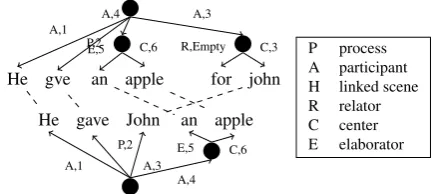
Figure 1: UCCA structures of a learner language (top) and correction (bottom) including word align-ments (dashed). On the edges are labels and numbers aligned to (top) or indexes (bottom). Precision is 7
9
Re-call is 7 7.
IAA Measure. We define a similarity measure over UCCA annotationsG1 andG2 that share their set of
leaves (tokens)W. For a nodevinG1orG2, define
its yieldyield(v) ⊆ W as its set of leaf descendants.
Define a pair of edges(v1, u1)∈G1and(v2, u2)∈G2
to be matching ifyield(u1) =yield(u2)and they have
the same label. Labeled precision and recall are defined by dividing the number of matching edges inG1 and G2by|E1|and|E2|respectively.DAGF-scoreis their
harmonic mean. The measure collapses to the common parsingF-score ifG1, G2are trees.
TheUSIMMeasure. Computing a faithfulness
mea-sure is slightly more involved, as the source sentence graphGsand its correctionGc do not share the same
set of leaves. We assume a (possibly partial, possi-bly many-to-1) alignment betweenGs andGc, A ⊂
Vs×Vc.
An edge (v1, v2) ∈ Ec is said to match an edge
(u1, u2) ∈ Es if they have the same label and
(v2, u2) ∈ A. Recall (Precision) is defined as the
ra-tio of edges inEs(Ec) that have a match inEc (Es)
respectively, andF-score is their harmonic mean. We note that this measure collapses to theDAGF-scoreif
Aincludes all pairs of nodes inEsandEcthat have the
same yield. See Figure1.
In order to define the alignment betweenVsandVc,
we begin by aligning the leaves (tokens) in Vs and
Vc. Alignment is cast as a weighted bipartite graph
matching problem. Edge weights are assigned to be the edit distances between the tokens. We note that aligning words in GEC (and other monolingual trans-lation tasks) is much simpler than in MT, as most of the words are unchanged, deleted fully, added, or changed slightly. Denote the resulting leaf alignment withAl⊂Leavess×Leavesc. We extendAlto define
the node alignmentA, aligning each non-leafv ∈ Vs
to the nodeu∈Vcthat maximizes
w(v, u) = |Al∩(yield(u)×yield(v))|
|yield(u)| .
We exclude fromAzero-weighted pairs. USIMis
and the other way around, we report USIMin both
di-rections.
USIMis somewhat more relaxed thanDAGF-score,
as, unlike DAG F-score, it also aligns nodes whose
yields are not in perfect alignment with one another. This relaxation is necessary, given that corrections of-ten add or remove nodes, thus eliminating the possibil-ity of a perfect alignment. In order to obtain compara-ble IAA scores, we report IAA using USIMas well.
For completeness, we replicate the protocol used by
Sulem et al. (2015) for comparing the UCCA anno-tations of standard English-French translations, which we call Distributional Similarity (DISTSIM). For a given UCCA labell, ci(l)is the number of l-labeled
UCCA edges in the i-th source sentence, anddi(l)is
the number ofl-labeled UCCA edges in its
correspond-ing correction. We define DISTSIM(l) between these
sentences to be 1
N
PN
i=1|ci(l)−di(l)|, whereN is the
total number of sentence pairs.
4 Experiments
We conduct four types of experiments to validate USIM, showing that: (1) semantic annotation can
be consistently applied to LL through inter-annotator agreement (IAA) experiments; (2) a valid corrector scores high on USIM; (3) an automatic UCCA parser can reliably replace human annotation for USIM; (4) USIMis sensitive to changes in meaning.
4.1 Experimental Setup.
We train two UCCA annotators, the first author and a paid in-house annotator by annotating both LL and standard English passages, until a high enough agree-ment is reached (6 training hours). Training passages are excluded from the evaluation. We use UCCA’s an-notation guidelines2without any adaptations.
We experiment on 7 essays and their corrections, each comprising about 500 tokens (see supplementary material1). In order to measure IAA, we assigned 4 of these essays to both annotators. In order to measure the faithfulness score for a valid correction, we annotate both the source and the manually corrected versions of 6 essays, 3 of which were annotated by both annotators.
4.2 The Faithfulness of Valid Corrections.
We obtain an IAA DAGF-scoreof 0.845 (Precision 0.834, Recall 0.857), which is comparable to the IAA reported for English Wikipedia texts by Abend and Rappoport (2013). As another point of comparison, we doubly annotate 3 corrected NUCLE (Dahlmeier et al.,2013) passages, obtaining a similar IAA. These results suggest that UCCA annotating LL does not de-grade IAA: it can be applied as consistently to LL as to standard English.
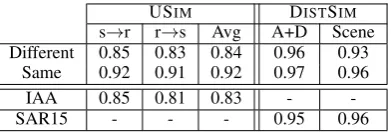
Table 1 (left-hand side) presents the USIM scores
obtained by comparing the NUCLE references and the
2http://www.cs.huji.ac.il/~oabend/
ucca.html
USIM DISTSIM
s→r r→s Avg A+D Scene Different 0.85 0.83 0.84 0.96 0.93
Same 0.92 0.91 0.92 0.97 0.96
IAA 0.85 0.81 0.83 -
-SAR15 - - - 0.95 0.96
Table 1: The faithfulness of valid corrections. The left-hand side presents USIM, where s→r is the
set-ting where alignment is computed from the source to the reference, r→s is the other way around, and Avg is their average. The right-hand side presents DISTSIM
for the UCCA categories Participants and Adverbials together (A+D), and for Scenes (Scene). Rows indi-cate whether the same annotator annotated the source and reference or not. For comparison, the IAA row is the IAA computed using USIM. Results show that the
valid corrector’s faithfulness is comparable with IAA. SAR15 are reported by Sulem et al. on English-French translations; similarity is comparable to ours.
source, or equivalently the score of a valid correction. To control for differences between the annotators, we explore both a setting where both sides are annotated by the same annotator, and a setting where they are an-notated by different ones. As an upper bound on the score of a valid corrector (using different annotators), we also report the USIMIAA on source sentences.
Our results indicate that a valid correction obtains a score comparable to the IAA, which indicates that USIM is indeed insensitive to the surface divergence
between a source sentence and its valid corrections. Finally, we compute the DISTSIM measure between the source and reference sentences (Table1, right-hand side), obtaining similar results to those obtained by
Sulem et al.(2015). It suggests that on a coarse grained level, UCCA structures are as robust to grammatical er-ror corrections as they are to translation from English to French, which was shown to be very robust, specifi-cally more robust than syntactic representation (Sulem et al.,2015).
4.3 AutomaticUSIM.
We experiment with an automatic variant of USIM,
where UCCA structures are parsed automatically. We use the TUPA parser (Hershcovich et al.,2017) to gen-erate UCCA structures, instead of the human annota-tors. Otherwise the setup is as above. TUPA is used with its biLSTM model, trained on the UCCA English Wikipedia corpus.
We obtain a USIM score of 0.7 between the parses
[image:3.595.320.516.71.137.2]pars-ing technology is sufficiently mature to be applicable to USIM. Results also suggest an improvement in parsing
performance may further improve these scores.
4.4 Sensitivity to Error Types
To provide another perspective on automated USIM’s
behaviour, we examined the measure’s sensitivity to different error types, using MAEGE (Choshen and Abend,2018a). For each NUCLE sentence and set of edits (replacements of sub-strings that contain an er-ror by corrected ones. Such edit for the example in fig.1might be”gva”→”gave”, with typespelling),
we sample an order in which edits are applied. We se-lect the source randomly to be one of the resulting sen-tences. We then compare the difference in USIMbefore
and after applying each edit, and average these differ-ences by the applied edit type. We denote the average difference in USIMdue to correction of errors of type twith∆t. The hypothesis is that∆tshould be close
to 0 for allt, as edits are manual and are thus assumed to be faithful. We focus on edit types with high|∆t|to
better understand where USIMfails. See table2in the supplementary material for complete results.
We find that among the 5 most penalized error types by USIM are “unclear meaning” and corrections of type “other”, that fit no specific type; these correc-tions may actually change the meaning of the origi-nal sentence. In the most peorigi-nalized and most rewarded changes we see ”Dangling Modifier“, ”Pronoun Refer-ence“ and ”Word Tone“ errors, the first usually changes a word into a more complex structure and the latter two the opposite. Such changes alter the lower levels of the UCCA structure (near the leaves); a similarity measure that focuses on the top of the DAG, or one that performs a better lexical semantic abstraction, may address this sensitivity. Corrections of incorrect word order are also highly rewarded (high∆t), probably due to parser
per-formance (the UCCA structures themselves are not af-fected by word order). Training the parser with LL an-notated data may address this sensitivity.
Among the most rewarded changes we also see er-rors of replacing rare or misconstructed words with proper English words (Acronym and Mechanical er-rors). We assume this is due to parser performance, as TUPA only extracts features over complete words, and has no character-level encoding at this point. Thus, all misconstructed words fall into an out-of-vocabulary category and can only be labeled by the context.
Lastly, adding a missing verb is shown to be highly rewarded. Under the UCCA guidelines, a missing verb should be annotated as an implicit unit, but as TUPA does not generate implicit units, it is not surprising that when corrections transforms an implicit unit into an explicit word, the parser’s output changes (and hence USIM). Future improvements to TUPA may address this.
4.5 Sensitivity to Unfaithfulness.
We have shown that UCCA is insensitive to differences between a source sentence and its valid correction. We now present an evaluation of the sensitivity of USIM
to proposed corrections that diverge semantically from the source. A semantic measure is, by its definition, sensitive to variation in the semantic dimensions which it encodes. In UCCA’s case, these distinctions focus on predicate-argument structures, the inter-relations be-tween them, and the semantic heads of complex argu-ments. These distinctions are widely regarded as fun-damental in the NLP and linguistic literature.
In order to empirically validate this claim, we present an experiment which shows that corrections of a fairly low quality indeed receive a much lower USIMfaithfulness score. Current state-of-the-art
sys-tems rarely alter the source sentences enough to yield semantically unfaithful outputs (Choshen and Abend,
2018b). Consequently, their human rankings are not determined by their semantic faithfulness, rendering them unuseful for validating USIM. We instead
exper-iment with 5 partially trained correctors, trained and evaluated on the JFLEG corpus (Napoles et al.,2017) bySakaguchi et al.(2017).
USIMis computed automatically for each system’s
output on 754 source sentences. Low faithfulness results are expected, as these outputs include major changes, sometimes deleting full phrases from the out-put or changing every other word. Indeed, automatic USIMobtains scores of 0.32-0.39 for 4 of the systems,
and 0.19 for the system that obtains the lowest GLEU (Napoles et al., 2015) score. For completeness, we run USIMon the 4 references provided by JFLEG for
each source and obtain scores of 0.72-0.78, suggesting the domain change is not the reason for the low USIM
score.
Taken together, these results indicate that USIM,
even in its automatic variant, is sensitive to semantic changes. Consider the example:
Source the good student must know how to under-stand and work hard to get the iede.
Reference A good student must be able to understand and work hard to get the idea.
Corrector The good student must know how to under-stand and work hard to get on.
USIM assigns the reference 0.71 and only 0.33 to the corrector. Moreover, although the reference makes more word changes than the proposed correction, it still obtains a higher USIMscore.
5 Conclusion
challenge of over-conservatism, and the high costs of acquiring many references.
Future work will conduct user studies to assess the relative importance of different evaluation criteria. Specifically, we will explore to what extent users are tolerant to invalid changes to the sentence’s structure, i.e., violation of conservatism, relative to their toler-ance to invalid changes to the sentence’s meaning, i.e., violation of faithfulness. A better understanding of how these interact may lead to improved semantic eval-uation that will alleviate the need for a high number of references.
Acknowledgments
This work was partially supported by the Israel Science Foundation (grant No. 929/17), as well as by the HUJI Cyber Security Research Center in conjunction with the Israel National Cyber Bureau in the Prime Min-ister’s Office. We thank Joel Tetreault and Courtney Napoles for helpful feedback and help with obtaining the partially trained GEC system outputs.
References
Omri Abend and Ari Rappoport. 2013. Universal con-ceptual cognitive annotation (ucca). In ACL (1), pages 228–238.
Joshua Albrecht and Rebecca Hwa. 2007. A re-examination of machine learning approaches for sentence-level mt evaluation. InProc. of ACL, vol-ume 45, pages 880–887.
Hiroki Asano, Tomoya Mizumoto, and Kentaro Inui. 2017. Reference-based metrics can be replaced with reference-less metrics in evaluating grammatical er-ror correction systems. InProceedings of the Eighth International Joint Conference on Natural Language Processing (Volume 2: Short Papers), volume 2, pages 343–348.
Laura Banarescu, Claire Bonial, Shu Cai, Madalina Georgescu, Kira Griffitt, Ulf Hermjakob, Kevin Knight, Philipp Koehn, Martha Palmer, and Nathan Schneider. 2013. Abstract meaning representation for sembanking. InProceedings of the 7th Linguistic Annotation Workshop and Interoperability with Dis-course, pages 178–186, Sofia, Bulgaria. Association for Computational Linguistics.
Rafael E Banchs, Luis F D’Haro, and Haizhou Li. 2015. Adequacy-fluency metrics: Evaluating mt in the continuous space model framework. IEEE Transactions on Audio, Speech, and Language Pro-cessing, 23(3):472–482.
Yevgeni Berzak, Jessica Kenney, Carolyn Spadine, Jing Xian Wang, Lucia Lam, Keiko Sophie Mori, Se-bastian Garza, and Boris Katz. 2016. Universal de-pendencies for learner english. InProceedings of the 54th Annual Meeting of the Association for Compu-tational Linguistics (Volume 1: Long Papers), pages
737–746. Association for Computational Linguis-tics.
Johnny Bigert, Jonas Sjöbergh, Ola Knutsson, and Magnus Sahlgren. 2005. Unsupervised evaluation of parser robustness. InCICLing, pages 142–154. Springer.
Alexandra Birch, Omri Abend, Ondˇrej Bojar, and Barry Haddow. 2016. Hume: Human ucca-based evaluation of machine translation. InProceedings of the 2016 Conference on Empirical Methods in Natu-ral Language Processing, pages 1264–1274. Christopher Bryant and Hwee Tou Ng. 2015. How far
are we from fully automatic high quality grammati-cal error correction? InACL (1), pages 697–707. Martin Chodorow, Markus Dickinson, Ross Israel, and
Joel R Tetreault. 2012. Problems in evaluating gram-matical error detection systems. InCOLING, pages 611–628. Citeseer.
Leshem Choshen and Omri Abend. 2018a. Automatic metric validation for grammatical error correction. In Proceedings of the 56th Annual Meeting of the Association for Computational Linguistics (Volume 1: Long Papers).
Leshem Choshen and Omri Abend. 2018b. Inherent biases in reference-based evaluation for grammatical error correction and text simplification. In Proceed-ings of the 56th Annual Meeting of the Association for Computational Linguistics (Volume 1: Long Pa-pers).
Daniel Dahlmeier and Hwee Tou Ng. 2012. Better evaluation for grammatical error correction. In Pro-ceedings of the 2012 Conference of the North Amer-ican Chapter of the Association for Computational Linguistics: Human Language Technologies, pages 568–572. Association for Computational Linguis-tics.
Daniel Dahlmeier, Hwee Tou Ng, and Siew Mei Wu. 2013. Building a large annotated corpus of learner english: The nus corpus of learner english. In Pro-ceedings of the Eighth Workshop on Innovative Use of NLP for Building Educational Applications, pages 22–31.
Mariano Felice and Ted Briscoe. 2015. Towards a stan-dard evaluation method for grammatical error detec-tion and correcdetec-tion. InHLT-NAACL, pages 578–587. Jennifer Foster. 2004. Parsing ungrammatical input: an
evaluation procedure. InLREC. Citeseer.
Daniel Hershcovich, Omri Abend, and Ari Rappoport. 2017. A transition-based directed acyclic graph parser for ucca. InProceedings of the 55th Annual Meeting of the Association for Computational Lin-guistics (Volume 1: Long Papers), volume 1, pages 1127–1138.
Chi-kiu Lo, Meriem Beloucif, Markus Saers, and Dekai Wu. 2014. Xmeant: Better semantic mt eval-uation without reference translations. In Proceed-ings of the 52nd Annual Meeting of the Association for Computational Linguistics (Volume 2: Short Pa-pers), pages 765–771, Baltimore, Maryland. Associ-ation for ComputAssoci-ational Linguistics.
Nitin Madnani, Joel Tetreault, Martin Chodorow, and Alla Rozovskaya. 2011. They can help: Using crowdsourcing to improve the evaluation of gram-matical error detection systems. InProceedings of the 49th Annual Meeting of the Association for Com-putational Linguistics: Human Language Technolo-gies: short papers-Volume 2, pages 508–513. Asso-ciation for Computational Linguistics.
Ryo Nagata and Keisuke Sakaguchi. 2016. Phrase structure annotation and parsing for learner english. InProc. of ACL, pages 1837–1847.
Courtney Napoles, Keisuke Sakaguchi, Matt Post, and Joel Tetreault. 2015. Ground truth for grammati-cal error correction metrics. InProceedings of the 53rd Annual Meeting of the Association for Compu-tational Linguistics and the 7th International Joint Conference on Natural Language Processing, vol-ume 2, pages 588–593.
Courtney Napoles, Keisuke Sakaguchi, and Joel Tetreault. 2016. There’s no comparison: Reference-less evaluation metrics in grammatical error correc-tion. In Proceedings of the 2016 Conference on Empirical Methods in Natural Language Process-ing, pages 2109–2115. Association for Computa-tional Linguistics.
Courtney Napoles, Keisuke Sakaguchi, and Joel Tetreault. 2017. Jfleg: A fluency corpus and benchmark for grammatical error correction. arXiv preprint arXiv:1702.04066.
Marwa Ragheb and Markus Dickinson. 2012. Defining syntax for learner language annotation. InCOLING (Posters), pages 965–974.
Florence Reeder. 2006. Measuring mt adequacy using latent semantic analysis. InProceedings of the 7th Conference of the Association for Machine Trans-lation of the Americas. Cambridge, Massachusetts, pages 176–184.
Keisuke Sakaguchi, Matt Post, and Benjamin Van Durme. 2017. Grammatical error correction with neural reinforcement learning. arXiv preprint arXiv:1707.00299.
Lucia Specia, Dhwaj Raj, and Marco Turchi. 2010. Machine translation evaluation versus quality esti-mation. Machine translation, 24(1):39–50.
Lucia Specia, Marco Turchi, Nicola Cancedda, Marc Dymetman, and Nello Cristianini. 2009. Estimat-ing the sentence-level quality of machine translation systems. In13th Conference of the European Asso-ciation for Machine Translation, pages 28–37.
Elior Sulem, Omri Abend, and Ari Rappoport. 2015. Conceptual annotations preserve structure across translations: A french-english case study. Proceed-ings of S2MT 2015, page 11.
Elior Sulem, Omri Abend, and Ari Rappoport. 2018. Semantic structural annotation for text simplifica-tion. InProc. of NAACL. To appear.
Elaine Tarone. 1983. On the variability of interlan-guage systems. Applied linguistics, 4(2):142–164. Joel R Tetreault and Martin Chodorow. 2008.