FORMULATION DEVELOPMENT OF MODEL FAST DISSOLVING
ORAL FILM OF A POORLY SOLUBLE DRUG WITH IMPROVED
DRUG LOADING USING MIXED SOLVENCY CONCEPT AND ITS
EVALUATION
Neha Sonkeshariya* and R. K. Maheshwari
Department of Pharmacy, Shri G.S. Institute of Technology and Science,
Park Road, Indore-452 003, Madhya Pradesh, India.
ABSTRACT
The present study was aimed to develop a fast dissolving oral film
containing ondansetron hydrochloride dihydrate (as model drug) with
enhanced drug loading, which was achieved by improving drug
solubility and reducing the total surface area of oral film using mixed
solvency concept. HPMC E-5 as film forming polymer, propylene
glycol as plasticizer and crospovidone as superdisintegrant were
optimized and selected on the basis of thickness, disintegration time
and mechanical properties of film. Initially solubility of ondansetron
hydrochloride dihydrate was enhanced in aqueous solution by using
various solubilizers like niacinamide (NM), sodium citrate (SC), PVP
K30, caffeine, HP beta cyclodextrin, PEG 4000, PEG 200, PEG 400,
PEG 600, propylene glycol (PG), glycerin etc, individually and as
combinations of four and five solubilizers. The maximum solubility of ondansetron
hydrochloride dehydrate 13.63% w/v was achieved in 27% w/v mixed solvent system
containing 15% v/v propylene glycol + 3% w/v NM + 3% w/v PVP K30 + 3% w/v SC + 3%
w/v caffeine. Petriplate method was used for casting the polymeric film. Evaluation of
prepared formulation was carried out including thickness, folding endurance test,
disintegration time, in-vitro dissolution test, drug content, surface pH test and stability test.
KEYWORDS: Ondansetron hydrochloride dehydrate (O), niacinamide (NM), sodium citrate
(SC), propylene glycol (PG), fast dissolving film (FDF).
Volume 7, Issue 6, 484-499. Research Article ISSN 2277– 7105
Article Received on 21 Jan. 2018,
Revised on 11 Feb. 2018, Accepted on 04 March 2018,
DOI: 10.20959/wjpr20186-10981
*Corresponding Author
Neha Sonkeshariya
Department of Pharmacy,
Shri G.S. Institute of
Technology and Science,
Park Road, Indore-452
003, Madhya Pradesh,
INTRODUCTION
Among all dosage forms 60% dosage forms are oral solid dosage forms and they are highly
accepted by the patients.[1] But there are some groups of patients who feel difficulty to
administer oral dosage forms, for example- pediatric, geriatric, bedridden, nauseous or
noncompliant patients. Scientists developed new dosage alternatives for oral route to keep
these patients group in mind and mouth dissolving film is one of the alternative dosage forms
of oral route. It was developed based on the technology of “transdermal patch”. The mouth
dissolving film also called as fast dissolving film (FDF), rapid film, or rapid disintegrating
film/ strip.[2]
The mouth dissolving film is a very thin film placed on the tongue, gets instantly wetted by
saliva, disintegrates and dissolves rapidly to release drug. This released drug gets absorbed
directly in to the systemic circulation by oral mucosa.[2]
Fast dissolving film gives various advantages over conventional dosage forms and fast
dissolving tablets. It avoids the problem of swallowing of tablets, does not require water for
swallowing the dosage form, highly convenient at the time of travelling, produce rapid onset
of action, bypasses first pass metabolism, avoids risk of chocking & suffocation, provides
patient compliance. But fast dissolving films have some limitation like small dose loading
and require special packaging.[3][4]
General composition of fast dissolving film[5]
Drug (1 -25 %)
Water soluble polymer (40-50 %)
Plasticizer (0-20 %)
Fillers, colour, flavour etc. (0-40 %)
Method of preparation of FDF[4]
There are five methods for the preparation of FDF
Solvent casting method.
Semisolid casting method.
Hot melt extrusion.
Solid dispersion extrusion.
Solvent casting was used for making fast dissolving film in this project work.
In this research work, ondansetron hydrochloride dihydrate was used as a model drug and for
increasing the solubility of poorly water soluble drug (ondansetron hydrochloride dihydrate)
mixed solvency concept was used in place of organic solvent, which is a novel concept to
enhance the solubility of the drug in the solvent medium with the aid of solubilizers in
combination and by this technique the limitation of drug loading in FDF can be avoided.
The concept of mixed solvency proposed by Dr. R. K. Maheshwari states that each and every
substance present in the universe has got solubilizing property i.e. all the liquids, gases and
solids possess solubilizing power. As per his statement, each substance is a solubilizer. A
concentrated aqueous solution containing various water soluble substances may act as good
solvent for poorly water soluble drugs. Such concentrated solutions may show synergistic or
additive solubilizing actions of solubilizers present in the solution for a particular solute.[6]
For example solubility of ibuprofen has been enhanced by 47.46 folds in a 40% w/v mixed
blend of PEG 400 (10% v/v) + PEG 300 (10% w/v) + Urea (10% w/v) + Sodium citrate (10%
w/v).[7] Similarly, solubility of salicylic acid was also enhanced by more than 54 fold in a
mixed blend of PEG 300 (10% v/v) + PEG 400 (10% v/v) + glycerin (10% v/v) + Sodium
citrate (10% w/v), in 40% w/v total concentration. The solubilities of several water insoluble
drugs have been enhanced by mixed solvency concept.[8][21]
Present study was aimed to enhance drug loading by incorporating large dose of drug in
polymer matrix by oral dose of drug keeping in mind. For showing drug loading, area of film
was reduced to half as compared to marketed ondansetron hydrochloride dihydrate oral film
of same dose (4 mg).
MATERIALS AND METHOD
Materials
Ondansetron hydrochloride dihydrate was obtained as a gift sample from Modern
Laboratories Ltd., Indore, India. Other chemicals like super disintegrants, plasticizers,
solubilizers, polymers used were of analytical grade. Demineralised water was used in the
METHOD
Solubility studies
Solubility studies in different aqueous systems of solubilizers were carried out by equilibrium
solubility method. According to this method, 5 ml of respective mediums were taken in vials
and excess amount of drug (ondansetron hydrochloride dihydrate) was added in above vials.
Vials were closed by rubber caps with aluminium seals, and were placed on a mechanical
shaker at room temperature for 12 hrs. Solutions were allowed to equilibrate for 24 hrs
undisturbed. Then, the solutions were centrifuged and filtered through Whatman filter papers
no. 41. The filtrates were appropriately diluted with the respective aqueous mediums and the
absorbances of the solutions were measured at 310 nm on a double beam UV/Visible
spectrophotometer (Simadzu 1700) against respective reagent blanks. The percent solubilities
were calculated using the respective calibration curves.
For the preparation of different blends of solubilizers (% w/v), niacinamide, sodium citrate,
caffeine, HP beta cyclodextrin, PVP k30(film forming polymer), PEG 4000, PEG 6000, propylene
glycol, PEG 200, PEG 400, PEG 600, glycerin etc. were weighed/ measured and taken in a
volumetric flask and about 50 ml of D.M. water was added in this flask and was shaken to
achieve complete dissolution of solubilizers. Then volume was made up to 100 ml by D.M.
water. Total solute concentration was varied up to 40% w/v concentration and the %
solubility of drug (ondansetron hydrochloride dihydrate) was calculated.
To decrease the individual concentration of solubilizers as well as individual toxicity of
solubilizers, combinations of solubilizers in blends were used to increase the solubility of
drug in various ratios.
Solubility enhancement ratio = Solubility of drug in solution containing solubilizers
/Solubility of drug in demineralised water.
Preparation of fast dissolving film
125 mg Ondansetron hydrochloride dihydrate (equivalent to 100 mg of ondansetron) was
accurately weighed and dissolved in 1ml of respective solubilizer blend in a vial. Then 15%
v/v propylene glycol (as plasticizer), 0.4% w/v crospovidone (as superdisintegrant) and
respective concentration (20 or 15% w/v) of HPMC E-5 (as film forming polymer) were
added and properly mixed and volume was made up to 10ml with D.M. water. The
and then calculated volume of polymeric preparations were uniformly spread in petriplates
and dried in oven at temperature 40°C for 24 hrs. After proper drying, films were cut into
desired calculated dimension i.e. 2.0×2.0 cm2 in which 4mg of ondansetron hydrochloride
dihydrate was present. At last it was wrapped in an aluminium foil with sealing plastic bag
and stored for further evaluations.
Dose calculation of drug
Outer diameter of petriplate = 5.5 cm
Inner diameter of petriplate = 5.1 cm
Inner radius of petriplate = 5.1/2 cm = 2.55 cm
Inner area of petriplate = area of circle
= 3.14× (2.55)2
= 20.41785 cm2
10 ml of polymeric preparation contains 100mg of drug.
Therefore 2 ml of polymeric preparation contains 20mg of drug.
This 2 ml polymeric preparation was spread over 20.41785 cm2 area of petriplate.
Therefore, 20mg of drug is present in 20.41785 cm2 area of petriplate.
So, 4mg present in…..= (20.41785 cm2
/20mg) ×4mg
= 4.08357 cm2 area
Area of circle = area of square = a2 (a= length of side of square)
4.08357 cm2 = a2
a =
a = 2 cm
By this calculation 4mg dose of drug present in 2.0×2.0 cm2 area of film.
Evaluation of films
a) Disintegration time
For orally disintegrating tablets disintegration time limit is 30 seconds or less described in
CDER guidance and it can be applied to fast dissolving oral strips. Although, no official
guidance is available for oral fast disintegrating films, this may be used as a qualitative
guideline for quality control test at development stage. Disintegration time for film is 5-30
Slide frame method
One drop of distilled water was dropped by a pipette onto the oral films. Therefore the films
were clamped into slide frames and were placed planar on a Petridish. The time until the film
dissolved and caused a hole within the film was measured.
Petri dish methods
2 ml of distilled water was placed in a petridish and one film was put on the surface of the
water and the time measured until the oral film was dissolved completely. “Petridish method
was used for conducting disintegration test of film”.
b) Folding endurance
Folding endurance was determined by repeatedly folding the film at the same position until it
breaks. The number of times the films can be folded without breaking is termed as the folding
endurance value.
c) Thickness
The thickness of film was determined by the use of micrometer (Digimatic micrometer,
Mitutoyo, Tokyo, Japan) at five locations (center and four corners) and mean thickness was
calculated.
d) In-vitro dissolution test
Dissolution tests of ondansetron hydrochloride dihydrate films containing 4mg drug were
performed by using USP II apparatus (rotating paddle apparatus) at 50 rpm with 900 ml 0.1 N
HCl or phosphate buffer of pH 6.8 as dissolution medium. The temperature of dissolution
medium was maintained at 37± 0.5°C. Ten ml of dissolution media was withdrawn at regular
intervals and fresh media was replaced immediately after withdrawal of sample. The sample
was filtered, diluted when ever required, analysed in U.V. at 310nm and absorbance was
noted against reagent blank.
e) % Drug content determination
It was determined by taking one film (ondansetron hydrochloride dihydrate 4mg) in 500 ml
volumetric flask and dissolved in sufficient amount phosphate buffer of pH 6.8 and after
complete dissolution volume was made upto the mark with phosphate buffer of pH 6.8.
Absorbance was noted at 310 nm and % drug content with respect to 4 mg/ 4cm2 was
% drug content= (practical value/ theoretical value) × 100
f) Surface pH
Film was taken and placed in a petriplate containing 5 ml of water. After wetting of the film,
the surface pH of the film was checked by using pH electrode.
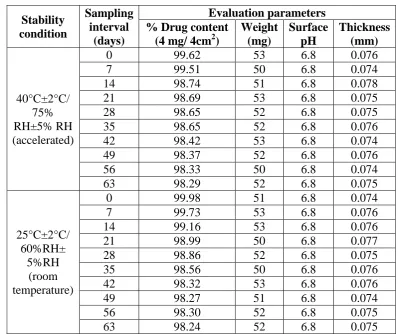
g) Stability study
Stability study of optimized film formulation was carried out for two month at 40°C±2°C/
75% RH±5% RH (accelerated) and 25°C±2°C/ 60%RH± 5%RH (room temperature).
RESULTS AND DISCUSSION
On the basis of solubility studies, combinations of five solubilizer’s aqueous blends were
selected for dissolving drug because of low individual toxicity of solubilizer and achieved
desired required solubility of drug described in table 7 & 8. For formulation development
HPMC E5 (15% w/v & 20% w/v), propylene glycol (15% v/v) and crospovidone (0.4% w/v)
were optimized and selected on the basis of mechanical properties and disintegration time of
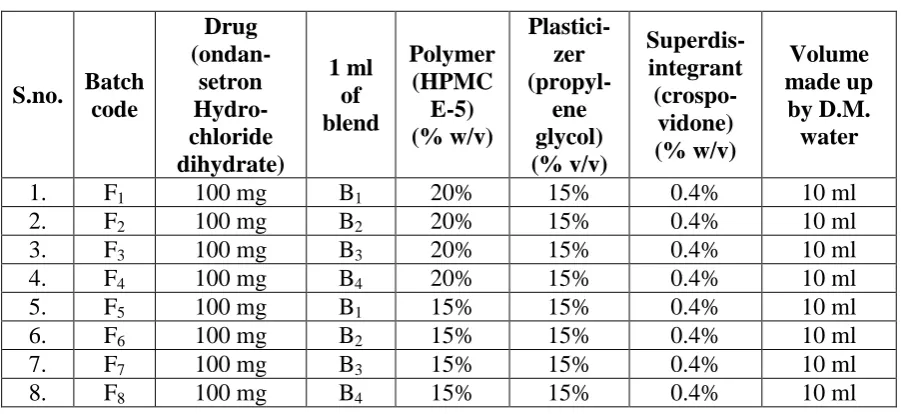
film. Eight batches of optimised formulation were made described in table 9. Evaluations of
eight batches were performed described in table 10 & fig 1, 2, 3. Among eight batches, F6
batch showed better evaluation results and was selected for stability studies. It was found to
be stable for 2 months described in table 11. F6 batch was compared with the marketed
formulation (Emifilm 4 mg ) and was found to be comparable with the parameters of
marketed formulation described in table 12 & fig 4, 5 whereas the area of formulated film F6
[image:7.595.69.532.653.774.2](4mg/4cm2) was half of the area of marketed film product (4mg/8cm2).
Table 1: Calibration curve of ondansetron hydrochloride dihydrate in different media.
S.no. Media Regression equation Correlation coefficient
1. D.M. water y = 0.048x + 0.010 R² = 0.997
2. Phosphate buffer of pH 6.8 y = 0.049x + 0.008 R² = 0.999
3. 0.1 N HCl y = 0.049x + 0.000 R² = 0.999
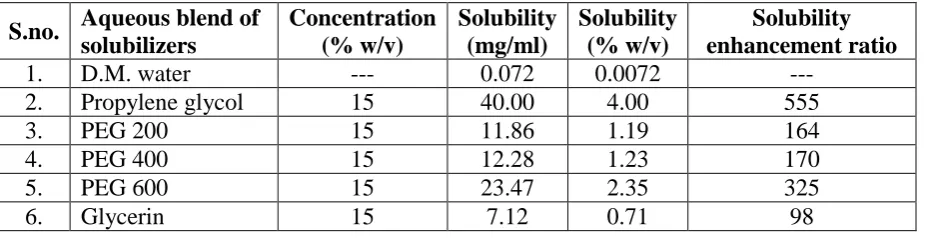
Table 2: Solubility of drug in aqueous solutions containing liquid solubilizers.
S.no. Aqueous blend of solubilizers
Concentration (% w/v)
Solubility (mg/ml)
Solubility (% w/v)
Solubility enhancement ratio
1. D.M. water --- 0.072 0.0072 ---
2. Propylene glycol 15 40.00 4.00 555
3. PEG 200 15 11.86 1.19 164
4. PEG 400 15 12.28 1.23 170
5. PEG 600 15 23.47 2.35 325
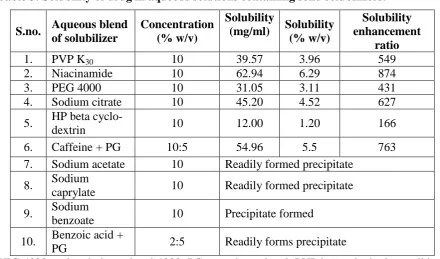
Table 3: Solubility of drug in aqueous solutions containing solid solubilizers.
S.no. Aqueous blend of solubilizer
Concentration (% w/v)
Solubility
(mg/ml) Solubility (% w/v)
Solubility enhancement
ratio
1. PVP K30 10 39.57 3.96 549
2. Niacinamide 10 62.94 6.29 874
3. PEG 4000 10 31.05 3.11 431
4. Sodium citrate 10 45.20 4.52 627
5. HP beta
cyclo-dextrin 10 12.00 1.20 166
6. Caffeine + PG 10:5 54.96 5.5 763
7. Sodium acetate 10 Readily formed precipitate
8. Sodium
caprylate 10 Readily formed precipitate
9. Sodium
benzoate 10 Precipitate formed
10. Benzoic acid +
PG 2:5 Readily forms precipitate
PEG 4000- poly ethylene glycol 4000, PG-propylene glycol, PVP k30- polyvinyl pyrrolidone
grade k30.
Table 4:Solubility of drug in aqueous solutions containing two solubilizers.
S.no. Aqueous blend of solubilizer
Ratio of solubilizer concentration
(% w/v)
Solubility
(mg/ml) Solubility (% w/v)
Solubility enhancement
ratio
1. PG + PVP K30 15:15 71.00 7.10 986
2. PG + NM 15:20 150.02 15.00 2083
3. PG + HP beta
cyclo-dextrin 15:10 52.43 5.24 727
4. PG + SC 15:10 85.62 8.56 1188
5. PG + caffeine 15:5 94.72 9.47 1315
6. PG + PEG
4000 15:10 69.08 6.91 959
PEG 4000- poly ethylene glycol 4000, PG-propylene glycol, NM-niacinamide, PVP k30
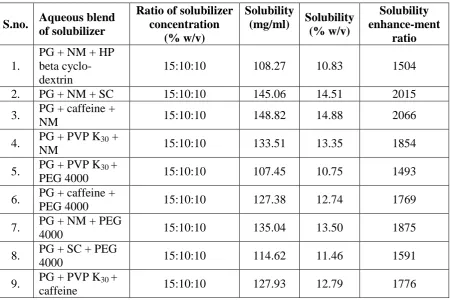
Table 5:Solubility of drug in aqueous solutions containing three solubilizers.
S.no. Aqueous blend of solubilizer
Ratio of solubilizer concentration
(% w/v)
Solubility
(mg/ml) Solubility (% w/v)
Solubility enhance-ment
ratio
1.
PG + NM + HP beta cyclo-dextrin
15:10:10 108.27 10.83 1504
2. PG + NM + SC 15:10:10 145.06 14.51 2015
3. PG + caffeine +
NM 15:10:10 148.82 14.88 2066
4. PG + PVP K30 +
NM 15:10:10 133.51 13.35 1854
5. PG + PVP K30 +
PEG 4000 15:10:10 107.45 10.75 1493
6. PG + caffeine +
PEG 4000 15:10:10 127.38 12.74 1769
7. PG + NM + PEG
4000 15:10:10 135.04 13.50 1875
8. PG + SC + PEG
4000 15:10:10 114.62 11.46 1591
9. PG + PVP K30 +
caffeine 15:10:10 127.93 12.79 1776
PEG 4000- poly ethylene glycol 4000, PG-propylene glycol, NM-niacinamide, PVP k30
[image:9.595.72.524.458.718.2]-polyvinyl pyrrolidone grade k30, SC-sodium citrate.
Table 6: Solubility of drug in aqueous solutions containing four solubilizers.
S.no. Aqueous blend of solubilizer Ratio of solubilizer concentration (% w/v) Solubility
(mg/ml) Solubility (% w/v)
Solubility enhancement
ratio
1.
PG + HP beta CD+ SC + caffeine
15:5:5:5 90.08 9.01 1251
2.
PG + caffeine +SC + PEG 4000
15:5:5:5 101.61 10.16 1411
3. PG + SC +PEG
4000 + NM 15:5:5:5 112.50 11.25 1562
4.
PG + PEG 4000 + NM + PVP K30
15:5:5:5 104.87 10.49 1456
5.
PG + PEG 4000 + SC + HP beta CD
15:5:5:5 84.13 8.41 1168
PEG 4000- poly ethylene glycol 4000, PG-propylene glycol, NM-niacinamide, PVP k30
Table 7:Solubility of drug in aqueous solutions containing five solubilizers.
S.No. Aqueous blend of solubilizer Ratio of solubilizer concentration (% w/v) Solubilit y (mg/ml) Solubilit y (% w/v) Solubility enhance-ment ratio
1. PG + NM + PVP K30 +
SC + caffeine 15:3:3:3:3 136.33 13.63 1893
2. PG + NM + SC + PVP
K30 + PEG 4000
15:3:3:3:3 94.00 9.40 1305
3. PG + NM + SC +
caffeine + PEG 4000 15:3:3:3:3 134.29 13.43 1865
4. PG + SC + caffeine +
PVP K30 + PEG 4000
15:3:3:3:3 112.67 11.27 1565
5. PG + NM + caffeine +
PVP K30 + PEG 4000
15:3:3:3:3 128.34 12.83 1781
PEG 4000- poly ethylene glycol 4000, PG-propylene glycol, NM-niacinamide, PVP k30
[image:10.595.73.524.494.701.2]-polyvinyl pyrrolidone grade k30, SC-sodium citrate, HPB CD-HP beta cyclo-dextrin.
Table 8: Optimized blend for formulation development.
S.no. Blend name Composition of blends
1. B1 15% PG + 3% NM + 3% SC + 3% caffeine + 3% PEG 4000
2. B2 15% PG + 3% NM + 3% PVP K30 + 3% SC + 3% caffeine
3. B3 15% PG + 3% SC + 3% caffeine + 3% PVP K30 + 3% PEG 4000
4. B4 15% PG + 3% NM + 3% caffeine + 3% PVP K30 + 3% PEG 4000
PEG 4000- poly ethylene glycol 4000, PG-propylene glycol, NM-niacinamide, PVP k30
-polyvinyl pyrrolidone grade k30, SC-sodium citrate.
Table 9: Optimized batch formula of fast dissolving film.
S.no. Batch code Drug (ondan-setron Hydro-chloride dihydrate) 1 ml of blend Polymer (HPMC E-5) (% w/v) Plastici-zer (propyl-ene glycol) (% v/v) Superdis-integrant (crospo-vidone) (% w/v) Volume made up by D.M. water
1. F1 100 mg B1 20% 15% 0.4% 10 ml
2. F2 100 mg B2 20% 15% 0.4% 10 ml
3. F3 100 mg B3 20% 15% 0.4% 10 ml
4. F4 100 mg B4 20% 15% 0.4% 10 ml
5. F5 100 mg B1 15% 15% 0.4% 10 ml
6. F6 100 mg B2 15% 15% 0.4% 10 ml
7. F7 100 mg B3 15% 15% 0.4% 10 ml
Table 10: Evaluation of formulated film batches (n=3).
S.no. Batch code Thickness (mm) ± S.D.
Folding endurance ±S.D.
Disintegration time (sec) ±S.D.
1. F1 0.092 ± 0.04 151±1.27 31±0.52
2. F2 0.088 ± 0.03 156±2.39 27±1.04
3. F3 0.128 ± 0.07 157±1.16 28±0.67
4. F4 0.132 ± 0.05 160±2.23 28±1.02
5. F5 0.112 ± 0.05 155±1.75 30±0.57
6. F6 0.074 ± 0.01 162±2.18 27±0.49
7. F7 0.100 ± 0.02 154±1.54 30±0.15
8. F8 0.091 ± 0.06 157±1.94 29±0.38
Fig. 1: Graphical representation of % cumulative drug release in phosphate buffer of
pH 6.8.
[image:11.595.151.446.479.635.2]Fig. 3: In-vitro dissolution profiles of optimized batch F6.
Table 11: Stability studies of final optimized batch F6.
Stability condition Sampling interval (days) Evaluation parameters % Drug content
(4 mg/ 4cm2)
Weight (mg) Surface pH Thickness (mm) 40°C±2°C/ 75% RH±5% RH (accelerated)
0 99.62 53 6.8 0.076
7 99.51 50 6.8 0.074
14 98.74 51 6.8 0.078
21 98.69 53 6.8 0.075
28 98.65 52 6.8 0.075
35 98.65 52 6.8 0.076
42 98.42 53 6.8 0.074
49 98.37 52 6.8 0.076
56 98.33 50 6.8 0.074
63 98.29 52 6.8 0.075
25°C±2°C/ 60%RH±
5%RH (room temperature)
0 99.98 51 6.8 0.074
7 99.73 53 6.8 0.076
14 99.16 53 6.8 0.076
21 98.99 50 6.8 0.077
28 98.86 52 6.8 0.075
35 98.56 50 6.8 0.076
42 98.32 53 6.8 0.076
49 98.27 51 6.8 0.074
56 98.30 52 6.8 0.075
63 98.24 52 6.8 0.075
Table 12: Evaluation parameter comparison of formulated film and marketed film.
S.No. Evaluation parameter
Formulation comparison Marketed film
(4 mg dose)
Optimized film (F6)
(4 mg dose)
1. Area 2.5×3.2 cm2 i.e. 8cm2 2.0×2.0 cm2 i.e. 4cm2
2. Thickness 0.054 mm 0.075 mm
3. Weight 50 mg 57 mg
4. Percent drug content 100% 98.99%
[image:12.595.96.495.283.617.2]Fig. 4: % Cumulative drug release comparison graphical representation in 0.1 N HCl.
Fig. 5: % Cumulative drug release comparison graphical representation in phosphate
buffer of pH 6.8.
CONCLUSION
The purpose of present research work was to explore the possibility of employing
mixed-solvency concept in the formulation of a poorly soluble drug. Practically
water-insoluble drug, ondansetron hydrochloride dihydrate was tried to be solubilized by employing
the combinations of physiologically compatible solubilizers to endeavor its fast dissolving
formulations.
The aqueous solubility of drug was found to be 0.0072 % w/v which was increased by using
blends of solubilizers of total strength 27% w/v to get expected solubility of drug which is
[image:13.595.150.449.285.458.2]For the development of fast dissolving film, different film forming polymers, plasticizers,
superdisintegrants were tested. According to their mechanical properties and disintegration
time of film, they were selected and optimized. By these ingredients, eight batches of fast
dissolving film containing 4mg dose of drug per 4 cm2 were developed and evaluated.
Amongst these batches, F6 batch showed better in-vitro dissolution profile, disintegration time
and was selected for stability studies. It was found to be stable for 2 months.
After that the prepared film (F6,4mg) was compared with the marketed film (Emefilm, 4mg).
It was found that the prepared film (F6) showed parameters closed to the marketed film like
disintegration time, thickness, % cumulative drug release etc. whereas the area of formulated
film (4mg/4cm2)was half of the area of marketed film product (4mg/8cm2). By decreasing the
area of film it was concluded that the loading of drug got increased.
From all the above studies, it was concluded that the approach of mixed solvency concept is
novel, safe, cost-effective and user friendly. It also eliminates the problem of toxicity
associated with high concentration of water-soluble solubilizers. So, it may be employed in
dosage form development of drugs where fast onset of action is required.
ACKNOWLEDGEMENT
Ondansetron hydrochloride dihydrate bulk drug sample was a generous gift sample by
Modern Laboratories Ltd., Indore, India.
REFERENCES
1. Rao, Raghavendra N. G., Khatoon, N., Reddy, B. M., Overview on fast dissolving oral
films, International Journal of Chemistry and Pharmaceutical Sciences, 2013; 1(1): 63-75.
2. Arya, A., Chandra, A., Sharma, V., Pathak, K., Fast dissolving oral film: an innovative
drug delivery system and dosage form, International Journal of Chem Tech Research,
2010; 2(1): 576-583.
3. Patil, Swapnil L., Mahaparale, Paresh R., Shivnikar, Madhavi A., Tiwari, Shradha S.,
Pawar, K. V., Sane, P. N., Fast dissolving oral film: an innovative drug delivery system,
International Journal of Research and Reviews in Pharmacy and Applied Science, 2013;
2(3): 482-496.
4. Thakur, N., Bansal, M., Sharma, N., Yadav, G., Khare P., Overview on “a novel approach
of fast dissolving films and their patents”, Advances in Biological Research, 2013; 7(2):
5. Gupta, M. M., Patel, M. G., Kedawat, M., Enhancement of dissolution rate of rapidly
dissolving oral film of meclizine hydrochloride by complexation of Meclizine
hydrochloride with β-cyclodextrine, Journal of Applied Pharmaceutical Science, 2011;
1(9): 150-153.
6. Maheshwari, R. K., "Mixed-Solvency" – A novel concept for solubilization of poorly
water-soluble drugs, Journal of Technology and Engineering Sciences, 2009; 1(1): 39-44.
7. Maheshwari R. K. & Rajagopalan R., Solubilization of ibuprofen by mixed solvency
approach. Indian Pharm, 2009; 8: 81-4.
8. Maheshwari RK. "Mixed solvency approach" boon for solubilization of poorly water
soluble drugs. Asian J Pharm, 2010; 1: 60-3.
9. Jain, R., Maheshwari, R. K., George, P., Formulation development and evaluation of
controlled release tablets of lamotrigine using mixed solvency concept, Bulletin of
Pharmaceutical Research, 2015; 5(1): 14-9.
10.Patel, S. K. and Maheshwari, R. K. “Formulation development and evaluation of SEDDS
of poorly soluble drug made by novel application of mixed-solvency concept”,
International Journal of Pharmaceutical Research, 2012; 4: 51-56.
11.Shilpkar, R. and Maheshwari, R. K. “Formulation development and evaluation of
injection of poorly soluble drug using mixed solvency concept”, International Journal of
Pharma and Bio Sciences, 2012; 3: 179-189.
12.Agarwal S. and Maheshwari, R. K. “Formulation development and evaluation of in situ
nasal gel of poorly water soluble drug using mixed solvency concept,” Asian Journal of
Pharmaceutics, 2011; 5(3): 131-140.
13.Solanki, S. S., Soni, L. K., Maheshwari, R. K., Study on mixed solvency concept in
formulation development of aqueous injection of poorly water soluble drug, Journal of
Pharmaceutics, 2013; 4(2): 58-61.
14.Chaklan, N. and Maheshwari, R. K., Novel pharmaceutical application of mixed solvency
for solubility enhancement of piroxicam, development of its solid dispersions and fast
dissolving oral film. S.G.S.I.T.S., Indore., 2009.
15.Rajagopalan, R.,Formulation and evaluation of tinidazole syrup made by mixed solvency
concept, Scholars Research Library, 2012; 4(1): 170-174.
16.Maheshwari, Y., Mishra D. K., Mahajan, S. C., Maheshwari, R. K.,novel pharmaceutical
application of mixed solvency in the formulation development of syrups (liquid oral
solutions) of poorly water-soluble drugs, International Jornal of Pharmacy, 2013; 3(4):
17.Karwande V. K. and Maheshwari, R. K. “Application of novel concept of
mixed-solvency in the design and development of floating microspheres of furosemide,
International Journal of Pharmacy and Pharmaceutical Sciences, 2013; 5: 167-175.
18.Chandna, C. and Maheshwari, R. K., Mixed solvency concept in reducing surfactant
concentration of self emulsifying drug delivery system of candesartan cilexetil using
D-optimal mixture design, Asian Journal of Phamaceutics, 2013; 7: 83-91.
19.Soni L. K., Solanki S. S., Maheshwari R. K., Studies on mixed solvency concept in
formulation development of oral solution (syrup) of poorly water soluble drugs, Journal
of harmonized research in pharmacy, 2015; 4(4): 305-315.
20.Soni L. K., Solanki S. S., Maheshwari R. K., Solubilization of poorly water soluble drug
using mixed solvency approach for aqueous injection, British Journal of Pharmaceutical
Research, 2014; 4(5): 549-568.
21.Maheshwari Yash, Mishra D. K, Mahajan S. C, Maheshwari Prachi, Maheshwari R. K,
Jain V., Novel pharmaceutical application of mixed solvency in the formulation
development of syrups (liquid oral solutions) of poorly water-soluble drugs, International