Abstract—Evaluating and selecting the most suitable ship for a given cargo shipping task is of tremendous importance for organizations in the maritime shipping industry. In practical decision making situations, the multi-dimensional nature of the ship evaluation and selection problem and the imprecise and subjective characteristics of the human decision making process make it difficult for the decision maker (DM) to precisely determine the relative importance of the selection criteria in a given situation. As a result, inconsistent criteria weightings are often produced, which lead to unreliable decisions being made in selecting the most suitable ship for a specific shipping task. This paper proposes an intelligent decision support system (DSS) for effectively assisting the DM in determining the criteria weightings in ship evaluation and selection. An example is presented for demonstrating the applicability of the proposed intelligent DSS for determining the criteria weightings in the ship evaluation and selection process.
Index Terms— Criteria weighting, intelligent decision
support system, imprecision and subjectiveness, ship selection
I. INTRODUCTION
Evaluating and selecting the most suitable ship for a given cargo shipping task is an important activity for organizations in the maritime shipping industry. This is because making effective decisions on this problem greatly helps organizations reduce the maritime shipping risk and improve the overall profitability of these organizations. As a result, selecting the most suitable ship from available ships becomes a critical problem in the global transportation industry [1].
In evaluating and selecting the most suitable ship from various ships available with respect to a specific shipping task, the interests of various stakeholders including the supplier, the customer, the insurance company, and the financial institution have to be considered [1]. These stakeholders usually have different requirements for a given shipping task that directly affect the determination of the
Manuscript received December 13, 2010.
Santoso Wibowo is with the School of Business IT and Logistics at RMIT University, Melbourne, Victoria 3001, Australia (phone: 61-03-8662-0571; fax: 61-03-9925-5823; e-mail: santoso.wibowo @ rmit.edu.au).
Hepu Deng is a Professor with the School of Business IT and Logistics at RMIT University, Melbourne, Victoria 3001, Australia (e-mail: hepu.deng @ rmit.edu.au).
criteria weightings in the ship evaluation and selection process. Adequately determining the criteria weightings for a given situation therefore requires the decision maker (DM) to effectively consider all these task requirements [2].
To evaluate and select the most suitable ship for accomplishing a specific task, existing approaches require the DM to consider all the task requirements simultaneously for determining the criteria weightings. This often places a heavy cognitive burden on the DM due to the limitation on the amount of information that humans can effectively handle [3]. The presence of imprecision and subjectiveness in describing the task requirements further complicates the criteria weighting process. As a result, accurately determining the criteria weights in a consistent manner is complex and challenging.
Much research is conducted on the development of various approaches for criteria weighting in multicriteria analysis (MA) [4]-[6]. Tabucanon [4], for example, proposes a direct ranking and rating approach for criteria weighting. The approach, however, suffers from its inadequacy in modeling the subjectiveness and imprecision of the human decision making process. Shirland et al [5] present a goal programming approach for determining the interval of criteria weightings within which the same ranking of alternatives is produced. This approach, however, requires tedious mathematical computation in the evaluation process. Wang and Luo [6] propose a mathematical programming approach for criteria weighting by considering the standard deviation of each criterion and their corresponding correlation coefficients with the overall assessment of the decision alternatives. However, this approach becomes difficult to manage as the number of criteria increases.
The complexity of the weighting process imposes a great challenge on the DM for assessing the criteria weights consistently due to the multi-dimensional nature of the problem and the presence of imprecision and subjectiveness of the human decision making process. The development of decision support system (DSS) for criteria weighting is therefore desirable for helping the DM solve the evaluation and selection problem. The application of such a DSS would greatly reduce the complexity of the ship evaluation and selection process.
This paper presents an intelligent DSS for effectively assisting the DM in determining the criteria weightings in ship evaluation and selection. Rule-based criteria weighting
Intelligent Decision Support for Criteria
Weighting in Multicriteria Analysis for
Evaluating and Selecting Cargo Ships under
Uncertainty
process is constructed for acquiring the knowledge of experts on criteria weights. An example is presented to demonstrate the applicability of the proposed intelligent DSS for determining criteria weights in the ship evaluation and selection problem.
In what follows, we first describe the ship evaluation and selection problem. We then present a rule-based criteria weighting process for helping the DM evaluate the relative importance of the criteria. This is followed by the development of an intelligent DSS for effectively assisting the DM in determining criteria weights in ship evaluation and selection. Finally we present an example for demonstrating the applicability of the proposed DSS for determining criteria weights in the ship selection problem.
II.THE SHIP SELECTION PROBLEM
The ship evaluation and selection problem is common in the maritime shipping industry. Effectively evaluating and selecting the most suitable ship for a given shipping task is critical for satisfying the increasing expectation of the stakeholders for achieving their organizational performance [7]-[9]. With the increasing globalization and the rapid growth in international seaborne trade exemplified by the growth of almost 70% from 1990 to 2004 [9], cargo shipping becomes increasingly important to all the stakeholders involved in international trade. As a result, evaluating and selecting the most suitable ship for a given shipping task is of critical importance.
The process of evaluating and selecting the most suitable ship is complex and challenging. To assign the most suitable ship to a specific shipping task, the DM needs to evaluate the overall performance of all available ships with respect to the specific conditions of individual ships and the multiple requirements of the given shipping task [1], [3]. With the multi-dimensional nature of the ship evaluation and selection problem, MA provides a systematic framework for solving the shipping evaluation and selection problem.
The ship evaluation and selection process consists of four phases, including (a) identification of the requirements for a specific shipping task, (b) assessment of the task requirements, (c) evaluation of the performance of all the available ships, and (d) selection of the most suitable ship.
Identifying the specific requirements in solving the ship evaluation and selection problem involves in determining the various stakeholders in a given shipping task. Such stakeholders include the supplier, the customer, the insurance company, and the financial institution [1]. They often have different requirements due to the nature of a particular problem under consideration. For example, ship owners are mainly concerned with profitability based on the overall efficiency and performance of the ship [8]. Ship managers are concerned with ensuring that the ship selected complies with international rules and regulations. Ship operators are concerned with ensuring that all ships achieve optimal voyages and efficient cargo operations [9]-[11].
Task requirements are a reflection of the expectations of the stakeholders on a given shipping task assessed subjectively by the DM in the ship evaluation and selection process. For example, the ship operator is more concerned with the type of cargo that is being shipped and places a
much higher weight on the cargo criterion. On the other hand, a ship manager may be concerned with the urgency of delivering the cargo without delay and allocates higher criteria weight on the ship criterion. It is evident that the requirements of the task, reflecting the objectives to be achieved, affect mainly the criteria weightings in the ship evaluation and selection process.
The performance ratings of the ship with respect to each criterion or its associated sub-criterion are usually determined by the DM subjectively. With the determination of the performance rating of individual ships and the criteria weightings, the overall performance of each ship across all the selection criteria and their associated sub-criteria can then be calculated on which the most suitable ship can then be selected.
The ship evaluation and selection problem can usually be formulated as a MA problem. It often involves in the selection of one or more ships from a set of n available ships
Ai(i = 1, 2, ..., n). These ships are to be evaluated based on
m criteria Cj (j = 1, 2, ...,m) with respect to task requirements Tl (l = 1, 2, ...,s).
The ship characteristics (C1) reflect on the subjective assessment of the DM regarding features and specifications of the available ships. This is assessed by the size of the ship, the length of the ship, the width of the ship, and the year of construction.
The route characteristics (C2) reflect the DM’s subjective assessments regarding the destination of travel that the ship is undertaking to deliver the cargo. This is measured by the traffic condition and density, the port of call, and the likelihood of piracy.
The cargo characteristics (C3) are used to reflect the DM’s concerns on the type of cargo to be transported by the ship. This is measured by the level of corrosiveness, the level of explosiveness, the level of toxicity, the level of radioactivity, and the level of flammability of the cargo.
The meteorology characteristics (C4) address the concern of the DM on the weather condition during the ship’s journey. This is assessed from the wind speed, the vision and light, the chance of rain, and the chance of strong wave.
The specific ship task is characterized by four requirements including the ship condition (T1), the destination condition (T2), the cargo condition (T3), and the weather condition (T4). Ship condition is a measure of the DM’s concern of how reliable the ship is in handling the specific task. The destination condition reflects on the DM's concern in regards to the destination that the ship is travelling to. The cargo condition is a reflection of the DM on the safety of the cargo being transported. The weather condition is used to reflect the DM's concerns about the weather during the ship’s journey. These task requirements reflect the DM's concerns in evaluating the performance of ships for a given task.
As a result, inconsistent weights are often produced, which may lead to unreliable decision outcomes [11].
The development of a structured approach for assigning weights consistently with regard to various task requirements is therefore desirable for solving practical ship evaluation and selection problems.
III. RULE-BASED CRITERIA WEIGHTING
The ship evaluation and selection process relies on the subjective judgment of the DM in evaluating the performance of available ships with respect to multiple selection criteria and the relative importance of the selection criteria. As a result, imprecision and subjectiveness are present in the criteria weighting process. To adequately model the imprecision and subjectiveness of the criteria weight process, fuzzy set theory [2], [12] is used.
To represent the knowledge of experienced experts in criteria weighting, a rule based approach is adopted [12]-[13]. This rule based approach for the criteria weighting process is chosen due to its (a) consistency in providing the decision outcome, (b) simplicity of use, and (c) flexibility in specifying the rules. As a result, reliable criteria weights can be determined consistently in a simple and less cognitively demanding manner for the DM in assessing the effect of the task requirements on criteria weights [13].
In this section, the criteria weighting process is modelled by a fuzzy knowledge base, in which fuzzy sets are incorporated into its knowledge representation and reasoning process to formulate the imprecise way the experts communicate their knowledge and make their decisions. The knowledge and experience of experts for handling different conditions are collected and stored in the fuzzy knowledge base, in which no precise data are required. This approach helps reduce the burden of the DM for precise data gathering and manipulation.
In the form of fuzzy rules, knowledge of experts is represented as a set of conditional fuzzy rules. Each fuzzy rule is a conditional statement: IF (fuzzy proposition) THEN (fuzzy proposition) [13]. The rules are expressed in terms of linguistic statements according to the importance of the factors involved in the statement. These IF-THEN rules explicitly reflect the effect of individual task requirements on the weights of individual criteria, and the characteristics of the ship evaluation and selection problem for handling the ship evaluation and selection problem. Each rule takes the form of: IF <requirement> THEN <outcome> where
requirement describes the requirements of the DM and the
characteristics of the ship evaluation and selection problem,
and outcome represents the most suitable outcome.
The fuzzy knowledge base determines the criteria weights of available ships (the output variable) in relation to a specific task (the input variables). The input linguistic variables (fuzzy conditions) to the fuzzy knowledge base are ship condition (T1), the destination condition (T2), the cargo condition (T3), and the weather condition (T4). These conditions are dependent and have to be considered simultaneously. All these four fuzzy conditions are to be judged by the knowledge and observations of the experts.
Fuzzy numbers can have a variety of shapes. A triangular
or a trapezoid form often provides an adequate representation of the expert knowledge, and significantly simplifies the computational process [11]. In practical applications, the triangular or trapezoid form of the membership function is used most often for representing fuzzy numbers [12].
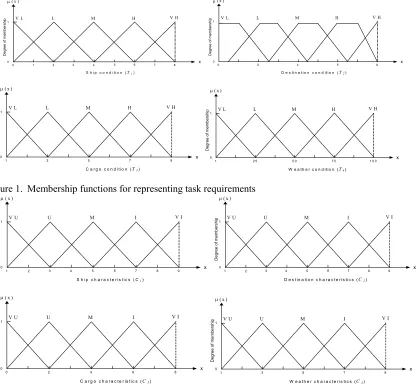
For computational efficiency and ease of data acquisition, triangular fuzzysets are used to describe the linguistic terms used in fuzzy rules. These linguistic terms are used (a) to describe the states of the corresponding task requirement, and (b) to represent the weights of the corresponding criterion. Membership functions of the term set {Very Low (VL), Low (L), Medium (M), High (H), Very High (VH)} shown in Figure 1 are used to describe the states of task requirements, obtained through extensive consultations with the industry experts. Figure 2 shows the linguistic terms and their corresponding triangular fuzzy numbers for the DM to elicit criteria weights.
Based on Table I, fuzzy rules can be generated using IF-THEN statements to assist the DM in determining the criteria weights in relation to a specific task requirement. For example, Rule 1 is IF Task requirements T1 is VL AND T2 is VH AND T3 is VH AND T4 is VH THEN C1 is U AND C2 is VI AND C3 is VI AND C4 is VI. Rule 15 is IF Task requirements T1 is L AND T2 is M AND T3 is VH AND T4 is VH THEN C1 is U AND C2 is M AND C3 is VI AND C4 is M. These fuzzy rules are easily understood and can be readily modified to reflect a specific problem situation.
A set of fuzzy rules is constructed through extensive consultations with the industry experts. These rules specify the relationship between individual task requirements and the weights of the four criteria. A set of 21 fuzzy rules is constructed for determining the criteria weights with respect to specific task requirements as shown in Table I.
To illustrate the effectiveness of the fuzzy rules for determining the criteria weights of available ships in relation to a specific task requirement, an example is presented in Section 5.
IV. AN INTELLIGENT DECISION SUPPORT SYSTEM A DSS is an interactive, flexible, and adaptable computer-based information system, specially developed for supporting the solution of a non-structured management problem for improving the effectiveness of human decision making. It utilizes data, provides an easy-to-use interface, and allows for the DM’s own insight [14].
The DSS provides the DM with effective mechanisms to better understand the decision problem and the implications of their decision behaviors by allowing them to interactively exchange information between the system and themselves [15]. Due to the diversity and complexity of the selection criteria, their inter-relationships, and the volume of information available, the DSS has to be efficient, effective and flexible for effectively solving the practical multicriteria decision problem.
manner by allowing the DM to input values to express his/her requirements, and fully explore the relationships between the task requirements, criteria weights, and the available ships in the selection process. Through interactive exchange of information between the DM and the DSS, the
system can help the DM adopt a problem-oriented approach in the ship evaluation and selection process [15]. This problem-oriented approach is vital for effectively and efficiently solving the ship evaluation and selection problem in an organization.
µ( x )
x
V L L M H V H
1
0
0 2 4 6 8
D e g re e o f m e m b e rs h ip
1 3 5 7
S h i p c o n d i t i o n (T1)
µ( x )
x
V L L M H V H
1
0
0 2 4 6 8
D e g re e o f m e m b e rs h ip
D e s t i n a t i o n c o n d i t i o n (T2)
µ( x )
x
V L L M H V H
1
0
1 3 5 7 9
C a r g o c o n d i t i o n (T3)
D e g re e o f m e m b e rs h ip
µ( x )
x
V L L M H V H
1
0
1 2 5 5 0 7 5 1 0 0
W e a t h e r c o n d it io n (T4)
D e g re e o f m e m b e rs h ip
Figure 1. Membership functions for representing task requirements
µ( x )
x
V U U M I V I
1
0
1 3 5 7 9
D e g re e o f m e m b e rs h ip
2 4 6 8
S h ip c h a r a c t e r is t i c s (C1)
µ( x )
x
V U U M I V I
1
0
1 3 5 7 9
D e g re e o f m e m b e rs h ip
2 4 6 8
D e s t in a t io n c h a r a c t e r i s t ic s (C2)
µ( x )
x
V U U M I V I
1
0
0 2 4 6 8
C a r g o c h a r a c t e r is t i c s (C3)
D e g re e o f m e m b e rs h ip
µ( x )
x
V U U M I V I
1
0
1 3 5 7 9
W e a t h e r c h a r a c t e r is ti c s (C4)
D e g re e o f m e m b e rs h ip
Figure 2. Membership functions for representing individual criteria weights Table I A Summary of the Fuzzy Rules for
Determining Criteria Weights
Rule IF THEN
T1 T2 T3 T4 C1 C2 C3 C4
1 VL VH VH VH U VI VI VI
2 VH VL VH VH VI U VI VI
3 VH VH VL VH VI VI U VI
4 VH VH VH VH VI VI VI VI
5 H H H H I VI I I
6 M M M M M M M M
7 VL VL VL VL VU VU U U
8 VL L M H VU U I I
9 L VL VH M U VU VI M
10 M H VL VH M I U VI
11 VH L H VL VI I I U
12 H VH L L I VI U M
13 L M VH L U M VI M
14 M L L VH I U M VI
15 VH H M H VI I M I
16 L M H L U M I M
17 L H L VH U I U VI
18 H L VH L I U VI M
19 L L H L U U VI I
20 L H L L U I U M
21 L L L L U VU U U
The proposed DSS consists of six sub-systems, namely, (a)
the knowledge base sub-system, (b) the working memory sub-system, (c) the inference engine sub-system, (d) the user interface system, (e) the knowledge acquisition sub-system, and (f) the explanation sub-system. The knowledge base sub-system comprises of a database and a rule base. The database contains the membership functions which provide flexibility in modeling commonly used linguistic terms, such as “the ship condition is low” or “the weather condition is very high.” These linguistic terms are often used by the DM in assessing the specific requirements of a given shipping task. The rule base contains a set of linguistic statements with antecedents and consequents, respectively, connected by AND operator. The knowledge base stores the knowledge and experience acquired from experts for the particular area of expertise. These knowledge and experience are represented in the form of IF-THEN rules.
[image:4.595.60.479.115.499.2]data/information to other system components. For instance, during the execution of a decision support scenario, if the DM requires specific information about the specification of a particular ship, the data management system is the one that coordinates the acquisition and delivery of the summarized data to the requesting sub-system in the required format.
The working memory sub-system stores the input data and the information generated through processing rules. The inference engine performs the function of the reasoning mechanism, which is usually called fuzzy reasoning. This fuzzy reasoning is used to derive conclusions from a set of fuzzy IF-THEN rules and from one or more given conditions [13] which leads to the determination of the criteria weights.
The user interface sub-system serves to integrate various other sub-systems as well as to be responsible for user friendly communications between the DSS and the DM. This sub-system provides the means for the DM to interface with the DSS and to (a) access the database, data warehouse, and knowledge base; (b) input information such as the task requirements and the available ships; (c) display and evaluate ships decisions; and (d) view output displays. To provide flexibility for the DM, the interface is designed in such a way that the DM can create, modify or eliminate task requirements, criteria, and ships [15].
In the knowledge acquisition sub-system, a human expert interacts with the system to create a knowledge base of what he/she knows in a particular subject area. The knowledge acquisition facility provides the DM with appropriate tools during the knowledge acquisition process. Finally the explanation sub-system allows the system to present its reasoning to the DM regarding its conclusions.
The explanation sub-system is to enable the system display the motivation for all of its actions and conclusions to the DM. The purpose of this sub-system is to explain to the DM how it reached those conclusions.
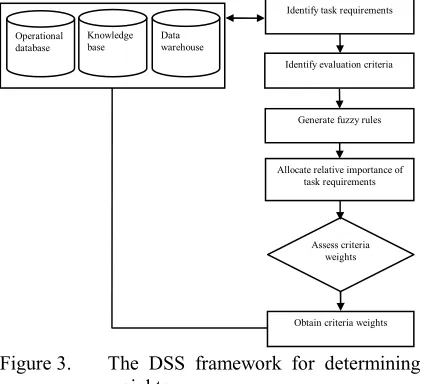
The application of the proposed DSS consists of three phases, including: (a) identification of the requirements including task requirements, criteria, available ships, and defining the membership functions, (b) construction of fuzzy rules, and (c) determination of criteria weights of ships with respect to each criterion. Figure 3 shows the overall DSS framework for solving the ship decision problem.
The first phase starts with the collection and compilation of a list of task requirements, criteria, and available ships based on in-depth interviews with industry experts. For ease of data acquisition and computational efficiency, triangular fuzzy numbers are used to represent linguistic terms.
The next phase is the construction of fuzzy rules. The DSS makes decisions and generate output values based on knowledge provided by the expert in the form of IF-THEN rules. The number of input variables and their associated membership functions determine the number of rules.
This is followed by the determination of the relative importance of task requirements in relation to a specific task. In practical applications, all the assessments with respect to criteria importance and alternative performance are not always fuzzy. Both crisp and fuzzy data are often present simultaneously in a specific MA problem [15]. Each performance ratings of ship can be assigned as crisp numbers or linguistic terms depending on the preference of
[image:5.595.305.516.249.441.2]the DM. To maintain the effectiveness of data evaluated, crisp numbers can be used to represent the DM’s quantitative assessments. Linguistic terms are available for use to the DM with a need to know their corresponding fuzzy representations. In case the DM is not sure which linguistic values should be chosen, a defaulted linguistic value is presented. If the terms used in the scale are different from the terms the DM wants to use for criteria weighting, the proposed DSS tries to match the scale that the DM wants with an existing scale in the knowledge base according to the number of terms used. Therefore, even the verbal terms used in our knowledge base are in the universe U = {excellent, very high, high to very high, high, fairly high, medium, fairly low, low, low to very low, very low, none} can easily be adjusted to accommodate the nature of the decision making process.
Figure 3. The DSS framework for determining criteria weights
The final phase evaluates the input values given by the DM. This phase is designed to determine the criteria weights for a given shipping task in a specific situation. The most suitable outcome that fulfils the task requirements of the DM in a specific problem situation will then be recommended to the DM. This leads to effective decisions being made based on the recommendation by the DSS supported by valuable explanation from the DSS [15].
V.EXAMPLE
An example is presented to demonstrate the applicability of the proposed intelligent DSS for determining criteria weights in the ship selection problem. The hierarchical structure of the problem is shown in Figure 4.
The ship evaluation and selection process starts with the DSS instructing the DM to enter the set of task requirements and criteria to be used for determining the criteria weights in solving the ship evaluation and selection problem. In this case, the DM enters four task requirements (T1, T2, T3, and
T4) and four criteria (C1, C2, C3, and C4).
The system then requests the DM to enter the subjective assessments of task requirements for each ship. To facilitate the making of subjective assessments, the term set {Very Low (VL), Low (L), Medium (M), High (H), Very High (VH)} is used to denote the fuzzy values, whose membership functions are given in Figure 1.
Identify task requirements
Allocate relative importance of task requirements Identify evaluation criteria
Generate fuzzy rules
Obtain criteria weights Assess criteria
weights Knowledge
base
Data warehouse Operational
Level 1 Cargo Ship Evaluation and Selection
Level 2 C1 C2 C3 C4
Criteria
Level 3 C11 C12 C13 C14 C21 C22 C23 C31 C32 C33 C34 C35 C41 C42 C43 C44
Sub-criteria
Level 4
Cargo ships A1 A2 A3 A4 A5
Legend:
C1: Ship Characteristics, C2: Route Characteristics, C3: Cargo Characteristics, C4: Meteorology Characteristics. C11: Size of the ship C12: Length of the ship
C13: Width of the ship C14: Year of construction C21: Traffic condition and density C22: Port of call
C23: Likelihood of piracy
C31: Level of corrosiveness C32: Level of explosiveness
C33: Level of toxicity C34: Level of radioactivity C35: Level of flammability
C41: Wind speed C42: Vision and light C43: Chance of heavy rain C44: Chance of strong wave
A1: Ship 1 A2: Ship 2 A3: Ship 3 A4: Ship 4
[image:6.595.46.255.50.265.2]A5: Ship 5
Figure 4. Hierarchical structure for cargo ship evaluation and selection
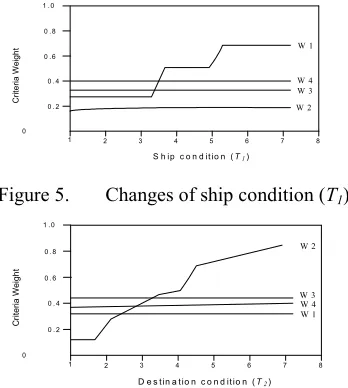
In this case, the DM decides to test the impact of two task requirements (a) Ship condition (T1) and (b) Destination condition (T2) on the criteria weights. This is carried out by adjusting one task requirement at a time while keeping the other task requirements unchanged. The states of the two task requirements are changed from the lowest to the highest and from the highest to the lowest respectively. In case of condition changes from the lowest to the highest, the ship condition is increased from 0 (VL) to 8 (VH), and the destination condition is increased from 0 (VL) to 8 (VH).
Based on the information provided by the DM, the IF-THEN rules explicitly determine the criteria weights of ships based on the requirements of the DM. Figures 5 and 6 show the impact of the changes of two task requirements (a) Ship condition (T1) and (b) Destination Condition (T2) on the criteria weights in the simulation. It can be observed from Figures 5 and 6 that individual task requirement plays an important role in determining criteria weights in solving the ship evaluation and selection problem.
W 3 W 2 W 1
W 4
1 . 0
0 0 . 2
3 5 7
C
ri
te
ri
a
W
e
ig
h
t
2 4 6 8
S h i p c o n d i t i o n (T1) 1
[image:6.595.48.222.528.722.2]0 . 4 0 . 6 0 . 8
Figure 5. Changes of ship condition (T1)
W 3 W 2
W 1 W 4
1 . 0
0 0 . 2
3 5 7
C
ri
te
ri
a
W
e
ig
h
t
2 4 6 8
D e s t in a t io n c o n d it io n (T2) 1
0 . 4 0 . 6 0 . 8
Figure 6. Changes of destination condition (T2)
This intelligent DSS is capable of assisting the DM in determining the criteria weights of the selection criteria in an effective and systematic manner. These criteria weights are
then used for generating an overall performance index for each ship across all criteria, on which the final decision of the most suitable ship is made.
VI. CONCLUSION
This paper has presented an intelligent DSS for effectively assisting the DM in determining the criteria weightings in ship evaluation and selection. A fuzzy knowledge base is constructed for acquiring the knowledge of experts in criteria weighting.
An example is presented for demonstrating the applicability of the proposed intelligent DSS framework. The example shows that the proposed DSS framework has a number of advantages for determining criteria weights in the ship evaluation and selection problem including (a) its simplicity and comprehensibility of the underlying concept, (b) its consistencies in deriving the criteria weights, and (c) its ability to adequately handle the subjectiveness and imprecision of the weighting process.
REFERENCES
[1] A. Kandakoglu, M. Celik, and I. Akgun, “A multi-methodological approach for shipping registry selection in maritime transportation industry,” Mathematical and Computer Modelling, vol. 49, pp. 586-597, 2009.
[2] H. Deng, C. H. Yeh, and R. J. Willis, “Inter-Company Comparison Using Modified TOPSIS with Objective Weights,” Computers and
Operations Research, vol. 27, pp. 963-973, 2000.
[3] H. Deng, and S. Wibowo, “Fuzzy Approach to Selecting Information Systems Projects,” in Proceedings of the 5th ACIS International Conference on Software Engineering, Artificial Intelligence,
Networking and Parallel/Distributed Computing, Beijing, China, 30
June-2 July 2004.
[4] M.T. Tabucanon, Multiple Criteria Decision Making in Industry. New York: Elsevier, 1988.
[5] L. E. Shirland, R. R. Jesse, R. L. Thompson, and C. L. Iacovou, “Determining attribute weights using mathematical programming,”
Omega, vol. 31, pp. 423-437, 2003.
[6] Y. M. Wang, and Y. Luo, “Integration of correlations with standard deviations for determining attribute weights in multiple attribute decision making,” Mathematical and Computer Modelling, vol. 51, pp. 1-12, 2010.
[7] C. C. Chung, and C. C. Hwang, “Analysis on vessel registration and operational performance of bulk-shipping firms,” in Proceedings of
the Eastern Asia Society for Transportation Studies, pp. 631-646,
2005.
[8] J. F. Balmat, F. Lafont, R. Maifret, and N. Pessel, “MAritime RISk Assessment (MARISA), a fuzzy approach to define an individual ship risk factor,” Ocean Engineering, vol. 36, pp. 1278-1286, 2009. [9] United Nations Conference on Trade and Development, 2006.
Review of Maritime Transport 2006, http://www.unctad.org/en/docs/rmt2006_en.
[10] M. Stopford, Maritime Economics. 3rd edition, New York: Routledge, 2008.
[11] C. H. Yeh, H. Deng, and Y. H. Chang, “Fuzzy Multicriteria Analysis for Performance Evaluation of Bus Companies,” European Journal
of Operational Research, vol. 126, pp. 1-15, 2000.
[12] H. J. Zimmermann, “An application-oriented view of modeling uncertainty,” European Journal of Operational Research, vol. 122, pp. 190-198, 2000.
[13] T. P. Hong, K. Y. Lin, and S. L. Wang, “Fuzzy data mining for interesting generalized association rules,” Fuzzy Sets and Systems, vol. 138, pp. 255-269, 2003.
[14] E. Turban, and J. Aronson, Decision Support Systems and Intelligent
Systems, 8th ed., New Jersey: Prentice Hall, 2000.
[15] S. Wibowo, and H. Deng, “Consensus-Based Decision Support for Supplier Selection in Multi-criteria Group Decision Making,” in
Proceedings of the 10th International Conference on Intelligent
Technologies (InTech 2009), Guilin, China, 12 December - 15