Abstract—PCR-CTPP (Polymerase chain reaction with confronting two-pair primers) is a simple SNP genotyping method with time- and cost-effective. Many SNPs have been successfully genotyped by PCR-CTPP. However, the design of feasible PCR-CTPP primer sets is still challenging. In this study, we propose a FAPSO (fuzzy adaptive particle swarm optimization)-based method to design feasible PCR-CTPP primer sets. Two hundred and eighty-eight SNPs which exclude the deletion/insertion polymorphism (DIP) and multi-nucleotide polymorphism (MNP) in SLC6A4 gene were tested in silicon by the proposed method. The results shown the proposed method provides more feasible PCR-CTPP primers than a native PSO (particle swarm optimization)-based method. In conclusion, the FAPSO-based method is useful to assist the biologists and researchers to design feasible CTTP primer sets.
Index Terms—PCR-CTPP, FAPSO, PSO, SNP
I. INTRODUCTION
NPs (Single Nucleotide Polymorphisms) are usually used in association studies of diseases and cancers due to its great quantity. Many high-throughput platforms of SNP genotyping such as real-time PCR (polymerase chain reaction) [1] and SNP array [2] have been introduced to validate SNPs or novel mutations by some laboratories, but the PCR-restriction fragment length polymorphism (RFLP) genotyping [3-5] is still favorite due to its inexpensive for the small-scale genotyping. However, the PCR-RFLP is usually long digestion time in 2-3 hours for restriction enzymes [6, 7].
Recently, a restriction enzyme-free SNP genotyping technique [8, 9] was developed named PCR with confronting two-pair primers (PCR-CTPP). PCR-CTPP genotyped many SNPs successfully, such as interleukin-1B (IL-1B) C-31T, interleukin-2 (IL-2) -330G, beta2-adrenergic receptor (beta2-AR) Gln27Glu, aldehyde dehydrogenase 2 (ALDH2) [10], pylori-induced gastric atrophy [11], severe coronary artery disease [12], and esophageal cancer risk [13]. PCR-CTPP is suitable and reliable for most cases of SNPs.
Manuscript received December 30, 2011. This work was supported in part by the National Science Council in Taiwan under grants
NSC99-2622-E-151-019-CC3, NSC99-2221-E-151-056-, NSC100-2221-E-151-049-MY3, and NSC100-2221-E-151-051-MY2.
Yu-Huei Cheng is with the Department of Network Systems, Toko University, Chiayi, Taiwan (e-mail: [email protected]).
Li-Yeh Chuang is with the Department of Chemical Engineering & Institute of Biotechnology and Chemical Engineering, I-Shou University, Kaohsiung, Taiwan (email: [email protected])
Cheng-Hong Yang is with the Department of Electronic Engineering, National Kaohsiung University of Applied Sciences, and Department of Network Systems, Toko University, Chiayi, Taiwan (e-mail: [email protected]).
However, the lack of an effective computation method for designing feasible PCR-CTPP primer sets.
In the past, we have introduced a genetic algorithm to design available PCR-CTPP primer sets [14, 15]. However, thecomputational results still need to be improved, especially the factor of Tm (melting temperature) difference. PCR-CTPP
primers are only tolerant of a small difference in melting temperature between the four primers [16]. The fuzzy adaptive particle swarm optimization (FAPSO) [17] is therefore proposed to apply to the problem.
II. METHOD
Particle swarm optimization (PSO) developed by Kennedy and Eberhart is a population-based stochastic optimization technique [17]. PSO simulates the social behavior of organisms, such as birds in a flock or fish in a school. In a PSO, each single candidate solution is described as "an individual bird of the flock", that is, a particle in the search space. Each particle finds the better solution using its own memory as well as knowledge gained by the swarm. Each particle has a fitness value evaluated by an optimized fitness function and a velocity directs the movement of the particles. During movement, each particle adjusts its position in terms of its own experience and the experience of a neighbouring particle, thus making the best position encounter. PSO has been successfully applied in many fields, such as function optimization, artificial neural network training, and fuzzy system control. A comprehensive survey of PSO algorithms and their applications can be found in Kennedy et al. [18]. However, a fixed inertia weight or linearly decreasing inertia weight used in PSO simplifies the complex non-linear search process [19, 20]. In order to balance the global and local search ability of PSO, a fuzzy system adapts the inertia weight of PSO dynamically had been implemented [21]. In this paper, we introduced the fuzzy adaptive PSO (FAPSO) for the design of PCR-CTPP primer sets. The problem definition and the proposed method of PCR-CTPP primer design is described below in detail.
A. Problem formulation
Let TD be the DNA template sequence composed of nucleotidecodes with an identified SNP. TD is defined as:
SNP} of code IUPAC !
, 1
sequence, DNA
of index the is | {
∈ ∃ ≤ ≤ =
i i
D
B i
i B T
ι (1)
where Bi is the regular nucleotide code (‘A’, ‘T’, ‘C’, or ‘G’) mixed with a single IUPAC code of SNP (‘M’, ‘R’, ‘W’, ‘S’, ‘Y’, ‘K’, ‘V’, ‘H’, ‘D’, ‘B’ or ‘N’) ( ! ∃ is the symbol for existence and uniqueness).
Fuzzy Adaptive
Particle Swarm Optimization for
Confronting Two-Pair Primer Design
Yu-Huei Cheng, Li-Yeh Chuang, and Cheng-Hong Yang, Member, IAENG
The PCR-CTPP primer design is to find two available short sequences in TD based on a defined SNP site as illustrated (Fig. 1). The forward primer 1 (Pf1) is a short sense
sequence in the upstream (5’ end) of TD far from a defined SNP site; the reverse primer 1 (Pr1) is a short antisense
sequence which contains a nucleotide (the minor allele in the defined SNP site) located at its 3’ end; the forward primer 2 (Pf2) is a short sense sequence which contains a nucleotide
(the major allele in the defined SNP site) located at its 3’ end, and the reverse primer 2 (Pr2) is the antisense sequence in the
downstream of TD far from a defined SNP site. These four primers are defined as follows:
}
, of index the is |
{ 1 e1
1 B i T F i F
Pf = i D s ≤ ≤ (2)
} ,
of index the is |
{ 1 e1
1 B i T R i R
Pr = i D s ≤ ≤ (3)
} ,
of index the is |
{ 2 e2
2 B i T F i F
Pf = i D s ≤ ≤ (4)
} ,
of index the is |
{ 2 e2
2 B i T R i R
Pr = i D s ≤ ≤ (5)
where both Pf1/Pr1 and Pf2/Pr2 are two sets of primer pairs. Fs1
vs. Fe1 and Rs1vs.Re1 indicate the start index vs. the end index
of Pf1 and Pr1 in TD, respectively. Fs2vs. Fe2 and Rs2vs.Re2
indicate the start index vs. the end index of Pf2 and Pr2 in TD,
respectively. Bi is the complementary nucleotide of Bi,
which is described in formula (1).
The SNP site defined at the 3’ end positions of Pf2 and Pr1
indicated by the symbols Fe2 and Rs1 in Fig. 1, respectively. A
vector (v) with Fl1, Pl1, Rl1, Fl2, Pl2 and Rl2 is used to represent
a PCR-CTPP primer set. This vector is defined as follows: Pv = (Fl1, Pl1, Rl1, Fl2, Pl2, Rl2) (6)
Fl1, Pl1, Rl1, Fl2, Pl2 and Rl2 represent the number of
nucleotides of the forward primer 1, product length between Pf1 and Pr1, reverse primer 1, forward primer 2, product
length between Pf2 and Pr2 and reverse primer 2, respectively.
Consequently, the forward and the reverse primers can be calculated from Pv. Pv is used to perform evolutionary computations as described in the following sections.
B. PCR-CTPP design method
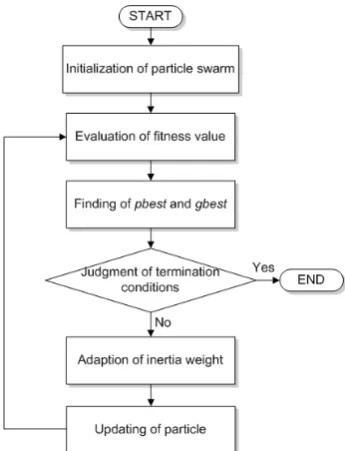
The flowchart of the proposed method is shown as Fig. 2.
The proposed method consists of six processes: (1) initialization of particle swarm, (2) evaluation of fitness value, (3) finding of pbest and gbest, (4) judgment of termination conditions, (5) adaption of inertia weight, and (6) updating of particle, are described below.
(1) Initialization of particle swarm
To start the algorithm, particles Pv = (Fl1, Pl1, Rl1, Fl2, Pl2,
Rl2) of particular number are randomly generated for an
initial population without duplicates. Fl1, Rl1, Fl2 and Rl2 are
randomly generated between the minimum and the maximum length of the primer length constraint. The minimum and maximum primer length constraints are set to between 16 bp and 28 bp, respectively. The PCR product lengths, Pl1 and Pl2
are randomly generated between 100 bp and δ1, and between
100 bp and δ2, respectively. (δ1 and δ2 are maximum tolerant
PCR product length of Pl1 and Pl2 shown in Fig.1)
(2) Evaluation of fitness value
The fitness value in the fitness function is used to individually ascertain that a particle (i.e., solution) is either good or bad. We use formula (7) [14] to evaluate the fitness values of all particles in the population for related operations later.
Fitness(Pv) = 3 × (Lendiff(Pv) + GCproportion(Pv) + GCclamp(Pv)) + 10 × (dimer(Pv)+ hairpin(Pv) + specificity(Pv)) + 50 × (Tm(Pv) + Tmdiff(Pv)) + 100 * Avg_Tmdiff(Pv) + 60 * PCRlenratio(Pv)
(7)
[image:2.595.337.510.50.276.2]The weights (3, 10, 50, 60 and 100) of the fitness function are applied to estimate the importance of the primer Fig. 1. Parameters of the DNA template and the PCR-CTPP primer set.
[image:2.595.45.293.54.150.2]Symbols indicate: F: Forward primer; R: Reverse primer; s: Start nucleotide position; e: End nucleotide position; P: Length of PCR product using a primer set (F/R); l: Length of primer or product;ι: Length of DNA template; δ1: Length from the Rs1 end to downstream of DNA template; δ2: Length from Fs2 to the downstream end of DNA template.
constraints. These weights are set by the experiential conditions for PCR-CTPP. They also accept adjustment based on the experimental requirements. The respective function is described as follows:
Primer length
A feasible primer length for a PCR experiment is set between 16 nt and 28 nt. Since the random values of Fl1, Rl1, Fl2 and Rl2 have been limited by the constraint condition, the primer length estimation does not be considered to join to the fitness function. A length difference (Lendiff) less than or equal to 3 bp between the Fl1/Rl1, Fl2/Rl2, and Fl1/Rl2 primer
sets is considered optimal. The Lendiff(Pv) function is used to judge the constraint.
GC content
In general primer design, the typical GC proportion constraint is set between 40% and 60%. However, the designed PCR-CTPP primers contain the target SNP limiting the range of the GC proportion. To relax this constraint, the constraint of GC proportion in a primer is adjusted to between 20% and 80%. The GCproportion(Pv) function is proposed to lead the GC proportion of PCR-CTPP primers corresponding this constraint.
GC Clamp
To meet the presence of ‘G’ or ‘C’ at the 3’ terminal of a primer to ensure a tight localized hybridization bond, the GCclamp(Pv) function is proposed to meet the criterion. Melting temperature
The melting temperature (Tm) for each PCR-CTPP primer
must be considered carefully for PCR experiment. The Tm
calculation formula for a primer is described as follows: TmBM(P) = 81.5 + 16.6 * (log10[Na+])
+ 0.41 * (GC%) – 675 / | P | (8) where P represents a primer and | P | represents the length of primer P; Na+ is the molar salt concentration. The suffix BM
represents the formula which was proposed by Bolton and McCarthy [22].
The Tm(Pv) function is proposed to confine a PCR-CTPP primer set ranging from 45oC to 62oC. Similar T
m between a
primer pair is important when a PCR experiment is performed in a tube. The Tmdiff(Pv) function is proposed to guide the difference of the melting temperatures to less than or equal to 1oC. In order to balance the T
m values among a
PCR-CTPP primers, the Avg_Tmdiff(Pv) function is proposed to calculate the average Tm difference.
Dimer and hairpin
Primer dimers (annealing of two primers), such as cross-dimers (a forward primer and a reverse primer) and self-dimers (two forward primers or two reverse primers) must also be avoided. To check for the occurrence of primer dimers, the function dimer(Pv) is proposed. In addition, the hairpin check is also implemented to avoid annealing to itself. To check for the presence of a hairpin structure in PCR-CTPP primers, the hairpin(Pv) function is proposed.
Specificity
The function specificity(Pv) is proposed to check for each PCR-CTPP primer if reappearance in the template DNA sequence to ensure its specificity. The PCR experiment may fail when a designed primer is not sequence-specific (i.e., it appears more than once in the DNA template).
PCR product length
The PCRlenratio(Pv) function is proposed to calculate the appropriate PCR product length. Three ratios, i.e., ratio1, ratio2 and ratio3, are introduced to the function of PCRlenratio(Pv) representing Pl1, Pl2 and Pl3, respectively. The
minimum PCR product length needs to be greater than 100 bp.
(3) Finding of pbest and gbest
One of the characteristics of PSO is that each particle has a memory of its own best experience. Each particle finds its personal best position and velocity (called pbest) and the global best position and velocity (called gbest) when moving. If the fitness of a particle Pv is better than the fitness of pbest in the previous generation, pbest will be updated to Pv in the current generation. If the fitness of a particle Pv is better than gbest in the previous generation and is the best one in the current generation, gbest will be updated to Pv. Each particle adjusts its direction based on pbest and gbest in the next generation.
(4) Judgment of termination conditions
The algorithm is terminated when gbest has achieved the best position, i.e., its fitness value is 0, or when a maximum number of generations have been reached.
(5) Adaption of inertia weight
In PSO, the inertia weight is used to balance the global and local search ability. A large inertia weight facilitates a global search while a small inertia weight facilitates a local search [21]. In order to adjust the search ability, the inertia weight is changed dynamically using a fuzzy system. In this paper, we used the fuzzy system proposed by Shi and Eberhart [21]. According to Shi and Eberhart, two variables are used as inputs for the fuzzy system. The first variable is the current best performance evaluation (CBPE) and the other is the current inertia weight. The CBPE is converted into a normalized format so that it can be applied to apply to the specific primer design problem. The normalized CBPE (NCBPE) is described by:
min max
min CBPE CBPE
CBPE CBPE NCBPE
− −
= (9)
where CBPEmin represents the real minimum and CBPEmax
represents the real maximum. (6) Updating of particle
) (
) (
2 2
1 1
current i g
current i p i current
i next i
s s r c
s s r c v w v
− × × +
− × × + × =
(9)
next i current i next
i s v
s = + (10)
In equations (9) and (10), next i
v is the updated velocity of the ith particle; current
i
v is the current velocity of the ith particle; c1 and c2 are the acceleration constants; w is the
inertia weight; r1 and r2 are a number which is randomly
generated within 0~1; p i
s is the personal best position of the ith particle; sg is the global best position of the particles;
current i
s is the current position of the ith particle; next i
s is the updated position of the ith particle. In order to prevent a particle from overshooting the limits of Fs, Fl, Pl and Rl during the update process, we randomly reset the particle according to the primer constraints.
III. RESULTS AND DISCUSSION A. Template sequence
A point mutation was identified and shown to be associated with psychosis [23], and bipolar [24] patients in the SLC6A4 gene. Here, two hundred and eighty-eight SNPs were used to estimate the efficiency of the proposed method exclude the deletion/insertion polymorphism (DIP) and multi-nucleotide polymorphism (MNP) in SLC6A4 gene. All SNPs were retrieved with 500 bp flanking length (at both sides of the target SNP) from SNP-Flankplus (http://bio.kuas.edu.tw/snp-flankplus/) [25] as available template sequences.
B. Parameter settings
Four main parameters are set for both the FAPSO- and PSO-based methods, i.e., the number of iterations (generations), the number of particles, the inertia weight w, and the acceleration constants c1 and c2. Their values were set
to 50, 10, 0.8, 2 and 2, respectively.
C. The results for the PSO- and FAPSO- based PCR-CTPP primer design methods
We design the primer lengths are all randomly generated between 16 nt and 28 nt for the 288 SNPs. The results of the entire designed PCR-CTPP primers are shown in Table 1. For PSO, 82.87% designed primers satisfy the length difference criterion. Most of the primer length differences were between 0 and 5 bp (data not shown). For GC%, 96.61% primers satisfy the criterion; only 15 primers were less than 20%, 28 primers were more than 80% (data not shown). There are 57.73% primers satisfy the GC clamp criterion. Most of the designed primers also satisfy Tm
(95.40%); more than half of the primer pairs are satisfied with the Tm difference criteria (58.80%). The criterion for the
product length is satisfied in 57.06%. For the criteria for primer dimer and specificity, only few primers are problematic (3.85% and 1.91%, respectively). For hairpin, 13.37% primers are not satisfactory.
For FAPSO, 86.0% designed primers satisfy the length difference criterion. Most of the primer length differences
were between 0 and 5 bp (data not shown). For GC%, 97.31% primers satisfy the criterion; only 12 primers were less than 20%, 23 primers were more than 80% (data not shown). There are 60.94% primers satisfy the GC clamp criterion. Most of the designed primers also satisfy the Tm
(96.53%) and the Tm difference criteria (73.61%). The
criterion for product length was satisfied in 57.06% of the designed primer pairs. For the criteria for primer dimer and specificity, only few primers were problematic (3.19% and 2.43%, respectively). For hairpin, 10.94% primers are not satisfactory.
D. Comparison of the results of FAPSO-based with PSO-based PCR-CTPP method
From Table 1, all satisfactory rates of the primer constraints using FAPSO-based method is better than PSO-based method eliminating the specificity criterion. The satisfied primer length difference of FAPSO-based method is higher 3.13% than PSO-based method. The satisfied GC% of FAPSO-based method is higher 0.7% than PSO-based method. The satisfied GC clamp of FAPSO-based method is higher 3.21% than PSO-based method. The satisfied Tm and
Tm difference of FAPSO-based method is higher 1.13% and
14.81% than PSO-based method, respectively. The satisfied product length of FAPSO-based method is equal to PSO-based method. The satisfied dimer and hairpin of FAPSO-based method are higher 0.66% and 2.43% than PSO-based method, respectively. However, the satisfied specificity of FAPSO-based method is lower 0.52% than PSO-based method.
In PCR-CTPP, the Tm difference is the most important
factor that affects experiments. From the above results, we observe the satisfactory rate of Tm difference is greatly
improved by FAPSO-based method. Simultaneously, the other criteria are also improved eliminating the specificity. Although satisfactory rate of the specificity is lightly decreased, it still arrives 97.57%. In summary, the FAPSO-based PCR-CTPP primer design method is useful to facilitate SNPs genotyping.
IV. CONCLUSIONS
The FAPSO-based PCR-CTPP primer design method provides better melting temperature as well as better common
TABLEI
RESULTS OF PCR-CTPP PRIMER DESIGN
Constraints
PSO satisfactory
rate (%)
FAPSO satisfactory
rate (%)
Rate of improvement
(%) primer length
difference 82.87 86.00 3.13
GC% 96.61 97.31 0.7
GC clamp 57.73 60.94 3.21
Tm 95.40 96.53 1.13
Tm difference 58.80 73.61 14.81
product length 57.06 57.06 0
dimer 96.15 96.81 0.66
hairpin 86.63 89.06 2.43
specificity 98.09 97.57 -0.52
primer constraints estimation than PSO-based method. Feasible PCR-CTTP primer sets are always obtained to assist SNP genotyping experiments. The experimental flexibility of the FAPSO-based designed PCR-CTPP primers in 288 polymorphisms has been confirmed by in silicon simulations. In the future, PCR-CTPP may replace PCR-RFLP due to its lower costs and shorter genotyping times [16]. To date, we have developed the PCR-CTPP primer design methods to facilitate PCR-CTPP for validating SNPs or novel mutations. In conclusion, the in silicon simulation results indicate that FAPSO applied to PCR-CTPP primer design sets outperform a native PSO method. FAPSO-based method is a useful tool to design feasible PCR-CTPP primers since its conformation of the most of the PCR-CTPP constraints and with a closer melting temperature among designed primers.
REFERENCES
[1] L. Hui, T. DelMonte, and K. Ranade, "Genotyping using the TaqMan assay," Curr Protoc Hum Genet, vol. Chapter 2, p. Unit 2 10, Jan 2008. [2] F. Jasmine, H. Ahsan, I. L. Andrulis, E. M. John, J. Chang-Claude, and M. G. Kibriya, "Whole-genome amplification enables accurate genotyping for microarray-based high-density single nucleotide polymorphism array," Cancer Epidemiol Biomarkers Prev, vol. 17, pp. 3499-508, Dec 2008.
[3] H. W. Chang, C. H. Yang, P. L. Chang, Y. H. Cheng, and L. Y. Chuang, "SNP-RFLPing: restriction enzyme mining for SNPs in genomes,"
BMC Genomics, vol. 7, p. 30, 2006.
[4] G. T. Lin, H. F. Tseng, C. H. Yang, M. F. Hou, L. Y. Chuang, H. T. Tai, M. H. Tai, Y. H. Cheng, C. H. Wen, C. S. Liu, C. J. Huang, C. L. Wang, and H. W. Chang, "Combinational polymorphisms of seven CXCL12-related genes are protective against breast cancer in Taiwan,"
OMICS, vol. 13, pp. 165-172, Jan 23 2009.
[5] H. W. Chang, Y. H. Cheng, L. Y. Chuang, and C. H. Yang, "SNP-RFLPing 2: an updated and integrated PCR-RFLP tool for SNP genotyping," BMC Bioinformatics, vol. 11, p. 173, 2010.
[6] L. Y. Chuang, C. H. Yang, K. H. Tsui, Y. H. Cheng, P. L. Chang, C. H. Wen, and H. W. Chang, "Restriction enzyme mining for SNPs in genomes," Anticancer Res, vol. 28, pp. 2001-7, Jul-Aug 2008. [7] NCBI, "Restriction Fragment Length Polymorphism (RFLP)
http://www.ncbi.nlm.nih.gov/genome/probe/doc/TechRFLP.shtml
(accessed September 2009)."
[8] N. Hamajima, T. Saito, K. Matsuo, K. Kozaki, T. Takahashi, and K. Tajima, "Polymerase chain reaction with confronting two-pair primers for polymorphism genotyping," Jpn J Cancer Res, vol. 91, pp. 865-8, Sep 2000.
[9] A. Tamakoshi, N. Hamajima, H. Kawase, K. Wakai, N. Katsuda, T. Saito, H. Ito, K. Hirose, T. Takezaki, and K. Tajima, "Duplex polymerase chain reaction with confronting two-pair primers (PCR-CTPP) for genotyping alcohol dehydrogenase beta subunit (ADH2) and aldehyde dehydrogenase 2 (ALDH2)," Alcohol Alcohol,
vol. 38, pp. 407-10, Sep-Oct 2003.
[10] N. Katsuda, N. Hamajima, A. Tamakoshi, K. Wakai, K. Matsuo, T. Saito, K. Tajima, and S. Tominaga, "Helicobacter pylori seropositivity and the myeloperoxidase G-463A polymorphism in combination with interleukin-1B C-31T in Japanese health checkup examinees," Jpn J Clin Oncol, vol. 33, pp. 192-7, Apr 2003.
[11] S. Togawa, T. Joh, M. Itoh, N. Katsuda, H. Ito, K. Matsuo, K. Tajima, and N. Hamajima, "Interleukin-2 gene polymorphisms associated with increased risk of gastric atrophy from Helicobacter pylori infection,"
Helicobacter, vol. 10, pp. 172-8, Jun 2005.
[12] K. K. Abu-Amero, O. M. Al-Boudari, G. H. Mohamed, and N. Dzimiri, "The Glu27 genotypes of the beta2-adrenergic receptor are predictors for severe coronary artery disease," BMC Med Genet, vol. 7, p. 31, 2006.
[13] S. J. Yang, H. Y. Wang, X. Q. Li, H. Z. Du, C. J. Zheng, H. G. Chen, X. Y. Mu, and C. X. Yang, "Genetic polymorphisms of ADH2 and ALDH2 association with esophageal cancer risk in southwest China,"
World J Gastroenterol, vol. 13, pp. 5760-4, Nov 21 2007.
[14] C. H. Yang, Y. H. Cheng, L. Y. Chuang, and H. W. Chang, "Genetic Algorithm for the Design of Confronting Two-Pair Primers," Ninth IEEE international Conference on BioInformatics and BioEngineering (BIBE), pp. 242-247, 2009.
[15] C. H. Yang, Y. H. Cheng, L. Y. Chuang, and H. W. Chang, "Confronting two-pair primer design for enzyme-free SNP genotyping based on a genetic algorithm," BMC Bioinformatics, vol. 11, p. 509, 2010.
[16] N. Hamajima, T. Saito, K. Matsuo, and K. Tajima, "Competitive amplification and unspecific amplification in polymerase chain reaction with confronting two-pair primers," J Mol Diagn, vol. 4, pp. 103-7, May 2002.
[17] J. Kennedy and R. Eberhart, "Particle swarm optimization," IEEE International Conference on Neural Networks, vol. 4, pp. 1942-1948, 1995.
[18] J. F. Kennedy, R. C. Eberhart, and Y. Shi, Swarm intelligence. US: Springer, 2001.
[19] Y. Shi, R. Eberhart, and Y. Chen, "Implementation of evolutionary fuzzy systems." vol. 7, 1999, pp. 109-119.
[20] R. C. Eberhart and Y. Shi, "Tracking and optimizing dynamic systems with particle swarms." vol. 1, 2001.
[21] Y. Shi, R. C. Eberhart, E. Team, and I. N. Kokomo, "Fuzzy adaptive particle swarm optimization." vol. 1, 2001.
[22] J. Sambrook, E. F. Fritsch, and T. Maniatis, Molecular cloning: Cold Spring Harbor Laboratory Press Cold Spring Harbor, NY, 1989. [23] T. E. Goldberg, R. Kotov, A. T. Lee, P. K. Gregersen, T. Lencz, E.
Bromet, and A. K. Malhotra, "The serotonin transporter gene and disease modification in psychosis: Evidence for systematic differences in allelic directionality at the 5-HTTLPR locus," Schizophr Res, vol. 111, pp. 103-8, Jun 2009.
[24] L. Mandelli, M. Mazza, G. Martinotti, M. Di Nicola, T. Daniela, E. Colombo, S. Missaglia, D. De Ronchi, R. Colombo, L. Janiri, and A. Serretti, "Harm avoidance moderates the influence of serotonin transporter gene variants on treatment outcome in bipolar patients," J Affect Disord, vol. 119, pp. 205-9, Mar 28 2009.