Proceedings of NAACL-HLT 2019, pages 1797–1807 1797
Unsupervised Dialog Structure Learning
Weiyan Shi
University of California, Davis [email protected]
Tiancheng Zhao
Carnegie Mellon University [email protected]
Zhou Yu
University of California, Davis [email protected]
Abstract
Learning a shared dialog structure from a set of task-oriented dialogs is an important challenge in computational linguistics. The learned dialog structure can shed light on how to analyze human dialogs, and more impor-tantly contribute to the design and evalua-tion of dialog systems. We propose to ex-tract dialog structures using a modified VRNN model with discrete latent vectors. Different from existing HMM-based models, our model is based on variational-autoencoder (VAE). Such model is able to capture more dynam-ics in dialogs beyond the surface forms of the language. We find that qualitatively, our method extracts meaningful dialog structure, and quantitatively, outperforms previous mod-els on the ability to predict unseen data. We further evaluate the model’s effectiveness in a downstream task, the dialog system build-ing task. Experiments show that, by integrat-ing the learned dialog structure into the reward function design, the model converges faster and to a better outcome in a reinforcement learning setting.
1 Introduction
Human dialogs are like well-structured buildings, with words as the bricks, sentences as the floors, and topic transitions as the stairs connecting the whole building. Therefore, discovering dialog structure is crucial for various areas in compu-tational linguistics, such as dialog system build-ing (Young,2006), discourse analysis (Grosz and Sidner,1986), and dialog summarization (Murray et al.,2005;Liu et al.,2010). In domain specific tasks such as restaurant booking, it’s common for people to follow a typical conversation flow. Cur-rent dialog systems require human experts to de-sign the dialog structure, which is time consuming and sometimes insufficient to satisfy various cus-tomer needs. Therefore, it’s of great importance to
automatically discover dialog structure from exist-ing human-human conversations and incorporate it into the dialog system design.
However, modeling human conversation is not easy for machines. Some previous work rely on human annotations to learn dialog structures in su-pervised learning settings (Jurafsky, 1997). But since human labeling is expensive and hard to ob-tain, such method is constrained by the small size of training examples, and by the limited number of application domains (Zhai and Williams,2014). Moreover, structure annotations on human conver-sation can be subjective, which makes it hard to reach inter-rater agreements. Therefore, we pro-pose an unsupervised method to infer the latent di-alog structure since unsupervised methods do not require annotated dialog corpus.
Limited previous work has studied unsuper-vised methods to model the latent dialog struc-ture. Most of the previous methods use thehidden Markov modelto capture the temporal dependency within human dialogs (Chotimongkol,2008; Rit-ter et al., 2010; Zhai and Williams, 2014). We propose to adopt a new type of models, the varia-tional recurrent neural network(VRNN, a recur-rent version of the VAE) (Chung et al.,2015), and infer the latent dialog structure with variational in-ference. VRNN is suitable for modeling sequen-tial information. Compared to the simpler HMM models, VRNN also has the flexibility to model highly non-linear dynamics (Chung et al., 2015) in human dialogs.
VRNN with Gumbel-Softmax (Jang et al.,2016) to obtain discrete latent vectors to represent the la-tent states. A common way to represent the dialog structure both visually and numerically is to con-struct a transition probability table among latent states. The idea of transition table inspires us to develop two model variants to model the depen-dency between states indirectly and directly.
Once we obtain such a human-readable dialog structure, we can use it to facilitate many down-stream tasks, such as dialog system training. The motivation is that the dialog structure contains im-portant information on the flow of the conversa-tion; if the automatic dialog system can mimic the behaviour in human-human dialogs, it can inter-act with users in a more natural and user-friendly way. Therefore, we propose to integrate the dialog structure information into the reward design of the reinforcement learning (RL). Experiments show that the model with the proposed reward functions converges faster to a better success rate.
2 Related Work
Variational Autoencoders (VAEs) (Kingma and Welling, 2013; Doersch, 2016; Kingma et al., 2014) have gained popularity in many computa-tional linguistics tasks due to its interpretable gen-erative model structure (Miao and Blunsom,2016; Miao et al., 2017). Zhao et al. (2018) applied VAE to learn discrete sentence representations and achieved good results. This is similar to our work, but we focus more on modeling the dialog struc-ture and using the learned strucstruc-ture to improve the dialog system training. Serban et al. (2017) presented a VHRED model which combines the VRNN and encoder-decoder structure for direct dialog response generation. While also similar, our model uses discrete latent vectors instead of continuous ones, and re-constructs the utterances to recover the latent dialog structure, instead of modeling the responses directly.
There are some previous studies on discovering latent structure of conversations (Chotimongkol, 2008; Ritter et al., 2010; Zhai and Williams, 2014). But they are all based on Hidden Markov Model (HMM).Ritter et al. (2010) extended the HMM-based method in Chotimongkol (2008) by adding additional word sources to social interac-tion data on Twitter. Zhai and Williams (2014) decoupled the number of topics and the number of states to allow an additional layer of information
in task-oriented dialogs. Our work also focuses on task-oriented dialogs but adopts the VRNN to perform variational inference in the model. Ac-cording toChung et al.(2015), the VRNN retains the flexibility to model highly non-linear dynam-ics, compared to simpler Dynamic Bayesian Net-work models such as HMM.
Gunasekara et al.(2017) described a Quantized-Dialog Language Model (QDLM) for task-oriented dialog systems, which performs cluster-ing on utterances and models the dialog as a se-quence of clusters to predict future responses. The idea of dialog discretization is similar to our method, but we choose VAE over simple cluster-ing to allow more context-sensitivity and to cap-ture more dynamics in the dialog beyond surface forms of the conversation. Additionally, we pro-pose to utilize the dialog structure information to improve the dialog system training.
Traditional reward functions in RL dialog train-ing use delayed reward to provide feedback to the model. However, delayed reward suffers from po-tential slow convergence rate problem, so some studies integrated estimated per-turn immediate reward. For example,Ferreira and Lef`evre(2013) studied expert-based reward shaping in dialog management. We use the KL-divergence between the transition probabilities and the predicted prob-abilities as the immediate per-turn reward. Dif-ferent from the expert-based reward shaping, such reward does not require any manual labels and is generalizable to different tasks.
3 Models
Fig. 1 gives an overview of the Discrete-VRNN (D-VRNN) model and the Direct-Discrete-VRNN (DD-VRNN) model. In principal, the VRNN con-tains a VAE at every timestep, and these VAEs are connected by a state-level RNN. The hidden state variableht-1in this RNN encodes the dialog
context up to time t. This connection helps the VRNN to model the temporal structure of the di-alog (Chung et al.,2015). The observed inputsxt to the model is the constructed utterance embed-dings. ztis the latent vector in the VRNN at time
t. Different from Chung et al. (2015), zt in our model is a discrete one-hot vector of dimension
zt
ht
xt
ht-1 zt-1
(a) Discrete-VRNN
zt
ht
xt
ht-1 zt-1
[image:3.595.149.445.59.186.2](b) Direct-Discrete-VRNN
Figure 1: Discrete-VRNN (D-VRNN) and Direct-Discrete-VRNN (VRNN) overview. D-VRNN and DD-VRNN use different priors to model the transition betweenzt, shown in red solid lines. The regeneration ofxtis
in blue dotted lines. The recurrence of the state-level RNN is in gray dash-dotted lines. The inference ofztis in
black dashed lines.
context ht-1, shown in red in Fig. 1(a), which is
the same as inChung et al.(2015); while in DD-VRNN we assume that in the prior,ztdirectly de-pends on zt-1 in order to model the direct
transi-tion between different latent states, shown in red in Fig. 1(b). We use zt and ht-1 to regenerate
the current utterancesxtinstead of generating the next utterancesxt+1, shown in blue dotted lines in
Fig.1. The idea of regeneration helps recover the dialog structure. Next, the recurrence in the RNN takes ht-1, xt and zt to update itself, and allows the context to be passed down as the dialog pro-ceeds, shown in gray dash-dotted lines. Finally in the inference, we construct the posterior ofztwith the contextht−1 andxt, and inferztby sampling from the posterior, shown in black dashed lines in Fig.1. The mathematical details of each operation are described below. ϕ(τ·) are highly flexible fea-ture extraction functions such as neural networks.
ϕx τ,ϕzτ,ϕ
prior
τ ,ϕencτ ,ϕdecτ are feature extraction net-works for the inputx, the latent vectorz, the prior, the encoder and the decoder.
Sentence Embedding. ut = [w1,t,w2,t, ...wnw,t] andst = [v1,t,v2,t, ...vnv,t]are the user utterance and the system utterance at timet, where wi,j and
vi,jare individual words. The concatenation of
ut-terances from both parties,xt= [ut, st], is the ob-served variable in the VAE. We useMikolov et al. (2013) to perform word embedding and the av-erage of the word embedding vectors of ut and
st are ut and st. The concatenation of ut and
st is used as the feature extraction ofxt, namely
ϕx
τ(xt) = [ut, st].ϕxτ(xt)is the model inputs. Prior in D-VRNN. The prior quantifies our as-sumption onztbefore we observe the data. In the D-VRNN, it’s reasonable to assume that the prior
ofzt depends on the contextht-1 and follows the
distribution shown in Eq. (1), because conversa-tion context is a critical factor that influences di-alog transitions. Sinceztis discrete, we use soft-max to obtain the distribution.
zt∼softmax(ϕpriorτ (ht−1)) (1)
Prior in DD-VRNN. The dependency ofzton the
entire context ht-1 in Eq. (1) makes it difficult to
disentangle the relation between zt-1 andzt. But
this relation is crucial in decoding how conversa-tions flow from one conversational exchange to the next one. So in DD-VRNN, we directly model the influence ofzt-1onztin the prior, shown in Eq. (2)
and Fig. 1(b). To fit this prior distribution into the variational inference framework, we approximate
p(zt|x<t,z<t)withp(zt|zt-1)in Eq. (3). Later, we
show that the designed new prior has benefits un-der certain scenarios.
zt∼softmax(ϕpriorτ (zt-1)) (2)
p(x≤T,z≤T) = T
Y
t=1
p(xt|z≤t,x≤t)p(zt|x<t,z<t)
≈
T
Y
t=1
p(xt|z≤t,x≤t)p(zt|zt-1)
(3)
Generation. ztis a summarization of the current conversational exchange under the context. We useztandht-1to reconstruct the current utterance
xt. This regeneration ofxtallows us to recover the dialog structure.
[image:3.595.309.527.542.649.2]states ofdec1anddec2. The contextht-1 and
fea-ture extraction vectorϕzτ(zt) are concatenated to form the initial hidden statehdec10 ofdec1. c(nw,t) is the last hidden state of dec1. Since vt is the response ofutand will be affected byut, we con-catenatec(nw,t)tod0to pass the information from uttovt. This concatenated vector is used ashdec20
ofdec2. This process is shown in Eq. (4) and (5).
c0 = [ht−1, ϕzτ(zt)],
w(i,t), c(i,t)=fγ1(w(i−1,t), c(i−1,t))
(4)
d0 = [ht−1, ϕzτ(zt), c(nw,t)], v(i,t), d(i,t)=fγ2(v(i−1,t), d(i−1,t))
(5)
Recurrence. The state-level RNN updates its hidden state ht with ht-1 based on the following
Eq. (6).fθis a RNN parameterized byθ.
ht=fθ(ϕzτ(zt), ϕxτ(xt),ht−1) (6)
Inference. We infer zt from the contextht-1 and
current utterances xt, and construct the posterior distribution of zt by another softmax, shown in Eq. (7). Once we have the posterior distribution, we apply Gumbel-Softmax to take samples ofzt. D-VRNN and DD-VRNN differ in their priors but not in their inference, because we assume the di-rect transitions betweenztin the prior instead of in the inference.
zt|xt∼softmax([ϕencτ (ht−1), ϕxτ(xt)]) (7)
Loss function. The objective function of VRNN is a timestep-wise variational lower bound, shown in Eq. (8) (Chung et al., 2015). To mitigate the vanishing latent variable problemin VAE, we in-corporate bow-loss and Batch Prior Regulariza-tion (BPR) (Zhao et al., 2017, 2018) with tun-able weights, λ to the final loss function, shown in Eq. (9).
LVRNN=Eq(z≤T|x≤T)[logp(xt|z≤t,x<t))+
T
X
t=1
-KL(q(zt|x≤t,z<t)kp(zt|x<t,z<t))]
(8)
LD-VRNN =LVRNN-BPR+λ∗ Lbow
(9)
3.1 Transition Probability Calculation
A good way to represent a dialog structure both numerically and visually is to construct a transi-tion probability table among latent states. Such transition probability can also be used to design reward function in the RL training process. We calculate transition table differently for D-VRNN and DD-VRNN due to their different priors. D-VRNN. From Eq. (6), we know that ht is a function ofx≤t andz≤t. Combining Eq. (1) and (6), we find thatzt is a function of x≤t and z<t. Therefore, z<t has an indirect influence on zt throughht-1. This indirect influence reinforces our
assumption that the previous statesz<timpacts fu-ture state zt, but also makes it hard to recover a clear structure and disentangle the direct impact ofzt-1onzt.
In order to better visualize the dialog struc-ture and compare with the HMM-based models, we quantify the impact of zt-1 on zt by estimat-ing a bi-gram transition probability table, where
pi,j = #(state#(statei,statei)j). The numerator is the total number of the ordered tuples (statei, t-1, statej, t)
and the denominator is the total number of statei in the dataset. We choose a bi-gram transition ta-ble over a n-gram transition tata-ble with a biggern, as the most recent context is usually the most rel-evant, but it should be noted that unlike the HMM models, the degree of transition in our model is not limited nor pre-determined, becauseztcaptures all the context. Depending on different applications, differentnmay be selected.
DD-VRNNAs stated before, the dependency ofzt on the entire contextht-1 creates difficulty in
cal-culating the transition table. This is our motivation to derive the prior in DD-VRNN. The outputs from the softmax in the prior (Eq. (2)) directly consti-tute the transition table. So rather than estimating the transition probabilities by frequency count as in D-VRNN, we can optimize the loss function of DD-VRNN and get the parameters in Eq. (2) that directly form the transition table.
3.2 NE-D-VRNN
recon-structed utterances to have more correct named en-tities, therefore influencing the latent state to have better representation. We refer this model as NE-D-VRNN (Named Entitiy Discrete-VRNN).
4 Datasets
We test the proposed method on the CamRest676 corpus, which was released and collected byWen et al.(2016). The task is to help users find restau-rants in Cambridge, UK. While this task is highly similar to DSTC2, we choose this dataset instead of DSTC2 because it is relatively clean and comes with good entity extraction methods. There are a total of 676 dialogs in this dataset with three infor-mation slots (food, price range and area) and three request table slots (address, phone and postcode). We also evaluate our model on another dataset of simulated conversations, proposed inZhao and Eskenazi(2018). The task is to help users get the weather report in a certain place at a specific time. The dialog system is controlled by a fixed structure and hand-set probabilities. Therefore, learning the dialog structure of this dataset might be easier.
We assume each latent vector in the VAE emits one conversational exchange, including one user utterance and the corresponding system response at timet, and each conversational exchange cor-responds to one latent vector, followingZhai and Williams(2014).
5 Experiments
We use LSTM (Hochreiter and Schmidhuber, 1997) with 200-400 units for the RNNs, and a fully-connected network for all the ϕ(τ·) with a dropout rate of 0.4. Additionally, we use train-able 300-dimension word embeddings initialized by Google word2vec (Mikolov et al.,2013). The maximum utterance word length is 40 and the maximum dialog length is 10. We set theλfor the bow-loss to be 0.1. 80% of the entire dataset are used for training, 10% for validation and 10% for testing. Parameters mentioned are selected based on the performance of the validation set.
The evaluation of unsupervised methods has al-ways been a challenge. We first compare our mod-els with a simple K-means clustering algorithm to show its context sensitivity. Then we compare our models with traditional HMM methods both qual-itatively and quantqual-itatively. Finally, we compare the three proposed model variants. The qualita-tive evaluation involves generating dialog
struc-tures with different models, and the quantitative evaluations involves calculating the likelihood on a held-out test set under a specific model, which measures the model’s predictive power.
5.1 Comparison with K-means Clustering
We apply the model and obtain a latent state zt for each conversational exchange. Since zt is a discrete one-hot vector, we can group the conver-sational exchanges with the same latent state to-gether. This process is similar to clustering the conversational exchanges. But we choose the VAE over simple clustering methods because the VAE introduces more flexible context-sensitive infor-mation. A straightforward clustering method like K-means usually groups sentences with similar surface forms together, unless the previous context is explicitly encoded along with the utterances. To compare the grouping result of our model with a traditional clustering method, we perform K-means clustering on the dataset and calculate the within-cluster cosine similarity between the bag-of-word vectors of the utterances and the context. This cosine similarity measures how similar the utterances are on the word token level, higher the value is, more words the utterances share in com-mon. It turns out the average cosine similarity be-tween the current utterance is 0.536 using the K-means and 0.357 using the D-VRNN, while the average cosine similarity between the context is 0.320 using the K-means and 0.351 using the D-VRNN. This does show that in the D-VRNN re-sult, the context are more similar to each other, while in the K-means, the current utterances are more similar on the surface textual level,which is not ideal because the dialog system needs context information. Table1shows an example where the D-VRNN clustering result is different from the K-means result. The conversational exchanges to be clustered are in the last row. These two ex-changes have the same surface form but differ-ent contexts. D-VRNN iddiffer-entifies them as differdiffer-ent by incorporating context information, whereas K-means places them into the same cluster ignoring the context.
5.2 Comparison with HMM
HMM is similar to our model. Actually, if we remove the ht layer from Fig. 1, it becomes an
HMM. But it is this additional layer ofhtthat
From Utterance
SYS: Okay, you don’t careplace, do you? USR: That’s correct.
SYS: What date are you interested? USR: Weather this morning.
SYS: I believe you said this morning.
(a) One example in State 2, “provide place and time”
From Utterance
USR: Weather tomorrow.
SYS: [api call]. your weather report is here [report]. what else can I do?
USR: Weather this morning.
SYS: I believe you said this morning.
[image:6.595.74.533.60.151.2](b) One example in State 3, “additional time request”
[image:6.595.328.495.210.365.2]Table 1: The utterances in bold in both tables have similar surface forms but different context. They are grouped in different latent states using the Discrete-VRNN. In contrast, they are in the same cluster using the K-means.
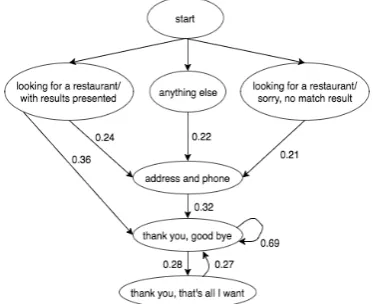
Figure 2: Dialog structure of restaurant data by D-VRNN. Transitions withP ≥0.2are visualized.
Figure 3: Dialog structure of weather data by D-VRNN. Transitions withP ≥0.2are visualized.
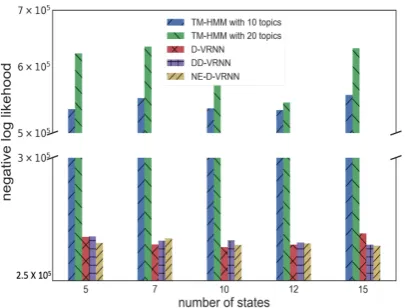
In Fig.4and 5, we compare our models quan-titatively with the TM-HMM model with 10 top-ics and 20 toptop-ics fromZhai and Williams(2014), which performs the best on a similar task-oriented dialog dataset, the DSTC1 . The y-axis shows the negative log likelihood of reconstructing the test set under a specific model. The lower the nega-tive log likelihood, the better the model performs. The x-axis shows different numbers of latent states
N used in the models. As we can see, all of the VRNN-based models surpass the TM-HMM mod-els by a large margin and are more invariant to the change inN on both datasets. Especially whenN
is small, the performance of HMM is not stable.
Qualitatively, we compare the dialog structures generated by different models. Fig. 2 and 3 show the discovered dialog structures using the D-VRNN model, and Fig.7 in the Appendix shows the dialog structures learned by HMM. Each circle in these figures represents a latent stateztwith ex-pert interpreted meanings, and the directed-arrows between the circles represent the transition proba-bilities between states. Human experts interpret each zt consistently by going through conversa-tional exchanges assigned to the same zt. For a
better visualization effect, we only visualize the transitions with a probability equal or greater than 0.2 in the figures.
We observe reasonable dialog structures in Fig. 2 and 3. The D-VRNN captures the ma-jor pathlooking for restaurant (anything else) →
get restaurant address and phone→thank youin the restaurant search task. It also captureswhat’s the weather → place and time →api call in the weather report task. However, we do not get a dia-log structure with entities separated (such asfood type I like→ area I prefer→price range I want
[image:6.595.92.281.211.363.2]“pro-viding place and time”, which is not reasonable. Another interesting phenomenon is that there are two “thank you concentrated” states in Fig.2. This is because, users frequently say “thank you” on two occasions, 1) after the dialog system presents the restaurant information, most users will say “thank you”; 2) then the system will ask “is there anything else I can help you with”, af-ter which users typically respond with “thank you, that’s all”. This interesting structure is a reflection of the original rules in the dialog system. More-over, in Fig.3, we see 1) transitions from both di-rections between states “place and time” and “api call”, and 2) transitions from “api call” to itself, as there are simulated speech recognition errors in the data and the system needs to confirm the entity values and update the API query.
Figure 4: Negative log likelihood on restaurant data.
Figure 5: Negative log likelihood on weather data.
5.3 VRNN Model Variants Comparison
Even though the three proposed VRNN-based models have similar structures, they perform dif-ferently and are able to compensate each other.
For example, in Fig. 8(b) in the Appendix, DD-VRNN is able to recognize a new state “not done yet, what’s the weather”, when users start a new query. This can complement D-VRNN’s result.
Quantitatively, the three model variants also perform differently. On the restaurant test set shown in Fig. 4, DD-VRNN has the best overall performance compared with other models. Espe-cially when the number of statesN is small (e.g. 5 or 7 states), the advantage of the direct transi-tion is more obvious. We think the reason behind is that it’s easier and more accurate to model the direct transitions between a smaller set of states; as we increase N, the direct transitions between states become less and less obvious and therefore, help less on the predictive power. To our surprise, putting more weights on the named entities has a negative impact on the performance on the restau-rant dataset. The underlying reason might be that the emphasis on the named entities shifts the focus of the model from abstract latent representation to a more concrete word token level. However, on the simulated weather dataset shown in Fig.5, NE-D-VRNN performs relatively well. It might be be-cause the weather dataset is completely simulated, which makes it easier to recognize the named en-tities. With a more accurate named entity recog-nition, NE-D-VRNN is able to help the perfor-mance. Overall, D-VRNN is the most stable one across datasets, so we will use D-VRNN in the fol-lowing experiments.
6 Application on RL
The ultimate goal of such a structure discov-ery model is to utilize the structure to facilitate downstream tasks, such as dialog system training. Therefore, we propose to incorporate the dialog structure information into the reward function of the RL training. We believe that the transition ta-ble learned from the original dataset will guide the policy to make better decisions and converge faster by encouraging the policy to follow the real-data distribution. Similar to other RL models, we build a user simulator to perform the RL training. Please refer to the Appendix for the training details.
6.1 Reward Function Design
[image:7.595.80.283.508.662.2]re-ward to penalize a failed task and -1 at each ex-tra turn to encourage the system to finish the task sooner rather than later (Williams et al., 2017). But this type of delayed reward functions doesn’t have immediate rewards at each turn, which makes the model converge slowly. Therefore, we propose to incorporate the learned conversational exchange transition information as an immediate reward. The intuition is that in order to complete a task sooner, most users will follow a certain pattern when interacting with the system, for example, a typical flow is that users first give the entities in-formation such as location, then ask for the restau-rant information and finally, end the conversation. If we can provide the RL model with the informa-tion on what acinforma-tion is more likely to follow another action, the model can learn to follow real-data dis-tributions and make better predictions. We encode the transition information through KL-divergence, a measurement of the distance between two distri-butions, in the reward function.
We design four types of reward functions and describe each of them in Algorithm1and Eq.10 in the Appendix. The traditional delayed reward is the baseline. The second reward function, Rep-reward, uses constant penalty for repeated ques-tions, as penalizing repetition yields better results, according to Shi and Yu (2018). The third re-ward function, KL-rere-ward, incorporates the tran-sition table information. From the RL model, we get the predicted probabilityppredfor different
ac-tions; from the D-VRNN model, we get the transi-tion probabilityptransbetween states and each state
is translated to an action. We calculate the nega-tion of the KL-divergence betweenptransandppred
and use it as the immediate reward for every turn. This immediate reward links the predicted distri-bution with the real-data distridistri-bution by calculat-ing the distance between them. The fourth reward function (KL+Rep) gives an additional -2 repeti-tion penalty to the KL-reward to test the combina-tion effect of the two types of penalties.
6.2 Result Analysis
[image:8.595.318.524.73.227.2]We evaluate the RL performance by the average success rate, shown in Fig.6. We observe that all the experimental reward functions greatly improve the performance of the baseline. We also observe that the baseline has a higher variance, which is due to the inefficient delayed rewards. Moreover, both the KL-reward and the KL-Rep reward reach
Figure 6: Average success rate of RL models with dif-ferent reward functions.
a higher success rate at around 10,000 iterations than the Rep-reward and converges faster. These two reward functions also achieve a better conver-gent success rate after 10,000 iterations. This sug-gests that adding KL-divergence ofptransandppred
into the reward helps develop a better policy faster. The good performance comes from the tran-sition probability ptrans learned by the
discrete-VRNN.ptranssummarizes the communication
pat-tern of most users in the real world and the KL-divergence measures the distance between the pre-dicted distribution ppred and ptrans from the real
dataset. The RL model processes this KL-reward signal and learns to minimize the gap between
ptransandppred. As a result,ppredwill follow closer
to the real data distribution, leading the model to converge faster to a better task success rate. In this way, we successfully incorporate the dialog structure information from the real data into the RL system training.
We observe that the use of KL reward improves the performance significantly in terms of both con-vergence rate and the final task success rate. Fur-ther, the combination of KL and repetition reward makes the model more stable and achieves a better task success rate, compared with the model with only KL-reward or Rep-reward. This indicates that the KL-reward can be combined with other type of rewards to achieve a better performance.
7 Conclusion and Future Work
each conversational exchange and the transitions between these states in an unsupervised fashion. We applied the algorithm on a restaurant search task and a simulated weather report task, and eval-uated the model quantitatively and qualitatively. We also proposed a way to incorporate the learned dialog structure information into a downstream di-alog system building task. We involved the didi-alog structure in the RL reward design, which made the model converge faster to a better task success rate. The performance of the Discrete-VRNN model has a major impact on the performance of the pol-icy training. We plan to further improve the dia-log structure learning process. Currently, we try to capture the status of the named entities by increas-ing the weights on the entities, which focus on the concrete word token level. In the future, we may use more sophisticated ways to encode the entity information into the latent states.
References
Ananlada Chotimongkol. 2008. Learning the structure of task-oriented conversations from the corpus of in-domain dialogs. Ph.D. thesis, Carnegie Mellon Uni-versity, Language Technologies Institute, School of Computer Science.
Junyoung Chung, Kyle Kastner, Laurent Dinh, Kratarth Goel, Aaron C Courville, and Yoshua Bengio. 2015. A recurrent latent variable model for sequential data. In Advances in neural information processing sys-tems, pages 2980–2988.
Carl Doersch. 2016. Tutorial on variational autoen-coders.arXiv preprint arXiv:1606.05908.
Emmanuel Ferreira and Fabrice Lef`evre. 2013. Expert-based reward shaping and exploration scheme for boosting policy learning of dialogue management. In Automatic Speech Recognition and Understand-ing (ASRU), 2013 IEEE Workshop on, pages 108– 113. IEEE.
Barbara J Grosz and Candace L Sidner. 1986. Atten-tion, intentions, and the structure of discourse. Com-putational linguistics, 12(3):175–204.
R Chulaka Gunasekara, David Nahamoo, Lazaros C Polymenakos, Jatin Ganhotra, and Kshitij P Fad-nis. 2017. Quantized-dialog language model for goal-oriented conversational systems. Dialog State Tracking Challenge 6, COLIPS.
Sepp Hochreiter and J¨urgen Schmidhuber. 1997.
Long short-term memory. Neural computation,
9(8):1735–1780.
Eric Jang, Shixiang Gu, and Ben Poole. 2016. Categor-ical reparameterization with gumbel-softmax. arXiv preprint arXiv:1611.01144.
Dan Jurafsky. 1997. Switchboard swbd-damsl
shallow-discourse-function annotation coders man-ual. Institute of Cognitive Science Technical Report.
Diederik P Kingma, Shakir Mohamed, Danilo Jimenez Rezende, and Max Welling. 2014. Semi-supervised learning with deep generative models. InAdvances in Neural Information Processing Systems, pages 3581–3589.
Diederik P Kingma and Max Welling. 2013.
Auto-encoding variational bayes. arXiv preprint
arXiv:1312.6114.
Jingjing Liu, Stephanie Seneff, and Victor Zue. 2010. Dialogue-oriented review summary generation for spoken dialogue recommendation systems. In Hu-man Language Technologies: The 2010 Annual Conference of the North American Chapter of the Association for Computational Linguistics, pages 64–72. Association for Computational Linguistics.
Yishu Miao and Phil Blunsom. 2016. Language
as a latent variable: Discrete generative
mod-els for sentence compression. arXiv preprint
arXiv:1609.07317.
Yishu Miao, Edward Grefenstette, and Phil Blun-som. 2017. Discovering discrete latent topics with neural variational inference. arXiv preprint arXiv:1706.00359.
Tomas Mikolov, Ilya Sutskever, Kai Chen, Greg S Cor-rado, and Jeff Dean. 2013. Distributed representa-tions of words and phrases and their compositional-ity. InAdvances in neural information processing systems, pages 3111–3119.
Gabriel Murray, Steve Renals, and Jean Carletta. 2005. Extractive summarization of meeting recordings.
Alan Ritter, Colin Cherry, and Bill Dolan. 2010. Un-supervised modeling of twitter conversations. In Human Language Technologies: The 2010 Annual Conference of the North American Chapter of the Association for Computational Linguistics, pages 172–180. Association for Computational Linguis-tics.
Iulian Vlad Serban, Alessandro Sordoni, Ryan Lowe, Laurent Charlin, Joelle Pineau, Aaron C Courville, and Yoshua Bengio. 2017. A hierarchical latent variable encoder-decoder model for generating di-alogues. InAAAI, pages 3295–3301.
Weiyan Shi and Zhou Yu. 2018. Sentiment
adap-tive end-to-end dialog systems. arXiv preprint arXiv:1804.10731.
Tsung-Hsien Wen, David Vandyke, Nikola Mrksic, Milica Gasic, Lina M Rojas-Barahona, Pei-Hao Su, Stefan Ultes, and Steve Young. 2016. A network-based end-to-end trainable task-oriented dialogue system. arXiv preprint arXiv:1604.04562.
Jason D Williams, Kavosh Asadi, and Geoffrey
Zweig. 2017. Hybrid code networks: practical
and efficient end-to-end dialog control with super-vised and reinforcement learning. arXiv preprint arXiv:1702.03274.
Ronald J Williams. 1992. Simple statistical gradient-following algorithms for connectionist reinforce-ment learning. Machine learning, 8(3-4):229–256.
Steve Young. 2006. Using pomdps for dialog manage-ment. In Spoken Language Technology Workshop, 2006. IEEE, pages 8–13. IEEE.
Ke Zhai and Jason D Williams. 2014. Discovering
latent structure in task-oriented dialogues. In Pro-ceedings of the 52nd Annual Meeting of the Associa-tion for ComputaAssocia-tional Linguistics (Volume 1: Long Papers), volume 1, pages 36–46.
Tiancheng Zhao and Maxine Eskenazi. 2018. Zero-shot dialog generation with cross-domain latent ac-tions. arXiv preprint arXiv:1805.04803.
Tiancheng Zhao, Kyusong Lee, and Maxine Eskenazi. 2018. Unsupervised discrete sentence representa-tion learning for interpretable neural dialog gener-ation.arXiv preprint arXiv:1804.08069.
Tiancheng Zhao, Ran Zhao, and Maxine Eskenazi. 2017. Learning discourse-level diversity for neural dialog models using conditional variational autoen-coders.arXiv preprint arXiv:1703.10960.
A Appendices
A.1 Reward Functions in RL
Algorithm 1Reward function ifsuccessthen
R= 20
else iffailurethen
R=−10
else ifrepeated questionthen
R=freward(ptrans, ppred)
else ifeach proceeding turnthen
R=−1
end if
freward(ptrans, ppred) =
−1 Baseline
−5 Rep-reward
−KL(ptrans, ppred) KL-reward
−KL(ptrans, ppred)−2 KL+Rep
(10)
A.2 RL Simulation Setting
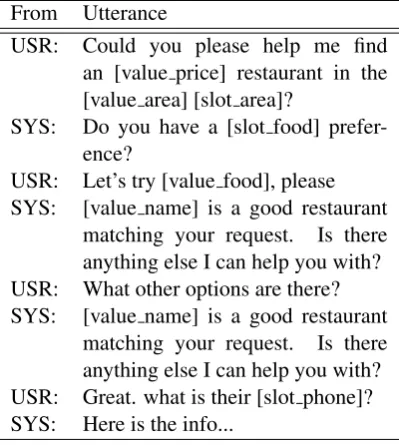
The main purpose of the user simulator is to pro-vide named entities. Therefore, it is built by sam-pling utterances from the real dataset according to the current status of named entities. Table2shows one simulated dialog in the reinforcement learn-ing. We design seven system template actions in the simulated setting which fall under four cate-gories,ask for entity,present results,give restau-rant informationandclosing statement. But there arenlatent states learned from the real data, andn
is not necessarily equal to four. To solve this mis-match in dimensions betweenppred andptran,
hu-man experts further collapse similar latent states and reduce the number of latent states to four, which represents the four main categories in the actions,ask for entity,present results,give restau-rant information andclosing statement. For ex-ample, the two “thank you concentrated” states in Fig.2 will be combined to the closing statement category. The probability of each category is the sum of the original probabilities whose actions are now under the same category.
From Utterance
[image:10.595.308.508.390.613.2]USR: Could you please help me find an [value price] restaurant in the [value area] [slot area]?
SYS: Do you have a [slot food] prefer-ence?
USR: Let’s try [value food], please SYS: [value name] is a good restaurant
matching your request. Is there anything else I can help you with? USR: What other options are there? SYS: [value name] is a good restaurant
matching your request. Is there anything else I can help you with? USR: Great. what is their [slot phone]? SYS: Here is the info...
Table 2: A simulated dialog.
A.3 RL Training Details
(a) HMM, restaurant data, 5 states (b) HMM, weather data, 10 states
Figure 7: Dialog structures generated by HMM on different datasets. Transitions withP ≥0.2are visualized.
[image:11.595.98.503.268.438.2](a) DD-VRNN, restaurant data, 5 states (b) DD-VRNN, weather data, 10 states
Figure 8: Dialog structures generated by DD-VRNN on different datasets. Transitions withP ≥0.2are visualized.
Four different reward functions are used. A dis-count factor of 0.9 is applied to all the experi-ments and the maximum number of turns is 10. An LSTM with 32 hidden units is used and the RL policy is updated after each dialog. We also apply-greedy exploration strategy (Tokic,2010). Because the RL training can sometimes be unsta-ble, we initialize all the model parameters using supervised learning on a simulated dataset, which consists of 500 dialogs between the user simulator and a rule-based agent simulator. The method is evaluated by freezing the policy after every 1000 updates and running 200 simulated dialogs to cal-culate the task success rate. We repeat the entire process 10 times and report the average success rate in Fig.6.
A.4 Dialog Structures by Different Models