A Preliminary Study of Word Clustering Based on Syntactic
Behavior
Wide R. Hogenhout and Yuji
M a t s u m o t o
Nara Institute of Science and Technology
8916-5 Takayama-cho, Ikoma-shi, Nara 630-01, Japan
{marc-h ,mat
su}~is, aist-nara, ac. jp
Abstract
We show how a t r e e b a n k can be used to cluster words on the basis of their syntac- tic behavior. T h e resulting clusters repre- sent distinct t y p e s of behavior w i t h much m o r e precision t h a n p a r t s of speech. As an e x a m p l e we show how prepositions can be a u t o m a t i c a l l y s u b d i v i d e d by their syntac- tic behavior and discuss the a p p r o p r i a t e - ness of such a subdivision. A p p l i c a t i o n s of this work are also discussed.
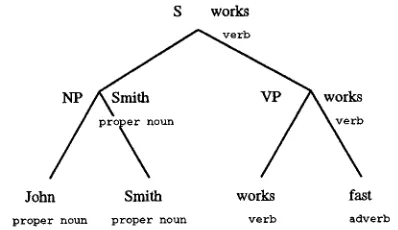
S works
v e r b
NP ~$mith
John Smith works fast
p r o p e r n o u n p r o p e r n o u n v e r b a d v e r b
Figure 1: Sentence w i t h Parse Tree and H e a d w o r d s
1
I n t r o d u c t i o n
T h e c o n s t r u c t i o n of classes of words, or calculation of distances between words, has frequently drawn the interest of researchers in n a t u r a l language pro- cessing. M a n y of these studies a i m e d at finding classes based on co-occurrences, often combined with the a i m of establishing s e m a n t i c s i m i l a r i t y between words ( M c M a h o n and S m i t h , 1996, Brown et el., 1992, Dagan, Markus, and Markovitch, 1993, Da- gan, Pereira, and Lee, 1994, Pereira and Tishby, 1992, Grefenstette, 1992).
We suggest a m e t h o d for clustering words purely on t h e basis of s y n t a c t i c behavior. We show how the necessary d a t a for such clustering can easily be drawn from a p u b l i c l y available t r e e b a n k , and how distinct t y p e s of behavior can be discovered. Al- t h o u g h a p a r t of speech t a g set can be t h o u g h t of as a classification based on s y n t a c t i c behavior, we can c o n s t r u c t an a r b i t r a r y n u m b e r of clusters, or a b i n a r y tree of words t h a t share their p a r t of speech. We discuss in d e t a i l a b i n a r y word tree for prepo- sitions t h a t was created by s y n t a c t i c - b e h a v i o r based clustering, to show w h a t sort of properties are re- vealed by t h e clustering and w h a t one can learn from this a b o u t language. We also discuss various ways in which this kind of clustering can be used in NLP applications.
2
Headwords and Dependencies
T h e d a t a we e x t r a c t are based on t h e concept of
headwords. Such headwords are chosen for every
c o n s t i t u e n t in the parse tree by m e a n s of a s i m p l e set of rules. These have been used in various studies in this field, see (Collins, 1996, M a g e r m a n , 1995, Je- linek et el., 1994). Every h e a d w o r d is p r o p a g a t e d up t h r o u g h the tree such t h a t every p a r e n t receives a headword from t h e head-child. F i g u r e 1 gives an e x a m p l e of a parse tree with headwords.
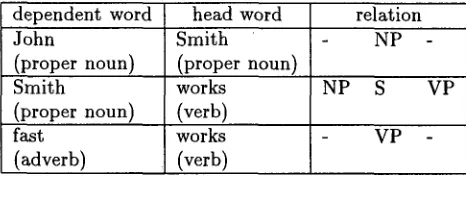
Following the techniques suggested by (Collins, 1996), a parse tree can subsequently be described as a set of dependencies. Every word except t h e head- word of the sentence d e p e n d s on t h e lowest head- word it is covered by. T h e s y n t a c t i c relation is t h e n given by the t r i p l e of n o n t e r m i n a l s : t h e m o d i f y i n g n o n t e r m i n a l , the modified n o n t e r m i n a l , and t h e non- t e r m i n a l t h a t covers t h e j o i n t phrase. T a b l e 1 gives an e x a m p l e of such a description.
On one p o i n t our m e t h o d is different f r o m t h e m e t h o d suggested by Collins. Collins uses a reduced sentence in which every basic noun p h r a s e (i.e., a noun phrase t h a t has no noun phrase as a child) is reduced to its headword. T h e reason for this is t h a t it improves co-occurrence counts and a d j a c e n c y statistics. We however do not reduce the sentence
Hogenhout ~ Matsumoto 16 Word Clustering from Syntactic Behavior
Wide R. Hogenhout and Yuji Matsumoto (1997) W o r d C l u s t e r i n g f r o m S y n t a c t i c B e h a v i o r . (ed.) CoNLL97: Computational Natural Language Learning, ACL pp 16-24.
(~) 1997 Association for Computational Linguistics
[image:1.596.321.520.254.369.2]since we do. not need to consider adjacency statis- tics or unresolved ambiguities, and therefore never face the problem t h a t a word in a basic noun phrase, t h a t is not the headword, is adjacent to or modifies something outside of the basic noun phrase.
Table 1 gives the relations for one sentence, but instead of considering one sentence we collect such patterns for the whole corpus and study statistics for individual words. In this way it can be dis- covered that, for example, a particular verb is of- ten used transitively, or t h a t a particular preposi- tion is mostly used to produce locative prepositional phrases. Words can be distinct or similar in this re- spect, but note t h a t this is not related to semantic similarity. Words such as
eat
anddrink
have a se- mantic similarity, but m a y be completely different in their syntactic behavior, whereastend
andappear
do not have an obvious semantic relation, but they do have a similarity since they can both be used as raising verbs, as will be exemplified later.T h r o u g h o u t this paper we will use the term "word" to refer to words for which the part of speech has already been disambiguated. In tables and fig- ures we emphasize this by indicating the part of speech together with the word.
Table 1: Dependencies for the sentence
John Smith
works fast
dependent word head word relation
John Smith NP -
(proper noun) (proper noun)
Smith works NP S VP
(proper noun) fast
(adverb)
(verb)
works VP -
(verb)
3
Collecting S t a t i s t i c s for I n d i v i d u a l
W o r d s
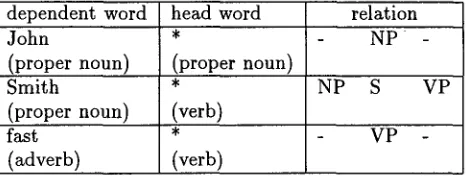
The next step we take, is eliminating one of the two words in this table of dependencies. Consider ta- bles 2 and 3. These show we can take three "ob- servations" from the sentence by eliminating either the headword or the dependent word. If headwords are eliminated we obtain three observations, for the words
John, Smith
andfast.
If dependent words are eliminated we also obtain three observations, two forworks
and one forSmith.
By collecting the observations over the entire cor- pus we can see t o / b y what sort of words and with what kind of relations a word modifies or is modified.
We consider the following distributions:
p(R, talwdt~)
(1)p(R, tdlWhth)
(2)where R indicates the triple representing the syn- tactic relation,
Wd
a dependent word t h a t modifies headwordWh,
and td andth
their respective part of speech tags. For example, in the second line of table 3, which corresponds to distribution 1, R is (NP,S,VP),th
is "verb", wd is "Smith" and td is "proper noun".Statistics of the distributions (1) and (2) can eas- ily be taken from a treebank. We took such d a t a from the Wall Street Journal Treebank, calculating the probabilities with the Maximum Likelihood Es- timator:
f ( R , th, Wdtd)
p(R, th]Wdtd) = ER',t' f ( R ' , t ' , Wdtd)
where f stands for frequency. Note t h a t we only ex- tract the dependency relations, and ignore the struc- ture of the sentence beyond these relations. This shows the equation for distribution (1), distribution (2) is calculated likewise.
Compare the dependency behavior of the proper nouns
Nippon
andRep.
in table 4. T h e wordNippon
is Japanese forJapan,
and mainly occurs in names of companies. T h e wordRep.
is the abbreviation ofRepublic,
and obviously occurs mainly in names of countries. As can be seen, the wordRep.
oc- curs far more frequently, but the distributions are highly similar. Both always modify another proper noun, about 33% of the time forming an NP-SBJ and 67% of the time an NP. Both are a particular kind of proper noun t h a t almost always modifies other proper nouns and almost never appears by itself.It also became clear t h a t the noun
company
is very different from a noun such ashostage,
sincecompany
often is the subject of a verb, whilehostage
is rarely in the subject position. Both are also very different from the nounyear,
which is frequently used as the object of a preposition.The gerund
including
has an extremely strong ten- dency to produce prepositional phrases, as in"Safety
advocates, including some members of Congress,...",
making it different from most other gerunds. A past tense such asfell
has an unusual high frequency as the head of a sentence rather t h a n a verb phrase, which is probably a peculiarity of the Wall Street Journal ("Stock prices fell... ").
Our observation is t h a t among words which have the same part of speech, some word groups exhibit behavior that is extremely similar, while others dis- play large differences. T h e m e t h o d we suggest aims
[image:2.596.53.286.458.557.2]at making a clustering based on such behavior. By using this technique any number of clusters can be obtained, sometimes far beyond what humans can be expected to recognize as distinct categories.
Table 2: Dependencies with dependent words elimi- nated.
dependent word head word relation
* Smith NP -
(proper noun) (proper noun)
* works NP S VP
(proper noun) (verb)
* works ! - VP
(adverb) (verb)
Table 3: Dependencies with headwords eliminated.
dependent word head word relation
John * NP -
(proper noun) (proper noun)
Smith * NP S VP
(proper noun) (verb)
fast * VP -
(adverb) (verb)
Table 4: Distribution of dependencies of the words
Nippon
andRep., as
proper nouns.dep. word headword tag
Nippon
proper n.
Rep.
proper n.proper noun proper noun
proper noun
relation NP-SBJ NP
- NP-SBJ proper noun NP
freq. 3 6
23 45
4 C o m p a r i s o n w i t h C o - O c c u r r e n c e B a s e d C l u s t e r i n g
Clustering of words based on syntactic behavior has to our knowledge not been carried out before, but clustering has been applied with the goal of obtain- ing classes based on co-occurrences. Such clusters were used in particular for interpolated n-gram lan- guage models.
By looking at co-occurrences it is possible to find groups of words such as
[director, chief, professor,
commissioner, commander, superintendent].
T h emost prominent m e t h o d for discovering their simi- larity is by finding words t h a t tend to co-occur with these words. In this case they m a y for example co- occur with words such as
decide
andlecture.
T h e group of verbs
[tend, plan, continue, want,
need, seem, appear]
also share a similarity, but one has to look at structures rather t h a n meaning or co- occurrences to see why. All these verbs tend to occur in the same kind of structures, as can be seen in the following examples from the Wall Street Journal.The f u n d s ' s h a r e p r i c e s t e n d t o swing m o r e t h a n t h e b r o a d e r m a r k e t .
Investors continue to pour cash into money funds.
Cray Research did not want to fund
a project that did not include
Seymour.
No one has worked out the players' average age, but most appear to be in their late 30s.
W h a t these verbs share is the property t h a t they often modify an entire clause (marked as 'S' in the Wall Street Journal Treebank) rather t h a n noun phrases or prepositional phrases, usually forming a subject raising construction. This is only a tendency, since all of them can be used in a different way as well, but the tendency is strong enough to make their usage quite similar. Co-occurrence based clustering ignores the structure in which the word occurs, and would therefore not be the right m e t h o d to find re- lated similarities.
As mentioned, co-occurrence based clustering methods often also aim at producing semantically meaningful clusters. Various methods are based on Mutual Information between classes, see (Brown et al., 1992, McMahon and Smith, 1996, Kneser and Ney, 1993, Jardino and Adda, 1993, Martin, Lier- mann, and Ney, 1995, Ueberla, 1995). This mea- sure cannot be applied in our case since we look at structure and ignore other words, and consequently algorithms using t h a t measure cannot be applied to the problem we deal with.
The mentioned studies use word-clusters for in- terpolated n-gram language models. Another ap- plication of hard clustering methods (in particular b o t t o m - u p variants) is t h a t they can also produce a binary tree, which can be used for decision-tree based systems such as the S P A T T E R parser (Mager- man, 1995) or the A T R Decision-Tree Part-Of- Speech Tagger (Black et al., 1992, Ushioda, 1996).
[image:3.596.71.307.205.297.2] [image:3.596.74.307.354.442.2]In this case a decision tree contains binary questions to decide the properties of a word.
We present a
hard
clustering algorithm, in the sense t h a t every word belongs to exactly one cluster (or is one leaf in the binary word-tree of a particular part of speech). Besideshard
algorithms there have also been studies tosoft
clustering (Pereira, Tishby, and Lee, 1993, Dagan, Pereira, and Lee, 1994) where the distribution of every word is smoothed with the nearest k words rather than placed in a class which supposedly has a uniform behavior. In fact, in (Da- gan, Markus, and Markovitch, 1993) it was argued t h a t reduction to a relatively small number of pre- determined word classes or clusters m a y lead to sub- stantial loss of information. On the other hand, when using soft clusteringit is not possible to give a y e s / n o answer about class membership, and binary word trees cannot be constructed.5
Similarity Measure and
Algorithm
The choice of the clustering algorithm is to some ex- tent independent from the way d a t a is collected, but as mentioned clustering is carried out on the basis of distributional similarity, and methods using Mu- tual Information are not applicable. The algorithm we present here is meant to demonstrate how syn- tactic behavior can be used for clustering. However, we feel the optimal choice for the clustering m e t h o d depends on the application it will be used for.
Studies in distribution based clustering often use the KuUback-Leibler (KL) distance, see for example (Pereira, Tishby, and Lee, 1993, Dagan, Pereira, and Lee, 1994). However, this distance is not symmetri- cal, and since we are (for the time being) interested
in
hard clustering
it is desirable to have a symmet-rical measure. We could possibly use Jeffery's Infor- mation, i.e. the sum of the KL-distances:
D(p,q) = ~ p ( x ) l o g ~ p ( x ) ~ +
= \ q ( x ) ]
q(x) loglq(x)~
" (3)We have tried this distance measure, but in many cases we have found it to have undesirable effects, primarily because the goal of our algorithm is join- ing words (and their statistics) together to make one cluster, and a distorted image results from this measure when words have different total frequen- cies. Furthermore, Jeffery's Information is undefined if either distribution has a value of 0 and the other not. For this reason they would have to be smoothed with, for example, a part of speech based distribu-
tion, such as
p(R, thlWdtd) ---- A(R, thlWdtd) +
(1 -
A)(R, th[td),
(4)but we wanted to avoid using an unlexical distri- bution since we believe lexical information is more valuable.
Instead we suggest a different measure. Assume there are a number of patterns i = 1...n, and ob- served frequencies
al...an
for wordwata,
andbl...bn
for wordWbt b.
Also, let A = ~ i ai and B = ~ i bi. The Maximum-Likelihood estimates forWa
are thus calculated aspa(x) = a~/A
and likewise forWb.
We now define the distance between words as
ai
( ~ ( A + B ) ~
i(woto, btb) doj
log
i ( a i 7 ~ ) +
b' log ( ~ (A + B) ~
which can be interpreted as the sum of KL-distances between a hypothetical word t h a t would be created if the observations of the words
Wata
andWbtb
would be joined together, andWata
and Wbtb respectively. Like Jeffery's Information, this measure is symmet- rical, although not a true distance since it does not obey the triangle inequality.This measure is more appropriate for two reasons. First, this distribution is better tailored toward mak- ing clusters where observations will be joined to- gether. Second, we take this sum to be zero for values of i when ai = bi = 0 (no observations for either word), therefore pre-smoothing is not neces- sary.
T h e equation can easily be transformed into the form
M(w~t~,wbtb) =
l o g ( - - ~ - ~ ) + l o g ( - - ~ - ) +~ - ~ l o g ( a ~ b ~ ) + ~ l o g ( a ~ b ~ ) (5)
which makes calculation significantly faster since patterns for which only one word has a non-zero frequency do not need to be calculated within the summation, as they always becomes zero.
T h e A l g o r i t h m T h e algorithm initially regards every word as a 1-element cluster, and works
bot-
tom up
towards a set of clusters. T h e strategy of agreedy algorithm
is followed, every time finding thetwo clusters t h a t have the least distance between them and merging them until the desired number of clusters is reached. However, only words with the
same part o f speech may be merged, so distances between words that have different parts of speech are never calculated. Words can therefore receive a 'combined tag' consisting of their part of speech tag, and a syntactic behavior tag. This is similar to what McMahon (1996) refers to as a
structural tag.
The algorithm is actually applied
twice,
once to clustering for dependent-context (1) and once to clustering for head-context (2).An obvious problem with this sort of clustering is low frequency words. For many words only a one or a few observations are available, which may give some information about what Sort of word it is, but which does not give a reliable estimate of the distributions. We will mention a solution to this problem later. In the example we present only words for which at least 25 observations are available.
One problem with co-occurrence based clustering that has been pointed out in the past is that of almost-linear dendrograms, caused by the properties of Mutual Information. We have not encountered this problem with the described algorithm.
6 R e s u l t : t h e C a s e o f P r e p o s i t i o n s
We present a binary word tree that was produced by the algorithm described in the previous section. The main goal of this is to show what sort of prop- erties are revealed by this clustering, and what kind of words are problematic. Even in situations where words are clustered by syntactic behavior without making a binary tree, it can be useful to study the type of properties that decide syntactic behavior.
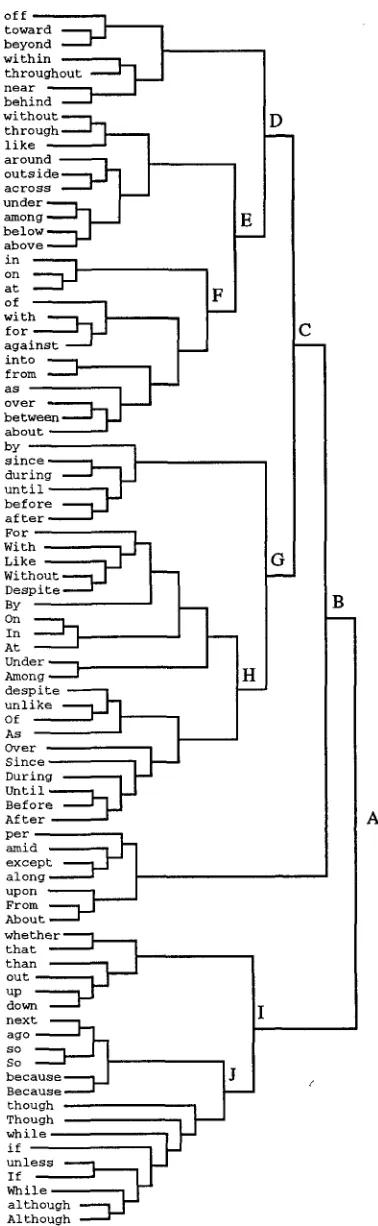
Please refer to figure 2 for an example of the re- sults obtained with clustering. This is a dendro- gram that reflects the clustering process from loose words until the point were they are all merged into one cluster. The dendrogram shows the result for prepositions, although only those prepositions were considered for which at least 25 observations were available. In the division of words over the parts of speech we follow the tagging scheme of the Wall Street Journal Treebank, and for example subordi- nators such as
while, if
andbecause
are included in the prepositions. Of course it is possible to use a more fine grained tag set, when available. On the other hand, as will be shown later, the algorithm does decide to classify most subordinators into one cluster.off
t o w a r d
--"l..J""'-I
b e y o n d ~ [within ~ [
throughout ~ [
near I !
behind without ~.. through I like ~ ~ [ around--- I ] outs ide - - - ~ J - ~ l
a c r o s s ~ I ]
u n d e r , I
ong l
b e l o w J
a b o v e
!
in ~
on
at
against ---J ]
!i='
,
I
by
s i n c e
during ] until---~
b e f o r e a f t e r
For With
Like ~ ]
With?ut---~J I
I
On , , ' i t - - ~ I n
At ~
Under
Among
]
d e s p i t e
~
unlike Of As Over
S i n c e
During Until,
B e f o r e
After
p e r a m i d except a l o n g u p o n
From About,
w h e t h e r
that l ]
d o w n !
n e x t
a g o
SO
so t b e c a u s e B e c a u s e
though
|
Though
I[
w h i l e - m -
|
i f
unless If ~
~
While ---i F- although
Although i
I
F ED
i,],
G C
B
A
Figure 2: Clustering Result for Dependency Behav- ior of Prepositions
[image:5.596.332.521.102.715.2]We will discuss the m a j o r distinctions made by the algorithm. At first it m a y not be clear why words should be divided in this way, but inspection of the d a t a from the corpus shows t h a t m a n y of these choices are very natural. We also discuss in which cases the dendrogram does not form natural cate- gories.
T h e first partition, marked A, is a quite natu- ral division. T h e upper branch (from off through
About) are prepositions t h a t usually cover some
phrase themselves, whereas the prepositions in the lower branch usually do not cover any phrase.
T h e preposition whether occurs, for example, in structures such as
'' We have no u s e f u l i n f o r m a t i o n on (SBAR w h e t h e r (S users are at
r i s k ) ) , ~ ~ said James A. T a l c o t t of B o s t o n ' s D a n a - F a r b e r C a n c e r Institute.
where in our headword-selection scheme whether de- pends on the headword are. (Even if this is changed, they still become one cluster because of the typical patterns with S and SBAR.)
For comparison, the preposition below usually oc- curs in structures such as
Magna r e c e n t l y c u t i t s q u a r t e r l y d i v i d e n d i n h a l f and t h e c o m p a n y ' s C l a s s A s h a r e s a r e (VP w a l l o w i n g
(PP-LOC f a r b e l o w t h e i r 52-week h i g h of 16.125 C a n a d i a n d o l l a r s
(US$ 1 3 . 7 3 ) ) ) .
where it is the headword of a prepositional phrase before it modifies the verb.
T h e partition marked with B is not a natural di- vision; it rather separates a set of prepositions that do not fit in elsewhere. The prepositions from per
through About are not similar to each other or to other prepositions in their behavior.
Partition C again resembles to groups t h a t can be characterized easily. T h e prepositions by through
After, the lower branch of C, depended almost exclu-
sively on verbs. T h e prepositions from off through
about, the upper branch of C, depend on more var-
ied headwords. Most of these frequently depend on both nouns and verbs. T h e following example shows
around depending on a noun, although around also
tends to depend on cardinal numbers.
You n o w m a y d r o p by the Voice of A m e r i c a offices in W a s h i n g t o n and
r e a d the text of what the Voice is b r o a d c a s t i n g to those 130 m i l l i o n
p e o p l e (PP-LOC a r o u n d the w o r l d )
who tune in to it e a c h week.
An example for the lower branch of C is
A p l a n to b r i n g the stock to m a r k e t
before y e a r end a p p a r e n t l y (VP was upset (PP by the r e c e n t w e a k n e s s of
F r a n k f u r t share prices) ).
The prepositions at the upper branch of partition D tend to form a higher a m o u n t of P P - T M P type phrases, as in
And i n e a c h c a s e , h e s a y s , a s h a r p d r o p i n s t o c k p r i c e s (VP b e g a n
(PP-TMP w i t h i n a y e a r ) ) .
although, while this is strongly the case for the prepositions within and throughout, it is not the case
for behind.
At partition E prepositions with a preference for verbs are at the upper branch. Prepositions t h a t almost exclusively deal with verbs were separated at C, but here the distinction is less absolute. T h e prepositions at the upper branch of E have a chance of about two thirds to depend on a verb, whereas this is only one third at the lower branch.
Partition F is once again a very clear, natural di- vision. T h e prepositions in, on and at have a strong tendency to form phrases of the type P P - L O C as in
Mr. Nixon i s t r a v e l i n g ( P P - L O C
i n China) as a p r i v a t e c i t i z e n ,
b u t h e h a s made c l e a r t h a t h e i s an u n o f f i c i a l e n v o y f o r t h e Bush a d m i n i s t r a t i o n .
while the prepositions at the lower branch, of
through about have much lower frequencies for these locative phrases.
The division at G is also very clear when the d a t a are inspected. T h e upper branch reflects preposi- tions for which the covering phrase (the middle part of the triple representing the grammatical relation) is mostly VP or NP. T h e prepositions For through
After at the lower branch of G are mainly covered
by phrases of type S. A preposition such as during
is found in structures such as
F u j i t s u s a i d i t (VP b i d t h e e q u i v a l e n t o f l e s s t h a n a U . S . p e n n y on t h r e e s e p a r a t e m u n i c i p a l c o n t r a c t s (PP-TMP d u r i n g t h e p a s t two y e a r s ) ) .
while a preposition such as without is usually found in the PP-S-VP pattern:
(S In fact, (PP without Wall Street firms trading for their own accounts), the s t o c k - i n d e x
arbitrage trading o p p o r t u n i t i e s for the b i g funds (VP may be all the m o r e abundant). )
At H this is further divided in words t h a t tend more to depend on loose words, P P type phrases (such as without in the last example) or S type phrases, at the lower branch, and those that usu- ally depend on heads of a VP.
As for the division at point I, the prepositions next
through Although share the property t h a t their cov- ering phrase (the middle part of the triple represent- ing the grammatical relation) is often of the type SBAR-ADV or SBAR-PRP. The prepositions at the upper branch, whether through down, mainly share not having this property.
While the status of the upper branch of J is some- what unclear, the lower branch of J is a perfectly clear and intuitive group. All of the words from
though through Although appear almost exclusively
in the patterns (-,SBAR-ADV,S), (-,S,S), (-,SBAR- PRP,S) and ( - , S B A R - P R P , - ) . An example is
The g r o u p says standardized
a c h i e v e m e n t test scores are g r e a t l y
inflated b e c a u s e t e a c h e r s often
'Cteach the test'' as Mrs. Y e a r g i n
did, (SBAR-ADV although (S most are n e v e r caught)) .
where in our headword scheme are becomes the headword of the SBAR-ADV type phrase.
Concluding, m a n y of the divisions made by the algorithm are quite natural. There are some parts of speech (such as nouns and verbs) were a much larger number of words is included in the hierarchy, while some other parts of speech, for example per- sonal pronouns, produce very small hierarchies. In general the hierarchy is more interesting for parts of speech t h a t are used in a varied way, and less inter- esting for, for example, symbols such as the percent- age sign, t h a t are used in a monotone way.
It is interesting to see that capitalization turns out to be a meaningful predictor about the way a word will be used for some words, but not for others. The word pair so and So, and the pair because and Be-
cause are clustered next to each other, which indi-
cates t h a t they modify the same kind of structures, independent of whether they are at the beginning of the sentence. T h e word pair under and Under,
and the pair after and After on the other hand are rather far apart, indicating t h a t their usage changes
substantially when they become the first word of the sentence.
7
Applications
A first application of this work, of which we carried out a first step in this article, is the lexicographi- cal one of studying word behavior. Some proper- ties of words, such as the peculiar behavior of the gerund including or the similarities between prepo- sitions such as though and while only becomes clear once the corpus d a t a is analyzed in the way we de- scribed. When inspecting manually, the binary word tree representation appears to be the most easy to understand.
A second application of the binary word tree can be found in decision-tree based systems such as the S P A T T E R parser (Magerman, 1995) or the A T R Decision-Tree Part-Of-Speech Tagger, as described by Ushioda (Ushioda, 1996). In this case it is nec- essary to use a hard-clustering method, such t h a t a binary word tree can be constructed by the cluster- ing process, as we did in the example in the previous sections.
A decision tree classifies d a t a according to its properties by asking successive (often binary) ques- tions. In the case of a part of speech tagger or a parsing system, it is particularly i m p o r t a n t for the system to ask lexicalizing questions. However, ques- tions about individual words such as "Is this the word display?" are not efficient on a large scale since it would easily require thousands of questions. A bi- nary tree allows one to separate the vocabulary into two parts at every question, which is efficient when these two parts are maximally different. In t h a t case it is possible to obtain as much information as pos- sible with a small number of questions. A condition for this application is t h a t trees m a y not be very unbalanced, as the extreme case of a linear tree be- comes equal to asking word-by-word. As mentioned, the m e t h o d we suggest did not produce a very unbal- anced tree for the parts of speech in the Wall Street Journal Treebank.
A third application can be found in Information Retrieval. This can be seen from the example of
including: words with such behavior have little con-
tent because they have a rather functional role in the sentence. This can be seen in the sentence "Safety advocates, including some members of Congress,..."
where terms such as Safety advocates or members
of Congress indicate much more a b o u t the topic of
the sentence t h a n the relatively e m p t y word includ-
ing. It is possible to cluster words and decide which
clusters are likely to indicate the topic, and which are not likely to do so. For this application a wider
variety of algorithms can be applied; words can for example be exchanged or shuffled between classes to improve the entire model.
A fourth application is class-based smoothing of interpolated n-gram models. The co-occurrence based classes described in the literature are, of course, created with this as objective function, but on the other hand the classes we suggest clearly con- tain information t h a t is inaccessible to co-occurrence based classes. It is possible t h a t a combination of co-occurrence based classes and classes of syntactic behavior would give better results, but this would have to be demonstrated experimentally.
In some of these applications words with a low fre- quency cannot be ignored because of their quantity, but at the same time the algorithm cannot rely too heavily on their observations. A possible solution is to carry out clustering without these words, and distribute the low-frequency words over the leaves of the tree afterwards. A solution along this line was chosen for co-occurrence based clustering in (McMa- hon and Smith, 1996), where a first algorithm han- dles more frequent words, and a second algorithm adds the low-frequency words afterwards.
8
C o n c l u s i o n
We have presented a m e t h o d which constructs classes of words with similar syntactic behavior, or binary trees t h a t reflect word similarity, by cluster- ing words using treebank data. In this way it is pos- sible to discover particular types of behavior, such as the peculiar behavior of the gerund including, verbs t h a t modify an entire clause (raising verbs), nouns t h a t prefer either subject position or object position, or prepositions t h a t prefer locative phrases.
Most of the classes found in this way would not be found if clustering were performed on the basis of co-occurrences, as has been described in the liter- ature. For example, the verbs [tend, plan, continue,
want, need, seem, appear] share a particular sentence
structure rather than, say, the sort of noun t h a t be- comes the object.
As became clear from the case study of preposi- tions, the clustering process reveals similarities in the syntactic structure in which words appear which in some cases can be clearly felt by intuition. For example, the words in, on and at often are the head of locative prepositional phrases, and a preposition such as within usually is the head of a temporal prepositional phrase. Using this m e t h o d these in- tuitions can be quantified.
One of the applications we described is t h a t of a decision-tree based system for syntactic analysis.
We are currently applying the m e t h o d in this appli- cation, which will be described in later publications.
9
A c k n o w l e d g e m e n t s
We would like to express our appreciation to the anonymous reviewers who have provided m a n y valu- able comments and criticisms.
R e f e r e n c e s
Black, E., F. Jelinek, R. Mercer, and S. Roukos. 1992. Decision tree models applied to the la- beling of text with parts-of-speech. In Pro- ceedings DARPA Speech and Natural Language
Workshop, pages 117-121.
Brown, P. F., S. A. Della Pietra, P. V. deSouza, J. C. Lai, and R. L. Mercer. 1992. Class-based n-gram models of natural language. Computa-
tional Linguistics, 18(4):467-479.
Collins, M. J. 1996. A new statistical parser based on bigram lexical dependencies. In Proceedings of the 3~th Annual Meeting of the Association
for Computational Linguistics, pages 184-191.
Dagan, I., S. Markus, and S. Markovitch. 1993. Con- textual similarity and estimation from sparse data. In Proceedings of the 31st Annual Meet- ing of the Association for Computational Lin-
guistics, pages 164-171.
Dagan, I., F. Pereira, and L. Lee. 1994. Similarity- based estimation of word cooccurrence prob- abilities. In Proceedings of the 32nd Annual Meeting of the Association for Computational
Linguistics, pages 272-278.
Grefenstette, G. 1992. Finding semantic similarity in raw text: the Deese antonyms. In Working
Notes, Fall Symposium Series, AAAI, pages
61-68.
Jardino, M. and G. Adda. 1993. A u t o m a t i c word classification using simulated annealing. In
ICASSP 93, pages II 41-44.
Jelinek, F., J. Lafferty, D. Magerman, R. Mercer, A. Ratnaparkhi, and S~ Roukos. 1994. Decision tree parsing using a hidden derivation model.
In ARPA: Proceedings of the Human Language
Technology Workshop, pages 272-277.
Kneser, R. and H. Ney. 1993. Improved clustering techniques for class-based statistical language modelling. In Proceedings of European Confer- ence on Speech Communication and Technol-
ogy, pages 973-976.
Magerman, D. M. 1995. Statistical decision-tree models for parsing. In Proceedings of the 33d Annual Meeting of the Association for Com-
putational Linguistics, pages 276-283.
Martin, M., J. Liermann, and H. Ney. 1995. Al- gorithms for bigram and trigram word cluster- ing. In Proceedings of European Conference on
Speech Communication and Technology, pages
1253-1256.
McMahon, John G. and Francis J. Smith. 1996. Improving statistical language model performance with automatically generated word hierarchies. Computational Linguistics,
22(2):217-247.
Pereira, F. and N. Tishby. 1992. Distributional sim- ilarity, phase transitions and hierarchical clus- tering. In Working Notes, Fall Symposium Se-
ries, AAAI, pages 108-112.
Pereira, F., N. Tishby, and L. Lee. 1993. Distri- butional clustering of English words. In Pro- ceedings of the 31st Annual Meeting of the As-
sociation for Computational Linguistics, pages
183-190.
Ueberla, J. 1995. More efficient clustering of n-grams for statistical language modeling. In Proceed- ings of European Conference on Speech Com-
munication and Technology, pages 1257-1260.
Ushioda, Akira. 1996. Hierarchical clustering of words and application to nlp tasks. In Proceed- ings of the Fourth Workshop on Very Large Corpora.