
c
�Owned by the authors, published by EDP Sciences, 2016
Forward Physics with the CMS Experiment at LHC
D. Sunar Cerci1,a,b
1Adiyaman University, Faculty of Arts and Sciences, Department of Physics, 02040 Adiyaman, Turkey.
Abstract.Forward physics measurements with the Compact Muon Solenoid (CMS) ex-periment, one of the two large multi-purpose experiments at the Large Hadron Collider (LHC) at CERN, cover a wide range of physics subjects. The forward calorimeters of CMS, HF and CASTOR, are used to collect data up to a pseudo-rapidity of 6.6. These detectors provide sensitivity to a large part of the total inelastic cross section, including di↵ractive events that produce particles only at forward rapidity, with the exception of
very low mass di↵raction. The results obtained with a centre-of-mass energy of 13 TeV
are presented. The measurements are compared to model predictions and provide valu-able input for tuning of Monte Carlo models used to describe high-energy hadronic inter-actions.
1 Introduction
The LHC at CERN has started to deliver proton-proton collisions at the highest energy of
ps
= 13 TeV ever reached by any other accelerator since 2015. Therefore, the CMS detector [1]
at the LHC is a suitable machine which provides the opportunity to study forward physics. The for-ward physics programme at CMS mainly focuses on the physics that can be reached with the forfor-ward detectors HF and CASTOR at 3.0 < |⌘| <5.2 and−6.6 < ⌘ < −5.2, respectively. Measurements in the forward region can be used to improve the knowledge of the content of the proton at small values of the momentum fraction xcarried by the partons and to provide inputs for parton density functions (PDFs). The hard scattering events are produced by the strong interactions of partons in a region where non-perturbative QCD and multiple partonic interactions (MPI) play an important role. Measurements performed in the forward region can shed light on MPI and the underlying events (UE) as well as provide useful information on the tuning of Monte Carlo (MC) event generators available.
2 Measurements
In the following the measurements performed with the data taken at a centre-of-mass energy
ps
= 13 TeV in 2015 within the forward physics program of CMS are presented.
ae-mail: [email protected]
2.1 Inelastic pp cross section
One of the fundamental observables in high energy particle physics is the hadronic total cross section which has been measured in many experiments, covering several orders of magnitude in centre-of-mass energy ps. The hadronic cross section can be divided into two parts as elastic and inelastic interactions. In inelastic interactions, which can be described by non-perturbative and phenomeno-logical models, either one or both protons dissociate as a result of colorless (di↵ractive) or colored
(non-di↵ractive) exchange. Precise measurements of the hadronic cross sections provide valuable
input for the phenomenological models as well as for the tuning of MC event generators.
The inelastic proton-proton cross section measurement at a centre-of-mass energy of
ps = 13 TeV is performed with the CMS detector, particularly with information from forward
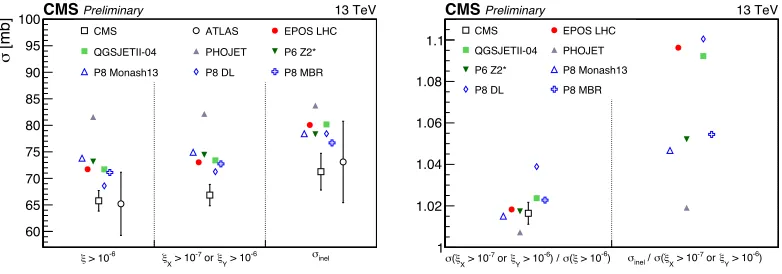
calorimeters, HF and CASTOR, at pseudorapidities of 3.0< ⌘ <5.2 and−6.6< ⌘ <−3.0 [2]. Fig. 1 shows the comparison of corrected cross sections in various phase space regions to di↵erent models
(left) and the same cross sections normalized to the cross section obtained for⇠ > 10−6 (right). A
visible cross section ofσ(⇠X >10−7or⇠Y >10−6) =66.9±0.4 (exp.)±2.0 (lum.) mb is measured forMX >4.1 GeV andMY>13 GeV whereMXandMYare the invariant masses of the two hadronic systems separated by the largest rapidity gap in the event. The visible cross section is extrapolated to the full inelastic phase space domain and is obtained as 71.3±0.5 (exp.)±2.1 (lum.)±2.7 (ext.) mb.
The increase from⇠ >10−6to⇠X >10−7or⇠Y >10−6 observed in data is reasonably described by most of the models used in the analysis. However, the hadronic scattering models predict higher cross section than the measured one.
-6 > 10
ξ > 10-7 or ξY > 10-6
X
ξ σinel
[mb]
σ
60 65 70 75 80 85 90 95
100 CMS ATLAS EPOS LHC
QGSJETII-04 PHOJET P6 Z2*
P8 Monash13 P8 DL P8 MBR
13 TeV
CMSPreliminary
) -6 > 10
ξ
(
σ
) / -6 > 10 Y
ξ
or -7 > 10 X
ξ
(
σ > 10-6)
Y
ξ
or -7 > 10 X
ξ
(
σ
/ inel
σ 1
1.02 1.04 1.06 1.08
1.1 CMSQGSJETII-04 EPOS LHCPHOJET
P6 Z2* P8 Monash13
P8 DL P8 MBR
13 TeV
CMSPreliminary
Figure 1.Left: Comparison of corrected cross sections in various phase space regions to di↵erent models. Right:
the same cross sections scaled to the cross section obtained for⇠ >10−6[2].
2.2 Forward energy flow and transverse energy density
The forward energy flow measurement is sensitive to the Underlying Event activity (UE) and parton shower dynamics. Therefore the measurement provides an opportunity to study multiple parton in-teractions (MPI), which are at the origin of UE activity. On the other hand, such a measurement can provide useful input for the tuning of existing hadronic interaction models.
2.1 Inelastic pp cross section
One of the fundamental observables in high energy particle physics is the hadronic total cross section which has been measured in many experiments, covering several orders of magnitude in centre-of-mass energy ps. The hadronic cross section can be divided into two parts as elastic and inelastic interactions. In inelastic interactions, which can be described by non-perturbative and phenomeno-logical models, either one or both protons dissociate as a result of colorless (di↵ractive) or colored
(non-di↵ractive) exchange. Precise measurements of the hadronic cross sections provide valuable
input for the phenomenological models as well as for the tuning of MC event generators.
The inelastic proton-proton cross section measurement at a centre-of-mass energy of
ps = 13 TeV is performed with the CMS detector, particularly with information from forward
calorimeters, HF and CASTOR, at pseudorapidities of 3.0< ⌘ <5.2 and−6.6< ⌘ <−3.0 [2]. Fig. 1 shows the comparison of corrected cross sections in various phase space regions to di↵erent models
(left) and the same cross sections normalized to the cross section obtained for⇠ > 10−6 (right). A
visible cross section ofσ(⇠X >10−7or⇠Y >10−6) =66.9±0.4 (exp.)±2.0 (lum.) mb is measured forMX >4.1 GeV andMY >13 GeV whereMXandMYare the invariant masses of the two hadronic systems separated by the largest rapidity gap in the event. The visible cross section is extrapolated to the full inelastic phase space domain and is obtained as 71.3±0.5 (exp.)±2.1 (lum.)±2.7 (ext.) mb.
The increase from⇠ > 10−6 to⇠X >10−7or⇠Y >10−6 observed in data is reasonably described by most of the models used in the analysis. However, the hadronic scattering models predict higher cross section than the measured one.
-6 > 10
ξ > 10-7 or ξY > 10-6
X
ξ σinel
[mb]
σ
60 65 70 75 80 85 90 95
100 CMS ATLAS EPOS LHC
QGSJETII-04 PHOJET P6 Z2*
P8 Monash13 P8 DL P8 MBR
13 TeV
CMSPreliminary
) -6 > 10
ξ
(
σ
) / -6 > 10 Y
ξ
or -7 > 10 X
ξ
(
σ > 10-6)
Y
ξ
or -7 > 10 X
ξ
(
σ
/ inel
σ 1
1.02 1.04 1.06 1.08
1.1 CMSQGSJETII-04 EPOS LHCPHOJET
P6 Z2* P8 Monash13
P8 DL P8 MBR
13 TeV
CMSPreliminary
Figure 1.Left: Comparison of corrected cross sections in various phase space regions to di↵erent models. Right:
the same cross sections scaled to the cross section obtained for⇠ >10−6[2].
2.2 Forward energy flow and transverse energy density
The forward energy flow measurement is sensitive to the Underlying Event activity (UE) and parton shower dynamics. Therefore the measurement provides an opportunity to study multiple parton in-teractions (MPI), which are at the origin of UE activity. On the other hand, such a measurement can provide useful input for the tuning of existing hadronic interaction models.
The energy flow and transverse energy measurement [4] is performed with low luminosityppdata at ps = 13 TeV collected in 2015 in the pseudorapidity range 3.15<|⌘|<6.6. The forward energy
flow is defined as the total energy measured by the HF and CASTOR calorimeters by using the sum of all energy deposits of calorimeter towers above noise threshold (5 GeV). The forward energy flow measurements presented here are obtained for two di↵erent event selections: soft inclusive inelastic
events (INEL) allowing significant fraction of di↵ractive events and non-single di↵ractive enhanced
events (NSD-enhanced) where di↵ractive contributions are e↵ectively suppressed.
In order to have a comparison with model predictions the energy flow measured in calorimeters is corrected to the particle level by using GEANT4 [3] based MC detector simulation. The correction factors are defined as ratios of MC predictions at particle level and detector level where the detec-tor level MC is defined as a fully simulated and reconstructed sample which goes through the same analysis chain as data. The average value of these correction factors is taken for the final correc-tion. For INEL events, the event selection at the particle level is defined using the kinematic variable
⇠ = M2/s > 10−6, which is the scaled mass of the largest (di↵ractively dissociated) system separated
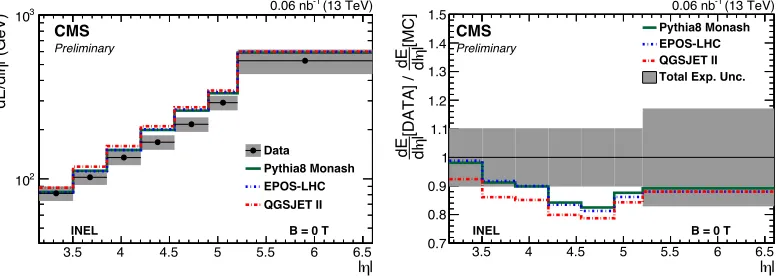
from the rest of the observed final state by the largest rapidity gap. NSD-enhanced event selection at particle level is done with a requirement of at least one particle except muon or neutrino on both sides with respect to the interaction point. The comparison of energy flow measurement as a function of⌘for soft-inclusive-inelastic events to various MC models is shown in Fig. 2 (left). The ratio of
data to MC models is shown in Fig. 2 (right). The gray band represents the total systematic uncertain-ties. Similar plots are also shown for non-single di↵ractive enhanced events in Fig. 3. In Fig. 4, the
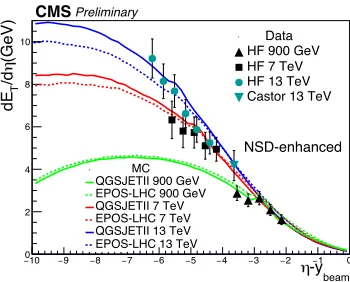
measured transverse energy density as a function of shifted pseudorapidity variable,⌘0 =⌘−ybeam, is compared to published CMS data at lower centre-of-mass energies and MC models. The results at di↵erent psare consistent in terms of⌘−ybeam, and the trends observed both in data and MC models support the limiting fragmentation hypothesis.
| η |
3.5 4 4.5 5 5.5 6 6.5
| (GeV)
η
dE/d|
2
10
3
10 (13 TeV)
-1 0.06 nb CMS
Preliminary
Data Pythia8 Monash EPOS-LHC QGSJET II B = 0 T INEL
|
η
|
3.5 4 4.5 5 5.5 6 6.5
[MC] |η
d|
dE
[DATA] / |η
d|
dE
0.7 0.8 0.9 1 1.1 1.2 1.3 1.4
1.5 0.06 nb-1 (13 TeV)
CMS
Preliminary
B = 0 T INEL
Pythia8 Monash EPOS-LHC QGSJET II Total Exp. Unc.
Figure 2. Left: Energy flow for soft-inclusive-inelastic events compared to various MC models: PYTHIA8, EPOS-LHC and QGSJET II. Right: Ratio of data to MC models [4].
2.3 Pseudorapidity distributions of charged-particles
A measurement of charged-particle pseudorapidity distributions, dNch/d⌘, produced in ppcollisions at ps = 13 TeV is performed by CMS [6]. The charged-particles with a transverse momentum pT > 0.5 GeV in the pseudorapidity range|⌘|<2.4 are required. Four di↵erent event classes cor-responding to di↵erent topologies of the final state particles and the activity measured in the forward
|
η
|
3.5 4 4.5 5 5.5 6 6.5
| (GeV)
η
dE/d|
2
10
3
10 0.06 nb-1 (13 TeV)
CMS
Preliminary
Data Pythia8 Monash EPOS-LHC QGSJET II
B = 0 T NSD-enhanced
|
η
|
3.5 4 4.5 5 5.5 6 6.5
[MC] |η
d|
dE
[DATA] / |η
d|
dE
0.8 1 1.2 1.4 1.6
1.8 0.06 nb-1 (13 TeV)
CMS
Preliminary
B = 0 T NSD-enhanced
Pythia8 Monash EPOS-LHC QGSJET II
Data[(NSD-enhanced)/(INEL)] Total Exp. Unc.
Figure 3.Left: Energy flow for non-single di↵ractive enhanced events compared to various MC models. Right:
Ratio of data to MC models [4].
beam -y
η
10
− −9 −8 −7 −6 −5 −4 −3 −2 −1 0
(GeV)
η
/dT
dE
0 2 4 6 8 10
MC QGSJETII 900 GeV EPOS-LHC 900 GeV QGSJETII 7 TeV EPOS-LHC 7 TeV QGSJETII 13 TeV EPOS-LHC 13 TeV
Data HF 900 GeV HF 7 TeV HF 13 TeV Castor 13 TeV
CMSPreliminary
NSD-enhanced
Figure 4. Comparison of transverse energy density measured by CMS at di↵erent centre-of-mass energies [5]
and MC models [4].
in Fig. 5. The shaded bands around the data points represent the total systematic uncertainties. The measurements are compared to various MC event generators predictions and a reasonable agreement is observed between data and the MC predictions.
2.4 Energy distribution in the very forward direction
The energy spectrum, dN/dE, in the very forward direction−6.6 < ⌘ < −5.2 is measured with the CMS detector inppcollisions at ps=13 TeV [7]. The hadronic and electromagnetic energy spectra
are also presented. The data corrected to the particle level is compared to models. A sensitivity is found on data to the production of neutral and charged mesons, which is an important input for the modeling of cosmic ray induced extensive air showers at ultra-high energies. The comparison of normalized total energy spectra in the pseudorapidity range−6.6 < ⌘ < −5.2 to di↵erent MC and
|
η
|
3.5 4 4.5 5 5.5 6 6.5
| (GeV)
η
dE/d|
2
10
3
10 0.06 nb-1 (13 TeV)
CMS
Preliminary
Data Pythia8 Monash EPOS-LHC QGSJET II
B = 0 T NSD-enhanced
|
η
|
3.5 4 4.5 5 5.5 6 6.5
[MC] |η
d|
dE
[DATA] / |η
d|
dE
0.8 1 1.2 1.4 1.6
1.8 0.06 nb-1 (13 TeV)
CMS
Preliminary
B = 0 T NSD-enhanced
Pythia8 Monash EPOS-LHC QGSJET II
Data[(NSD-enhanced)/(INEL)] Total Exp. Unc.
Figure 3.Left: Energy flow for non-single di↵ractive enhanced events compared to various MC models. Right:
Ratio of data to MC models [4].
beam -y
η
10
− −9 −8 −7 −6 −5 −4 −3 −2 −1 0
(GeV)
η
/dT
dE
0 2 4 6 8 10
MC QGSJETII 900 GeV EPOS-LHC 900 GeV QGSJETII 7 TeV EPOS-LHC 7 TeV QGSJETII 13 TeV EPOS-LHC 13 TeV
Data HF 900 GeV HF 7 TeV HF 13 TeV Castor 13 TeV
CMSPreliminary
NSD-enhanced
Figure 4. Comparison of transverse energy density measured by CMS at di↵erent centre-of-mass energies [5]
and MC models [4].
in Fig. 5. The shaded bands around the data points represent the total systematic uncertainties. The measurements are compared to various MC event generators predictions and a reasonable agreement is observed between data and the MC predictions.
2.4 Energy distribution in the very forward direction
The energy spectrum, dN/dE, in the very forward direction−6.6 < ⌘ < −5.2 is measured with the CMS detector inppcollisions at ps=13 TeV [7]. The hadronic and electromagnetic energy spectra
are also presented. The data corrected to the particle level is compared to models. A sensitivity is found on data to the production of neutral and charged mesons, which is an important input for the modeling of cosmic ray induced extensive air showers at ultra-high energies. The comparison of normalized total energy spectra in the pseudorapidity range−6.6 < ⌘ < −5.2 to di↵erent MC and
cosmic ray models is shown in Fig. 6. Despite the large systematic uncertainties where the energy
η 2
− −1.5 −1 −0.5 0 0.5 1 1.5 2
η
/dch
) dN
events
(1/N
2 2.5 3 3.5 4 4.5 5
CMS Preliminary
| < 2.4
η
1 in |
≥
ch
N > 0.5 GeV
T
p
(13 TeV) Inelastic selection
data
PYTHIA8 CUETM1 PYTHIA8 MONASH EPOS LHC HERWIG++ UE-EE-4C
η
2
− −1.5 −1 −0.5 0 0.5 1 1.5 2
η
/dch
) dN
events
(1/N
0.4 0.6 0.8 1 1.2 1.4
1.6 CMSPreliminary
| < 2.4 η 1 in | ≥
ch N
> 0.5 GeV T p
(13 TeV) SD selection
data
PYTHIA8 CUETM1 PYTHIA8 MONASH EPOS LHC HERWIG++ UE-EE-4C
η
2
− −1.5 −1 −0.5 0 0.5 1 1.5 2
η
/dch
) dN
events
(1/N
2 2.5 3 3.5 4 4.5 5
CMS Preliminary
| < 2.4
η
1 in |
≥
ch N
> 0.5 GeV T p
(13 TeV) NSD selection
data
PYTHIA8 CUETM1 PYTHIA8 MONASH EPOS LHC HERWIG++ UE-EE-4C
Figure 5.Pseudorapidity distributions of charged-particles for the inelastic-enhanced (top-left), single di↵ractive
enhanced (top-right) and non-single di↵ractive enhanced (bottom) event samples [6].
scale is the dominant one, all models show significant di↵erences with the data within the uncertainty
band. The best agreement is observed between data and SIBYLL 2.1.
2.5 Very forward inclusive jet cross section
The very forward inclusive jet cross section is sensitive to radiation of partons, underlying partonic QCD processes and to the parton density functions (PDF) of the incoming hadrons. As shown by the previous measurements, jet cross sections can be described by perturbative QCD over several orders of magnitude inQ2 and x, whereQis the scale of scattering and xis the longitudinal momentum
fraction of the parton.
The very forward inclusive jet cross section measurement presented here is based on the very forward detector of CMS, CASTOR, and ppcollisions recorded in 2015 at ps = 13 TeV. Jets are
reconstructed using the anti-ktalgorithm [9] with a radius parameter ofR = p∆φ2+ ∆⌘2 =0.5 and are required to have their axis between−6.6< ⌘ <−5.2. The transverse momentum of the jets must
]
-1
dN/dE [GeV
evt
1/N
6
−
10 5
−
10 4
−
10 3
−
10 2
−
10 1
−
10
Data Total uncertainty Model uncertainty Sibyll 2.1 Sibyll 2.3 EPOS 1.99 EPOS LHC QGSJet II.03 QGSJet II.04
=13 TeV (B=0T) s
-1 b µ 41.5 -6
>10 SD ξ < -5.5 , η -6.6 <
CMS
Preliminary
Total Energy [GeV]
0 1000 2000 3000 4000 5000
Ratio MC/Data
0 1 2
]
-1
dN/dE [GeV
evt
1/N
6
− 10
5
− 10
4
− 10
3
− 10
2
− 10
1
−
10 Data
Total uncertainty Model uncertainty PYTHIA8 CUETP8M1 PYTHIA8 CUETP8M1, MPI off PYTHIA8 CUETP8M1, pt0Ref = 1.5 PYTHIA8 CUETP8M1, pt0Ref = 3.0 PYTHIA8 4C+MBR Herwig++ 2.7 UE-EE-5C
=13 TeV (B=0T) s
-1
b
µ
41.5
-6
>10
SD
ξ
< -5.5 ,
η
-6.6 <
CMS
Preliminary
Total Energy [GeV]
0 1000 2000 3000 4000 5000
Ratio MC/Data
0 1 2
Figure 6.Comparison of normalized total energy spectrum to various MC models (left) and to PYTHIA8 tunes (right) [7].
b/GeV]
µ
[ T
/dp
σ
d
-1
10 1 10
2
10
3
10
4
10
5
10 Data
Lumi Position Model CES
EPOS-LHC QGSJetII.4 PYTHIA6 Z2* PYTHIA8 CUETP8M1 PYTHIA8 Monash13 PYTHIA8 MBR
(13 TeV) -1 0.212 nb
< -5.2) η (R=0.5) (-6.6 <
t
anti-k
CMS
Preliminary
[GeV] T p
4 6 8 10 12
MC / Data 01
2 3
b/GeV]
µ
[ T
/dp
σ
d
1 − 10
1 10
2
10
3
10
4
10
5
10
(13 TeV) -1 0.212 nb
< -5.2) η (R=0.5) (-6.6 <
t
anti-k
CMS
Preliminary
Data Lumi Position Model CES
PYTHIA8 CUETP8M1 PYTHIA8 CUETP8M1 (no MPI) PYTHIA8 CUETP8M1 CTEQ6.1 PYTHIA8 CUETP8M1 HeraPDF
[GeV] T p
4 6 8 10 12
MC / Data 01
2 3
Figure 7. The measured very forward inclusive jet cross-section at ps = 13 TeV compared to various MC
models (left) and to PYTHIA8 tune CUETP8M1 with di↵erent PDFs (right) [8].
] -1 dN/dE [GeV evt 1/N 6 − 10 5 − 10 4 − 10 3 − 10 2 − 10 1 − 10 Data Total uncertainty Model uncertainty Sibyll 2.1 Sibyll 2.3 EPOS 1.99 EPOS LHC QGSJet II.03 QGSJet II.04
=13 TeV (B=0T) s -1 b µ 41.5 -6 >10 SD ξ < -5.5 , η -6.6 <
CMS
Preliminary
Total Energy [GeV]
0 1000 2000 3000 4000 5000
Ratio MC/Data 0 1 2 ] -1 dN/dE [GeV evt 1/N 6 − 10 5 − 10 4 − 10 3 − 10 2 − 10 1 − 10 Data Total uncertainty Model uncertainty PYTHIA8 CUETP8M1 PYTHIA8 CUETP8M1, MPI off PYTHIA8 CUETP8M1, pt0Ref = 1.5 PYTHIA8 CUETP8M1, pt0Ref = 3.0 PYTHIA8 4C+MBR Herwig++ 2.7 UE-EE-5C
=13 TeV (B=0T) s -1 b µ 41.5 -6 >10 SD ξ
< -5.5 ,
η
-6.6 <
CMS
Preliminary
Total Energy [GeV]
0 1000 2000 3000 4000 5000
Ratio MC/Data
0 1 2
Figure 6.Comparison of normalized total energy spectrum to various MC models (left) and to PYTHIA8 tunes (right) [7]. b/GeV] µ [ T /dp σ d -1 10 1 10 2 10 3 10 4 10 5 10 Data Lumi Position Model CES EPOS-LHC QGSJetII.4 PYTHIA6 Z2* PYTHIA8 CUETP8M1 PYTHIA8 Monash13 PYTHIA8 MBR (13 TeV) -1 0.212 nb < -5.2) η (R=0.5) (-6.6 <
t anti-k
CMS
Preliminary [GeV] T p4 6 8 10 12
MC / Data 01
2 3 b/GeV] µ [ T /dp σ d 1 − 10 1 10 2 10 3 10 4 10 5 10 (13 TeV) -1 0.212 nb < -5.2) η (R=0.5) (-6.6 <
t anti-k
CMS
Preliminary Data Lumi Position Model CES PYTHIA8 CUETP8M1 PYTHIA8 CUETP8M1 (no MPI) PYTHIA8 CUETP8M1 CTEQ6.1 PYTHIA8 CUETP8M1 HeraPDF[GeV] T p
4 6 8 10 12
MC / Data 01
2 3
Figure 7. The measured very forward inclusive jet cross-section at ps = 13 TeV compared to various MC
models (left) and to PYTHIA8 tune CUETP8M1 with di↵erent PDFs (right) [8].
corrected cross section measurement of the very forward inclusive jet production is normalized by the luminosity and is shown in Fig. 7. The yellow band represents the total systematic uncertainty. The dominating systematic uncertainties on the very forward inclusive jet cross section measurement are the jet energy scale of CASTOR (CES), model dependence and the alignment of CASTOR. Within the current experimental uncertainty all models are consistent with the data. However, an overestimation
is observed in all the PYTHIA tunes whereas the cosmic ray MC models EPOS-LHC and QGSJETII.4 underestimate the data. A high sensitivity to MPI is observed, but the measurement is found to have a moderate sensitivity to the underlying PDF set of the model.
3 Summary
An extensive list of forward physics measurements performed with data taken in 2015 atps=13 TeV
is presented. The measurements presented here can be used as input for tuning of existing hadronic interaction models. The collection of measurements in the forward region is an important baseline for more exclusive analyses and shows that forward physics is well understood within the systematic uncertainties at a ps=13 TeV scale collected by CMS.
4 Acknowledgments
The author would like to acknowledge the Adiyaman University Scientific Activity Foundation and the organizers of ICNFP2016 for the funding.
References
[1] S. Chatrchyanet al.[CMS Collaboration], JINST3S08004 (2008)
[2] CMS Collaboration, CMS Physics Analysis SummaryCMS PAS FSQ-15-005, (2016)
[3] S. Agostinelliet al., Nuclear Instruments and Methods in Physics Research Section A: Accelera-tors, Spectrometers, Detectors and Associated Equipment506, no. 3, 250 – 303, (2003)
![Figure 5. Pseudorapidity distributions of charged-particles for the inelastic-enhanced (top-left), single dienhanced (top-right) and non-single di↵ractive↵ractive enhanced (bottom) event samples [6].](https://thumb-us.123doks.com/thumbv2/123dok_us/8633515.1423223/5.482.76.402.81.410/figure-pseudorapidity-distributions-particles-inelastic-enhanced-dienhanced-enhanced.webp)
![Figure 6. Comparison of normalized total energy spectrum to various MC models (left) and to PYTHIA8 tunes(right) [7].](https://thumb-us.123doks.com/thumbv2/123dok_us/8633515.1423223/6.482.45.433.336.527/figure-comparison-normalized-energy-spectrum-various-models-pythia.webp)
