http://www.sciencepublishinggroup.com/j/cse doi: 10.11648/j.cse.20190302.12
Review Article
Design Modified Robust Linear Compensator of Blood
Glucose for Type I Diabetes Based on Neural Network and
PSO Algorithm
Ekhlas Hameed Karam, Eman Hassony Jadoo
Computer Engineering Department, College of Engineering, Mustansiriyah University, Baghdad, Iraq
Email address:
To cite this article:
Ekhlas Hameed Karam, Eman Hassony Jadoo. Design Modified Robust Linear Compensator of Blood Glucose for Type I Diabetes Based on Neural Network and PSO Algorithm. Control Science and Engineering. Vol. 3, No. 2, 2019, pp. 29-36. doi: 10.11648/j.cse.20190302.12 Received: December 15, 2019; Accepted: December 30, 2019; Published: January 8, 2020
Abstract:
Type I diabetic patients is a chronic condition marked by an abnormally large level of glucose in human blood. Persons with diabetes characterized by no insulin secretion in the pancreas (ß-cell) also known as insulin-dependent diabetic Mellitus (IDDM). The treatment of type I diabetes is depending on the delivery of the exogenous insulin to reach the blood glucose level near to the normal range (70-110mg/dL). In this paper, a modified robust linear compensator (MRLC) is suggested to regulate the glucose level of the blood in the presence of the parameter variations and meal disturbance. The Bergman minimal mathematical model is used to describe the dynamic behavior of blood glucose concentration due to insulin regulator injection. Firstly, the robust linear compensator (RLC) is designed based on the linear algebraic method, the simple PD-ADALINE neural network is used to modified the RLC based on the Particle Swarm Optimization technique (PSO) which is used to adjusted the proposed neural network parameters. The simulation part, based on MATLAB/Simulink, was performed to verify the performance of the proposed controller. It has been shown from the results of the effectiveness of the proposed MRLC in controlling the behavior of glucose deviation to a sudden rise in blood glucose.Keywords:
Type I Diabetes, Robust Linear Compensator, Linear Algebraic Method, Bergman Minimal Model, ADALINE Neural Network, Particle Swarm Optimization1. Introduction
Diabetes mellitus is one of the most important chronic diseases which results from a high blood sugar for a long time due to insufficient insulin generation in the blood [1]. The concentration of glucose in the bloodstream is naturally regulated by two hormones: insulin and glucagon. Both of these hormones are secreted by β-cells and α cells in the Langerhans islands of the pancreas, respectively. The concentration of glucose ranges from 70 to 110 ( / ). Accordingly, there are two states, hyperglycemia (glucose concentration is above the normal ranges) and hypoglycemia (low glucose concentration than the normal ranges) [2].
Diabetes is classified into two common types. Type 1 diabetes mellitus (T1DM) is caused by the autoimmune destruction of (β-cells) in the pancreas that produce insulin deficiency. Therefore, patients with insulin-dependent T1DM,
they need insulin injections to regulate the external glucose concentration they have to a normal level. Type 2 diabetes begins with insulin resistance, a condition in which cells do not respond to insulin properly. This model is noninsulin-dependent diabetes-dependent diabetes. The most common cause is excessive body weight and not enough exercise [3].
controllers starting from classical control methods like PID controller [5], pole placement [6] for controlling blood glucose, robust and optimal control techniques like output
feedback based robust controller [7], / control [8] and robust glucose control by µ-synthesis has given in [9].
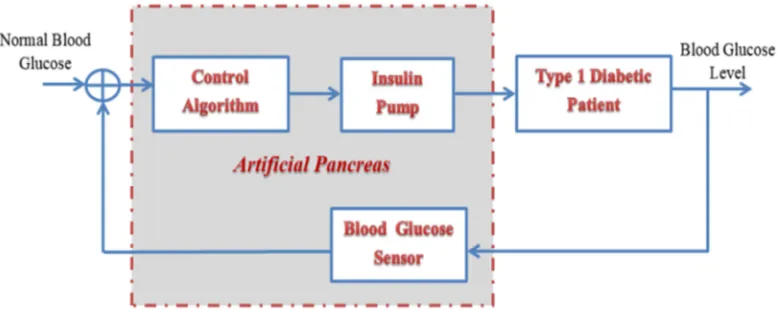
Figure 1. Closed loop insulin regulation system block diagram.
One of the efficient linear controller is linear compensators controller (LCC), this controller which is used to stabilize the unstable system is designed by forming set of linear algebraic equations. In this paper we design a modified linear compensators controller (MLCC) to regulate the blood glucose level of type 1 diabetes. The modification is made based on simple PD-ADALINE neural network and PSO algorithm.
The paper organized as follows. In section 2 modeling for glucose and insulin regulation system are presented. Section 3 includes the design steps of the LCC control. Simulations and concluding observations were included respectively in sections 4 and 5.
2. Insulin-Glucose Regulation Model
Different mathematical models have been proposed to understand the dynamics of diabetes and to correlate the relationship between glucose and insulin distribution models that help design a diabetes control model. Among these models, the minimal Bergman model, a common reference model in the literature, approaches the dynamic response of blood glucose concentration in a diabetic to insulin injections. Bergman model consists of three differential equations as follows [3, 4]:
(1)
Where G(t) is the plasma glucose concentration in [mg/dL],
X(t) proportional to the insulin concentration in the remote compartment [1/min], I(t) is the plasma insulin concentration in [mU/dL], and u(t) is injected insulin rate in [mU/min],
, , , , , are parameters of the model. the term, , in the third equation of this model, serves as an internal regulatory function that formulates insulin secretion in the body, which does not exist in diabetics [8], the
represent the rate of exogenous insulin. The value of will be significantly reduced; therefore it can be approximated as zero [3, 4]. The is disturbance signal can be modeled by a decaying exponential function of the following form [16]:
!"#"$%&' ()*+,)
$*+,- (2)
The nonlinear mathematical model (Eq. (1)) become linear around steady state values of the model and the transfer function of overall system is given below [4]:
. / 0 /
('1.2
/ '3 / '- / 4 (3)
. / 0 /
('1.2
/1 /-4 '3 '- / 4'3 4'- '3'- '3'-4 (4)
In order to apply the control design of LCC the parameters value given in (Table 1) is used and the transfer function (Eq. 4) reduced to second order transfer function by using Matlab command (reduce instruction), then the modification is made for this reduction model.
3. Linear Compensator Controller Design
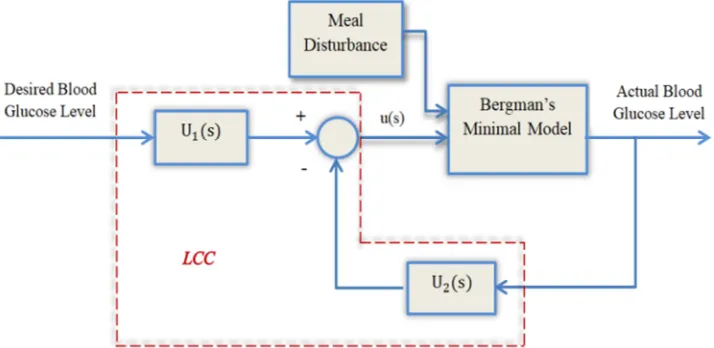
The block diagram for designed linear compensator controller is shown in figure 1, this controller consist of two linear compensator (U 6 and U 6 ). This method consists of two steps: the choice of the total transportable function of the executable, and then the compensator can be obtained by solving the sets of linear algebraic equations [11]. Linear compensator (U 6 and U 6 ) designed by forming a set of linear equations, where
7 6 # /8 / (5)
7 6 9 /8 / (6)
where 7 6 , 7 6 is a linear first order compensator,
Figure 2. Linear compensator control design.
In order to simplified and reduce the order of the
7 6 , 7 6 to first order equations, the linear transfer function (Eq. 4) of the nominal operating is reduced to second order equation by using Matlab command (reduce instruction), the obtained equation will be:
6 = /> / ?/ 3
/- @3/ @- (7)
A simple modification then made for the reduction model (Eq. 7) to convert the numerator (AB6 A in above equation to only constant gain C as;
6 /- ED3/ E- (8)
After that, equation (8) can be represented as a ratio of two coprime polynomials 6 = /> / . The transfer function
B 6 =>??// (there are three constraints that must be met to make the overall system is implementable (for more details see [12, 13]). The implementable closed loop transfer function (C. L. T. F) is
B 6 =>??// /- .IFFG-G/ FG- (9)
Where J4 is the suitable selected natural frequency. The designed steps can be illustrated as shown below: Step 1: compute
.?/
= / = =?/
>? / .= / =
=*/
>*/ (10)
Where KE 6 , E 6 are two coprime polynomials. Step 2: Check if the degree of E 6 L 2 1, suggest an arbitrary of OOOOE(s) 2 1 , which is Hurwitz polynomial (i.e. all its pole lies in the left half-s plane). Because this polynomial can be canceled in the design,
its root should be chosen inside an acceptable pole-zero cancellation region. If degree of E 6 2 1, then
E
OOOO(s) 1 and the case degree of E 6 P 2 1 will not be discussed [11]. Because the degree of ' 6 2 then we suggested a Hurwitz polynomial of degree 1, arbitrary choose it as OOOO'(s)=(s+5),
The A(s), C(s) and B(s) that are mentioned previously can obtained as shown below:
A(s)=KE 6 .OOOOE(s) (11)
The solution of Diaphantine equation can obtained as;
Q B 0 KB K K 0 0 B 0 KB K K S Q <B ;B < ; S Q TB T T T
S (12)
where
F(s)= D.OOOO T! 6 T 6 T 6 TB (13)
C(s)= < 6 <B (14)
B(s)= ; 6 ;B (15)
According to the polynomial C(s), A(s) and B(s) the compensator 7 6 U 7 6 can be obtained as illustrated in Eq. (5) and Eq. (6).
The steps design shown below with numerical values:
: 6 0.82646 4.132 (16)
T 6 6 5.0426 0.21096 0.0045 (17) The solution of Diaphantine equation can obtained as;
Q 0.0003291 0.03799 1 0 0.001089 0 0 0 0 0.0003291 0.03799 1 0 0.001089 0 0 S Q <B ;B < ; S Q 0.0045 0.2109 5.042 1
C(s)= < 6 <B (19)
B(s)= ; 6 ;B (20)
< 6 6 5, ; 6 18.86 2.6 (21) According to the polynomial C(s), A(s) and B(s)
the compensator 7 6 U 7 6 can be obtained as:
7 6 (B.] ^/(I./ _ , 7 6 ( ].]/( .^/ _ (22)
4. Modified Linear Compensator
Controller Based on PD-ADALINE
Neural Network
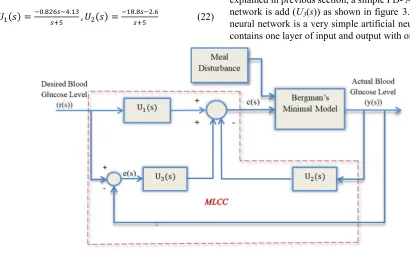
In order to enhance the operation of designed LCC that explained in previous section, a simple PD- ADALINE neural network is add (U3(s)) as shown in figure 3. The ADALINE neural network is a very simple artificial neural network that contains one layer of input and output with only one neuron.
Figure 3. Modified linear compensator controller block diagram.
The general structure of ADALINE neural network is shown in figure 4.
Figure 4. ADALINE Network Architecture.
In this work, MLCC is designed based on PD-ADALINE neural network. The control part U3(s) that based on PD-ADALINE can be described as shown below:
J 1 J `a b (23) where
J 1 is the previous weight vector for the network,
a c 6 d 6 is the error, b is the input vector and ` the learning rate.
@& A T J , (24)
A is the constant basis, F is the applied identity (Purlin) activation function.
e> a fga , (25)
@& e>, (26)
7 6 6U (27) Then the parameters (fg, `) are tuning based on Particle Swarm Optimization algorithms (PSO). The PSO algorithm is initialized with a population of candidate solutions which is called a particle. N particles are moving around in a D-dimensional search space of the problem [15].
The position of the h$i particle at the h$i iteration is represented by bj bj , bj , . . . , bj> . The velocity for the
h$i particle can be written as k
kj 1 Jkj m c npbestj bj t m c ngbestj bj t (28)
bj 1 bj kj (29) Where m , m are called acceleration coefficients. w is called inertia weight, and c , c are random value in the range [0, 1].
Table 1. Bergman Minimal Model Parameters [10].
Parameter normal Patient 1 Patient 2 Patient 3
0.0317 0 0 0
0.0123 0.02 0.0072 0.0142
4.92 5.3v 10(^ 2.16v 10(^ 9.94v 10(_
n 0.2659 0.3 0.2465 0.2814
0.0039 - - -
h 79.0353 - - -
70 70 70 70
7 7 7 7
Table 2. The parameters of the modified linear compensator controller obtained by PSO.
Parameter Value
fg 0.0034
` 0.5
5. Simulation Results
The closed-loop system simulates using MATLAB to prove the proposed design confirmation. Most commonly available glucose sensing devices operate by measuring the blood glucose content of a small finger-prick blood sample, the method is disturbing upon frequent use.
As a result, some diabetic patients gage blood sugar as a little as once per day or less. Although the last advanced work has led to semi-aggressive systems, for example, the Cygnus Gluco Watch Biographer blood glucose meter [7]. This device shows the sampling rate reading every (20 minute) and can gage and save data permanently for up to (12 hour) before new sensor pads are needed. Because of limitations in the measurement rate of blood
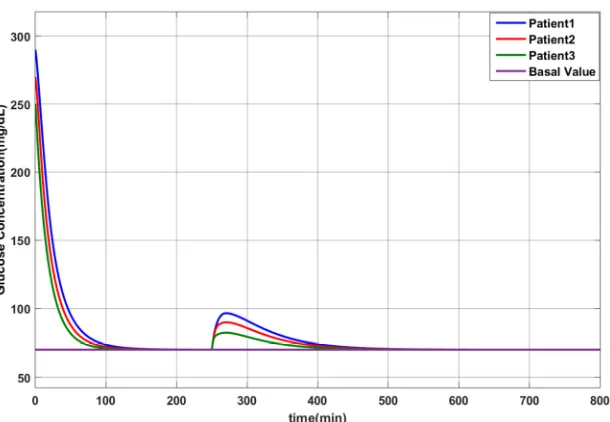
glucose level and cannot have a continuous insulin infusion rate. In this paper, the simulations are carried out dynamically for three patients with the initial conditions 290, 270 and 250mg/dl for patients 1, 2 and 3, respectively. In the simulation, the meal glucose disturbance is given in Eq. (2) and the value of its parameters is wl 60 is Amount of carbohydrates in the meal, :l 0.8 is constant in the model, E@& 280 h is the moment of time when the absorption is at its peak value.
You can note that the glucose value of the normal person is stabilized at the basal level in the presence of the disturbance (meal), while the patient's glucose level remains dangerous outside the range.
The simulation second part is the proposed controller is applied to the system and the response of a patients in the presence of the disturbance is tested. To examine the robustness of the control algorithm to the parameter change, three sets of parameters for three different patients have been used. The selected wn in this work equal to (J4 0.03cU /6am). Figures
5 to 8 shows the results obtained from the simulation. The parameters values for the controller tuned using PSO.
Figure 6. Glucose regulatory system using LCC with meal.
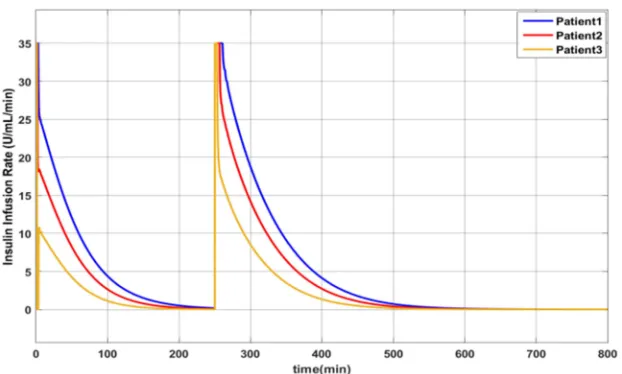
Figure 7.Insulin infusion rate for three patients using LCC.
Figure 9.Insulin infusion rate for three patients using MLCC.
It is revealed from the figures 6-8 that the glucose output with MLCC tracks the basal value with small settling time ( /), study state error (a/./.) and mean absolute percentage error (MAPE). The comparison between controllers is shown in
Tables 3, 4 and 5. These tables illustrate the performance of the controllers. The MLCC has the best average performance for the three patients.
Table 3. The simulation result’s evaluation parameters for patient 1.
The controller used xy% {| }~•. €|.|. MAPE
LCC 0 531.22 0.0063 0.207
MLCC 0 490.45 0.0013 0.1393
Table 4. The simulation result’s evaluation parameters for patient 2.
The controller used xy% {| }~•. €|.|. MAPE
LCC 0 531.21 0.0024 0.1685
MLCC 0 479.82 0.0004 0.1076
Table 5. The simulation result’s evaluation parameters for patient 3.
The controller used xy% {| }~•. €|.|. MAPE
LCC 0 531.22 0.0006 0.1241
MLCC 0 463.45 0.00014 0.0772
6. Conclusion
Diabetes is an important problem in human regulatory systems, which has been discussed in recent years. In this paper we propose a modified linear compensator controller which give robust stability for diabetes system as well as the robust performance of normoglycemic average for type I diabetic patients, the modification is made by single PD-ADALINE neural network. The effectiveness and performance analysis of the proposed control strategy concerning plasma glucose-insulin stabilization is verified by simulation results in MATLAB environment. To validate the robustness of the proposed controller, the diabetic patient is exposed to external disturbance, that is, a meal at a time (250min.). The closed- loop control system has been simulated for different patients with different parameters, in the presence of the food intake disturbance and it has been shown that the glucose level is stabilized at its base value in a reasonable amount of time.
References
[1] Bergman, R. N., L. S. Phillips, and C. Cobelli, Physiologic evaluation of factors controlling glucose tolerance in man: measurement of insulin sensitivity and beta-cell glucose sensitivity from the response to intravenous glucose. The Journal of clinical investigation, 1981. 68 (6): p. 1456-1467. [2] Basher, A. S., design fuzzy control system for blood glucose
level for type-1 diabetes melitus patients using ga a simulation study, 2017.
[3] Sylvester, D. D. and R. K. Munje, Back stepping SMC for blood glucose control of type-1 diabetes mellitus patients. 2017. [4] Hassan, S. M. and R. A. Riaz, Closed loop blood glucose
control in diabetics. Biomedical Research, 2017. 28 (16): p. 7230-7236.
[6] György, A., et al., Quasi-model-based control of type 1 diabetes mellitus. Journal of Electrical and Computer Engineering, 2011: p. 4.
[7] Colmegna, P. and R. S. Peña, Analysis of three T1DM simulation models for evaluating robust closed-loop controllers. Computer methods and programs in biomedicine, 2014. 113 (1): p. 371-382.
[8] Mourad, A., G. Keltoum, and H. Aicha, Blood glucose regulation in diabetics using H∞ control techniques. European Journal of Advances in Engineering and Technology, 2015. 2 (5): p. 1-6.
[9] Morales-Contreras, J., E. Ruiz-Velázquez, and J. García-Rodríguez. Robust glucose control via µ-synthesis in type 1 diabetes mellitus. in 2017 IEEE International Autumn Meeting on Power, Electronics and Computing (ROPEC). 2017. IEEE.
[10] Abadi, D. N. M., et al., Design of optimal self-regulation Mamdani-type fuzzy inference controller for type I diabetes mellitus. Arabian Journal for Science and Engineering, 2014. 39 (2): p. 977-986.
[11] Karam, E. H., Reduce the Effect of Disturbance from Linear
Unstable Second Order Systems Using Hybrid Controller Scheme. Journal of Engineering and Sustainable Development, 2012. 16 (4): p. 241-255.
[12] Chen, C.-T., Linear system theory and design. 1998: Oxford University Press, Inc.
[13] Chen, C.-T., Introduction to the linear algebraic method for control system design. IEEE Control Systems Magazine, 1987. 7 (5): p. 36-42.
[14] Yacine, A., C. Fatima, and B. Aissa. Trajectory tracking control of a wheeled mobile robot using an ADALINE neural network. in 2015 4th International Conference on Electrical Engineering (ICEE). 2015. IEEE.
[15] Wang, D., Tan, D., & Liu, L. (2018). Particle swarm optimization algorithm: an overview. Soft Computing, 22 (2), 387-408.
![Table 1. Bergman Minimal Model Parameters [10].](https://thumb-us.123doks.com/thumbv2/123dok_us/8475634.1712468/5.595.145.451.539.745/table-bergman-minimal-model-parameters.webp)