103 | P a g e
BIOMETRIC SECURITY SYSTEM AIDED BY AN
ANDROID APPLICATION
Aditi Singh
1, Ayushi Vishwakarma
2, Amritanshu Srivastava
31,2
Computer Science and Information Technology Engineering, MJP Rohilkhand University
3
Electronics and Communication Engineering, Shri Mata Vaishnno Devi University
ABSTRACT
In today’s world where the highlysecured banks and lockers have proved to be vulnerable to unauthorized
access, we cannot completely rely on ordinary locks for the security of our houses. Even our workplace where
all the official information resides, high quality extortionate fortification is required. Making use of advanced
technologies like biometric systems and password protected digital locks is the demand of the time. Using
biometric systems for security lays more emphasis not on what all you know about the security of the place but
who you are with respect to the place. In juxtaposition with the normal lock and key system, the advantages of
Biometric security systems are umpteen, but the biometric security system alone cannot provide us with a
pragmatic security system. Thus, combining it with a backup of password protection relaxes the inflexibility of
the system and meets all the requirements of an ideal house security system. This allows multiple users to access
the locked place. In this paper we elaborate our idea of using a Biometric and Password Protected System for
the security of a place, viz. a house or workplace.
Keywords: Biometric System, Fingerprint Recognition, Android Application, GSM Module,
Security System.
I. INTRODUCTION
In today’s world where greed has taken over the minds of people, the instances of thefts and burglary have
increased manifolds. Working hard and earning are not the only things that one needs to take care of, securing
their hard-earned assets and estates have become imperative tasks of any individual. Over the years, the use of
heavy locks made up of iron and steels have served the purpose of securing our properties but with the passage
of time where the thieves have been coming up with gnarly techniques to break into houses, we need better
technology to protect our houses. Use of biometric devices for this purpose is indispensable.Various efforts have
been made for the improvement of technology used in security systems which include the work of Dushyant Khosla,
who developed Fingerprint Identification in Biometric Security Systems [1]. Senthil Kumar.M, who worked on the
development of Android Based Security and Remote Surveilance System [4]. K.Saravanan, who worked on a new
application of Multimodal Biometrics in home and office security system [3]. Kawser WazedNafi [2], developed An
Advanced Door Lock Security System using Palmtop Recognition System. Prabhakar Telagarapu [5], worked on
Finger Print Recognition using Minutiae Extraction using Bank Locker Security.Every owner tries to keep his assets
safe by using the best security system available. Security of place and property has been the main concern of mankind
since antiquity. Use of password protected electronic locks have been effective in safeguarding houses but such a
104 | P a g e
conjecture or sophisticated hacking techniques. Thus, it is better to use Biometric Security Systems in locks of the
doors of the house. Password protection can be used as a back-up in case the kins of the authorized person require
access to the house. The advantages of Biometric Security outweigh the cost of implementation of such a system.
Besides, other merits of Biometric System include freeing the user from the responsibility of carrying around the key
of the lock of the main door and keeping it safe from pocket pickers and sneak thieves. Leaving ones house for a long
period of time peacefully will no longer remain a figment of one’s imagination. All this can be possible because the
only way a door with such a security system can be unlocked is by the use of the fingerprints of the authorized person.
The idea conceived by us also involves provisions for limiting access attempts to 5 times. If the Biometric inputs are
invalid for 5 times the security system sirens an alarm and also resets the password and sends the password to the
authorized user on his registered number using the GSM module.
This ystem is thus a fool-proof system that ensures all round security of the house.
The biometric system is used in many countries for not only the purpose of security but also for the purpose of
registering the attendance of employees and students. Even the Central Government of India has employed
biometric system for checking the regularity and punctuality of the employees. The distribution of Adhar Card
that serves as a unique id of an individual also uses biometric technology.
II. REASONS FOR CHOOSING THIS PROJECT
Developing an application that would prove to be useful in real life was our main objective. Our application
incorporates infallible security features that would help in safeguarding precious possessions. The security
system developed by us would be quite useful in the present as well as in the future.
It has the added feature of adaptability which would help in broadening the horizons of its reachability with
further advancement in technology. Furthermore, the ease with which our security system can be operated is an
added bonus.
III. OVERVIEW OF THE TECHNOLOGY USED
3.1. Biometric System
Biometric is a word which means “life and measurement”. The main technology behind fingerprint recognition
is the use of biometric authentication. Biometric authentication is used for the verification of the right person by
some of his inherent trait for the purpose of granting access control. There are two types of Biometric systems,
viz. 1. Physical 2.Behavioral. Physiological characters include fingerprints, face patterns, palm print, iris
recognition, etc. whereas behavioural characteristics include voice recognition, etc. The reliability of Biometric
Systems increases as the Biometric identifiers are specific for individuals. This technology also frees the user
from the complexity involved in generating an efficient passcode that cannot be easily cracked. This technology
is fraud free and when employed with password protection can prove to be a panacea in the field of security.
105 | P a g e
3.1.1 Fingerprint Representation
The uniqueness of a fingerprint is determined by the topographic relief of its ridge structure and the presence of
certain ridge anomalies termed as minutiae points.
Typically, the global configuration defined by the ridge structure is used to determine the class of the
fingerprint, while the distribution of minutiae points is used to match and establish the similarity between two
fingerprints.
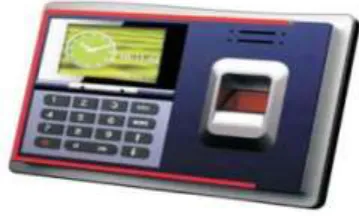
Fig. 2 Finger Print based Security System
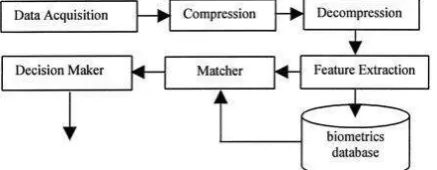
Automatic fingerprint identification systems, that match a query print against a large database of prints (which
can consist of millions of prints), rely on the pattern of ridges in the query image to narrow their search in the
database (fingerprint indexing), and on the minutiae points to determine an exact match (fingerprint matching).
The ridge flow pattern itself is rarely used for matching fingerprints.
Fig. 3 Fingerprint Fig. 4 Access Through Fingerprint
3.1.2 Minutiae
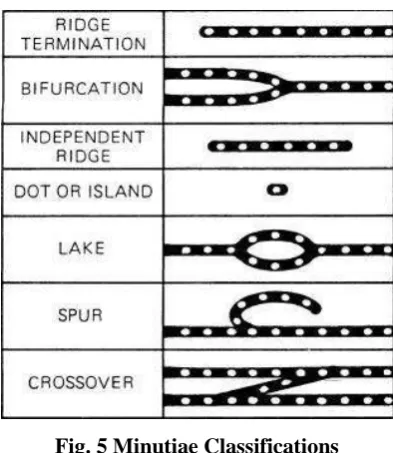
Minutiae, in fingerprinting terms, are the points of interest in a fingerprint, such as bifurcations (a ridge splitting
into two) and ridge endings (Fig 5). Examples are:
i. Ridge Endings- a ridge that ends abruptly
ii. Ridge Bifurcation- a single ridge that divides into two ridges
iii. Short Ridges, Island Or Independent Ridge- a ridge that commences, travels a short distance and then ends
iv. Ridge Enclosures- a single ridge that bifurcates and reunites shortly afterward to continue as a single ridge
v. Spur- a bifurcation with a short ridge branching off a longer ridge
106 | P a g e
Fig. 5 Minutiae Classifications
Minutiae also refer to any small or otherwise incidental details. But the focus when matching is only on the 2
main minutiae i.e. Ridge Ending and Ridge Bifurcation (Fig 6).
Fig. 6 Minutiae Graph
3.2. Android Application
Operating system for mobile phones developed by Google is known as ANDROID. This was developed basically for
touch screens because the user-interface is based on direct manipulation by the user. The OS is responsive to actions
like typing, swiping and pinch-to-zoom. The OS is based on the LINUX kernel. The application designed by us for
our security model is an android application. It also provides a hepatic feedback to the users using the vibratory
capabilities of the user’s phone. His application always maintains a real time contact with the security system so that
immediate actions could be taken in case of emergency.
IV. BLOCK DIAGRAM AND ITS DESCRIPTION
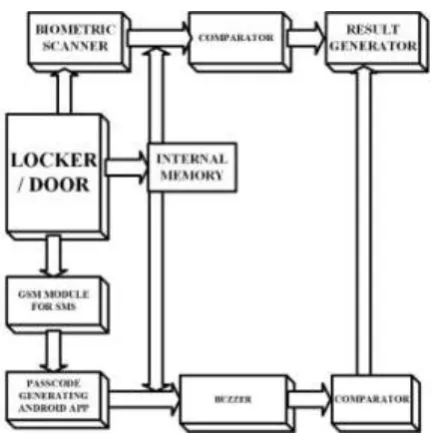
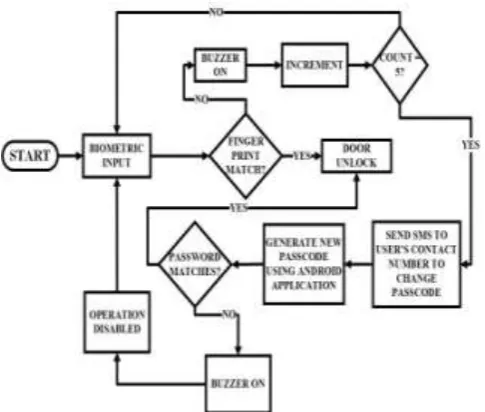
We start by feeding in the scanners, the biometric information. If the information fed matches the one that has
been stored, the door unlocks. In case amismatch occurs, the same procedure is repeated 5 times. If in iteration
less than five, the match is found, the door unlocks. Otherwise, the security system sends a text message to the
authorized user’s mobile number. The user is alerted that there had been five failed attempts to unlock the door
and asks the user to generate a passcode. The user uses the application software of the security system to send
107 | P a g e
the passcode matches then the door unlocks. In case a match is not found, a message is sent to the nearest police
station as well as anti-intrusive alarms are blared to scare off the thief.
Fig. 7 Block Diagram of Security System
V. ALGORITHM
STEP 1. Feed your biometric (fingerprint) and store your personal contact number which will be used in case of
wrong inputs.
STEP 2. Install the locking system and establish the connection with GSM module.
STEP 3. Input biometric information (your fingerprint).
STEP 4. The system scans the fingerprint. If match is found, go to step 5 else go to step 6.
STEP 5. Match found. Door unlocked. Go to step 12.
STEP 6. Match not found. Initialize counter to 1. Go to step 3. Increment counter by 1. Repeat till counter
equals 5.
STEP 7. The security system would generate a new 6 digit passcode which would be a combination of alphabets and
numbers. This passcode would be transmitted via. GSM module and the user would receive it in the form of a
text message.
STEP 8. Input the passcode.
STEP 9. The system checks and matches the passcode with its own passcode.
STEP 10. If match found, door unlocked. Go to step 12.
STEP 11. If match not found, door remains locked. Nearby, security personnel is informed and an alarm is rung.
108 | P a g e
VI. FLOWCHART
Fig. 8 Flowchart of the Security System
VII. SCOPE OF IMPROVEMENT
In cases of emergency, passcodes can be changed easily with the help of the application software. However, a
situation may arise when the biometric identifier is out of reach yet the door needs to be accessed. Such a
situation may lead to serious consequences and possibly result in loss of access to the place. Apart from death,
injury in fingers may also be a reason that authorized person is not granted access, besides our technology
requires the user to have clean hands. Hence, if the hands are not clean enough, biometric recognition may fail
and the access would be denied. Apart from this, if the application designed to change the passcode is
somehow lost, the users will face problems accessing the house. Even the mobile phone of the user needs to be
kept with utmost safety so that no unknown person can misuse the application.
VIII. CONCLUSION
Efficient security systems are the need of the hour. Our security system along with its application software
establishes itself as the most fool-proof technology available. The short comings would be rectified with further
development in technology. Our system is totally cost-effective. There is no danger of keys being lost or stolen.
It helps in preventing unauthorized entry on all costs. The application software is also easy to install and
user-friendly. There is minimal possibility of bugs cropping up in the application.
All in all, our design is futuristic and innovative and also has real life significance.
REFERENCES
[1] Mary Lourde R and Dushyant Khosla, “Fingerprint Identification in Biometric Security Systems,”
International Journal of Computer and Electrical Engineering, Vol. 2, No. 5, October, 2010 1793-8163
[2] Kawser Wazed Nafi,“ An Advanced Door Lock Security System using Palmtop Recognition System,”
109 | P a g e
[3] K.Saravanan, C.Saranya and M.Saranya, “A new application of Multimodal Biometrics in home and office
security system,” DRDO Sponsored National Conference on Control, Communication and System
Engineering.
[4] Senthil Kumar.M and Padmavathy.N, “Android Based Security and Remote Surveilance System,” Graduate
Research in Engineering and Technology (GRET): An International Journal.
[5] PrabhakarTelagarapu, “Finger Print Recognition using Minutiae Extraction using Bank Locker Security,”