BILLBOARD ADVERTISING MODELING BY USING NETWORK
COUNT LOCATION PROBLEM
Hamid Reza Lashgarian Azad1, Nader Shetab Boushehri2
1, 2 Industrial Engineering Department, Isfahan University of Technology, Isfahan, Iran
Received 14 December 2013; accepted 6 February 2014
Abstract: Many applications in engineering and science rely on the optimization of computationally cost functions. A successful approach in such states is to couple an evolutionary algorithm with a mathematical model which replaces the cost function. By considering of importance of advertising in the business declaration, especially billboard advertising, in this paper we have formulated billboard selection decision making, by using network count location approach which determine informative links in a network, to optimize cost of advertising and billboard visiting. Then, opposition based colonial competitive algorithm, which originally inspired by imperialistic competition, is used to solve mathematical model. Also, we implement proposed model on Sioux Falls city network.
Keywords: optimization, billboard advertising, opposition based colonial competitive algorithm, network count location problem.
1 Corresponding author: [email protected]
1. Introduction
A basic description of advertising that Merriam-Webster Dictionary (2011) presented is to “The action of calling something to the attention of the public especially by paid announcements”. A more descriptive definition presented by Entrepreneur (2011) is “To call the public’s attention to your business, usually for the purpose of selling products or services, through the use of various forms of media, such as print or broadcast notices”. Advertising presents a direct line of statement to existing and potential customers with regards to a product or service. Advertising has its origin in Europe, although some of its forms, such as radio and television commercials, as well as advertising on the Internet, for example, are
uniquely American. In the study of O’Barr (2010), a main factor in advertising history is in the technique used whereby there was a transition from face to face selling messages to the stilted, repetitive, printed advertisements of early newspapers, to the mass communication by radio and television, to the re-personalization of messages via direct mail, cable and internet.
individual messages, draw customers to the business, and to hold on hand customers. Today, advertising plays a very important role in competition as below:
• Advertising plays a very important role in customers’ life. Customers are the people who buy the product only after they are made aware of the products available in the market. If the product is not advertised, no customer will come to know what products are available and will not buy the product even if the product was for their benefit. Also advertising helps people to obtain the best products because they are able to compare the products and buy. Thus, advertising is important for the customers.
• Advertising plays very important role for the producers and the sellers of the products, because advertising helps increasing sales, identifies their competitors to adjust the level of competition, makes ground for a new product in the market, helps creating goodwill for the company and keeps demand.
• Advertising helps educating people. There are some social issues also which advertising deals with like energy optimization, driving rules, smoking, family planning education, etc.
These days there are more ways than ever before to advertising. Most common of ways is to:
• Generally TV commercial is considered the most ef fective mass-market advertising type, as is ref lected by the high prices TV networks fee for commercial airtime during popular TV programs. Radio advertising is a
type of advertising via the medium of radio and broadcast as radio waves to the air. Airtime is bought from a station or network in switching for airing the commercials. Radio is a growing medium that can be found not only on air, but also online. According to Arbitron, radio has approximately 241.6 million weekly listeners, or more than 93 percent of the U.S. population. • Billboards are big structures placed
in public position which present advertisements to passing passerby. Most often, they are located on main roads with a large amount of passing motor and pedestrian traffic; however, they can be located in any location with large amounts of visitors, such as in stations, in shopping centers or buildings and in stadiums.
• On line adver tising is a t y pe of promotion that uses internet for the expressed purpose of delivering marketing messages to draw customers. Examples of online advertising include background advertisements that show on search engine results pages, social network advertising and e-mail marketing.
• Product placement is the purposeful incorporation of commercial content into non-commercial settings, that is, a product plug generated via the fusion of advertising and entertainment. In product placement, the involved audience gets exposed to the brands and products during the natural process of the movie, television program, or content vehicle.
a modified type of imperialist competitive algorithm, a numerical example is given in Section 5 and Section 6 presents the conclusion and future works.
2. Billboard Advertising
Taylor et al. (2006) explain billboards as the most common type of outdoor advertising. Over the years billboards have been build in all sorts of shapes and sizes, mostly along highways or major streets in cities in order to attract the attention of people. However there are advantages and disadvantages of using billboards. An obvious benefit is that they are very visible and can be easily observed and so their message is seen by passers. Also, advantages of billboards have been listed as including: potential assignment of the advertisement near the point of sale; 24-hour attendance; geographic flexibility for local advertisers; visual effect from advertisement size and message creativity. A study of billboard users found that compared with other media, billboards were rated higher in terms of ability to attract new customers, communicate information affordably and to increase sales.
In today’s challenging recessionary economy, many companies are forced to shrink their advertising costs to meet the new realities of the marketplace, as are mentioned by Savitz and Shipp (2009).
Murty (2003) illustrates that making decisions on issues w ith impor tant consequences has become a highly complex problem due to the many competing forces under which the world is operating today, and the manual method very often leads to decisions quite far from being optimal. In fact many bad decisions are being made daily due to this. Many companies have become
aware of this problem, and have made efforts to use mathematical models for decision making, and even spent considerable sums of money to acquire software systems to solve these models. However, often the software sits unused because the people who make the decisions are not trained in using it properly. Or, the results obtained by the software may not be practical due to an inappropriate mathematical model being used for the problem. Intelligent modeling is essential to get good results.
Considering the importance of advertising, the purpose of the present paper is to use billboard medium purposefully through a Meta-heuristic algorithm and familiarizing the behavioral science with mathematical issues. Innovative algorithms are the algorithms which are designed for reaching to good answers not necessarily the optimized ones.
3. Network Count Location Problem
An origin-destination (OD) matrix is essential for efficient traffic control and management. In the past two decades, we have witnessed the development of a fast growing body of research focused on methods of estimating OD matrices from traffic counts.
problem of identifying a set of links for which flow information should be collected and used.
Most location models have been developed to determine the optimal locations of facilities so as to serve as much as possible customers, but without particular reference to OD matrix estimation. Hodgson (1990) discussed the flow-capturing location-allocation problem in a transportation network. He assumed that all flows between each OD pair take the same minimum path. Based on Hodgson’s earlier work, Berman et al. (1992) presented a model for determining the optimal locations of a number of service facilities so as to intercept the maximum possible potential customer flow. However, studies of this issue in the past seem to ignore the fact that the facilities compete with each other regardless of whether they are of the same or a different chain. The competitive FCLAP is, thus, addressed in the Wu and Lin (2003) study. They have developed a mathematical model and a greedy-based heuristic. Also, Yang et al. (2009) have constructed a bi-level programming static model and designed a heuristic based on a greedy search to solve model. Teodorović and Šelmić (2013) developed a model to determine the locations of the flow-capturing facilities in the transportation network. Berman et al. (1995) further studied the location problem without requirement of the knowledge of flows on all paths. The flow information required in their model is the fraction of customers travelling from a given node to all adjacent nodes (i.e. the turning probabilities at nodes) and the fraction of customers starting their travel from any origin node of the network.
The identification of informative links for a given number of stations in the road network is referred to as the NCLP2. For modeling 2 Network Count Location Problem
of optimal decision making in billboard advertising, we have used network count location problem.
Recent approaches to solve the NCLP follow a number of selection rules. Yang and Zhou (1998) defined the most comprehensive set of rules:
Rule (1) OD covering rule: A certain minimum proportion of trips between each OD pair should be observable.
Rule (2) Maximal flow fraction rule: For a particular OD pair, links with the highest fraction of that OD flow should be selected.
Rule (3) Maximal flow interception rule: The set of links which intercept the maximum number of OD movements should be selected.
Rule (4) Link independence rule: Links with linearly independent flows should be selected.
Yang and Zhou (1998) formulated a rigorous mathematical framework for the problem. The final objective is to find the set of link count locations and the minimum number that minimizes the Maximal Possible Relative Error (MPRE), i.e. a minmax-risk averse methodology. The developed framework is founded on the above rules. Constraints can be assumed for the upper number of detectors for e.g. budget reasons.
this software also the extension of Chung’s budget constraint and a set of weight, for ranking OD pairs by importance were included.
So far, the sensor problem has been dealt with analytically, i.e. OD flows and vehicle counts have been interrelated in a system of equations. Yang and Zhou (1998) proposed a risk-averse solution in order to minimize the error in traffic count information while maximizing the information inference power. Their solution is strongly dependent on the assignment approach adopted, and, as said in the case of OD-matrix estimation problems, DTA-type of approaches are not yet fully developed. Fei et al. (2007) among other studies adopted a simulation approach to solve the problem. The simulation software used was Dynasmart. Adopting from Yang and Zhou (1998) the 4-rule criterion, they propose to solve the problem with the GLS approach as in and a Kalman filtering method to match real traffic counts and the ones simulated with the DTA.
Now, we explain two cases for modeling of Optimal Decision Making in Billboard Advertising.
1. To maximize number of billboards visits subject to fixed cost for billboard advertising.
According to the NCLP, we have a network that contains some nodes and links. So we assume there is a billboard in each link. Let us define X=(x1,…,xa,…,xnumber of links) as decision variables for network count location problem where xa=1 if link a is selected as a informative link, and 0 otherwise. Selection of link a means that billboard a is selected. The maximization problem takes the following form:
Where is visit number of billboard a, C is a given billboard advertising cost and represents costs for placing an advertisement on billboard a.
2. To minimize cost of billboard advertising subject to fixed billboards visits.
The minimization problem takes the following form:
Where is visit number of billboard a, V is a given visit number for advertisement and represents costs for placing an advertisement on billboard a.
4. Opposition Based Colonial Competitive
Algorithm
to address general optimization problems using virtually any reasonable representation and performance index, with variation operators that can be tailored for the problem at hand, and selection mechanisms tuned for the appropriate level of stringency, gives these techniques an advantage over classic numerical optimization procedures. Moreover, the two-step procedure to self-adapt parameters that control the evolutionary search frees the human operator from having to handcraft solutions, which would often be time consuming or simply infeasible. Evolutionary algorithms offer a set of procedures that may be usefully applied to problems that have resisted solution by common techniques, and can be hybridized with such techniques when such combinations appear beneficial.
Atashpaz-Gargari and Lucas (2007) proposed a new evolutionary algorithm in the Evolutionary Computation field based on the human’s socio-political evolution that called Colonial Competitive Algorithm (CCA). Colonial Competitive Algorithm (CCA) and its extended version by opposition-based concept (OCCA) have been briefly reviewed in following subsections.
4.1. Colonial Competitive Algorithm (CCA)
This algorithm starts with an initial random population called countries. Some of the best countries in the population selected to be the imperialists and the rest form the colonies of these imperialists. In an N dimensional optimization problem, a country is a 1× n array. This array is defined as below (Eq. (1)):
1 2 3
[ , , ,..., Nvar]
country p p p= p (1)
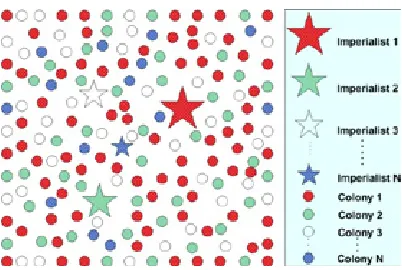
The algorithm starts with N initial countries and the best of them (countries with minimum cost) chosen as the imperialists. The remaining countries are colonies that each belong to an empire.
The initial colonies belong to imperialists in convenience with their powers. To distribute the colonies among imperialists proportionally, the normalized cost of an imperialist is defined as follow (Eq. (2)):
max{ }
n i i n
C = c −c (2)
Where, cn is the cost of n-th imperialist and Cn
is its normalized cost. Each imperialist that has more cost value, will have less normalized cost value.
Having the normalized cost, the power of each imperialist is calculated as Eq. (3) and based on that the colonies distributed among the imperialist countries.
1
imp
n n N
i i
C p
C
=
=
∑
(3)The more colonies an imperialist possess, the bigger is its relevant ★ mark.
Fig. 1.
Generating the Initial Empires
To distribute the colonies among imperialist, of the colonies is selected randomly and assigned to their imperialist. The imperialist countries absorb the colonies towards themselves using the absorption policy. The absorption policy shown in Fig. 2 makes the main core of this algorithm and causes the
countries move towards to their minimum optima. The imperialists absorb these colonies towards themselves with respect to their power. The total power of each imperialist is determined by the power of its both parts, the empire power plus percents of its average colonies power (Eq. (4)).
. .n ( n) { ( n)}
T C Cost imperialist= +ξmean Cost coloniesof empire (4)
Where T.C.n is total cost of the n-th empire and ξ is a positive number which is considered
to be less than one.
Fig. 2.
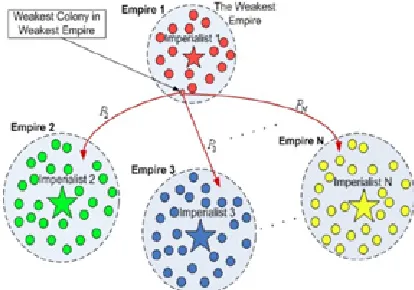
In this algorithm, the imperialistic competition has an important role. During the imperialistic competition, the weak empires will lose their power and their colonies. To model this competition, firstly we calculate the probability of possessing all the colonies by each empire considering the total cost of empire (Eq. (5)).
. . . max{ . . }n i . .n i
N T C = T C −T C (5)
Where T.C.n is the total cost of n-th empire
and N.T.C.n is the normalized total cost of
n-th empire. Having the normalized total cost, the possession probability of each empire is calculated as Eq. (6):
1
. . . . . .
n imp
n
p N
i i
N T C p
N T C
=
=
∑
(6)
After a while all the empires except the most powerful one will collapse and all the colonies will be under the control of this unique empire.
Fig. 3 shows a big picture of the modeled imperialistic competition.
The more powerful an empire is, the more likely it will possess the weakest colony of the weakest empire.
Fig. 3.
Imperialistic Competition
4.2. Opposition Based Learning (OBL)
The concept of opposition-based learning (OBL) was introduced by Tizhoosh (2005) and has thus far been applied to accelerate reinforcement learning and back propagation learning in neural networks. The main
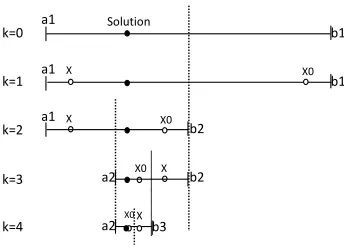
idea behind OBL is the simultaneous consideration of an estimate and its corresponding opposite estimate (i.e., guess and opposite guess) in order to achieve a better approximation for the current candidate solution.
a1
a1
a1
b1
b1
a2
a2
b2
b2
b3
Solution
k=0
k=1
k=2
k=3
k=4
X0
X0
X0
X0X X X
X
Fig. 4.
Solving a One-Dimensional Equation via Recursive Halving of the Search Interval with Respect to Optimality of the Estimate x and Opposite-Estimate xo
Considering the unite interval [a1, b1] in Fig. 4, the solution for a given problem can be found by repeated examination of guess and counter-guess. The opposite number xo of the initial guess x will be generated. Based on which of the estimate or counter-estimate is closer to the solution, the search interval can be recursively halved until either the estimate or the counter-estimate is close enough to an existing solution.
Any population-based optimization algorithm has two main phases, namely, population initialization and evolutionary generating of the new population. Rahnamayan (2007) introduces three possible stages to employ opposition-based optimization to accelerate the parent algorithm.
These three stages are:
1. During population initialization, 2. During population evolution, and 3. After population evolution.
4.3. Opposition Based Colonial
Competitive Algorithm (OCCA)
Concept of opposition has been employed to accelerate CCA. Opposition concept
was utilized to introduce opposition-based population initialization and opposition-based generation jumping. Azad et al. (2012) have proposed OCCA by embedding these two steps within CCA.
To solve proposed models in the previous section, first, we defined a coverage matrix with rows corresponding to paths in R, and columns corresponding to links in
A, where if link a is on path r, and 0 otherwise. With a given prior OD matrix, the coverage matrix can be obtained using a proper assignment model. If path flows between OD pairs are known, link flows can be obtained below:
Where is a row vector of all
path flows and is the a-th column vector of the coverage matrix B.
Let us define
Now, we employed opposition based colonial competitive algorithm to determine the desirable number and locations of billboards. In OCCA, countries are defined as below:
Where if billboard a is selected, and 0 otherwise. OCCA begins with N initial countries and the best of them (countries with maximum visit for first model and with minimum cost for second model) selected as the imperialists. Empires creation and evolutionary processes continue and OCCA obtain best solution for two models.
5. Results
We now employ opposition based colonial competitive algorithm to solve above cases for Sioux Falls city.
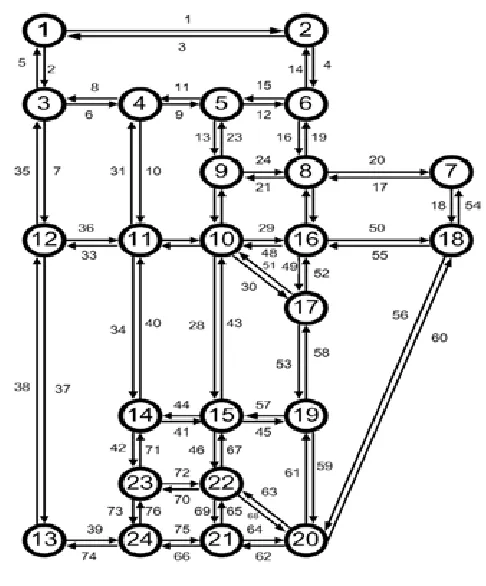
Sioux Falls is the largest city in the U.S. state of South Dakota. This network includes 24 centroids and 76 links. There are links input data and prior origin – destination (OD) matrix.
Also, it is assumed that there is a billboard in the each link and Table 1 shows rent cost of each billboard. Network is shown in Fig. 5.
Table 1
Rent Cost of Billboards
Billboard Number Rent Cost Billboard Number Rent Cost Billboard Number Rent Cost
C1 $400 C27 $450 C52 $550
C2 $850 C28 $800 C53 $800
C3 $650 C29 $650 C54 $700
C4 $850 C30 $400 C55 $550
C5 $850 C31 $600 C56 $600
C6 $550 C32 $400 C57 $550
C7 $1,000 C33 $500 C58 $450
C8 $900 C34 $850 C59 $850
C9 $800 C35 $950 C60 $1,000
C10 $750 C36 $850 C61 $750
C11 $500 C37 $700 C62 $450
C12 $850 C38 $800 C63 $600
C13 $600 C39 $700 C64 $500
C14 $650 C40 $650 C65 $800
C15 $950 C41 $850 C66 $650
C16 $450 C42 $650 C67 $850
C17 $750 C43 $750 C68 $1,000
C18 $650 C44 $950 C69 $700
C19 $1,000 C45 $800 C70 $650
C20 $850 C46 $500 C71 $400
C21 $750 C47 $400 C72 $950
C22 $800 C48 $500 C73 $950
C23 $800 C49 $900 C74 $600
C24 $1,000 C50 $400 C75 $450
C25 $500 C51 $600 C76 $450
C26 $800
Fig. 5.
Sioux Falls City Network
To solving above models, let us define
a coverage matrix with rows
corresponding to paths in R, and columns corresponding to links in A, where if link a is on path r, and 0 otherwise. With a given prior OD matrix, the coverage matrix can be obtained using an appropriate assignment model. If path flows between OD pairs are known, link flows can be obtained using Eq. (7):
(7)
Where are to a row vector
of all paths flows and is the a-th column vector of the coverage matrix B.
Main Step Case 1 - maximize number of billboards visits Case 2 - Minimize cost of billboard advertising
Step 1
Creation of initial empires: in this step, first, we have generated initial random countries and initial opposite countries subject to billboard advertising cost restriction and then, we have selected fittest countries.
Creation of initial empires: in this step, first, we have generated initial random countries and initial opposite countries subject to billboard visits restriction and then, we have selected fittest countries.
Step 2 Evolutionary process according to the objective function. This step includes assimilation, revolution and imperialistic competition.
Step 3
Creation of new generation: in this step, opposite colonies generate for produced colonies from evolutionary process and evaluate by billboard visits function.
Creation of new generation: in this step, opposite colonies generate for produced colonies from evolutionary process and evaluate by billboard advertising cost function.
Fig. 6.
Modified Steps of OCCA for Solving Proposed Model
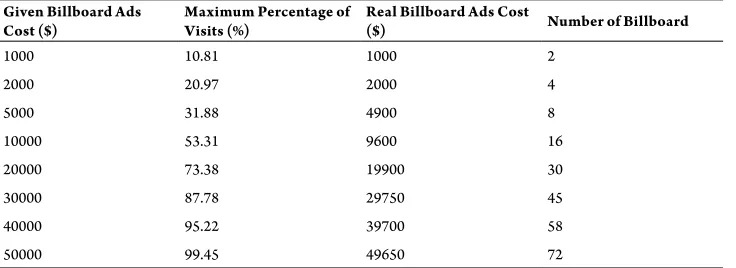
According to the above descriptions, we have solved first model and maximized billboard visits subject to fixed billboard advertising cost. To perform OCCA
for first model, billboard advertising cost parameter has varied from 1000$ to 50000$ and results are shown in the Table 2.
Table 2
Results for Model 1 Given Billboard Ads
Cost ($) Maximum Percentage of Visits (%) Real Billboard Ads Cost ($) Number of Billboard
1000 10.81 1000 2
2000 20.97 2000 4
5000 31.88 4900 8
10000 53.31 9600 16
20000 73.38 19900 30
30000 87.78 29750 45
40000 95.22 39700 58
50000 99.45 49650 72
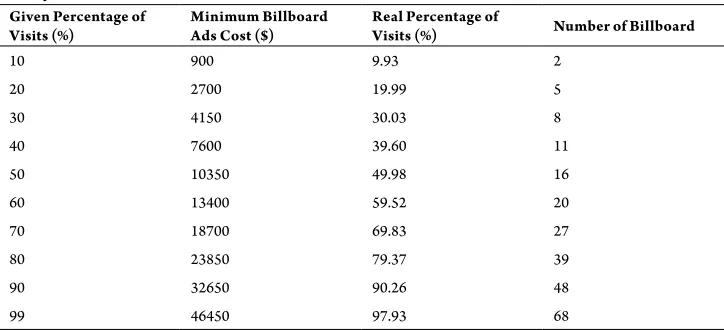
Now, we have solved second model and minimized billboard advertising cost subject to fixed billboard visits. To perform OCCA
Table 3
Result for Model 2 Given Percentage of
Visits (%) Minimum Billboard Ads Cost ($) Real Percentage of Visits (%) Number of Billboard
10 900 9.93 2
20 2700 19.99 5
30 4150 30.03 8
40 7600 39.60 11
50 10350 49.98 16
60 13400 59.52 20
70 18700 69.83 27
80 23850 79.37 39
90 32650 90.26 48
99 46450 97.93 68
In this paper, we studied network which include 24 nodes and 76 links. Total number of solutions for models can be calculated as follows:
In fact, large number of solutions for mentioned problem show the importance of proposed model and coverage of opposition based colonial competitive algorithm imply the validation of results. Now, according to the proposed model, companies can plan with having necessary information.
6. Conclusion
To minimize the cost of billboard advertising and maximize the observations of billboards, selecting a suitable billboard location has become one of the most important issues for companies. This paper aims at designing an
optimization model for making optimized decision in this case, for a billboard location problem. For this purpose, network count location is employed, which identifies informative links in a network. Afterward, the opposition based colonial competitive algorithm was used to solve optimization model. Finally, an application example, Sioux Falls city network case, is presented to show the applicability and suitability of the proposed model.
References
Atashpaz-Gargari, E.; Lucas, C. 2007. Imperialist Competitive Algorithm: An algorithm for optimization inspired by imperialistic competition,IEEE Congress on Evolutionary Computation, 4661-4667.
Azad, H.R.L. 2014. An Application of Opposition Based Colonial Competitive Algorithm to Solve Network Count Location Problem, International Journal of Intelligent Systems and Applications. DOI: http://dx.doi.org/10.5815/ ijisa.2014.01.04, 01: 29-35.
Azad, H.R.L.; Boushehri, N.S.; Mollaverdi, N. 2012. Investigating the application of opposition concept to colonial competitive algorithm, International Journal of Bio-Inspired Computation. DOI: http://dx.doi.org/10.1504/ IJBIC.2012.049897, 4(5): 319-329.
Berman, O.; Hodgson, M.J.; Krass, D. 1995. Flow-interception problems, Facility location. In: Z. Drezner (Ed) A survey of applications and methods, New York: Springer-Verlag. 389-426.
Berman, O.; Larson, R.C.; Fouska, N. 1992. Optimal location of discretionary service facilities, Transportation Science, 26(3): 201-211.
Ehlert, A.; Bell, M.G.H.; Grosso, S. 2006. The optimisation of traffic count locations in road networks, Transportation Research Part B: Methodological. DOI: http:// dx.doi.org/10.1016/j.trb.2005.06.001, 40(6): 460-479.
Entrepreneur. 2011. Small Business Encyclopedia: Advertising. Retrieved November 20, 2011.
Fei, X.; Eisenman, S.M.; Mahmassani, H.S. 2007. Sensor coverage and location for real-time prediction in large-scale networks. In Proceedings of the 86th TRB Annual meeting, January, Washington D.C.
Fogel, D.B. 1997. The advantages of evolutionary computation. In Proceedings of the Biocomputing and emergent computation, 1-11.
Hodgson, M.J. 1990. A f low-capturing location-allocation model, Geographical Analysis. DOI: http:// dx.doi.org/10.1111/j.1538-4632.1990.tb00210.x, 22(3): 270-279.
Merriam-Webster Dictionary. 2011. Retrieved October 30, 2011.
Murty, K.G. 2003. Optimization Models for Decision Making, Junior Level Web-Book.
O’Barr, W.M. 2010. A Brief History of Advertising in America, Advertising & Society Review. DOI: http://dx.doi. org/10.1353/asr.0.0046, 11(1).
Rahnamayan, S. 2007. Opposition-based differential evolution. PhD thesis, Department of Systems Design Engineering, University of Waterloo, Waterloo, Ontario, Canada.
Savitz, J.; Shipp, R. 2009. Optimizing Advertising Budgets, Savitz Research Solutions.
Taylor, C.R.; Franke, G.R.; Bang, H. 2006. Use and Effectiveness of Billboards: Perspectives from Selective-Perception Theory and Retail-Gravity Models, Journal of Advertising. DOI: http://dx.doi.org/10.2753/JOA0091-3367350402, 35(4): 21-34.
Taylor, J.R. 1978. How to start and succeed in a business of your own, Indiana University. 293 p.
Teodorović, D.; Šelmić, M. 2013. Locating flow-capturing facilities in transportation networks: a fuzzy sets theory approach, International Journal for Transport and Traffic Engineering. DOI: http://dx.doi.org/10.7708/ ijtte.2013.3(2).01, 3(2): 103-111.
Wu, T.H.; Lin, J.N. 2003. Solving the competitive discretionary service facility location problem, European Journal of Operational Research. DOI: http://dx.doi. org/10.1016/S0377-2217(01)00391-5, 144(2): 366-378.
Yang, H.; Zhou, J. 1998. Optimal Traffic Counting locations for Origin-destination matrix estimation, Transportation Research Part B: Methodological. DOI: http://dx.doi.org/10.1016/S0191-2615(97)00016-7, 32(2): 109-126.