A state‑of‑the‑art survey of malware
detection approaches using data mining
techniques
Alireza Souri
1*and Rahil Hosseini
2Introduction
In the recent years, the application of malware detection mechanisms utilize through data mining techniques through have increased using machine learning to recognize malicious files [1, 2]. Machine learning methods can take in hidden examples from a given preparing set which includes both malware and benign examples. These basic examples can separate malware from benevolent code [3, 4]. Malware is a standout most thoughtful intimidations for distributed systems and the Internet [5]. The battle between security analyzers and malware scholars is everlasting as innovation grows. Malware is a program that makes your framework accomplish something that an assailant needs it to do [6]. The most generally utilized malware detection develops a straightforward exam-ple coordinating way to deal with identify vindictive code. Typically malware designers
Abstract
Data mining techniques have been concentrated for malware detection in the recent decade. The battle between security analyzers and malware scholars is everlasting as innovation grows. The proposed methodologies are not adequate while evolution-ary and complex nature of malware is changing quickly and therefore turn out to be harder to recognize. This paper presents a systematic and detailed survey of the malware detection mechanisms using data mining techniques. In addition, it classifies the malware detection approaches in two main categories including signature-based methods and behavior-based detection. The main contributions of this paper are: (1) providing a summary of the current challenges related to the malware detection approaches in data mining, (2) presenting a systematic and categorized overview of the current approaches to machine learning mechanisms, (3) exploring the structure of the significant methods in the malware detection approach and (4) discussing the important factors of classification malware approaches in the data mining. The detec-tion approaches have been compared with each other according to their importance factors. The advantages and disadvantages of them were discussed in terms of data mining models, their evaluation method and their proficiency. This survey helps researchers to have a general comprehension of the malware detection field and for specialists to do consequent examinations.
Keywords: Data mining, Malware detection, Classification, Behavior-based, Signature-based
Open Access
© The Author(s) 2018. This article is distributed under the terms of the Creative Commons Attribution 4.0 International License (http://creativecommons.org/licenses/by/4.0/), which permits unrestricted use, distribution, and reproduction in any medium, provided you give appropriate credit to the original author(s) and the source, provide a link to the Creative Commons license, and indicate if changes were made.
RESEARCH
*Correspondence: [email protected]
1 Department of Computer
don’t compose new code without any preparation, yet redesign the old code with new components or muddling strategies [7]. With a large number of malware cases seeming each day, proficiently preparing countless specimens which display comparable conduct, has turned out to be progressively essential [8].
Up to now, malware analysis [9, 10] have the high growing impact in the procedure of deciding the reason and the usefulness the conduct of a given suspicious application. Such a procedure is an important essential with a specific end goal to create effective and powerful identification furthermore characterization techniques; malware analysis is partitioned into two primary classifications that include dynamic and static meth-ods [11, 12]. To the best of our knowledge, the most data mining methods have some benefits and weaknesses in malware detection subject [13]. In addition, having a new literature review can be influenced on the research studies and explore some technical details in malware detection using data mining techniques. Of course, some research [13–17] had discussed the malware detection approaches. There are some defects in the surveyed research. Some papers are published in out of date and did not considered new articles in comparison and analysis. In addition, some surveys have not any sys-tematic classification and article selection for their researches. For example, Muazzam Siddiqui et al. [18] presented a survey of malware detection using data mining tech-niques. Some defects of the survey are as follow: this survey used old research in lit-erature analysis. In addition, they did not any systematic review for article selection in their research. This research did not specified an appropriate categorization for mal-ware detection techniques. Just, they analyzed the scanning and data analysis methods in the proposed research.
To overcome some defects, this paper presents a systematic literature review on the new recent malware detection techniques using data mining approaches. This review classifies the malware detection approaches in two main fields: signature-based and behavior-based. The contributions of this paper are as follows:
• Providing a summary of the current challenges related to malware detection approaches in data mining.
• Presenting a systematic and categorized overview of the current approaches to machine learning mechanisms in the data mining topics.
• Exploring a structure of the important methods that are significant in malware detection approach.
• Discussing the important factors of classification malware approaches in the data mining to improve their problems in the futures.
Malware detection approaches
As a result of the developing malware in the innovation, the information of obscure mal-ware protection is a fundamental subject in the malmal-ware recognition as per the machine learning strategies [19]. The machine learning strategies are divided into supervised and unsupervised classes. Malware detection approaches are divided into two main catego-ries that include behavior-based and signature-based methods [20]. Also, there are two static and dynamic [21] malware analysis that generally performed in finding malicious applications [22].
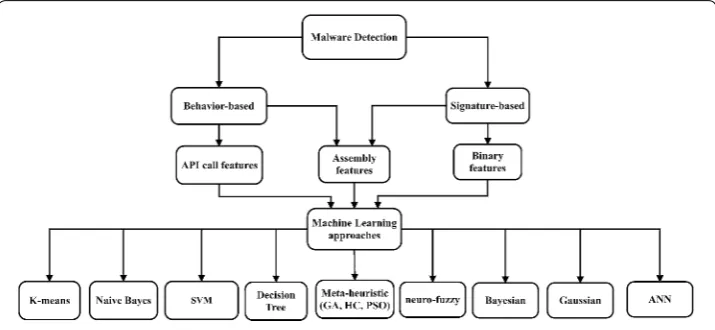
In Fig. 1, we illustrate a malware detection taxonomy based on machine learning approaches. According to this figure, the API calls features, assembly features, and binary features are existing approaches for malware detection method. These features use machine learning methods for predicting and detecting malicious files.
Signature‑based malware detection
Recently, signature-based detection is the most generally utilized procedure in antivi-rus programming highlighting exact correlation. Malware recognition has essentially centered on performing static investigations to review the code-structure mark of infec-tions, instead of element behavioral methods [23]. The signature-based system finds interruptions utilizing a predefined list of known assaults. Despite the fact that this arrangement has the ability to identify malware in the versatile application, it requires steady overhauling of the predefined signature database. Moreover, it is less effective in identifying noxious exercises utilizing the signature-based technique because of the quickly changing nature of portable malware [24, 25]. Signature-based strategies depend in light of exceptional crude byte examples or standard articulations, known as marks, made to coordinate the noxious document. For example, static highlights of a record are utilized to decide if it is a malware. The main advantage of signature-based techniques is their thoroughness since they follow all conceivable execution ways of a given document.
In inside of the malware structure, existing malicious objects have characteristics that can be used to generate a unique digital signature. The anti-malware provider utilizes the meta-heuristic algorithms that can scan efficiently the malicious object to control its signature [26]. After identifying the malicious object, the detected signature is added
to the existing database as the recognized malware. The database sources include huge number of the various signatures that classify malicious objects. In the signature-based malware detection, there are some various qualities including fast identification, easy to run, and broadly accessible [27].
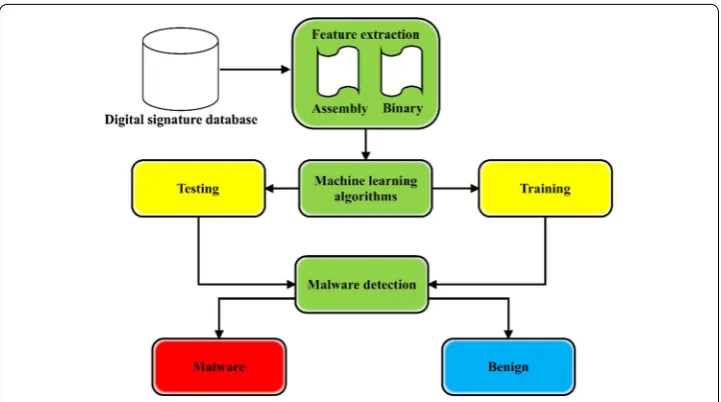
Since the digital signature plans are gotten from known malware, these plans are like-wise generally known. Subsequently they can be effectively evaded by programmers uti-lizing straightforward confusion procedures. Hence malware code can be modified and signature-based identification can be sidestepped. Since anti-malware providers are built on the premise of known malware, they can’t to distinguish obscure malware, or even variations of known malware. In this way, without exact digital signature, they can’t ade-quately distinguish polymorphic malware. Along these lines, signature-based recogni-tion does not give zero-day insurance. Besides, since a signature-based indicator utilizes an isolate signature for each malware variation, the database of signatures develops at an exponential rate [28]. The signature-based malware detection has two main methods for applying malware detection approach in machine learning methods including assem-bly features and binary features. Figure 2 illustrates a standard signature-based malware detection framework using data mining approaches.
Also, Table 1 shows the advantages and weaknesses of the signature-based malware detection approach.
Fig. 2 The signature-based malware detection framework
Table 1 The advantages and weaknesses of the signature-based detection
Advantage Weakness
Easy to run Failing to detect the polymorphic malwares Fast identification Replicating information in the huge database Broadly accessible
Behavior‑based malware detection
This subsection illustrates the behavior-based approaches in malware detection. In addi-tion, it reviews the selected behavior-based approaches in the data mining. Finally, the discussed behavior-based approaches compared and summarized in the last subsection. Behavior-based methodologies require execution of a given example in a sandboxed sit-uation and run-time exercises are checked and logged. Dynamic investigation systems utilize both virtualization and imitating conditions to execute a malware and to remove its practices. The primary advantage of the behavior-based approach is that gives a supe-rior comprehension of how malware is produced and implemented [8, 14].
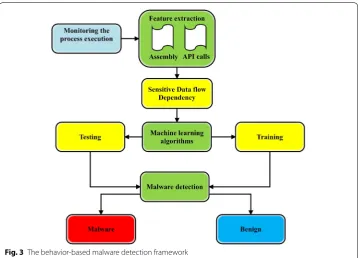
In the behavior-based malware approach, the suspicious objects are assessed based on their activities that they cannot execute in system. Efforts to achieve activities that are clearly irregular or unofficial would specify the suspicious object is malicious, or at least apprehensive. A malicious behavior is known using a dynamic analysis that evalu-ates malicious intent by the object’s code and structure. In the behavior-based detection, the API calls and assembly features are two main methods for applying machine learn-ing algorithms. Figure 3 depicts a standard behavior-based malware detection approach using data mining algorithms.
Table 2 shows the advantages and weaknesses of the behavior-based malware detec-tion approach.
Fig. 3 The behavior-based malware detection framework
Table 2 The advantages and weaknesses of the behavior-based detection
Advantage Weakness
Detecting unconceived types of malware attacks Storage complexity for behavioral patterns Data-flow dependency detector Time complexity
After describing the existing malware detection approaches, next section presents the technical analysis of the current research studies in the malware detection with data mining algorithms.
Review of the malware detection approaches
In this section, the existing malware detection approaches are analyzed according to some evaluation factors such as the main idea, advantages and disadvantages, algorithm type and assessment type in data mining techniques. We analyze the selected studies according to existing approaches and discuss on them.
Review of the signature‑based approaches
Wu et al. [29] have utilized an artificial immune-based smartphone malware detection model (SP-MDM) both static malware examination and element malware investigation as indicated by the component of the biologic resistant framework that can shield us from disease by creatures. In this model, the static marks and dynamic marks of mal-ware are separated, and in view of the genuine esteemed vector encoding, the antigens are produced. The youthful identifier develops into a develop one on the off chance that it experiences self-resistance. Finder posterity with higher fondness is made after the streamlining of developing identifiers utilizing clonal determination calculation. Also, they collected twenty malware and twenty benign files as testing samples set.
Bat-Erdene et al. [30] presented a strategy for characterizing the packing algorithms of given unknown packed executable. To begin with, they measured the entropy estima-tions of a given executable and change over the entropy estimaestima-tions of a specific area of memory into typical representations. Their presented strategy utilized symbolic aggre-gate approximation (SAX), which is known to be viable for huge information changes. Second, we order the conveyance of images utilizing managed learning order strategies, i.e., credulous Bayes and bolster vector machines for recognizing pressing calculations. The aftereffects of our examinations including a gathering of 324 pressed kindhearted projects and 326 stuffed malware programs with 19 pressing calculations illustrate that our strategy can distinguish pressing calculations of given executable with a high preci-sion of 95.35%, a review of 95.83%, and an accuracy of 94.13%. We propose four likeness estimations for distinguishing pressing calculations based on SAX representations of the entropy values and an incremental total examination. Among these four measurements, the loyalty closeness estimation shows the best-matching result, i.e., a rate of precision running from 95.0 to 99.9%, which is from 2 to 13 higher than that of the other three measurements. Our review affirms that pressing calculations can be recognized through an entropy examination in view of a measure of the instability of the running procedures and without earlier information of the executable.
utilizes earlier learning to lessen dataset measure. In addition, a multi-module location plan was acquainted with improve framework precision. The aftereffects of this plan are created by incorporating the location consequences of a few calculations, including Naive Bayes and Decision Tree.
Fan et al. [32] proposed a compelling arrangement mining calculation to find vindic-tive quintal examples, and afterward, All-Nearest-Neighbor (ANN) classifier is con-structed for malicious position in the established samples. The created information mining structure made out of the proposed consecutive example mining technique and ANN classifier can well describe the malevolent examples from the gathered record test set to adequately distinguish recently concealed malware tests. A thorough exploratory review on a genuine information accumulation is performed to assess our recognition structure. The promising test comes about demonstrate that their structure beats other to exchange information mining based discovery techniques in distinguishing new vin-dictive executable.
Hellal and Ben Romdhane [33] displayed another diagram mining technique to rec-ognize variations of malware utilizing static examination while covering the current defects. Also, they proposed a novel calculation, called minimal contrast frequent sub-graph miner method (MCFSM), for separating negligible discriminative and generally utilized malevolent behavioral designs which can distinguish definitely a whole group of vindictive projects, conversely to another arrangement of benevolent projects. The pro-posed technique demonstrates high recognition rates and low false positive rates and creates a predetermined number of behavioral malware marks.
Martín et al. [34] illustrated outsider calls to sidestep the impacts of these disguise methodologies since they can’t be obfuscated. We join bunching and multi-target advancement to produce a classifier in view of particular practices characterized by out-sider call bunches. The analyzer guarantees that these gatherings are identified with nox-ious or favorable practices cleaning any non-discriminative example. This device, named MOCDroid,1 accomplishes a precision of 95.15% in test with 1.69% of false positives
with genuine applications extricated from the wild, overcoming all business antivirus motors from VirusTotal.
Santos et al. [35] proposed another strategy to identify obscure malware families. This model depends on the recurrence of the presence of opcode groupings. Moreover, they depicted a system to mine the importance of each opcode and evaluate the recurrence of each opcode grouping. Furthermore, they provided experimental approval that this new strategy is fit for recognizing obscure malware.
Wang and Wang [24] presented a malware recognition framework to ensure a little order mistake by machine learning using the speculation capacity of support vector models (SVMs). This review built up a programmed malware location framework via preparing a SVM classifier in light of behavioral marks. Over approval, plan was utilized for taking care of grouping exactness issues by utilizing SVMs connected with 60 groups of genuine malware. The trial comes about uncover that the characterization blunder diminishes as the measuring of testing information is expanded. For various estimating (N) of malware tests, the expectation precision of malware discovery runs up to 98.7%
with N = 100. The general recognition precision of the SVC is more than 85% for unspe-cific versatile malware.
Summary of the reviewed signature‑based approaches
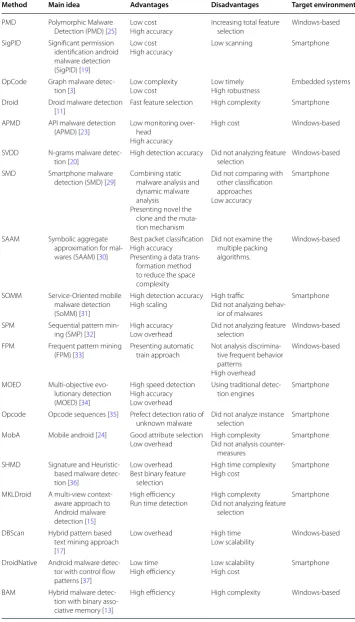
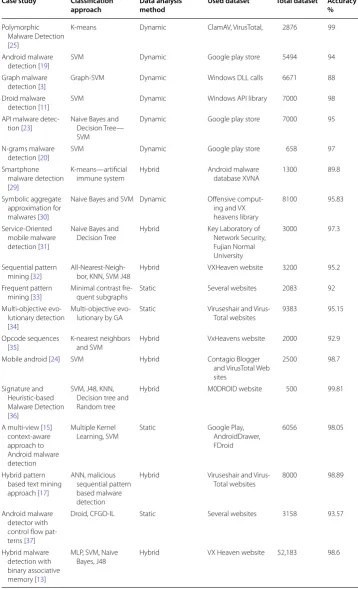
According to the discussed and reviewed signature-based detection approaches, the comparison of the proposed articles is demonstrated in Table 3 which shows the used case study in research, the main advantages, disadvantages and target environment for the existing studies. The main advantage of signature-based detection approaches is using pattern detection that decreases the system overhead and execution time for mal-ware prediction. The main disadvantage of the signature-based detection approaches is omitting feature selection. The target environment is categorized into three main platforms including embedded systems, Windows-based and smartphones. The most research studies in the signature-based detection have used the Windows-based envi-ronment for representing the proposed malware detection approach.
In addition, Table 4 depicts a side-by-side comparison of the signature-based detec-tion factors in each article. These factors include case-study method, classificadetec-tion or clustering approach, data analysis method, and data set type and accuracy factor.
Review of the selected behavior‑based approaches
Altaher [38] proposed an evolving hybrid neuro-fuzzy classifier (EHNFC) for Android-based malware grouping utilizing consent Android-based components. The proposed EHNFC not just has the capacity of distinguishing obscured malware utilizing fluffy tenets, yet can likewise advance its structure by adopting new malware recognition fluffy tenets to enhance its discovery exactness when utilized as a part of the location of more malware applications. To this end, a developing bunching technique for adjusting and advanc-ing malware location fluffy tenets was changed to consolidate a versatile methodology for overhauling the radii and focuses of grouped authorization based components. This adjustment to the advancing bunching strategy improves group merging also, produces decides that are better custom-made to the input information, henceforth enhancing the characterization precision of the proposed EHNFC. The exploratory outcomes for the proposed EHNFC demonstrate that the proposition outflanks a few cutting-edge jum-bled malware order approaches as far as a false negative rate (0.05) and false positive rate (0.05). The outcomes likewise show that the proposition identifies the Android malware superior to other neuro-fuzzy frameworks as far as precision (90%).
Table 3 A side-by-side comparison of the reviewed signature-based articles
Method Main idea Advantages Disadvantages Target environment
PMD Polymorphic Malware Detection (PMD) [25]
Low cost High accuracy
Increasing total feature selection
Windows-based SigPID Significant permission
identification android malware detection (SigPID) [19]
Low cost High accuracy
Low scanning Smartphone
OpCode Graph malware detec-tion [3]
Low complexity Low cost
Low timely High robustness
Embedded systems Droid Droid malware detection
[11]
Fast feature selection High complexity Smartphone APMD API malware detection
(APMD) [23]
Low monitoring over-head
High accuracy
High cost Windows-based
SVDD N-grams malware detec-tion [20]
High detection accuracy Did not analyzing feature selection
Windows-based SMD Smartphone malware
detection (SMD) [29]
Combining static malware analysis and dynamic malware analysis
Presenting novel the clone and the muta-tion mechanism
Did not comparing with other classification approaches Low accuracy
Smartphone
SAAM Symbolic aggregate approximation for mal-wares (SAAM) [30]
Best packet classification High accuracy Presenting a data
trans-formation method to reduce the space complexity
Did not examine the multiple packing algorithms.
Windows-based
SOMM Service-Oriented mobile malware detection (SoMM) [31]
High detection accuracy
High scaling High trafficDid not analyzing behav-ior of malwares
Smartphone
SPM Sequential pattern min-ing (SMP) [32]
High accuracy Low overhead
Did not analyzing feature selection
Windows-based FPM Frequent pattern mining
(FPM) [33]
Presenting automatic train approach
Not analysis discrimina-tive frequent behavior patterns
High overhead
Windows-based
MOED Multi-objective evo-lutionary detection (MOED) [34]
High speed detection High accuracy Low overhead
Using traditional
detec-tion engines Smartphone Opcode Opcode sequences [35] Prefect detection ratio of
unknown malware
Did not analyze instance selection
Smartphone MobA Mobile android [24] Good attribute selection
Low overhead
High complexity Did not analysis
counter-measures
Smartphone
SHMD Signature and Heuristic-based malware detec-tion [36]
Low overhead Best binary feature
selection
High time complexity
High cost Smartphone
MKLDroid A multi-view context-aware approach to Android malware detection [15]
High efficiency Run time detection
High complexity Did not analyzing feature
selection
Smartphone
DBScan Hybrid pattern based text mining approach [17]
Low overhead High time Low scalability
Windows-based
DroidNative Android malware detec-tor with control flow patterns [37]
Low time High efficiency
Low scalability High cost
Smartphone
BAM Hybrid malware detec-tion with binary asso-ciative memory [13]
(4000 specimens) and expansive scale datasets (more than 115,000 samples) collected and broke down via AutoMal shows AMAL’s adequacy in precisely describing, ordering, and gathering malware tests. MaLabel accomplishes an exactness of 99.5% and review of 99.6% to confident relations demand, and more than 98% of accuracy and evaluation for unsupervised classification.
Yuan et al. [40] presented a deep learning method to connect the components from the static investigation with elements from the dynamic investigation of Android appli-cations. In addition, they actualized an Android malware detection engine based on the deep-learning method (DroidDetector) that can consequently distinguish whether a file has a malicious behavior or not. With a large number of Android applications, they tested DroidDetector and play out an in-depth examination of the elements that deep learning basically adventures to portray malware completely. The outcomes appear that deep learning is appropriate for characterizing Android malware and particularly com-pelling with the accessibility of additional preparation information. DroidDetector can accomplish 96.76% detection accuracy, which traditional machine learning methods.
Boukhtouta et al. [41] presented the issue of fingerprinting perniciousness of activ-ity with the end goal of recognition and arrangement. This research pointed first at fin-gerprinting perniciousness by utilizing two approaches: Deep Packet Inspection (DPI) and IP bundle headers arrangement. To this end, we consider malignant activity created from element malware examination as movement perniciousness ground truth. In light of this supposition, they exhibited how these two methodologies are utilized to recog-nize what’s more, attribute maliciousness to the various threat. In this work, we con-centrate the positive and negative angles for Deep Packet Review and IP bundle headers order. They assessed every approach in view of its recognition and attribution precision and additionally their level of multifaceted nature. The results of both methodologies have demonstrated promising outcomes as far as discovery; they are great possibility to constitute a collaboration to expand or prove recognition frameworks as far as runtime speed and grouping exactness.
Ding et al. [42] proposed an affiliation mining strategy based on API calls to recog-nize malware. To expand the identification speed of the Objective-Oriented association (OOA) mining, distinctive methodologies are exhibited: to enhance the govern quality, criteria for API determination are proposed to expel APIs that can’t get to distinctly visit things; to discover affiliation decides that have solid segregation control, we characterize the manage utility to assess the affiliation runs; and to enhance the location exactness, a characterization strategy in view of numerous affiliation guidelines is embraced. The tri-als demonstrate that the proposed systems can essentially enhance the running velocity of OOA. In our investigations, the time cost for information mining is decreased by 32%, and the time cost for arrangement is decreased by 50%.
Table 4 A side-by-side comparison of the important factors in the signature-based detec-tion of each article
Case study Classification approach
Data analysis method
Used dataset Total dataset Accuracy %
Polymorphic Malware Detection [25]
K-means Dynamic ClamAV, VirusTotal, 2876 99
Android malware
detection [19] SVM Dynamic Google play store 5494 94
Graph malware
detection [3] Graph-SVM Dynamic Windows DLL calls 6671 88
Droid malware
detection [11] SVM Dynamic Windows API library 7000 98
API malware
detec-tion [23] Naive Bayes and Decision Tree— SVM
Dynamic Google play store 7000 95
N-grams malware
detection [20] SVM Dynamic Google play store 658 97
Smartphone malware detection [29]
K-means—artificial
immune system Hybrid Android malware database XVNA 1300 89.8 Symbolic aggregate
approximation for malwares [30]
Naive Bayes and SVM Dynamic Offensive comput-ing and VX heavens library
8100 95.83
Service-Oriented mobile malware detection [31]
Naive Bayes and
Decision Tree Hybrid Key Laboratory of Network Security, Fujian Normal University
3000 97.3
Sequential pattern
mining [32] All-Nearest-Neigh-bor, KNN, SVM J48 Hybrid VXHeaven website 3200 95.2 Frequent pattern
mining [33] Minimal contrast fre-quent subgraphs Static Several websites 2083 92 Multi-objective
evo-lutionary detection [34]
Multi-objective evo-lutionary by GA
Static Viruseshair and Virus-Total websites
9383 95.15
Opcode sequences
[35] K-nearest neighbors and SVM Hybrid VxHeavens website 2000 92.9 Mobile android [24] SVM Hybrid Contagio Blogger
and VirusTotal Web sites
2500 98.7
Signature and Heuristic-based Malware Detection [36]
SVM, J48, KNN, Decision tree and Random tree
Hybrid M0DROID website 500 99.81
A multi-view [15] context-aware approach to Android malware detection Multiple Kernel Learning, SVM
Static Google Play,
AndroidDrawer, FDroid
6056 98.05
Hybrid pattern based text mining approach [17]
ANN, malicious sequential pattern based malware detection
Hybrid Viruseshair and
Virus-Total websites 8000 98.89
Android malware detector with control flow pat-terns [37]
Droid, CFGO-IL Static Several websites 3158 93.57
Hybrid malware detection with binary associative memory [13]
MLP, SVM, Naïve Bayes, J48
the end goal to enlarge the precision of static investigation. Truth be told, the execu-tion overhead has been endured in learning stage; hence, it does not force on highlight extraction stage which is performed in examining operation. The exploratory outcomes illustrate that HDM-Analyzer accomplishes better general exactness and time many-sided quality than static and element investigation strategies.
Miao et al. [44] presented a bilayer conduct reflection strategy in light of the seman-tic examination of dynamic API sequences. Operations on touchy framework assets and complex practices are disconnected in an interpretable way at various semantic layers. At the lower layer, crude API calls are joined to extract low-layer practices by means of information reliance investigation. At the higher layer, low-layer practices are fur-ther joined to build more intricate high-layer practices with great interpretability. The separated low-layer furthermore, high-layer practices are at last inserted into a high dimensional vector space. Henceforth, the disconnected practices can be specifically uti-lized by numerous prominent machine learning calculations. In addition, to handle the issue that considerate projects are not satisfactorily examined or malware and amiable projects are seriously imbalanced, an enhanced one-class bolster vector machine (OC-SVM) named OC-SVM-Neg is proposed which makes utilization of the accessible nega-tive examples. The trial comes about demonstrate that the proposed include extraction technique with OC-SVM-Neg beats double classifiers on the false caution rate and the speculation capacity.
Ming et al. [45] have presented a substitution attacks to cover comparable practices by harming behavior-based specifications. The key strategy for the attacks is to supplant a system call dependence graph to its semantically identical variations so that the compa-rable malware tests confidential unique family end up being characteristic. Accordingly, malware investigators need to put more endeavors into reconsidering the similar sam-ples which may have been examined sometime recently. They distill general attacking strategies by mining more than 5200 malware tests’ behavior specifications and execute a compiler-level model to automate replacement attacks. By evaluating on the real mali-cious examples, the effectiveness of the proposed method to obstruct several behavior-based malware analysis tasks, such as clustering and malware comparison. Finally, they discussed likely countermeasures to support current malware protection.
Sheen et al. [47] have considered Android-based malware for examination and an adaptable recognition component is planned to utilize multi-feature collaborative deci-sion fudeci-sion (MCDF). The distinctive features of a malicious record like the consent-based features and the API call based features are considered keeping in mind the end goal to give a superior discovery via preparing a gathering of classifiers and combining their choices utilizing collective approach in view of likelihood hypothesis. The execution of the proposed model is evaluated on a gathering of Android-based malware including diverse malware families and the outcomes demonstrate that the presented approach give a superior execution than best in class troupe plans accessible.
Norouzi et al. [48] have proposed distinctive classification techniques with a specific end goal to recognize malware in light of the element and conduct of each malware. A dynamic investigation technique has been exhibited for recognizing the malware features. A recommended program has been introduced for changing over a malware behavior executive history XML document to an appropriate WEKA instrument input. To represent the execution proficiency and preparing information and test, the authors apply the proposed ways to deal with a genuine contextual investigation information set utilizing WEKA instrument. The evaluation results described that the availability of the proposed data mining approach. In addition, their proposed data mining methodology is more proficient for identifying malware and behavioral classification of malware can be helpful to recognize malware in a behavioral antivirus.
Galal et al. [49] proposed a behavior-based features model that defines malicious action exhibited by malware example. To remove the proposed model, the authors first perform dynamic examination on a generally late malware dataset inside a controlled virtual environment and capture traces of API calls conjured by malware examples. The traces are then generalized into high-level features refer to as actions. The proposed method is evaluated using some famous classification methods such as random forests, decision tree and SVM. The experimental results show that the classifiers attain high precision and satisfactory results in the detection of malware variants.
Summary of the reviewed behavior‑based approaches
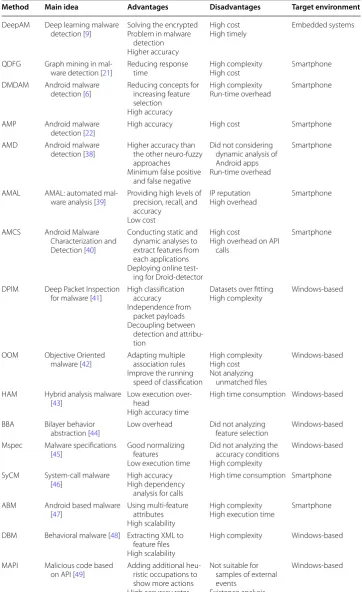
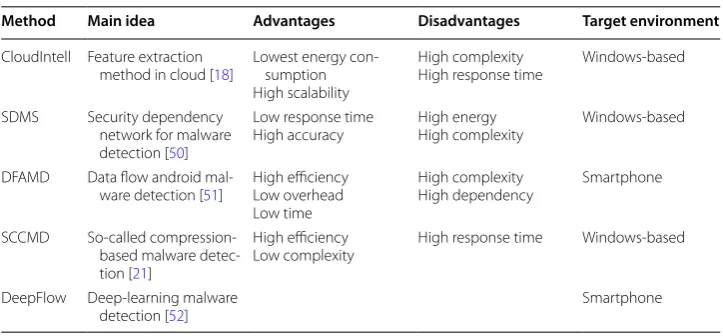
According to the discussed and reviewed behavior-based detection approaches, the comparison of the proposed articles has illustrated in Table 5. Table 5 presents the main idea, advantages, disadvantages and target environment of each technical study in behav-ior-based approaches. The main advantage of behavbehav-ior-based detection approaches is detecting all of the suspicious files according to their calls’ behavior that increases the accuracy of malware prediction. The main disadvantage of the signature-based detection approaches is the runtime overhead. The target environment is categorized into three main platform including embedded systems, windows-based and smartphones. The most research studies in the behavior-based detection have used the smartphone envi-ronment for representing the proposed malware detection approach.
Table 5 A comparison of the reviewed behavior-based articles
Method Main idea Advantages Disadvantages Target environment
DeepAM Deep learning malware
detection [9] Solving the encryptedProblem in malware detection
Higher accuracy
High cost
High timely Embedded systems
QDFG Graph mining in
mal-ware detection [21] Reducing response time High complexityHigh cost Smartphone DMDAM Android malware
detection [6] Reducing concepts for increasing feature selection
High accuracy
High complexity
Run-time overhead Smartphone
AMP Android malware
detection [22] High accuracy High cost Smartphone AMD Android malware
detection [38] Higher accuracy than the other neuro-fuzzy approaches
Minimum false positive and false negative
Did not considering dynamic analysis of Android apps Run-time overhead
Smartphone
AMAL AMAL: automated
mal-ware analysis [39] Providing high levels of precision, recall, and accuracy
Low cost
IP reputation
High overhead Smartphone
AMCS Android Malware Characterization and Detection [40]
Conducting static and dynamic analyses to extract features from each applications Deploying online
test-ing for Droid-detector
High cost
High overhead on API calls
Smartphone
DPIM Deep Packet Inspection
for malware [41] High classification accuracy Independence from
packet payloads Decoupling between
detection and attribu-tion
Datasets over fitting
High complexity Windows-based
OOM Objective Oriented
malware [42] Adapting multiple association rules Improve the running
speed of classification
High complexity High cost Not analyzing
unmatched files
Windows-based
HAM Hybrid analysis malware
[43] Low execution over-head High accuracy time
High time consumption Windows-based
BBA Bilayer behavior
abstraction [44] Low overhead Did not analyzing feature selection Windows-based Mspec Malware specifications
[45] Good normalizing features Low execution time
Did not analyzing the accuracy conditions High complexity
Windows-based
SyCM System-call malware
[46] High accuracyHigh dependency analysis for calls
High time consumption Smartphone
ABM Android based malware
[47] Using multi-feature attributes High scalability
High complexity
High execution time Smartphone DBM Behavioral malware [48] Extracting XML to
feature files High scalability
High complexity Windows-based
MAPI Malicious code based
on API [49] Adding additional heu-ristic occupations to show more actions High accuracy rates
Not suitable for samples of external events
Existence analysis
Discussion
In this section, a statistical analysis of reviewed approaches of malware detection using data mining is presented. Figure 4 shows the statistical diagram for all of the classifi-cation methods in the selected malware detection approaches. In this report, the SVM method has most percentage for malware detection approach with 29%, j48 has 17%, NB has 10%, RF has 5%, ANN has 3% and the other methods have less than 2% usage in data mining results. We discover that the SMV method just has the best accuracy in the signature-based malware detection approaches using data mining.
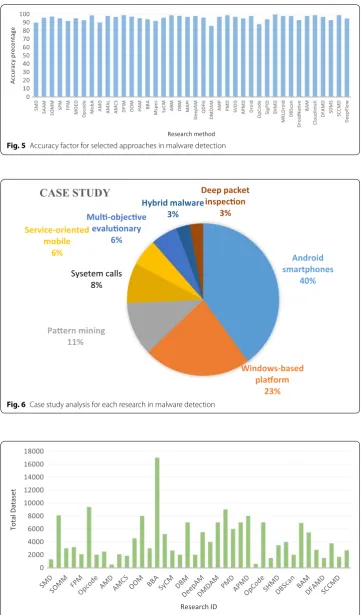
Also, Fig. 5 shows the accuracy factor for each research. As shown, all of the accu-racy factors higher than 80%. The maximum accuaccu-racy percentage is 99.2% for the DPIM approach [41] and the minimum accuracy percentage is 86% for the DMDAM approach [22].
Also, Fig. 6 shows the main case study diagram of each research in malware detec-tion. As shown, the recent researches have considered android smartphones to analyze malware detection approaches with 40%. The symbolic code aggregation case studies in windows-based platform has 23%, the pattern mining has 11%, the system calls has 8% usage in malware detection.
In addition, Fig. 7 illustrates the total number of data set used for malware detection analysis in each research. In this figure, there are five research that use higher than 5000 real samples during the evaluation process. The BBA approach [44] has the maximum dataset with 17,000 samples and the AMD approach [38] has the minimum dataset with 500 samples.
Also, Fig. 8 shows the data analysis methods percentage in terms of static, dynamic and hybrid analysis in selected research. The most data analysis methods have used dynamic analysis with 51%, the hybrid analysis has 29% and the static analysis has 20% usage. The 30% of the signature-based approaches have used the dynamic data analysis. The 65% of the behavior-based malware detection approaches have used the dynamic data analysis method.
Table 5 continued
Method Main idea Advantages Disadvantages Target environment
CloudIntell Feature extraction
method in cloud [18] Lowest energy con-sumption High scalability
High complexity
High response time Windows-based SDMS Security dependency
network for malware detection [50]
Low response time
High accuracy High energyHigh complexity Windows-based DFAMD Data flow android
mal-ware detection [51] High efficiencyLow overhead Low time
High complexity
High dependency Smartphone SCCMD So-called
compression-based malware detec-tion [21]
High efficiency
Low complexity High response time Windows-based DeepFlow Deep-learning malware
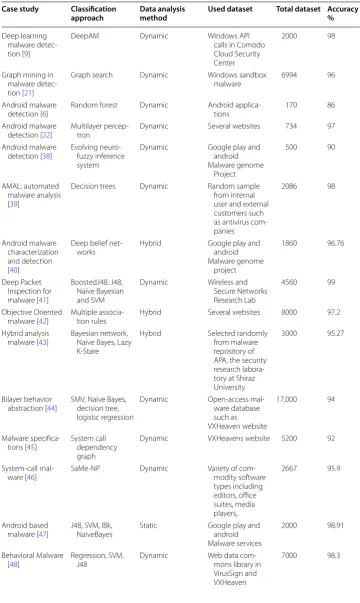
Table 6 A side-by-side comparison of the important factors in behavior-based detection of each article
Case study Classification
approach Data analysis method Used dataset Total dataset Accuracy%
Deep learning malware detec-tion [9]
DeepAM Dynamic Windows API calls in Comodo Cloud Security Center
2000 98
Graph mining in malware detec-tion [21]
Graph search Dynamic Windows sandbox
malware 6994 96 Android malware
detection [6] Random forest Dynamic Android applica-tions 170 86 Android malware
detection [22] Multilayer percep-tron Dynamic Several websites 734 97 Android malware
detection [38] Evolving neuro-fuzzy inference system
Dynamic Google play and android Malware genome Project 500 90 AMAL: automated malware analysis [39]
Decision trees Dynamic Random sample from internal user and external customers such as antivirus com-panies
2086 98
Android malware characterization and detection [40]
Deep belief
net-works Hybrid Google play and android Malware genome
project
1860 96.76
Deep Packet Inspection for malware [41]
BoostedJ48, J48, Naïve Bayesian and SVM
Dynamic Wireless and Secure Networks Research Lab
4560 99
Objective Oriented
malware [42] Multiple associa-tion rules Hybrid Several websites 8000 97.2 Hybrid analysis
malware [43] Bayesian network, Naive Bayes, Lazy K-Stare
Hybrid Selected randomly from malware repository of APA, the security research labora-tory at Shiraz University
3000 95.27
Bilayer behavior
abstraction [44] SMV, Naïve Bayes, decision tree, logistic regression
Dynamic Open-access mal-ware database such as VXHeaven website
17,000 94
Malware
specifica-tions [45] System call dependency graph
Dynamic VXHeavens website 5200 92
System-call
mal-ware [46] SaMe-NP Dynamic Variety of com-modity software types including editors, office suites, media players, 2667 95.9 Android based
malware [47] J48, SVM, IBk, NaiveBayes Static Google play and android Malware services
2000 98.91
Behavioral Malware
[48] Regression, SVM, J48 Dynamic Web data com-mons library in VirusSign and VXHeaven
Open issues
Due to applying the survey on the malware detection approaches, the following research challenges as the open issues are presented that are not addressed by the research popu-lations up to now.
Table 6 continued
Case study Classification
approach Data analysis method Used dataset Total dataset Accuracy%
Malicious code
based on API [49] Decision tree, SVM and random forest
Dynamic API hooking library
in VirusSign 2000 96.89 Feature extraction
method in cloud [18]
Decision tree, SVM,
Boosting Static Random dataset of VirusTotal 15,000 99.69 Security
depend-ency network for malware detec-tion [50]
No read down and
no write up Dynamic VXHeavens website 7257 93.92
Data flow android malware detec-tion [51]
KNN, LR, BN Static VXHeavens website
and Google play 2200 97.66 So-called
compression-based malware detection [21]
k-NN, QDA, LDA, SVN, Decision Trees, and ran-dom forest
Dynamic Cuckoo sandbox 7507 99.3
Deep-learning malware detec-tion [52]
Naive Bayes, PART, Logistic Regres-sion, SVM and MLP
Hybrid Google play, virus
share 11,000 95.05
SVM 29%
J48 17% Decision tree
14%
NB 10%
RF 5%
ANN 3%
KNN 3%
GA 3%
Regresion 3%
DBN 2% BN
2%
LKS 2%2%NF
IBK 2% LKS2%
MLP 2%
CLASSIFICATION METHODS
0 10 20 30 40 50 60 70 80 90 100
SM
D
SAAM SOMM SP
M
FP
M
MOED Opcode MobA AM
D
AMAL AMCS DPIM OOM HAM BB
A
Mspe
c
SyCM AB
M
DB
M
MAPI
D
eepAM QDFG DMDA
M
AM
P
PM
D
SVDD APMD Droi
d
OpCode SigPID SHMD MKLDroid DBScan
DroidNave
BA
M
CloudIntel
l
DFAM
D
SDMS SCCM
D
D
eepFlow
Accuracy precentage
Research method Fig. 5 Accuracy factor for selected approaches in malware detection
Android smartphones
40%
Windows-based plaorm
23% Paern mining
11%
Sysetem calls 8% Service-oriented
mobile 6%
Mul-objecve evaluonary
6%
Hybrid malware 3%
Deep packet inspecon
3%
CASE STUDY
Fig. 6 Case study analysis for each research in malware detection
0 2000 4000 6000 8000 10000 12000 14000 16000 18000
Total Dataset
• Decryption/encryption detection: One of the important open issues in malware detection is information hiding malware techniques. Information hiding techniques are utilized to make information hard to take note. This practice ought not to be mis-taken for encryption, in which the substance is disjointed, as it is rather clear. Such components are regularly utilized mutually to guarantee that a discussion stays indis-cernible. Steganography is a standout amongst the most surely understood subfields of data stowing away and means to shroud mystery information in an appropriate transporter.
• Meta-heuristic detection: The malware detection analyses using meta-heuristic algo-rithms can influence the speed up of the execution time and the total accuracy factor of the data mining process.
• Real-time malware detection: Is based on hybrid analysis, secure multi-objective evolutionary malware detection, secure e-banking environments and secure health-care systems are very challenging to recognize the malicious files and hidden attacks using data mining approaches.
Further studies are suggested to improve the accuracy of the related malware detec-tion methods using evoludetec-tionary mechanisms.
In this survey, we performed a full description research to find more than 35 authors and different works. However, by considering the increasing development of studies on this topic, it is not possible to guarantee that all of the articles were recovered, particu-larly for 2010, because the research finished in July 2017.
Suggestion criteria
According to the existing discussion analysis, some technical suggestions are introduced to expand the malware detection approaches in the new platforms and architectures such as Internet of Things (IoT) applications, e-banking and social networks.
Some evolutionary methods can be improve the malware detection for predicting the polymorphism attacks in the electronic wallet applications. For example, a meta-heuris-tic algorithm finds the optimal signature detection for a polymorphism malware attacks in the electronic mobile payments.
Dynamic 51%
Hybrid 29%
Stac 20%
ANALYSIS METHOD
Context-aware detection is a new idea for dynamic malware detection approaches in the IoT applications based on semantic signature that categorize API calls with respect to the most interactions between end user and application layer of the IoT. When the smart devices cannot interact between user devices and datacenters, the reliability and availability of the smart services have been decreased.
Providing a safe condition for the huge data collection such as big data against the malware attacks is the key challenge for the malware detection for navigating big data security. Therefore, to select the minimal sample space of the malware damage, the data collection and storing big data can be navigate using data mining and synthesis methods.
Conclusion
This paper presented a systematic literature survey of the malware detection approaches using data mining. The reviewed and papers were investigated and classified into two main categories; (1) signature-based and (2) behavior-based approaches. The malware detection approaches were compared and analyzed according to various essential fac-tors such as classification approaches, data analysis methods, the number of the used dataset, accuracy factor and case study analysis. The advantage and disadvantage of each method were deliberated in the malware detection methods. Most of the selected arti-cles in data mining are behavior-based techniques. In the malware analysis stage, the most case studies are proposed for the android smartphones. In addition, using meta-heuristic algorithms in malware detection analysis can speed up and improve the exe-cution time and the overall accuracy of the data mining process. As the experimental results, we observed that the SVM method has most percentage for malware detection approach with 29%, j48 has 17%, Decision tree has 14%, NB has 10%, BF has 5% and the other methods have less than 3% usage in data mining results. We discover that the SVM method just has the best accuracy in the signature-based malware detection approaches using data mining. In addition, the maximum accuracy percentage is 99.2% for the DPIM approach and the minimum accuracy percentage is 86% for the DMDAM approach. Also, we observed that the recent researches have considered android smart-phones to analyze malware detection approaches with 40%. The symbolic code aggrega-tion case studies in windows-based platform has 23%, the pattern mining has 11%, the system calls has 8% usage in malware detection. Finally, we have seen that The 30% of the signature-based approaches have used the dynamic data analysis. The 65% of the behav-ior-based malware detection approaches have used the dynamic data analysis method. As an important open issue, some important topics such as secure multi-objective mal-ware, e-banking environments, and healthcare systems malware attacks are challenging areas to recognize the malicious files and hidden attacks.
Authors’ contributions
AS as the corresponding author. RH as the co-author. Both authors read and approved the final manuscript.
Author details
1 Department of Computer Engineering, Science and Research Branch, Islamic Azad University, Tehran, Iran. 2
Depart-ment of Computer Engineering, Shahr-e-Qods Branch, Islamic Azad University, Tehran, Iran.
Acknowledgements
Not applicable.
Competing interests
Availability of data and materials
Not applicable.
Consent for publication
Not applicable.
Ethics approval and consent to participate
We confirm that this manuscript has not been published elsewhere and is not under consideration by another journal. All authors have approved the manuscript and agree with its submission.
Funding
Not applicable.
Publisher’s Note
Springer Nature remains neutral with regard to jurisdictional claims in published maps and institutional affiliations. Received: 20 July 2017 Accepted: 2 January 2018
References
1. Souri A, Norouzi M, Asghari P (2017) An analytical automated refinement approach for structural modeling large-scale codes using reverse engineering. Int J Inf Technol 9:329–333. https://doi.org/10.1007/s41870-017-0050-7 2. Souri A, Navimipour NJ, Rahmani AM (2017) Formal verification approaches and standards in the cloud computing:
a comprehensive and systematic review. Comput Stand Interfaces. https://doi.org/10.1016/j.csi.2017.11.007 3. Hashemi H, Azmoodeh A, Hamzeh A, Hashemi S (2017) Graph embedding as a new approach for unknown
mal-ware detection. J Comput Virol Hacking Tech 13:153–166. https://doi.org/10.1007/s11416-016-0278-y
4. Park JH (2017) Novel approaches for applying linguistic processing techniques based on pattern recognition and machine learning. JIPS (J Inf Process Syst) 13:643–652
5. Souri A, Asghari P, Rezaei R (2017) Software as a service based CRM providers in the cloud computing: challenges and technical issues. J Serv Sci Res 9:219–237. https://doi.org/10.1007/s12927-017-0011-5
6. Bhattacharya A, Goswami RT (2017) DMDAM: data mining based detection of android malware. In: Mandal JK, Satapathy SC, Sanyal MK, Bhateja V (eds) Proceedings of the first international conference on intelligent computing and communication springer Singapore, Singapore, pp 187–194
7. Nikolopoulos SD, Polenakis I (2017) A graph-based model for malware detection and classification using system-call groups. J Comput Virol Hacking Tech 13:29–46. https://doi.org/10.1007/s11416-016-0267-1
8. Pektaş A, Acarman T (2017) Classification of malware families based on runtime behaviors. J Inf Secur Appl 37:91–100. https://doi.org/10.1016/j.jisa.2017.10.005
9. Ye Y, Chen L, Hou S, Hardy W, Li X (2017) DeepAM: a heterogeneous deep learning framework for intelligent mal-ware detection. Knowl Inf Syst. https://doi.org/10.1007/s10115-017-1058-9
10. Safarkhanlou A, Souri A, Norouzi M, Sardroud SEH (2015) Formalizing and verification of an antivirus protection service using model checking. Procedia Comput Sci 57:1324–1331. https://doi.org/10.1016/j.procs.2015.07.443 11. Li Z, Sun L, Yan Q, Srisa-an W, Chen Z (2017) DroidClassifier: efficient adaptive mining of application-layer header for
classifying android malware. In: Deng R, Weng J, Ren K, Yegneswaran V (eds) Security and privacy in communication networks: 12th international conference, securecomm 2016, Guangzhou, China, October 10–12, 2016, Proceedings. Springer International Publishing, Cham, pp 597–616
12. Malhotra R, Jangra R (2017) Prediction & assessment of change prone classes using statistical & machine learning techniques. J Inf Process Syst 13(4):778–804. https://doi.org/10.3745/JIPS.04.0013
13. Chowdhury M, Rahman A, Islam R (2018) Malware analysis and detection using data mining and machine learning classification. In: Abawajy J, Choo K-KR, Islam R (eds) International conference on applications and techniques in cyber security and intelligence: applications and techniques in cyber security and intelligence. Springer Interna-tional Publishing, Cham, pp 266–274
14. Palumbo P, Sayfullina L, Komashinskiy D, Eirola E, Karhunen J (2017) A pragmatic android malware detection proce-dure. Comput Secur 70:689–701. https://doi.org/10.1016/j.cose.2017.07.013
15. Narayanan A, Chandramohan M, Chen L, Liu Y (2017) A multi-view context-aware approach to Android malware detection and malicious code localization. Empir Softw Eng. https://doi.org/10.1007/s10664-017-9539-8 16. Mohamed GAN, Ithnin NB (2018) SBRT: API signature behaviour based representation technique for improving
metamorphic malware detection. In: Saeed F, Gazem N, Patnaik S, Saed Balaid AS, Mohammed F (eds) Recent trends in information and communication technology. Proceedings of the 2nd international conference of reliable infor-mation and communication technology (IRICT 2017). Springer International Publishing, Cham, pp 767–777 17. Malhotra A, Bajaj K (2016) A hybrid pattern based text mining approach for malware detection using DBScan. CSI
Trans ICT 4:141–149. https://doi.org/10.1007/s40012-016-0095-y
18. Siddiqui M, Wang MC, Lee J (2008) A survey of data mining techniques for malware detection using file features. In: Proceedings of the 46th annual southeast regional conference on xx. 2008. ACM
19. Sun L, Li Z, Yan Q, Srisa-an W, Pan Y (2016) SigPID: significant permission identification for android malware detec-tion. In: 2016 11th international conference on malicious and unwanted software (MALWARE), pp 1–8
21. Wuechner T, Cislak A, Ochoa M, Pretschner A (2017) Leveraging compression-based graph mining for behavior-based malware detection. IEEE Trans Dependable Secur Comput. https://doi.org/10.1109/tdsc.2017.2675881 22. Bhattacharya A, Goswami RT (2017) Comparative analysis of different feature ranking techniques in data
mining-based android malware detection. In: Satapathy SC, Bhateja V, Udgata SK, Pattnaik PK (eds) Proceedings of the 5th international conference on frontiers in intelligent computing: theory and applications: FICTA 2016, Volume 1. Springer Singapore, Singapore, pp 39–49
23. Fan CI, Hsiao HW, Chou CH, Tseng YF (2015) Malware detection systems based on API log data mining. In: 2015 IEEE 39th annual computer software and applications conference, pp 255–260
24. Wang P, Wang Y-S (2015) Malware behavioural detection and vaccine development by using a support vector model classifier. J Comput Syst Sci 81:1012–1026. https://doi.org/10.1016/j.jcss.2014.12.014
25. Fraley JB, Figueroa M (2016) Polymorphic malware detection using topological feature extraction with data mining. In: SoutheastCon 2016, pp 1–7
26. Sun M, Li X, Lui JC, Ma RT, Liang Z (2017) Monet: a user-oriented behavior-based malware variants detection system for android. IEEE Trans Inf Forensics Secur 12:1103–1112
27. Sun H, Wang X, Buyya R, Su J (2017) CloudEyes: cloud-based malware detection with reversible sketch for resource-constrained internet of things (IoT) devices. Softw Pract Exp 47:421–441. https://doi.org/10.1002/spe.2420 28. Tang Y, Xiao B, Lu X (2011) Signature tree generation for polymorphic worms. IEEE Trans Comput 60:565–579.
https://doi.org/10.1109/TC.2010.130
29. Wu B, Lu T, Zheng K, Zhang D, Lin X (2014) Smartphone malware detection model based on artificial immune system. China Commun 11:86–92. https://doi.org/10.1109/CC.2014.7022530
30. Bat-Erdene M, Park H, Li H, Lee H, Choi MS (2017) Entropy analysis to classify unknown packing algorithms for mal-ware detection. Int J Inf Secur 16(3):227–248. https://doi.org/10.1007/s10207-016-0330-4
31. Cui B, Jin H, Carullo G, Liu Z (2015) Service-oriented mobile malware detection system based on mining strategies. Pervasive Mob Comput 24:101–116. https://doi.org/10.1016/j.pmcj.2015.06.006
32. Fan Y, Ye Y, Chen L (2016) Malicious sequential pattern mining for automatic malware detection. Expert Syst Appl 52:16–25. https://doi.org/10.1016/j.eswa.2016.01.002
33. Hellal A, Romdhane LB (2016) Minimal contrast frequent pattern mining for malware detection. Comput Secur 62:19–32. https://doi.org/10.1016/j.cose.2016.06.004
34. Martín A, Menéndez HD, Camacho D (2016) MOCDroid: multi-objective evolutionary classifier for Android malware detection. Soft Comput 21:7405–7415. https://doi.org/10.1007/s00500-016-2283-y
35. Santos I, Brezo F, Ugarte-Pedrero X, Bringas PG (2013) Opcode sequences as representation of executables for data-mining-based unknown malware detection. Inf Sci 231:64–82. https://doi.org/10.1016/j.ins.2011.08.020
36. Rehman Z-U, Khan SN, Muhammad K, Lee JW, Lv Z, Baik SW, Shah PA, Awan K, Mehmood I (2017) Machine learning-assisted signature and heuristic-based detection of malwares in Android devices. Comput Electr Eng. https://doi. org/10.1016/j.compeleceng.2017.11.028
37. Alam S, Qu Z, Riley R, Chen Y, Rastogi V (2017) DroidNative: automating and optimizing detection of Android native code malware variants. Comput Secur 65:230–246. https://doi.org/10.1016/j.cose.2016.11.011
38. Altaher A (2016) An improved Android malware detection scheme based on an evolving hybrid neuro-fuzzy classifier (EHNFC) and permission-based features. Neural Comput Appl 28:4147–4157. https://doi.org/10.1007/ s00521-016-2708-7
39. Mohaisen A, Alrawi O, Mohaisen M (2015) AMAL: high-fidelity, behavior-based automated malware analysis and classification. Comput Secur 52:251–266. https://doi.org/10.1016/j.cose.2015.04.001
40. Yuan Z, Lu Y, Xue Y (2016) Droiddetector: android malware characterization and detection using deep learning. Tsinghua Sci Technol 21:114–123. https://doi.org/10.1109/TST.2016.7399288
41. Boukhtouta A, Mokhov SA, Lakhdari N-E, Debbabi M, Paquet J (2016) Network malware classification com-parison using DPI and flow packet headers. J Comput Virol Hacking Tech 12:69–100. https://doi.org/10.1007/ s11416-015-0247-x
42. Ding Y, Yuan X, Tang K, Xiao X, Zhang Y (2013) A fast malware detection algorithm based on objective-oriented association mining. Comput Secur 39(Part B):315–324. https://doi.org/10.1016/j.cose.2013.08.008
43. Eskandari M, Khorshidpour Z, Hashemi S (2013) HDM-Analyser: a hybrid analysis approach based on data mining techniques for malware detection. J Comput Virol Hacking Tech 9:77–93. https://doi.org/10.1007/ s11416-013-0181-8
44. Miao Q, Liu J, Cao Y, Song J (2016) Malware detection using bilayer behavior abstraction and improved one-class support vector machines. Int J Inf Secur 15:361–379. https://doi.org/10.1007/s10207-015-0297-6
45. Ming J, Xin Z, Lan P, Wu D, Liu P, Mao B (2016) Impeding behavior-based malware analysis via replacement attacks to malware specifications. J Comput Virol Hacking Tech 13:193–207. https://doi.org/10.1007/s11416-016-0281-3 46. Nikolopoulos SD, Polenakis I (2016) A graph-based model for malware detection and classification using system-call
groups. J Comput Virol Hacking Tech 13:29–46. https://doi.org/10.1007/s11416-016-0267-1
47. Sheen S, Anitha R, Natarajan V (2015) Android based malware detection using a multifeature collaborative decision fusion approach. Neurocomputing 151(Part 2):905–912. https://doi.org/10.1016/j.neucom.2014.10.004
48. Norouzi M, Souri A, Samad Zamini M (2016) A data mining classification approach for behavioral malware detection. J Comput Netw Commun 2016:9. https://doi.org/10.1155/2016/8069672
49. Galal HS, Mahdy YB, Atiea MA (2016) Behavior-based features model for malware detection. J Comput Virol Hacking Tech 12:59–67. https://doi.org/10.1007/s11416-015-0244-0
50. Mao W, Cai Z, Towsley D, Feng Q, Guan X (2017) Security importance assessment for system objects and malware detection. Comput Secur 68:47–68. https://doi.org/10.1016/j.cose.2017.02.009
51. Wu S, Wang P, Li X, Zhang Y (2016) Effective detection of android malware based on the usage of data flow APIs and machine learning. Inf Softw Technol 75:17–25. https://doi.org/10.1016/j.infsof.2016.03.004