41 Education in Medicine Journal. 2018; 10(2): 41–47
www.eduimed.com Penerbit Universiti Sains Malaysia. 2018
COMMUNICATION
To cite this article: Abdul Rahman NF, Albualy R. A comparative analysis of reflection in a primary care outpatient setting in two learning environments. Education in Medicine Journal. 2018;10(2):41– 47. https://doi.org/10.21315/eimj2018.10.2.5
To link to this article: https://doi.org/10.21315/eimj2018.10.2.5
ABSTRACT
Situated learning characterises the learning that takes place in the clinical environment. Learning in the workplace is characterised by transferring classroom knowledge into performing tasks and this may take various forms. In the medical education field, the cognitive apprenticeship instructional model developed by Collins (2016) supported this learning in the workplace setting due to its common characteristics of apprenticeship. This paper analysed two concrete learning situations in a Malaysian undergraduate and an Omani postgraduate learning environment. Both learning situations occurred in the primary healthcare outpatient setting. The cognitive apprenticeship model was used to identify characteristics of the individual learning environments and discusses factors that stimulate learning. Attention was paid to the role of reflection in stimulating learning in the described settings. The paper provided the context in both institutes, described the learning situation and provided an analysis based on the theoretical framework. Based on the analysis of the situations, solutions to problems in the two settings were suggested.
Keywords: Reflection, Primary care, Cognitive apprenticeship, Malaysia, Oman
INTRODUCTION AND BACKGROUND
Situated learning characterises the learning that takes place in a context (1). For example, the clinical environment such as the outpatient clinic set the stage for primary care clerkship learning. Learning in the workplace is characterised by transferring classroom knowledge into performing tasks. Learning at the workplace has been the tradition of medical program and continues to be relevant until today. This paper described how reflection was
learned in primary care outpatient settings using comparative discourses from Malaysia and Oman. Despite being situated in the primary care setting, it was unclear if the effect of situated learning is the same between Malaysia and Oman. We therefore aimed to unravel some of the similarities and differences between reflections learned in the primary care setting. We chose to be informed by the theory of cognitive apprenticeship as coined by Collins and colleagues.
Volume 10 Issue 2 2018
DOI: 10.21315/eimj2018.10.2.5
ARTICLE INFO
Submitted: 05-03-2018 Accepted: 31-05-2018 Online: 29-06-2018
CORRESpONDINg AuThOR Nur Faraheen Abdul Rahman, Faculty of Medicine and Health Sciences, Universiti Sains Islam Malaysia, Tingkat 13, Menara B, Bangunan MPAJ, Jalan Pandan Utama, Pandan Indah 55100, Kuala Lumpur, Malaysia | Email: [email protected]
A Comparative Analysis of Reflection in a
primary Care Outpatient Setting in Two
Learning Environments
Nur Faraheen Abdul Rahman, Raghdah Albualy
Faculty of Medicine and Health Sciences, Universiti Sains Islam Malaysia, Kuala Lumpur, MALAYSIA
THEORETICAL FRAMEWORK
Cognitive apprenticeship (CA), was described by Allan Collins and colleagues in 1988. It was based on the apprenticeship model. It was introduced to support learning in the cognitive domain to gain cognitive, as well as metacognitive skills (2). In the traditional apprenticeship model, learners observe teachers’ actions and mimic their behaviour. Through the traditional model, teachers’ thoughts and analyses are not apparent to learners. One feature of the CA model is that the reasoning behind experts’ decision-making is made covert. In addition, learning happens by solving real problems. It is also said to be applicable across different settings. CA is an instructional model of situated learning theory where learners perform context-driven real tasks. It is followed by reflection, where learners ponder at their performance and related expected principles. Collins (2), describe six teaching methods that support learning under this model. These include, modeling, coaching, scaffolding, articulation, reflection, and exploration.
METHODS
Study design: We conducted a qualitative study to compare the situated learning between the undergraduate and postgraduate students within the primary care setting.
Setting: Two institutes were chosen based on the authors’ familiarity of the setting. Malaysian institute was chosen to describe situated learning in the undergraduate program. Omani institute was chosen to describe the postgraduate program. Below is the context of both Institutes 1 and 2. Emphasis was given to describe the setting as this comparative study was on situated learning.
Institute 1
The context of Institute 1 was within a primary care posting of a five-year Bachelor
of Medicine and Bachelor of Surgery program at a university in Malaysia. The 4th year primary care posting was eight
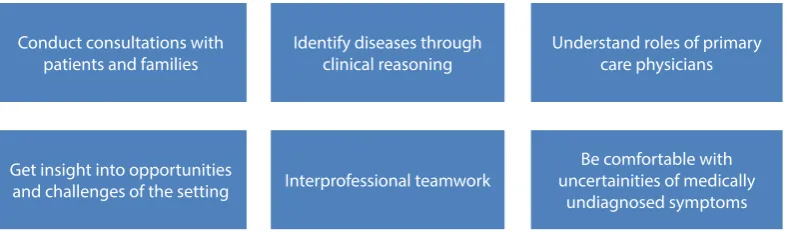
weeks in duration. In the posting, medical students learned via various instructional methods including traditional lectures, small group tutorials, and clinical skills practice in a simulated environment. Students were also placed in outpatient clinics for clinical attachment. Students took part in most of the clinic activities. These included consulting patients, observing and performing clinical procedures, observing clinical laboratory processes, learning about medicines, and observing community rehabilitation activities. Students also participated in home visits of high-risk antenatal and postnatal patients. The assessment for students in the clerkship included individual clinical case presentations, group presentation of clinical cases in classroom, designated seminar presentations, fulfillment of a record of patient encounters, a case write-up, and a field-visit report. Students were continuously assessed and undergo end-of-posting theoretical and clinical exams in the form of OSCE, as well as professionalism assessment. Besides the primary care posting, Year 4 student groups rotate in specialties such as otolaryngology, community medicine, urban health, orthopedics, emergency medicine, anesthesiology, radiology, ophthalmology, and forensic medicine of variable durations. These rotations were work place based in nature. Students entered Year 4 with prerequisites knowledge of internal medicine, surgery, paediatrics, and obstetrics and gynaecology, in addition to pre-clinical fundamental sciences. Figure 1 illustrates the learning opportunities at the outpatient setting of Institute 1.
Subsequently, students observed the consultations between attending doctors and their patients. Clinical reasoning ensued leading to decision making and management plan. Case discussions between students and the faculty member. Students were encouraged to relate the case with encounters of similar cases in the past to further consolidate their knowledge. Finally, students were instructed to verbally reflect on their performance using a specific protocol.
Table 1: Reflection protocol at Institute 1 Reflective questions during case discussions What did the student do well in the course of learning about the case?
What could be improved in terms of learning the case?
What are the action plans with regard to learning the case going forward?
How has the clinical encounter affect the students?
Reflective practice was uncommon within the medical faculty. However, if it was, students reported the activities as helpful to gain perspective on their strengths and weaknesses, allowing them to plan for their future learning. Teachers find the reflective exercise beneficial to help students find meanings to each patient encounter and knowledge consolidation (see Table 1).
Issues with the learning situation include limited students’ participation in the clinical consultations due to time and resource constraints at the expense of students’
elaborate interviews with patients. Some students have problems with limited insight and this hinders self-regulated learning. Furthermore, students are not obliged to record their reflections. As a result, students may not retain the information as soon as the discussion end. Among the teaching faculty, not all teachers facilitate in reflective process. Hence, although students were briefed to reflect on the clinical encounters, not all managed to articulate their reflections.
Institute 2
The context in the second institute was a 4-year Family Medicine postgraduate residency-training program at the Oman Medical Specialty Board (OMSB). Throughout the training program, residents were given graded responsibility for the care of their patients. Residents’ clinical experience with patients in the outpatient clinics gradually increased as they progressed from Year 1 to Year 4 of their training. All 4 years of training were divided into 13 blocks, each of 4-weeks in duration. A major portion of the residency program was spent in the primary care setting. Residents completed 15 blocks in the family medicine rotation spread over four years of training. As residents reached the fourth year, they must demonstrate their ability to run their practice independently. Many teaching methods were used to foster this responsibility, including case-based discussions, and the use of a learning portfolio. Specifically, residents were required at the end of each rotation to Conduct consultations with
patients and families
Get insight into opportunities
and challenges of the setting Interprofessional teamwork
Be comfortable with uncertainities of medically
undiagnosed symptoms Understand roles of primary
care physicians Identify diseases through
clinical reasoning
perform an exercise of reflection on a case they have seen in their clinic. This is aimed to develop residents’ reflective and learning skills and is evaluated by their supervisors.
At the end of each postgraduate family medicine rotation in the local healthcare centre, residents acquire a list of patients they have encountered during the block. The list of patients is usually reviewed with their trainers, and residents identify patients or cases that require further clarification due to uncertainty about the case or encountering a new situation or guideline. The Family Medicine program calls this exercise “Linking Learning to Practice (LLP)”. The exercise has some elements of case based discussion as well as reflection on action. This is a required component of the Family Medicine residency curriculum and is used for evaluation as well as part of the resident portfolio. Residents posted in the local healthcare centre are required to complete two LLPs. The main goal of this exercise is to engage residents in reflection and reflective practice. Through this exercise, residents are encouraged to revisit cases where they have encountered uncertainty and as a result they are required to explore further to identify their learning goals and needs. Exploration should be completed in an evidence-based manner. Residents are trained to use evidence based medicine methods through various lectures and workshops. In addition to the LLP, residents are also required to complete Case Based Discussions, Mini-CEX and other professionalism evaluation exercises.
Once a patient or case is identified, residents complete the LLP exercise by providing a brief history of the patient and then answering a predetermined set of questions including: what was your specific question/ learning need; what are the search terms used; assessment of quality of information gathered in terms of validity and relevance; and application of knowledge to practice (was it applied to the patient in question, what must you do to integrate decisions in your practice, and what kinds of barriers/ difficulties do you foresee). In order to
answer these questions, residents need to: identify a learning need through formulating a question; use evidence based medicine to answer their question; reflect on the newly acquired knowledge in order to apply it to practice; and discuss with their supervisors their learning needs and followed approach.
Through interviewing supervisors and residents engaged in this learning situation, a few problems were described. From the supervisors’ perspective, residents’ identified questions or learning needs are initially vague. Also, the curriculum requirements were slightly modified in that now residents in the local healthcare centre are required to do less LLPs due to the increase of other required learning activities. From the residents’ perspective, the lack of time with the supervisors to discuss the LLPs can lead to incorrect use of the exercise. Furthermore, residents feel if the supervisors are not trained to conduct the sessions, there is little benefit in the exercise. Residents also described situations of discrepancy and inconsistency of the feedback they receive from one supervisor to the other. This again relates to the experience the supervisor has with giving feedback for such an exercise.
Sampling: It was a theoretical sampling. Participants were students and clinical teachers and supervisors.
Data collection: We observed and held unstructured interviews with students and clinical teachers at both settings. We also read student guidebook to understand the primary care/family medicine curriculum in both settings better.
Data analysis: Data was analysed thematically to look for emerging themes.
RESULTS
work (1). In Institute 1, undergraduate students participated in group processes and working alongside others. In Institute 2, doctors in Family Medicine residency program use problem solving to consolidate management skills and work with clients. CA were used in clinical practice and proven useful for undergraduate medical students (3). Through our analysis of the learning situations, CA teaching methods became apparent in varying degrees. The degree of teaching method used is determined by learners’ competency level. For example, modeling is observed more in the undergraduate level as opposed to the postgraduate level. This finding was similar what Eraut had described as
novice, and advanced beginner to competent
depending on their level of training (4). The learning climate in both institutes differed
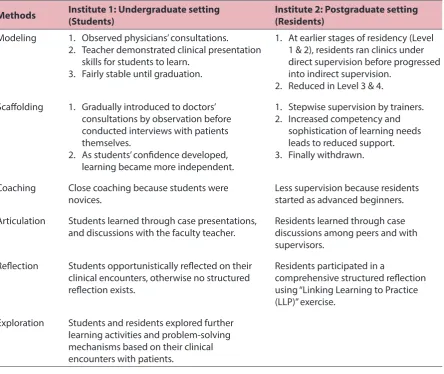
greatly since postgraduate residents in Oman initially ran clinics with supervisors and later; independently. The Malaysian undergraduate students however, had more of the observatory role and were not responsible for patients’ care. The Table 2 highlights the differences of cognitive apprenticeship situated in the two institutes.
Students and residents were expected to reflect on their clinical encounters. In Institute 1, even verbal reflection was perceived to be useful for students’ future learning activities. This was because in their opinion, reflection provided clear learning direction. The caveat was in the construction of further knowledge because such consolidation will only occur if students and teachers pursued the generated learning points. However, residents in
Table 2: Observation of instructional methods of CA in two institutes
Methods Institute 1: Undergraduate setting(Students) Institute 2: Postgraduate setting(Residents)
Modeling 1. Observed physicians’ consultations.
2. Teacher demonstrated clinical presentation skills for students to learn.
3. Fairly stable until graduation.
1. At earlier stages of residency (Level 1 & 2), residents ran clinics under direct supervision before progressed into indirect supervision.
2. Reduced in Level 3 & 4.
Scaffolding 1. Gradually introduced to doctors’ consultations by observation before conducted interviews with patients themselves.
2. As students’ confidence developed, learning became more independent.
1. Stepwise supervision by trainers. 2. Increased competency and
sophistication of learning needs leads to reduced support. 3. Finally withdrawn.
Coaching Close coaching because students were
novices. Less supervision because residents started as advanced beginners.
Articulation Students learned through case presentations,
and discussions with the faculty teacher. Residents learned through case discussions among peers and with supervisors.
Reflection Students opportunistically reflected on their clinical encounters, otherwise no structured reflection exists.
Residents participated in a
comprehensive structured reflection using “Linking Learning to Practice (LLP)” exercise.
Institute 2 had a comprehensive structured reflection via LLP, thus created positive learning opportunities. Residents were also encouraged to find alternative solutions and limitations to current practice. Lessons learned were either applied to the same patient, other patients and/or disseminated to others. Residents however thought that LLP to be advantageous in shifting paradigm and improving practice when the solutions were evidence-based.
DISCUSSION
Considering the learning situation similarities between two institutions, and differences between undergraduate and postgraduate apprenticeship, we have chosen to focus on reflection (also a cognitive apprenticeship method). Reflection is a metacognitive process that “occurs before, during and after situations with the purpose of developing greater understanding of both the self and the situation so that future encounters … are informed from previous encounters” (6). From cognitive apprenticeship perspective, reflection is exercised when teachers encourage students to compare their learning activities with the expected standards. Through reflection, trainees practice self-regulated learning (7). Articulation encourages learners to ask questions leading to reflection. Articulation by discussions, build a rapport between students and teachers, which enhances the learning environment. This educational relationship is improved when trainers explicitly discuss the learning process and learning conditions within the workplace (5).
CHALLENGES OF REFLECTION
LEARNING IN THE PRIMARY CARE
SETTING
A problem found in the undergraduate setting was the lack of written portfolio and structured follow-up. We saw that this
issue was prevented in residency through a required learning portfolio and scheduled assessments to ensure that residents identify their learning needs and supervisors help them develop the required skills. If the undergraduate setting adopts the process, CA requirement of coaching and scaffolding could be better fulfilled. Medical students, should also write their reflections in addition to verbally discussing them with their teachers for ease of follow-through.
In Institute 2, supervisors described residents’ questions as being vague when they first utilised LLP. This signified poor insight towards self and situation and may impact articulation and exploration. Questions became sophisticated as experience increased. It complemented the role of coaching and articulation in developing residents’ learning.
We noticed that there was also variability in teacher and supervisor evaluations. It depended on their experience with feedback. It was limited further by the time constraint. This inconsistency negatively affected scaffolding efforts. In the same vein, the lack of trainer teaching causes deficient modeling skills. Training the trainers in best practices, promotes a positive learning environment and enhances the cognitive apprenticeship model’s effectiveness.
LIMITATIONS AND FUTURE
RESEARCH DIRECTION
CONCLUSION
Learning reflection could be done in the workplace for the purpose of both undergraduate as well as postgraduate levels as described by this paper. We used Cognitive Apprenticeship modeling to compare how learning reflection was done in two settings. The authenticity and dynamism in clinical setting allowed students to reflect deeply but guidance from the supervisors is important to consolidate this skill as the outcome of such learning.
REFERENCES
1. Eraut M. Learning from other people in the workplace. In: Hall K, Murphy P, Soler J, editors. Pedagogy and practice: culture and identities. London: SAGE Publications Ltd. in association with The Open University; 2008. p. 57.
2. Collins A. Cognitive apprenticeship. In: Sawyer RK, editor. The Cambridge handbook of the learning sciences. Cambridge: Cambridge University Press; 2006. p. 47–60.
3. Stalmeijer RE, Dolmans DHJM, Wolfhagen, IHAP, Scherpbier AJJA. Cognitive apprenticeship in clinical practice: can it stimulate learning in the opinion of students? Advances in Health Sciences Education. 2009;14(4):535–46. https://doi.org/10.1007/ s10459-008-9136-0
4. Eraut M. Knowledge, working practices, and learning. In Billett S, editor. Learning through practice. professional and practice-based learning, vol 1. Dordrecht: Springer; 2010. p. 37–58. https://doi.org/10.1007/978-90-481-3939-2_3
5. Sandars J. The use of reflection in medical education: AMEE Guide No. 44. Med Teach. 2009: 31(8):685–95. https://doi. org/10.1080/01421590903050374
6. Sagasser MH, Kramer AWM, van der Vleuten CPM. How do postgraduate GP trainees regulate their learning and what helps and hinders them? A qualitative study. BMC Medical Education. 2012;12(1):67. https://doi.org/10.1186/1472-6920-12-67