2013; 1(4): 96-102
Published online October 20, 2013 (http://www.sciencepublishinggroup.com/j/wcmc) doi: 10.11648/j.wcmc.20130104.13
Genetic algorithm based Finite State Markov Channel
modeling
Rakesh Ranjan
1, *, Dipen Bepari
2, Debjani Mitra
21
Department of Electronics and Communication Engineering, National Institute of Technology (NIT), Patna, 800005, India 2
Department of Electronics Engineering, Indian School of Mines (ISM), Dhanbad, 826004, India
Email address:
[email protected](R. Ranjan), [email protected](D. Bepari), [email protected](D. Mitra)
To cite this article:
Rakesh Ranjan, Dipen Bepari, Debjani Mitra. Genetic Algorithm Based Finite State Markov Channel Modeling. International Journal of Wireless Communications and Mobile Computing. Vol. 1, No. 4, 2013, pp. 96-102. doi: 10.11648/j.wcmc.20130104.13
Abstract:
Statistical properties of the error sequences produced by fading channels with memory have a strong influence over the performance of high layer protocols and error control codes. Finite State Markov Channel (FSMC) models can represent the temporal correlations of these sequences efficiently and accurately. This paper proposes a simple genetic algorithm (GA) based search for the optimum state transition matrix for a block diagonal Markov model. The burst error statistics of the GA based FSMC model with respect to Autocorrelation Function and error free interval distribution of the original error sequence are presented to validate the proposed method. The superiority of the GA approach over the semi-hidden Markov model (SHMM) based Fritchman model is exhibited in significant improvement of closeness of match and in the usage of shorter length of error sequences. Another Baum-Welch algorithm (BWA) based GA search method has been proposed and compared with the BWA and SHMM methods for the same error sequence. Again the superiority of GA approaches is recognized, especially for the smaller error lengths.Keywords:
Genetic Algorithm, Finite State Markov Channel, Semi-Hidden Markov Model, Baum-Welch Algorithm, Autocorrelation Functions, Error-Free Interval Distributions1. Introduction
The current generation networking and communication technology which has to cater to high speed multimedia traffic is strongly dependent on the identification and availability of accurate and tractable models for the mobile/wireless radio fading channels. Fading affects the overall network performance in the physical or media access control layers, and also the designing of efficient and reliable transceivers. The radio link is highly variable due to the statistical distribution of the environmental propagation parameters. Reliable and efficient channel modeling can thus be effective to develop network protocols that mitigate or exploit fading. There are two main approaches to capture the inherent memory in fading channels: the physical (analog) or waveform level and the digital or discrete channel modeling. Physical channel modeling is based on parameters such as received signal strength, noise/interference power, speed of mobile etc. They are more appropriate for design and testing of transmitter-receiver applications and parameter optimization. Discrete Channel Modeling on the other hand places
The source has two states: good or no errors and bad or burst errors. Fritchman [4] studied the Markov chains where the outputs are a deterministic function of the states based on the principle of semi-hidden Markov models. As an extension of the Hidden Markov Model (HMM), a hidden semi-Markov model (HSMM) is traditionally defined by allowing the underlying process to be a semi-Markov chain. Each state has a variable duration, which is associated with the number of observations produced while in the state [5]. Fritchman’s model has received considerable attention in recent years because it is relatively easy to estimate the parameters of this model from burst error distributions. FSMC and other error modelling approaches and its features such as computational efficiency, etc have been excellently reviewed and discussed in literature [6-10]. HMMs are an important category of generative error models that can accurately represent the statistical patterns of bursty error data in fading channels [11]. The most important and difficult problem in HMMs is to estimate the model parameters that best explains the observations and training is usually performed by an iterative procedure following the Maximum likelihood criteria. Genetic Algorithms, on the other hand, are a powerful computational model having optimization capabilities that can encode a solution on a simple chromosome like data structure using techniques inspired by natural evolution such as inheritance, crossover, mutation and selection. GA’s ability of global searching of better maxima without getting trapped into local maxima can offer better and computationally efficient solutions [12-16]. In this context, Genetic Algorithms (GA) for HMM training in general has already been identified to be a promising area mostly in applications related to automatic speech recognition [17], text/web information extraction [18-19], etc. Most of the GA and HMM related papers have used the chromosome structure as the complete set ofΓ =
{
A B, ,Π}
, and the chromosomes have been evaluated for the objective function of log likelihood ratio. In the area of Discrete Channel Modeling, however, not much work has been reported on the applicability of Genetic Algorithms for reproducing error sequences following certain statistical characteristics. Zhao Zhi-Jin et al [20] have proposed a hybrid method of using (GA) and simulated annealing (SA) to train HMM for discrete channel modeling. A GA based equalization technique has been proposed [21] with much lower computational complexity for direct sequence ultra-wideband (DS-UWB) wireless communications. The Genetic Algorithm is associated with the RAKE receiver to combat the inter-symbol interference (ISI) due to the frequency selective nature of UWB channels. Another GA based novel technique has been developed to train a hidden Markov model (HMM) with for the cognitive radio channel [22]. This paper has used the idea of HMM and SHMM in proposing new GA based FSMC model which is slightly different from the papers encountered in the literature. The mean square error of the statistical properties of the error sequences has primarily been used as the fitness function in the GA for the search based estimation of the parameters ofthe Markov model. Upon comparison of the validation with the analytical HMM/SHMM approach, the proposed GA methods are observed to have some significant improvement towards the closeness of match as well as in the length of training sequences required for a given accuracy.
The rest of the paper is organized as follows. Section 2 discusses the finite state channel model for discrete channel modeling. The GA based FSMC models have been proposed in section3. The proposed models are based on BWA and SHMM approaches. The simulation results for these two proposed technique have been provided in section 4. The results are compared with the BWA and SHMM methods for the same error sequence. The superiority of GA approaches is recognized, especially for the smaller error lengths and finally conclusions are summarized in Section 5.
2. Finite State Channel Model
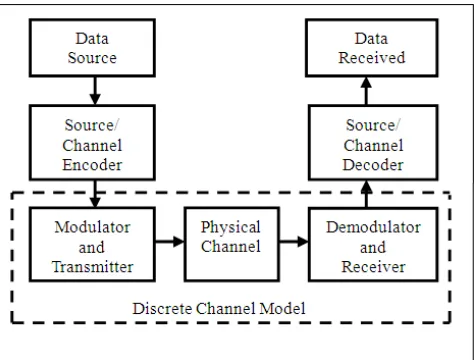
Discrete or Finite State Channel models are characterized generally by conducting waveform level simulations and/or from measurement data. The output of waveform level simulation is a time series of bit errors that are long enough to represent the statistical properties of the discrete channel. Once a DCM is developed, it eliminates the necessity of further waveform level simulations at high sampling rates. From the modulator input at the transmitter to the output at the receiver, the blocks can be clubbed as a sequence of discrete symbols as shown in Figure 1.
Figure 1: Basic Communication system with the Discrete Channel Model.
“hidden” and the Markov model is called a hidden Markov model (HMM). Both Gilbert and Fritchman are types of hidden Markov models that for large data sets need the powerful Baum Welch algorithm for computation of the HMM parameters [23]. Long error sequences of millions of symbols may be required for accurately estimating the small values of the state transition matrix. The variables in the algorithm are computed for each symbol in the given error sequence, resulting in slow convergence and high computational burden. To improve the efficiency and speed of estimation, several approaches have been adopted. A common one is based on the fact that for a general Markov model there is a statistically equivalent Fritchman like model with k good states and N-k bad states [24]. These models also referred as block diagonal Markov models are computationally more efficient as the variables in the estimation algorithms are computed at the beginning of each burst of errors rather than once every symbol. The motivation in this work was to work towards improving the efficiency of estimation of the HMM parameters still further with respect to better characterization of the original error vector and training with shorter length of error sequence.
3. The Proposed GA Based FSMC
Model
Inspired from biology and based on natural genetics law of the survival of the fittest, GA has already proved to be very capable in many research areas and NP problems. The algorithm can evolve new and better solutions in the expectation of which an implementation of GA based FSMC models are being proposed here to search for the best model parameters for a block-diagonal Markov model. A three state Fritchman model with two good states and one bad state is considered, so that a known error observation matrix, say
1 1 0
0 0 1
B=
denotes the third state to be the ‘bad’ error producing state. This model is semi hidden in the sense that if an error is produced, it is known that it has been generated by the third state. If however, no error is generated, the state cannot be identified. The implementation of this estimation algorithm based on block equivalent Markov model has been named as SHMM (semi-hidden Markov model) in the results of the current work. The state transition probability
matrix
B
ij, of the 3-state channel model11 12 13 21 22 23 31 32 33
A A A
A A A
A A A
,
thus has basically six independent variables (Pm=1%) to be estimated, as the sum of the rows of the
A
ij matrix is unity.A master error sequence
E
M was made available from a waveform level simulation of an OFDM system. Another GA search method based on Baum-Welch algorithm has been proposed for 3-state channel model, with nine independentvariables A11,A12,A22,A23,A31,A33,B11,B12,B13 , with the sum of rows of state transition matrix Aij is unity and the
sum of columns of error generation matrix Bij is also unity.
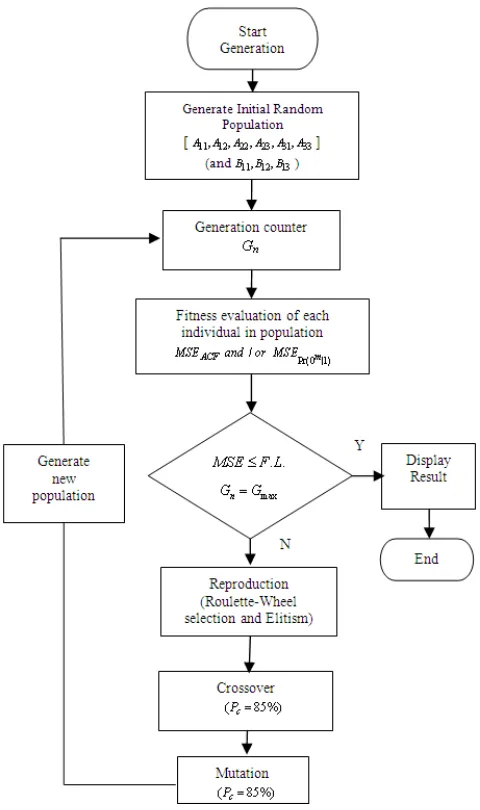
Figure 2: Block diagram of the proposed GA model
(
)
1N
Oi Gi
i ACF
A A
MSE
N
= −
∑
= (1)
where,
N = total number of elements of Autocorrelation function,
Oi
A = elements of ACFs of the original error sequences,
Gi
A = elements of ACFs of the GA-generated error sequences.
The GA is made to minimize this error with a targeted value of5 10× −7. This approach seems to be quite promising as seen from the results of the extensive simulations carried out. The distribution of error-free intervals is also a popular metric for validating the accuracy of DCMs. It is commonly denoted as, Pr 0 |1
( )
m , where, m is the length ofintervals and
( )
0 |1m denotes the event of observing m or more consecutive errors-free transmission followed by an error. Here both ACF and Pr 0 |1( )
m have been used for validating the performance of our proposed GA method with the SHMM method. The roulette wheel selection method is capable of effectively eliminating the weaker chromosomes in preference to fitter solutions. The standard genetic operators of cross-over (two point crossovers have beenused) and mutation has been applied. The Elite count denoting the number of individuals that are assured to survive to the next generation is taken as four.
4. Results and Discussions
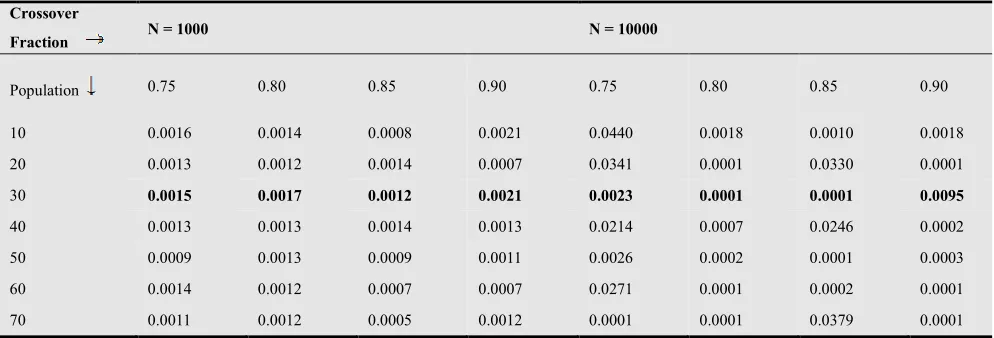
In this section the SHMM and BWA based GA approaches are discussed for channel modeling. Waveform level simulations of three different lengths, 50000, 10000, and 1000 bits of error have been used to estimate the transition probability matrix by the proposed GA approach and then the same has been compared with the popular SHMM technique for discrete channel modelling. The proposed GA algorithm was experimented upon to give a reasonably good match using a crossover fraction of 0.85 and an optimal population size of 30 for the different length of error sequences used. We can consider the smaller population size, but this may lead to missing of global fitness value. While larger population size, will results in increased simulation time. The variations in the values of MSE of ACFs with different population size, and with different crossover probabilities have been shown in Table 1 for N = 1000 and 10000. From the table, it is clear that population size of 30 and crossover fraction of 0.85 is most suitable for implementation of Genetic Algorithm for different length of error sequences.
Table 1: Variations of MSE of ACFs with the population size, for a particular value of crossover fraction, for N (length of error sequence) = 1000, and 10000.
Crossover
Fraction N = 1000 N = 10000
Population 0.75 0.80 0.85 0.90 0.75 0.80 0.85 0.90
10 0.0016 0.0014 0.0008 0.0021 0.0440 0.0018 0.0010 0.0018
20 0.0013 0.0012 0.0014 0.0007 0.0341 0.0001 0.0330 0.0001
30 0.0015 0.0017 0.0012 0.0021 0.0023 0.0001 0.0001 0.0095
40 0.0013 0.0013 0.0014 0.0013 0.0214 0.0007 0.0246 0.0002
50 0.0009 0.0013 0.0009 0.0011 0.0026 0.0002 0.0001 0.0003
60 0.0014 0.0012 0.0007 0.0007 0.0271 0.0001 0.0002 0.0001
70 0.0011 0.0012 0.0005 0.0012 0.0001 0.0001 0.0379 0.0001
Figure 3 shows the ACF comparison of original training sequence error data along with that of the GA generated and SHMM generated error data, using a training sequence of length 50,000. Figure 4 presents the similar ACF comparisons for much shorter error sequences of length 10,000. From the figure, the superiority of the GA method over the SHMM method is clearly established as the former is seen to have better matching capability even in the face of a short length error sequence. This is indeed a significant result in context to discrete channel modeling. The statistical parameterPr 0 |1
( )
m , is also used to judge the performancecomparison of GA over SHMM. Figure 5 shows the error-free interval distribution comparisons and again it is
0 5 10 15 20 25 30 -0.2 0 0.2 0.4 0.6 0.8 1 1.2 Lag S a m p le A u to co rr el at io n
N = 50000
Original GA SHMM
Figure 3: ACF comparisons of GA-generated error data and SHMM-generated error sequence with the original channel error statistics for N = 50000.
0 5 10 15 20 25 30
-0.2 0 0.2 0.4 0.6 0.8 1
N = 10000
Lag S a m p le A u to c o rr e la ti o n Original GA SHMM
Figure 4: ACF comparison of GA and SHMM methods for N = 10000.
0 50 100
0 0.2 0.4 0.6 0.8 1
N = 10000
Length of Intervals
P r( 0 m|1 ) Original GA SHMM
0 20 40 60 80
0 0.2 0.4 0.6 0.8 1
N = 1000
Length of Intervals
P r( 0 m|1 ) Original GA SHMM
Figure 5: Comparison of error-free interval distribution of the original error data with error-free interval distributions of GA-generated and SHMM-generated error sequences, for N = 10000 and 1000.
0 10 20 30 40 -0.5
0 0.5 1
N = 1000
Lag S a m p le A u to c o rr e la ti o n Original GA SHMM
0 10 20 30
0 0.2 0.4 0.6 0.8 1
N = 1000
Length of Intervals
P r( 0 m|1 ) Original GA SHMM
Figure 6: ACFs and error-free interval distribution comparison for arbitrary error sequences with length of error sequence = 1000.
The values of best fitness and mean fitness obtained during the GA experimentations for several generations have been plotted in the Figure 7 to depict the nature of the convergence in successive generations as the algorithm progresses towards the terminating criteria.
0 10 20 30 40 50 60 70 80 90 100
0 0.005 0.01 0.015 0.02 0.025 Generation F it n e ss v a lu e
Best: 0.0007481 Mean: 0.0039197
Best fitness Mean fitness
Figure 7: A typical nature of the GA performance for a 1000 length error sequence.
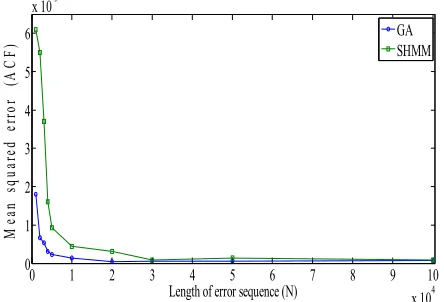
The MSE of the autocorrelation functions for different lengths of error sequences have been plotted in Figure 8 to compare the performance of the GA and SHMM methods. It
shows clearly that GA performs better in comparison to SHMM for lower lengths of error sequences up to about 30,000 while for larger length of error sequences both approaches have almost similar performance. Table 2 shows the values of MSEs of ACFs and probability of distribution of error-free intervals in testing the superiority of GA method over the SHMM method for different lengths of sequence.
0 1 2 3 4 5 6 7 8 9 10
x 104
0 1 2 3 4 5 6
x 10-3
Length of error sequence (N)
M e an sq u a re d e rr o r (A C F
) GASHMM
Table 2: MSEs of ACFs and Error-free interval distributions for different length sequences.
Pr(0m|1) MSE of ACF and
Length of error
sequence 50,000 10,000 1000
GA SHMM GA SHMM GA SHMM
ACF
MSE 0.000057 0.000063 0.00012 0.0011 0.0010 0.0020
Pr(0 |1)m
MSE 0.0000081 0.000019 0.000088 0.00015 0.00034 0.0014
Another BWA based GA approach for the same error statistics has been provided next. The experiments show that GA formulations with the previous values of crossover fraction, population size, elite count, etc. can provide reasonably good fitting. Figure 9 shows the ACF comparison of original error data with the GA-generated and BWA-generated error data of lengths 50000 and 10000. The closeness of the curves establishes the superiority of GA approach over BWA method, especially for smaller lengths of error sequence.
0 10 20 30
-0.2 0 0.2 0.4 0.6 0.8 1
N = 50000
Lag
S
am
p
le
A
u
to
co
rr
el
at
io
n
0 5 10 15 20 25 30 -0.2
0 0.2 0.4 0.6 0.8 1
N = 10000
Lag
S
am
p
le
A
u
to
co
rr
el
at
io
n
Original GA BWA Original
GA BWA
Figure 9: Comparison of Autocorrelation function of original error sequence with autocorrelation functions of GA-generated and SHMM-generated error sequences, for the same error data with lengths of 50000 and 10000.
Now the performances of both the proposed GA techniques have been compared with the BWA and SHMM techniques for the smaller lengths of error statistics (N = 1000). The autocorrelation function of the original error data has been compared with the ACFs of the BWA-generated, SHMM-generated and GA-generated error data in Figure 10. It illustrates that error sequences generated by both the proposed GA approaches have very close match with the original error data in comparison to the regenerated error data by the existing BWA and SHMM techniques. Figure 11 shows the similar performance comparison in terms of error-free interval distribution and again the
advantage of proposed GA approach for discrete channel modeling has been recognized. Therefore, for the shorter lengths of error data the proposed GA search techniques have significantly improved performance over the BWA and SHMM approaches.
0 5 10 15 20 25 30
-0.2 0 0.2 0.4 0.6 0.8 1
Lag
S
a
m
p
le
A
u
to
c
o
rr
e
la
ti
o
n
N = 1000
Original GA (SHMM) SHMM GA (BWA) BWA
Figure 10: Comparison of ACF of original error data with ACFs of GA-generated and SHMM-generated, and BWA-generated error sequences, for length of error data = 1000.
0 10 20 30 40 50 60 70 80
0 0.2 0.4 0.6 0.8 1
N = 1000
Length of intervals (m)
E
rr
o
r-fr
ee
i
n
te
rv
al
d
is
tr
ib
u
ti
o
n
s Original
GA (SHMM) SHMM GA (BWA) BWA
Figure 11: Comparison of of original error data with of the error data regenerated by proposed GAs, SHMM and BWA for length of error data = 1000.
5. Conclusion
Also, GA performs better in comparison to SHMM and BWA for lower lengths of error sequences, which is a significant result in context to discrete channel modeling. With HMM training, the variance of several random variables or estimated values of DCM is increased by decreasing the length of error sequence, while with the proposed GA method, these variations are very less. The training with shorter sequence is important for DCM, as it reduces the simulation run-time as well as computational burden of a particular training algorithm. Also in order to model the channel error-statistics dynamically/online, one cannot wait for the entire error sequence to be received at receiver and in that case small trace of error sequence plays a significant role in analysis and modeling of channel error-bursts.
References
[1] H. S. Wang, and N. Moayeri, “Finite-State Markov Channel: A Useful Model for Radio Communication Channels,” IEEE Transactions on Vehicular Technology, vol. 44, pp. 163–171, 1995.
[2] E. N. Gilbert, “Capacity of a burst-noise channel,” Bell System Technical Journal, vol. 39, pp. 1253–1265, 1960.
[3] E. O. Elliott, “Estimates of error rates for codes on burst-noise channels,” Bell System Technical Journal, vol. 42, pp. 1977–1997, 1963.
[4] B. D. Fritchman, “A binary channel characterization using partitioned Markov chains,” IEEE Transactions on Information Theory, vol. IT-13, pp. 221–227, 1967.
[5] Shun-Zheng Yu, “Hidden semi-Markov models,” Artificial Intelligence, vol. 174, pp. 215–243, 2010.
[6] P. Sadeghi, R. Kennedy, P. Rapajic, and R. Shams, “Finite-state Markov modeling of fading channels - A survey of principles and applications,” IEEE Signal Processing Magazine, vol. 25, pp. 57-80, 2008.
[7] H. Bai, and M. Atiquzzaman, “Error modeling schemes for fading channels in wireless communications: A survey,” IEEE Communications Surveys & Tutorials, vol. 5, pp. 2-9, 2003.
[8] C. Pimentel, and I. F. Blake, “Enumeration of Markov chains and burst error statistics for finite-state channel models,” IEEE Transactions on Vehicular Technology, vol. 48, pp. 415–428, 1999.
[9] F. Babich, and G. Lombardi, “A Markov model for the mobile propagation channel,” IEEE Transactions on Vehicular Technology, vol. 49, pp. 63-73, 2003.
[10] C. C. Tan, and N. C. Beaulieu, “On first-order Markov modeling for the Rayleigh fading channel,” IEEE Transactions on Communications, vol. 48, pp. 2032-2040, 2000.
[11] N. Nefedov, “Generative Markov models for discrete channel modelling,” The 8th IEEE International Symposium on Personal, Indoor and Mobile Radio Communications, vol. 1, pp. 7-11, 1997.
[12] D. Whitley, “A genetic algorithm tutorial,” Statistics and computing, vol. 4, pp. 65-85, 2003.
[13] K. S. Tang, K. F. Man, S. Kwong, and Q. He, “Genetic algorithms and their applications,” IEEE Signal Processing Magazine, vol. 13, pp. 22-37, 1996.
[14] T. V. Mathew, Genetic algorithm.
http://www.civil.iitb.ac.in/tvm/2701_dga/2701-ga-notes/gad oc.pdf.
[15] S. Forrest, “Genetic algorithms: principles of natural selection applied to computation,” Science, vol. 261, pp. 872-878, 1993.
[16] A. Chipperfield, P. Fleming, H. Pohlheim, and C. Fonseca, Genetic Algorithm Toolbox: User's Guide, For Use with
MATLAB, Version 1.2.
http://www.pohlheim.com/Papers/tr_gatbx12/ChipperfieldFl emingPohlheimFonseca_tr_GATbx_v12.pdf.
[17] S. O. C. Morales, Y. P. Maldonado, and F. T. Romero, “Improvement on Automatic Speech Recognition Using Micro-genetic Algorithm,” in 11th Mexican International Conference on Artificial Intelligence, pp. 95-99, 2012.
[18] R. Li, Jia-heng Zheng, and Chun-qin Pei, “Text Information Extraction Based on Genetic Algorithm and Hidden Markov Model,” in First International Workshop on Education Technology and Computer Science, vol. 1, pp. 334-338, 2009.
[19] J. Xiao, L. Zou, and C. Li, “Optimization of Hidden Markov Model by a Genetic Algorithm for Web Information Extraction,” in International Conference on Intelligent Systems and Knowledge Engineering, 2007.
[20] Z. Zhi-Jin, Z. Shi-Lian, X. Chun-Yun, and K. Xian-Zheng, “Discrete channel modeling based on genetic algorithm and simulated annealing for training hidden Markov model,” Chinese Physics, vol. 16, pp. 1619-1623, 2007.
[21] N. Surajudeen-Bakinde, Xu Zhu, J. Gao, and A. K. Nandi, "Genetic algorithm based equalization for direct sequence Ultra-Wideband communications systems," In Proceedings of the 2009 IEEE wireless communications and networking conference, pp. 145-149, 2009.
[22] T. W. Rondeau, C. J. Rieser, T. M. Gallagher, and C. W. Bostian, "Online modeling of wireless channels with hidden Markov models and channel impulse responses for cognitive radios, In proceeding of 2004 IEEE International Microwave Symposium Digest, vol. 2, pp. 739-742, 2004.
[23] W. H. Tranter, K. S. Shanmugan, T. S. Rappaport, and K. L. Kosbar, Principles of Communication Systems Simulation with Wireless Applications. Prentice Hall, NJ, Professional Technical Reference, 2004.