REVIEW
REVIEW OF ELDERLY DRIVER VISUAL PERCEPTION SIMULATION SYSTEM
FOR VEHICLE DESIGN
R.A.R.Ghazilla, H.J.Yap
Centre for Product Design, Department of Mechanical, Faculty of Engineering, University of Malaya, 50603, Kuala Lumpur, Malaysia
ABSTRACT
The number of people above 60 years of age will increases due to the growth of the population in the first half of the 21st century, particularly in Malaysia. This has led to the growing number of older drivers which is often
unavoidable as driving is a necessary task that not only achieves mobility but also shows a sign of independence and improves self-esteem, which are essential towards effecting the lifestyle. This paper briefly looks at common elderly related visual impairment, reviews design approaches and tools that tackle or include these issues in the design process and further outlines new research needs. It is the intention of this paper to steer the research direction of the development of future design approach and tools that would enhance the capabilities of designers to be well prepared to cater for inclusive design for the elderly, more specifically for visual impairments issues.
Keywords: Elderly, vision simulator, vehicle design, design for aging
INTRODUCTION
The fast growth of the population in the first half
of the 21st century mean that the number of
people above 60 years old will increase from about 600 million in the year 2000 to almost 2 billion in 2050. The proportion of people defined as an elderly is projected to increase globally
from 10% in 1998 to 15% in 20251. In this context,
Malaysia is no exception. At present, the number of Malaysians aged 60 years and above is estimated to be 1.4 million and is projected to increase to 3.3 million in the year 2020. This trend is largely expected to continue and Malaysia will achieve a full “aged” nation status in 2035 when the proportion of people aged 60
years and over reaches the 15% mark2-3. Apart
from medical care, the main aim in the care of the elderly is to maintain the quality of life by assisting them to have a full life for as long as possible in issues such as work, retirement, income, housing, family, community and leisure activities. This points to the need for mobility and this often leads to the use of vehicles such as a car. This has led to the growing numbers of older driver which is often unavoidable as driving is one of the necessary tasks that not only achieves mobility but also shows a sign of independence and improves self-esteem, which directly effects lifestyle4-6. The share of older
drivers in the driver population will grow because of increasing licensing rates among the ageing
population7. Unfortunately for older drivers, they
are at higher risk of accidents due to the deterioration of many of their functional abilities
that could lead to injuries8. Elderly drivers most
often suffer from the degradation of visual function. Nonetheless, most do not stop themselves from driving as indicated by a study of Melbourne elderly drivers on the association between impaired vision and drivers‟ decisions to
stop driving, voluntarily restrict driving, and motor vehicle accidents. While many older drivers with impaired vision limit their driving in adverse conditions and some drivers with impaired vision stop driving altogether, there are a significant number of current drivers with impaired vision9.
This scenario, coupled with the known fact of the spending ability and economic stability of elderly population, presents clear global opportunity to improve the safety, mobility, and quality of life of older adults. This can be achieved by designing vehicles that help overcome common age-related deficits such as vision problem, to the extent of developing elderly market specific vehicle variant, which many researchers pointed out that the research in this area is lacking10-12. The luxury automotive
market is current made up of mostly elderly population which have been largely ignored by the automotive industry, failing to keep pace with the aging population and their changing approach to purchasing decisions, with regards to both the vehicles produced and the strategies
used to market them13. This begs the question; is
for the elderly, more specifically for visual impairments issues.
ELDERLY VISION IMPAIRMENT AND THE DRIVING TASK
Many studies have reported on the elderly population‟s potential impairments associated with aging such as psychomotor, cognitive and visual abilities12,14-16. In a driving task situation,
visual impairment is also a cause of concern
towards safety. As mentioned byLeAnn9 it is
likely that even when the elderly is visually impaired, they would still be behind the wheel,
thus causing concerns for safety. These will surely affect the driving task performance which is very much dependent upon the effective capture and processing of visual information from the vehicle and the environment. The decline of the visual ability and its impact towards risk of accidents during driving have been widely studied, in which many findings and guideline have been reported and tabulated17-19.
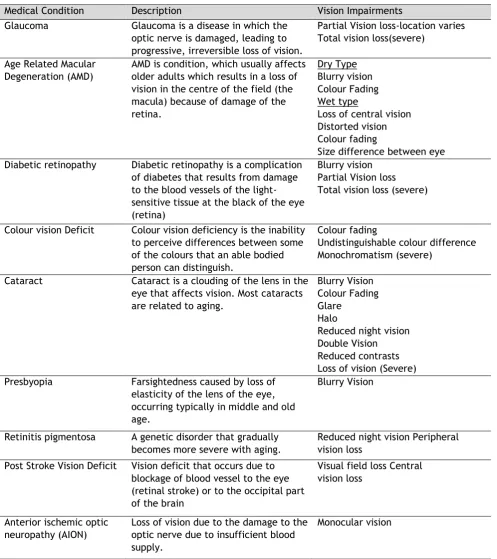
Table 1 describes some of the aging–related conditions that causes visual impairments.
Table 1 – Common aging related conditions causing visual impairments
Medical Condition Description Vision Impairments
Glaucoma Glaucoma is a disease in which the
optic nerve is damaged, leading to progressive, irreversible loss of vision.
Partial Vision loss-location varies Total vision loss(severe)
Age Related Macular Degeneration (AMD)
AMD is condition, which usually affects older adults which results in a loss of vision in the centre of the field (the macula) because of damage of the retina.
Dry Type Blurry vision Colour Fading Wet type
Loss of central vision Distorted vision Colour fading
Size difference between eye
Diabetic retinopathy Diabetic retinopathy is a complication
of diabetes that results from damage to the blood vessels of the light-sensitive tissue at the black of the eye (retina)
Blurry vision Partial Vision loss Total vision loss (severe)
Colour vision Deficit Colour vision deficiency is the inability
to perceive differences between some of the colours that an able bodied person can distinguish.
Colour fading
Undistinguishable colour difference Monochromatism (severe)
Cataract Cataract is a clouding of the lens in the
eye that affects vision. Most cataracts are related to aging.
Blurry Vision Colour Fading Glare
Halo
Reduced night vision Double Vision Reduced contrasts Loss of vision (Severe)
Presbyopia Farsightedness caused by loss of
elasticity of the lens of the eye, occurring typically in middle and old age.
Blurry Vision
Retinitis pigmentosa A genetic disorder that gradually
becomes more severe with aging.
Reduced night vision Peripheral vision loss
Post Stroke Vision Deficit Vision deficit that occurs due to blockage of blood vessel to the eye (retinal stroke) or to the occipital part of the brain
Visual field loss Central vision loss
Anterior ischemic optic neuropathy (AION)
Loss of vision due to the damage to the optic nerve due to insufficient blood supply.
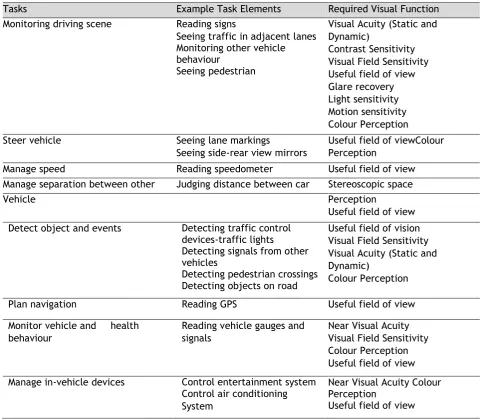
These impairments are caused by the decline of the visual function. Table 2 shows the required visual function in executing the tasks in driving. The decline of these visual functions are known to affect driving related task elements such as reading street signs, traffic control devices, and in-vehicle displays; seeing lane markings and other low contrast information at night; seeing pedestrians and roadside objects; driving safely at night; and seeing traffic in adjacent lanes. In the case of elderly drivers, the decline of the visual function is often irreversible and gradual.
In order to overcome this situation20,
development of training programmes, restrictive policies, infrastructural design and high technology design that could improve the safety
of elderly drivers is recommended21. The four
main elements that need to be improved to overcome this problem are the road design elements, policy element, technology element and vehicle design element that need to be more inclusive of the elderly driver. The synergistic improvements of these elements will surely provide a more holistic approach towards improving road safety for the elderly driver. In reference to the vehicle design elements posed in the previous section, the automotive manufacturing industry needs to be prepared to tackle the issue of designing for the elderly driver and more specifically towards designing for the visually impaired elderly driver. The next section briefly looks at the development of
approaches towards this problem.
Table 2 – Tasks in driving and required visual function
Tasks Example Task Elements Required Visual Function
Monitoring driving scene Reading signs
Seeing traffic in adjacent lanes Monitoring other vehicle
behaviour
Seeing pedestrian
Visual Acuity (Static and Dynamic)
Contrast Sensitivity Visual Field Sensitivity Useful field of view Glare recovery Light sensitivity Motion sensitivity Colour Perception
Steer vehicle Seeing lane markings
Seeing side-rear view mirrors
Useful field of viewColour Perception
Manage speed Reading speedometer Useful field of view
Manage separation between other Judging distance between car Stereoscopic space
Vehicle Perception
Useful field of view
Detect object and events Detecting traffic control
devices-traffic lights Detecting signals from other vehicles
Detecting pedestrian crossings Detecting objects on road
Useful field of vision Visual Field Sensitivity Visual Acuity (Static and Dynamic)
Colour Perception
Plan navigation Reading GPS Useful field of view
Monitor vehicle and health behaviour
Reading vehicle gauges and signals
Near Visual Acuity Visual Field Sensitivity Colour Perception Useful field of view
Manage in-vehicle devices Control entertainment system
Control air conditioning System
Near Visual Acuity Colour Perception
Useful field of view
CURRENT APPROACHES IN DESIGNING FOR THE VISUALLY IMPAIRED ELDERLY DRIVER
Although many findings on visual impairment of elderly drivers are available to designers, very
practices often isolate elderly user by considering them with special needs users and do not consider their problems during the design phase. Thus design problem faced by the elderly population is often rectified by providing a few accessibility features.
Considering any part of the society as “special” can never solve the accessibility problems in design especially for a system that requires interaction such as vehicle design. It is unfortunate that existing accessibility guidelines are also not adequate to analyse the effects of
impairment on interaction with designs23. Due to
the risk of dangers often associated with driver visual distraction and limitation, methods and tools that help us predict and mitigate the problem are valuable. In the design of user interfaces in vehicle, this is very much true. However, such methods and tools are sparse.
Most designers often resort to empirical studies using real subjects (of elderly population), which are time-consuming and expensive, and also require a working prototype of the designs. Though the importance of user involvement in the design process cannot be over emphasized, there is value in utilizing analytical design tools in the evaluation process due to constraints of time, cost and logistical difficulties in recruiting and testing with real users. The next best and most common method to date involves experimentation with a driving simulator by population representative subjects, in this case elderly subjects, which minimizes any physical dangers while offering some sense of realism24.
Such simulation based experimentation is often conducted at the later stages of the design iteration process as there is still a need for population representative subjects to evaluate the simulated experiments. This may still be too costly, logistically difficult and probably too late in the design process to explore design improvement opportunities. The use of virtual reality technology could further enhance the
simulation based evaluation. The major
advantage of virtual prototyping is that using computational models instead of real prototypes in the development or design process leads to a
more rapid product design and development25-28.
However, there is a demand to replace the need for population representative subjects, in this case elderly/older drivers, to conduct the design evaluation in a rigorous iterative design cycle. Such evaluations, especially in the early stages should be carried out by the designers. There is a strong need to empower 'non-experts' so that inclusive design becomes a fundamental part of
design practice29. Such examples of the approach
have been adopted30, where a virtual prototype
of a switch was develop and then the model was tested on a haptic device, where the user feels physically how the real switch will behave, meaning that the designers can immediately see
the effect of the design parameter‟s variation and can test different arrangements and/or models. This enables the identification and elimination of possible design faults in the very early stage of the development, negating the usual repetitive prototyping process. For the evaluation of visual perception of elderly drivers, no such approach has been reported.
Another approach being developed towards evaluating elderly driver visual perception is the use of human models. Among the more recent and notably works is the development of the HADRIAN digital human model. HADRIAN is a digital human modelling system which uses discrete data sets for individuals, in this case varied individual of different abilities of elderly
and less able, rather than statistical
populations31. These alternative digital
approaches try to minimize the difficulty of using pre-defined families of manikins to represent human diversity, whereas in the real world, carefully selected real people take part in „fitting trials‟. In a separate study of current
digital human model for ergonomics, trends32
indicates that the current digital human model are very limited in simulating the aging population where they do not consider time-variant characteristics due to age such as reduced visual acuity and mobility. There seems to be a need for digital human models to support vision/sight analysis including field of vision and occlusion of information content and graphical
user interface. Characterization of user
capabilities to support inclusive design
evaluation includes the visual capabilities of elderly people for product design evaluation, which later contributes to the development of Inclusive Design Simulator33.
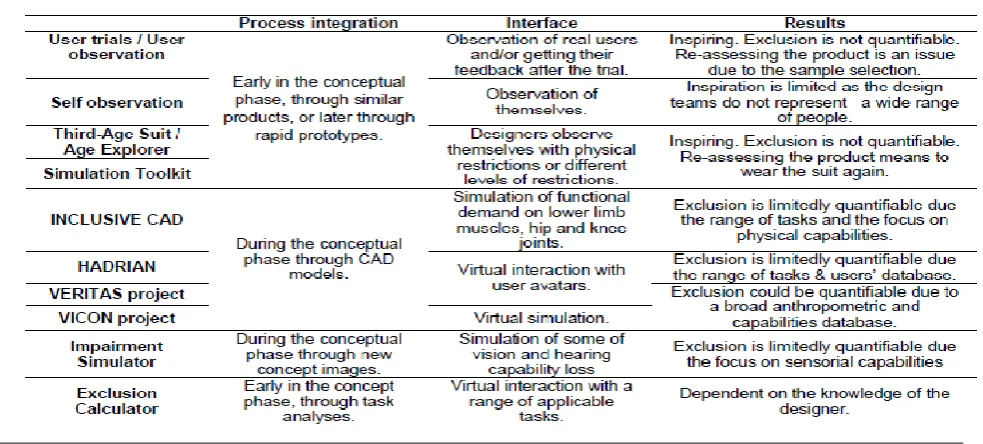
Summarizes the various approach for the
inclusive design, which includes elderly
population, as shown in Table 3 below34. VERITAS
and VICON are two big projects that attempts at developing human models catering for inclusivity of elderly population. Nonetheless, both still have limitations on simulating special needs for vision impairment. Both are VR based approach whereby simulating actual driving may need motion information to be gathered first that may not be accessible to designers35-36. It is noted
that although the range of tools available seems sufficient to support for assessing the accessibility, their application in an industrial setting as part of the systematic design process practice are fairly limited. Further indicate that the problem could either be due to the technique of inclusive design that is not in-sync with the design process or that there may be shortcomings
on the application interface34. Thus, these points
Proposes an interactive technique to help designers understand the level of inclusivity afforded by new concept design during conceptualization by the designers, called the
impairment simulator34. The impairment
simulator is akin to the software version of the impairment simulator glasses, which are widely used in understanding the visual impact of vision impairments towards prototype designs. The impairment simulator software provides easier access to designers in evaluating visual impacts
of inclusive design. The impairment simulators are slightly limited in its use as it may not be able to provide sufficient understanding of visual impact in dynamic tasks where motion in dynamic tasks may occlude different sections of the design at different periods of a task motion, which is critical in driving tasks. The impairment simulator may not be able to complement seamlessly with Computer Aided Design (CAD) and Computer Aided Engineering tools, which are
common practices in the industry
Table 3 – Summary of inclusive design tools34
Based on the above brief literature review, it is found that there are several tools to assist design engineers to design for the aging population, which is particularly important in automotive industry due to the growing trends of the older driver market. Very limited methods and tools are available, especially the ones that focuses on designing for the visual perception of older drivers. Current simulation tools however suffer from a number of limitations pertaining cost,
accuracy and immersion. Current simulation systems are inadequate which are not able to support designers to visualize and analyse the visual perception for dynamic tasks that are space and time dependent. A simulation system is needed that would allow the first perspective visualization of the designed environment and analyse the potential response to the visual perception.
PROPOSAL FOR DEVELOPMENT OF AUGMENTED REALITY (AR) BASED VISUAL IMPAIRMENT SIMULATION SYSTEM
Thus, this paper proposes an augmented reality (AR) based visual impairment simulation system. This is achieved through the application of visual impairment simulator coupled with augmented reality system. The use of augmented reality with a visual impairment simulator would complement the common design practice in the industry. Currently, it may not be economically feasible for car manufacturers to produce specific car variants for the elderly market considering the impairments also differs from individual to individual. Thus a more feasible solution is through adaptive design approach where design modifications are made to current variants to be more inclusive of the elderly. The use of AR system allows CAD modifications, of
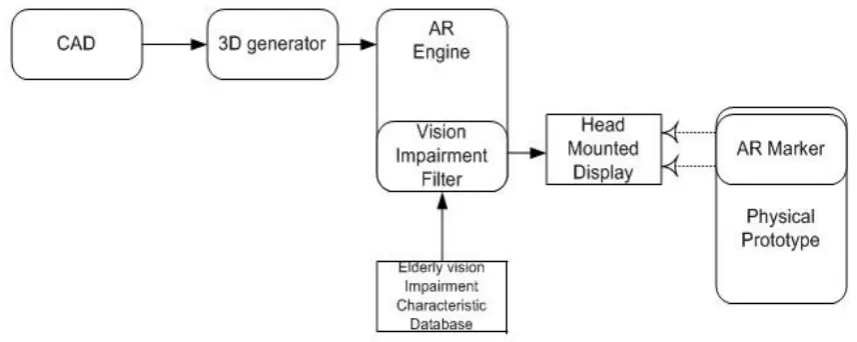
e.g. metering panel, entertainment panel and positioning of controls that can be mapped on to the physical prototype of current variants. Coupling the vision impairment simulator to the AR system allows an immersive perspective while running an actual dynamic motion task of driving. Rapid design changes can easily be made by modifying the CAD models or within the AR environment itself. Figure 1 below depicts the system flow of the proposed system. The proposed system is an attempt at allowing designers to 1) immersive visualise the design from a dynamic tasks perspective of elderly drivers and 2) conduct rapid trade-off assessment of the design by detecting the visual cues.
operation tasks) within the vehicle design. The benefits of the proposed system are as follows: helping designers in understanding the problems faced by older drivers with different range of
visual abilities; estimates the effect towards perception-response time during driving tasks; and investigate the possibilities of adaptation of different prototype designs.
Figure 1 – System flow of the propose implementation of the AR based visual impairment simulation system
The utilization of the augmented reality system would also be in-sync with industry practices, especially automotive. Augmented Reality has been widely used in many fields such as product design, medicine, entertainment, education,
research purpose and so on37. Augmented Reality
is a newly emerging technology which superimposes computer generated virtual 3D images, texts, and information on the real world38. AR involved a real time view of user‟s
environment as the background and mixes the virtual image with this background to create a
partially synthetic view for the user39. AR is able
to increase a user‟s perception of the surrounding environment by blending real objects and virtual objects to generate an AR
environment40. In vehicle design, the use of
augmented and virtual reality in vehicle design evaluation, either for ergonomics or aesthetics evaluation, is an industry accepted practice41.
The academic and industry partners agree that there is a huge potential for the technology in a broad variety of applications42-43.
CONCLUSION
The utilization of the augmented reality system would also be in-sync with industry practices, especially automotive. Augmented Reality has been widely used in many fields such as product design, medicine, entertainment, education,
research purpose and so on37. Augmented Reality
is a newly emerging technology which superimposes computer generated virtual 3D images, texts, and information on the real world38. AR involved a real time view of user‟s
environment as the background and mixes the
virtual image with this background to create a
partially synthetic view for the user39. AR is able
to increase a user‟s perception of the surrounding environment by blending real objects and virtual objects to generate an AR
environment40. In vehicle design, the use of
augmented and virtual reality in vehicle design evaluation, either for ergonomics or aesthetics
evaluation, is an industry accepted practice41.
The academic and industry partners agree that there is a huge potential for the technology in a broad variety of applications42-43.
REFERENCES
1. Madrid International Plan of Action.
Available from
www.un.org/en/events/pastevents/pdfs /Madrid_plan.pdf (accessed 2015)
2. United Nations. (Population Ageing in
Malaysia –Facts and Figure. (1st ed.) [Boucher]. Kuala Lumpur:Institute of Gerontology, 2006.
3. Pala, J. Senior citizens and population
ageing in Malaysia. Population census monograph series. No.4. Department of Statistics Malaysia: Kuala Lumpur, 1998.
4. Sharifah NSAR. Benjamin, YF. Chan, SSF.
&Yeoh. Driving Habits of Older Malaysian Drivers: Influences of Experience and Confidence. Proceeding in The 6th
international Malaysian Studies
5. Metz, DH. Mobility of older people and
their quality of life.Transport Policy
2000; 7(2): 149-152.
6. Owsley, C. Driving mobility, older adults,
and quality of life. Gerontechnology
2002; 1: 220-230.
7. FridulvSagberg, AG. Traffic safety for the
elderly: Literature study, risk analyses, and assessment of safety measures (Rep. No. 440/1999), Norway, 1999.
8. Marottoli, RA. & Richardson, ED.
Confidence in, and self-rating of, driving
ability among older drivers,Accident
Analysis & Prevention 1998; 30: 331-336.
9. LeAnn, MW. Jennifer,HB. & Jill, K.
Assessment of the Impact of Vision
Impairment.Investigative Ophthalmology
& Visual Science 2002; 43: 927-935.
10. Shaheen, SA. &Niemeier, DA. Integrating
vehicles design and human factors:
minimizing elderly driving
constraints.Transportation Research Part
C 2001; 9: 155-174.
11. Zhao, C. Popovic, V. Ferreira, L. & Lu, X. Vehicle design research for Chinese elderly drivers. Proceedings Computer-Aided Industrial Design and Conceptual Design, New Brunswick, NJ: IEEE, 2006.
12. Eby, D.W., Molnar, L.J., &Kartje, P.S., Maintaining Safe Mobility in an Aging Society, New York, CRC Press, 2009.
13. Coughlin, JF. Not your father‟s auto
industry? Aging, the automobile, and
thedrive for product
innovation.Generations2005; 28(4):
38-44.
14. Charness N. Aging and Human
Performance Human Factors.The Journal
of the Human Factors and Ergonomics Society 2008; 50: 548
15. Klavora, P. &Heslegrave, RJ. Senior
drivers: An overview of problems and
intervention strategies.Journal of Aging
and Physical Activity2002; 10: 322-335.
16. Anstey, KJ. Wood, J. Lord, S. & Walker,
JG. Cognitive, sensory and physical factors enabling driving safety in older
adults.Clinical Phsycology Review 2005;
25: 45-65.
17. Owsley, C. & Sloane, ME. Vision and
aging. InBolter, F. &Grafman, J. (eds.).
Handbook of Neuropsychology,
Amsterdam, Vol 4, 1990.
18. Ball, KK. Beard, BL. Roenker, DL. Miller,
RL. & Griggs, DS. Age and visual search:
Expanding the useful field of
view.Journal of the Optical Society of
America 1998; 5: 2210-2219.
19. Wolf, E. Glare and age.Archives of
Ophthalmology 1960; 64: 502-514.
20. Organisation for Economic Co-Operation
and Development.Ageing and transport: mobility needs and safety issues, Organisation for Economic Co-operation andDevelopment 2001. Available from: http://ntl.bts.gov/lib/24000/24400/244 70/2675189.pdf (accessed 1 April 2015)
21. Eby, DW. &Molnar, LJ. University of
Michigan Transportation Research
Institute (UMTRI) Report 2012.
22. Goodman, J. Langdon, PM. &Clarkson,
PJ. Providing strategic user information for designers: methods and initial findings.In Clarkson, J. Langdon, P.& Robinson, P. (eds.). Designing Accessible Technology, Springer, Heidelberg, 2006.
23. Biswas, P. Robinson, P.& Langdon, P.
Designing Inclusive Interfaces Through
User Modelling and Simulation.Intl.
Journal of Human–Computer Interaction
2012; 28: 1–33.
24. Salvucci, DD. A multitasking general
executive for compound continuous
task.Cognitive Sciences 2005; 29(3):
457-492.
25. Moreau, G. Fuchs, P.&Stergiopoulos, P. Applications ofvirtual reality in the manufacturing industry: from design
reviewto ergonomic studies.Mec Ind.
2004; 5(2): 171–179.
26. Canfield, T.Disz, T.Papka, M. Stevens, R.
Huang, M. Taylor, V.&Chen, J. Toward realtime interactive virtual prototyping
ofmechanical systems: experiences
coupling virtual reality with finite element analysis. High performance
computing conference, New
Orleans,1996.
27. Sun, G. A digital mock-up visualization
system capable of processing giga-scale
CAD models.Computer-Aided Design
28. Rooks, B. A shorter product development
time with digital mock-up.Assembly
automation1998; 18(1): 34-38.
29. Porter JM. Marshall, R. Case, K. Gyi, D. Sims, R. &Summerskill, S. HADRIAN: A Human Factors Computer-Aided Inclusive Design Tool for Transport Planning. The Institution of Engineering and Technology Human Factor / Systems Engineering and Railway Networks Publication 2012.
30. Erdelyi, H. &Talaba. D. Virtual
prototyping of a car turn-signal switch
using haptic feedback. Engineering with
Computers 2010; 26: 99–110.
31. Case, K. Marshall, R. Hogberg, D.
Summerskill, S. Gyi, D.& Sims, R. HADRIAN: Fitting Trials by Digital Human
Modelling.Digital Human Modeling, HCII
2009; LNCS 5620: 673– 680.
32. Alexander, T. & Gunther, P. Ergonomics DHM systems- limitations and trends- a systematic literature review focuses on
the future of ergonomics. 3rd
International Digital Human Modelling Symposium, Japan, 2014.
33. Persad, U. Langdon PM. & Clarkson P.
Characterising user capabilities to
support inclusive design evaluation. Universal Access in the Information Society (UAIS) 2007; 6(2): 119-135.
34. Zitkus, E. Langdon, PM.&Clarkson, PJ.
Accessibility evaluation: Assistive tools
for design activity in product
development. In: Proceedings of the 1st International conference on Sustainable
Intelligent Manufacturing, Leiria,
Portugal 2011.
35. Yehya, M.Mirko, G. Pierre,
K.&Antoinette, F.Survey regarding
limitation of virtual user approach. Virtual User Concept (VICON) 2013.
Available from
http://vicon-project.eu/wpcontent/uploads/2013/06/ VICON_D5-1_Final.pdf on 23/4/2015 (accessed 15th April 2015)
36. VERITAS(2010), Report: Final Project
Report, Downloaded from
http://veritasproject.eu/deliverables/Ve ritas_D4.1.13.pdf on 25/4/2015
37. Yen, J. C., Lee, C. Y., & Chen, I. J., The effects of image-based concept mapping on the learning outcomes and cognitive processes of mobile learners. British Journal of Educational Technology, 43(2) (2012) 307-320.
38. Dong, S., Behzadan, A. H., Chen, F.,
&Kamat, V. R. Collaborative visualization of engineering processes using tabletop
augmented reality, Advances in
Engineering Software. 55 (2013) 45-55.
39. Behzadan, A. H., Timm, B. W., &Kamat,
V. R., General-purpose modular
hardware and software framework for mobile outdoor augmented reality applications in engineering, Advanced Engineering Informatics. 22(1) (2008) 90-105.
40. Ong, S. K., Pang, Y., & Nee, A. Y. C., Augmented reality aided assembly design and planning, CIRP Annals-Manufacturing Technology. 56(1) (2007) 49-52.
41. Monacelli, G., &Elasis, S. C. P., VR Applications for reducing time and cost of Vehicle Development Process, 2003.
42. Regenbrecht, H., Baratoff, G., & Wilke, W., Augmented reality projects in the automotive and aerospace industries, Computer Graphics and Applications, IEEE, 25(6) (2005) 48-56.
43. Milgram P, Zhai S, Drasic D, Grodski JJ.,
Applications of augmented reality for
human–robot communication. in: