Out-of-Home Care and
Subsequent Preterm Delivery: An
Intergenerational Cohort Study
Can Liu, MD, PhD, a, b Bo Vinnerljung, PhD, c Viveca Östberg, PhD, a Karl Gauffin, PhD, aSol Juarez, PhD, a Sven Cnattingius, MD, PhD, b Anders Hjern, MD, PhDa, b
OBJECTIVES: Adverse early-life experience may affect preterm delivery later in life through priming of stress response. We aim to investigate the links between out-of-home care (OHC) experience in childhood, as a proxy of severe adversities, on subsequent risk of preterm delivery.
METHODS: A register-based national cohort of all women born in Sweden between 1973 and 1977 (N = 175 821) was crosslinked with information on these women’s subsequent deliveries as recorded in the Swedish medical birth register. During 1986–2012, 343 828 livebirths of these women were identified. The associations between women’s OHC experience and her risk of preterm delivery were analyzed through logistic regression models, adjusting for women’s own preterm birth, intrauterine growth, and childhood socioeconomic situation.
RESULTS: Compared with women that never entered OHC, women with OHC experience up to and after age 10 were both associated with increased risks of preterm delivery (adjusted odds ratio [aOR] = 1.23 [95% confidence interval 1.08–1.40] and aOR = 1.29 [1.13–1.48], respectively). Women who experienced OHC before or at 10 years of age had increased risk of both spontaneous and medically indicated preterm delivery (aOR = 1.19 [1.03–1.38] and aOR = 1.27 [1.02–1.59], respectively). Women who experienced OHC after age 10 had a more pronounced risk of medically indicated preterm delivery (aOR = 1.76 [1.44–2.16]) than for spontaneous preterm delivery (aOR = 1.08 [0.92–1.27]).
CONCLUSIONS: Women who were placed in OHC in childhood had increased risk of preterm delivery independent from their own perinatal history. Stress response, as 1 consequence of early life adversities, may take its toll on women’s reproductive health and their offspring, calling for integrative efforts in preventing early life adversity.
abstract
aCentre for Health Equity Studies, and cDepartment of Social Work, Stockholm University, Stockholm, Sweden; and bClinical Epidemiology Unit, Department of Medicine Solna, Karolinska Institutet, Stockholm, Sweden
Dr Liu had full access to all the data in the study and takes responsibility for the integrity of the data and the accuracy of the data analysis, conceptualized and designed the study, selected data for inclusion in analyses, conducted the analyses, interpreted the results, and drafted the initial manuscript; Dr Vinnerljung helped interpret the results and draft the initial manuscript; Drs Östberg, Gauffin, and Juarez helped design the study and revised the manuscript; Dr Cnattingius helped interpret the results and revised the manuscript; Dr Hjern acquired the data, had full access to all of the data, helped interpret the results, and revised the manuscript; and all authors approved the final manuscript as submitted and agree to be accountable for all aspects of the work.
DOI: https:// doi. org/ 10. 1542/ peds. 2017- 2729 Accepted for publication May 9, 2018
WHAT’S KNOWN ON THIS SUBJECT: Early childhood adversities could alter functioning of the stress response system, which may also play a critical role in reproduction. Maternal childhood adversities have been shown to associate with shortened gestational age.
WHAT THIS STUDY ADDS: Severe childhood adversity of the mother, indicated by experiencing out-of-home care, is associated with preterm birth of her offspring when adjusting for her own perinatal history, including being born preterm.
Despite being a main risk factor for neonatal and infant mortality, the etiology of preterm birth is still unclear.1 Most perinatal research has
been devoted to potential etiological factors observed during or shortly before pregnancy, which are used to explain a merely small proportion of the variability in preterm delivery risk.2, 3 Some maternal genetic
factors may predispose risk of preterm delivery, 4, 5 as well as certain
environmental exposures.6 The
genetic and environmental factors interact and intertwine across the life span at certain developmental stages more than others.7, 8 Thus, the entire
preconception life, 2, 9 especially early
life, deserves more investigation to unveil preterm birth etiology.
Life-course theory is used to advocate the link between early life exposures and later life health consequences, 10
including reproductive health.2, 9
Mothers being born preterm or small for gestational age (SGA) have increased risks of preterm delivery, which may result from higher risks of hypertensive disorders.11, 12
Childhood development has an even more profound impact on future health and well-being.13
Such impact can be explained by material, educational, and behavioral pathways independently14–16 or by
taxing on the stress response system (ie, allostatic load).17, 18 Burgeoning
research reveals that early childhood adversities could exert structural and functional changes of the brain related to emotional regulation and stress response.15, 19, 20 Such
changes may contribute to emotional dysregulation in adolescence, which is a mentally and physically stressful time on its own.21 The affected
stress response system20 (ie, the
hypothalamic-pituitary-adrenal [HPA] axis) is also known to play a central role in regulating pregnancy duration.9, 22, 23
Out-of-home care (OHC) is for younger children and is the most commonly applied child welfare
intervention in the Swedish welfare system in situations of abuse, neglect, or household dysfunctions, as indicated by parental psychiatric problems, violence, or death.24
Therefore, OHC could be used as a marker for adverse childhood experience and household dysfunction, which have been demonstrated to have long-term health impact.25–27 Meanwhile,
children entering OHC for the first time during adolescence is a more mixed group. Approximately one-third of the girls are placed by child welfare authorities because of severe behavioral problems. Teenaged OHC recipients are dominated by those having behavioral problems. Other prominent reasons for girls entering OHC in adolescence are severe family conflicts, parental rejection, and runaway behavior. Two out of 3 among these girls have a childhood history of severe household
dysfunction or abuse and/or neglect in the parental home.24, 28, 29 Despite
the expected positive effect of the intervention being used to moderate or revert such adverse conditions, OHC is consistently associated with unpromising social, behavioral, and health outcomes, especially for children entering OHC during adolescent years.30–34
Maternal childhood socioeconomic and psychosocial adversities have been associated with shortened gestational age and lower birth weight, suggesting maternal achieved socioeconomic position, smoking, and obesity as possible pathways.3, 8, 35–37
However, authors of previous studies failed to control for the mothers’
own birth outcomes associated with future pregnancy through genetic mechanism or prenatal programing. In addition, none of the authors investigated subtypes of preterm delivery. Distinguishing between spontaneous and medically indicated preterm delivery is important to provide information of possible underlying mechanisms.
Our aim with this nationwide Swedish study is to investigate links between severe early life stress, indicated by OHC in childhood and adolescence in mothers, and preterm delivery.
METHODS
Every Swedish resident has a unique personal number that makes it possible to link individual information from different
administrative registers. The study was based on deidentified data provided by the register holder, given the ethics permission by the local ethics committee (2015/1347-32).
Study Population
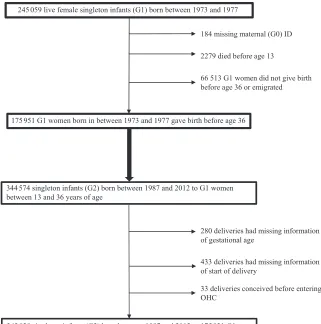
All live singleton female infants were identified from the Swedish medical birth register (SMBR) for 1973–1977 (the generation 1 [G1] cohort). The generation 2 (G2) cohort consists of all the singleton infants from the SMBR for 1987–2012 (NG2 = 344574) born to G1 before age 36 (NG1 = 175951). After excluding those from the G2 cohort with missing information of gestational age, onset of delivery, and those who conceived before the last OHC episode of women in the G1 cohort, the study population included 175821 women (G1) who delivered 343828 live singleton births (G2) (Fig 1). All psychiatric and perinatal diagnoses were coded according to the International Classification of Diseases, Eighth Revision (ICD-8), used until 1986, the International Classification of Diseases, Ninth Revision (ICD-9), used for 1987–1996, and the International Classification of Diseases, 10th Revision (ICD-10), used thereafter.
Covariates
Dependent Variables
Preterm delivery was defined as giving birth before 37 weeks’
very preterm delivery (before 32 weeks’ gestation [ie, <224 gestational days]) and moderately preterm delivery (32–36 completed weeks’
gestation [ie, 224–258 gestational days]). Spontaneous preterm delivery included preterm deliveries with a spontaneous onset of delivery or a diagnosis of preterm premature rupture of membrane (ICD-9 code 658.1 and ICD-10 code O42). Medically indicated preterm delivery was defined as a preterm delivery with an onset of delivery recorded as induced labor or a cesarean delivery before labor contractions.
Independent Variables
Records of OHC (foster or residential care) were retrieved from the Child Welfare Register. Any record of OHC entry, regardless of length of
stay, was categorized as an OHC experience. Those who entered care before or at 10 years of age were separated from those who entered OHC for the first time after 10 years of age. Being placed in OHC before or at 10 years of age is mostly caused by reasons related to parental behavior, whereas later OHC entries are more of a mix, with a significant proportion of the girls placed for antisocial behavior.29
Perinatal and Childhood Confounders of G1
Maternal (generation 0 [G0]) country of birth, as recorded in the total population register, was categorized into Swedish, Finnish, other Nordic, other European, and Non-European countries. Information on the gestational age at birth and birth
weight of G1 was retrieved from the SMBR between 1973 and 1977, together with maternal diagnosis of hypertensive disorder (ICD-8 codes 400–404) and pregestational or gestational diabetes (ICD-8 code 250). The birth weight for gestational age in G1 was defined according to the Swedish reference curve for normal fetal growth.38 SGA was
defined as being ˂−2 SD, appropriate for gestational age was defined as being between −2 and +2 SD, and large for gestational age was defined as being ˃+2 SD.
The superior socioeconomic index score (SEI) of the parents, who were living in the same household with G1 when the individuals of G1 were 3 to 7 years old, were linked from the census in 1980 and used as a measure of socioeconomic position in childhood.
Potential Mediators in Later Life of G1
The education level of G1 in the year of childbirth was linked from the longitudinal integration database for health insurance and labor market studies, which started in 1991. For deliveries before 1991, G1’s education was taken as in the year of 1991.
G1’s inpatient care for severe psychiatric disorder, drug-related disorders, alcoholic addictive disorder, and mood disorders (See Supplemental Table 5 for ICD-9 and ICD-10 codes) in 2 years before childbirth were linked from the patient discharge register. Age at delivery, parity, smoking status, BMI at first antenatal care visit, and diagnosis during pregnancy and childbirth for G1 were recorded in the SMBR. We included information on pregnancy complications that are commonly related to medical interventions, including preeclampsia, gestational diabetes, placenta previa, placenta abruption, chorioamnionitis and maternal infectious, and parasitic diseases (Supplemental Table 5). FIGURE 1
Statistical Analyses
Logistic regression models were used for analyzing the odds ratios of preterm delivery among those who had an OHC experience compared with those who had not. Multinomial logistic regression models were applied for the same purpose when the outcome variable was nominal categorical (ie, preterm delivery due to spontaneous or medically indicated onset of delivery versus term delivery). Cluster robust estimation of SE was employed to account for independence between deliveries to the same woman. A sensitivity analysis, in which we used a generalized estimation equation estimator with an exchangeable correlation structure, was performed to take into account the within-subject correlation.
The data management was performed in SAS 9 (SAS Institute, Inc, Cary, NC). All statistical modeling was performed in Stata 13 (Stata Corp, College Station, TX).
RESULTS
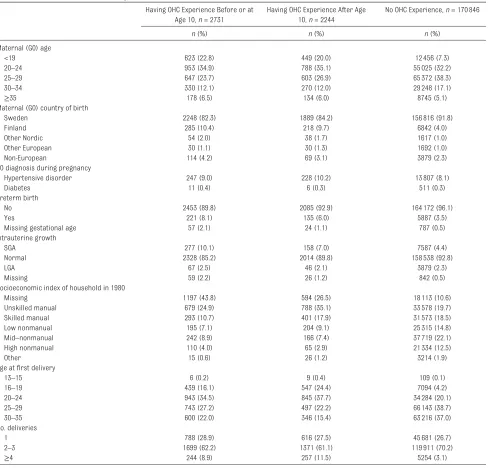
Compared with women who never entered OHC, women with OHC experience were more likely to have a teenaged mother or a mother of foreign origin, be born preterm or SGA themselves, be born to a mother diagnosed with a hypertensive disease during pregnancy, live in a lower socioeconomic position in 1985, be a teenager when delivering their first infant, and accomplish ˃3 deliveries before 36 years of age (Table 1).
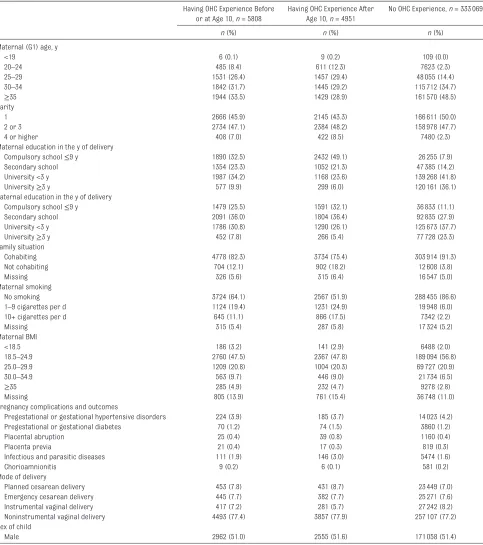
Of 10759 mothers with OHC experience, 45% had spent <2 months in OHC, 19% had spent 2 to 6 months, 30% had spent 6 months to 5 years, and 6% had spent ˃5 years in OHC. The variation of preterm delivery related to duration of care was negligible (data not shown). Infants of mothers with OHC experience (G2) were more likely to
be born of mothers who were young (<25 years), had a high parity (fourth or higher) and lower educational level, were smoking during pregnancy, and were obese. The father’s education was also lower among infants of mothers with OHC experience, and it was more common that the father was not cohabiting with the mother during pregnancy. The older OHC group (>10 years of age) was even more likely to have more of these adverse indicators mentioned above. Placental
abruption and infectious disease also appeared to be more common among the girls entering OHC after 10 years of age (Table 2).
Having an experience of OHC before or at 10 years and after 10 years of age was associated with increased risks of preterm delivery when only adjusted for age at delivery and parity (adjusted odds ratio [aOR]≤10 = 1.28 [95% confidence interval (CI) 1.13–1.46] and aOR>10 = 1.32 [95% CI 1.32–1.51], respectively) (model 1; Table 3). Further adjustment of demographic, perinatal, and childhood health indicators only marginally affected these risks (aOR≤10 = 1.23 [95% CI 1.08–1.40] and aOR>10 = 1.29 [95% CI 1.13–1.48], respectively) (model 2; Table 3). Sensitivity analysis with a hierarchical model and a generalized estimation equation estimator revealed consistent results (data not shown).
Having experienced OHC before or at 10 years of age was associated with increased risks of both spontaneous and medically indicated preterm delivery. In contrast, having experienced OHC after 10 years of age was associated with medically indicated preterm delivery (aOR = 1.76 [95% CI 1.44–2.16]) but not with spontaneous preterm delivery (aOR = 1.08 [95% CI 0.92–1.27]) (Table 3).
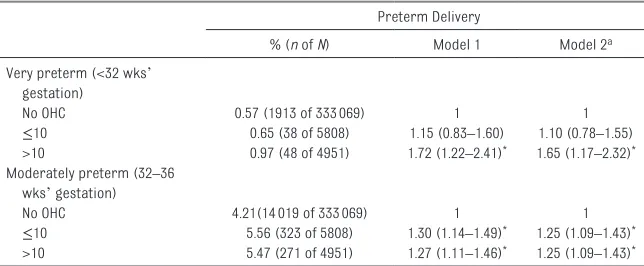
An increased risk of very preterm delivery was only obtained for those with OHC after 10 years of age
(aOR = 1.64 [95% CI 1.17–2.31]). Both age groups had increased risk of moderately preterm birth (both aOR = 1.25 [95% CI 1.09–1.43])(Table 4). Adjusting for potential mediators of own achieved education (Supplemental Table 6; model 3), as well as height, smoking, and BMI in early pregnancy (Supplemental Table 6; model 4) for the mothers were accounted for the association to a certain extent, especially among those who experienced OHC after 10 years of age. Psychiatric inpatient care for depression or severe psychiatric or addictive disorders in 2 years before childbirth only marginally accounted for the association between OHC experience and preterm delivery (Supplemental Table 6; model 5). Having an infant who was SGA or a maternal diagnosis of pregestational or gestational diabetes, placental abruption, placenta previa, or infectious and/or parasitic diseases partly accounted for the increased risk of medically indicated preterm delivery among those who experienced OHC after 10 years of age (Supplemental Table 6; model 6).
DISCUSSION
In line with previous findings, 27–31
our results also revealed that experience with OHC was associated with subsequent increased rates of adverse social position, as well as a higher tendency to health-related risky behavior and psychiatric disorders. The multiple adversities in later life probably follow a chain of risk events (eg, childhood household dysfunction leads to lower education achievement, which may have an impact on the living and working
situation, which in turn engenders health-related risky behaviors, such as smoking, among other intermediate factors). Maternal obesity and diagnosis during pregnancy are also indicative of maternal ill health before childbirth, which is associated with preterm delivery.1, 39 The specific pathways
between OHC and subsequent risk of having a preterm delivery, incorporating interactions of the intermediate social, behavioral, and
biological factors, are beyond the scope of this article. However, the coexisting multiple adversities may also be used to suggest a model of accumulation of exposures, in which a chronically stressful life course may be common among the former OHC recipients.
The adverse psychosocial environment in childhood or adolescence may exert its impact on later health through making biological change of the developing
TABLE 1 Characteristics of G0 and G1 (NG1 = 175821)
Having OHC Experience Before or at Age 10, n = 2731
Having OHC Experience After Age 10, n = 2244
No OHC Experience, n = 170846
n (%) n (%) n (%)
Maternal (G0) age
<19 623 (22.8) 449 (20.0) 12456 (7.3)
20–24 953 (34.9) 788 (35.1) 55025 (32.2)
25–29 647 (23.7) 603 (26.9) 65372 (38.3)
30–34 330 (12.1) 270 (12.0) 29248 (17.1)
≥35 178 (6.5) 134 (6.0) 8745 (5.1)
Maternal (G0) country of birth
Sweden 2248 (82.3) 1889 (84.2) 156816 (91.8)
Finland 285 (10.4) 218 (9.7) 6842 (4.0)
Other Nordic 54 (2.0) 38 (1.7) 1617 (1.0)
Other European 30 (1.1) 30 (1.3) 1692 (1.0)
Non-European 114 (4.2) 69 (3.1) 3879 (2.3)
G0 diagnosis during pregnancy
Hypertensive disorder 247 (9.0) 228 (10.2) 13807 (8.1)
Diabetes 11 (0.4) 6 (0.3) 511 (0.3)
Preterm birth
No 2453 (89.8) 2085 (92.9) 164172 (96.1)
Yes 221 (8.1) 135 (6.0) 5887 (3.5)
Missing gestational age 57 (2.1) 24 (1.1) 787 (0.5)
Intrauterine growth
SGA 277 (10.1) 158 (7.0) 7587 (4.4)
Normal 2328 (85.2) 2014 (89.8) 158538 (92.8)
LGA 67 (2.5) 46 (2.1) 3879 (2.3)
Missing 59 (2.2) 26 (1.2) 842 (0.5)
Socioeconomic index of household in 1980
Missing 1197 (43.8) 594 (26.5) 18113 (10.6)
Unskilled manual 679 (24.9) 788 (35.1) 33578 (19.7)
Skilled manual 293 (10.7) 401 (17.9) 31573 (18.5)
Low nonmanual 195 (7.1) 204 (9.1) 25315 (14.8)
Mid–nonmanual 242 (8.9) 166 (7.4) 37719 (22.1)
High nonmanual 110 (4.0) 65 (2.9) 21334 (12.5)
Other 15 (0.6) 26 (1.2) 3214 (1.9)
Age at first delivery
13–15 6 (0.2) 9 (0.4) 109 (0.1)
16–19 439 (16.1) 547 (24.4) 7094 (4.2)
20–24 943 (34.5) 845 (37.7) 34284 (20.1)
25–29 743 (27.2) 497 (22.2) 66143 (38.7)
30–35 600 (22.0) 346 (15.4) 63216 (37.0)
No. deliveries
1 788 (28.9) 616 (27.5) 45681 (26.7)
2–3 1699 (62.2) 1371 (61.1) 119911 (70.2)
≥4 244 (8.9) 257 (11.5) 5254 (3.1)
body (ie, biological embedding, as termed by Hertzman and Wiens).13, 40
Elevated allostatic load (ie, wear and tear in neural, neuroendocrine, and immune systems in adaptation to chronic stress18) has been reported
among adults exposed to early life adversities.17, 41, 42 The HPA axis,
where the systems crosslink to each other, also plays a central role in human pregnancy. The increased corticotrophin-releasing hormone
of HPA axis is a potential link between maternal stress and preterm delivery.22
The observed differences between age groups reveal even worse social and behavioral outcomes in the adolescent OHC group, which may
TABLE 2 Characteristics of G2 (NG2 = 343828)
Having OHC Experience Before or at Age 10, n = 5808
Having OHC Experience After Age 10, n = 4951
No OHC Experience, n = 333069
n (%) n (%) n (%)
Maternal (G1) age, y
<19 6 (0.1) 9 (0.2) 109 (0.0)
20–24 485 (8.4) 611 (12.3) 7623 (2.3)
25–29 1531 (26.4) 1457 (29.4) 48055 (14.4)
30–34 1842 (31.7) 1445 (29.2) 115712 (34.7)
≥35 1944 (33.5) 1429 (28.9) 161570 (48.5)
Parity
1 2666 (45.9) 2145 (43.3) 166611 (50.0)
2 or 3 2734 (47.1) 2384 (48.2) 158978 (47.7)
4 or higher 408 (7.0) 422 (8.5) 7480 (2.3)
Maternal education in the y of delivery
Compulsory school ≤9 y 1890 (32.5) 2432 (49.1) 26255 (7.9)
Secondary school 1354 (23.3) 1052 (21.3) 47385 (14.2)
University <3 y 1987 (34.2) 1168 (23.6) 139268 (41.8)
University ≥3 y 577 (9.9) 299 (6.0) 120161 (36.1)
Paternal education in the y of delivery
Compulsory school ≤9 y 1479 (25.5) 1591 (32.1) 36833 (11.1)
Secondary school 2091 (36.0) 1804 (36.4) 92835 (27.9)
University <3 y 1786 (30.8) 1290 (26.1) 125673 (37.7)
University ≥3 y 452 (7.8) 266 (5.4) 77728 (23.3)
Family situation
Cohabiting 4778 (82.3) 3734 (75.4) 303914 (91.3)
Not cohabiting 704 (12.1) 902 (18.2) 12608 (3.8)
Missing 326 (5.6) 315 (6.4) 16547 (5.0)
Maternal smoking
No smoking 3724 (64.1) 2567 (51.9) 288455 (86.6)
1–9 cigarettes per d 1124 (19.4) 1231 (24.9) 19948 (6.0)
10+ cigarettes per d 645 (11.1) 866 (17.5) 7342 (2.2)
Missing 315 (5.4) 287 (5.8) 17324 (5.2)
Maternal BMI
<18.5 186 (3.2) 141 (2.9) 6488 (2.0)
18.5–24.9 2760 (47.5) 2367 (47.8) 189094 (56.8)
25.0–29.9 1209 (20.8) 1004 (20.3) 69727 (20.9)
30.0–34.9 563 (9.7) 446 (9.0) 21734 (6.5)
≥35 285 (4.9) 232 (4.7) 9278 (2.8)
Missing 805 (13.9) 761 (15.4) 36748 (11.0)
Pregnancy complications and outcomes
Pregestational or gestational hypertensive disorders 224 (3.9) 185 (3.7) 14023 (4.2)
Pregestational or gestational diabetes 70 (1.2) 74 (1.5) 3860 (1.2)
Placental abruption 25 (0.4) 39 (0.8) 1160 (0.4)
Placenta previa 21 (0.4) 17 (0.3) 819 (0.3)
Infectious and parasitic diseases 111 (1.9) 146 (3.0) 5474 (1.6)
Chorioamnionitis 9 (0.2) 6 (0.1) 581 (0.2)
Mode of delivery
Planned cesarean delivery 453 (7.8) 431 (8.7) 23449 (7.0)
Emergency cesarean delivery 445 (7.7) 382 (7.7) 25271 (7.6)
Instrumental vaginal delivery 417 (7.2) 281 (5.7) 27242 (8.2)
Noninstrumental vaginal delivery 4493 (77.4) 3857 (77.9) 257107 (77.2)
Sex of child
potentially explain the higher risk of preterm delivery for women in that group. Development of the brain and the stress response system might also be used to provide some insight on the differences between age groups. The psychosocial environment perturbations might be especially influential on the HPA axis in the peripubertal period.43, 44 Meanwhile,
the demonstrated problematic adolescence may already have its roots from the beginning of postnatal life, in which adverse psychosocial environment increases cortisol level and modifies the functioning of emotion-related brain circuits, leading to higher anxiety level in
adolescence.45–47 This plasticity of the
brain development and adaptation of the stress response system conditioned by adverse psychosocial environment may in turn affect the mood, cognition, and behaviors of individuals, as postulated by McEwen and Gianaros.48, 49
We do not imply that OHC has a causal effect on preterm delivery because of the observed association. Rather, OHC is a good indicator of most severe childhood adversities. Beyond inadequate care from the parents, many children who enter OHC have a history of suffering from maltreatment, including abuse and neglect. Childhood
sexual abuse, suffered by every 1 out of 5 women in the world, may increase risk of preterm delivery, 50 potentially through
dysregulated HPA axis and elevated corticotrophin-releasing hormone and cortisol in the circulation during pregnancy.51 Elevated levels of
fear and worry among women who experience childhood abuse52 may
also contribute to the increased use of medical intervention, as the increased cesarean rate in the adolescent OHC group reveals. The risk of pregnancy complications in later pregnancies is also increased with previous cesarean section.
Strengths and Limitations
With this register-based national cohort study, we overcame several limitations of previous studies within the field. The study was based on a large enough sample to allow further exploration of preterm birth subtypes, outcomes that were not included in previous studies. Secondly, the study had minimal selection bias, which survey-based studies mostly suffer from. Thirdly, prospectively collected data also eliminate recall bias, another common limitation when studying early life exposures. Moreover, linking with the women’s own perinatal characteristics, including
TABLE 3 Age of G1 at First OHC Experience and aORs and CIs of Preterm Delivery (N = 343828)
Preterm Delivery
% (n of N) Model 1 Model 2a
All preterm delivery
No OHC 4.78 (15932 of 333069) 1 1
≤10 6.22 (361 of 5808) 1.28 (1.13–1.46)* 1.23 (1.08–1.40)*
>10 6.44 (319 of 4951) 1.32 (1.16–1.51)* 1.29 (1.13–1.48)*
Spontaneous onset of preterm delivery
No OHC 3.56 (11863 of 333069) 1 1
≤10 4.56 (265 of 5808) 1.27 (1.10–1.46)* 1.23 (1.06–1.42)*
>10 4.22 (209 of 4951) 1.17 (0.99–1.37) 1.16 (0.98–1.35)
Medically indicated onset of preterm delivery
No OHC 1.22 (4069 of 333069) 1 1
≤10 1.65 (96 of 5808) 1.33 (1.06–1.68)* 1.23 (0.97–1.56)
>10 2.22 (110 of 4951) 1.79 (1.44–2.22)* 1.69 (1.36–2.10)*
Model 1 adjusted for age of G1 at delivery (continuous + quadratic term) and parity. Model 2 adjusted for variables in model 1 and G0’s SEI in 1980, G0’s country of birth, G0’s diagnosis of preeclampsia when pregnant with G1, G1’s prematurity at birth, G1’s intrauterine growth status, and G1’s calendar y of birth.
a A total of 1868 deliveries missing gestational age or birth weight of G1 were excluded from model 2. *P < .05.
TABLE 4 Age of G1 at First OHC Experience and aORs and CIs of Preterm Delivery by Gestational Age (N = 343828)
Preterm Delivery
% (n of N) Model 1 Model 2a
Very preterm (<32 wks’ gestation)
No OHC 0.57 (1913 of 333069) 1 1
≤10 0.65 (38 of 5808) 1.15 (0.83–1.60) 1.10 (0.78–1.55)
>10 0.97 (48 of 4951) 1.72 (1.22–2.41)* 1.65 (1.17–2.32)*
Moderately preterm (32–36 wks’ gestation)
No OHC 4.21(14019 of 333069) 1 1
≤10 5.56 (323 of 5808) 1.30 (1.14–1.49)* 1.25 (1.09–1.43)*
>10 5.47 (271 of 4951) 1.27 (1.11–1.46)* 1.25 (1.09–1.43)*
Model 1 adjusted for age of G1 at delivery (continuous + quadratic term) and parity. Model 2 adjusted for variables in model 1 and G0’s SEI in 1980, G0’s country of birth, G0’s diagnosis of preeclampsia when pregnant with G1, G1’s prematurity at birth, G1’s intrauterine growth status, and G1’s calendar y of birth.
gestational age, allowed controlling for their own perinatal exposures, as well as for genetic risk factors. Both are alternative mechanisms for intergenerational transmission of preterm birth but were not adjusted for in previous studies.
To our knowledge, this is the first large population-based study that reveals that maternal adverse childhood environment is associated with subsequent risk of preterm delivery independent of women’s prenatal and genetic predisposition. With this finding, we add to the knowledge of how social environment gets under the skin and how such disadvantages are transmitted to the next generation. Although we cannot pinpoint a specific life-course model to explain the finding, with these results, we suggest that temporality of exposure in early life may play a critical role in affecting preterm deliveries that varies in the way of presentation.
Measurement error is one of the main disadvantages of register-based studies. Specific reasons for OHC entries are not available in the Swedish child welfare register, which has prevented a more rigorous investigation of links between abuse or neglect and the outcome variables. Because antisocial behavior is also the reason of OHC for many women in this cohort, a
poor mental health predisposed by genetic factor may be the potential confounder of the association thus limiting the interpretation of adverse early life environment in affecting later health. Hospital inpatient care admission was only used to capture the most severe case of psychiatric and addictive disorders, limiting our exploration of the women’s psychiatric health and substance abuse before and during pregnancy.
Implications
With national population data and information across 3 generations, we use this study to confirm the association between maternal early-life adverse experience and preterm delivery. The adverse pregnancy outcomes after early life stress require further exploration, taking women’s neural development and mental health into consideration. Their risky health behaviors, partly accounting for their adverse pregnancy outcomes, is probably amenable in preconceptional and antenatal care. Nevertheless, the future mothers’ adverse early life development, as well as their cumulative social and psychosocial adversities, calls for better social welfare intervention strategies for substitutive care, which may stabilize their HPA activities.53 Integrative
efforts used to make better
preventive measures across the life
course of women have the potential to break the intergenerational vicious circle of adverse social, behavioral, and health outcomes.
CONCLUSIONS
OHC is associated with higher risk of preterm delivery. The early-life psycho-neurodevelopment, which predisposes a dysregulated stress response system, may be used to partly explain the association, along with socioeconomic and behavioral pathways.
ABBREVIATIONS
aOR: adjusted odds ratio CI: confidence interval G0: generation 0 G1: generation 1 G2: generation 2
HPA: hypothalamic-pituitary- adrenal
ICD-8: International Classification of Diseases, Eighth
Revision
ICD-9: International Classification of Diseases, Ninth Revision ICD-10: International
Classification of Diseases, 10th Revision
OHC: out-of-home care SGA: small for gestational age SMBR: Swedish medical birth
register
SEI: socioeconomic index score
REFERENCES
1. Goldenberg RL, Culhane JF, Iams JD, Romero R. Epidemiology and causes of preterm birth. Lancet. 2008;371(9606):75–84
2. Lu MC, Halfon N. Racial and ethnic disparities in birth
outcomes: a life-course perspective. Matern Child Health J. 2003;7(1): 13–30
3. Gavin AR, Thompson E, Rue T, Guo Y. Maternal early life risk factors for offspring birth weight: findings
from the add health study. Prev Sci. 2012;13(2):162–172
4. Varner MW, Esplin MS. Current understanding of genetic factors in preterm birth. BJOG. 2005;112(suppl 1):28–31
Address correspondence to Can Liu, MD, PhD, Centre for Health Equity Studies, Sveavägen 160, SE-106 91 Stockholm, Sweden. E-mail: [email protected] PEDIATRICS (ISSN Numbers: Print, 0031-4005; Online, 1098-4275).
Copyright © 2018 by the American Academy of Pediatrics
FINANCIAL DISCLOSURE: The authors have indicated they have no financial relationships relevant to this article to disclose. FUNDING: Supported by the Karolinska Institutet.
5. Svensson AC, Sandin S, Cnattingius S, et al. Maternal effects for preterm birth: a genetic epidemiologic study of 630, 000 families. Am J Epidemiol. 2009;170(11):1365–1372
6. Behrman RE, Butler AS, eds; Institute of Medicine (US) Committee on Understanding Premature Birth and Assuring Healthy Outcomes. Preterm Birth: Causes, Consequences, and Prevention. Washington, DC: National Academies Press (US); 2007
7. Pembrey M, Saffery R, Bygren LO; Network in Epigenetic Epidemiology; Network in Epigenetic Epidemiology. Human transgenerational responses to early-life experience: potential impact on development, health and biomedical research. J Med Genet. 2014;51(9):563–572
8. Vågerö D, Rajaleid K. Does childhood trauma influence offspring’s birth characteristics? Int J Epidemiol. 2017;46(1):219–229
9. Wadhwa PD, Entringer S, Buss C, Lu MC. The contribution of maternal stress to preterm birth: issues and considerations. Clin Perinatol. 2011;38(3):351–384
10. Kuh D, Ben-Shlomo Y, Lynch J, Hallqvist J, Power C. Life course epidemiology. J Epidemiol Community Health. 2003;57(10):778–783
11. Selling KE, Carstensen J, Finnström O, Sydsjö G. Intergenerational effects of preterm birth and reduced intrauterine growth: a population-based study of Swedish mother-offspring pairs. BJOG. 2006;113(4):430–440
12. Klebanoff MA, Secher NJ, Mednick BR, Schulsinger C. Maternal size at birth and the development of hypertension during pregnancy: a test of the Barker hypothesis. Arch Intern Med. 1999;159(14):1607–1612
13. Hertzman C, Wiens M. Child
development and long-term outcomes: a population health perspective and summary of successful interventions. Soc Sci Med. 1996;43(7):1083–1095 14. Lynch JW, Smith GD, Kaplan GA, House
JS. Income inequality and mortality: importance to health of individual income, psychosocial environment,
or material conditions. BMJ. 2000;320(7243):1200–1204
15. Hackman DA, Farah MJ, Meaney MJ. Socioeconomic status and the brain: mechanistic insights from human and animal research. Nat Rev Neurosci. 2010;11(9):651–659
16. Bandura A. Social cognitive theory of self-regulation. Organ Behav Hum Decis Process. 1991;50(2):248–287 17. Barboza Solís C, Fantin R, Castagné
R, Lang T, Delpierre C, Kelly-Irving M. Mediating pathways between parental socio-economic position and allostatic load in mid-life: findings from the 1958 British birth cohort. Soc Sci Med. 2016;165:19–27
18. McEwen BS, Stellar E. Stress and the individual. Mechanisms leading to disease. Arch Intern Med. 1993;153(18):2093–2101 19. McEwen BS. Understanding the
potency of stressful early life experiences on brain and body function. Metabolism. 2008;57(suppl 2):S11–S15
20. Maniam J, Antoniadis C, Morris MJ. Early-life stress, HPA axis adaptation, and mechanisms contributing to later health outcomes. Front Endocrinol (Lausanne). 2014;5:73
21. Malter Cohen M, Tottenham N, Casey BJ. Translational developmental studies of stress on brain and behavior: implications for adolescent mental health and illness?
Neuroscience. 2013;249:53–62 22. Kramer MS, Lydon J, Séguin L, et al.
Stress pathways to spontaneous preterm birth: the role of stressors, psychological distress, and stress hormones. Am J Epidemiol. 2009;169(11):1319–1326
23. Kramer MR, Hogue CR. What causes racial disparities in very preterm birth? A biosocial perspective. Epidemiol Rev. 2009;31(1):84–98 24. Hessle S, Vinnerljung B. Child Welfare
in Sweden: an overview. Stockholm: Stockholms Universitet, Stockholm Studies of Social Work 15; 1999 25. Dube SR, Anda RF, Felitti VJ, Chapman
DP, Williamson DF, Giles WH. Childhood abuse, household dysfunction, and the risk of attempted suicide throughout
the life span: findings from the Adverse Childhood Experiences Study. JAMA. 2001;286(24):3089–3096
26. Dube SR, Felitti VJ, Dong M, Chapman DP, Giles WH, Anda RF. Childhood abuse, neglect, and household dysfunction and the risk of illicit drug use: the adverse childhood experiences study. Pediatrics. 2003;111(3):564–572 27. Dube SR, Felitti VJ, Dong M, Giles
WH, Anda RF. The impact of adverse childhood experiences on health problems: evidence from four birth cohorts dating back to 1900. Prev Med. 2003;37(3):268–277
28. Franzén E, Vinnerljung B, Hjern A. The epidemiology of out-of-home care for children and youth: a national cohort study. Br J Soc Work. 2007;38(6):1043–1059
29. Vinnerljung B, Sallnäs M, Kyhle-Westermark PSammanbrott vid tonårsplaceringar – om ungdomar i fosterhem och på institution [Breakdowns among placements of adolescents in out-of home care – a report on youth in foster and residential care]. Stockholm: Socialstyrelsen/CUS; 2001 30. Vinnerljung B, Sallnäs M. Into
adulthood: a follow‐up study of 718 young people who were placed in out‐
of‐home care during their teens. Child Fam Soc Work. 2008;13(2):144–155 31. Björkenstam E, Hjern A, Vinnerljung
B. Adverse childhood experiences and disability pension in early midlife: results from a Swedish National Cohort Study. Eur J Public Health. 2017;27(3):472–477
32. Björkenstam E, Burström B, Vinnerljung B, Kosidou K. Childhood adversity and psychiatric disorder in young adulthood: an analysis of 107, 704 Swedes. J Psychiatr Res. 2016;77:67–75
33. Björkenstam E, Kosidou K,
Björkenstam C. Childhood household dysfunction and risk of self-harm: a cohort study of 107 518 young adults in Stockholm County. Int J Epidemiol. 2016;45(2):501–511
care utilisation in young adults: a register study of 96 399 individuals in Stockholm County. J Epidemiol Community Health. 2016;70(5):473–480 35. Harville EW, Boynton-Jarrett R,
Power C, Hyppönen E. Childhood hardship, maternal smoking, and birth outcomes: a prospective cohort study. Arch Pediatr Adolesc Med. 2010;164(6):533–539
36. Huang JY, Gavin AR, Richardson TS, Rowhani-Rahbar A, Siscovick DS, Enquobahrie DA. Are early-life socioeconomic conditions directly related to birth outcomes? Grandmaternal education, grandchild birth weight, and associated bias analyses. Am J Epidemiol. 2015;182(7):568–578
37. Smith MV, Gotman N, Yonkers KA. Early childhood adversity and pregnancy outcomes. Matern Child Health J. 2016;20(4):790–798
38. Marsál K, Persson PH, Larsen T, Lilja H, Selbing A, Sultan B. Intrauterine growth curves based on ultrasonically estimated foetal weights. Acta Paediatr. 1996;85(7):843–848 39. Cnattingius S, Villamor E, Johansson
S, et al. Maternal obesity and risk of preterm delivery. JAMA. 2013;309(22):2362–2370
40. Hertzman C. The biological embedding of early experience and its effects on
health in adulthood. Ann N Y Acad Sci. 1999;896(1):85–95
41. Widom CS, Horan J, Brzustowicz L. Childhood maltreatment predicts allostatic load in adulthood. Child Abuse Negl. 2015;47:59–69 42. Tomasdottir MO, Sigurdsson JA,
Petursson H, et al. Self reported childhood difficulties, adult multimorbidity and allostatic load. A cross-sectional analysis of the Norwegian HUNT study. PLoS One. 2015;10(6):e0130591
43. Romeo RD. Pubertal maturation and programming of hypothalamic-pituitary-adrenal reactivity. Front Neuroendocrinol. 2010;31(2):232–240 44. Bale TL, Epperson CN. Sex differences
and stress across the lifespan. Nat Neurosci. 2015;18(10):1413–1420 45. Burghy CA, Stodola DE, Ruttle PL, et al.
Developmental pathways to amygdala-prefrontal function and internalizing symptoms in adolescence. Nat Neurosci. 2012;15(12):1736–1741 46. Kim P, Evans GW, Angstadt M, et
al. Effects of childhood poverty and chronic stress on emotion regulatory brain function in adulthood. Proc Natl Acad Sci USA. 2013;110(46):18442–18447 47. Chin-Lun Hung G, Hahn J, Alamiri B,
et al. Socioeconomic disadvantage
and neural development from infancy through early childhood. Int J Epidemiol. 2015;44(6):1889–1899 48. McEwen BS, Gianaros PJ. Central role
of the brain in stress and adaptation: links to socioeconomic status, health, and disease. Ann N Y Acad Sci. 2010;1186(1):190–222
49. McEwen BS. Brain on stress: how the social environment gets under the skin [published correction appears in Proc Natl Acad Sci USA. 2013;110(4):1561]. Proc Natl Acad Sci USA. 2012;109(suppl 2):17180–17185
50. Wosu AC, Gelaye B, Williams MA. Maternal history of childhood sexual abuse and preterm birth: an epidemiologic review. BMC Pregnancy Childbirth. 2015;15:174
51. Horan DL, Hill LD, Schulkin J. Childhood sexual abuse and preterm labor in adulthood: an endocrinological hypothesis. Womens Health Issues. 2000;10(1):27–33
52. Lukasse M, Vangen S, Øian P, Schei B. Fear of childbirth, women’s preference for cesarean section and childhood abuse: a longitudinal study. Acta Obstet Gynecol Scand. 2011;90(1):33–40 53. Laurent HK, Gilliam KS, Bruce J, Fisher
DOI: 10.1542/peds.2017-2729 originally published online July 18, 2018;
2018;142;
Pediatrics
and Anders Hjern
Can Liu, Bo Vinnerljung, Viveca Östberg, Karl Gauffin, Sol Juarez, Sven Cnattingius
Cohort Study
Out-of-Home Care and Subsequent Preterm Delivery: An Intergenerational
Services
Updated Information &
http://pediatrics.aappublications.org/content/142/2/e20172729 including high resolution figures, can be found at:
References
http://pediatrics.aappublications.org/content/142/2/e20172729#BIBL This article cites 50 articles, 7 of which you can access for free at:
Subspecialty Collections
e_sub
http://www.aappublications.org/cgi/collection/adoption_-_foster_car
Adoption & Foster Care
ub
http://www.aappublications.org/cgi/collection/psychosocial_issues_s
Psychosocial Issues
al_issues_sub
http://www.aappublications.org/cgi/collection/development:behavior
Developmental/Behavioral Pediatrics
following collection(s):
This article, along with others on similar topics, appears in the
Permissions & Licensing
http://www.aappublications.org/site/misc/Permissions.xhtml in its entirety can be found online at:
Information about reproducing this article in parts (figures, tables) or
Reprints
DOI: 10.1542/peds.2017-2729 originally published online July 18, 2018;
2018;142;
Pediatrics
and Anders Hjern
Can Liu, Bo Vinnerljung, Viveca Östberg, Karl Gauffin, Sol Juarez, Sven Cnattingius
Cohort Study
Out-of-Home Care and Subsequent Preterm Delivery: An Intergenerational
http://pediatrics.aappublications.org/content/142/2/e20172729
located on the World Wide Web at:
The online version of this article, along with updated information and services, is
http://pediatrics.aappublications.org/content/suppl/2018/07/16/peds.2017-2729.DCSupplemental Data Supplement at:
by the American Academy of Pediatrics. All rights reserved. Print ISSN: 1073-0397.