Volume-6 Issue-2
International Journal of Intellectual Advancements
and Research in Engineering Computations
A descriptive study on workers safety in construction industry
Kavitha.S
Manoj.S
Student -M.E (CEM)) Assistant Professor-Dept. of civil Kongu Engineering College, Kongu Engineering College, Erode, Tamil Nadu, India. Erode, Tamil Nadu, India. [email protected] [email protected]
Abstract—
The paper analyses and inquires about points to assess and find the record for safety execution in development of construction industry also discusses in detail about the number of accidents and injuries taking place in construction sites. The preliminary data for this research was collected through a literature review and the use of a questionnaire survey targeted at workers in some construction projects in India. The study highlights the importance of safety performance in the construction industry, and the main factors affecting workers safety in the construction industry are falling from high heights or scaffolding, getting caught in between objects or materials, electrocution accidents, overexertion. A questionnaire is designed based on safety factors which affect the worker's safety management in a construction firm. Based on the responses collected, the analysis will be done using SPSS software with the inference made from the responses suitable suggestions and recommendations on practical counter measures to improve workers safety management in construction site are proposed.Index Terms— workers safety, construction, accidents.
I. INTRODUCTION
In India, the construction industry contributed about 8.1% to GDP in 2010–2011, up from about 5.1% in 1999– 2002. The project management institute-federation of the Indian chamber of commerce and industry (PMI-FICCI) also reported that the infrastructure sector is the largest contributor to India‘s GDP. Construction industry is =also one of the largest employment sectors in the economy. Construction is an integral part of infrastructure development, but construction is inherently hazardous. This is evident from the comparative statistics of fatal and non-fatal injuries that have taken place over the years, in different industries involving construction.
Safety and health of workers and the protection of environment have been of great concern during the recent years to many parties involved in the construction process in many countries around the world leading to a number of laws and regulations enacted by these countries following the recommendations of international organizations such as international labor organization, world health organization, international organization for standardization.
Despite the importance, the industry still continues to be one of the most hazardous industries. Worldwide every
day some 6,300 people die as a result of work-related injuries or diseases more than 2.3 million deaths per year.
According to Ahmad et al (2000), those who spend their working lives on construction sites have 1 in 300 chances of being killed at work while the chance of being disabled by injury or serious illness is much greater than in most other industrial fields.
II. WORKERS SAFETY MANAGEMENT
A health and safety management system put in place by an employer to minimize the risk of injury and illness. This is made possible by identifying, assessing and controlling risks to workers in all workplace operations. Construction safety engineer monitors and documents compliance with the applicable safety and health codes, standards, and regulations. The scope and complexity of a system will vary according to the type of workplace, and the type of operations carried out. As highlighted, approximately 350,000 people die around the world every year due to workplace accidents and around 60,000 of those deaths happened during the construction process. As revealed, the fatality rate of construction industry is appreciably high compared with other industries. Additionally, highlighted that the ratio of fatal and non-fatal accidents in construction industry is 1:13 while, the ratio of fatal and non-fatal accidents in other industries is 1:115.
A health and safety management system is a process put in place by employer to minimize the risk of injury and illness. Control measures to eliminate or reduce the risks to workers from hazards. Safety can be defined as the absence of danger from which harm or loss could result or freedom from hazards. However, it is practically impossible to completely eliminate all hazards. Safety management, like many other management activities, consists of planning, organizing, controlling and communications.
III. OBJECTIVES
To study the accident rates in construction sites.
To minimize the level of accidents in working environment.
IV. SCOPEOFTHESTUDY
This study provides information about various tasks performed in the construction industry and also explains the safety practices adopted by the industries.
It becomes necessary to consider certain safety measures and programs to prevent accidents and injuries at site.
This study helps to shaping employee‘s beliefs and attitudes that leads to safe behavior and ultimately to a strong safety culture.
V. LITERATURE REVIEW
Workers Safety practices differ based on the size of the construction firms. This confers the review of literatures regarding the issues of construction safety in the past researches and studies. The most noteworthy of them which are relevant to the current study are being reviewed.
According to Anil Kumar Sharma et al. describes a systematic approach for the development of a benchmarked model for a safety-oriented residential construction site or project analyzed up to the sub-component level. By adopting construction safety management system, they can measure all attributes and represent in Benchmarked model they identified.
According to Jessica et al. has achieved stand down to reduce construction workers falls by implementing the National safety stand down to prevent falls. This paper deals with the non-fatal injuries in construction. Methods used for collecting data by Occupational Safety & Health Administration (OSHA), CPWR.
Mohana Priya et al. investigate the safety measures and strategies followed in the construction sites and evaluate the safety regulations and policies on construction sites and examine the challenges faced by the management in construction project sites. It will also look at the relationship between personal characteristics of construction employees and safety climate/safe work behavior.. This study provides information about various tasks performed in the construction industry and also explain the safety practices adopted by the industries.
Hafiz Zahoor et al. classifies the safety climatic issues which can suggestively enhance the safety concert in the construction of multi-storey buildings. Structured interviews and Delphi survey are being conducted to identify and prioritize; the causes of accidents, the impediments in the safety implementation, and the strategies to enhance the safety performance. Future safety climate extent model would be convenient to measure, monitor and recover the safety performance of construction companies in the developing countries.
Mohd et al. determine the site safety and planning for building construction. Based on their literature review they can conclude that safety climate can be used as an effective measure of assessing and improving site safety for projects
under construction. They can be achieved by safety climate surveys, peer observation, and system audits.
Xianguo Wu et al. research based on Structural Equation Modeling approach for Prospective Safety Performance Evaluation (PSPE) on construction sites, with causal relationships and interactions between enablers and the goals of PSPE taken into account. Three typical types of construction enterprises, namely the state-owned enterprise, private enterprise and Sino-foreign joint venture, are selected as samples to measure the level of safety performance given the enterprise scale; ownership and business strategy are different.
Kadiri et al.the main cause of accidents on construction sites, laborers are also the major victims of these site accidents, loss of time in project execution is the major effect caused by these accidents in project execution. To safeguard and to diminish the incidence of construction site accidents to the least, management has to implement some safety policy, use of safety items and gears, training on safety measures and accident prevention methods, ensuring safe working environment and enforcing safety rules. These accidents can minimize by providing proper safety training and regular inspection to the site
Zubaidah Ismail et al. Perceptions of this paper are to; they control the influential safety factors that ruled the success of a victory of a safety management scheme for construction sites. The number of incidences among construction workers and the level of awareness on matters concerning safety were also determined. This paper provides suggestion and recommendations on equipment design and improved work practices and procedures to improve the efficiency and productivity of construction workers were proposed.
Langford et al. identifies the critical factors that factors significantly correlated to the development of influence the attitudes of construction workers towards strong positive attitudes towards safety management. The five factors were: organizing for safety supervision and equipment management, industry norms culture, attitudes to risk taking and management behavior.
The above literatures deal about the safety performance in the construction industry which helps to gain knowledge about the worker safety needs and improvement techniques.
VI. METHODOLOGY
Figure.1.Methodology flow chart
VII. FACTORS AFFECTING SAFETY
PERFORMANCE
Factors identified based on personal analysis and literature study. Listed below are just a few of the main hazards that are encountered on a typical construction site based on that study the following safety factors are identified are shown below.
1. Fall Accidents 8.Equipment Efficiency 2. Trench Collapses 9.Labour Inefficiency 3. Labour Attitude 10.Overexertion 4. Duration Curtailment 11.Slips and fall 5. Fire Accidents 12.Task Stifle
6. Materials Handling 13.ElectrocutionAccidents 7. Equipment‘s Emplacement
Fall Accidents
Fatalities and injuries involving height relating factors account for many accidents each year.. Fall protection are generally occurs in construction sites and sub-contractor shall insure that each employee working at or above 6 feet shall be protected from fall hazards by guardrail systems, personal fall
arrest and safety net system. Scaffold surrounded by guard-rails and toe-boards must be
installed on all open sides and ends of scaffolds and platforms more than 3 m above the ground or floor. Scaffolds 1.2– 3 m in height having a least horizontal measurement in either direction of less than 1.1 m must have average railing installed on all open sides and ends of the platform. All scaffolds are to be inspected daily by a competent person.
Trench Collapses
Excavation/trenching/ground penetration/dig permit are types of work that will require excavation, drilling, or driving of stakes or poles into the ground requires a permit. A permit is also required to penetrate 1-5/8 inches or deeper into existing concrete surfaces such as floor slabs, walls, beams, or columns. A competent person is required for all excavation
and trenching operations. Not exactly a hazard, more a risk an accident in waiting.
Labour Attitude
Due to their personal issues they can work lethargically and lack of concentration in their work. So there is a chance of occurring accidents so their concentration is very much important before starting any work.
Duration Curtailment
Time remains money to owners, constructors, and workers of the constructed capacity. From the owner‘s viewpoint there is lost income by not receiving return on investment, cash flow crunch, potential alienation then loss of clients/tenants, prolonged interest payments, and negative marketing impressions. From the workers ‗view, there are financial allegations similar to owners. Delays in upgrading facilities translate into operating at below optimum efficiency resulting in higher user cost. Time implications from the constructor‘s perspective include liquidated damages (negative) and incentive/disincentive payments. A reputation for late completions is bad for business, especially in negotiated work. Construction companies are currently subject to enormous pressure to achieve time and budget objectives. However, this situation can result in an unsafe accident-prone workplace because, often, when meeting deadlines takes priority, the implementation of occupational safety measures is relegated to the background.
Fire Accidents
For all construction, there was an average of 1,071 deaths annually, with an average annual rate of 15.3 deaths per 100,000 workers in fire blast. Improper labeling, handling or storage of certain materials can pose a risk of fire or explosion. Every workplace should have an evacuation plan for getting people out of a building in case of fire and an alarm or alert system to quickly inform employees of an emergency. Every worker should be trained on what to do in case of an emergency.
Materials Handling
Material handling includes activities such as loading, unloading, storage and movement of goods and supplies. These tasks are carried out either by hand or with the aid of mechanical devices or mobile equipment, such as forklifts and hoists, cranes and forklifts. Employees must not be required to lift heavy or bulky objects that might overtax them physically. The mechanical devices must be appropriate for the lifting or moving task and must be operated only by personnel trained and authorized to operate them. All hoists, cranes, and secondary support equipment used at the Laboratory must be certified and approved by an appropriate engineer.
Equipment’s Emplacement
In 2016, 21 construction industry deaths were caused by caught-in/between incidents and it is still responsible for 2.5 percent of the total worker death count. A caught-in/between event occurs when a worker sustains an injury as a result of being crushed between two objects, or when he is caught in moving equipment. For example, being hit by a vehicle is a struck-by event, whereas being pinned between a vehicle and another piece of equipment or a wall is a caught-between event. A simple saw or conveyer belt can easily grab on to loose clothing or a
LITERATURE REVIEW
STUDY ON SAFETY MANAGEMENT IN CONSTRUCTION
PROJECTS
IDENTIFICATION OF SAFETY FACTORS
QUESTIONNAIRE DESIGN
DATACOLLECTION BY
QUESTIONNAIRE SURVEY DATA ANALYSIS BY
SPSS
RESULTS AND DISCUSSION CONCLUSIONS
finger placed in the exact wrong spot also you can be struck by flying objects from machines without protective guards.
Equipment Efficiency
Commotion is a primary hazard inside the development business. So be wary, utilizing ear plugs are essentially for add up to insurance against hearing harm Hand arm vibration disorder, or 'blue finger' as it is ordinarily alluded to, is an agonizing and incapacitating mechanical infection of the veins, nerves and joints, activated by the drawn out utilization of vibratory power devices and ground working gear and the representative's obligations include manual taking care of, at that point sufficient preparing must be completed. Specialists need to know where it is and what to do on the off chance that they run over suspicious materials that may contain asbestos. Development destinations are a throng of movement and kick up a great deal of clean a regularly undetectable, fine, lethal blend of risky materials, for example, unending obstructive aspirator, asthma and silicosis. Labour Inefficiency
Due to lack of skill there might be accidents occur in construction site. They are end in fatal cases so proper knowledge is important before operating any equipment to avoid unnecessary accidents.
Overexertion
Overexertion alludes to intemperate physical and skeletonmuscular that result in distress or wounds. Overexertion in the work environment causes harm when an individual works past his or her physical capacity and resilience of his or her body‘s delicate tissues.Components related to overexertion are age, physical condition, body adaptability, weight, quality and resistance. Overexertion wounds are for the most part of two sorts: Sprains- extending or tearing of tendons, Strains- extending or tearing ligaments or muscles. Overexertion is by and large caused by the taking after exercises are Lifting, Pulling, Pushing and carrying overwhelming things (ordinarily more than 50 pounds), Rehashed or long term twisting or bending at the midsection, Long term destitute pose such as sitting or standing, Long-time retaining vibration from machine or transport.
Slips and fall
Caution when you consider the assorted run of exercises going on at a development location at any one time it appears barely astounding slips, trips, and falls happen on a nearly every day premise. Development destinations are a mesh squash of gaps in the ground, buildings at different stages of completion, platform, put away materials and hardware you truly do require eyes in the back of your head at times. Terrible housekeeping and destitute waste can make floors and other strolling surfaces damp and elusive. You can drop in case you are not given with drop assurance gear, guardrails, and secure steps.
Task Stifle
Task related components incorporate stack dealing with, physical effort and weariness, and complexity of the assignments. A stairway or stepping stool should be given at all faculty focuses of get to where there is a break in rise of 19 inches or more, and no slope, runway, inclined dike, or work force raise is given. Aerial devises are vehicle mounted or self-propelled, and utilize extensible and/or verbalized booms
with connected buckets or stages to position workers, instruments and fabric. Operators must utilize a full body saddle with cord also frame and scrap amble with projecting nails and all other flotsam and jetsam should be kept sensibly cleared from work regions, paths and stairs in and around buildings or other structures. Construction ranges, walkways, stairs, slopes runways, passages, workplaces, shops, and capacity ranges where work is in advance might be lit with either characteristic or counterfeit brightening.
Electrocution Accidents
On normal, three development industry labourers are shocked each year amid restoration work on commercial and residential buildings. Individuals working close overhead control lines and cables are moreover at hazard. There are moreover a developing number of electrocutions including specialists who are not qualified circuit testers but who are carrying electrical work, such as handymen and joiners and decorators. Electrical wounds in worksites comprise of four fundamental sorts are electrocution, electric stun, burns, falls caused by contact with electric current.
VIII. DATA ANALYSIS AND IMPLICATIONS
The questionnaire was distributed among different construction companies. Totally 100 responses are collected. The response rate is 50% which is considered a good response in this type of survey. Questions regarding the general information about the safety measures adopted in site, facilities availability in the site, hazard analysis, PPE usage at the site.
8.1 Stastical Analysis
SPSS Statistics is a software package used for statistical analysis. The current versions (20) are officially named "IBM SPSS Statistics". The software name begins with Statistical Package for the Social Sciences (SPSS) was released in its first version in 1968 later than developed by Norman H. Nie, Dale H. Bent, and C. Hadlai Hull. SPSS is among the most broadly used software for statistical analysis in social science
.
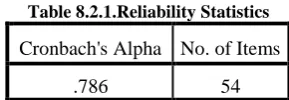
8.2 Reliability AnalysisThe internal consistency is predicted using a reliability coefficient called Cronbach‟s alpha. Reliability scores for the factors range from 0.642 to 0.880 indicating adequate internal consistency. For these data, the cronbach‟s alpha value is 0.786. It shows the project is reliable one.
Table 8.2.1.Reliability Statistics
Cronbach's Alpha No. of Items
.786 54
. 8.3 Simple Percentage Method
8.3.1 Gender
Frequency Table 8.3.1: Gender Gender Frequency Percentage
Male 87 87.0
Female 13 13.0
Total 100 100.0
Figure 8.3.1: Gender
Inference:From the above table and figure. We can note that the gender of most of the individuals study are (male) by (48) with percentage (48%).
8.3.2
Type of job position
Frequency Table 8.3.2: Type of job position
Figure 8.3.2: Type of job position
Inference: From the above table and figure. We can note that the type of job position of most of the individuals study are (labour) by (61) with percentage (61%)
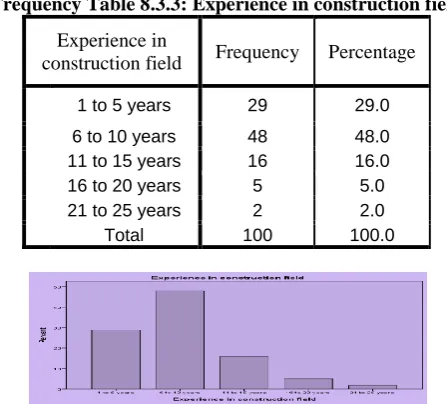
8.3.3 Experience in construction field
Frequency Table 8.3.3: Experience in construction field
Experience in
construction field Frequency Percentage
1 to 5 years 29 29.0
6 to 10 years 48 48.0
11 to 15 years 16 16.0
16 to 20 years 5 5.0
21 to 25 years 2 2.0
Total 100 100.0
Figure 8.3.3: Experience in construction field
Inference:From the above table and figure. We can note that the experience of most of the individuals study are (6 to 10 years) by (48) with percentage (48%).
8.3.4 Labour working on site
Frequency Table 8.3.4: Labour working on site Labour working on site Frequency Percentage
below 50 workers 8 8.0
50 to 100 workers 9 9.0
100 to 500 workers 17 17.0
500 to 1000 workers 40 40.0
above 1000 workers 26 26.0
Total 100 100.0
Figure 8.3.4: Labour working on site
Inference:From the above table and figure. We can note that the labours working on sites of most of the individuals study are (500 to 1000 workers) by (40) with percentage (40%).
8.4 Independent sample T-Test
Null Hypothesis: There is no significant difference between male and female with respect
to workers safety.
Type of job position Frequency Percentage
Site engineer 15 15.0
Labour 61 61.0
Supervisor 13 13.0
Quantity Surveyor 7 7.0
Purchase officer 3 3.0
Project Manager 1 1.0
Since null hypothesis is accepted, there is no significant relationship between male and female with regards to workers safety performance.
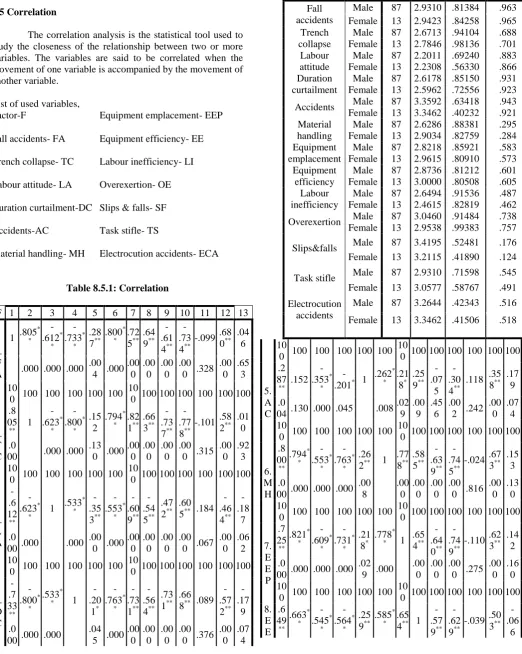
8.5 Correlation
The correlation analysis is the statistical tool used to study the closeness of the relationship between two or more variables. The variables are said to be correlated when the movement of one variable is accompanied by the movement of another variable.
List of used variables,
Factor-F Equipment emplacement- EEP
Fall accidents- FA Equipment efficiency- EE
Trench collapse- TC Labour inefficiency- LI
Labour attitude- LA Overexertion- OE
Duration curtailment-DC Slips & falls- SF
Accidents-AC Task stifle- TS
Material handling- MH Electrocution accidents- ECA
Table 8.5.1: Correlation
F 1 2 3 4 5 6 7 8 9 10 11 12 13
1. F A
1 .805
* * -.612* * -.733* * .28 7** .800* * .72 5** .64 9** -.61 4** -.73 4**
-.099 .68 0**
.04 6
.000 .000 .000 .00 4 .000
.00 0 .00 0 .00 0 .00 0 .328
.00 0
.65 3 10
0 100 100 100 100 100 10
0 100 100 100 100 100 100
2. T C .8 05 ** 1 -.623* * -.800* * .15 2 .794* * .82 1** .66 3** -.73 7** -.77 8**
-.101 .58 2**
.01 0 .0
00 .000 .000 .13
0 .000 .00 0 .00 0 .00 0 .00
0 .315 .00
0 .92
3 10
0 100 100 100 100 100 10
0 100 100 100 100 100 100
3. L A -.6 12 ** -.623* *
1 .533
* * -.35 3** -.553* * -.60 9** -.54 5** .47 2** .60 5** .184
-.46 4** -.18 7 .0
00 .000 .000 .00
0 .000 .00 0 .00 0 .00 0 .00
0 .067 .00
0 .06
2 10
0 100 100 100 100 100 10
0 100 100 100 100 100 100
4. D C -.7 33 ** -.800* * .533* * 1 -.20 1* -.763* * -.73 1** -.56 4** .73 1** .66 8** .089
-.57 2** -.17 9 .0
00 .000 .000
.04 5 .000
.00 0 .00 0 .00 0 .00 0 .376
.00 0
.07 4
10
0 100 100 100 100 100 10
0 100 100 100 100 100 100
5. A C .2 87 ** .152 -.353* * -.201* 1
.262* * .21 8* .25 9** -.07 5 -.30 4**
.118 .35 8**
.17 9 .0
04 .130 .000 .045 .008 .02 9 .00 9 .45 6 .00
2 .242 .00
0 .07
4 10
0 100 100 100 100 100 10
0 100 100 100 100 100 100
6. M H .8 00 ** .794* * -.553* * -.763* * .26 2** 1
.77 8** .58 5** -.63 9** -.74 5**
-.024 .67 3**
.15 3 .0
00 .000 .000 .000 .00 8 .00 0 .00 0 .00 0 .00 0 .816
.00 0
.13 0 10
0 100 100 100 100 100 10
0 100 100 100 100 100 100
7. E E P .7 25 ** .821* * -.609* * -.731* * .21 8* .778*
* 1 .65
4** -.64 0** -.74 9**
-.110 .62 3**
.14 2 .0
00 .000 .000 .000 .02
9 .000 .00
0 .00
0 .00
0 .275 .00
0 .16
0 10
0 100 100 100 100 100 10
0 100 100 100 100 100 100 8. E E .6 49 ** .663* * -.545* * -.564* * .25 9** .585* * .65 4** 1
-.57 9** -.62 9**
-.039 .50 3**
-.06
6 Table 8.4.1: T-Test
Factors Gender N Mean Std.
Deviation Sig.Value Fall
accidents
Male 87 2.9310 .81384 .963 Female 13 2.9423 .84258 .965 Trench
collapse
Male 87 2.6713 .94104 .688 Female 13 2.7846 .98136 .701 Labour
attitude
Male 87 2.2011 .69240 .883 Female 13 2.2308 .56330 .866 Duration
curtailment
Male 87 2.6178 .85150 .931 Female 13 2.5962 .72556 .923 Accidents Male 87 3.3592 .63418 .943 Female 13 3.3462 .40232 .921 Material
handling
Male 87 2.6286 .88381 .295 Female 13 2.9034 .82759 .284 Equipment
emplacement
Male 87 2.8218 .85921 .583 Female 13 2.9615 .80910 .573 Equipment
efficiency
Male 87 2.8736 .81212 .601 Female 13 3.0000 .80508 .605 Labour
inefficiency
Male 87 2.6494 .91536 .487 Female 13 2.4615 .82819 .462 Overexertion Male 87 3.0460 .91484 .738 Female 13 2.9538 .99383 .757
Slips&falls Male 87 3.4195 .52481 .176 Female 13 3.2115 .41890 .124
Task stifle Male 87 2.9310 .71598 .545 Female 13 3.0577 .58767 .491 Electrocution
accidents
.0
00 .000 .000 .000 .00
9 .000 .00
0
.00 0
.00 0 .702
.00 0
.51 4 10
0 100 100 100 100 100 10
0 100 100 100 100 100 100
9. LI -.6 14 ** -.737* * .472* * .731* * -.07 5 -.639* * -.64 0** -.57 9**
1 .65 6** -.047
-.51 8** -.04 5 .0
00 .000 .000 .000 .45
6 .000 .00
0 .00
0
.00 0 .644
.00 0
.65 8 10
0 100 100 100 100 100 10
0 100 100 100 100 100 100
10 .O E -.7 34 ** -.778* * .605* * .668* * -.30 4** -.745* * -.74 9** -.62 9** .65
6** 1 .120 -.60 9** -.08 3 .0
00 .000 .000 .000 .00
2 .000 .00
0 .00
0 .00
0 .236 .00
0 .41
2 10
0 100 100 100 100 100 10
0 100 100 100 100 100 100
11 .S F -.0 99
-.101 .184 .089 .11 8 -.024
-.11 0 -.03 9 -.04 7 .12
0 1 .07 2 -.11 5 .3
28 .315 .067 .376 .24
2 .816 .27 5 .70 2 .64 4 .23 6 .47 8 .25 3 10
0 100 100 100 100 100 10
0 100 100 100 100 100 100
12 .T S .6 80 ** .582* * -.464* * -.572* * .35 8** .673* * .62 3** .50 3** -.51 8** -.60 9**
.072 1 .18 7 .0
00 .000 .000 .000 .00
0 .000 .00 0 .00 0 .00 0 .00
0 .478 .06
3 10
0 100 100 100 100 100 10
0 100 100 100 100 100 100
13 .E C A
.0
46 .010 -.187 -.179 .17
9 .153 .14 2 -.06 6 -.04 5 -.08 3
-.115 .18 7 1
.6
53 .923 .062 .074 .07
4 .130 .16 0 .51 4 .65 8 .41
2 .253 .06
3 10
0 100 100 100 100 100 10
0 100 100 100 100 100 100 **. Correlation is significant at the 0.01 level (2-tailed).
*. Correlation is significant at the 0.05 level (2-tailed).
Pearson‘s correlation coefficient is used to measure the strength of a linear relationship between two variables.
If the significant level is very small (less than 0.05) then the correlation is significant and the Duration curtailment, Accidents and Equipment emplacement variables are linearly related.
If the significant level is very very small (less than 0.01) then the correlation is significant and the with Fall accidents, Trench collapse,Labour attitude,Material Handling,Equipment efficiency,Labour inefficiency, Overexertion, Task stifle has moderately related.
If the significant level is relatively large (above 0.1) then the correlation is not significant and the Slips and falls, Electrocution accidents are not linearly related.
XI.CONCLUSION
As the construction industry is one of the most injury-prone industries worldwide in terms of its unique dynamic, complex and decentralized nature, there is a great need to improve worker safety at construction sites. A number of studies have been carried out in different parts of the world, to identify the attributes influencing general safety performance in construction practices. Safety is a management initiative, which was found completely lacking on almost all the sites surveyed. Based primarily on the literature review, 50 successful attributes were identified. Generally, all aspects of safety are neglected at construction sites. Further methodology is suggested to work out critical factors from available various techniques to identify most crucial factor which affect to the safety performance in building construction project. . From the analysis results, it indicates that slips and falls and electrocution accidents have significant disagreement about the importance of safety factors on more than half of the items.
Safety is everyone‘s responsibility it is a ―way of life‖ for 24 hours/day. Individual will be skilled and equipped to have the skills and facilities to make sure an accident free workplace. Based on results obtained we can create a framework to improve the safety measures adopted currently in site and also train the employees to achieve the goal of zero accidents. Finally all parties in construction project must contribute their rightful parts towards making construction sites healthy and safe working environment
REFERENCES
[1] Anil Kumar Sharma, Chitranjan Kumar (2017), ―Design and Evaluation of an Overall Construction Safety Management System for Residential Construction Sites: A Graph Theoretic Approach‖, International Journal of Engineering Science & Computing, Vol.07, No.06, pp.146-159.
[2] Hafiz Zahoor, Albert P C Chan, Wahyundi P Utama, Ran Gao(2015), ―A Research Framework for Investigating the Relationship Between Safety Climate and Safety Performance in the Construction of Multi-Storey Buildings in Pakistan‖, Procedia Engineering, Vol. 118,pp.581-589.
[3] Jan K.Wachter, Patrick L.Yorio (2014), ―A System of Safety Management Practices and Worker Engagement for Reducing and Preventing Accidents: An Empirical and Theoretical Investigation‖, Accident Analysis & Prevention Vol.68, pp.117-130. [4] Jessica Bunting, Christine Branche, Chrisb Trahan,
[5] Korea Occupational Safety and Health Agency (2004), Major Accident Cause Analysis Rep., KOSHA, Seoul.
[6] Langford D, Rowlinson S &SawachaE (2008), ―Safety Behaviour and Safety Management: its Influence on the Attitudes of Workers in the UK Construction Industry‖ Engineering Construction & Architectural Management, Vol.7, No.2, pp.133–140.
[7] MohdAqleem Mir, BibhaMahto (2015),‖Site Safety and Planning for Building Construction‖, International Research Journal of Engineering & Technology, vol.02 No.02, pp.660-671.
[8] Pieter A cornelissen, Joris J Van Hoof, Menno D T De Jong (2017), ―Determinants of Safety Outcomes and Performance: A Systematic Literature Review of Research in Four Construction Industry‖, Journal of Safety Research,Vol. 62, pp.127-141.
[9] Williams C A, Smith M L and Peter C Y (1998), Risk Management and Insurance, Irwin/McGraw Hill Boston, Mass Wassmer L (1998), Contractors All Risks Insurance, Swiss Reinsurance Company, Zurich.
[10]Xianguo Wu, Quian Liu, Limao Zhang, MiroslawJ.Skibniewski, Yanhong Wang (2015), ―Prospective Safety Performance Evaluation on Construction Sites‖, Accidents Analysis and Prevention, Vol 78, pp.58-72.
[11]Yuting Chen, Brenda McCabe, Douglas Hyatt (2017), ―Impact of Individual Resilience and Safety Climate on Safety Performance and Psychological Stress of Construction Workers: A Case Study of the Ontario Construction Industry‖, Journal Safety Research,Vol.61,pp.167-176.