CHARACTERIZATION OF PALM KERNEL
SHELL POWDER FOR USE IN
POLYMER MATRIX COMPOSITES
Dagwa, I.M. , Builders , P.F.
and J. Achebo
Abstract--
The use of biomaterials as fillers/reinforcing agents
in thermoplastics /thermosets materials is increasing nowadays due to economic reasons and environmental awareness. This work was aimed at characterising the powdered palm kernel shell for use in composite materials formulation. Properties such as powder porosity, hydration capacity, moisture sorption, particle size distribution, bulk density, tapped density, powder flow, pH of powder dispersion as well as differential scanning calorimetry thermal (DSC), X-ray diffraction (X-RD) and scanning electron microscopy (SEM) were evaluated. The following results were obtained; pH was found to be 4 ± 0.0, average true density, powder porosity and hydration capacity were; 1.58 ±0.07g/cm3, 6.76 ±0.42%, and 150.08 ±76.91%, respectively. The average values of the moisture content and moisture sorption were; 11.16±016% and 2 ±0.54%, respectively. The average angle of repose for the palm kernel shell (PKS) was found to be 34.09±4.77o .The scanning electron microscopy showed that PKS powder had spherical shape. Based on EDX analysis PKS has a high carbon content of about 63 wt %. The XRD pattern for the PKS powder showed that the PKS powder was more of amorphous material with small amount of micro crystalline materials. PKS is therefore suggested as filler to be used in polymer composite production.
Index Term-- palm kernel shell powder, physico-
chemical properties, thermal characterizations.
INTRODUCTION
The use of biomaterials in general and agro-waste in particular is a subject of great interest nowadays not only from the technological and scientific points of view, but also socially,
and economically, in terms of employment, cost and environmental issues. Nigeria is endowed with a lot of mineral
and agro-based resources that could be used in the development of environmental- friendly composite materials such as Eco-pad used in modern vehicle braking systems. As of 2009, Indonesia was the largest producer of palm oil, Dagwa,
I.M is serving in
Department of Mechanical Engineering, University of Abuja, Abuja, FCT, Nigeria
Builders, P.F are serving in
National Institute for Pharmaceutical Research and Development, Idu, Abuja, FCT, Nigeria
J. Achebo is serving in
Department of Production Engineering, University of Benin, Benin-city, Nigeria
surpassing Malaysia in 2006, producing more than 20.9 million tonnes. Food Agriculture Organisation (FAO) data showed production increased by over 400% between 1994– 2004, to over 8.66 million metric tonnes. In 2008, Malaysia produced 17.7 million tonnes of palm oil on 4,500,000 hectares of land, and was the second largest producer of palm oil, employing more than 570,000 people. Malaysia is the world's second largest exporter of palm oil. As of 2011, Nigeria was the third-largest producer, with more than 2.5 million hectares (6.2×10⁶ acres) under cultivation. Until 1934, Nigeria had been the world's largest producer. Both small- and large-scale producers participated in the industry[1].
In the light of the above, large quantities of cracked palm kernel shell (PKS) are therefore generated by the producers. The PKS are obtained after extraction of the palm oil the nuts are broken and the kernels are removed with the shells mostly left as waste. The PKS are hard stony endocarps that surround the kernel and the shells come in different shapes and sizes ([2].These shells are mainly of two types the “Dura” and “Tenera”. The Tenera is a hybrid which has specially been developed to yield high oil content and it has a thin shell thickness compared to Dura type [3]. There are several efforts being made towards the utilization of the PKS. Some of the areas where palm kernel shell are used or are being considered for use include: automobile disk brake pad [4, 5], carbon activation for water purification, concrete ingredient in building industry, fuel for heat generation [6], thermal insulator [7], etc. The shell is made up of 33% charcoal, 45% pyroligneous liquor and 21% combustible gas as reported [6]. The use of materials such as rice husk, bagasse, palm kernel shell powder, etc. as fillers and/ or reinforcement agents in polymers and composite materials manufacture such as in brake pads have been reported by several authors [4,5,8,9]. However, some of the detailed biomaterials properties are scarcely found in literatures.
Therefore, in this work we have attempted to characterize palm kernel shell powder towards generating a data base on PKS powder properties so that it could be exploited for industrial utilization.
EXPERIMENTAL Materials
Methods
Preparation of specimen
The cracked PKS were thoroughly washed in clean water with small quantity of detergent to remove residual oil on the shells. Thereafter, the cracked shells were sun dried for 72 hours. Three kilogram quantity of the shells was pulverized using an engine mill, the desired particle size was obtained after 3 passing through the machine.
Material Properties: pH
One gram and 10g of powder was dispersed in 100ml distilled water with continuous stirring for 1 hour. The pH was determined with a corning pH meter 215 (USA) PH+ meter.
Particle Size Analysis
The particle size distribution was determined using 1000g quantity of the pulverized kernel which was placed in the sine shaker holding a set of sieves. The shaker was set to vibrate for 15 min at amplitude of 150.
Bulk and Tapped Densities
Powder samples of 10g quantity each was placed in a 50ml clean, dry measuring cylinder and the volume Vo occupied by each of the samples without tapping was determined. After 1050 taps with the stamp volumeter the volumes were recorded. The bulk and tapped densities was calculated as the ratio of weight to volume (Vo and V1050 respectively). True density
The true densities (ρt) of the PKS were determined by the liquid displacement method using xylene as the immersion fluid and computed using equation (1) as reported[10]:
t
w
x SG
a w b
... (1) Where w is the weight of powder, SG is specific gravity of liquid (xylene) (=0.8802), a, is weight of pycnometer + xylene and b is weight of pycnometer + xylene + PKS powder.
The weight of pycnometer filled with xylene was determined and 1 g of the powdered kernel shell was transferred into the xylene filled pycnometer and the weight determined. The true density was then evaluated.
Powder Flow
The flow property of the powdered PKS were determined by direct methods by measuring the flow rates: Ten grams (10g) weight (w) of the PKS powder was placed in the flow apparatus and allowed to flow through the funnel orifice. The time taken (t) for the PKS powder to flow through the orifice was noted. Hence, the flow rate was calculated as mass of powder divided by the time taken (w/t).
Compressibility Index (CI) was determined by imputing the values of the bulk and tapped densities according to equation 2.
100% tapped density bulk density
Cl x
tapped density
... ...(2)
The static angle of repose (α), was measured according to the fixed funnel and free standing cone method and the tangent of the angle of repose calculated using the equation 3.
2h Tan
D
. . .
... ... (3)
Where h is the height of the heap of PKS powder and D is the diameter of the base of the heap of powder.
Powder Porosity
This was calculated from the values of true and bulk densities using the formula:
1 b 100%
t
B
e x
………
……….(4)
Were Bb, is the bulk density, ρt is the true density and e is the porosity.
Hydration Capacity
5 g (Wd) quantities of dry powder of the differentiated particles sizes of the powdered palm kernel shells were placed in 25 ml capacity beaker. 20 ml of distilled water was then added and the content stirred with a glass stirring rod. The dispersion was then allowed to stand for 24 h. Excess water was removed by decanting and upturning until all water has drained. The weight of hydrated mass (Wh) was then determined. Therefore, the hydration capacity, (Q) was determined using equation (5) as follows:
% , h d 100%
d
w w
Hydration Q x
w
. . . . .
………..………..………….. . (5)
Moisture Content
5 g (W1) quantities of the different particle sizes of the powdered palm kernel shells were placed in an aluminium foil and placed in an (Genlabs N30C, England) oven set at 100 oC. The foils and there content were weighed every 3 h until a constant weight (W2) was established. Moisture content was determined using equation (6):
2 1
1
%Moisture content w w x100%
w
. .
……….…..………..………. . (6)
Differential Scanning Calorimetry (DSC)
DSC machine (DSC 204F1-Phoenix NETZSCH,Germany) equipped with a thermal analysis system. Indium (156.8 ◦C) was used as the internal standard. Approximately 1mg of the powdered palm kernel shell (particle size <150 μm) was placed in an aluminum pan (25μl) and covered with a perforated lid. Dry nitrogen was used as the purge gas (purge 20 ml min−1). The probes were heated from 25 to 500 ◦C at a rate of 10 ◦Cmin−1. The relevant thermodynamic parameters were evaluated with Proteus analysis software.
X-ray Diffraction (XRD).
The PKS samples were grinded to powder form. Thereafter, the XRD analysis for the raw palm kernel shell powder was taken to detect the presence of crystalline phase or structure. This was carried out using a PAnalytical X'Pert Pro MPD XRD at room temperature with CuKα radiation.
Scanning Electron Microscopy (SEM)
Carl Zeiss MA-10 SEM with EDX was used to examine the morphology of the PKS powders.
RESULTS AND DISCUSSION pH
The Ph of the PKS powder using a Dispasin of 1% and 10% were found to be 4 ± 0.08
and 4.1 ± 0.08, respectively. Characterization of particle size
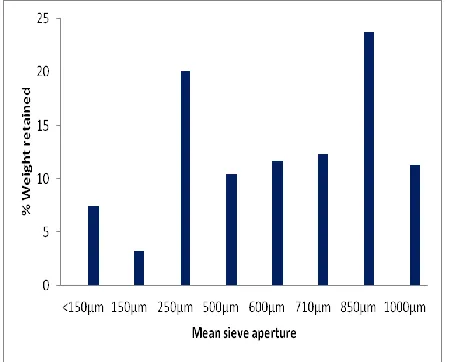
The particle size distribution of the PKS powder which was obtained after grinding is as shown in Fig.1
Fig. 1. Particle size distribution of palm kernel shell powder after three passes in the grinding
Flow Properties
From Fig. 2a, it was observed that the true density increases with increase in particle sizes of the PKS powder, this had similar behaviour with the densities of sawdust particle sizes as reported by Cardona (2009) . For smaller particle sizes, their compressibilities were higher this was as presented in Fig2b because they had more porosity (Fig2c). The smaller particle sizes also had higher hydration capacities as presented in (Fig.2d) this was probably due to the increase in surface area. The average true density, compressibility index, powder
porosity and hydration capacity were; 1.58 ±0.07g/cm3, 18.58±5.58, 6.76 ±0.42%, and 150.08 ±76.91%, respectively. From Fig 2e-i it was observed that the smaller the particle sizes the more the moisture sorption and angle of repose, these could be attributed to the increase in surface area and inter –particle friction leading to smaller flow rates, respectively. The moisture content appears to be constant as it varied between 11.0 ±0.15 to 11.5±0.42%. The average values of the following properties: moisture content, moisture sorption, angle of repose, were; 11.16±016%, 2 ±0.54%, 34.09±4.77, respectively. The angle of repose for the PKS was found to be 34.09±4.77. From the classification of flow properties by Carr [11] if the angle of repose is between 31 and 35, the material flow is good, whereas materials having values below 30 flow easily and well. The rougher and more irregular the surface of the particles the higher is the angle of repose.
The average compressibility index and Hausner ratio were 18.58±5.58 and 1.2328, respectively, which falls within the range of fair flowability based on the scale of flowability [11], while values above 35 % indicate cohesiveness and Hausners ratios greater than 1.25 indicate poor flow, which would require the addition of a lubricant such a gliddant depending on the purpose, to further improve flow [12]. However, it was observed that for smaller particle size (see Fig.2b) the compressibility index was high due to the reason earlier mentioned elsewhere.
0 500 1000
1.4 1.6 1.8 2
(a)mean size aperture(microns)
T ru e d e n s it y (g /m l)
Mean size aperture vs true density
0 500 1000
10 15 20 25 30 35
(b)Mean size aperture(microns)
C o m p re s s ib ili ty i n d e x
Mean size aperture vs compressibility index.
0 500 1000
6 6.5 7 7.5 8
(c)mean size aperture(microns)
p o w d e r p o ro s it y (% )
Mean size aperture vs powder porosity
0 500 1000
0 100 200 300
(d)Mean size aperture(microns)
H y d ra ti o n c a p a c it y
Mean size aperture vs Hydration capacity
0 500 1000
10 10.5 11 11.5
(e)mean size aperture(microns)
m oi st ur e co nt en t( % )
Mean size aperture vs moisture content
0 500 1000
1 2 3 4
(f)mean size aperture(microns)
M oi st ur e so rp tio n( % )
Mean size aperture vs moisture sorption
0 500 1000
30 35 40 45
(g)mean size aperture(microns)
A ng le o f re po se (d eg )
Mean size aperture vs angle of repose
0 500 1000
0 5 10 15 20
(h)mean size aperture(microns)
A ve ra ge f lo w r at e( g/ s)
Mean size aperture vs average flow rate
Morphological Characterization
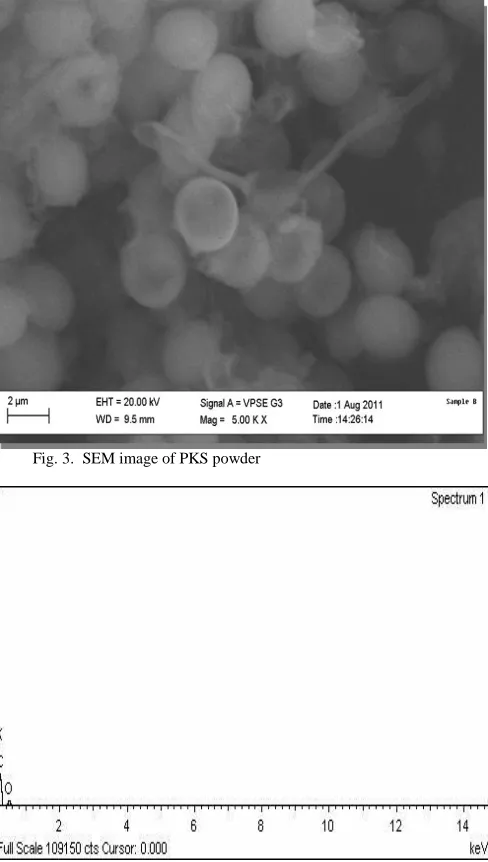
Fiber-matrix interface plays a vital role in composite properties. This is because the formation of mechanical bonding at the surface is mainly dependent on the surface topology of the fibers/fillers. Scanning electron microscopic analysis examined the surface topology of the PKS powder and its shape was observed to be spherical. Figure 3 shows the SEM photograph of PKS powder.
Fig. 3. SEM image of PKS powder
Fig. 4. The EDS spectrum shows the presence of C, O
DSC analysis
From Fig.5, Thermogram results showed an initial broad endothermic peak at 56oC was observed which could be attributed to the loss of volatile compounds as melting took place or due to removal of absorbed moisture in the PKS powder which is amorphous and partially crystalline. The aforementioned statement is in agreement with the report [13], thus; in all TG curves, the first weight loss step refers to
volatile components of the samples. While, the second phase (around 150ºC to 430ºC) corresponds to cellulose weight loss and the third part (starting around 430ºC) is attributed to lignin thermal decomposition.
In the region between 100 oC -260 oC showed no exothermic or endothermic reactions, which suggest stability. The exothermic hump in the DSC at about 260 oC suggests the commencement of the thermal degradation of hemi-cellulose and the glycosidic linkages of cellulose [14]. Within the temperature ranges the commencement of charing was not noticed which suggest that the degradation of cellulose, leading to the formation of char for PKS was possibly at a temperature greater than 500 oC. This unit was capable of operating up to a maximum temperature of 500 oC. The glass transition temperature (Tg) could not be observed.
Fig. 5. DSC thermogram
EDX Analysis
TABLE III Energy dispersive x-ray
Element Weight (%) Atomic %
C K 63.02 69.67
O K 36.04 29.91
Al K 0.43 0.21
Si K 0.17 0.08
P K 0.17 0.07
K K 0.17 0.06
Total 100.00 100.00
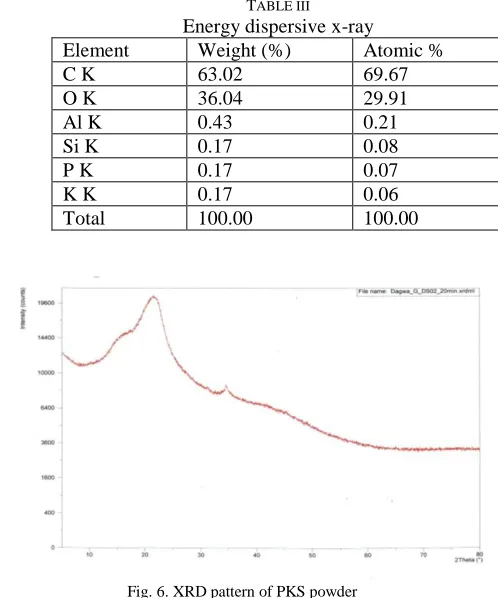
Fig. 6. XRD pattern of PKS powder
Fig. 6.shows the XRD pattern for the PKS powder. This broad peak shape of the diffractogram suggests that the PKS powder was in amorphous state while very small sharp peaks suggests small amount of micro crystalline materials could be present. Fig. 7 shows a typical performance of PKS based automobile disk brake pad compared with the commercial disk brake pad as reported [4]. This shows that the PKS powder is potentially good filler for use in polymer composite manufacture as the correlation coefficient between the stopping distance of the commercial and prototype (Laboratory) brake pads was 0.9935.
0 10 20 30 40 50 60 70 80 90 100 110
0 10 20 30 40 50 60 70 80 90 100 110
Stopping distance (m)
S
p
e
e
d
(k
m
/h
r)
combrkpd labkpd
Fig. 7. Effect of vehicle speed on stopping distance (source: Dagwa and Ibhadode[4])
CONCLUSIONS
From this study the following conclusions were drawn: Some of the properties possessed by the PKS favour its utilisation as a friction material. Especially, the average true density (1.58 ±0.07g/cm3), powder porosity (6.76 ±0.42%), moisture content (11.16±016% ) and moisture sorption (2 ±0.54%). The average angle of repose for the PKS was found to be 34.09±4.77o which suggests that during production, the powder material will flow with ease. From the SEM image, it was observed that PKS powder had spherical shape. The aforementioned properties of the PKS and the close performance level between the PKS based brake pad and the commercial brake pad (complex composite) suggests that PKS powder is potentially good filler which could be used in the manufacture of polymer composite. Further research is recommended on the study of environmental effect on the properties of PKS based composite.
ACKNOWLEDGEMENT
The authors wish to acknowledge the assistance provided by Raw Materials Research and Development Council ( RMRDC), Abuja, for part funding, the National Institute for Pharmaceutical Research and Development (NIPRD), Idu, Abuja, for the use of their facilities, and Physics Laboratory, Sheda Science and Technology Complex (SHESTCO), Abuja for SEM image.
REFERENCES
[1] (en.wikipedia.org/wiki/Palm_oil).
[2] Alangaram, U.J., Jumaat, M.Z. and Mahmud, H. (2008) Ductility Behaviour of Reinforced Palm Kernel Shell Concrete Beams, European Journal of Scientific Research Vol. 23, No. 3 pp.406-420.
[3] Dagwa,I.M. and Ibhadode, A. O. A. I (2008) Some physical and Mechanical properties of palm kernel shell (PKS) Botswana Journal of Technology. Vol 17 No. 2 (Oct. 2008)
[4] Dagwa, I.M. and Ibhadode, A.O.A. (2006), “Field performance evaluation of asbestos – free brake pad”, Nigerian Journal of Engineering Research and Development, Vol.5, No. 1
[5] Koya, O. A. , Fono, T. R.(2008) Palm Kernel Shell in the Manufacture of Automotive Brake Pad
www.rmrdctechnoexpo.com/.../Palm%20Kernel%20Shell%20in% 20the%20Manufacture%20of%20Autom...
[6] Okly, D.A (1987) “Chemical and Biological Characterization of the by-products of Nifor Palm oil”. Proceedings of the 1987 international oil palm/palm oil conferences (progress and prospectus) organized by palm oil research institute of Malaysia, Kaula lumpur.
[7] Ighodalo, O. A., Okoebor, W. J. (1996) “Thermal conductivity of some local waste materials Rice husk, Palm kernel shells and wood shavings” NSE Technical Transactions vol. 31. No. 3, 68-73 [8] Mutlu, I.(2009) Investigation of tribological properties of brake
pads by using rice straw and rice husk dust. Journal of Applied sciences 9 (2) pp377-381
[9] Aigbodion,V. S., Akadike, U., Hassan, S.B., Asuke ,F., Agunsoye ,J.O., (2010) Development of Asbestos -Free Brake Pad Using Bagasse, Tribology in Industry, Volume 32, No. 1, 2010
[10] Ohwoavworhua, F. O. and Adelakun, T.A. (2005) Some Physical Characteristics Of Microcrystalline Cellulose Obtained From Raw Cotton Of Cochlospermum Planchonii , Tropical Journal of Pharmaceutical Research 4(2)pp 501-507
[11] http://www.pharmacopeia.cn/v29240/usp29nf24s0_c1174.html
[12] Bakre, L.G., and Jaiyeoba, K.T.(2009) Evaluation of a new tablet disintegrant from Dried Pods Of Abelmuscus Esculentus L (Okra) Asian Journal of Pharmaceutical and Clinical Research Vol.2 Issue 3, July-September 2009
[13] Lucio C. Severiano1*, Francisco A. R. Lahr2, Marcelo A. G. Bardi1 and Luci D. B. Machado1 (2009) Influence of gamma radiation on mechanical and thermal properties of Cedrella Fissilis and Ocotea Porosa used in works of art, International Nuclear Atlantic Conference - INAC 2009 Rio de Janeiro, R J, Brazil, September 27 to October 2, 2009
[14] Atuanya.C.U, and Ibhadode.A.O.A(2011) Characterization of
Okhuen (Brachystegia Nigerica) Wood as a potential Reinforcement for polymer composites, International Journal of Engineering & Technology IJET-IJENS Vol: 11 No: 04 pp68-76
[15] Yacob, A.R., Majid, Z.A., Dasril ,R.S., and Inderan, V. (2008) Comparison of various sources of High surface area carbon prepared by different types of activation, The Malaysian Journal of Analytical Sciences Vol. 12, No.1 pp264-271.