ISSN (Online): 2320-9364, ISSN (Print): 2320-9356
www.ijres.org Volume 4 Issue 10 ǁ October. 2016 ǁ PP.49-54
A Smart Two-Cell Random Access Algorithm for Wireless
CDMA Communication Networks Using Smart Antenna
Enfel Barkat
1, Mourad Barkat
1Department Of Electrical Engineering University Of Colorado At Colorado Springs Colorado Springs, USA
2Department Of Computer Engineering King Saud University Riyadh, KSA
Abstract:
We propose to upgrade the performance of a class of random access protocols for wireless digital networks with smart antennas operating in the presence of Rayleigh slowly fading multipath transmission channels. The capture model assumed is a threshold model based on the signal to noise ratio, while the MAC protocol deployed isthe two-cell random access algorithm, in a network environment where nodesare equipped with adaptive array smart antennas. The deployed protocol relies on the ability of the antenna to deploy Direction of Arrival (DoA) algorithms, to identify the direction of transmitters and to subsequently beam-form accordingly for Signal- to Interference and Noise Ratio (SINR) maximization. The performance of the protocol is evaluated using analytical modeling as well as Monte Carlo simulations usingMATLAB, where we demonstrate the benefits of using smart antennas.I.
INTRODUCTION
Over the past few years, the demand for cellular communication applications such as internet access, multimedia data transfer and other wireless multimedia services witnessed a serious growth in thirdgeneration(3G)wirelesscommunications systems. Thus, 3G wirelesscommunications systemsmustprovidea varietyofnewserviceswithdifferentdataraterequirementsunder
differenttrafficconditions,whilemaintainingcompatibilitywith2Gsystems.
In wireless communications, one of the major causes of radio interferences and energyuse inefficiencies is the universally radiated antenna energy [1]. On the other hand, one of the several advantages of smart antenna deployment is their effect on the reduction of such interferences. Indeed, smart antennas have the capability of beaming in the direction of the desired signal, as means towards Signal to Noise Ratio (SNR) maximization due to the effective minimization (nulling) of the interfering signals [2]. In this paper, we propose to upgrade the performance of a deployed MAC protocol via the use of smart antennas. In addition, we consider enhancing of the overall network performance via the deployment of a powerful MAC protocol. This study will discuss powerful random access MAC algorithms, in conjunction with smart antenna beam forming.
1. Communication System Considered
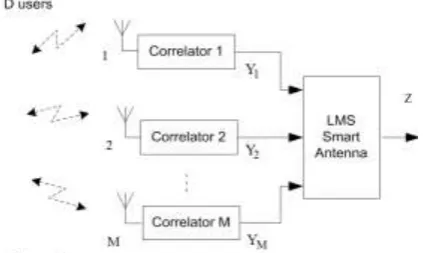
The CDMA communication system model for multiple users and using smart antenna was proposed by Sofwan and Barkat in [3] and is shown in Fig. 1. A linear array with 𝑀 elements spaced equally to one half of the carrier wavelength is assumed 𝑑 = 0.5𝜆 . We also assume that 𝐷 users transmit simultaneously, but the first user is assumed as the initial synchronization user whose performance is to be evaluated.
Figure 1 Block diagram of the proposed communication system model
The transmitted signal of the 𝑖th user is given by
where
𝑃𝑖is the transmitted power of the 𝑖th signal, 𝑏𝑖is the data waveform,
𝑐𝑖is the spreading sequence of the 𝑖𝑡ℎ user, 𝜔𝑐is the common angular carrier frequency, and 𝜑𝑖is the phase of the 𝑖th modulator from the transmitter.
The user signals are sent through a communication channel assumed to be a Rayleigh slowly fading multipath channel. The transmitted signals are received by an antenna array of 𝑀 elements and go through an LMS processor. The transmitter aids the initial synchronization by transmitting an unmodulated PN sequence 𝑏1 𝑡 = 1.
2. Channel Model
The mobile radio channel considered consists of 𝐿 tapped delay lines that correspond to the number of resolvable multipath with amplitudes𝛼𝑖𝑙 and phases𝜑𝑖𝑙, 𝑖 = 1,2, ⋯ , 𝐷, and 𝑙 = 1,2, ⋯ , 𝐿 − 1. The probability
density function (pdf) of the independent and identically distributed (i.i.d.) Rayleigh random variables is given by [11, 19]:
𝑓𝛼𝑖𝑙 𝑥 =
2𝑥
σ𝑓
exp −𝑥
2
σ𝑓2
, 𝑥 ≥ 0 (2)
where𝜎𝑓2= 𝐸 𝛼𝑖𝑙2 is the average fading power in each path and is defined as [20]
3.1 Smart Antennas
Smart antenna in the proposed system which performs adaptive beam-forming by using the LMS algorithm for directing the main array pattern towards the preferred source signal and for creating nulls in the directions of the interfering signals [21]. The LMS algorithm computes iteratively the optimum beam-forming weight vector iteratively, utilizing the Minimum Squares Error (MSE) criterion between the desired signal value and the LMS processor output. The pdf of the aligned hypothesis is given by [19]:
𝑓𝑍 𝐻1 𝑧 𝐻1 =
1
2𝜎02 𝑀 + 𝑀2𝜈 exp −
𝑧
2𝜎02 𝑀 + 𝑀2𝜈 , 𝑧 ≥ 0 3
Contrarily, if the output𝑌𝑚of the correlator is under a non-aligned hypothesis, then that the smart antenna is
assumed tracking in a different angle from the desired signal. The pdf of the non-aligned hypothesis is given by
𝑓𝑍 𝐻0 𝑧 𝐻0 =
1
2𝜎02𝑀
exp − 𝑧
2𝜎02𝑀
, 𝑧 ≥ 0 4
3. Two-Cell Random Access Protocol
In our system model [7], we assume slotted channel, packet-transmitting users, zero propagation delays, initial absence of feedback errors and that the collided packets are totally destroyed which makes retransmission necessary. We also assume binary collision-versus-non-collision (C-NC) feedback after each slot where slot units correspond to time intervals defined as follows: slot t occupies the time interval [𝑡, 𝑡 + 1) where
𝑥𝑡 designates the feedback corresponding to slot 𝑡; 𝑥𝑡 = 𝐶 and 𝑥𝑡 = 𝑁𝐶 express the collision and non-collision
events in slot t, respectively.
Algorithms are implemented independently by each user in the class. The users’ knowledge of the feedback history is said to be asynchronous because each user will only need to monitor the channel feedback after generating a packet to the time this packet is transmitted successfully. Whether or not a collision resolution is in progress within a limited number of slots will be decided by each user and such decision could only be induced by the unique operational characteristics of each algorithm in the class. This would also help in preventing the interference from new arrivals occurring within the duration of a collision resolution process.
Individual algorithms in the class employ a window of size as an operational parameter and induce a sequence of consecutive Collision Resolution Intervals (CRIs). Maximizing the throughput is the main criterion in selecting the window length. Each CRI corresponds to the successful transmission of all packet arrivals within an arrival interval of length, where the number of packet arrivals in this interval and algorithmic steps of the collision resolution process are the key factors in determining the length of each CRI. The packet arrivals asynchronously determine the placement of the -size window.
user uses a counter whose values lie in the set [1, 2, 3, … . , 𝐾] where 𝑟𝑡denotes the counter value of a user within
slot 𝑡.
The user is then placed in one of the 𝐾 cells of a 𝐾-cell stack depending on the various 𝐾 possible values. The user could initiate transmission when the counter value is 1 and withholds at 𝑘 − 1 different stages otherwise. All users in a -size window will set the counters to 1and transmit within the first slot of the CRI as soon as it begins. The number of packets in the window will determine whether the first slot will be a collision or non-collision slot. If the window contains one packet then the first slot of the CRI is non-collision and it will last only one slot. On the other hand, if the window contains at least two packets instead of one then the CRI will start with a collision which will be resolved within the duration of the CRI according to the following rules:
The user transmits in slot t if and only if𝑟𝑡= 1.
A packet is successfully transmitted in 𝑡 if and only if𝑟𝑡= 1 and𝑥𝑡 = 𝑁𝐶.
The counter values transition in time as follows:
If𝑥𝑡−1= 𝑁𝐶and𝑟𝑡−1 = 𝑗; 𝑗 = 2,3, ⋯ , 𝑘, then 𝑟𝑡 = 𝑗 − 1
If𝑥𝑡−1= 𝐶 and𝑟𝑡−1 = 𝑗; 𝑗 = 2,3, ⋯ , 𝑘, then 𝑟𝑡= 𝑗
If𝑥𝑡−1= 𝐶 and𝑟𝑡−1 = 1, then
𝑟𝑡 =
𝐷; 𝑤. 𝑝1
𝐾
𝐷; 𝑤. 𝑝1
𝐾
𝐷; 𝑤. 𝑝1
𝐾 ⋮
𝐾; 𝑤. 𝑝1
𝐾
For any K value, the throughput of the algorithm is 0.43.
The above rules show that a CRI which begins with a collision slot ends with a 𝐾 consecutive non-collision slots, an event which cannot occur at any other time during the CRI. A user who arrives in the system lacking any knowledge of the channel feedback can still synchronize with the system upon observing the first
𝐾-tuple of consecutive non-collision slots. Indeed, the observation of the 𝐾 consecutive non- collision slots signals the end of a CRI for all users, which either means the end of a CRI that started with a collision or the occurrence of a sequence of 𝐾 consecutive length-one CRIs. Thus, if a CRI ends with slot t, then the next CRI will involve the packets whose arrivals occurred within the time interval 𝑡 − 𝐾 + 1 −, 𝑡 − 𝐾 + 1 .
Before participating in a CRI, a packet arrival computes arrival instant updates sequentially; these updates comprise the initialisation rule of the algorithm and dictate the time instant when the packet will first participate in a CRI. The generation of the updates 𝑡𝑘 of the packet is as follows: Let 𝑡
0 be the slot within
which a packet is generated. Then define𝑡0 to be equal to𝑡
0. The user will then continuously sense the channel
feedback starting with slot𝑡0. This will continue passively until the user observes the first 𝐾-tuple of
consecutive NC slots, ending with slot𝑡1. If 𝑡0𝜖 t1 − 𝐾 + 1 −, 𝑡1 − 𝐾 + 1 then the user will participate in
the CRI starting with the slot𝑡1+ 1. Otherwise, the user will update the instant of arrival to𝑡1= 𝑡0+ ∆ and
waits passively until the end of the latter CRI ending with slot𝑡2. On the other hand, the user will participate in
the CRI starting with the slot 𝑡2 if 𝑡1𝜖 t2 − 𝐾 + 1 −, 𝑡2 − 𝐾 + 1 , otherwise, the user will have to update his
arrival instant again by ∆ and repeat the process again. In general if 𝑡𝑛 , 𝑛 ≥ 1 denotes the sequence of
consecutive CRI endings since the first 𝐾-tuple of consecutive 𝑁𝐶 slots, the packet participates in the𝑘𝑡ℎ CRI
if 𝑡𝑘−1𝜖 𝑡
𝑘− 𝐾 + 1 −, 𝑡𝑘− 𝐾 + 1 and 𝑡𝑛 ∉ (𝑡𝑛 +1− 𝐾 + 1 −, 𝑡𝑛− 𝐾 + 1) for all 𝑛 ≤ 𝑘 − 2.
II.
RESULTS AND DISCUSSION
In this section we present the delay analysis and the Monte Carlo simulation results using MATLAB for both the two cell random access algorithm and the smart two cell random access algorithm. We adopt the limit Poisson user model. Indeed, for a large class of random access algorithm, as the user population increases the stability of the algorithm in the class is determined by its throughput under the Poisson user model. as a worst case scenario, where, subject to this user model, the throughput of a random access algorithm is a lower bound to throughputs induced by any other user model and the algorithm.
0.050 0.1 0.15 0.2 0.25 0.3 0.35 0.4 3 6 9 12 15 18 21 24 27 30 33 36 39 40
Arrival rate (packet/slot)
A ve ra g e d e la y (sl o ts)
as the number of cells in the stack which depicts the collision resolution process of the corresponding algorithm increases.
We define the delay 𝐷𝑛 experienced by the 𝑛𝑡ℎ packet as the time difference between its arrival instant
and instant when its successful transmission ends. In Figure 1 we exhibit the expected delays induced by the 2-cell algorithm, in the absence of smart antennas; thus, in the absence of capture.
Figure 2 Two cell algorithm Expected delays
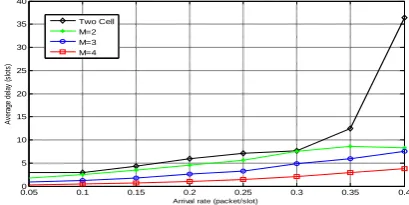
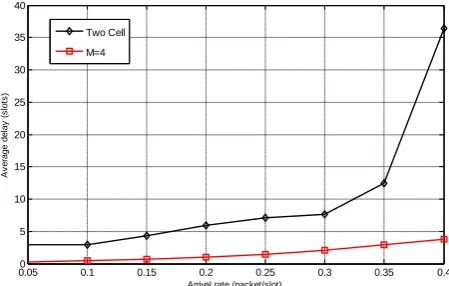
The two cell algorithm was then simulated with different number of smart antenna elements and plotted with the original two cell algorithm for comparison purposes. Figures 3, 4 and 5show the expecteddelays for the smart two cell algorithm for arrival rates being equal to 0.05 to 0.4. We observe that the delaysof the smart two-cell are notaffected as much by the traffic rate and the delays remain low, while the same delays for the regular two-cell are significantly increasing as the rate of the boundary traffic increases. The figures show that the expected delays of the two-cell algorithm for the rates =0.1 to =0.3 are relatively low, then after the rate
=0.3 the expected delay start increasing significantly. On the other hand, the smart two-cell show low delay rates for the rates =0.1 to =0.3, and also maintain low delay for the rates greater than =0.3. Furthermore, we also note that by increasing the number of antenna array elements 𝑀 the delay performance improved, which shows clearly the effect of employing a smart antenna with more than one antenna elements in increasing the received signal power and thereby improving the delay performance.
Figure 3 Average packet delay performance of the smart two-cell algorithm
Figure 4 Effect of the number of antenna elments M on the two cell algorithm
0.050 0.1 0.15 0.2 0.25 0.3 0.35 0.4
1 2 3 4 5 6 7 8 9
Arrival rate (packet/slot)
Av er ag e de la y (s lo ts ) M=4 M=2 M=3
0.050 0.1 0.15 0.2 0.25 0.3 0.35 0.4
5 10 15 20 25 30 35 40
Arrival rate (packet/slot)
Figure 5 Average packet delay performance of the two cell algorithm with the best smart two cell performance
𝑀 = 4
III.
CONCLUSION
In this paper, we considered a mobile random access algorithm for wireless digital networks with smart antennas in a Rayleigh slowly fading multipath channel. The model is a threshold model based on the signal to noise ratio and the protocol is a two-cell random access based protocol for use in ad hoc networks where nodes are equipped with adaptive array smart antennas. The signal received by all antenna elements of a smart antenna is a CDMA signal in the presence of multiple access interference (MAI) and multipath. The smart antenna uses an iterative adaptive LMS algorithm to adjust its weight for better signal reception of the desired signal while minimizing the effect of multipath and interferences. We simulated the two-cell random access algorithm with and without employing smart antennas and exhibited the antenna effect on the algorithm under different design parameters.
We have shown that employing all smart antenna elements significantly improved the performance of the system and reduced the expected delays induced by the two-cell algorithm, especially for higher traffic rates. We have also shown that when we increase the number of array elements from 𝑀 = 2to 𝑀 = 4, the expected delays decreased. Hence, the simulation results presented showed the performance improvement induced by the proposed communication system containing smart antennas and deploying a smart two-cell algorithm for wideband communication in a Rayleigh slowly fading multipath channel.
REFERENCES
[1].
L. C. Godara, ―Applications of Antenna Arrays to Mobile Communications, Part I: PerformanceImprovement, Feasibility, and System Considerations‖ , Proceedings of the IEEE, vol. 85, No. 7, pp. 1031-1060, July 1997
[2].
L. C. Godara, ―Applications of Antenna Arrays to Mobile Communications, Part II: Beam-Forming and Direction-of-Arrival Considerations‖ , Proceedings of the IEEE, vol. 85, No. 7, pp. 1195-1245, August 1997[3].
A. Sofwan and M. Barkat, "PN code acquisition Using Smart antennas and adaptive thresholding trimmed-mean CFAR processing for CDMA communication,"Spring World Congress on Engineering and Technology (SCET2012), Xi'an, China, 2012.[4].
J. Hsu and I. Rubin, ―Performance Analysis on Directional Random Access Scheme for Multiple Access Mobile Ad-Hoc Wireless Networks‖, IEEE Military Communications Conference, MILCOM 2005, vol. 1, pp. 45-51, October 2005.[5].
H.Harkirat, ―Smart-802.11 MAC protocol for use with Smart Antenna‖, IEEE international communication conference, Vol. 6, pp. 3684-3688[6].
W. K. Fung, M. Hamdi, and R. D. M. Murch, "Performance Evaluation of Mobile Radio Slotted ALOHA with Smart Antennas", IEEE Wireless Communications and Networking Conference, WCNC 1999, vol. 1,pp. 271 - 275[7].
A. T. Burrell and T. P. Papantoni, ―A Class of Limited Sensing Random Access Algorithms with Resistance to Feedback Errors and Effective Delay Control‖, Journal of Communications and Networks, Vol. 8, No. 1, pp. 21-27, March 2006[8].
A. T. Burrell and T. Papantoni, ―Signalling Protocols for Wireless Networks, 3rd International Conference Broadnets, San Jose, California, October 1-5, 2006.0.050 0.1 0.15 0.2 0.25 0.3 0.35 0.4
5 10 15 20 25 30 35 40
Arrival rate (packet/slot)
A
v
e
ra
g
e
d
e
la
y
(
s
lo
ts
)
Two Cell
[9].
B. Yucel and H. Delic, ―Mobile Radio Window Random-Access Algorithm with Diversity‖, IEEE Transactions on Vehicular Technology, vol. 49, no. 6, November 2000[10].
I. Stevanovi´c, A. Skrivervik and J. R. Mosig, Smart Antenna Systems for Mobile Communications, FinalReport, Laboratoire d’Electromagnetisme et d’Acoustique, Ecole Polytechnique Federale de Lausanne, Switzerland, January 2003.
[11].
M. Barkat, Signal Detection and Estimation, 2nd edition, Artech House, Boston, MA., USA, 2005[12].
K. S. Zigangirov, Theory of Code Division Multiple Access Communication, 1st Edition, Wiley-IEEEPress, 2004.
[13].
R. Pickholtz, D. L. Schilling, and L. B. Milstein,"Theory of Spread-Spectrum Communications -ATutorial," IEEE Transactions on Communications, vol. 30, pp. 855-884, 1982.
[14].
D. Campana and P. Quinn, "Spread-spectrum communications," IEEE Potentials, vol. 12, pp. 13-16, 1993.[15].
D. Prabakaran, ―Spread-Spectrum Technology and its Application,‖ Electronics for you, pp. 104-114,December 2005
[16].
I. J. Meel, "Spread Spectrum (SS) introduction," De Nayer Institut, Belgium, 1999.[17].
M. K. Simon, J. K. Omura, R. A. Scholtz, and B. K. Levitt, Spread Spectrum CommunicationsHandbook, McGraw-Hill, 2002.
[18].
R. A. Monzingo, R. L. Haupt, and T. W. Miller, Introduction to Adaptive Arrays, Scitech Publishing Inc.,Raleigh, NC., USA, 2011.
[19].
R. R. Rick and L. B. Milstein, ―Optimal decision strategies for acquisition of spread spectrum signals infrequency selective fading channels‖, IEEE Transactions on Communications, vol. 46, No. 5, pp. 1613-1628, Nov. 2001.
[20].
F. Gross, Smart Antennas for Wireless Communications with Matlab, McGraw-Hill, New York, USA,2005.
[21].
M. schwartz, Telecommunication Networks Protocols, Modelling and Analysis, Addison Wesley, UK.1987.
[22].
C. E. Shannon, ―Two-Way Communication Channels‖, Proceedings of the fourth Berkeley Symposiumon Probability and Statistics, pp. 611-644, Berkeley, CA, 1961
[23].
A. T. Burrell and T. P. Papantoni-Kazakos, "Random Access Algorithms in Packet Networks—A Reviewof Three Research Decades," International Journal of Communications, Network and System Sciences, Vol. 5 No. 10, 2012, pp. 691-707.
[24].
M. Zorzi, ―Mobile radio slotted ALOHA with capture and diversity,‖ Wireless Networks, vol. 1, pp. 227–239, May 1995.
[25].
M. Zorzi, ―Mobile radio slotted ALOHA with capture, diversity and retransmission control in thepresence of shadowing,‖ Wireless Networks, vol. 4, pp. 379–388, August 1998.