GIS based Spatial Mining of GPS Logs for Optimal
Path Routing
M Monica Bhavani1, DR. A. Valarmathi2
1
Department of CSE Anna University (Bit Campus) Trichy, India 2
Department of Computer Application Anna University (Bit Campus) Trichy, India
Abstract: This paper deals with the spatial mining of the GPS logs for finding optimal shortest path between every source & destination. The optimal route finding is based on the fuzzy logic based on shortest path calculation. The fuzzy logic is used for finding the optimal route based on various constraints like real time traffic, traffic intensity and the path with the optimal travel cost between the source to the destination. This paper is GIS based implementation of finding the optimal path with fuzzy logic and it is the comparison with the other GIS based tools for finding the shortest path between every source & destination. This fuzzy logic based shortest path algorithm is better than the classical Dijkstra’s algorithm for finding the shortest path. This fuzzy logic based shortest path algorithm outperforms all the other shortest path algorithms.
Keywords: shortest path; fuzzy logic; optimal route; GIS; spatial mining
I. INTRODUCTION
In today’s networks, one of the main goals of a service provider is to satisfy their customer demands while using the network resources efficiently. Currently, the prevalent use of topology-driven IP routing protocols with shortest-path computations is causing serious imbalance of packet traffic distribution when least-cost paths converge on the same set of links, leading to unacceptable delays or packet loss even when feasible paths over less utilized links are available. However, recently proposed enhancements to common routing protocols are promising to overcome such shortcomings by providing the means to distribute link-state information that is more pertinent to traffic engineering (TE) in routed networks [1]. Also, emerging TE routing techniques are promising to enable network service providers to optimize their resource utilization by evenly distributing or balancing the traffic load on their network links while maintaining the promised levels of service to their customer traffic [2]. Load balancing is a process that attempts to improve network utilization by choosing lightly loaded links for routing new path requests so that the maximum and average link utilization is minimized. When successful this process can eliminate, or at least delay, link congestion until network utilization approaches saturation. However, load balancing may result in selecting paths that are not necessarily the shortest between peers, potentially leading to increased delays and using more network nodes. In this paper, we propose a fuzzy-logic based algorithm for routing under traffic engineering constraints. The proposed Fuzzy Routing Algorithm (FRA) modifies the well known Dijkstra’s shortest path algorithm [3], by using fuzzy-logic membership functions in the path-cost update process. FRA is a low complexity on-line routing algorithm that computes the “best” paths under multiple TE optimization objectives.
In this paper, we consider optimization subject to three concurrent objectives, which are balanced end-to-end path utilization, balanced link utilization, and reduced number of hops, under bandwidth constraint. It is worth noting that previous studies [2], have indicated that load-balancing algorithms perform better than shortest path algorithms under low network load conditions.
At higher loads, shortest path algorithms normally outperform load balancing algorithms. The results reported in this paper show that FRA achieves load balancing at higher loads without increasing the path-request blocking probability. Most of the current TE routing methods either provide load balancing in the network or reduced path-request blocking, but not both [4] [5] [6].
II. RELATEDWORK
Computing the best (or lowest cost) paths on a graph under two or more constraints (or objectives) is a well known NPhard problem. For this reason, several heuristic algorithms, with polynomial time complexity, have proposed in the past. We discuss below two of the most common approaches to solve this problem, highlighting their pros and cons.
Widest Shortest Path (WSP) Algorithm [4]: A widely used routing algorithm for guaranteed-bandwidth connection requests is the Constrained-based Shortest Path First (CSPF) algorithm. CSPF works by first removing all links that have less available bandwidth than that required by the path request, then computing the shortest path in the residual graph. CSPF is guaranteed to find a guaranteed bandwidth path, if one exists, but does not provide any load balancing because it keeps selecting the same shortest path until it saturates. This will lead to blocking future route request through this path even when other underutilized paths with sufficient bandwidth are present in the network. The WSP method is an enhancement of CSPF that works as follows. WSP maintains a list of multiple shortest paths then selects the widest path among them for routing the pending request. The widest path is defined as the path that provides the highest residual bandwidth on its bottleneck link(s). Even with this improvement, WSP will still not be able to select highly underutilized paths, which are slightly longer than the shortest
path, thus resulting in an unbalanced network. Moreover, WSP will keep selecting the same shortest paths until some links on these paths are saturated. At this point many path requests will get rejected, which could be avoided if earlier requests have chosen slightly longer paths over underutilized links. The main advantage of WSP is its low computational complexity, which is the same as the complexity of Dijkstra’s Algorithm. This makes WSP suitable for online routing.
Minimum Interference Routing Algorithm (MIRA) [5]: MIRA’s path selection is based on information about location
of the ingress/egress router pairs involved in the routing process. For each connection request, MIRA finds the route that provides the least interference with paths for other ingress/egress router pairs. MIRA does this by finding critical links for each potential path for a router pair. If a path is routed through a critical (bottleneck) link then it reduces the maximum possible bandwidth flow between corresponding ingress/egress pairs. MIRA assigns higher weights to the links that are critical for more ingress/egress pairs. It was shown in [5], that MIRA provides a good solution only when the number of potential ingress/egress router pairs is small, but its performance degrades quickly when the number of such router pairs is large relative to the network size (number of routers). This is because, in this situation, most of the links are critical and it is hard for the routing algorithm to differentiate between
them in the path selection process. The second major problem with the MIRA approach is its high time complexity which may render it impractical for online routing. As reported in [5], the time complexity of MIRA is O(p.n2.√e), where p is the number of ingress/egress router pairs, n is the number of routers, and e is the number of links (edges) in the network. Since it is quite possible, and perhaps desirable, to have most
of the network routers configured as “edge” routers, the number of ingress/egress router pairs in this case will be O(n2). This means that p = e = n2, which results in a worst case time complexity of O(n5). By contrast WSP requires O(n2) time.
III. FUZZYCONSTRAINT-BASEDROUTING
In TE-based routing there is a fundamental trade off between load balancing and minimizing path length (number of hops). While shortest path routing can leads to congestion and possibly blocking, load balancing tends to use more links than
necessary to spread the traffic load thus wasting more network resources. Our fuzzy routing algorithm, FRA, provides a trade-off between load balancing and path length by using multiple objectives in the path cost optimization. In its current
formulation, FRA incorporates the following route optimization objectives: number of hops, maximum link utilization, and the average utilization of links other than the bottle neck link. Unlike WSP which performs load balancing for a path request based on the path’s bottleneck link only, FRA load-balancing is based on all links on the path. In reservation-based online routing, the only one constraint is the amount of requested bandwidth. Achieving better load balancing, however, requires satisfying several resource oriented objectives. We define following three resource-oriented objectives for load balancing:
Objective 1: Maximize the path bandwidth, i.e. maximizing the bandwidth on bottleneck link(s) with the least residual bandwidth on the path.
Objective 2: Maximize the bandwidth on links other than bottleneck link. When there is more than one path with same bottleneck bandwidth, then the path with higher residual bandwidth on links other than the bottleneck link is the better path.
Objective 3: Minimize the number of hops. This objective is
Solving a multi-objective routing problem, with more than one cost metric, is a well-known NP-hard problem [12]. The problem is further complicated by conflicting optimization objectives. In our case, maximizing the path bandwidth may increase the number of hops and vice-versa. Fuzzy logic is a particularly useful vehicle for solving hard optimization problems with potentially conflicting objectives. Fuzzy optimization allows mapping values of different criteria into linguistic values that characterize the level of satisfaction with the numerical value of the objectives. The numerical values are chosen typically to operate in the interval [0,1] according to the membership function of each objective [13]. FRA starts by satisfying the main constraint in the path request i.e., the requested bandwidth b between source router s and destination router d. This can be done by removing all links j having residual bandwidth rj < b from the graph G(N,L).
The next step of the algorithm computes the path feasibility according to a fuzzy criterion. FRA uses this to route each path request while maintaining a load balanced network. The
following fuzzy-logic rule defines a node reachability criterion.
Rule R1: IF A path to node y through node x has low bandwidth utilization on bottleneck link AND path to y through x has low bandwidth utilization on links other than bottleneck link AND path to y through x has less number of hops THEN The node y is highly reachable.
FRA uses this rule as follows: when routing a path-request, the path through which the destination router d is most reachable will be selected as the “best” path. To understand the above rule, we need to present some standard fuzzy logic methods. A fuzzy logic rule is an If-Then rule. The If part (antecedent) is a fuzzy predicate defined in terms of linguistic values and fuzzy operators Intersection and Union. The Then part is called the consequent. In our case, the linguistic value used in the consequent part identifies the fuzzy subset of reachable nodes through node x. There are many implementations of fuzzy union and fuzzy intersection operators.
IV. ALGORITHM ALGORITHM FRA(G,R, C, ingress, egress, b)
A. Notation
G = G(N,L) = Input Graph. R = Set of link residual bandwidth ri C = Set of link capacities ci. ingress = Ingress node. egress = Egress node. b = Bandwidth demand. Pathy = Set of nodes in the path from ingress to node y
B. Begin
1) Remove all links which does not satisfy bandwidth constraint “b” from G 2) Run Dijkstra’s Algorithm to calculate Hmin for each node
3) P = {}, Pathy ={}∀y, mringress=1, and mri = 0∀i ≠ingress.
C. Loop
1) Find x∉P such that mrx is maximum ∀x∉P; 2) P = P U {x}. If P contains egress then exit loop;
D. Loop
1) ∀y∉ P having a link xy Update test y =β×min ( pxy ,lxy ,hxy )+
β) ×1/3( pxy ,lxy ,hxy )
If testy > mry then Pathy = PathxU {x};
mr max(mr,test ); End If
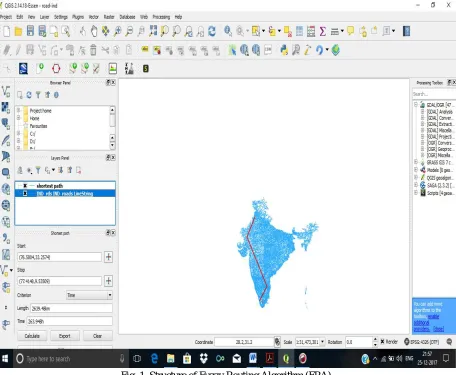
Fig. 1 .Structure of Fuzzy Routing Algorithm (FRA).
V. COMPUTATIONALCOMPLEXITY
The FRA algorithm employs Dijsktra’s graph search method to calculate minimum number of hops to each node from source node. The fuzzy logic membership computations do not add to the complexity in the asymptotic sense. Therefore, FRA has the same complexity as Dijkstra’s algorithm, which has a worst case value of O(n2) for a network graph with n nodes.
VI. SIMULATIONRESULTS
We have preformed extensive simulations to test the performance of the proposed algorithm. Our simulator is capable of modeling different routing algorithms for different input graphs and different flow request distributions.
Most of the previously reported algorithms [5][9][16] were tested for path requests routed between a small set of ingress/egress router pairs. This scenario is restricted and not representative of deployed networks. In our simulation environment, we have modeled networks with a large number of edge routers then generated path requests between all possible pairs of edge routers.We have compared FRA against WSP and MIRA under both static and dynamic conditions. In the static scenario once a request is routed it will not be removed throughout the simulation.
VII. CONCLUSION
REFERENCES
[1] H. M. Alnuweiri, L-Y K. Wong, and T. Al-Khasib,“Performance of new link-state advertisement mechanisms in routing protocols with traffic engineering extensions,” IEEE Communication Magazine, May 2004.
[2] P. Fafali, C. Patrikakis, A. Michalas, and V. Loumos, “Internet Traffic Engineering: History monitoring information featuring routing algorithms,” International Conference on Automation and Information, Sofia 2003.
[3] D. Bertsekas, and R, Gallager, “Data Networks,” seconded., Prentice Hall, New Jersey, 1992.
[4] R. Guerin, A. Orda, and D. Williams, “QoS routing mechanisms and OSPF extensions,” IEEE GLOBCOM’97, vol.3, pp. 1903-1908, November 1997. [5] K. Kar, M. Kodialam, and T. V. Lakshman, “Minimum interference routing of bandwidth guaranteed tunnels with MPLS traffic engineering applications,”
IEEE Journal on Selected Areas in Communications, issue 18, No. 12, pp. 2566-2579, December 2000.
[6] Z. Wang, and J. Crowcroft, “Quality of service routing for supporting multimedia applications,” IEEE Journal of Selected Areas in Communications, vol. 14, issue 7, pp.1288-1234, September 1996.
[7] E. Rosen, A. Vishwanathan, and R. Callon,“Multiprotocol label switching architecture,” IETF Network Working Group, RFC 3031, January 2001. [8] L. Andersson, P. Doolan, N. Feldman, A. Fredette, and B.Thomas, “LDP specification,” IETF Network Working Group, RFC 3036, January 2001
[9] A. Capone, L. Fratta, and F. Martignon, “Virtual Flow Deviation: Dynamic routing of bandwidth guaranteed connections,” The 2nd International Workshop on QoS in Multiservice IP Networks (QoS-IP 2003), pp. 592-605,Italy, 2003.
[10] A. K. Parekh, and R. G. Gallager, “A generalized processor sharing approach to flow control in integrated services networks: The multiple-node Case,” IEEE/ACMTransaction on Networking vol. 2, no. 2, pp 137-150,1994.
[11] K. Kar, M. Kodialam, and T. V. Lakshman, “MPLS traffic engineering using enhanced minimum interference routing: An approach based on lexicographic max-flow,” Eighth International Workshop on Quality of Service(IWQoS), Pittsburgh, USA, June 2000.
[12] E.Aboelela, and C. Douligeris, “Fuzzy reasoning approach for QoS routing in B-ISDN,” Journal of Intelligent and Fuzzy Systems, Application in Engineering and Technology, Vol. 9, pp. 11-27,November 2000.
[13] S. M. Sait, H. Youssef, and J. A. Khan. “Fuzzy evolutionary algorithm for VLSI placement,” Genetic and Evolutionary Computer Conference 2001 (GECCO-2001), pp. 1056-1063, San Francisco, July 2001.
[14] L. A. Zadeh. “Outline of a new approach to the analysis of complex systems and decision processes,” IEEE Transaction Systems Man. Cybern, SMC-3 (1): pp. 28–44, 1973.
[15] Ronald R. Yager, “On ordered weighted averaging aggregation operators in multicriteria decision making,”IEEE Transaction on systems, MAN, and Cybernetics,vol.18, pp. 183-190, January 1988.