comment
reviews
reports
deposited research
interactions
information
refereed research
Minireview
Towards a complete sequence of the human Y chromosome
Doris Bachtrog and Brian Charlesworth
Address: Institute of Cell, Animal and Population Biology, University of Edinburgh, Edinburgh EH9 3JT, UK.
Correspondence: Doris Bachtrog. E-mail: [email protected]
Abstract
A few dozen genes are known on the human Y chromosome. The completion of the human genome sequence will allow identification of the remaining loci, which should shed further light on the function and evolution of this peculiar chromosome.
Published: 26 April 2001
GenomeBiology2001, 2(5):reviews1016.1–1016.5
The electronic version of this article is the complete one and can be found online at http://genomebiology.com/2001/2/5/reviews/1016 © BioMed Central Ltd (Print ISSN 1465-6906; Online ISSN 1465-6914)
In humans, sex is determined by the presence or absence of the Y chromosome, which encodes the SRYgene necessary for testis development [1]. The Y chromosome is very unusual: it harbors just a few dozen genes, does not recom-bine over most of its length, is largely heterochromatic, and is riddled with repetitive DNA. Of all human chromosomes, the Y is probably the most intractable to genetic and molecu-lar analysis; because it does not recombine during meiosis, classical linkage mapping is impossible, and the high density of repeated sequences makes physical mapping and sequencing difficult. In a recent article [2], David Page and colleagues describe the first detailed map of the non-recom-bining region of the human Y chromosome, providing a foundation for the sequencing and further analysis of this chromosome.
Evolution of the human Y chromosome
The human Y chromosome is small and mostly devoid of genes, while the X chromosome, its meiotic pairing partner, contains several thousand genes [3]. Comparative studies strongly suggest that the X and Y chromosomes in mammals are descended from a homologous pair of autosomes [3-5]; this hypothesis is further supported by the existence of regions of homology between the two sex chromosomes [6].
But how did the X and Y chromosomes evolve to become so different? A likely scenario is that the pair of autosomes that would eventually become the sex chromosomes acquired a sex-determining role, and suppression of recombination
between the nascent Y and X chromosomes allowed them to evolve independently [5]. The X chromosome can still recombine in females, where two X chromosomes can pair, while most of the Y chromosome is completely sheltered from crossing over. The lack of recombination over most of the Y chromosome means that natural selection is less effec-tive in preventing the accumulation of deleterious mutations and in driving the fixation of beneficial ones, resulting in the genetic erosion of the Y chromosome [5]. In response, dosage compensation evolves to restore equality of the dosage of gene products from X-linked loci in males and females [5]. In eutherian mammals, this is achieved by the inactivation of one of the two X chromosomes in females.
2 GenomeBiology Vol 2 No 5 Bachtrog and Charlesworth
polymorphic inversion (3.5 megabases) has been identified on the human Y chromosome [2].
Gene content of the human Y chromosome
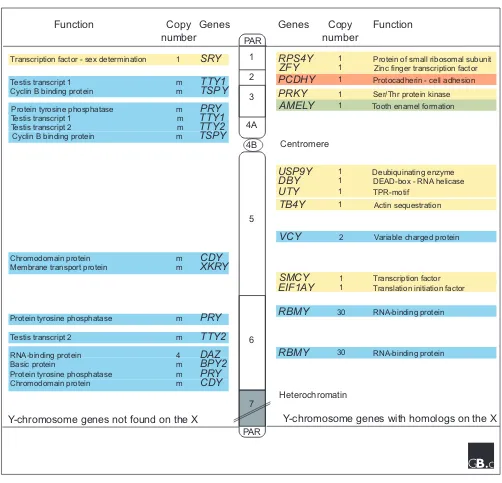
X-Y homologous regions are located at either end of the Y chromosome; these pair and recombine with the X chromo-some during male meiosis [7]. Because genes that map to these regions do not show strict sex linkage, they are called pseudoautosomal regions (PARs, see Figure 2). The PARs contain several genes that are active on the Y chromosome and not subject to X inactivation in females [8].
In humans, about 95% of the Y chromosome forms the non-recombining region (NRY). The NRY was long thought to be a functional wasteland, but reports in 1959 of XO females and XXY males established the existence of a sex-determining gene on the human Y chromosome [9], and in 1976 a factor
required for spermatogenesis was mapped to the human Y chromosome [10]. The search for the testis determinant resulted in the cloning of the SRY gene in 1990 [1]. Now, more than 20 active genes or gene families have been identi-fied. These genes fall into two main classes (Figure 2), unlike the situation on other chromosomes, whose gene content is relatively haphazard [11]. Genes in the first class are expressed in many tissues; these housekeeping genes have homologs on the X chromosome that escape X inactivation in females. Genes in the second group have a testis-specific function and have no X-linked homologs. Nearly all the testis-specific genes are present in multiple copies.
[image:2.609.60.558.86.440.2]What are the evolutionary forces responsible for this bipartite division of genes on the Y chromosome? Selection will oppose the degeneration of genes that have critical functions in males and lack X homologs. Accordingly, most of the Y-specific genes are transcribed solely in the testis, indicating a function Figure 1
A proposed path for the evolution of the human sex chromosomes. Lahn and Page [6] postulate four inversions on the human Y chromosome, which suppressed recombination between the ‘proto’ sex chromosomes. Each inversion (designated 1-4) is thought to have reduced the size of the pseudoautosomal region (white) and enlarged the non-recombining portions of the X (yellow) and Y (blue) chromosomes. Time points at which the human X and Y may have diverged from the sex chromosomes of other mammals are indicated.
Autosomes
SRY
Proto-Y Proto-X Y X Y X Y X Y X
4 3
2
1 3
2
1
1 1
2
XY in
monotremes marsupialsXY in non-simianXY in placental mammals
XY in humans
comment
reviews
reports
deposited research
interactions
information
refereed research
in spermatogenesis, and several deletions on the human Y chromosome are associated with male infertility [12]. The presence of these genes in multiple copies may reflect selec-tion for high levels of their products. The loci shared between X and Y chromosomes are probably genes whose Y-linked copies have simply not degenerated. Most of these
[image:3.609.52.554.80.563.2]genes are located in the younger strata of the Y chromo-some [6], suggesting that they have not had sufficient time to degenerate. Many pseudogenes on the Y chromosome also have active homologs on the X, most of which are located in the younger strata as well (for example, STSP, KALP and GYG2P). Some of the housekeeping genes that are active on Figure 2
Genetic map of the non-recombining region of the human Y chromosome. The human Y chromosome consists of a large non-recombining region (NRY, which consists roughly of 24 megabases (Mb) euchromatin and 30 Mb heterochromatin) flanked by short pseudoautosomal regions (PAR, about 2.6 Mb and 0.4 Mb, respectively). Genes specific to the Y
chromosome are indicated on the left-hand side of the diagram, and genes with homologs on the X chromosome are on the right-hand side. Ubiquitously expressed genes are shown in yellow, testis-specific genes are in blue, tooth-bud-specific genes in green, and brain-specific genes in red. Some testis-specific gene families have additional locations on the NRY not shown (m: multiple copies). The extensive region of Y-chromosomal heterochromatin is indicated by the grey area. The NRY is divided into intervals (as indicated by numbers on the chromosome), defined by naturally occurring deletions.
RPS4Y
Protein of small ribosomal subunitZFY
Zinc finger transcription factorUSP9Y
Deubiquinating enzymeDBY
DEAD-box - RNA helicaseUTY
TPR-motifAMELY
Tooth enamel formationPCDHY
Protocadherin - cell adhesionRBMY
RNA-binding proteinRBMY
RNA-binding proteinEIF1AY
Translation initiation factorSMCY
Transcription factorVCY
Variable charged proteinTB4Y
Actin sequestrationPAR PAR
Heterochromatin
Function
Copy
Function
number
Genes
Genes
number
Copy
Cyclin B binding protein m
TSPY
Testis transcript 1Protein tyrosine phosphatase mm
TTY1
PRY
Testis transcript 2 mTTY2
Transcription factor - sex determination 1SRY
Testis transcript 1 m
TTY1
Cyclin B binding protein m
TSPY
Chromodomain protein m
CDY
Membrane transport protein mXKRY
RNA-binding protein 4
DAZ
Basic protein mBPY2
Y-chromosome genes not found on the X
Y-chromosome genes with homologs on the X
Centromere
PRKY
Ser/Thr protein kinaseProtein tyrosine phosphatase m
PRY
Testis transcript 2 mTTY2
Protein tyrosine phosphatase m
PRY
Chromodomain protein mCDY
1 1
1 1 1 1 1
1 1
30 30 1 1 2
1
2 3
4A
4B
5
6
the human Y chromosome are pseudogenes in other euther-ian lineages. For example, RPS4Y can be detected only in primates, where the homologous X-linked locus RPS4X escapes X inactivation [13]. In non-primate lineages, RPS4X has not retained a Y-linked homolog and is subject to X inac-tivation in females [13]. Similarly, ZFX, which has a strongly conserved homolog, ZFY, on the human Y chromosome, has lost its Y-linked copy in myomorph rodents [13]. The ubiqui-tin-activating enzyme locus UBE1X, in contrast, has a homolog on the squirrel-monkey Y chromosome, but no Y-linked copy can be detected in humans [14].
Comparative studies across mammalian taxa have demon-strated that the Y chromosome in humans has undergone multiple rearrangements [15]. Some genes such as SRY, RPS4Y or SMCY, were presumably originally Y-linked and escaped degeneration, as indicated by their presence on the sex chromosomes of marsupials, which diverged from a common ancestor with eutherians around 170 million years ago [16]. Others are derived from direct additions of autoso-mal genes, like the Y-specific DAZ gene cluster [17] or the CDYgene family [18]. CDYis intronless, suggesting that it originated by retrotransposition, while DAZcontains introns. Another source of Y-linked genes is provided by originally autosomal genes that were incorporated via the pseudoauto-somal region. STSand ANT3, which are autosomal in marsu-pials, have been added to the PAR in eutherians, as revealed by their locations in sheep and dogs [15]. In humans, ANT3is part of the PAR, while STS is incorporated into the non-recombining region of the sex chromosomes, where its Y-linked homolog (STSP) has become a pseudogene.
Non-coding and repetitive DNA
One of the greatest challenges for mapping the human Y chromosome was presented by massive, NRY-specific ampli-fied regions, which comprise about one third of the euchro-matic NRY [2]. These euchroeuchro-matic amplified regions are diverse in composition, size, copy number and orientation, with some occurring as tandem repeats, others as inverted repeats, and still others dispersed throughout both arms of the chromosome [2]. Most Y-specific genes are found in these amplified regions [2].
The Y chromosome also contains highly abundant Alu and LINE repetitive elements, which are found throughout the entire human genome [19]. Much of the human Y chromo-some is composed of repetitive satellite DNA, the bulk of which is located in the block of heterochromatin in the long arm (roughly 30 Mb in size; see Figure 2). This heterochro-matic region mostly consists of the 3.4 kilobase (kb) DYZ1 and the 2.5 kb DYZ2repeat families, which together account for around 50-70% of the DNA content of the human Y chro-mosome [20]. Heterochromatic regions, which are assumed to have no genes, are generally ignored in mapping and sequencing projects, because of the difficulties in cloning and
sequencing them. Several genes have been identified in the heterochromatic Y chromosome of Drosophila[21], however, suggesting that there may be some genes to discover in the heterochromatic block of the human Y chromosome.
It is interesting to note some differences between Y-linked genes in Drosophila and humans. All known functional genes on the D. melanogasterY chromosome have essential male-specific functions. In contrast to the human Y-specific genes, almost all are believed to be single-copy [21]. In Drosophila, the dynein genes present on the Y chromosome have huge introns up to several megabases in size [22]. These introns contain satellite- and transposable-element-derived DNA. Non-recombining genomic regions, such as the Y chromosome, are predicted to accumulate transpos-able elements and satellite repeat sequences [23]. In humans, no systematic trend towards larger introns can be seen in the genes characterized on the Y chromosome; this may be associated with the reduced activity of transposable elements in the human lineage [19].
What future insights may be provided by the human Y chro-mosome sequence? Probably the major difference between the X and the Y chromosomes from an evolutionary perspec-tive is the lack of recombination over most of the Y chromo-some. Evolutionary biologists are uncertain about the nature of the advantage gained from recombination [24]; the grisly fate of a large piece of non-recombining genome is demonstrated by the degenerate Y chromosome, however. Sequence analysis will provide a better understanding of the evolution of this bizarre chromosome.
But a more practical benefit may also be derived. As many as 7.5% of men are infertile, and one estimate suggests that in up to a quarter of these men infertility is caused by a Y-chro-mosomal defect [12]. Discoveries of Y-chromosome genes that influence reproductive capacity could lead to new treat-ments for men who lack those genes or have defective copies.
References
1. Sinclair AH, Berta P, Palmer MS, Hawkins JR, Griffiths BL, Smith MJ, Foster JW, Frischauf AM, Lovell-Badge R, Goodfellow PN: A gene from the human sex-determining region encodes a protein with homology to a conserved DNA-binding motif. Nature 1990, 346:240-244.
2. Tilford CA, Kuroda-Kawaguchi T, Skaletsky H, Rozen S, Brown LG, Rosenberg M, McPherson JD, Wylie K, Sekhon M, Kucaba TA, Waterston RH, Page DC: A physical map of the human Y chro-mosome.Nature 2001, 409:943-945.
3. Graves JA: The origin and function of the mammalian Y chro-mosome and Y-borne genes - an evolving understanding.
Bioessays 1995, 17:311-320.
4. Ohno S: Sex Chromosomes and Sex Linked Genes. Berlin: Springer, 1967.
5. Charlesworth B: The evolution of chromosomal sex determi-nation and dosage compensation.Curr Biol 1996, 6:149-162. 6. Lahn BT, Page DC: Four evolutionary strata on the human X
chromosome.Science 1999, 286:964-967.
7. Burgoyne PS: Genetic homology and crossing over in the X and Y chromosomes of mammals.Hum Genet 1982, 61:85-90.
8. Polani PE: Pairing of X and Y chromosomes, non-inactivation of X-linked genes, and the maleness factor.Hum Genet 1982, 60:207-211.
9. Jacobs PA, Strong JA: Case of human intersexuality having a possible XXY sex-determining mechanism. Nature 1959, 183:302-303.
10. Tiepolo L, Zuffardi O: Localization of factors controlling sper-matogenesis in the nonfluorescent portion of the human Y chromosome long arm.Hum Genet 1976, 34:119-134.
11. Lahn BT, Page DC: Functional coherence of the human Y chromosome.Science 1997, 278:675-680.
12. Stuppia L, Gatta V, Calabrese G, Guanciali Franchi P, Morizio E, Bombieri C, Mingarelli R, Sforza V, Frajese G, Tenaglia R, Palka G: A quarter of men with idiopathic oligo-azoospermia display chromosomal abnormalities and microdeletions of different types in interval 6 of Yq11.Hum Genet 1998, 102:566-570. 13. Jegalian K, Page DC: A proposed path by which genes common
to mammalian X and Y chromosomes evolve to become X inactivated.Nature 1998, 394:776-780.
14. Mitchell MJ, Wilcox SA, Watson JM, Lerner JL, Woods DR, Scheffler J, Hearn JP, Bishop CE, Graves JA: The origin and loss of the ubiquitin activating enzyme gene on the mammalian Y chromosome.Hum Mol Genet 1998, 7:429-434.
15. Graves JA, Wakefield MJ, Toder R: The origin and evolution of the pseudoautosomal regions of human sex chromosomes.
Hum Mol Genet 1998, 7:1991-1996.
16. Toder R, Wakefield MJ, Graves JA: The minimal mammalian Y chromosome - the marsupial Y as a model system.Cytogenet
Cell Genet 2000, 91:285-292.
17. Saxena R, Brown LG, Hawkins T, Alagappan RK, Skaletsky H, Reeve MP, Reijo R, Rozen S, Dinulos MB, Disteche CM, Page DC: The DAZgene cluster on the human Y chromosome arose from an autosomal gene that was transposed, repeatedly ampli-fied and pruned.Nat Genet 1996, 14:292-299.
18. Lahn BT, Page DC: Retroposition of autosomal mRNA yielded testis-specific gene family on human Y chromosome. Nat
Genet 1999, 21:429-433.
19. International Human Genome Sequencing Consortium: Initial sequencing and analysis of the human genome.Nature 2001, 409:860-921.
20. Cooke HJ, Fantes J, Green D: Structure and evolution of human Y chromosome DNA.Differentiation 1983, 23:Suppl:S48-55. 21. Carvalho AB, Lazzaro BP, Clark AG: Y chromosomal fertility
factors kl-2 and kl-3 of Drosophila melanogaster encode dynein heavy chain polypeptides.Proc Natl Acad Sci USA 2000, 97:13239-13244.
22. Reugels AM, Kurek R, Lammermann U, Bunemann H: Mega-introns in the dynein gene DhDhc7(Y) on the heterochro-matic Y chromosome give rise to the giant threads loops in primary spermatocytes of Drosophila hydei. Genetics 2000, 154:759-769.
23. Charlesworth B, Sniegowski P, Stephan W: The evolutionary dynamics of repetitive DNA in eukaryotes. Nature 1994, 371:215-220.
24. Barton NH, Charlesworth B: Why sex and recombination?
Science 1998, 281:1986-1990.
comment
reviews
reports
deposited research
interactions
information
![Figure 1A proposed path for the evolution of the human sex chromosomes. Lahn and Page [6] postulate four inversions on thehuman Y chromosome, which suppressed recombination between the ‘proto’ sex chromosomes](https://thumb-us.123doks.com/thumbv2/123dok_us/8602482.865121/2.609.60.558.86.440/evolution-chromosomes-postulate-inversions-chromosome-suppressed-recombination-chromosomes.webp)