ANALYSIS AND DESIGN OF MULTI - STOREY BUILDING UNDER LOAD
COMBINATION
V. Nagaraju
1, N. Vedakala
2, Y. Purnima
3, Ajay Kumar
4, Y Sudheer Babu
51,2,3 UG Student, Civil engineering Dept, MIC College of Technology, Kanchikacherla, India 4Asst. Professor, Civil engineering Dept, MIC College of Technology, Kanchikacherla, India
5Professor, Civil engineering Dept, MIC College of Technology, Kanchikacherla, India
---***---ABSTRACT: To design and evaluate the Reinforced
Concrete (RC) building structures for precise results with various loads is a wide and complex problem. Proper design of structure and valid results leads to better life and performance of structure, under various load combinations. It is necessary to carry out the most realistic definition of the structural capacity, in terms of strength and deformability of the system under the effect of multiple loads. For this purpose, it is necessary to adopt a clear and concise procedure with specified load combinations that will enable quick and simple methods to reduce defects. In this study, the G+5 storey RC building has been analyzed and designed with load combinations under seismic considerations, which is considered for very high seismic prone area zone - V and also, virtually considered for heavy snow fall. Comparison between manual and software design has been analyzed, which leads to increase the design quality and accuracy. Structural members under lateral and seismic forces have been designed for torsion and ductility.
Keywords: - Structural load, load combination, Snow load, Comparison
1. INTRODUCTION
The main aim of the project is to design a multi - storey building (G+5) for residential purpose, taking different load combinations into consideration. The design process of multi - storey building require not only imagination and conceptual thinking but also a knowledge in structural engineering and practical aspects such as recent design codes, bye laws, backed up with sample experience. The purpose of standards is to ensure and enhance the safety with vigilance balance between beams, columns, footings, slabs etc., This study has been carried out for the analysis of G+5 multi - storey residential building against to sustain natural calamities like Earthquake and snow loads as per Indian standard codes of 1893(part1) - 2002(in some cases IS13920 also used) and IS 875(part4) - 1987. The member forces have been calculated for load combinations by using limit state method given in IS 456: 2002 and designed for the most critical member forces among them. The snow, wind (IS 875 part3) and seismic loads which are acting on the building have been calculated for seismic zone - V in Himachal Pradesh, (kangra). In most cases, dead and live loads are
considered using the codes IS 875 - part1 and IS 875 - part2, whereas for load combinations IS 875 -part 5 is used.
1.1 Building elements 1.2 Loads
1.3 Load combination 1.4 Basics of design
1.1 Building Elements
a) Foundation b) Beams c) Column d) Staircase
1.2 Loads
a) Dead load b) Live load c) Seismic load d) Wind load e) Snow load f) Other loads
1.3 Load Combination
Load combinations provide the basic set of building load conditions that should be considered by the designer.
i) 1.5(DL+LL) ii) 1.2(DL+LL+EQX) iii) 1.2(DL+LL+EQZ) iv) 1.5(DL+EQX) v) 1.5(DL+EQZ) vi) 1.5(DL + WLX) vii) 1.5(DL + WL Z) viii) 0.9DL+1.5EQX ix) 0.9DL+1.5EQZ x) 0.8DL +0.9 SL
xii) 1.2 DL + 1.2 LL +1.2 WL+1.2 SL
[image:2.595.40.280.117.334.2]2. PLAN AND LAY OUT
Figure 2.1 Typical Floor Layout Plan
(a) (b)
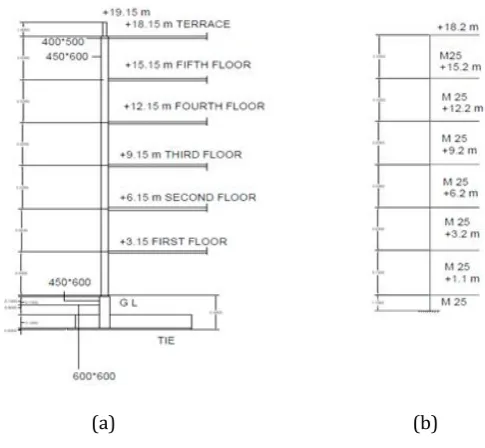
Figure 2.2 (a) Part Section (b) Part Frame Section
2.1 MODELING OF BUILDING
2.1.1 Details of Building
i) Length of Building = 25.66m ii) Width of Building = 11.6 m iii) Height of Building = 18 m
iv) Dimensions of column = (0.60m x 0.45m) v) Dimensions of beam = (0.40m x 0.50m) vi) Thickness of Slab = 0.18m
vii) Dead Load on Building for 0.23m thick wall = 14KN/m
viii) Live Load on Building =2.0 KN/m2 ix) Seismic load as per Zone factor
a) Earthquake load in X- Direction b) Earthquake load in Z- Direction x) Wind load
a) Wind load in X - Direction b) Wind load in Z - Direction xi) Snow load
a) Snow load in Y - Direction
2.2 Salient Features
Utility of building = Residential Building
No of stories = 5
No of stair cases = 1
No of flats = 10
No of lifts = 1
Type of structure = RCC framed structure Type of walls = brick wall
2.3 Geometric Details
Ground floor = 3 m Floor to floor height = 3 m Height of plinth = 0.6 m Depth of foundation = 2 m
2.4 Materials Used
Concrete grade = M25 All steel grades = Fe 415 steel Bearing capacity of soil = 250 KN/m2
3. METHODOLOGY
3.1 Design:
To design a structure with less anomalies and errors, it is very necessary to choose a suitable design method. A structure is embedded with no of elements and components hence any error in design can lead to failure of the entire structure. There are two design methods available as given below:
i) Working stress method ii) Limit state design method
3.1.1 Working Stress Method
[image:2.595.34.277.366.590.2]ii) It deals only with elastic behavior of member perfectly elastic at all stages of loading; Stress-strain relations obey hooks law (linear).
iii) Factor of safely for yield stress, allowable stresses are less than ‘fy’
iv) Since, the specifications set limit on the stress, it became working stress method.
v) Working Stress method does not give reasonable measure of strength, which is more fundamental measure of resistance than is allowable stress.
vi) Another, drawback in working stress method is that safety is applied only to stress level. Loads are considered to be deterministic (without variation). For example, Permissible bending & direct compression are as fraction of crushing strength.
3.1.2 Limit State Method
Limit state is a method in which a structure or structural components ceases to fulfil the functions for which it is designed. The above structural elements are designed based on limit state method which considers the variability not only in resistance but also in the effects of load. Concept of separate partial safety factors of loads of different combinations in the two limit state methods.In this method all relevant states must be considered in design to ensure a degree of safety. By adopting this method the structure leads to better and accurate results.
3.2 Analysis
Analysis deals with the study of strength and behavior of the members for working loads in which frames can be analyzed by various methods. However, the method of analysis which is adopted depends on the type of frame with its configuration on multi - storey buildings and the resulting degree of indeterminacy.
3.2.1 Analysis Methods
The methods used for Analysis are:
i) Flexibility coefficient method ii) Slope displacement method iii) Iterative methods
a. Moment distribution method (by Hardy cross in 1930’s).
b. Kani’s method (by Gasper kani in 1940’s)
iv) Approximate methods a. Substitute frame method b. Portal method c. Cantilever method
4. DESIGN FOR SEISMIC FORCES
4.1 Seismic Weight Calculations
Table No 4.1 Seismic weight of storey VI (terrace)
Details Dimensions D.L +L.L
From Slab 11.5 * 12.8 3680+2 Parapet 1*11.5 287.5+2 Walls 1* 11.5 230+2 Beams 0.40 * 0.500 5+2 Columns 0.45 * 0.600 6.75+2
Total 4219.5 KN
Table No 4.2 Seismic weight of storey V, IV, III
Details Dimensions D.L + L.L
Slab 11.5 * 12.8 3680 + 2 Walls 1 *11.5 287.5 + 2 Beams 0.400*0.500 5 + 2 Columns 0.450* 0.600 6.75 +2
Total 3987.25 KN
Table No 4.3 Seismic weight of storey II
Details Dimensions D.L + L.L
Slab 11.5 * 12.8 3680+2 Walls 1 * 11.5 230 + 2 Beams 0.40 * 0.5 5 + 2 Columns 0.45 * 0.6 6.75 +2
Total 3929.75 KN
Table No 4.4 Seismic weight of storey I(Plinth)
Details Dimensions D.L + L.L
Walls 1 * 11.5 230 + 2 Beams 0.4 * 0.5 5 + 2 Columns 0.45 * 0.6 6.75 + 2
Total 247.75 KN
Seismic weight of the entire building = 4219.25+3987.25+3929.25+247.75 = 12384 KN
4.2 Design Seismic Load
Ta = 0.075 h (0.75)
= 0.075 (18)(0.75)
= 0.65 sec
Importance factor, I = 2 Sa/g = 1/Ta
=1/0.65
= 1.538 [IS: 1893 (part 1): 2002]
Table No 4.5 Distribution of Total Horizontal Load to Different Floor Level
Storey Wi(Kn) Hi (M)
Wihi2 * 10(-3)
Qi Vi
VI 4219.25 18 1367.03 563.45 563.45 V 3987.25 15 897.13 369.77 933.25 IV 3987.25 12 574.16 236.65 1169.87 III 3987.25 9 322.96 131.11 1302.98 II 3929.75 6 141.47 58.31 1361.29 I 247.75 3 2.22 0.919 1362.20
Total 3304.97 1362.20
Ah = (z/2) * ( i/r) *(sa/g)
= (0.36/2) * (2/5) * (1/0.65) = 0.110
4.2.1 Base Shear
Vb = Ah * W
= 0.110 * 12384 = 1362.24 KN
4.2.2 Accidental Eccentricity
Edi = 1.5 esi + 0.05 bi
(Or)
= Esi – 0.05 bi
0.05 bi = 0.05 * 12.07
= 0.603 m
Figure 4.1 Accidental Eccentricity Including Torsion in the building
5. DESIGN OF SLAB
Dimensions = 4.15 * 4.88 m IY/Ix = 4.88/4.15
= 1.176 < 2 Hence, it is two way slab.
Thickness = 150 + 30 = 180 mm
Total load = 17.5 KN/m2Factored load = 26.25
KN/m2
Mux = 0.057 x 26.25 x 4.152
= 25.77 KN-m
Muy = 0.047x 26.25 x 4.152
= 21.25 KN-m
Vu = Wul/ 2 = (16.25 x 4.15)/2
= 54.47 KN
5.1 Reinforced Details
5.1.1 Along X Direction
Astx (req) = 504.04mm2
*Hence provide 10 mm bars at 220 mm c/c
5.1.2 Along Y Direction
Ast (req) = 443.74 mm2
*Provide 4bars of 12mm diameter bars of 250mm c/c.
5.2 Edge Strips
Hence, provide 8mm bars at 230mm c/c
6. DESIGN OF BEAM AND COLUMNS
6.1 Manual Analysis for Load Combination by Substitute Frame Method
Assumed dimensions Beam = 400 * 500 mm Column = 450 * 600 mm
6.1.1 Cases Considered
I) Max – Min – Max 160 KN – 110 KN – 160 KN II) Min – Max – Min 110 KN – 160 KN – 110 KN III) Max – Max – Max 160 KN – 160 KN – 160 KN
0 200 400 600
1 2 3 4 5 6
FLOO
R
NU
M
ER
S
Table 6.1 Cases for Fixed End Moments
[image:5.595.321.562.404.526.2]Table 6.2 Distribution Factor Table
Table No 6.3 Substitute Frame Moments
Table No 6.4 Substitute Frame Shear Forces
*From the above tables
Maximum bending moment = 457.83 KN m Maximum shear force = 706.57 KN
6.2. Beam Design
Assume beam dimensions = 400 * 500
d = 450 mm
d’ = 50 mm
fck = 25 N/mm2
fy = 415 N/mm2
L = 4.15 m
Total load = 58 KN/m Ultimate design load = 87 KN/m
6.2.1 Reinforcement Details
Ast = 2153.71 + 1235.13 = 3388 mm2
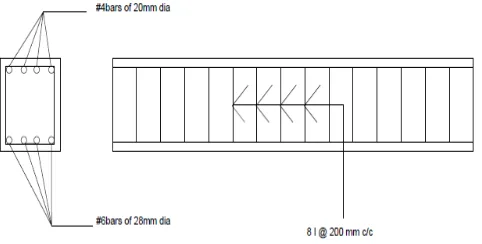
Provide 6 bars of 28mm diameter (Ast = 3694.51mm2)
6.2.2 Shear Reinforcement
[image:5.595.35.281.411.566.2]*Provide8 mm diameter bars spacing of stirrups 250mm.
Figure 6.1 Reinforcement Details of Beam
6.3 Column Design
Mux = 119.04 KN-m
Muy = 46.73 KN-m
Data
B = 450 mm
D = 600 mm
pu = 4219.25 KN
fck = 25 N/mm2
fy = 415 N/mm2
d’ = 60 mm
6.3.1 Reinforcement
As = pbD/100
= 3 * 450 * 600/100 = 8100 mm2
Using 18 bars of 25mm diameter distributed 3 on each face
As =8835.72 mm2
Mux1 =486 KN-m
,Muy =364.5 KN-m
puz =5688.21 KN
[image:6.595.35.554.42.822.2]*provide 8mm diameter lateral ties at 300mm centers will contours to the weld requirements.
Figure 6.2 Reinforcement Details of Column
7. SOFTWARE DESIGN
7.1 Beam Design
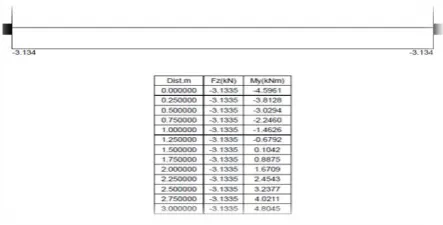
[image:6.595.319.557.273.416.2]Figure 7.1 Shear Force and Bending Moment Details of Beam
[image:6.595.39.280.283.435.2]Figure 7.2 Deflection of Beam
Figure 7.3 Reinforcement details of Beam
7.2 Design of column
Figure 7.4 Reinforcement Details of Column
[image:6.595.355.548.478.598.2] [image:6.595.328.550.643.755.2]Figure 7.6 Column Deflection
[image:7.595.44.275.86.218.2]8. DESIGN OF FOOTING
[image:7.595.51.263.291.429.2]Figure 8.1 Reinforcement Details of Mat Footing
Table No 8.1 Punch Shear Report
Table 8.2 Longitudinal Direction - Top Zone Reinforcement Summary
[image:7.595.327.549.309.497.2]9 DESIGN OF STAIR CASE
Figure 9.1 Details of Stair Case
10. IS CODES
i) IS 456-2000 (Design of RCC structural elements)
ii) IS 875-Part 1 ( Dead Load ) iii) IS 875-Part 2 ( Live Load ) iv) IS 875- Part 3 (Wind Load) v) IS 875- Part 4 (Snow Load) vi) IS 875- Part 5 (Load Combination) vii) IS 1893-part 1 (Seismic Forces) viii) IS 13920 (ductile details)
ix) SP-16 (Depth and Percentage of Reinforcement)
11. CONCLUSION
[image:7.595.35.288.500.709.2]ii) The structure has been designed by using staad.pro considering IS codes for safer results.
iii) By comparing the manual and the numerical model design the area of AST required for the beam, column, footing and slab are comparatively similar to that requirement.
iv) Structural members like columns and beams have been designed for ductility, hence the lateral forces at member joints will effect minimum and also resist for torsion.
The consideration of various load combinations was a challenging part for design of G+5 building in high seismic prone areas. Hence, in seismic design of forces as referred earlier, it’s important to design structures for earthquake resistant as well as for ductility.
12. REFERENCES
Bachmann, H. (2002, December). Seismic Conceptual Design of Buildings. Basic Principles for Engineers, Architects, Building Owners, and Authorities., 82.
Hardik, Desai., Taha, bookseller.,Prutha, Vyas. (2016). BASE SHEAR CALCULATION OF RCC STRUCTURE. International Conference on “Recent Research Development in Science, Engineering and Management” Mahratta, ISBN: 978-(May), 135–140.
IITKGP. (2009). Earthquake Resistant Design of Structures.
Murty, C. V. R., Rupen, Goswami., A. R. Vijayanarayanan., Vipul V. Mehta. (2012). Earth quake Behaviour of Buildings.
P, C, Vasani. Bhumika, B, Mehta. (n.d.). DUCTILITY REQUIREMENTS FOR BUILDINGS, (79), 1–10.
Paulay.T. (1996). Seismic Design of Concrete Structures. Eleventh World Conferences on Earthquake Engineering, ISBN:00804, 2001.
Rajesh, V., & Prakash, K. J. (2016). Wind And Seismic Analysis And Design Of Multistoried Building ( G + 30 ) By Using Staad Pro, 4(1), 116–123.
Shah, H. J. (2005). Design Example of a Six Storey Building. Design Example of a Six Storey Building, 3.0(IITK-GSDMA-EQ26), 51.
Sudhir, K, J. (2005). Explanatory Examples on Indian Seismic Code IS 1893 ( Part I ), (IITK-GSDMA-EQ21-V2.0), 27.
Tomasi, R. (2017). Seismic design of buildings Analysis and design of earthquake resistant buildings. Norwegian University of Life Sciences, 22.
Wagh, M. R., Nikhade, A. R., & Nikhade, H. R. (2014). Analysis and Design Considering Ductile Detailing of Reinforced Concrete Structure, 3(11), 2987–2991.