IJPSR (2012), Vol. 3, Issue 07 (Research Article)
Received on 26 March, 2012; received in revised form 25 June, 2012; accepted 28 June, 2012
SIMPLE AND SENSITIVE VALIDATED REVERSE PHASE HPLC-UV METHOD FOR THE DETERMINATION OF LYMECYCLINE IN PHARMACEUTICAL DOSAGE FORMS
T. Nageswara Rao*1, T.B. Patrudu ², T. Srinivasa Rao 3 and T. Parvathamma 1
Department of Analytical Chemistry, International Institute of Biotechnology and Toxicology (IIBAT) 1, Padappai-601 301, Kanchipuram District, Tamil Nadu, India
Department of Engineering Chemistry GITAM University, Hyderabad Campus ², Andhra Pradesh, India
Scientist, Johnson & Johnson – Health Care Products & Pharmaceuticals, Mumbai 3, Maharashtra, India
ABSTRACT
A Simple, Sensitive, Precise, and specific reverse phase high performance liquid chromatographic method has been developed for the determination of lymecycline in pharmaceutical Dosage Forms. Chromatographic separation was achieved on a PLRP-S (250×4.6 mm), 8.0 µm make: Varian column with a 11.5:10:20:1:57.5 mixture of 2-Methyl-2-propanol,3.5% w/v di-potassium hydrogen phosphate, 1.0% w/v Tetra butyl ammonium hydrogen sulphate, 4.0% w/v di -sodium edetate and JT Baker water as mobile phase, detection was at 254 nm. Response was a linear function of concentration in the range 5-0.02 mg/L for lymecycline; correlation coefficient was 0.9998, respectively. LOD and LOQ for lymecycline were found 0.02 mg/L and 0.05 mg/L. Accuracy (recoveries 95-97%) and reproducibility were found to satisfactory.
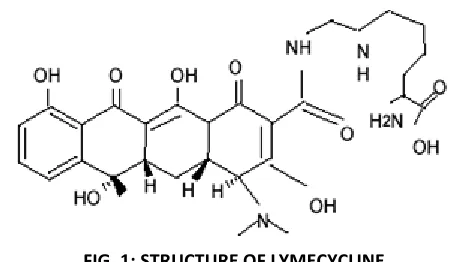
INTRODUCTION: Lymecycline (Fig. 1) (2S)-6-[({[(4S, 4aS, 5aS, 6S, 12As)-4(dimethylamino)-3, 6, 10, 10, 12a- pentahydroxy-6-methyl-1,11-dioxo-1, 4, 4a, 5, 5a6, 11, 12a-octahydrotetracen-2-yl]-formamido}-methyl) amino]-2-aminohexanoic acid is antibiotic work by killing bacteria that to the cause of acane. They also have a direct effect of reducing inflammation. Lymecycline (Tetralysal) 1 is a tetracycline –amino-acid compound obtained by combining tetracycline 2,3,4 base with L-lysine in the presence of formaldehyde. Its formula (de Carneri and Manfredi, 1962) gives a molecular weight for the pure substance of 602.7. In this paper, we described a simple, sensitive, and validated RP-HPLC method for determination of lymecycline in pharmaceutical Dosage Forms. The method has been successfully used for quality control
[image:1.612.333.562.487.618.2]analysis of the drugs and other analytical purposes.
FIG. 1: STRUCTURE OF LYMECYCLINE
Apparatus and Chromatographic Conditions:
Chromatographic separation was performed on a Shimadzu chromatographic system equipped with a LC-20AT pump and SPD-20A UV-VIS detector with 20µL fixed loop and analyzed by using LC-Solution software. PLRP-S (250×4.6 mm), 8.0 µm make: Varian column used for separation. Mobile phase consisting of a mixture of 11.5: 10: 20: 1: 57.5 mixture of
2-Methyl-2-Keywords: Lymicycline, RP-HPLC method, Reverse phase chromatography
Validation Correspondence to Author:
T. Nageswara Rao
1.0%w/v Tetra butyl ammonium hydrogen sulphate, 4.0%w/v di-sodium edetate and JT Baker water was delivered at flow rate 1ml/min. The mobile phase was filtered through 0.45µ membrane filter and sonicated for 10min. An external standard method was used. UV detection was performed at 254nm and column oven temperature is 50°C. Peak was confirmed by comparison of spectra and retention time with standard.
Reagents and solutions:
Preparation of Diluent (0.01 M Hydrochloric acid): In 1000 ml volumetric flask containing about 400ml milliQwater, added 0.9ml of concentrated Hydrochloric acid swirls to mix to the volume with water.
Preparation of Standard Solution: Accurately weighed 1.02mg of reference standard of Lymecycline in 100ml volumetric flask and the volume was brought upto the mark using diluent.
Preparation of Sample Solution One tablet, containing 408mg of lymecycline was weighed accurately and transferred to a 100 ml volumetric flask with 30ml diluent, shaken for 5min, and then diluted to volume with diluent to furnish a solution containing 408 mg/L lymecycline. After filtration the solution the solution was diluted with diluent to give a final concentration of 10 mg/L lymecycline.
Method Validation: Once the HPLC method development was over, the method was validated in terms of parameters like specificity, press ion, accuracy, linearity and range, LOD, LOQ, raggedness, robustness, stability etc. For all the parameters percentage relative standard deviation values ware calculated. The proposed HPLC method was validated as per ICH guidelines 5, 6, 7.
Linearity and Range: Different known concentrations of lymecycline (5.0 mg/L – 0.02 mg/L) were prepared in diluent by diluting the stock solution. Injected the standard solutions and measured the peak area. A calibration curve has been plotted for concentration of the standards injected versus area observed and the linearity of the method was determined from the correlation coefficient. The results were shown in (Table 2).
The slope, intercept and correlation coefficient values were found to be 28091, 23.54 and 0.9998.
Precision: Precision was evaluated by carrying out three independent sample preparation of a single lot of formulation. The sample solution was prepared in the same manner as described in the sample preparation. Percentage relative standard deviation (% RSD) was found to be less than 1% for within a day and day to day variations, which proves that that method is precise. Results were shown in (Table 3-4).
Accuracy: To study the reliability, suitability and accuracy of the method recovery experiments were carried out. A known quantity of the pure drug was added to the preanalysed sample formulation at the level of 50% and 100%, dissolved in diluents and made up to 100ml with same solvent. Further dilutions were made so that the each aliquot contained 0.05mg/L of lymecycline. The contents were determined from the respective chromatograms. The concentration of the drug product in the solution was determined using assay method. The recovery procedure was repeated 10 times and % RSD was calculated by using the following formula. The contents of lymecycline per tablet found by proposed method are shown in (Table 3); the lower values of RSD of assay indicate the method is accurate. The mean recoveries were in range of 95-97 % which shows that there is no interference from excipients (Table 5).
% recovery = b _a c
Where, a-The amount of drug found before the addition of standard drug, b-The amount of drug found after the addition of standard drug, c- The amount of standard drug added
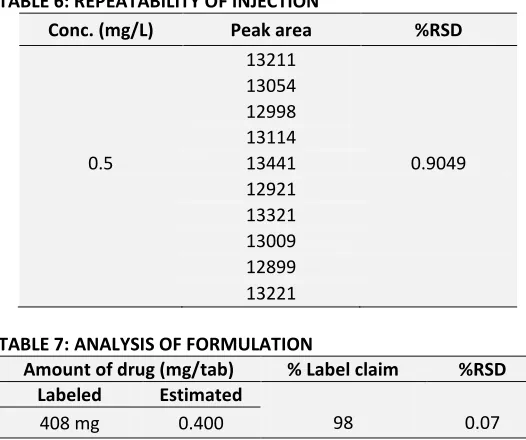
Repeatability of Solution: A standard solution of drug substance was injected ten times and corresponding peak areas were recorded. The % RSD was found to be less than 1 % (Table 6).
Assay: 20µl of standard and sample solutions were injected into an injector of RP-HPLC, from the peak area of standard amount of drug in sample were computed. The values are given in Table 7.
Limit of Detection and Limit of Quantification: The limit of Detection (LOD) and limit of Quantification (LOQ) of the development method were determined by injecting progressively low concentrations of the standard solutions using the developed RP-HPLC method. The LOD is the smallest concentration of the analyte that gives a measurable response (signal to noise ratio of 3). The LOD for lymecycline found to be 0.02mg/L The LOQ is the smallest concentration of the analyte, which gives response that can be accurately quantified (signal to noise ratio of 10) The LOQ was 0.05mg/L for lymecycline. It was concluded that the developed method is sensitive.
[image:3.612.314.582.358.528.2]Ruggedness and Robustness: The ruggedness of the method was determined by carrying out the experiment on different instruments like Shimadzu HPLC and Agilent HPLC by different operators using different columns of similar types. The %RSD values with two different instruments Shimadzu HPLC and Agilent HPLC, analyst and columns were 0.5-0.5, 0.6-0.5 and 0.4-0.3% respectively. Robustness of the method was determined by making slight changes in the chromatographic conditions, such as changes in mobile phase, flow rate and column temperature. It was observed that there were no marked changes in the chromatograms, which demonstrated that the RP-HPLC method is rugged and robust. The robustness limit for mobile phase variation, flow rate variation, and temperature variation are well within the limit, which shows that the method is having good system suitability and precision under given set of conditions and were within the acceptance criteria of not more than 2%.
FIG 2: CHROMATOGRAM OF STANDARD (1.0 mg/L)
RESULTS AND DISCUSSIONS: UV spectrum of lymecycline was recorded from which 254nm was selected as wavelength. Flow rate of 1ml/min was selected 11.5: 10: 20: 1: 57.5 mixture of 2-Methyl-2-propanol, 3.5%w/v di-potassium hydrogen phosphate, 1.0%w/v Tetra butyl ammonium hydrogen sulphate, 4.0%w/v di-sodium edetate and JT Baker water was selected as mobile phase. The retention time was found to be 8.0min.Lymecycline shown linearity in the range of 0.02-5mg/L and the co-efficient was found to be 0.9998.
[image:3.612.27.298.615.747.2]Recovery studies were performed at 50 and 100% levels. The sensitivity of method LOD and LOQ is shown in (Table 2). The stability at room temperature and refrigeration was found to be 3 and 8.5 hrs respectively. Hence the proposed method is simple, accurate, and rapid and can be employed for routine analysis. The low standard deviation and good percentage recovery indicates the reproducibility and accuracy of the method.
FIG 3: LINEARITY CURVE OF LYMECYCLINE
Repeatability of injection was performed using 0.5mg/L sample for 10 times and corresponding peak areas were recorded. The % RSD peak was reported.
Analysis of formulation was performed using Lymecycline 408 mg tablets and the claim was found to be 98.
TABLE 1: OPTIMIZED CHROMATOGRAPHIC CONDITIONS
Parameter Optimized condition
Chromatograph HPLC (Shimadzu system equipped with LC-20 AT pump and SPD-20A interfaced with LC Solution software
Column PLRP-S (250×4.6) mm, 8µ, make: Varian Mobile Phase
11.5:10:20:1:57.5 mixture of 2-Methyl-2-propanol,3.5% w/v di-potassium hydrogen phosphate,1.0% w/v Tetra butyl ammonium hydrogen sulphate,4.0% w/v di –sodium
edetate and JT Baker water
Flow Rate 1.0mL/min
Detection UV at 254nm
Injection Volume 20µL
Column Oven Temperature 50° C
TABLE 2: VALIDATION PARAMETERS
Parameters Lymecycline
Linearity range 0.02-5 mg/L Correlation coefficient 0.9998
Slope 28091
Y Intercept 23.54
TABLE 3: INTRADAY PRECESSION
Concentration (mg/L) Area %RSD
0.05
1325
1342 0.87
1349 0.5
13845
13798 0.36 13897
1
28845
[image:4.612.316.579.272.492.2]28952 0.31 29021
TABLE 4: INTERDAY PRECISION
Concentration (mg/L) Day Area % RSD
0.05
1 1268
2 1302 1.33
3 1289
0.5
1 12745
2 12985 1.12 3 13004
1
1 27945
2 28612 1.21 3 28414
TABLE 5: RECOVERY STUDIES
Level (mg/L) % Recovery % RSD
0.05 95 0.1
0.5 97 0.12
TABLE 6: REPEATABILITY OF INJECTION
Conc. (mg/L) Peak area %RSD
13211 13054 12998 13114
0.5 13441 0.9049
12921 13321 13009 12899 13221
TABLE 7: ANALYSIS OF FORMULATION
Amount of drug (mg/tab) % Label claim %RSD Labeled Estimated
98 0.07
408 mg 0.400
CONCLUSION: A convenient and rapid RP-HPLC method has been developed for estimation of Lymecycline in tablet dosage form. The assay provides a linear response across a wide range of concentrations. Low intra-day and inter-day % RSD coupled with excellent recoveries. The proposed method is simple, fast, accurate and precise for the simultaneous quantification of Lymecycline in dosage form, bulk drugs as well as for routine analysis in quality control.
REFERENCES:
1. J.W. Light Brown, A.H. Thomas & I.L. Berryman: Bull. The second international reference preparation of Lymecycline. Wld Hlth org 1973; 48: 81-84.
[image:4.612.31.290.513.747.2]3. Kenneth N. Agwuh and Alasdair Mac Gowan, J. Antmicrob. Pharmacokinetics and pharmacodynamics of the tetracycline’s including glycyclines. Chemother 2006; 2: 256-265.
4. A. Pines, K.Plucinski, J.S.B. Greenfield, R.C. Mitchell. Controlled comparison of lymecycline with tetracycline hydrochloride in exacerbations of chronic bronchitis. British medical journal 1964; 2: 1495-1498.
5. I.C.H Guidance on Analytical Method Validation, in proceedings of the International Conference of Harmonization, Geneva 1996.
6. I.C.H Guidelines Q2B, Analytical Method Validation.
7. Text on Validation of Analytical procedure Q2B, I.C.H. Harmonized tripartite guidelines Nov.1996.
**************************** How to cite this article: