Available online on www.ijpsr.com 462
IJPSR (2011), Vol. 2, Issue 2 (Research Article)
Received on 12 September, 2010; received in revised form 16 November, 2010; accepted 14 January, 2011
DESIGN AND EVALUATION OF LAMOTRIGINE ORAL SUSTAINED RELEASE TABLETS
S. Sangeetha*, G. Harish, T. Raghuprasath and N. Damodharan
Department of Pharmaceutics, SRM College of Pharmacy, SRM University, Kattankulathur, Kanchipuram District, Chennai, Tamil Nadu, India
ABSTRACT
Objective: The objective of the study is to design and evaluate oral sustained release tablet of lamotrigine using polymer such as HPMC K 4M, HPMC K 100M and methocel E50 LV at 15%, 25%, and 35% Concentration range.
Methods: All the selected ingredients were weighed and passed through 40# sieve, blended in a Poly Bag except Magnesium Stearate for 10 minutes. The resultant mixture was made in to a wet mass and passed through 20# sieve in order to obtain granules. These granules were air dried and passed through 30# sieve. These dried granules were lubricated with Magnesium stearate, which was previously passed through 60# Sieve and then punched using single punching machine.
Results: Pre-compression character such as compressibility index, angle of repose and Post-compressional characteristics such as weight variation, hardness, diameter, thickness, friability were found to be with in the I.P limits. In vitro release profile was studied using HPMC K4M, HPMC K 100M and methocel E50 LV at three different concentration. The percentage cumulative amount of drug release was found to be 82.72% in 12 hrs, 70.69% in 12hrs and 97.80% in 4hrs respectively for the entire batch at 15% polymer concentration.
Conclusion: The study proves that fluctuation in the drug release is overwhelmed when lamotrigine is administered in the form of SR tablet.
Keywords:
Lamotrigine,
Hydroxy propyl methyl cellulose, Methocel
Correspondence to Author:
S. Sangeetha
Assistant Professor, Department of Pharmaceutics, SRM College of Pharmacy, SRM University,
Available online on www.ijpsr.com 463 INTRODUCTION: Oral drug delivery continues to
rise in popularity as formulation scientists look for ways to control drug release and improve patient convenience. However, developing oral controlled release tablets for water soluble drugs with constant release rate has always been a challenge to the pharmaceutical technologist 1. Most of these water-soluble drugs, if not formulated properly, may readily release the drug at a faster rate and produce a toxic concentration of the drug on oral administration. Among various dosage forms, matrix tablets are widely accepted for oral sustained release (SR) as they are simple and easy formulate. Matrix system is the release system, which prolongs and controls the release of drug that is dissolved or dispersed 2.
In recent years, considerable attention has been focused on Hydrophilic polymers in the design of oral controlled drug delivery systems because of their flexibility to obtain a desirable drug release profile, cost-effectiveness, and broad regulatory acceptance. Among the hydrophilic polymers, cellulose derivative such as hydroxypropyl methylcellulose (HPMC) and methocel is generally considered to be stable and safe as release retardant excipient in the development of oral controlled release dosage forms 3. This semisynthetic polymer is quite expensive when compared with natural polymers such as guar gum, alginates, and so forth.
Lamotrigine is an antiepileptic drug (AED) which belongs to phenyltriazine class, used in the treatment of depression and bipolar disorder and exerts its anticonvulsant effect by stabilizing presynaptic neuronal membranes. It inhibits sodium currents by selectively binding to the sodium channel and subsequently suppresses the release of the excitatory amino acid, glutamate. Various tablet formulations of lamotrigine have been approved for marketing, for instance, conventional compressed instant release (IR)
tablets comprising 25 mg, 50 mg, 100 mg, 150 mg or 200 mg of active ingredient 4. These are administered once, twice, or three times daily. The peak plasma concentration of the drug is 1.4 to 4.8 hours following oral administration. The drawback in conventional tablets is that fluctuation in the level of plasma drug concentration which leads to inability to maintain appropriate therapeutic level which results in adverse events occurring in patients or alternatively the rate of increase in plasma concentration in the initial stages before the peak plasma concentration is achieved 5-6.
Until recently the site of absorption of the drug was unknown, in carrying out a regional absorption study it has recently been discovered that the extent of absorption of lamotrigine is consistent when the drug is delivered to any point in the GIT between stomach and the ascending colon. Even though the half-life of the drug is 36 hrs due to fluctuation in the plasma drug concentration leads to therapeutic insufficiency 7. Hence formulation of sustained release tablets of lamotrigine could be a possible approach to understand and overcome the above discussed constrain. The formulations were carried out using three different polymers by wet granulation technique followed by compression and evaluated. MATERIALS AND METHODS: Lamotrigine were obtained as a gift sample from Lota Pharmaceuticals Pvt. Ltd., Chennai, HPMC K4M, HPMC K100M and METHOCEL were obtained as gift sample from Tanmed Pharmaceuticals, Chennai. Mannitol and magnesium stearate were obtained from S.D. Fine Chemicals Ltd., Mumbai, India. All other ingredients used were of laboratory grade.
Available online on www.ijpsr.com 464 except magnesium stearate for 10 minutes. The
resultant mixture was made in to a wet mass using water (Qs) for granulation. This wet mass was passed through 20# sieve in order to obtain granules and were dried and the dried granules were passed through 30# sieve. These dried granules were lubricated with magnesium stearate, which was previously passed through 60# Sieve. Finally the granules were punched to tablets using single punching machine 8-11.
Evaluation of Granules:
Angle of Repose: The angle of repose of granules was determined by the funnel method. The accurately weighed granules were taken in a funnel. The height of the funnel was adjusted in such a way that the tip of the funnel just touched the apex of the heap of the granules. The granules were allowed to flow through the funnel freely onto the surface 12. The diameter of the powder cone was measured and angle of repose was calculated using the following equation 1:
Tan Ѳ = h/r……… (1) Where, h and r are the height and radius of the powder cone.
Bulk Density: Both loose bulk density (LBD) and tapped bulk density (TBD) were determined. A quantity of 7g of powder from each formula, previously lightly shaken to break any agglomerates formed, was introduced into a 10ml measuring cylinder. After the initial volume was observed, the cylinder was allowed to fall under its own weight onto a hard surface from the height of 2.5 cm at an interval of 2 seconds 13-15. The tapping was continued until no further change in volume was noted. LBD and TBD were calculated using the following formulas 2:
LBD = weight of the powder/volume of the packing……… (2)
TBD = weight of the powder/tapped volume of the packing……… (3) Compressibility Index: The compressibility index of the granules was determined by Carr’s compressibility index:
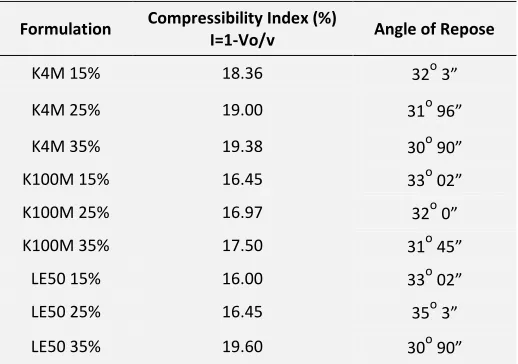
[image:3.612.312.571.241.423.2]Carr’s compressibility index (%) = *(TBD-LBD) *100]/TBD……… (4) The results are discussed in table 1.
TABLE 1: PRE FORMULATION CHARACTERISTICS Formulation Compressibility Index (%)
I=1-Vo/v Angle of Repose
K4M 15% 18.36 32o 3”
K4M 25% 19.00 31o 96”
K4M 35% 19.38 30o 90”
K100M 15% 16.45 33o 02”
K100M 25% 16.97 32o 0”
K100M 35% 17.50 31o 45”
LE50 15% 16.00 33o 02”
LE50 25% 16.45 35o 3”
LE50 35% 19.60 30o 90”
Available online on www.ijpsr.com 465
TABLE 2: POST COMPRESSIONAL PROPERTIES
Formulation Weight variation Hardness (kg/cm2) Diameter (mm) Thickness (mm) Friability (%)
K4M 15% complies 4.6 9.51 5.00 0.44
K4M 25% complies 4.5 9.50 5.10 0.51
K4M 35% complies 4.9 9.51 4.95 0.37
K100M 15% complies 4.8 9.50 5.12 0.49
K100M 25% complies 4.9 9.50 5.11 0.35
K100M 35% complies 5.0 9.51 5.00 0.31
LE50 15% complies 4.3 9.50 5.21 0.49
LE50 25% complies 4.6 9.50 5.10 0.41
LE50 35% complies 4.6 9.51 5.10 0.39
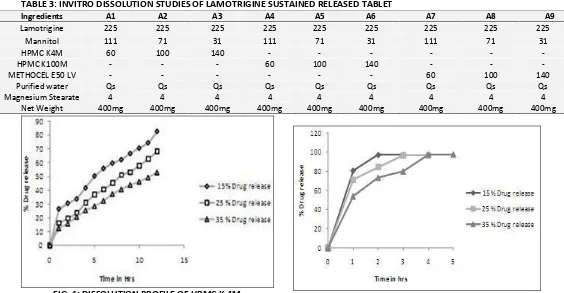
In-Vitro Dissolution: According to USP, dissolution test for Lamotrigine control release tablets was carried out by using distilled water as dissolution media. The type II paddle apparatus formed by a blade and a shaft as a stirring element 19. The dosage form was allowed to sink to the bottom of the flask before stirring. A constant temperature of 37±0.5oC was maintained. The motor was adjusted to turn at the specified speed of 50 rpm. Samples of specified volume were withdrawn at pre- determined time intervals, filtered, diluted suitably
and assayed spectrophotometrically. Determine the amount of Lamotrigine dissolved from UV absorbance at the wavelength of maximum absorbance of about 275nm of filtered portion of the solution under test. An equal volume of fresh medium was immediately replaced to maintain the dissolution. Dissolution studies were performed thrice for 12-24 hours for each tablet formulation and the mean values were taken 20-22 (table 3, fig 1-3).
TABLE 3: INVITRO DISSOLUTION STUDIES OF LAMOTRIGINE SUSTAINED RELEASED TABLET
Ingredients A1 A2 A3 A4 A5 A6 A7 A8 A9
Lamotrigine 225 225 225 225 225 225 225 225 225
Mannitol 111 71 31 111 71 31 111 71 31
HPMC K4M 60 100 140 - - - -
HPMC K100M - - - 60 100 140 - - -
METHOCEL E50 LV - - - 60 100 140
Purified water Qs Qs Qs Qs Qs Qs Qs Qs Qs
Magnesium Stearate 4 4 4 4 4 4 4 4 4
Net Weight 400mg 400mg 400mg 400mg 400mg 400mg 400mg 400mg 400mg
[image:4.612.24.588.393.686.2]Available online on www.ijpsr.com 466
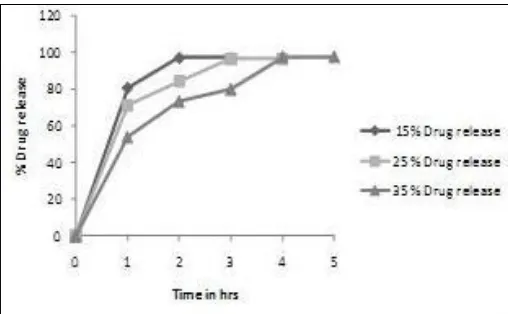
FIG. 3: DISSOLUTION PROFILE OF METHOCEL E 50 LV
Release Kinetics: To study the mechanism of drug release from the matrix tablets, the release date were fitted to the following equations:
Zero-order equation: Q = Q0-k0t………. (1) Where Q is the amount of drug release at time t, and k0 is the release rate;
First-order equation: ln Q = ln Q0 - k1t……… (2) Where k1 is the release rate constant;
Higuchi´s equation: Q = k2t1/2……….. (3) Where Q is the amount of drug release at time t, and k 2 is the diffusion rate constant 23-25.
RESULTS: Pre-compressional and post-compressional character such as average weight, hardness, friability and assay of all prepared tablets were within phramacopoeial specification. The formulations were prepared using HPMC K4M, HPMC K100M, and Methocel E50 as polymers followed by evaluated. The angle of repose values obtained for the formulations K4M 15%, LE50 25% are 32o.3”, 35o.3” This indicates good flow property of the powder blend. The compressibility index values for the formulations K100M 15%, LE 50. 25% are 16.45, and 16.45. This indicates the powder blend has good flow property. The tablets size and
thickness was also used to assess the quality of the tablet under uniform conditions of manufacturing process. Size of tablets ranged from 9.49 - 9.51mm and thickness of the tablets ranged from 4.90-5.2mm. The total weight of each formulation was not maintained uniformly however the weight variation of the tablets within the limits of 5%. The measured hardness of tablets in all batches was ranged from 4.32-5.0mm. Friability values were found to be less than 1% in all prepared formulations and considered to be satisfactory.
In vitro drug release profiles for all formulations were carried out by using 0.1N HCl as dissolution medium for about 12 hrs. From the results obtained it was observed that K4M 15% showed 82.72% release at end of 12hrs. Whereas K4M 25% and K4M, 35% showed release about 68.12% and 53.08%. K4M, 15% was found to show good release. The batches with K100M 15% showed 70.69% release, 25% showed 60.98% and 35% showed 52.67% release at end of 12hrs. In the batches with E50LV all three batches showed about 97% of release within 5hrs. From the above results it was found that the release of drug from HPMC K4M 15% gave the better release when compared to other formulations. On increase in the polymer concentration drug release declined. Higuchi ‘r’ value for the best batch (A1) was found to be 0.9881 were as Peppa’s ‘r’ and ‘k’ values are 0.9890 and 0.4835 respectively.
Available online on www.ijpsr.com 467 compressibility index and sieve analysis results
shown that the formulation is suitable for wet granulation. This study have been showed that Lamotrigine could be used in sustained release drug delivery system by formulating it has sustained drug delivery system, provides extend duration of action in therapeutic range without reaching toxic levels as in the case of conventional dosage forms. These dosage forms have the ability to reduce the dosing frequency. The technique employed in the preparation of matrix system i.e. wet granulation, is highly practical and economical from the industry point of view. By the results we can confirm that order of drug release follows first order and the mechanism of drug release from sustained release matrix tablets is by Non-Fickian diffusion. Success of the In vitro drug release studies recommends the product for further In vivo
studies, it may improve patient compliance. REFERENCES:
1. Sahel M A, Yellela S R K, Srinivas S P, Vemulapalli S: In Vitro and In Vivo Evaluation of Guar Gum Matrix Tablets for Oral Controlled Release of Water-soluble Diltiazem Hydrochloride. AAPS, PharmSciTech 2005: 6 (1).
2. Chien Y W : Novel drug delivery system, Marcel Decker Inc., New York, 2nd edn, 2005: 1-3.
3. Deshmukh V N, Singh S P, Sakarkar D M: Formulation and Evaluation of Sustained Release Metoprolol Succinate Tablet using Hydrophilic gums as Release modifiers. Int J PharmTech Res 2009; 1(2): 159-163.
4. Srivastava A K, Saurabh Wadhwa, Mishra B: Oral sustained delivery of Atenolol from floating matrix tablets - formulation and in vitro evaluation. Drug development and industrial pharmacy 2005; 31(4-5):367-374.
5. Ayhan Savaşer, Yalçın Ozkanand Aşkın Işımer: Preparation and in vitro evaluation of sustained release tablet formulations of diclofenac sodium. Department of Pharmaceutical Technology, Gulhane Military Medical Academy, Etlik, Ankara, Turkey 2008.
6. Azarmi S, Roa W, Lobenberg R: Current perspectives in dissolution testing of conventional and novel dosage forms. Int. J. Pharm 2007; 328: 12–27.
7. Morkhade D M, Fulzele S V: Gum Copal and Gum Damar- Novel Matrix forming Materials for Sustained Drug delivery. Int J of Pharm Sci 2004; 53-58.
8. Giovanna Corti, Marzia Cirri, Francesca Maestrelli, Natascia Mennini: Sustained-release matrix tablets of metformin
hydrochloride in combination with triacetyl-β-cyclodextrin. Eur J pharm and biopharm 2008; 68(2):303-309.
9. John W Skoug, Martin V Mikelsons, Cynthia N Vigneronand Nick L Stemm: Qualitative evaluation of the mechanism of release of matrix sustained release dosage forms by measurement of polymer release. Control Development 1993.
10. Li L L, Martini G L, Ford L J, Roberts M. The use of hypromellose in oral drug delivery. J. Pharm. Pharmacol 2005; 57: 533–546.
11. Lisa Brannan-Peppas, Polymers in Controlled Drug Delivary”nov.1997.
12. Narisawa S, Yoshino H, Hirakawa Y, Noda K: Porosity-controlled ethyl cellulose film coating. IV. Evaluation of mechanical strength of porous ethyl cellulose film. Chem
Pharm Bul 1994; 42(7): 1491–1495.
13. Padmaja U S, Text book of medical Pharmacology, CBS publishers, 2nd edn, 2009, pg 196,197, 201.
14. R S Satoskhar. Pharmacology and pharmacotherapeutics, popular prakashan, revised 18th edn, 2003:120.
15. Robert E Nortari: “Biopharmaceutics and pharmacokinetics An Introduction” 4th edn revised and expanded:208. 16. Robinson J R and Lee VHI (22Edition), New York Controlled
Drug Delivary Fundamentals and Applications: 1987. 17. S P Vyas, Roop K Khar, Controlled Drug Delivary Concepts
and Advances: 155-158.
18. Siepmann J, Peppas N A. Modelling of drug release from delivery systems based on hydroxy propyl methylcellulose (HPMC). Adv. Drug Deliv. Rev., 48:139–157.
19. Syed Nisar H S , Sajid A , Muhammad A C , Muhammad S. Formulation and evaluation of natural gum-based sustained release matrix tablets of ibuprofen using response surface methodology. Drug Development and Industrial Pharmacy 1998; 35(12); 1470-1478.
20. Uttam Mandal, Veeran Gowda, Animesh Ghosh, Senthamil Selvan, Sam Solomon And Tapan Kumar Pal, Bioequivalence Study Centre, Department of Pharmaceutical Technology, Jadavpur University.
21. Vinayak Dhopeshwarkar, Janet C. O'Keeffe, Joel L. Zatz, Robert Deete and Michael Horton (1994) . Development of An Oral Sustained-Release Antibiotic Matrix Tablet Using In-Vitro/In-Vivo Correlations, Drug Development and Industrial Pharmacy. 20(11): 1851-1867.
22. Yie. W. Chien, “Novel Drug Delivery System, 2nd edn, revised and expanded.182.
23. Bodmeier R, Paeratakul O (1994). The effect of curing on drug release and morphological properties of ethyl cellulose pseudolatex-coated beads. Drug Dev Ind Pharm., 20(9): 1517–1533.
24. Dressman JB, Derbin GM, Ismailos G (1995). Circumvention of pH-dependent release from ethyl cellulose-coated pellets. J control release., 36(3): 251–260.