© 2018, IRJET | Impact Factor value: 6.171 | ISO 9001:2008 Certified Journal | Page 990
Optimization Study of Fuzzy Parametric Uncertain System with
Observer
Tejal D. Apale
1, Vaibhav H. Jadhav
21
PG Student Dept. of Electrical Control System Engineering, Walchand College of engineering, Sangli,
Maharashtra, India
2
RTU SCADA Engineer, SCOPE, Pune
---***---Abstract -
This paper deals with the analysis and design ofthe optimal robust controller for the fuzzy parametric uncertain system. An LTI system in which coefficients depends on parameters described by a fuzzy function is called as fuzzy parametric uncertain system. This paper mainly studies uncertainty in the system. By optimal control design, we get control law and feedback gain matrix which can stabilize the system. The robust controller design is a difficult task so we go for the optimal control approach. The system can be converted into state space controllable canonical form with the α-cut property fuzzy. For optimal control design, we find control law and get the feedback gain matrix which can stabilize the system and optimizes the cost function. Stability analysis is done by using the Kharitonov theorem and Lyapunov-Popov method. The proposed method applied to a response of Continuous Stirred Tank Reactor (CSTR).To this system we applied an observer to control the system response. Linear regulator controller designs result in a state variable feedback law, so that implementing an optimal control requires measurement of all components of the state. In many situations such measurements are not possible and alternative approaches is needed. One such approach was originated by D. G. Luenberger, and is known as Luenberger observers.
Key Words: Fuzzy parametric uncertain system (FPUS), α-cut set, optimal control Kharitonov theorem, Lyapunov-Popov stability, Continuous Stirred Tank Reactor (CSTR), Disturbance Observer based controller (DOB).
1. INTRODUCTION
To design a proper controller for real time nonlinear system have many problems such as uncertainty, disturbance, unknown exact mathematical model etc. Uncertainty is either structure or Unstructured .Mostly the nonlinear system defined in terms of mathematical model doesn't have the exact parameter the calculated parameters are considered. So that type of model consists the parametric uncertainty. And because of that uncertain parameter, we have some information loss, which may be incomplete, unreliable. Also, the uncertainty affects the system response. So, we must design a controller such that it can deal with this type of uncertainty and removethe effects occurred because of that. For that, the fuzzy logic controller gives the best solution.
Many available system contain nonlinearity characteristics, such as microwave oscillation, chemical
process, hydraulic system, etc. It important to study behavior of nonlinear system. The most important part in nonlinear system is Optimization. The dynamic of non-linear system can be strongly depends on either one or more parameter since their operative condition remain stable only if the value of parameters are must be in specific limit. If these parameter gone out of range then the equilibrium point become unstable. Because of this reason, nonlinear controllers like Fuzzy logic controller are used to control such system because they are more robust than other controllers. [2]Fuzzy technique has been widely and effectively used now a days in nonlinear system modelling and control for more than two decades. In many of the model based fuzzy control approaches, the famous t-s fuzzy model is a popular and convenient tool in functional approximation. [3, 4] CSTR is one of the most commonly used non-linear system, which is mostly used in chemical industries, it offers a verity of researches in the area of chemical and control engineering. Due to non-linearity presents in the system, performance of the conventional controller may not be proper. Hence complexity of the system analysis increases. [6] It becomes difficult to have results under certain conditions. So here Type-1 fuzzy controller is used and optimized, for optimization, Jaya algorithm is used, because it is one of the best optimization algorithm which gives good performance and results.
The latter part of the paper is arranged in the following sequence. Section 2 presents type 1 fuzzy controller design and optimization for triangular membership functions and optimization by JAYA algorithm is presented in section 3.
The results of hardware implementation of controllers are presented in section 4. The main conclusions are reached through analysis of results.
2. FUZZY CONTROLLER DESIGN
© 2018, IRJET | Impact Factor value: 6.171 | ISO 9001:2008 Certified Journal | Page 991 definitely linearizable and the linear model is much accurate
enough for building up the controller. However, the highly nonlinear and discontinuous nature of many system for example, mechanical and electrical systems does not allow linear approximation practically. As In the process of designing controllers, it is also necessary that the system model is well achievable through a mathematical model and the parameters of the system model are reasonably well-known for controller design.
Significant performance degradation or even instability. The fuzzy model was proposed by Takagi and Sugeno [2] and it is described by fuzzy IF-THEN rules which represent local input-output relations of a nonlinear system. The main feature of a Takagi-Sugeno fuzzy model is to express the local dynamics of each fuzzy implication (rule) by a linear system model. The overall fuzzy model of the system is achieved by fuzzy "blending" of the linear system models. Almost all nonlinear dynamical systems can be represented by Takagi-Sugeno fuzzy models to high degree of precision. In fact, it is proved that Takagi-Sugeno fuzzy models are universal approximation of any smooth nonlinear system.
Fuzzification Interface
Inference Engine
Defuzzification Interface Knowledge Base
crisp
input fuzzy
input
fuzzy
output
crisp output
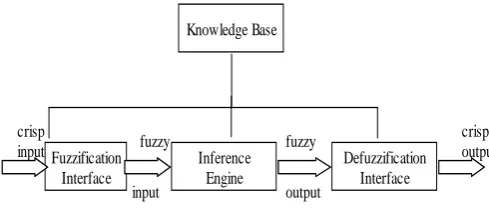
Fig -1: Graphical interpretation of fuzzy
3. OPTIMIZATION FOR TRIANGULAR MEMBERSHIP
FUNCTIONS
Here we have to optimize three membership functions one by one using the JAYA optimization technic using MATLAB Code. For that purpose we have to write m files for fitness function of each membership function and decide the bounds of the base for each membership function. This step is important because there are two types of bad membership function. First one type is too redundant and second type is too separated. Due to such membership function we cannot get the desired response or output as we want. Too redundant and too separated membership functions are shown in below Figure,
[image:2.595.319.551.82.167.2]Fig -2: Too redundant membership function
Fig- 3: Too separated membership function
For reducing the probability of getting such membership functions the bounds of base are chosen very correctly for each function. Selection of membership function and respective bounds can be done as follow. Triangular membership function can be defined as
[image:2.595.324.558.262.452.2]Fig - 4: Triangular membership function
f ( ; a, b, c)
=
=
a
=
= 0
Where a, b, c are the base value of membership function which we are optimizing to get good membership Function.
4. OPTIMIZATION BY JAYA ALGORITHM
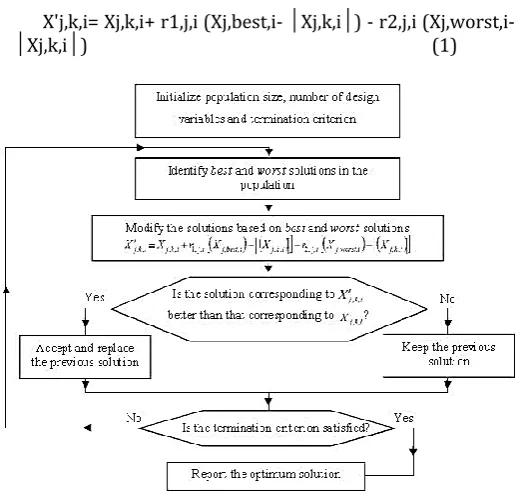
A simple, easy and powerful optimization algorithm until now is proposed for solving the constrained and unconstrained both optimization problems. And this algorithm is based on the concept that the solution obtained for a given problem should move towards the best solution if it is profit function and should avoid the Worst solution if it is loss function. This algorithm requires only the common control parameters and does not require any algorithm-specific control parameters unlike other Dr.Rao et al.
[image:2.595.52.297.349.455.2]© 2018, IRJET | Impact Factor value: 6.171 | ISO 9001:2008 Certified Journal | Page 992 Let f(x) is the objective function to be minimized (or
maximized). At any iteration i, assume that there are ‘m’ number of design variables (i.e. j=1, 2… m), ‘n’ number of candidate solutions (i.e. population size, k=1, 2… n). Let the best candidate best obtains the best value of f (x) (i.e. f (x) best) in the entire candidate solutions and the worst candidate worst obtains the worst value of f (x) (i.e. f (x) worst) in the entire candidate solutions. If, k, i is the value of the variable for the candidate during the iteration, then this value is modified as per the following Eq. (1)
X'j,k,i= Xj,k,i+ r1,j,i (Xj,best,i- │Xj,k,i│) - r2,j,i (Xj,worst,i-
[image:3.595.29.291.204.451.2]│Xj,k,i│) (1)
Fig-5: Flowchart of JAYA algorithm
5. FUZZY DISTURBANCE OBSERVER (FDO)
FDO is an effective method in nonlinear control. However, traditional FDO is confined to monitor dynamic disturbance, and the frequency bandwidth of the system is restricted. The basic Idea arises from the fact that a fuzzy logic system can approximate arbitrarily well a highly nonlinear system. Both the external disturbance and the internal parameter variations are combined and treated as a total disturbance and the disturbance is observed by a fuzzy logic system (named a fuzzy disturbance observer). Fig-6: Structure of the control system with fuzzy disturbance observer. 5.1 LUENBERGER OBSERVER In applications feedback control or diagnosis systems the entire state vector of the system must be controlled. If the state vector cannot be measured, what is a typical case in most complex systems, one suitable approximation to the state vector is needed. That can be substituted into a control law. A system which produces such an approximation, is called an Observer or Luenberger Observer for continuous time linear system x˙(t) = Ax (t) +Bu(t) (2)y (t) = Cx(t) where x ∈ R n , u ∈ R m, y ∈ R r , a linear system observer equation is given by ˙xˆ(t) = Axˆ(t) +Bu(t) +L[y(t)−yˆ(t)] (3)
yˆ (t) = Cxˆ (t). Observer error is defined as e = x−xˆ. (4)
Differentiating equation (4) e˙ = x˙− ˙xˆ (5)
And substituting equations (2), (3) into (5) we get e˙ = Ax+Bu− [Axˆ+Bu+L (y−yˆ)] (6)
Or e˙ = A (x−xˆ) −L (y−yˆ)] (7)
And with (7) e˙ = A (x−xˆ) −LC (x−xˆ)] (8)
e˙ = (A−LC) e. (9)
Solution of eqn. (14) is given by e (t) = e A−LCe(0) (10)
The eigenvalues of the matrix A−LC can be made arbitrary by appropriate choice of the observer gain L, when the pair [A,C] is observable (i.e. observability condition holds). So the observer error e → 0 when t → ∞. The given system is observable if and only if the n × n matrix, is of rank n. This matrix is called the observability matrix
[image:3.595.325.539.593.712.2] [image:3.595.46.265.628.729.2]© 2018, IRJET | Impact Factor value: 6.171 | ISO 9001:2008 Certified Journal | Page 993 Fig-8: simulation result of Luenberger observer
In fig.8 to make system converge to zero Luenberger Observer is used. That means all states starting from any condition going to zero hence this is the controlling of the system. Same approach is applied for Practical nonlinear system that is continuous stirrer tank reactor (CSTR).
5.2 Calculation of TF:
For calculating Transfer function of CSTR cooling process the step response is taken into consideration. The transfer function is calculated by using process reaction curve. The process has very large dead time and is highly damped. Therefore the step response can be fitted into a simple first-order model with dead-time.
Where, K=Process gain, θ =Dead-time, τ=Time constant Therefore, the transfer function of the process is given by
The Transfer Function of Valve is
By using Pade’s approximation the second order transfer function is calculated as
The state space matrices are given as
B=
D= [0]
Consider two uncertain parameters which represent in fuzzy no. as first a=tri (0.03 0.05 0.07) and second is b=tri (1.2 1.5 1.7) and c=tri (0.2 0.4 0.6). The αcut for this is a= [(0.02α+0.03), (0.07-0.02α)] b= [(0.2α+1.2), (1.7-0.2α)], and c= [(0.2α+0.2), (0.6-0.2α)].
Fig-9: simulation result of FPUS with LQR with and without DOB
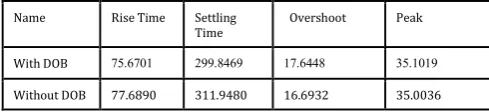
[image:4.595.299.553.49.207.2]Disturbance observer based controller is additionally attached to the system. Fig. 9 shows the comparative results between two system setup, one is without observer and another is with connecting luenberger observer. From simulation result is has been proved that system when connected with observer gives better response rather when without observer. Performance specification for above result is illustrated in below table 1.
Table-1: Performance specification for system with and without DOB
Name Rise Time Settling
Time Overshoot Peak
With DOB 75.6701 299.8469 17.6448 35.1019
Without DOB 77.6890 311.9480 16.6932 35.0036
Table 1 contains Performance specification for system with and without DOB. From table 1 it is clear that settling time of the system when connected to the observer is less as compared to the system when not connected to DOB.
6. CONCLUSION
The controller is designed for FPUS using the α-cut property of fuzzy set. Controller designed for a critical condition that is for maximum uncertainty interval and that will stabilize the other interval of uncertainty.
This technique is applied to continuous stirred tank reactor and study the responses. Also, the proposed technique is applied with a fuzzy optimized membership function using Jaya algorithm. The stability of the system is checked by Kharitonov polynomials and Popov-Lyapunov stability theorem.
REFERENCES
[1] Balasaheb M Patre and RJ Bhiwani. “Robust controller
[image:4.595.59.280.76.198.2] [image:4.595.310.555.391.447.2]© 2018, IRJET | Impact Factor value: 6.171 | ISO 9001:2008 Certified Journal | Page 994
[2] Palash Dutta, Hrishikesh Boruah, and Tazid Ali. “Fuzzy
arithmetic with and without using the α-cut method: A comparative study.” International Journal of Latest Trends in Computing, 2(1):99– 107, 2011.
[3] Venkata Rao, Ankit Saroj “A self-adaptive
multi-population-based Jaya algorithm for engineering optimization Swarm and Evolutionary Computation” 37 (2017) 1–26
[4] R.V. Rao, “Teaching Learning Based Optimization
Algorithm and its Engineering Applications”, Springer Verlang, London, 2016.
[5] R.V. Rao, “Review of applications of TLBO algorithm and
a tutorial for beginners to solve the unconstrained and constrained optimization problems”, Decis. Sci. Lett. 5 (2016) 1–30
[6] Weldon A. Lodwick, K. David Jamison “A Constraint
Fuzzy Interval Analysis approach to fuzzy optimization “ Information Sciences 426 (2018) 38–49
[7] Atul Tiwaria, M. K Pradhanb Materials “Applications of
TLBO algorithm on various manufacturing processes: A Review” Today: Proceedings 4 (2017) 1644–1652
[8] Xinghua Qub, Ran Zhangb, Bo Liua,, Huifeng Li “An
improved TLBO based memetic algorithm for aerodynamic shape Optimization” Engineering Applications of Artificial Intelligence 57 (2017) 1–15
[9] R.V. Rao ⇑, K.C. More “Design optimization and analysis
of selected thermal devices using self-adaptive Jaya algorithm” Elsevier Energy Conversion and Management 140 (2017) 24–35
[10] Weldon A. Lodwick, K. David Jamison “A Constraint
Fuzzy Interval Analysis approach to fuzzy optimization” Information Sciences 426 (2018) 38–49
[11] Chyun-Chau Fuh and Pi-Cheng Tung. “Robust stability
analysis of fuzzy control systems.” Fuzzy Sets and Systems, 88(3):289–298, 1997.
[12] VL Kharitonov. “Asymptotic stability of an Equilibrium
position of a family of systems of linear differential Equations.” Differntia Uravnen, 14(11):1483–1485, 1978.
[13] Jerry M Mendel. “Uncertain rule-based fuzzy logic
systems: introduction and new directions. “Prentice Hall PTR Upper Saddle River, 2001.
[14] Balasaheb M. Patre and P. J. Deore. “Robust stability and
performance for interval process plants.” ISA Transactions, 46(3):343{349, 2007
[15] R. Venkata Rao, “Jaya: A simple and new optimization
algorithm for solving constrained and unconstrained
optimization problems.” International Journal of Industrial Engineering Computations 7 (2015).
[16] R. Venkata Rao, “Review of applications of TLBO
algorithm and a tutorial for beginners to solve the unconstrained and constrained optimization problems.” International Journal of Industrial Engineering Computations 7 (2016) 19–34
[17] The Mathworks, Using Matlab version 7.10.0, The
Mathworks, R2014
[18] Ranjit Roy, and S. P. Ghosha”Evolutionary Computation
Based Optimization in Fuzzy Automatic Generation Control” 0-7803-9525-5/06/$20.00 © 2006 IEEE
[19] Zhao Duo, Jin Weidong “The Application of
Mullti-Criterion Satisfactory Optimization In Fuzzy Controller Design” 0 -7803 -7624 -2/02/$17.00 02002 IEEE
[20] Oscar Castillo, Leticia Amador-Angulo “A generalized
type-2 fuzzy logic approach for dynamic parameter adaptation in bee colony optimization applied to fuzzy controller design “Information Sciences 0 0 0 (2017) 1– 21 m3Gsc; October 21, 2017;4:54 ]
[21] Weldon A. Lodwick, K. David Jamison “A Constraint
Fuzzy Interval Analysis approach to fuzzy optimization “ Information Sciences 426 (2018) 38–49
[22] Mr.Jadhav Vaibhav Hari, Mr.A.B.Patil ‘Optimization of
FUZZY controller by JAYA algorithm’ International Research Journal of Engineering and Technology (IRJET) e-ISSN: 2395 -0056 Volume: 04 Issue: 07 | July -2017
[23] Long Wanga, Chao Huangc Optik “A novel Elite
Opposition-based Jaya algorithm for parameter estimation of photovoltaic cell models” 155 (2018) 351– 356