2016 International Conference on Artificial Intelligence and Computer Science (AICS 2016) ISBN: 978-1-60595-411-0
Based on the Artificial Rainfall System Nozzle Combination Design
Jian SUN
1, Yong REN
2, Lin-lin ZHANG
3, Yan YANG
4,
Yan-ling BAI
5and Wen-li JIN
6Institute of China Electronics Technology Group Co., LTD. 28, Nanjng, China E-mail: [email protected]
*Corresponding author
Keywords: Rainfall system, Rainfall intensity, Nozzle combination, Optimal combination.
Abstract: Rainfall system can be simulated on each separate partition different time and space, and also can be combined of different type rainfall in big underlying model. The nozzle as the core part of the rainfall device, different types of nozzle can be independently controlled with computer, to control all the related electrical equipment and improve the efficiency of experiments. This article through to the analysis of rainfall intensity uniformity and the modeling results of nozzle combination, getting a rainfall intensity distribution of different nozzle combination under different pressure, making sure the optimal combination of the rainfall nozzle system solutions.
Introduction
In recent years, the artificial rainfall system has been a necessary system of the law of soil and water loss, soil erosion research and to maintain water and soil, and prevent desertification, salinization, etc.
The artificial rainfall system uses a quantity of switch and the pressure of water supply to control the change of the rainfall intensity in the process of rainfall. The regulation of rainfall intensity has two areas to achieve, the sprinkler and the water supply. Choosing three different types of nozzle, constitute a nozzle system, different pressure corresponds to different rainfall intensity. There kinds of nozzles through single open or different control methods can achieve the rainfall intensity in the prescribed scope. In addition, through the frequency control of motor speed pump can realize stepless adjustment of the water supply pressure. For the same kind of sprinkler, different water supply pressures corresponds to different traffic and also come from different rainfall intensity. Through the analysis of these, accurate calculation is needed, choosing different water supply pressures and different diameters of nozzles to reform, meeting the different flow requirements.
Through calculation and analysis to chose the appropriate nozzle model, composed of a suitable nozzle combination, combined with the water pump frequency control of motor speed, rainfall intensity is formed in 12mm/h ~300mm/h continues adjustable with the scope of change.
Nozzle Layout Scheme and Digital Simulation The Test Data of Sprayer Characteristics
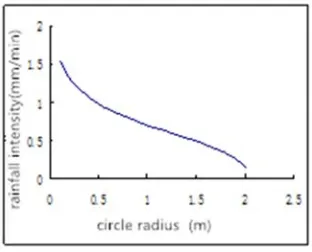
Figure 1. the relationship curve.
[image:2.612.213.400.245.393.2]between rainfall intensity and radius when the sprayer’s diameter is 2.45mm under the pressure of 0.25MPa
Figure 2. the rainfall intensity distribution contours when the sprayer’s diameter is 2.45mm under the pressure of 0.20MPa.
The Sprayer’s Mathematical Modeling and Simulation Analysis
To control the flow and rainfall intensity exactly, we build a modeling of the sprayer. As shown in figure 3, the sprayer is a small mouth throttling model. By the flow of throttling mouth, the accumulation is shown as below:
P A C
Q q
2
Among them:
P
-Differential pressure, C -The coefficient of flow, A-The cross-sectional areaof sprayer mouth, ρ-The density of water
From the above formula, by differential pressure, coefficient of sprayer mouth flow can be calculated section of sprayer flow Q, among them, the coefficient of flow can be acquired by the text data, at about 0.6-0.8.
-2 -1.5 -1 -0.5 0 0.5 1 1.5 2 -2
Figure 3. The injection process of sprayer and stress with raindrops.
The coefficient of flow is related with Reynolds number, the values is between 0.69-0.86.
ud
Re
Among them, ρ-The density of water; d-The diameter of pipe; µ-The viscosity coefficient of water; u- flow rate of water
When the numerical value of Re is under 2000, pipe flow must be laminar flow, it can enter the
turbulent flow when it above 2000. Re= pud⁄µ=1000 20 2.45 1002⁄ 10 =4800.
So it has entered a completely recirculation zone, that is to say, the coefficient of traffic has no relation with Re in this zone, only be connected with the ratio of pipeline diameter and length of nozzle.
When the diameter of nozzle is 2.45mm, d=2.45mm, atmospheric pressure is 0.25MPa, the calculation results and experimental results are consistent, the margin error is under 5%. It is proved that we can analysis traffic data of different nozzle pressure, it is conducive to simulation and control algorithm.
The Selection and Combination of Nozzle
In order to achieve the rainfall intensity change in the prescribed scope, choosing three kinds of nozzles through single and rolled ways to control the combination control with our strategy. In addition, through the frequency conversion and control of motor speed of water pump, can be realized stepless adjustment of the pressure of supply water. For the same kind of combination of nozzle, different pressure of supply water control different flow, forming the different rainfall intensity.
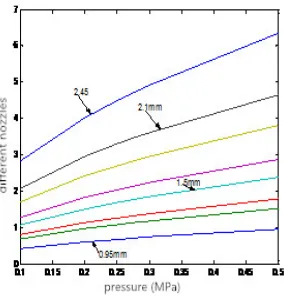
The specific numbers of the flow of nozzle in different pressures, as shown in figure 4, can be calculated the rainfall intensity of different nozzles in different pressures, as shown in figure 5.
[image:3.612.237.379.572.723.2]Figure 5.
According to the requirement of design, the rainfall intensity should be continuous and adjustable, due to the wider of the rainfall intensity, single nozzle cannot achieve this goal, that is to say, different combinations of nozzles are needed to control different rainfall intensity. We choose three different specifications of combinations of nozzles to conform a simulation system, which can form wider and uniform rainfalls. As the nozzle’s rainfall intensity space distribution curve is radial symmetry points of linear distribution, which to reach the required uniformity of rain fall must use lots of nozzle’s effective jet radius overlap to the most uniformity of rainfall.
Rainfall Intensity Uniformity Simulation
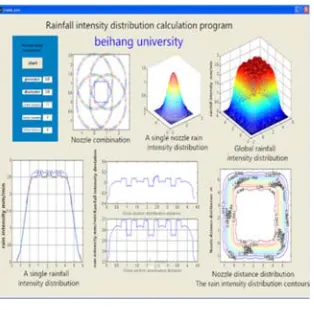
In order to simulate different aperture of nozzle in different pressure, we make a simulation software which simulate the artificial rainfall, it can set the value, such as nozzle pressure, nozzle diameter, nozzle center distance, nozzle in distance. And then we can look at the combination figure clearly, a three-dimensional figure of a single nozzle rain intensity distribution, a three-dimensional figure of all areas rainfall intensity distribution, a section figure of all areas rainfall intensity distribution, an 85% section figure of rainfall intensity distribution, and rainfall intensity distribution of the contour. The operation panel of simulation software interface is shown in figure 6.
Figure 6.
Conclusion
different diameter of nozzle in different pressure, making an artificial rainfall simulation software to set the parameter, such as nozzle pressure, nozzle diameter, nozzle center distance, and the ranks of nozzle number. At last, getting a result that a square layout has more advantages than the triangle arrangement on the uniformity, and increase the effective area of rainfall. It has an important significance of the layout of nozzle, the selection of nozzle, and the study of artificial rainfall.
References
[1] The Command Information System and Technology, 2011, 02 (2): 28-31(inChinese). [2 The Command Information System and Technology, 2010, 01 (5): 28 and 33 (inChinese). [3] The Command Information System and Technology, 2012, 3 (1): 25 to 28 (inChinese).
[4] Cui Peng. The mechanism of debris flow initiation [Ph.D. Thesis] [D]. Beijing: Beijing Forestry University, 1990. (in Chinese).
[5] The command information system and technology, 2016, 7 (3)
[6] Li Tianchi, Zhang Shucheng, Kang Zhicheng. Sliding debrisflow[A]. In: Memoirs of Lanzhou Institute of Glaciology andCryopedology, Chinese Academy of Sciences(No.4) [C]. Beijing: Sciences Press, 1984. 171–177. (in Chinese).
[7] Eckersley D. Instrumented laboratory flow slides [J]. Geotechnique, 1990, 40(3): 489–502. [8] Anderson S A, Siter N. Analysis of rainfall-induced debris flows[J]. J.Geotech. Eng., ASCE, 1995, 121(7): 544–552.
[9] Study on the landslides change into debris flows[A]. In: Proceedingsof Landslide [C]. Chengdu: Sichuan Science and Technology Press, 1989. 69–76.(in Chinese))
[10] Cui Peng. The mechanism of debris flow initiation [Ph.D. Thesis] [D]. Beijing: Beijing Forestry University, 1990. (inChinese).
[11] Cui P. Studies on condition and mechanism of debris flow initiationby means of experiment [J]. Chinese Science Bulletin, 1992, 37(9), 759–763.
[12] Mark E.R., Richard G.L.H., Richard M.I. Debris-flow initiationexperiments using diverse hydrologic triggers [A]. In: Chen C.L. ed. Debris-flow Hazards Mitigation Mechanics, Prediction, and Assessment [C]. New York: [s. n.], 1997. 1–11.
[13] Richard M.I., Mark E.R., Richard G.L. Debris-flow mobilization from landslides [J] Annu. Rev. Earth Planet. Sci., 1997, 25: 85–138.
[14] Hu Mingjian, Wang Ren, Zhang Pingcang. Primary research on the effect of rainfallon landslide [J]. Chinese Journal of Geotechnical Engineering, 2001, 23(4): 454–457. (in Chinese)). [15] Hu Mingjian, Zhang Pingcang, Wang Ren. Study oninspiring effect of landslide experiment on condition ofrainfall-example of slope piled by old landslide in Jiangjiagou Valley [J]. Journal of Soil and Water Conservation, 2001, 15(5): 116–118. (in Chinese)).