Munich Personal RePEc Archive
Capital controls: An evaluation
Reinhart, Carmen and Magud, Nicolas
University of Maryland, College Park, Department of Economics
2007
Online at
https://mpra.ub.uni-muenchen.de/14097/
Capital controls: An evaluation
Nicolas Magud
University of Oregon
Carmen M. Reinhart
University of Maryland and NBER
A revised version was published in: Sebastian Edwards (ed.), Capital Controls and Capital Flows in Emerging Economies: Policies, Practices, and Consequences (Chicago: Chicago University Press for the NBER, 2007), 645-674.
The literature on capital controls has (at least) four very serious apples-to-oranges problems: (i) There is not unified theoretical framework to analyze the macroeconomic consequences of controls; (ii) there is significant heterogeneity across countries and time in the control measures implemented; (iii) there are multiple definitions of what
constitutes a “success” and (iv) the empirical studies lack a common methodology – furthermore these are significantly “overweighted” by a couple of country cases (Chile and Malaysia). In this paper, we attempt to address some of these shortcomings by: being very explicit about what measures are construed as capital controls. Also, given that success is measured so differently across studies, we sought to “standardize” the results of over 30 empirical studies we summarize in this paper. The standardization was done by constructing two indices of capital controls: Capital Controls Effectiveness Index (CCE Index), and Weighted Capital Control Effectiveness Index (WCCE Index). The difference between them lies only in that the WCCE controls for the differentiated degree of methodological rigor applied to draw conclusions in each of the considered papers. Inasmuch as possible, we bring to bear the experiences of less well known episodes than those of Chile and Malaysia.
I. INTRODUCTION
The literature on capital controls has (at least) four very serious issues that make it
difficult, if not impossible, to compare across theoretical and empirical studies. We dub
these the apples-to-oranges problems and they include: (i) There is no unified theoretical
framework (say, as in the currency crisis literature) to analyze the macroeconomic
consequences of controls; (ii) there is significant heterogeneity across countries and time in
the capital control measures implemented; (iii) there are multiple definitions of what
constitutes a “success” (capital controls are a single policy instrument—but there are many
policy objectives); and (iv) the empirical studies lack a common methodology and are
furthermore significantly “overweighted” by the two poster children--Chile and Malaysia.
Our goal in this paper is to find a common ground among the non-comparabilities in
the existing literature. Of course, there is usually a level of generality that is sufficiently
encompassing. After all, an apples-to-oranges problem can be solved by calling everything
fruit. Our goal is, as far as possible, to measures of capital controls on a uniform basis.
Once done, it should be easier to understand the cross-country and time-series experience.
We attempt to address some of these apples-to-oranges shortcomings by being very
explicit about what measures are construed as capital controls. We not only document the
more drastic differences across countries/episodes and between controls on inflows and
outflows, but the more subtle differences in types of inflow or outflow controls. Also, given
that success is measured so differently across studies, we standardize (wherever possible)
the results of over 30 empirical studies summarized in this paper. Inasmuch as possible, we
bring to bear the experiences of episodes less well known than those of Chile and Malaysia.
The standardization was done by constructing two indices of capital controls:
Effectiveness (WCCE ). The difference between them lies only in that the WCCE controls
for the differentiated degree of methodological rigor applied to draw conclusions in each of
the considered papers.
With these indexes, our results can be summarized briefly. Capital controls on
inflows seem to make monetary policy more independent, alter the composition of capital
flows, and reduce real exchange rate pressures (although the evidence there is more
controversial). Capital controls on inflows seem not to reduce the volume of net flows (and
hence, the current account balance). As to controls on outflows, there is Malaysia and there
is everybody else. In Malaysia, controls reduced outflows, and may have given room for
more independent monetary policy (the other poster child does not fare as well, in that our
results are not as conclusive as for the Chilean controls on inflows). Absent the Malaysian
experience, there is little systematic evidence of “success” in imposing controls, however,
defined.
The paper proceeds as follows. The next section summarizes some of the key
reasons why capital controls—particularly capital controls on inflows—are either
considered or implemented. Controls, as we note help deal with what we dub as the “four
fears”. Section III focuses on the distinctions among types of capital controls—highlighting
that not all capital control measures are created equal and therefore can be simply lumped
together in a rough capital controls index. Section IV, examines the existing empirical
evidence by standardizing and sorting studies along a variety of criteria. Namely, we focus
on the following sorting strategy. First, we analyze separately cases where the study was
multi country or focused on a single case study; second, we distinguish the cases where the
controls were primarily designed to deal with inflows or outflows; third, we provide an ad
test hypotheses about the effects of the controls; and last, we evaluate the outcomes
reported in the studies according to the definition of what constitutes a success. The last
section discusses some of the policy implications of our findings.
II.THE RATIONALE FOR CAPITAL CONTROLS AND THE “FOUR FEARS”
Anyone examining the literature on capital controls, which spans many decades and
all the regions around the globe, would be well advised to retain a sense of irony.
Repeatedly, policy makers have sought refuge in tax laws, supervisory restraint, and
regulation of financial transactions to cope with external forces that they deem to be
unacceptable. Often they rationalized their actions on loftier grounds, sometimes so
effectively as to make it difficult to clearly identify episodes of controls on capital.
But in all these episodes, four fears lurk beneath the surface.
1. Fear of appreciation
Being the darling of investors in global financial centers has the decided, albeit often
temporary, advantage of having ample access to funds at favorable cost. With the capital
inflow comes upward pressure on the exchange value of the currency, rendering domestic
manufacturers less competitive in global markets, and especially so relative to their close
competitors who are not so favored as an investment vehicle. A desire to stem such an
appreciation (which Calvo and Reinhart, 2002, refer to as “fear of floating”) is typically
manifest in the accumulation of foreign exchange reserves. Over time, though, sterilizing
such reserve accumulation (the topic of Reinhart and Reinhart, 1998) becomes more
2. Fear of “hot money”
For policy makers in developing countries, becoming the object of foreign investors’
attention is particularly troubling if such affection is viewed as fleeting. The sudden
injection of funds into a small market can cause an initial dislocation that is mirrored by the
strains associated with their sudden withdrawal. Such a distrust of “hot money” was behind
James Tobin’s initial proposal to throw sand in the wheels of international finance, an idea
that has been well received in at least some quarters. Simply put, a high-enough tax (if
effectively enforced) would dissuade the initial inflow and pre-empt the pain associated
with the inevitable outflow.
3. Fear of large inflows
Policy makers in emerging market economies do not universally distrust the providers
of foreign capital. Not all money is hot but even then, sometimes the sheer volume of
flows matters. A large volume of capital inflows, particularly when it is sometimes
indiscriminate in the search for higher yields (in the manner documented by Calvo,
Leiderman and Reinhart, 1994), causes dislocations in the financial system. Foreing funds
can fuel asset price bubbles and encourage excess risk taking by cash-rich domestic
intermediaries. Again recourse to tax may seem to yield a large benefit.
4. Fear of loss of monetary autonomy
The interests of global investors and domestic policy makers need not always—or even
often—align. But a trinity is always at work that it is not possible to have a fixed (or highly
discussed in Frankel, 2001). If there is some attraction to retaining some element of
monetary policy flexibility, something has to give up. However, in the presence of the
aforementioned fear of floating, giving up capital mobility may seem more attractive than
surrendering monetary policy autonomy.
Whatever the reason inducing action, some form of capital control might seem as
controlling exchange rate pressures, stemming large inflows, and regaining an element of
monetary autonomy. Less fortunate are those policy makers who impose controls to reduce
capital flight, because investors seeking safety—most importantly including domestic
residents as well as foreigners—are seldom dissuaded by regulatory restraint.
III. CAPITAL CONTROLS?WHAT DO WE MEAN BY CAPITAL CONTROLS?
In most of the empirical literature there are no distinctions between controls on
outflows and inflows—these exercises suffer from the same problems as the de jure IMF
classification of exchange rate arrangements. Even when a distinction is made between
inflows and outflows (as we do here), controls can and do range from the explicit to the
subtle and the market friendly to the coercive. 1
Furthermore, when considering the impacts and effectiveness of capital controls one
cannot lump together the experiences of countries that have not substantially liberalized
(i.e., India and China) with countries that actually went down the path of financial and
capital account liberalization and decide at some point to reintroduce controls, as the latter
1
have developed institutions and practices that are integrated in varying degrees to
international capital markets.
Tables 1-2, which squarely focus on measures targeted to affect inflows in countries
which had already gone the route of capital account liberalization 2 indeed highlight the
heterogeneity in both subtlety and “market-friendliness” of capital control measures that
have been tried in Asia, Europe, and Latin America during booms (these involve controls
on capital inflows) as well as crashes (and attempts to curb capital outflows). These
measures not only differ in subtlety and other features but also in intensity. 3
2
Hence, these cases involve the reintroduction of controls.
3
Table1. Restrictions on Inflows and “Prudential Requirements:” Asia
Country and date (in parentheses) denoting the first year of the surge in inflows
Indonesia (1990)
March, 1991: Central Bank adopts measures to discourage offshore borrowing. Bank Indonesia begins to scale down its swap operations by reducing individual banks' limits from 25 to 20 percent of capital. The three-month swap premium was raised by 5 percentage points.
October, 1991: All state-related offshore commercial borrowing was made subject to prior approval by the Government and annual ceilings were set for new commitments over the next five years.
November, 1991: Further measures are taken to discourage offshore borrowing. The limits on banks' net open market foreign exchange positions were tightened by placing a separate limit on off-balance sheet positions. Bank Indonesia also announced that future swap operations (except for "investment swaps" with maturities of more than two years) would be undertaken only at the initiative of Bank Indonesia.
Malaysia (1989)
June 1, 1992: Limits on non-trade-related swap transactions were imposed on commercial banks.
January 17, 1994-August 1994: Banks were subject to a ceiling on their non-trade- or noninvestment-related external liabilities.
January 24, 1994-August 1994: Residents were prohibited from selling short-term monetary instruments to nonresidents.
February 2, 1994-August 1994: Commercial banks were required to place with Bank Negara the ringgit funds of foreign banking institutions (Vostro accounts) held in non-interest bearing accounts. However, in the January-May period these accounts were considered part of the eligible liabilities base for the calculation of required reserves, resulting in a negative effective interest rate in Vostro balances.
February 23, 1994-August 1994: Commercial banks are not allowed to undertake non-trade related swap and outright forward transactions on the bid side with foreign customers.
Philippines (1992)
July, 1994: Bangko Central begins to discourage forward cover arrangements with non-resident financial institutions.
Thailand (1988)
Banks and finance companies net foreign exchange positions may not exceed 20 percent of capital. Banks and finance companies net foreign liabilities may not exceed 20 percent of capital.
Residents are not allowed to hold foreign currency deposits except only for trade-related purposes.
April, 1990: Banks and finance companies net foreign exchange positions limit raised to 25 percent of capital.
August 8, 1995: Reserve requirements, to be held in the form of non-interest bearing deposits at the Bank of Thailand, on short-term non-resident baht accounts were raised from 2 percent to 7 percent. While reserve requirements on domestic deposits are also 7 percent, up to 5 percent can be held in the form of interest-bearing public bonds.
December 1995: The 7 percent reserve requirement is extended to finance companies short-term (less than one year) promissory notes held by non-residents.
A variety of measures aimed at reducing foreign-financed lending were introduced.
April 19, 1996: Offshore borrowing with maturities of less than 1 year by commercial banks, BIBF offices, finance companies and finance and security companies will be subject to a 7-percent minimum reserve requirement in the form of a nonremunerated deposit with the Bank of Thailand. Loans for trade purposes will be exempt.
Table1. (continued) Restrictions on Inflows and Prudential Requirements: Eastern Europe and Latin America
Country and date (in parentheses) denoting the first year of the surge in inflows
Brazil (1992)
October, 1994: A 1 percent tax on foreign investment in the stock market. Eliminated on March 10, 1995. The tax on Brazilian companies issuing bonds overseas was raised from 3 percent to 7 percent of the total. Eliminated on March 10, 1995.
The tax paid by foreigners on fixed interest investments in Brazil was raised from 5 percent to 9 percent. Reduced back to 5 percent on March 10, 1995.
The Central Bank raised limits on the amount of dollars that can be bought on foreign exchange markets.
Chile (1990)
June, 1991: Nonrenumerated 20 percent reserve requirement to be deposited at the Central Bank for a period of one year on liabilities in foreign currency for direct borrowing by firms.
The stamp tax of 1.2 percent a year (previously paid by domestic currency credits only) was applied to foreign loans as well. This requirement applies to all credits during their first year, with the exception of trade loans.
May, 1992: The reserve requirement on liabilities in foreign currency for direct borrowing by firms is raised to 30 percent. Hence, all foreign currency liabilities have a common reserve requirement.
Colombia (1991)
June, 1991: A 3 percent withholding tax on foreign exchange receipts from personal services rendered abroad and other transfers, which could be claimed as credit against income tax liability.
February, 1992: Banco de la Republica increases its commission on its cash purchases of foreign exchange from 1.5 percent to 5 percent.
June, 1992: Regulation of the entry of foreign currency as payment for services.
September, 1993: A nonrenumerated 47 percent reserve requirement to be deposited at the Central Bank on liabilities in foreign currency for direct borrowing by firms. The reserve requirement is to be maintained for the duration of the loan and applies to all loans with a maturity of 18 months or less, except for trade credit.
August, 1994: Nonrenumerated reserve requirement to be deposited at the Central Bank on liabilities in foreign currency for direct borrowing by firms. The reserve requirement is to be maintained for the duration of the loan and applies to all loans with a maturity of five years or less, except for trade credit with a maturity of four months or less. The percentage of the requirement declines as the maturity lengthens; from
140 percent for funds that are 30 days or less to 42.8 percent for five year funds.
Colombia (2002)
December, 2004: Foreigners investing in domestic markets must now keep their money in the country for at least one year.
Czech Republic (1992)
April, 1995: The central bank introduced a fee of 0.25 percent on its foreign exchange transactions with banks, with the aim of discouraging short-term speculative flows.
August 1, 1995: A limit on net short-term (less than one year) foreign borrowing by banks is introduced. Each bank is to ensure that its net short-term liabilities to nonresidents, in all currencies, do not exceed the smaller of 30 percent of claims on nonresidents or Kc 500 million.
Administrative approval procedures seek to slow down short-term borrowing by nonbanks.
Mexico (1990)
April, 1992: A regulation that limited foreign currency liabilities of commercial banks to 10 percent of their total loan portfolio was passed. Banks had to place 15 percent of these liabilities in highly liquid instruments.
Table 2. Restrictions on Outflows: Asia, Europe, and Latin America
Country and date (in parentheses) denoting the first year of the surge in outflows (or crisis)
Argentina (crisis ending the Convertibility Plan, 2001)
December, 2001: The Corralito is established, limiting bank withdrawal limits and restrictions on dollar transfers and loans. However, purchases through checks or credit cards available, and purchases of government bonds. Dec.30: suspension of external payments (debt default). January 2002 there is a 40% devaluation and a dual exchange rate regime is introduced (1.4 pesos per dollar for trade operations, while floating regime for all other transactions. Later in the month, there is an. easing of bank withdrawals restrictions followed by an asymmetric pesofication. Pesofication of dollar deposits at 1.4 pesos per dollar; dollar debts pesofied at market exchange rate; unification of exchange rate regimes in a floating scheme; right to withdraw wages and pension incomes in full; Corralon is imposed: freeze of bank term deposits. In September of that year it is required that stocks should be traded in domestic currency regulation. Since the latter is widely resisted, it was eased, but the new restriction significantly increased transactions costs. In December 2002 the Corralito is rescinded.
Brazil, (crisis ending the Real Plan, 1999)
March 1999: Government ordered local investment funds to increase their holdings of government bonds. The central bank raised to 80 percent from 60 percent the minimum amount of sovereign debt that must be held in the country foreign investment fund. This lowered the share that could be held in other countries’ debt.
Malaysia (Asian crisis, 1997)
September, 1998:: Bank and foreign exchange controls limiting offshore swap operations, ban on short-selling. 1998: repatriation of ringgit held offshore, and strict regulation on offshore operations and most international operations in ringgit, export and import operations allowed in foreign currency only, 12-month waiting period for non-residents to sell profits from Malaysian securities, approval required to invest abroad (above certain limits). In December residents are allowed to grant loans to nonresidents to purchase
immovable property. In January, 1999 some derivative transactions for nonresidents are permitted. In February there is a gradual ease on the 12-month waiting period and some repatriations funds exempted from exit regulations. In March exports and imports trade ceilings are raised for operations with Thailand. In September commercial banks allowed to enter into some short-term currency swaps with nonresident stockbrokers. In March, 2000 funds from sale of securities purchased by nonresidents can be repatriated without paying exit levy and in June administrative procedures to ease classification of securities as being free from exit levy. September 30th: Some offshore banks are allowed to invest in ringgit assets. December 1st: foreign-owned banks are allowed to increase domestic credit. In February 2001 the exit levy is abolished for some operations. In May of that year the remaining exit levy is abolished. While in June all controls on nonresidents’ futures and options are abolished. In July, resident financial institutions allowed to extend ringgit loans to nonresidents investing in immovable property in Malaysia. In November 2002, resident banks credit levels to finance nonresidents projects in Malaysia are raised. On December 3rd: foreign currency limit for investment abroad by residents is abolished, and payments are liberalized to allow them to be in either ringgit or foreign currency.
Spain (ERM Crisis, 1992)
September, 1992: Bank of Spain suspends regular money market operations and introduces foreign exchange controls. In October of that year the peseta is devalued and some of the controls a re lifted—in November the remaining foreign exchange controls rescinded.
Thailand (Asian crisis, 1997)
May, 1997: Bank of Thailand (BOT) introduces restrictions on capital account transactions. In June BOT introduces additional measures to limit capital flows. Baht proceeds from sales of stocks required to be converted at the onshore exchange rate. Additional controls are introduced and later in the month a two-tier exchange rate is introduced. In September of that year, Additional controls on invisible and current account transactions are introduced. In January 1998 it is required that proceeds on exports and invisible transactions and current account transfers must be surrendered after 7 days (instead of 15 days). BOT ends two-tier exchange rate regime.at the end of that month
IV.THE EMPIRICAL LITERATURE: FINDING A COMMON GROUND
This section aims to overcome (or at least take a step in that direction) two of the
apples-to-oranges problems we have identified in the capital controls literature. Namely,
we attempt to: (i) ascertain when and in what capacity capital controls were “successful” in
achieving the stated objectives of the authorities (this is not trivial, as what constitutes as a
success is defined very differently across studies) and; (ii) standardize (to some extent) the
very eclectic array of descriptive and empirical methodologies and approaches that have
characterized the empirical literature on capital controls. Lastly, we bring to bear evidence
on lesser well known episodes other than the “classics” (Chile’s controls on inflows starting
in 1990 and Malaysia’s 1998 controls on outflows).
In what follows, we review more than 30 papers that study capital controls either on
inflows or outflows around the world. Some are country case studies and some describe
several individual country experiences, while others are multi-country studies that bunch
several cases together. As noted earlier, the papers measure “success” differently--thus, our
aim is to standardize methodology and results where possible so as to facilitate
comparisons. This will not only enable us to assess the effectiveness of alternative capital
controls events, but it will also permit us to evaluate some of the policy implications of
imposing controls on capital inflows and/or outflows under alternative scenarios.
1. Types of studies
We proceed as follows. First, we cluster the papers into three broad groups: (i)
capital inflows (CI), (ii) capital outflows (CO); and (iii) multi-country (MC)—the latter
including the analysis of both capital inflows and/or capital outflow episodes. We collected
parenthesis): For CI, there are studies on: Brazil (6), Chile (11), Colombia (3), Czech
Republic (1), Malaysia (2), and Thailand (1). For CO, we obtained information for
Malaysia (5), Spain (3), and Thailand (2). For the MC group, we collected five papers,
covering a wide array of countries.4
2. Objective(s) of capital controls
Given the multiple objectives that capital controls are expected to achieve, in each
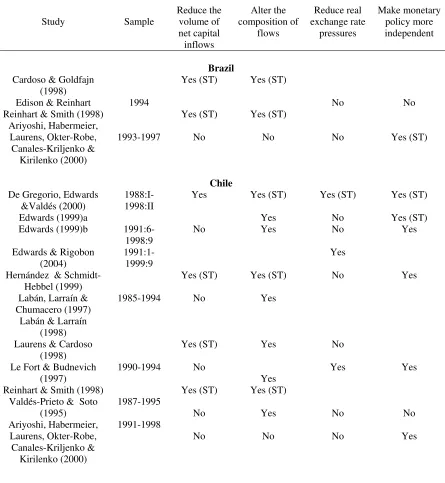
paper we asked the following questions: Were capital controls able to
(i) Reduce the volume of capital flows?
(ii) Alter the composition of capital flows (towards longer maturity flows)?
(iii) Reduce real exchange rate pressures?
(iv) Allow for a more independent monetary policy?
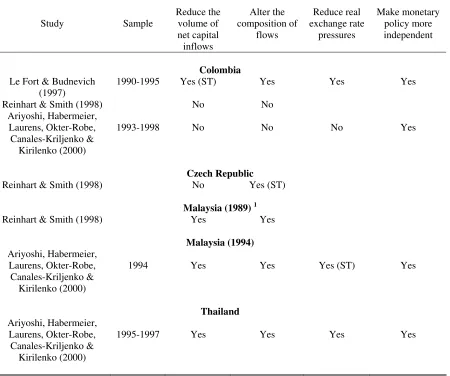
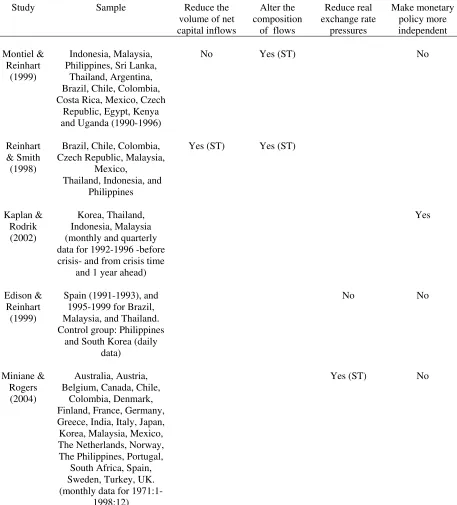
We asked these questions to each of the papers. As a first step to sort this
information, we constructed Tables 3, 4, and 5. Table 3 includes CI episodes, Table 4
displays CO episodes, and Table 5 focuses in MC studies. As can be seen on the tables,
possible answers are YES, NO, or a blank space. If the table reads YES in any cell, it
means that the paper finds that the corresponding objective of capital controls was
achieved. NO stands for the paper finding that there was not such effect as a result of the
capital controls. A blank space means that the paper does not address whether there was an
effect or not. Sometimes the answer is followed by (ST). This is there to inform that the
effects were only temporary, i.e. that an objective was achieved only in the Short Term.
Just to give an example, in Table 3, the paper by Laurens and Cardoso (1998) studying the
4
For example, one of the more comprehensive multi-country papers uses monthly data for the
case of the Chilean experience during the 1990’s, finds evidence that capital controls were
able to reduce the volume of capital flows only in the short term, that they were able to alter
the composition of these flows towards longer maturity flows, and they were not successful
in reducing pressures on the real exchange rate. They do not report results regarding the
effectiveness of capital controls in making monetary policy more independent.
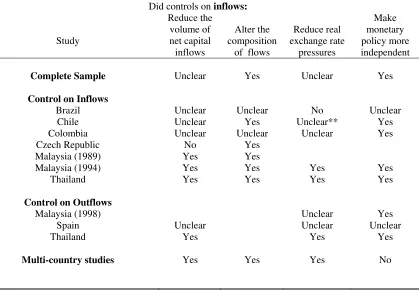
In a first pass to this information, by inspection, we can summarize the following
(see Table 6). We observe that in general, it looks like capital controls, as it emerges from
the results obtained in these papers, were successful in altering the composition of capital
flows towards longer maturities, and in making monetary policy more independent.
However, it looks that the papers are not very informative regarding the effectiveness of
capital controls in reducing the volume of capital flows and reducing real exchange rate
pressures.
3. Indices of capital control effectiveness
But this is not informative enough, since it still lacks some rigor to evaluate the
effectiveness of capital controls episodes. In order to better understand this, we construct
two indices of capital controls effectiveness. We call them Capital Controls Effectiveness
Index (CCE Index), and Weighted Capital Controls Effectiveness Index (WCCE Index).
The only difference in computing them, is that the WCCE Index weighs the results
obtained in each paper by the degree of methodological rigor applied to draw conclusions –
In both cases, following the information summarized in Tables 3-5, we arbitrarily
assigned the following values:
If the answer is YES, the corresponding value is 1,
If the answer is NO, the value assigned is -1.
If the question is not addressed at all, it corresponds a value of 0.
These values are designed to equally weigh the existence or not existence of effects
as a result of the imposition of capital controls, and to give no weight to questions not
addressed, so as not to distort the results in case any objective of capital controls is not
answered by the paper.
With these values at hand, for each country, we computed simple averages of these
numbers for each of the four questions asked to the papers. This gives, for example, a CCE
Index for volume reduction for each country, a CCE Index for real exchange rate pressures
reduction for each country, and so on and so forth. With this information we are able to
compare, for each objective, which country was more effective.
We also used this information to compute some sort of aggregate index of capital
controls effectiveness, by averaging out the four CCE Indices for each country, and then
compare a global CCE Index among countries.
However, as already mentioned, the methodology used to evaluate success is highly
heterogeneous. The latter is the consequence of how different papers evaluate capital
controls. Some papers are mainly descriptive, generating conclusions just by the
movements (or lack of thereof) in the time series of the main variables, lacking any
rigorous statistical or econometric analysis. Other papers do some statistical or econometric
methodology to evaluate capital controls events. Among them, the variance is still high
In order to control for these differences, we did another pass to the information in
the papers. We classify each study according to the degree of methodological rigor in,
LOW, INTERMEDIATE, and HIGH.
For this purpose, we consider a study to be LOW, INTERMEDIATE, and HIGH, according
to the following criteria:
Low: This includes studies that are mainly descriptive analysis of events and/or time series.
Intermediate: This groups papers that draw conclusions from a more formal evaluation of
events, still lacking any formal hypothesis testing. An example of this could be papers that
perform some time re-scaling to compare the effects of capital controls “before” and “after”
capital controls.
High: This includes only those studies that have highly developed econometric techniques,
with a well defined hypothesis testing.
Table 7 (in the Appendix) summarizes the methodology used in each paper, as well
as the corresponding classification in Low, Intermediate, High, following the above
definitions.
In order to compute the WCCE Index, we assigned the following values:
Low: 0.1
Intermediate: 0.5
High: 1.
With these values at hand, we compute the WCCE Index similarly to the CCE
Index, in order to compare, for each of the four objectives, which country has been more
effective in achieving them. We also compute an aggregate (per country) WCCE Index
This enables us to understand for which countries were capital controls more useful.
which capital controls tend to be effective. Once more, it is worth mentioning that these
exercises were done separately for the 3 clusters in which we separated the papers, namely
CI, CO, and MC.
4. Summary of results
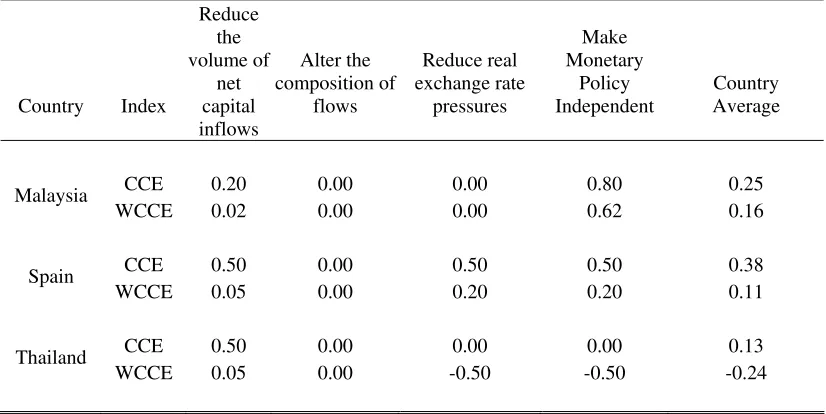
Summary results of CCE Index and WCCE Index are presented in Table 8 (Panels
A, B and C). From these indices, we can extract the following policy conclusions. Looking
at controls on inflows (Panel A) along with the preliminary results in Table 6, capital
controls were able to make monetary policy more independent, alter the composition of
capital flows towards longer maturities, and reduce real exchange rate pressures (although
the evidence on the latter is more controversial). Interestingly, the usual model economy for
these type of controls, Chile, stands out as achieving these goals quite comfortably, as the
WCCE Index shows. In this regard, initial conditions or characteristics such as the ones in
Chile in the early 1990’s, along with the continuing reforms during the 1990’s look like
necessary conditions for capital controls on inflows to be effective. On the other hand,
capital controls on inflows were not very effective in reducing the volume of net flows
(hence its impact on the current account balance).
Looking in more detail, we see that Malaysia (1994) stands out as the best
performance in terms of reducing the volume of capital flows, Chile dominates regarding
the change in capital flows maturity, Thailand does it in respect to reducing real exchange
rate pressures, and Chile also dominates in regards to monetary policy independence.
Overall, as the average of the WCCE Index reflects, Chile emerges as the more successful
When focusing on capital controls on outflows (Panel B), the received wisdom is
that Malaysia (1997) is the example to follow. From our results, we can see that these types
of capital controls were effective in reducing capital outflows, and in making monetary
policy more independent. Yet, the results from WCCE Index are not as conclusive as the
Chilean controls on inflows.
If we focus on the reduction in capital flows, Thailand and Spain dominate
Malaysia. Regarding the switch in capital flows towards more longer maturity no
conclusion can be extracted, whereas Spain emerges as the best in regard to real exchange
rate pressures reduction; on the other hand, Malaysia clearly dominates when dealing with
making monetary policy more independent. On the aggregate, Malaysia appears as the
more successful experience in terms of capital controls on outflows.
Some further comments are in order. First, it could be argued that these indices are
not taking into account many other variables that might be affecting the effectiveness of
capital controls, especially the set of “other” reforms being put in place in each country
during each capital controls episode. That is true. However, this paper is reviewing and
assessing only the conclusion contained in previous papers, not the papers themselves. All
the reviewed papers draw conclusions from their information sets, and we just put them
together and try to extract the main message that these papers give as a group. Furthermore,
precisely because of these “omitted variables bias” type of problem is that our WCCE
Index becomes more relevant. For example, any structural reform carried on in parallel
with capital controls is not usually specifically reflected in the papers we review—in a
sense, for us this is similar to running a regression with missing data that you have to
formal the analysis is, especially if including hypothesis testing, the more accurate the
information contained in it.
Second, a similar reasoning applies to the endogeneity of capital controls. Some
could argue that we should control for it. Again, we rely on the conclusions obtained in
previous papers, thus giving more value to the results we obtain from WCCE Index. Also,
this is relevant for how controls on capital inflows affect capital outflows. Moreover, that is
why we cluster CI and CO separately in our analysis above.
Third, it is worth mentioning that the papers we review are clearly not the only ones
dealing with capital controls. There are many papers that analyze the long-run effects of
capital controls, whereas we focus on the short-run only, as can be seen from the questions
we ask to the papers. For completeness, Table 9 lists some of the papers that study the
effects of capital controls on growth –we don’t go into further details since these papers are
out of our scope.
Fourth, another interesting point is whether capital controls regimes are transitory or
permanent. Here, as the type of questions we focus on clearly reveals, we are interested
only in transitory events. This is why episodes such as the Chinese or Indian approach to
capital controls are not covered here –see the papers on these countries contained in this
volume for that purpose.
Fifth, one interesting point to raise is related to the timing (and related endogeneity)
of capital controls: whether they are imposed in response to events – crises— or if they are
design in advance. Here, once more, we lack information because we rely only on what
papers conclude. It is worth mentioning though, that by inspection, it might appear like the
Malaysia (1997) episode could have been designed in advance, unlike most of the other
chronologies described in Tables 1 and 2. In the case of Malaysia (1997), a big chunk of
controls were imposed on September 1st, 1997. Furthermore, the level of detail in them
seems suggests that this was not decided and designed just in response to the crises.
Sixth, some times, temporary capital controls events become permanent. This could
be because of time consistency problems, or just because of the current response to future
changes: rational expectations calls for incorporating in your current decision the fact that
in a pre-specified time period capital controls will be levied. Furthermore, even if a country
imposed capital controls, and did levy them at the pre-established date, this might work as a
signal that capital controls might be imposed in the future if needed. However, this says
nothing about this being either good or bad –many things will influence the latter,
especially its effectiveness, as well as its effects on property rights. Anyway, imposing
capital controls once, establishes some kind of precedent regarding a country’s position
towards capital mobility, despite its costs and benefits. This is another dimension in which
Table 3. The Famous Chilean Case and Other Lesser Deities: Summary of Key Findings on “Effectiveness”
Did controls on inflows
Study Sample
Reduce the volume of net capital inflows Alter the composition of flows Reduce real exchange rate pressures Make monetary policy more independent Brazil
Cardoso & Goldfajn (1998)
Yes (ST) Yes (ST)
Edison & Reinhart 1994 No No Reinhart & Smith (1998) Yes (ST) Yes (ST)
Ariyoshi, Habermeier, Laurens, Okter-Robe, Canales-Kriljenko &
Kirilenko (2000)
1993-1997 No No No Yes (ST)
Chile
De Gregorio, Edwards &Valdés (2000)
1988:I-1998:II
Yes Yes (ST) Yes (ST) Yes (ST)
Edwards (1999)a Yes No Yes (ST)
Edwards (1999)b 1991:6-1998:9
No Yes No Yes
Edwards & Rigobon (2004)
1991:1-1999:9
Yes
Hernández & Schmidt-Hebbel (1999)
Yes (ST) Yes (ST) No Yes
Labán, Larraín & Chumacero (1997)
1985-1994 No Yes
Labán & Larraín (1998) Laurens & Cardoso
(1998)
Yes (ST) Yes No
Le Fort & Budnevich (1997)
1990-1994 No
Yes
Yes Yes
Reinhart & Smith (1998) Yes (ST) Yes (ST) Valdés-Prieto & Soto
(1995)
1987-1995
No Yes No No
Ariyoshi, Habermeier, Laurens, Okter-Robe, Canales-Kriljenko &
Kirilenko (2000)
1991-1998
No No No Yes
Notes: A blank entry refers to the cases where the study in question did not analyze that particular relationship. An (ST) refers to cases where only short-term effects were detected.
1
Table 3 (continued). The Famous Chilean Case and Other Lesser Deities: Summary of Key Findings on “Effectiveness”
Did controls on inflows
Study Sample
Reduce the volume of net capital inflows
Alter the composition of
flows
Reduce real exchange rate
pressures
Make monetary policy more independent
Colombia
Le Fort & Budnevich (1997)
1990-1995 Yes (ST) Yes Yes Yes
Reinhart & Smith (1998) No No Ariyoshi, Habermeier,
Laurens, Okter-Robe, Canales-Kriljenko &
Kirilenko (2000)
1993-1998 No No No Yes
Czech Republic
Reinhart & Smith (1998) No Yes (ST)
Malaysia (1989) 1
Reinhart & Smith (1998) Yes Yes
Malaysia (1994)
Ariyoshi, Habermeier, Laurens, Okter-Robe, Canales-Kriljenko &
Kirilenko (2000)
1994 Yes Yes Yes (ST) Yes
Thailand
Ariyoshi, Habermeier, Laurens, Okter-Robe, Canales-Kriljenko &
Kirilenko (2000)
1995-1997 Yes Yes Yes Yes
Notes: A blank entry refers to the cases where the study in question did not analyze that particular relationship. An (ST) refers to cases where only short-term effects were detected.
1
[image:22.612.86.536.146.522.2]Table 4. The Famous Malaysian Case and Other Lesser Deities: Summary of Key Findings on “Effectiveness”
Did controls on outflows:
Study Episode
Reduce the volume of net
capital outflows
Alter the composition of
flows
Reduce real exchange rate
pressures
Make monetary policy more independent
Malaysia
Tamirisia (2004) 1991:1-2002:12
No Yes
Dornbusch (2001) No
Edison & Reinhart (2000) Yes Yes Kaplan & Rodrik (2002) 1992-1996 Yes
Ariyoshi, Habermeier, Laurens, Okter-Robe, Canales-Kriljenko &
Kirilenko (2000)
1998-2000 Yes Yes Yes
Spain
Jose Vinals(1992) 1992 No
Edison & Reinhart 1995-1999 No No Ariyoshi, Habermeier,
Laurens, Okter-Robe, Canales-Kriljenko & Kirilenko (2000)
1992 Yes Yes (ST) Yes
Thailand
Edison & Reinhart (2000) No No
Ariyoshi, Habermeier, Laurens, Okter-Robe, Canales-Kriljenko & Kirilenko (2000)
1997-1998 Yes Yes Yes (ST)
Table 5. The “Others” – Multicountry Studies Summary of Key Findings on “Effectiveness”
Did controls on inflows:
Study Sample Reduce the volume of net capital inflows
Alter the composition
of flows
Reduce real exchange rate pressures Make monetary policy more independent Montiel & Reinhart (1999) Indonesia, Malaysia, Philippines, Sri Lanka,
Thailand, Argentina, Brazil, Chile, Colombia, Costa Rica, Mexico, Czech
Republic, Egypt, Kenya and Uganda (1990-1996)
No Yes (ST) No
Reinhart & Smith (1998)
Brazil, Chile, Colombia, Czech Republic, Malaysia,
Mexico,
Thailand, Indonesia, and Philippines
Yes (ST) Yes (ST)
Kaplan & Rodrik (2002)
Korea, Thailand, Indonesia, Malaysia (monthly and quarterly data for 1992-1996 -before crisis- and from crisis time
and 1 year ahead)
Yes
Edison & Reinhart (1999)
Spain (1991-1993), and 1995-1999 for Brazil, Malaysia, and Thailand. Control group: Philippines
and South Korea (daily data)
No No
Miniane & Rogers (2004)
Australia, Austria, Belgium, Canada, Chile,
Colombia, Denmark, Finland, France, Germany, Greece, India, Italy, Japan, Korea, Malaysia, Mexico, The Netherlands, Norway, The Philippines, Portugal,
South Africa, Spain, Sweden, Turkey, UK. (monthly data for
1971:1-1998:12)
Yes (ST) No
Table 6. Summary of Results By Country and Multi-country Studies
Did controls on inflows:
Study
Reduce the volume of net capital inflows
Alter the composition
of flows
Reduce real exchange rate
pressures
Make monetary policy more independent
Complete Sample Unclear Yes Unclear Yes
Control on Inflows
Brazil Unclear Unclear No Unclear
Chile Unclear Yes Unclear** Yes
Colombia Unclear Unclear Unclear Yes Czech Republic No Yes
Malaysia (1989) Yes Yes
Malaysia (1994) Yes Yes Yes Yes
Thailand Yes Yes Yes Yes
Control on Outflows
Malaysia (1998) Unclear Yes
Spain Unclear Unclear Unclear
Thailand Yes Yes Yes
Multi-country studies Yes Yes Yes No
Table 7. Capital Inflows: The Indices
Country Index
Reduce the volume of net capital inflows Alter the composition of flows Reduce real exchange rate pressures Make Monetary Policy Independent . Country Average
CCE 0.00 0.00 -0.67 0.00 0 Brazil
WCCE 0.35 0.35 -0.275 -0.225 0.05
CCE -0.09 0.64 -0.27 0.45 0.18 Chile
WCCE 0.03 0.67 -0.27 0.29 0.18
CCE -0.33 -0.33 0.00 0.67 0.00 Colombia
WCCE -0.17 -0.17 0.00 0.07 -0.07
CCE -1.00 1.00 0.00 0.00 0.00 Czech
Republic WCCE -0.50 0.10 0.00 0.00 -0.10
CCE 1.00 1.00 0.50 0.50 0.75 Malaysia
WCCE 0.30 0.30 0.05 0.05 0.18
CCE 1.00 1.00 1.00 1.00 1.00 Thailand
WCCE 0.10 0.10 0.10 0.10 0.10
Sources: Appendix Table 1 and sources cited therein.
Table 8.Capital Outflows: The Indices
Country Index
Reduce the volume of net capital inflows Alter the composition of flows Reduce real exchange rate pressures Make Monetary Policy Independent Country Average
CCE 0.20 0.00 0.00 0.80 0.25 Malaysia
WCCE 0.02 0.00 0.00 0.62 0.16
CCE 0.50 0.00 0.50 0.50 0.38 Spain
WCCE 0.05 0.00 0.20 0.20 0.11
CCE 0.50 0.00 0.00 0.00 0.13 Thailand
WCCE 0.05 0.00 -0.50 -0.50 -0.24
[image:26.612.84.497.486.693.2]Table 9. Multi-Country Studies: The Indices
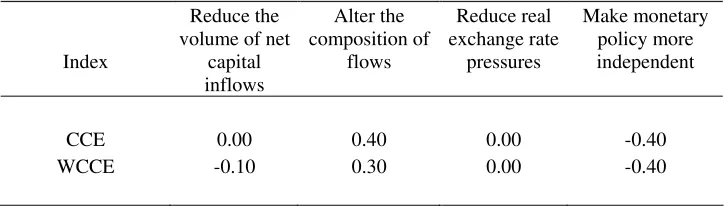
Index
Reduce the volume of net
capital inflows
Alter the composition of
flows
Reduce real exchange rate
pressures
Make monetary policy more independent
CCE 0.00 0.40 0.00 -0.40 WCCE -0.10 0.30 0.00 -0.40
Sources: Appendix Table 3 and sources cited therein.
V.CONCLUSIONS
In sum, capital controls on inflows seem to: make monetary policy more
independent; alter the composition of capital flows; reduce real exchange rate pressures
(although the evidence is more controversial). 5 Capital controls on inflows, however,
seem not to reduce the volume of net flows (and hence, the current account balance)
As to controls on capital outflows, there is Malaysia…and there is everybody else.
In Malaysia, controls reduce outflows, and may give room for more independent
monetary policy. 6 There is little evidence of “success” in other countries attempting to
control outflows, either in terms of altering the volume or regaining monetary policy
independence. These findings are in line with those of an earlier literature focused on
capital flight (as in Mathieson and Rojas Suarez, 1996) and dual or parallel exchange
markets (an in Kuigel and Lizondo, 1997).
While their effectiveness varies across time, countries, and types of measures used,
limiting private external borrowing in the “good times” plays an important prudential role
5
According to the WCCI, Chile stands out in achieving these goals.
6
because more often than not countries that are “debt intolerant”. Indeed, often the critical
problem in good times is that countries borrow too much! 7
While our study has made the case for the need to distinguish between measures
primarily designed to discourage inflows versus curbing outflows, it would be worthwhile
for future research to attempt to ascertain whether there are also important differences in
achieving “success” between measures that are more market friendly (as in the Chilean
reserve requirements) versus those that are based on more blunt quantitative restrictions.
Furthermore, in this study, owing to the nature of most of the empirical work reviewed
here, (which treats the control measures as single episodes) it would be interesting for
policy purposes to examine differences between short run and long run impacts of the
measures, so as to ascertain how quickly do control measures lose their effectiveness.
As long as capital flows to emerging markets remain volatile and potentially
disruptive, the discussion of capital controls in academic and policy circles will remain
alive and hence there is a real need, to evaluate their effectiveness, however defined. As
noted earlier it is an old discussion. Tobin’s seminal paper dates back to the early 1970s.
Furthermore capital controls have been used historically to deal with the fickle capital flow
cycle dating back at least two hundred years. Indeed, not unlike in past inflow episodes, at
the time of this writing countries like Colombia or Argentina have either implemented
controls of capital inflows or are contemplating doing so.
.
7
References
Ariyoshi, Akira, Karl Habermeier, Bernard Laurens, Inci Okter-Robe, Jorge
Canales-Kriljenko, and Anderi Kirilenko, “Capital Controls: Country Experiences with Their Use and Liberalization”, International Monetary Fund Occasional Paper 190, 2000.
Guillermo A. Calvo, Leonardo Leiderman, and Carmen M. Reinhart, “The Capital Inflows Problem: Concepts and Issues,” Contemporary Economic Policy, Vol. XII No. 3, July 1994, 54-66.
Guillermo A. Calvo and and Carmen M. Reinhart, “Fear of Floating,” Quarterly Journal of Economics, Vol. CXVII No. 2, May 2002, 379-408.
Chanda, Areendam, “The Influence of Capital Controls on Long Run Growth: Where and How Much?” Mimeograph, North Carolina State University, September 2003.
De Gregorio, José, Sebastian Edwards, and Rodrigo Valdés, “Controls on Capital Inflows: Do They Work?” Journal of Development Economics, Vol. 3 No. 1, 2000, 59-83. Desai, Mihir, Fritz Foley, and James Hanes, “Capital Controls, Liberalizations, and Foreign
Direct Investment”, National Bureau of Economic Research Working Paper 10337, March 2004.
Dornbusch, Rudi, “Malaysia: Was It Different?” National Bureau of Economic Research Working Paper 8325, June 2001.
Edwards, Sebastian, “How Effective Are Controls on Capital Inflows? An Evaluation of Chile’s Experience,” Mimeograph, UCLA, June 1999.
Edwards, Sebastian, “How Effective are Capital Controls?” Journal of Economic Perspectives Vol. 13 No.4, Fall 1999, 65-84.
Edwards, Sebastian and Roberto Rigobon, “Capital Controls, Managed Exchange Rates, and External Vulnerability,” Mimeograph, UCLA, February 2004.
Forbes, Kristen, “One Cost of the Chilean Capital Controls: Increased Financial Constraints for Smaller Trade Firms”, National Bureau of Economic Research Working Paper 9777, June 2003.
Edison, Hali and Carmen Reinhart, “Stopping Hot Money: On the Use of Capital Controls during Financial Crises”, Journal of Development Economics, Vol. 66 No. 2 December 2001, 533-553.
Edison, Hali, Michael Klein, Licca Ricci, and Torsten Slok, “Capital Account
Liberalization and Economic Performance: Survey and Synthesis”, International Monetary Fund Working Paper 02/120, July 2002
Johnston, Barry. and Natalia Tamirisia, “Why do Countries Use Capital Controls?”, International Monetary Fund Working Paper 98/181, December 1998.
DeKaplan, Ethan and Dani Rodrik, “Did the Malaysian Capital Controls Work?” in S. Edwards and J. Frankel, eds., Preventing Currency Crises in Emerging Markets, (Chicago: University of Chicago Press for the NBER, 2002).
Labán, Raul M., and Felipe Larraín, “What determines Capital Inflows? An Empirical Analysis for Chile,” Faculty Research Working Paper Series R97-09, JFK School of Government, Harvard University, April 1997.
Labán, Raul M., and Felipe Larraín, “The Return of Private Capital to Chile in the 1990s: Causes, Effects, and Policy Reactions,” Faculty Research Working Paper Series R98-02, JFK School of Government, Harvard University, January 1998.
Le Fort, Guillermo and Carlos Budnevich, “Capital Account Regulations and
Macroeconomic Policy: Two Latin Experiences,” Mimeograph, Banco Central de Chile, March 1996.
Miniane, Jacques and John Rogers, “Capital Controls and the International Transmission of U.S. Money Shocks,” Board of Governors of the Federal Reserve, mimeograph, June 2004.
Montiel, Peter and Carmen M. Reinhart (1999), “Do Capital Controls and Macroeconomic Policies Influence the Volume and Composition of Capital Flows? Evidence from the 1990’s,” Journal of International Money and Finance, Vol. 18 No. 4, August, 619-635.
NitithanPrapas, Isriya, Sunil Rongala, and Thomas D. Willett, “The Role of Capital
Controls and Currency Regimes in the Asian Crisis, Mimeograph School of Politics and Economics Claremint Graduate University, August 2002.
Reinhart, Carmen and Vincent R. Reinhart “Some Lessons for Policy Makers Who Deal with the Mixed Blessing of Capital Inflows,” in Miles Kahler, ed. Capital Flows and Financial Crises, Council on Foreign Relations Book (Ithaca, NY: Cornell University Press, 1998), 93-127.
Reinhart, Carmen and Todd Smith (1998), “Too Much of a Good Thing: The
Macroeconomic Effects of Taxing Capital Inflows,”in Reuven Glick, ed. Managing Capital Flows and Exchange Rates: Perspectives from the Pacific Basin,
(Cambridge: Cambridge University Press), 436-464.
Reinhart, Carmen and Todd Smith, “Temporary Controls on Capital Inflows”, Journal of International Economics,Vol. 57 No. 2, December 2002, 327-351.
Tamirisia, Natalia, “The Malaysian Batik of Capital Controls,” International Monetary Fund, mimeograph 2004.
Ulan, Michael K. “Is a Chilean-Style Tax on Sort-Term Capital Inflows Stabilizing?” Open Economies Review, Vol. 11.
Appendix Table 1
Capital Inflows: Methodology and Degree of Methodological Rigor
Study Sample Methodology Econometric
Rigor
Brazil
Cardoso & Goldfajn (1998)
1988:1-1995:12
OLS controlling for heteroscedasticity and serial correlation, IV, and VAR They control for endogeneity of capital controls (government’s reaction function)
High
Edison & Reinhart (1999)
1995-2001
Test for equality of moments and changes in persistence between capital controls and no controls, principal components analysis; block exogeneity tests (VAR) for causality; GARCH for the effects of controls on volatility; and Wald tests for structural brakes over a rolling window
High
Reinhart & Smith (1998)
1994-1996
Event comparison through time- rescaling (labeling the implementation of controls as period “t”, and analyzing the evolution of the series in “t-1”, and through “t+2”. Detailed chronological description of the various measures applied in each economy
Medium Ariyoshi, Habermeier, Laurens, Okter-Robe, Canales-Kriljenko & Kirilenko (2000) 1993-1997
Extensive descriptive and comparative country-studies analysis of time-series in each episode, dividing facts according to controls on capital inflows (limiting short-term flows), control on capital outflows (financial crises), extensive exchange controls (financial crises), long standing controls and their liberalization, rapid liberalization
Low
Chile
De Gregorio, Edwards &Valdés
(2000)
1988:I-1998:II
IV and VAR. With these, hey address simultaneity problems, exogenous upward trend in capital flow, bias due to measurement error because of loopholes in controls. They consider two alternative measures of expected devaluations: (i)effective rate of depreciation; and (ii) one step ahead forecast from a rolling ARMA. They consider two alternative measures of flows: (i) short tem flows to GDP; and (ii) total flows to GDP.
High
Edwards (1999)a 1994:10-1999:1
GARCH for changes in the short term central bank nominal interest rate, and changes in the log of the stock market index, using daily data. Descriptive analysis of the effects of capital controls on the composition of capital inflows, and domestic interest rates and monetary policy independence.
High
Edwards (1999)b 1991:6-1998:9
Descriptive analysis of the composition of capital flows during capital controls times. VAR on the effects of capital controls on the real exchange rate. GARCH for changes in the short term central bank nominal interest rate, and changes in the log of the stock market index.
High
Edwards & Rigobon (2004)
1991:1-1999:9
Using stochastic calculus, they compute the shadow exchange rate and its bands. GARCH (effect of capital controls on propagation of external shocks. Estimate a mean and a variance equation.
Appendix Table 1 (continued)
Capital Inflows: Methodology and Degree of Methodological Rigor
Study Sample Methodology Econometric
Rigor
Chile (continued)
Hernández & Schmidt-Hebbel (1999) 1989-1998:II and 1998:7-1999:6
Least squares estimation, controlling for spurious correlation, endogeniety of the RHS regressors, heteroscedasticity and autocorrelation. Co-integration analysis and error-correction model. TSLS estimation also included
High
Labán, Larraín & Chumacero (1997)
1985-1994
Estimation of a special case of non-linear models in which a particular variable may adopt a certain law of motion conditional on an observation passed a threshold (special case of Markov Switching Regime Models, with the threshold replacing the transition matrix). They run a full sample parsimonious regression for each series, to determine variables to include in the threshold process; for given choice of threshold variable, they estimated the model and got the p-value associated with a null of a unique stable representation; if the latter is rejected in favor of threshold process chose the threshold variable that minimizes the sum of squares of residuals; and reduce the threshold model to a parsimonious representation.
High
Labán & Larraín (1998)
1985-1996
Descriptive analysis of events, describing the context for implementing capital controls and the main macroeconomic effects.
Low
Laurens & Cardoso (1998)
1985:I-1994:IV
Linear and Cubic approximations of net inflows as primarily of interest rate differentials. High
Le Fort & Budnevich
(1997)
1990-1994
Descriptive analysis of events, describing the context for implementing capital controls and the main macroeconomic.
Low
Reinhart & Smith (1998)
1990-1994
Event comparison through time- rescaling (labeling the implementation of controls as period “t”, and analyzing the evolution of the series in “t-1”, and through “t+2”. Detailed chronological description of the various measures applied in each economy
Appendix Table 1 (continued)
Capital Inflows: Methodology and Degree of Methodological Rigor
Study Sample Methodology Econometric
Rigor Chile (concluded) Valdés-Prieto & Soto (1995) 1987-1995
Error-correction representation (that is efficient) with a two-step procedure: (i) OLS estimation of the real exchange rate on a set of explanatory variables to contrast the estimated residuals; and (ii) use these residuals to estimate by OLS an error correction equation measuring the deviation of the dependent variable from its long term equilibrium level (given by (i)). They checked for several endogeneity and simultaneity biases. They also looked at the effect of controls on short term credit
High
Colombia
Le Fort & Budnevich
(1997)
1990-1995
Descriptive analysis of events, describing the context for implementing capital controls and the main macroeconomic.
Low
Reinhart & Smith (1998)
Event comparison through time- rescaling (labeling the implementation of controls as period “t”, and analyzing the evolution of the series in “t-1”, and through “t+2”. Detailed chronological description of the various measures applied in each economy
Medium Ariyoshi, Habermeier, Laurens, Okter-Robe, Canales-Kriljenko & Kirilenko (2000) 1993-1998
Extensive descriptive and comparative country-studies analysis of time-series in each episode, dividing facts according to controls on capital inflows (limiting short-term flows), control on capital outflows (financial crises), extensive exchange controls (financial crises), long standing controls and their liberalization, rapid liberalization
Low
Czech Republic
Reinhart & Smith (1998)
1994-1997
Event comparison through time- rescaling (labeling the implementation of controls as period “t”, and analyzing the evolution of the series in “t-1”, and through “t+2”. Detailed chronological description of the various measures applied in each economy
Medium
Malaysia (1989)
Reinhart & Smith (1998)
1993-1996
Event comparison through time- rescaling (labeling the implementation of controls as period “t”, and analyzing the evolution of the series in “t-1”, and through “t+2”. Detailed chronological description of the various measures applied in each economy
Appendix Table 1 (concluded)
Capital Inflows: Methodology and Degree of Methodological Rigor
Study Sample Methodology Econometric
Rigor
Malaysia (1994)
Ariyoshi, Habermeier, Laurens, Okter-Robe, Canales-Kriljenko & Kirilenko (2000)
1994
Extensive descriptive and comparative country-studies analysis of time-series in each episode, dividing facts according to controls on capital inflows (limiting short-term flows), control on capital outflows (financial crises), extensive exchange controls (financial crises), long standing controls and their liberalization, rapid liberalization
Low
Thailand
Ariyoshi, Habermeier, Laurens, Okter-Robe, Canales-Kriljenko & Kirilenko (2000)
1995-1997
Extensive descriptive and comparative country-studies analysis of time-series in each episode, dividing facts according to controls on capital inflows (limiting short-term flows), control on capital outflows (financial crises), extensive exchange controls (financial crises), long standing controls and their liberalization, rapid liberalization
Appendix Table 2
Capital Outflows: Methodology and Degree of Methodological Rigor
Study Sample Methodology Econometric Rigor
Malaysia
Tamirisia (2004) 1991:1-2002:12
Error-correction model. Series on net foreign portfolio assets are by foreign portfolio assets to isolate country-specific effects
High
Dornbusch (2001) Descriptive analysis of different variables Low Edison & Reinhart
(2000)
Test for equality of moments and changes in persistence between capital controls and no controls, principal components analysis; block exogeneity tests (VAR) for causality; GARCH for the effects of controls on volatility; and Wald tests for structural brakes over a rolling window
High
Kaplan & Rodrik (2002)
1992-1996
Shifted difference in differences to separate the counterfactual of capital controls versus IMF-based-program recovery. This methodology enables the authors to re-schedule the episodes in terms of the timing of the crises (shifted). The difference in differences allows them to capture the comparison effect of the recovery with capital controls vis a vis with a successful IMF program, controlling for exogenous and country-specific effects (static and dynamics)
High
Ariyoshi, Habermeier, Laurens, Okter-Robe, Canales-Kriljenko & Kirilenko (2000)
1998-2000
Extensive descriptive and comparative country-studies analysis of time-series in each episode, dividing facts according to controls on capital inflows (limiting short-term flows), control on capital outflows (financial crises), extensive exchange controls (financial crises), long standing controls and their liberalization, rapid liberalization
Low
Spain
Jose Viñals(1992) 1992 Descriptive analysis of economic policy measures and its effect on various macroeconomic variables Low Edison & Reinhart
(1999)
1991-1993
Test for equality of moments and changes in persistence between capital controls and no controls, principal components analysis; block exogeneity tests (VAR) for causality; GARCH for the effects of controls on volatility; and Wald tests for structural brakes over a rolling window
Appendix Table 2 (continued)
Capital Outflows: Methodology and Degree of Methodological Rigor
Study Sample Methodology Econometric Rigor
Ariyoshi, Habermeier, Laurens, Okter-Robe, Canales-Kriljenko & Kirilenko (2000)
1992
Extensive descriptive and comparative country-studies analysis of time-series in each episode, dividing facts according to controls on capital inflows (limiting short-term flows), control on capital outflows (financial crises), extensive exchange controls (financial crises), long standing controls and their liberalization, rapid liberalization
Low
Thailand
Edison & Reinhart (2000)
1995-1999
Test for equality of moments and changes in persistence between capital controls and no controls, principal components analysis; block exogeneity tests (VAR) for causality; GARCH for the effects of controls on volatility; and Wald tests for structural brakes over a rolling window
High
Ariyoshi, Habermeier, Laurens, Okter-Robe, Canales-Kriljenko & Kirilenko (2000)
1997-1998
Extensive descriptive and comparative country-studies analysis of time-series in each episode, dividing facts according to controls on capital inflows (limiting short-term flows), control on capital outflows (financial crises), extensive exchange controls (financial crises), long standing controls and their liberalization, rapid liberalization
Appendix Table 3
Multi-country Studies: Methodology and Degree of Methodological Rigor
Study Sample Methodology Econometric Rigor
Montiel & Reinhart (1999)
1990-1996 They construct indices to measure incidence and intensity of capital account restrictions. Estimation of fix-effect panel regressions to explain volume and composition of capital flows. Results are checked for robustness by IV estimations. Covers Indonesia, Malaysia, Philippines, Sri Lanka, Thailand, Argentina, Brazil, Chile, Colombia, Costa Rica, Mexico, Czech Republic, Egypt, Kenya and Uganda
High
Reinhart & Smith (1998)
1990-1997 Event comparison through time- rescaling (labeling the implementation of controls as period “t”, and analyzing the evolution of the series in “t-1”, and through “t+2”. Detailed chronological description of the various measures applied in each economy. Covers Brazil, Chile, Colombia, Czech Republic, Malaysia, Mexico, Thailand, Indonesia, and Philippines.
Intermediate
Kaplan & Rodrik (2002)
1992-1996 Shifted difference in differences to separate the counterfactual of capital controls versus IMF-based-program recovery. This methodology enables the authors to re-schedule the episodes in terms of the timing of the crises (shifted). The difference in differences allows them to capture the comparison effect of the recovery with capital controls vis a vis with a successful IMF program, controlling for exogenous and country-specific effects (static and dynamics). Covers Korea, Thailand, Indonesia, Malaysia (monthly and quarterly data for 1992-1996 -before crisis- and from crisis time and 1 year ahead)
Edison & Reinhart (1999)
1991-1999 Test for equality of moments and changes in persistence between capital controls and no controls, principal components analysis; block exogeneity tests (VAR) for causality; GARCH for the effects of controls on volatility; and Wald tests for structural brakes over a rolling window. Covers Spain (1991-1993), and 1995-1999 for Brazil, Malaysia, and Thailand. Control group: Philippines and South Korea
Appendix Table 3 (concluded)
Multi-country Studies: Methodology and Degree of Methodological Rigor
Study Sample Methodology Econometric Rigor
Miniane & Rogers (2004)
1971:1-1998:12
Panel VAR and individual country VAR of commodity prices, US industrial production , US consumers prices, foreign industrial production, foreign interest rates, US Fed Funds Rate, non-borrowed reserves to reserves ratio and nominal exchange rate in response to a 25 basis points increase in the Fed Funds Rate. For the country level VAR they regress each country separately, compute the cumulative exchange rate and interest rate responses, and finally regress country– specific responses on the values of capital control index, exchange rate regime, degree of
dollarization, and trade integration. Covers Australia, Austria, Belgium, Canada, Chile, Colombia, Denmark, Finland, France, Germany, Greece, India, Italy, Japan, Korea, Malaysia, Mexico, The Netherlands, Norway, The Philippines, Portugal, South Africa, Spain, Sweden, Turkey, UK