Computer Science Dissertations Department of Computer Science
8-13-2019
Game Theory Based Privacy Protection for
Context-Aware Services
Yan Huang
Follow this and additional works at:https://scholarworks.gsu.edu/cs_diss
This Dissertation is brought to you for free and open access by the Department of Computer Science at ScholarWorks @ Georgia State University. It has been accepted for inclusion in Computer Science Dissertations by an authorized administrator of ScholarWorks @ Georgia State University. For more information, please [email protected].
Recommended Citation
FOR CONTEXT-AWARE SERVICES
by
YAN HUANG
Under the Direction of Anu G. Bourgeois, Ph.D. and Zhipeng Cai, Ph.D.
ABSTRACT
In the era of context-aware services, users are enjoying remarkable services based on data
collected from a multitude of users. To receive services, they are at risk of leaking private
information from adversaries possibly eavesdropping on the data and/or the un–trusted
service platform selling off its data. Malicious adversaries may use leaked information to
violate users’ privacy in unpredictable ways. To protect users’ privacy, many algorithms
are proposed to protect users’ sensitive information by adding noise, thus causing
context-aware service quality loss. Game theory has been utilized as a powerful tool to balance
the tradeoff between privacy protection level and service quality. However, most of the
existing schemes fail to depict the mutual relationship between any two parties involved: user,
platform, and adversary. There is also an oversight to formulate the interaction occurring
between multiple users, as well as the interaction between any two attributes. To solve
for context-aware services, thus optimize the service quality. Next, this dissertation extends
the framework to a multi-user scenario and proposes a two-layer three-party game framework.
This makes the proposed framework more realistic by further exploring the interaction, not
only between different parties, but also between users. Finally, we focus on analyzing the
impact of long-term time-serial data and the active actions of the platform and adversary.
To achieve this objective, we design a three-party Stackelberg game model to help the user
to decide whether to update information and the granularity of updated information.
FOR CONTEXT-AWARE SERVICES
by
YAN HUANG
A Dissertation Submitted in Partial Fulfillment of the Requirements for the Degree of
Doctor of Philosophy
in the College of Arts and Sciences
Georgia State University
FOR CONTEXT-AWARE SERVICES
by
YAN HUANG
Committee Chair: Anu G. Bourgeois
Committee: Zhipeng Cai
Wei Li Ruiyan Luo
Electronic Version Approved:
DEDICATION
This dissertation is dedicated to my parents Guangyong Huang and Qiulian Yang, my fiancee
Nanxi Peng for their endless support and love during my Ph.D. years. I cannot finish my
ACKNOWLEDGMENT
It is a truly life-changing experience for me to pursuing Ph.D. degree in Georgia State
University during the past four years. I would never have been able to finish my dissertation
without the guidance of my advisors and committee members, help from my group, and
support from my family and my friends.
I would like to show my deepest gratitude to my advisor Dr. Anu G. Bourgeois, and
Dr. Zhipeng Cai. They provided me with an excellent environment for research, and gave
me many opportunities to promote myself. They not only taught and encouraged me in my
research but also inspired me to achieve self-actualization.
It is very grateful and a great honor to have Dr. Wei Li, and Dr. Ruiyan Luo in my
committee, who gave me great supports for my Ph.D. study and spared time to participate
in my defense committee.
Also many thanks go to colleagues in my group and department. Special thanks for
my group colleagues Dr. Meng Han, Dr. Yi Liang, Dr. Dongjing Miao, Dr. Xu Zheng, Dr.
Zhuojun Duan, Dr. Zaobo He, Dr. Ji Li, who helped me study and live in U.S..
Last but not least, it is a pleasure to thank everybody who made the dissertation
TABLE OF CONTENTS
ACKNOWLEDGMENT . . . v
LIST OF TABLES . . . ix
LIST OF FIGURES . . . x
LIST OF ABBREVIATIONS . . . xii
Chapter 1 INTRODUCTION . . . 1
Chapter 2 BACKGROUND . . . 5
2.1 Two Parties Game model . . . 5
2.2 User Group centric Game Model . . . 6
2.3 Three Parties Game Model . . . 7
Chapter 3 PRIVACY PROTECTION AMONG THREE ANTITHETIC-PARTY FOR CONTEXT-AWARE SERVICES . . . . 9
3.1 Motivation . . . 9
3.2 Three-Party Game Model . . . 11
3.2.1 User Model . . . 11
3.2.2 Platform Model . . . 13
3.2.3 Adversary Model . . . 15
3.3 Nash Equilibrium Analysis . . . 16
3.3.1 Nash Equilibrium . . . 16
3.3.2 Strategy Analysis of User . . . 17
3.3.3 Strategy Analysis of Platform . . . 19
3.4 Simulation . . . 22
3.4.1 Interactions Among Three Parties with One Attribute . . . 22
Simulation Result of User’s Utility and Optimal Strategy . . . 22
Simulation Result of Platform’s Utility and Optimal Strategy . . 27
Simulation Result of Adversary’s Optimal Strategy . . . 28
3.4.2 Interactions Among Three Parties with Multiple Attributes . . . . 28
Results of User’s Utility and Optimal Strategy . . . 30
Results of Platform’s Utility and Optimal Strategy . . . 32
Simulation Result of Adversary’s Optimal Strategy . . . 33
Comparison with Two-Party Game . . . 34
3.5 Conclusion . . . 34
Chapter 4 PRIVACY PROTECTION FOR CONTEXT-AWARE SER-VICES: A TWO-LAYER THREE-PARTY GAME MODEL . . 36
4.1 Motivation . . . 36
4.2 Preliminary . . . 38
4.3 System Model . . . 39
4.3.1 Users Model . . . 39
4.3.2 Platform Model . . . 40
4.3.3 Adversary Model . . . 43
4.4 Game Model . . . 43
4.4.1 Aggregative Game Model . . . 43
4.4.2 Contract Model . . . 44
4.5 Simulation . . . 46
4.5.1 Simulation Setting . . . 46
4.5.2 Users Interaction . . . 47
4.6 Conclusion . . . 48
Chapter 5 GAME THEORY BASED PRIVACY PROTECTION FOR CONTEXT-AWARE SERVICES WITH LONG-TERM TIME SERIES DATA . . . 50
5.1 Motivation . . . 50
5.2 Related Work . . . 52
5.3 System Model . . . 54
5.3.1 Framework . . . 54
5.3.2 Adversary Model . . . 55
5.3.3 Platform Model . . . 56
5.3.4 User Model . . . 58
5.4 Nash Equilibrium . . . 58
5.5 Simulation . . . 59
5.5.1 Simulation Setting . . . 59
5.5.2 Nash Equilibrium . . . 60
5.5.3 Interactions Among Three Parties . . . 61
5.5.4 Significance of Three-Party Game Model . . . 62
5.6 Conclusion . . . 62
Chapter 6 FUTURE WORK . . . 63
6.1 Game Theory Based Application for Specific Domain . . . 63
6.2 Privacy Protection Middleware Powered by Game Theory . . . 64
Chapter 7 CONCLUSION . . . 65
ACKNOWLEDGMENT . . . 67
LIST OF TABLES
Table 3.1 Extracted strategies . . . 29
Table 3.2 Strategy simulation setting . . . 30
LIST OF FIGURES
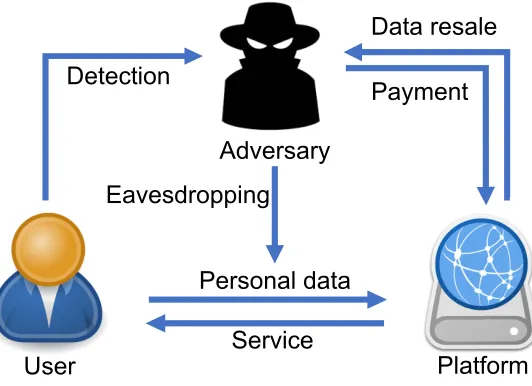
Figure 3.1 Structure of thee-party game. . . 10
Figure 3.2 Utility of user under various G and S. . . 23
Figure 3.3 Utility of user under various G and b1. . . 23
Figure 3.4 Optimal strategy of user under various S and b1. . . 23
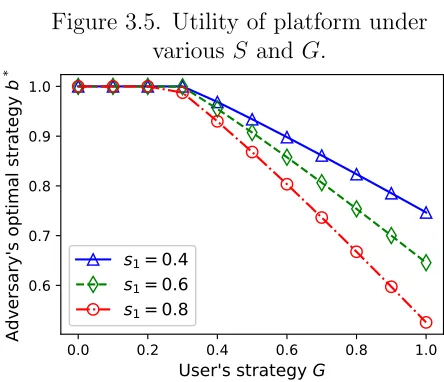
Figure 3.5 Utility of platform under various S and G. . . 23
Figure 3.6 Optimal strategy of platform under various Gand b1. . . 23
Figure 3.7 Optimal strategy of adversary under various Gand b1. . . 23
Figure 3.8 Utility of user under various G and S. . . 24
Figure 3.9 Optimal strategy of user under various S. . . 24
Figure 3.10 Optimal strategy of user under various b. . . 24
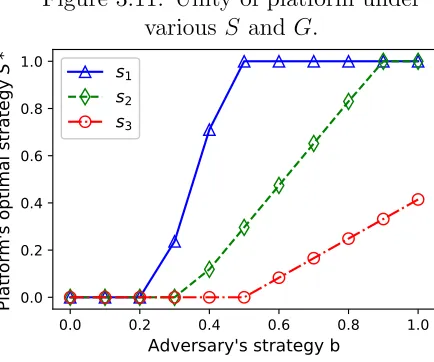
Figure 3.11 Uility of platform under various S and G. . . 24
Figure 3.12 Optimal strategy of platform under various G. . . 24
Figure 3.13 Optimal strategy of platform under various b. . . 24
Figure 3.14 Optimal strategy of adversary under various Gand b. . . 25
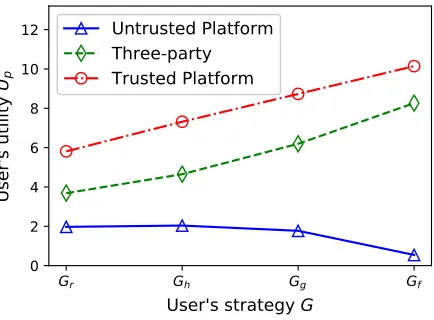
Figure 3.15 Utility comparison of user under various platform. . . 25
Figure 3.16 Cost comparison of user under various platform. . . 25
Figure 3.17 Utility comparison of various platforms. . . 25
Figure 4.1 Two-layer three-party Game model . . . 37
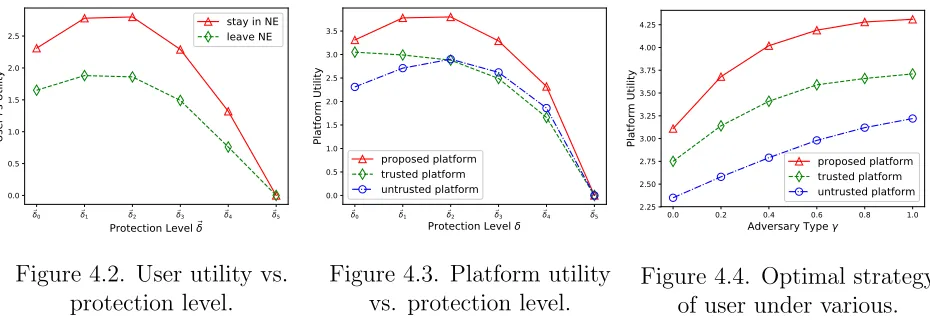
Figure 4.2 User utility vs. protection level. . . 46
Figure 4.3 Platform utility vs. protection level. . . 46
Figure 4.4 Optimal strategy of user under various. . . 46
Figure 5.1 Structure of thee-party Stackelberg game model. . . 54
Figure 5.2 Platform Utility vs. Reward. . . 60
Figure 5.3 User Utility vs. Granularity. . . 60
LIST OF ABBREVIATIONS
• DVD - Digital Versatile Disc
• LBSs - Lcation-Based Services
• LPPMs - Location-Privacy Preserving Mechanisms
• NE - Nash Equilibrium
• PSO - Particle Swarm Optimization
• PSNE - Pure Strategy Nash Equilibrium
• IR - Individual Rationality
• IC - Incentive Compatibility
• IoT - Internet of Things
• AI - Artificial Intelligence
Chapter 1
INTRODUCTION
People are enjoying a huge convenience from context-aware services, such as navigation
services provided by Google Map, reviews and recommendations services provided by Yelp,
ride-sharing services by Uber and Lyft, online social media services provided by Facebook,
etc. However, people are suffering from privacy leakage while enjoying these convenient
ser-vices. According to the statistics from [1], 55% of iOS applications and 59.7% of Android
applications surreptitiously leak user’s data. In recent news, we learned of Facebook
improp-erly sharing data that impacted 87 million users [2] and Equifax [3] compromised private
information of 143 million users.
This has led to considerable research on techniques to protect a user’s private data from
being leaked and/or sold. Most of the privacy protection algorithms, e.g. k-anonymity [4],
l-diversity [5], t-closeness [6], and differential privacy [7], protect the data by adding noise.
However, the added noise in existing work will decrease the quality of provided services [8].
To maximize the service quality while satisfying the privacy protection demands, researchers
made the efforts on two aspects: (i) optimizing the privacy protection algorithm to maintain
as much usable information under the privacy protection restriction, and (ii) utilizing Game
Theory to find the optimized privacy protection setting for the algorithms by balancing
privacy loss and service quality. However, each aspect has its drawbacks.
Current k-anonymity, l-diversity, t-closeness based algorithms suffer from differential
attack [9]. In October 2006, Netflix, the worlds largest online Digital Versatile Disc (DVD)
rental service, publicly released a data set containing 100 million anonymized movie
rat-ings, created by 500,000 users of Netflix. Narayanan and Shmatikov demonstrated that an
adversary could identify the users information with less background knowledge about
of the background knowledge [10]. Differential Privacy based algorithms can prevent users
from differential attacks [11]. The limitation of Differential Privacy based algorithm is that
it cannot be used in the scenario with only one user. To solve this problem, [12] mixed
differential privacy and k-anonymity proposed a perturbation method based on local
en-forcement of differential privacy. However, both k-Anonymity and differential privacy will
lead to unavoidable inaccurate service.
To maximize the service quality in the privacy protected context-aware services, many
researchers utilize Game Theory to find the best privacy protection level setting by balancing
the tradeoff between privacy loss and service quality. Most of the existing game theory
based work investigates the interaction between two parties: user/data owner and adversary.
In [13–18], games are based on a two-player model, i.e., one-against-one. When there are
multiple users trying to maintain a certain privacy preserving level, the user-adversary game
can be modeled as an n-player game [19–24], but with the drawback that all users must
have the same settings. Another drawback is that the two-party game cannot depict the
interactions among three antithetic parties. Recently, three-party game models have been
proposed to study complicated privacy issues among user/data owner, service provider/data
requester, and adversary. In [25], Li et. al. designed a hierarchical game, incorporating
a user-service provider game and a user-attacker game, to maximize the service provider’s
utility while assisting the user in defending the attacker. Adl et. al. [26] proposed a
three-party sequential game to analyze the interactions among a data provider, a data collector, and
a data user (i.e., the adversary), which can guide the data provider and the data collector to
find the optimal strategies deciding whether to cooperate with the data user. In [27,28], Wang
et. al. studied the interactions among a user, an application, and an adversary to answer two
questions: whether the user should submit data and whether the application should resell
the user’s data? To resolve the trade-off between sharing advantages and privacy exposure
of cybersecurity information exchange system, Vakilinia et. al. [29] designed a three-party
game for privacy-preserving cybersecurity information exchange framework consisting of an
three-party games in [25–29] fail to build the mutual interaction between any two of the three
parties, and the strategy of each party in [26–28] is coarse-grained, or binary, by indicating
“whether to cooperate with opponents or not”.
These drawbacks and challenges have not been properly solved. Contrasting from the
existing work, we establish our research by proposing a three-party game model to capture
the mutual interaction between any two of the three antithetic parties (including user/data
owner, service provider/data requester, and adversary) and aim to identify their strategies
on “how to defend (or cooperate with) others”, which can offer fine-grained guidance to the
three parties. The main contribution of each part includes:
In the first part, we design a privacy-preserving game to quantify the three parties’
concerns and capture interactions between any two of them. We also identify the best
strategy for each party at a fine-grained level, i.e. specific settings, not simply binary. Via
both theoretical analysis and real-data experiments, the performance of our proposed game
model is validated.
In the second part, we propose a platform-centric two-layer three-party game model to
protect the users’ privacy and provide quality of service. One layer focuses on the interactions
among the multiple asymmetric users and the second layer considers the influence between
any two of the three parties (user, platform, and adversary). We prove that the Nash
Equilibrium exists in the proposed game and find the optimal strategy for the platform
to provide quality service, while protecting private data, along with interactions with the
adversary. Using real datasets, we present simulations to validate our theoretical analysis.
The third part analyzes the influence of time-serial data and the possible feedback from
a platform with diverse reward for data according to the feedback in three-party game based
framework. This work enhances the three-party game based framework by making it more
realistic, thus providing more practical application scenario.
The rest of this dissertation proposal is organized as follows. Chapter 2 summarizes
the related literature. Chapter 3 studies the problem of “Privacy Protection among Three
IEEE International Conference on Distributed Computing Systems (ICDCS 2019).
Chap-ter 4 “Privacy Protection for Context-Aware Services: A Two-Layer Three-Party Game
Model” expands the work in Chapter 3. This work has been accepted by the 14th
Inter-national conference on algorithms, systems, and applications of wireless networks (WASA
2019). In chapter 5, we introduce game theory based privacy protection for context-aware
services with the long-term time series data. Finally, in Chapter 6, we provide future
Chapter 2
BACKGROUND
Context-aware services has been protected by privacy protection techniques [30–38].
Game Theory is a popular and efficient tool to find out the optimal privacy protection level
for the purpose of improve service quality under the protection algorithms. In this section,
we survey existing privacy protection level selection based on game theory .
2.1 Two Parties Game model
Two-party game models have two categories: single user centric game model and user
group centric game model.
Single user centric game models provide optimal local privacy protection strategy locally
by the user. Chorppath and Alpcan [13] propose a game theoretic approach to formulate
the interaction between users and companies for mobile commerce. In their game model,
users report their locations with granularity to protect privacy. The proposed game is
uti-lized to find the optimal anonymity level for mobile users and the optimal incentive strategy
for companies. To balance the service data quality and location privacy preservation in
location-based services (LBSs), Shokri [14] et. al. propose a methodology to utilize
Stack-elberg Bayesian game to enable a designer to find the optimal location-privacy preserving
mechanism (LPPM). Given the service quality constraint of the user, the optimal LPPM
can provide the best privacy protection. Shokri et. al. improve their work by taking
lo-cation correlation into account to protect the trajectory privacy of users [16]. The authors
use zero-sum Stackelberg Bayesian game to find the optimal LPPM to against adversary
subject to a service quality constraint. Sfar et. al. [17] propose a privacy preserving model
for retail applications. They utilize a Markov game model to reach a compromise between
on mobile phone, Wang and Zhang [39] construct a zero-sum stochastic game to formulate
the strategic and dynamic competition between a smart phone user and a malicious
adver-sary. According to the Nash Equilibrium (NE) of the game, the user can find the optimal
defense strategy. The users in single user centric game can achieve the privacy protection
by themselves. They do not need to consider the affection from other users and do not need
to corporate with other users. However, single user centric game models cannot provide
theoretical privacy protection guarantees like k-anonymization and differential privacy.
2.2 User Group centric Game Model
A group user based game model needs users in the group working together to maintain
a certain anonymization level.
Halkidi and Koutsipoulos [40] propose a game theoretic framework data privacy
preser-vation in recommender systems. In the recommender system, the quality of
recommenda-tions depends on the submitted data from all users. Each user prefers to submit less data
to preserve data privacy. However, the quality of recommendation will decay if all the users
choose to reveal less information to the platform. In [40], the authors propose a game based
framework to balance the trade-off between privacy preservation and quality of
recommen-dation. The Nash Equilibrium Point of the proposed game provides the optimal strategy for
each user. Wu et. al. [19] utilize game theory to balance the trade-off between privacy and
utility for correlated data publication. They find out the payoff of each user is dependent
on both its parameters and its neighbors’ privacy parameters. Therefore, they build a game
model of multiple players to analyze the optimal privacy parameters of data publication of
each user. When a user employs k-Anonymity in LBS, it needs to generate fake location
records, known as dummy users, to protection its location privacy. However, due to the high
cost of dummy user generation, self-interested users do not want generate dummy users but
free-ride on other’s efforts. Liu et. al [20] propose a distributed approach to guide users to
generate dummies according to their privacy demands and utilize Bayesian game model to
user generation strategy. To protect the pseudonyms used for authentication in mobile
net-works, users in a mix zone should collectively change their pseudonyms. A Sef-interested
user may not cooperate due to the high cost of pseudonym change. Freudiger et. al. [21]
define a game theoretical model to help each user in a mix zone to find the optimal time to
change their pseudonym by balancing the privacy protection and cost of pseudonym change.
Kumari and Chakravarthy [41] propose a Cooperative Game to achieve privacy preserving
before data publishing. The proposed game can incentivize users to stay in the coalition to
achieve k-anonymity. By using the optimal strategy from Nash Equilibrium, each user can
preserve its privacy and also contribute to preserving privacy of other users.
The user group centric game model is utilized to find the optimal strategy of each user
or incentivize users to stay in the group. Users in the group can have theoretical privacy
protection guarantee. However, they need to consider the interaction between users and need
a scheme to ensure all the users in the group are honest.
2.3 Three Parties Game Model
Most existing research only discusses the interaction between two parties: users and
adversaries or user and platforms (or service providers). However, privacy issues include
three parties: user, platform and adversary.
Adl et. al [26] analyze the trade-off between privacy and utility among three parties:
data provider (user), data collector (platform) and data user (adversary). They utilize a
sequential game to formulate the action of each party. In their game model, they assume the
data user is the leader of the game and can choose the privacy parameter. Data collector
and data provider has binary strategy: accept or reject. Obviously, their assumption is not
suitable in the real world. Wang et. al. [27] investigate the interaction between three parties:
user, application and adversary. They utilize a game model to find out the condition that can
make the three parties have good behavior. However, in their game model, the three parties
have only binary strategies. In another work of Wang et. al [28], they build a application
three parties: user, application and adversary. However, as the game model in [27], each
party only has two states: cooperation state and defection state. The simple strategy space
of each party is unpractical in a real scenario.
We build a three-party game model in this dissertation. The strategy of each party is
formulated according to their practical actions. Therefore, the proposed model in this paper
Chapter 3
PRIVACY PROTECTION AMONG THREE ANTITHETIC-PARTY FOR
CONTEXT-AWARE SERVICES
In this chapter, we study the issues in existing game theory based research on privacy
protection for context-aware services and propose a three party game model based framework
to solve these issues.
3.1 Motivation
In the past years, privacy-preserving mechanisms have received a lot of attention from
re-searchers. Besides cryptography, game theory has been widely applied as a strategic
method-ology to search for optimal strategies balancing the trade-off between the benefit of sharing
data and cost of privacy disclosure [13–17, 19–29, 42, 43]. Notice that most of the existing
research only focuses on the interaction between two opposite parties [13–17, 19–21], i.e.,
defender-attacker game model. In [25–29], various three-party game models are proposed.
But, the game models of [25–29] are not “real” three-party models because they fail to
de-pict the interaction between any two of the three parties, i.e. they considered either data
resale by the platform or attacks by the adversary. Additionally, the schemes in [26–28] only
provide a binary solution, specifically whether or not the user should submit their data to
receive services.
Further exploring the mutual relationships among user, platform, and adversary would
be more helpful for the user to defend against both the untrusted platform and the adversary.
Moreover, it would be beneficial to produce a more fine-grained solution, so that a user could
possibly provide obscured data and still receive adequate service. For this purpose, this
chapter aims to design a three-party game model among the three antithetic parties for users
Personal data
Service
Payment Data resale
Eavesdropping Adversary
User Platform
[image:25.612.171.437.75.268.2]Detection
Figure 3.1. Structure of thee-party game.
Such a realistic and complicated game model challenges us in the following aspects: (i)
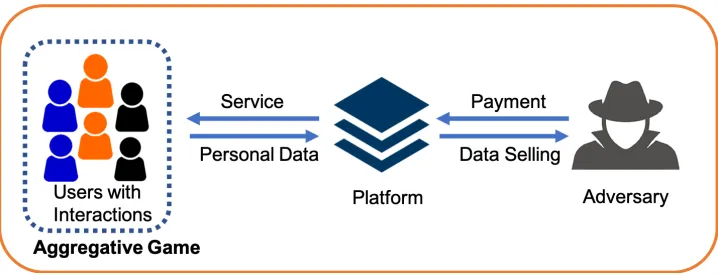
Complicated game structure. As shown in Fig. 3.1, the interaction occurs between any two
of the three parties, increasing difficulty in addressing the three parties’ individual concerns –
how does the user assess the potential risk of privacy loss and determine the granularity when
submitting personal data; how does the platform determine data resale with consideration of
the risk of reputation loss; and how does the adversary make a choice between purchase and
eavesdropping? (ii) Joint threats. In such a complicated game, the user has to defend the
joint threats from both the platform and the adversary, which may be hard to accomplish.
(iii) Multiple data attributes. For many services, it is common that users need to submit
multiple data attributes that could be correlated together. Any obscurity applied to one
attribute would need to be correlated accordingly. (iv) Theoretical analysis & solution.
Designing, analyzing, and solving the proposed three-party game are destined to be difficult
due to the complexity of the game structure and correlated data attributes.
Our research endeavor to overcome the above challenges is briefly introduced as follows.
Firstly, in our game model, we link the three parties elaborately quantifying their concerns
and mutual interactions such that they are inseparable. Secondly, based on our game model,
parties, including the optimal data release granularity for the user, the optimal data resale
strategy for the platform, and the optimal probability to purchase data (or launch attack)
for the adversary. Finally, we conduct simulations with real datasets under various settings
to validate the effectiveness of our proposed game model.
To the best of our knowledge, we are the first to provide a fine-grained analysis on the
behaviors and interactions for the user, platform, and adversary with considering resistance
to the joint threats. Our major contributions are summarized as below:
• A three-party game is designed to capture the complicated interactions among user,
platform, and adversary targeting defending the joint threats from both untrusted
platform and adversary.
• An in-depth theoretical analysis is presented to identify the best strategy of each party.
• Comprehensive simulations with real datasets are exploited to evaluate the performance of our game model, regarding optimal strategy, cost, and utility of the three parties.
The rest of this chapter is organized as follows. Our game model is introduced in
Section 3.2. The optimal strategy of each party and the performance of our game are
analyzed in Section 3.3 and Section 3.4, respectively. Finally, Section 3.5 briefly concludes
this chapter and discusses our future work.
3.2 Three-Party Game Model
In this section, the interaction among user, platform, and adversary is modeled as a
three-party game, in which their strategies, benefits, and costs are mathematically
formu-lated.
3.2.1 User Model
We consider the following scenario: a user submits personal dataset, denoted by D =
one or more attributes anddi (1≤i≤n) is the data of attributei. Due to privacy concerns,
the user may report data attributes with different data release granularity. Formally, the
data release granularity of attribute i is defined as gi ∈ [0,1], and the corresponding data
granularity set is G = {g1, g2, . . . , gi, . . . , gn}. Specifically, with a larger gi, the data of
attribute i is less obscured, revealing more personal/sensitive information; for examples,
gi = 0 if di does not contain any personal data, and gi = 1 if di is fully accurate. In this
chapter, we use data granularity as a measurement of data quality/obscurity.
As the data release granularity increases, the quality of user’s requested service is
in-creased with diminishing marginal benefit [44]. Suppose that the quality of attributei-based
service can achieve a maximum value qi when gi = 1. Then, the relationship between the
quality of attribute i-based service and data release granularity gi can be formulated to be
2qigi−qi(gi)2.In addition, any two data attributes may correlate with each other, and such
correlation can be exploited to infer more sensitive information [45, 46]. Let eij represent the
correlation between attribute i and attribute j. Due to correlations among data attributes,
the data of attribute i not only contributes to the quality of attribute i-based service, but
also contributes to the quality of attribute j-based service. Thus, given the user’s dataset
D, data release granularity set G, and data correlation{eij}, the overall service quality can
be estimated as follows.
n
X
i=1 1 +
n
X
j=1,j6=i
eijgj
2qigi−qi(gi)2
. (3.1)
While enjoying the service provided by the platform, privacy leakage incurred by data
submission brings privacy loss to the user. One possible method for this privacy loss could
be due to a malicious attack by an adversary that eavesdrops on the data submitted by
the user. In real-world scenarios, the working efficiency of information retrieval is restricted
by many factors, such as equipment performance and retrieval technique. The working
efficiency of eavesdropping at the adversary side is denoted by φ ∈[0,1], so the granularity of eavesdropped data is φgi. Assume the adversary purchases data from the platform with
eavesdropping of dataset D is defined as
(1−b)
n
X
i=1
ciφgi,
where ci is the unit privacy cost when gi = 1.
Another possible method for privacy loss could be that the user’s submitted data is
resold by the platform to a third-party (e.g., adversary) for more profit. We define the set of
platform’s resale strategy as S ={s1, s2, ..., sn}, where si ∈[0,1] and sigi is the resold data
granularity of attributei. The platform does not resell di if si = 0 but resells all collected di
ifsi = 1. The expected privacy cost due to data resale at the platform side can be computed
by
b
n
X
i=1
cisigi.
By combining the received service quality and the experienced privacy cost, the user’s
utility can be calculated in Eq. (3.2).
Uu =λ n
X
i=1 1 +
n
X
j=1,j6=i
eijgj
2qigi−qi(gi)2
−(1−b)
n
X
i=1
ciφgi−b n
X
i=1
cisigi, (3.2)
where λ is the convention rate between service quality and privacy cost, i.e., one unit of
privacy cost is equivalent to λ units of service quality loss. Moreover, λ is also used to
measure the user’s privacy preference; that is, the user would care more about privacy cost
than service quality if λ is large, and the service quality outweighs the privacy cost if λ is
small.
In our proposed three-party game, the user aims to maximize its utility by balancing
the trade-off between service quality and privacy cost by strategically setting the granularity
setG. Accordingly, the optimization problem at the user side is
max
G Uu,
s.t.gi ∈[0,1], i∈[1, n].
3.2.2 Platform Model
The platform provides users with requested services based on their submitted data. For
While providing service to the user, the platform has its private valuation, defined to
be Vp, for the collected data from the user. With user’s data, the platform can obtain profit
from data-based production, such as data statistic analysis and new product development.
From the viewpoint that data is a type of potential productivity, the value of data can be
computed according to the standard form of Cobb-Douglas production function [47] as
θp
n
X
i=1
gi
!ζp
,
where θp is the total value productivity of the platform, and ζp ∈ (0,1) is the platform’s
value output elasticities of G.
To get extra benefits, the platform may resell the collected data to a third party (i.e.,
the adversary) [48, 49]. Assume that pi is the unit data price of attributes i with gi = 1, so
the expected payment received from the adversary is
b
n
X
i=1
pisigi, (3.3)
in which b is the adversary’s purchase probability and si represents the platform’s resale
strategy.
However, reselling the user’s data may cause the risk of reputation loss at the user side
and/or in public. According to the instantaneous risk function [50, 51], we can define the
risk of reputation loss due to data resale of attribute ias
l1sigi+l2(sigi)2,
where l1 and l2 are constant parameters of the risk estimation function. Since there may
exist a correlation between two data attributes [52], the adversary can infer more
per-sonal/sensitive information from one data attribute to another, leading to an increase in
the reputation loss at the platform side. Accordingly, the risk of reputation loss can be
estimated as
n
X
i=1 1 +
n
X
j=1,j6=i
eijsjgj
!
l1sigi+l2(sigi)
2
In addition, there exists a data processing cost cp at the platform side. Since the data
processing cost may be determined by the processing technology, which is out of the scope
of this chapter, we assumecp is a system parameter for simplicity. Therefore, the platform’s
utility, denoted by Up, can be defined to be
Up =b n
X
i=1
pisigi+θp n
X
i=1 gi
!ζp
−cp− n
X
i=1 1 +
n
X
j=1,j6=i
eijsjgj
l1sigi+l2(sigi)2
. (3.4)
One can see that the platform faces a struggle between benefit and reputation cost from
data resale. More specifically, reselling more accurate data can enhance the profit while
damaging reputation, but reselling less accurate data can reduce reputation loss while losing
attractiveness of data resale. Thus, to improve utility via balancing the trade-off between
benefit and cost, the platform needs to choose a proper resale strategy S. Formally, the
optimization problem of the platform is formulated as
max
S Up,
s.t. si ∈[0,1], i∈[1, n].
3.2.3 Adversary Model
To retrieve the user’s private information, the adversary could purchase data from the
platform with probability b or eavesdrop on the communication between the user and the
platform with probability 1−b. With respect to each data attribute i, the granularity of purchased data is sigi, and that of the eavesdropped data is φgi.
The adversary also has private valuation for the obtained data. With the analysis similar
to that in Section 3.2.2, we can utilize Cobb-Douglas production function [47] to compute
adversary’s private valuation as
bθa
n
X
i=1 (sigi)
ζa
+ (1−b)θa n
X
i=1 (φgi)
ζa
,
where θa is the data productivity of the adversary and ζa ∈ (0,1) is the adversary’s value
output elasticities of data.
We suppose that the adversary can obtain all the data inDthrough eavesdropping at a
i.e.,
σ1(1−b)2+σ2(1−b) +σ3,
where σ1 > 0, σ2 ≥ 0, and σ3 ≥ 0 are constant parameters of the quadratic cost function. Note that when the adversary does not eavesdrop, there still is a cost because it needs to
purchase equipment and resources for eavesdropping. If the adversary chooses to purchase
data from the platform, the expected payment paid to the platform is formulated in Eq. (3.3).
To sum up, the utility of the adversary, denoted by Ua, can be computed to be
Ua=bθa n
X
i=1 sigi
!ζa
+ (1−b)θa n
X
i=1 φgi
!ζa
−b
n
X
i=1
pisigi− σ1(1−b)2+σ2(1−b) +σ3
.
(3.5)
In the three-party game, the adversary faces the trade-off between data purchase and
data eavesdropping, i.e., the probability to purchase/eavesdrop data. Therefore, to improve
utility, the adversary has to choose a proper purchase probability b to maximize its utility,
which can be formulated as the following optimization problem.
max
b Ua,
s.t.b∈[0,1].
3.3 Nash Equilibrium Analysis
In this section, we conduct in-depth theoretical analysis of the three parties’ strategies
and the relationships among their strategies.
3.3.1 Nash Equilibrium
In game theory, a Nash equilibrium is a strategy profile E∗ with the property that no
party can unilaterally do better by choosing an action different from E∗, given that other
parties adhere to E∗ [53]. Accordingly, the Nash equilibrium of our proposed three-party
Definition 1. A strategy profileE∗ = (G∗, S∗, b∗)is called Nash Equilibrium for the proposed
three-party game if the following properties simultaneously hold:
Uu(G∗, S∗, b∗)≥Uu(G, S∗, b∗);
Up(G∗, S∗, b∗)≥Up(G∗, S , b∗);
Ua(G∗, S∗, b∗)≥Ua(G∗, S∗, b).
3.3.2 Strategy Analysis of User
To solve the optimization problem of the user, we analyze the concavity of its
util-ity function. The first-order partial derivative and the second-order partial derivatives of
Eq. (3.2) are obtained, respectively.
∂ ∂gi
Uu =−(1−b)ciφ−bcisi+λ n
X
j=1,j6=i
eij −qj(gj)2+ 2qjgj
+λ 1 +
n
X
j=1,j6=i
eijgj
(−2qigi+ 2qi).
∂2
∂g2iUu =−2qiλ 1 +
n
X
j=1,j6=i
eijgj
.
∂2
∂gigj
Uu =λeij(−2qjgj + 2qj) +λeij(−2qigi+ 2qi).
To find the maximum value, we need to solve the following system of equations.
∂
∂g1Uu= 0;
∂
∂g2Uu= 0;
...
∂
∂gnUu = 0.
(3.6)
All the solutions of the system of equations are the extreme points of user’s utility. To
find the global maximum value, we create the corresponding Hessian matrix:
Hu=
∂2
∂g12Uu
∂2
∂g1∂g2Uu ...
∂2
∂g1∂gnUu ∂2
∂g2∂g1Uu
∂2
∂g22Uu ...
∂2
∂g2∂gnUu
..
. ... ... ...;
∂2
∂gn∂g1Uu
∂2
∂gn∂g2Uu ...
∂2
∂gn2Uu
The user has a maximum utility only if the matrix is a negative definite matrix. When
either of the following two conditions holds, a matrix is negative definite [55]: (1) all its
eigenvalues are less than 0; and (2) the even order principal minors are larger than 0 and
odd order principal minors are less than 0. In other words, when the Hessian matrix of
the user’s utility function can meet anyone of the above two conditions, the user’s optimal
strategy can be found by solving Eq. (3.6).
We take the scenario where eij = 0 for i, j ∈ [1, n] as an illustrative example. In this
scenario, the first-order partial derivative and the second-order partial derivatives of the
utility function are as follows.
∂ ∂gi
Uu=λ(−2qigi+ 2qi)−(1−b)ciφ−bcisi.
∂2
∂g2iUu =−2qiλ.
∂2 ∂gigj
Uu = 0.
Then we derive the corresponding Hessian matrix, i.e.,
Hu =
−2q1λ 0 ... 0
0 −2q2λ ... 0
..
. ... ... ...
0 0 ... −2qnλ
.
Because the even order principal minors are larger than 0 and the odd order principal minors
are less than 0, the matrix Hu is a negative definite matrix. Therefore, the utility function
has a maximum value and the maximum points can be calculated by solving Eq. (3.6), i.e.,
g1= −c1φ+(φ−2qs11λ)bc1+2q1λ; g2= −c2φ+(φ−2qs22λ)bc2+2q2λ;
...
Since gi ∈[0,1], the best data release granularity for attribute i isg∗i = max{min{gi,1},0}.
From the results, to preserve data privacy, the user should decrease the data granularity
gi of attribute i if the platform increases data resale strategy si.
3.3.3 Strategy Analysis of Platform
We can compute the Hessian matrix to analyze the concavity of the platform’s utility
function as follows.
Hp =
∂2
∂s12Up
∂2
∂s1∂s2Up ...
∂2
∂s1∂snUp ∂2
∂s2∂s1Up
∂2
∂s22Up ...
∂2
∂s2∂snUp
..
. ... ... ...
∂2
∂sn∂s1Up
∂2
∂sn∂s2Up ...
∂2
∂sn2Up
. where ∂2
∂si2
Up =−2l2g2i 1 +
n
X
j=1,j6=i
eijsjgj
!
,
and
∂2 ∂si∂gj
Up =−eijgj l1gi+ 2l2g2isi
−eijgi l1gj+ 2l2gj2sj
.
The platform has a maximum utility only if the Hessian matrix is a negative definite
matrix that can satisfy either of the following two conditions [55]:
(1) all eigenvalues of Hp are less than 0; and (2) the even order principal minors of Hp are
larger than 0 and odd order principal minors of Hp are less than 0.
If the maximum value exists, we can find the best strategy of the platform by solving
the system of equations as shown below.
∂
∂s1Up = 0;
∂
∂s2Up = 0;
...
∂
∂snUp= 0.
(3.7)
In Eq. (3.7), we have
∂ ∂si
Up=bpigi−
1 +
n
X
j=1,j6=i
eijsjgj
l1gi+ 2l2g2isi
−
n
X
j=1,j6=i
eijgi
l1sjgj+l2(sjgj)2
We use the scenario when eij = 0 (i, j ∈ [0,1]) as an example for demonstration. In
this scenario, the first-order partial derivative and the second-order partial derivatives of the
utility function are obtained in the following.
∂ ∂si
Up=bpigi−l1gi−2l2g2isi.
∂2 ∂si2
Up =−2l2g2i.
∂2 ∂si∂gj
Up= 0.
Then we derive the Hessian matrix as:
Hu =
−2l2g12 0 ... 0
0 −2l2g22 ... 0
..
. ... ... ...
0 0 ... −2l2gn2
.
Because the even order principal minors are larger than 0 and the odd order principal
minors are less than 0, the matrix Hp is a negative definite matrix. Thus, the platform’s
utility function has a maximum value and the maximum points can be calculated by solving
Eq. (3.7), i.e.,
s1 = bp2l12−g1l1; s2 = bp2l22−g2l1;
...
sn= bp2ln2−gnl1.
As si ∈[0,1], the best resale strategy for attribute iis s∗i = max{min{si,1},0}.
According to the above analysis, to avoid too much reputation loss, the platform should
decrease the value of si if the user increasesgi. Nevertheless, the granularity of resold data,
sigi, may be increased, bringing a profit increase to the platform. On the other hand, if
the adversary prefers to purchase data rather than eavesdropping (i.e., enhance purchase
more profit, in which the reputation loss maybe compensated by the payment from the
adversary.
3.3.4 Strategy Analysis of Adversary
To maximize the utility, the adversary has to find the best strategy b∗. The
first-order partial derivative and the second-first-order partial derivative of U with respect to b are
respectively calculated by
dUa
db =θa
n
X
i=1 sigi
!ζa
−θa n
X
i=1 φgi
!ζa
−
n
X
i=1
pisigi−σ1(2b−2) +σ2
and
d2Ua
db2 =−2σ1.
Since d2Ua
db2 = −2σ1 < 0, the utility function of the adversary is a concave function, which means the maximum value is achievable when dUa
db = 0. Thus, by setting dUa
db = 0, the
solution is b= θa n P i=1
sigi
ζa
−θa
n P i=1 φgi ζa − n P i=1
pisigi+ 2σ1+σ2
2σ1
.
Because b∈[0,1], the best purchase probability isb∗ = max{min{b,1},0}.
According to the above result, one can find that the purchase probability b is reduced
when the working efficiency of eavesdropping φ and/or data price pi increases. This is
because the adversary prefers to eavesdrop rather than buying data for cost reduction if the
granularity of eavesdropped data is higher than that of the purchased data. However, the
relationship between the adversary’s strategy and the platform’s strategy and the relationship
between the adversary’s strategy and the user’s strategy are not straightforward, because the
purchase probability is also affected by the working efficiencyφ, the price pi for attribute i,
the data productivity of the adversaryθa, and the data value output elasticities of adversary
3.4 Simulation
In this section, we study the interactions among the user, the platform, and the
ad-versary via intensive simulations. In this chapter, we assume that the user has multiple
attributes in its dataset. However, in some cases, the user’s dataset has only one attribute.
To provide a detailed simulation result, we study the interactions among three parties in
two scenarios: i) the user has one attribute in its dataset; ii) the user has more than one
attribute in its dataset.
3.4.1 Interactions Among Three Parties with One Attribute
We first discuss the interaction among the three parties when the user’s dataset has
only one attribute, D={d1}. We select default settings for the parameters as follows: The granularity of d1 isg1 = 0.6. The unit privacy cost due to leakage of d1 is c1 = 3.
Based on d1, the user can get maximum service quality q1 = 50. The convention rate λ of
the user is 0.1. The platform resells d1 by using reselling strategy s1 = 0.6 with the price
p1 = 20. The other parameters in the platform’s utility function are: θp = 15, ζp = 0.6, l1 =
5, l2 = 10, cp = 1. The adversary has a purchase probability b = 0.6 and working efficiency
φ= 0.2. The other parameters in the adversary’s utility function are: σ1 = 1.5, σ2 = 1, σ3 =
1, θa = 15, ζa = 0.6. The value of these parameters are chosen to reveal plain interactions
among three parties.
The simulations that follow depict different strategies by varying certain parameters
from the perspective of each of the three parties.
Simulation Result of User’s Utility and Optimal Strategy The utility and
optimal response of the user are investigated in this subsection. Fig. 3.2 to Fig. 3.4 reveal
the simulation result of the user.
The results of the user’s utility are presented in Fig. 3.2 and Fig. 3.3, from which we
observe that the utility increases at first and then decreases as the granularity increases. The
0.0 0.2 0.4 0.6 0.8 1.0
User's strategy G
0 1 2 3 4 U se r' s ut ili ty
Uu (0.8, 3.46)
[image:38.612.52.535.64.701.2]s1= 0.4 s1= 0.6 s1= 0.8
Figure 3.2. Utility of user under various
Gand S.
0.0 0.2 0.4 0.6 0.8 1.0
User's strategy G
0 1 2 3 4 U se r' s ut ili ty
Uu (0.8, 3.55)
[image:38.612.320.537.87.474.2]b1= 0.4 b1= 0.6 b1= 0.8
Figure 3.3. Utility of user under various
G and b1.
0.0 0.2 0.4 0.6 0.8 1.0
Platform's strategy
S0.7 0.8 0.9 1.0
Use
r's
Op
tim
al
Str
ate
gy
G*
b1=0.4
[image:38.612.69.287.91.253.2]b1
=0.6
b1=0.8
Figure 3.4. Optimal strategy of user under various S and b1.
0.0 0.2 0.4 0.6 0.8 1.0
Platform's strategy
S5 6 7 8 9 10 11 12 13 14
Pla
tfo
rm
's
uti
lity
Up
(0.4, 13.34)
g1
=0.4
g1=0.6
g1=0.8
Figure 3.5. Utility of platform under various S and G.
0.0 0.2 0.4 0.6 0.8 1.0
User's strategy
G0.2 0.4 0.6 0.8 1.0
Pla
tfo
rm
's
op
tim
al
str
ate
gy
S *b1
=0.4
b1=0.6
b1=0.8
Figure 3.6. Optimal strategy of platform under various G and b1.
0.0 0.2 0.4 0.6 0.8 1.0
User's strategy
G0.6 0.7 0.8 0.9 1.0
Ad
ve
rsa
ry'
s o
pti
ma
l st
rat
eg
y
b * [image:38.612.321.538.93.244.2]s1
=0.4
s1=0.6
s1=0.8
[image:38.612.66.285.106.394.2] [image:38.612.315.537.468.659.2]G0 G1 G2 G3 G4 G5 G6 G7 G8 User's strategy G
1 2 3 4 5 6 7 8 9 U se r' s ut ili ty Uu
(G6, 7.38) S = Sr
[image:39.612.35.545.69.681.2]S = Sh S = Sg S = Sf
Figure 3.8. Utility of user under various
Gand S.
S0 S1 S2 S3 S4 S5 S6 S7 S8
Platform's strategy
S0.4 0.5 0.6 0.7 0.8 0.9
Use
r's
op
tim
al
gra
nu
lar
ity
G*
g1 [image:39.612.65.285.81.237.2]g2 g3
Figure 3.9. Optimal strategy of user under various S.
0.0 0.2 0.4 0.6 0.8 1.0
Adversary's strategy b
[image:39.612.316.538.82.236.2]0.65 0.70 0.75 0.80 0.85
Use
r's
op
tim
al
gra
nu
lar
ity
G*
g1 g2 g3Figure 3.10. Optimal strategy of user under various b.
S0 S1 S2 S3 S4 S5 S6 S7 S8
Platform's strategy
S8 10 12 14 16 18 20 22
Pla
tfo
rm
's
uti
lity
Up(
S2, 15.23)
G
=
Gr G=
Gh G=
Gg G=
GfFigure 3.11. Uility of platform under various S and G.
G0 G1 G2 G3 G4 G5 G6 G7 G8
User's strategy
G0.0 0.2 0.4 0.6 0.8 1.0
Pla
tfo
rm
's
op
tim
al
str
ate
gy
S*
s1 s2 s3Figure 3.12. Optimal strategy of platform under variousG.
0.0 0.2 0.4 0.6 0.8 1.0
Adversary's strategy b
0.0 0.2 0.4 0.6 0.8 1.0
Pla
tfo
rm
's
op
tim
al
str
ate
gy
S*
s1 s2 s3 [image:39.612.55.281.298.462.2] [image:39.612.320.538.303.469.2] [image:39.612.319.536.490.671.2]Gr Gh Gg Gf
User's strategy
G0.2 0.3 0.4 0.5 0.6 0.7 0.8
Ad
ve
rsa
ry'
s o
pti
ma
l st
rat
eg
y
b * [image:40.612.59.284.193.347.2]S
=
Sr S=
Sh S=
Sg S=
SfFigure 3.14. Optimal strategy of adversary under various Gand b.
Gr Gh Gg Gf
User's strategy
G [image:40.612.321.538.194.354.2]0 2 4 6 8 10 12
Use
r's
uti
lity
UpUntrusted Platform
Three-party
Trusted Platform
Figure 3.15. Utility comparison of user under various platform.
Gr Gh Gg Gf
User's strategy
G2 4 6 8 10 12 14
Use
r's
co
st
Untrusted Platform
Three-party
Trusted Platform
Figure 3.16. Cost comparison of user under various platform.
Gr Gh Gg Gf
User's strategy
G10 12 14 16 18 20
Pla
tfo
rm
's
uti
lity
UpUntrusted Platform
Three-party
Tusted Platform
[image:40.612.317.537.386.560.2](e.g., 3.46 in line s1 = 0.8 of Fig. 3.2 and 3.55 in line b1 = 0.8 of Fig. 3.3), the increase rate
of privacy cost is smaller than that of received service quality, therefore the utility increases;
and (ii) when g1 continues increasing from such a certain value, the increase rate of privacy
cost is larger than that of received service quality, leading to a decrease in the utility. In
fact, such a certain value corresponds to the optimal granularity.
Besides, as shown in Fig. 3.2, the user’s utility Uu decreases as the platform increases
the value of its reselling strategy s1. This is because when the platform increases the value
of reselling strategy s1, the granularity of the reselling data increases. That increases user’s
privacy cost, resulting in decreasing of user’s utility.
Furthermore, the user’s utility Uu also decreases as adversary increases its purchase
probability as shown in Fig. 3.3. Because the purchased data of the adversary has a higher
granularity than eavesdropped data, when the adversary increases the probability of purchase
and decreases the probability of eavesdropping, the user has more privacy cost, leading to a
decrease in the user’s utility.
Fig. 3.4 states the optimal strategy of the user. We can see that the user decreases data
granularity if the platform increases the value of reselling strategy s1. When the platform
increases the value of reselling strategy s1, the granularity of the reselling data increases,
thus increasing user’s privacy cost. To reduce privacy cost, the user should decrease data
granularity as shown in Fig. 3.4.
Fig. 3.4 also reveals how the user adjusts its strategy when the adversary uses different
strategies. In Fig. 3.4, we can see that the three lines (b1 = 0.4, b1 = 0.6, and b1 = 0.8)
intersect at the point where s1 = φ = 0.2. When s1 = φ, the adversary’s purchased data
has the same data granularity with eavesdropped data, the user has the same privacy cost
no matter what the adversary prefers, purchase or eavesdropping. Thus, the user does not
need to change its data granularity as the adversary change its strategy when s1 =φ.
Fig. 3.4 shows that the user adjusts its strategy according to the adversary’s strategy
as well as the platform’s strategy: (i) the user decreases the granularity of the data as the
eaves-dropping when the platform resells data with strategy s1 < φ. (ii) the user decreases the
granularity of the data as the adversary increases the probability of data purchase and
de-creases the probability of eavesdropping when the platform resells data with strategys1 > φ.
The reason lies in two aspects: (i) when s1 < φ, the adversary’s eavesdropped data has a
higher granularity than purchased data. Thus, the eavesdropping causes more privacy cost
than data reselling to the user. To decrease privacy cost, the user should decrease the data
granularity if the adversary increases the probability of eavesdropping and decreases the
probability of data purchase.
(ii) On the contrary, when s1 > φ, the adversary’s purchased data has a higher granularity
than eavesdropped data. Thus, the data reselling causes more privacy cost than
eavesdrop-ping to the user. To decrease privacy cost, the user should decrease the data granularity
if the adversary decreases the probability of eavesdropping and increases the probability of
data purchase.
Simulation Result of Platform’s Utility and Optimal Strategy We then study
the utility and best response of the platform. The results are shown in Fig. 3.5 and Fig. 3.6.
From Fig. 3.5, we can tell that the platform’s utility increases at first and then decreases
with the increase of reselling strategyS ={s1}. Whens1 increases from 0 to a certain value (e.g., 13.34 in line g1 = 0.8), the increase rate of the cost is smaller than that of the profit,
resulting in an improvement of utility; however, when s1 continues increasing from such a
certain value, the increase rate of the cost is larger than that of the profit, further reducing
the utility. In other words, there is an optimal value of s1 for the platform to balance the
profit of data resale and cost of reputation loss.
In Fig. 3.5, when the data granularity g1 increases, the granularity of reselling data
increases and brings more profit to the platform, leading to the increase of utility of the
platform.
Fig. 3.6 reveals how the platform adjusts its optimal strategy when the user and
of the platform decreases. Both the profit and the reputation loss increase if the user
in-creases granularity. However, the higher profit cannot make up the increased reputation loss.
Thus, the platform should decrease the value of s1 to reduce reputation loss.
Moreover, Fig. 3.6 reveals that the optimal strategy of the platform increases if the
adversary increases its purchase probability b and decreases its eavesdropping probability
1−b. When the adversary increases the purchase probability b, the expected payment to the platform increases. Thus, to earn more profit, the platform increases the value of s1 as
the adversary increases the purchase probability b, as shown in Fig. 3.6.
Simulation Result of Adversary’s Optimal Strategy The study of the
adver-sary’s optimal strategy is shown in Fig. 3.7. From this figure, we can see that the optimal
strategy of the adversary decreases as the user increases the granularity g1 or the platform
increases the value of its reselling strategy s1. When the user increases the granularity g1
or the platform increases the value of its reselling strategy s1, the granularity of reselling
data increases correspondingly, resulting in the increasing of data’s price. To decrease the
payment, the adversary decreases the probability of data purchase (which also increases the
probability of eavesdropping) when the user increases the granularity g1, or the platform
increases the value of its reselling strategy s1 as shown in Fig. 3.7.
3.4.2 Interactions Among Three Parties with Multiple Attributes
According the aforementioned analysis, the theoretical optimal strategies of the user
and the platform may not always exist. For computation feasibility, we utilize a parallel
machine learning algorithm termed Particle Swarm Optimization (PSO) [56], to find the
quazi-optimal strategies for the user and the platform, which is performed in the following
manner: (i) we run the simulation 100 times; (ii) in each time, each initial strategy and
the update vector in each iteration are randomly generated. and (iii) we use the strategy
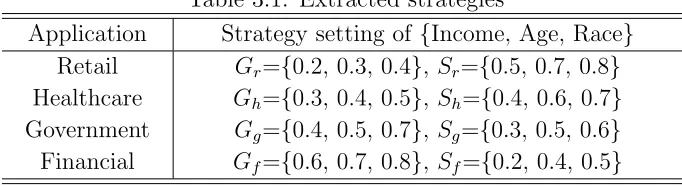
Table 3.1. Extracted strategies
Application Strategy setting of {Income, Age, Race} Retail Gr={0.2, 0.3, 0.4},Sr={0.5, 0.7, 0.8}
Healthcare Gh={0.3, 0.4, 0.5},Sh={0.4, 0.6, 0.7}
Government Gg={0.4, 0.5, 0.7},Sg={0.3, 0.5, 0.6}
Financial Gf={0.6, 0.7, 0.8},Sf={0.2, 0.4, 0.5}
with that in single attribute scenario, thus validating the simulation result. For more details
about the implementation of PSO, please refer to [57].
We use real datasets as the inputs of the user and platform. More specifically, based
on the privacy survey published by IBM [58] and Data Protection Survey published by
SANA [59], we extract four user’s strategies and four platform’s strategies. As shown in
Table 3.1,Gr,Gh, Gg, andGf, are the user’s strategies used for Retail applications,
Health-care applications, Government applications, and Financial applications, respectively.
Corre-spondingly, in Table 3.1,Sr,Sh,Sg, andSf are the strategies of Retail platforms, Healthcare
platforms, Government platforms, and Financial platforms, respectively.
Each extracted strategy contains three data attributes, including income, age, and race.
We set the correlation coefficient between income and age as 0.1, the correlation coefficient
between income and race as 0.01, and the correlation coefficient between age and race as 0.
For the three data attributes, the values of maximum service quality are q1 = 60, q2 = 50,
andq3 = 40, the unit privacy costs arec1 = 15,c2 = 10, andc3 = 5, and the unit data prices
are p1 = 20, p2 = 15, and p3 = 10. The convention rate λ in Eq. (3.2) is 0.1. The other
parameters in the platform’s utility function are: θp = 15, ζp = 0.6, l1 = 5, l2 = 10, and
cp = 1. The adversary has a purchase probability b = 0.6 and working efficiency φ = 0.2.
The other parameters in the adversary’s utility function are: σ1 = 1.5, σ2 = 1, σ3 = 1,
θa = 15, and ζa = 0.6.
The simulations that follow depict different strategies by varying certain parameters
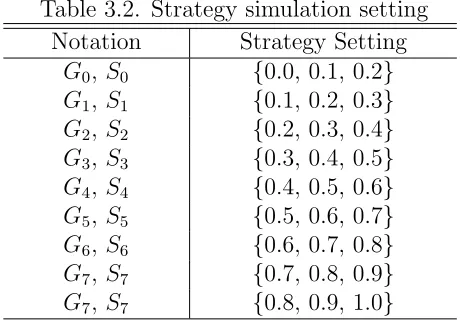
Table 3.2. Strategy simulation setting
Notation Strategy Setting
G0, S0 {0.0, 0.1, 0.2}
G1, S1 {0.1, 0.2, 0.3}
G2, S2 {0.2, 0.3, 0.4}
G3, S3 {0.3, 0.4, 0.5}
G4, S4 {0.4, 0.5, 0.6}
G5, S5 {0.5, 0.6, 0.7}
G6, S6 {0.6, 0.7, 0.8}
G7, S7 {0.7, 0.8, 0.9}
G7, S7 {0.8, 0.9, 1.0}
Results of User’s Utility and Optimal Strategy The utility and optimal response
of the user are investigated through Fig. 3.8 to Fig. 3.10 in this subsection.
We analyze user’s utility by using real platform’s strategy Sr, Sh, Sg, and Sf and
increasing the granularity of each attribute from G0 to G8 as shown in Table 3.2. The
results of the user’s utility are presented in Fig. 3.8, from which we observe that the utility
increases at first and then decreases as the granularity increases. The reason lies in two
aspects: (i) when the granularity of each attribute in user’s granularity setGincreases from
G0 to a certain granularity set (e.g., G6 in line S =Sg), the increase rate of privacy cost is
smaller than that of received service quality, therefore the user’s utility increases; and (ii)
when the granularity of each attribute in user’s granularity setG continues increasing from
such a certain strategy set, the increase rate of privacy cost is larger than that of received
service quality, leading to a decrease in the utility. In fact, such a certain granularity set
corresponds to the optimal granularity set among granularity sets from G0 to G8.
Also, as shown in Fig. 3.8, the user’s utility Uu decreases as the platform increases the
value of resale strategy of each attribute from Sr to Sf. This is because when the platform
increases the value of resale strategy, the granularity of the resale data increases, enhancing
user’s privacy cost and reducing user’s utility. In particular, the user can gain a larger utility
when using Financial Application than other applications because Financial Platform resells
The user’s best strategies defending against the platform’s different strategies and
ad-versary’s different strategies are respectively shown in Fig. 3.9 and Fig. 3.10, where each
line indicates the user’s optimal data release granularity for one attribute. The results of
Fig. 3.9 are obtained when the platform uses the strategies s1 = 0.2, s2 = 0.4, and s3 = 0.6.
The results of Fig. 3.10 are obtained when the adversary adopts the data resale strategies
b= 0.2,0.4,0.6.
Fig. 3.9 shows that the user decreases data release granularity to protect data privacy as
the platform increases the data resale granularity fromS0toS8. On the other hand, when the
value of resale strategy is small (e.g.,S0, S1, S2), the user’s optimal release granularity of data
attribute 1 (corresponding to g1) is larger than those of attributes 2 and 3 (corresponding
to g2 and g3, respectively). Since data attribute 1 has the largest service quality value q1,
the user can get more profit from submitting data attribute 1, which can compensate the
cost of privacy loss. On the contrary, when the value of resale strategy becomes large (e.g.,
S3, S4, S5, S6, S7, S8), releasing attribute 1 causes more privacy cost as data attribute 1 has
the largest unit privacy cost c1. As a result, to reduce privacy cost, the user releases less
information regarding data attribute 1, i.e., the optimal release granularity of attribute 1 is
less than those of other two attributes.
From Fig. 3.10, we can see that the optimal release granularity g1 does not change as
the adversary changes its strategy, and the optimal release granularitiesg2 and g3 decreases
when the adversary increases the data purchase probability and decreases the eavesdropping
probability.
When the platform resells attribute 1 (i.e., the line corresponds to g1), the platform
uses resale strategy s1 = 0.2 that is the same as the working efficiency of eavesdropping φ.
This means the granularity of purchased data and that of eavesdropped data are equal at the
adversary side. Thus, the change of the adversary’s strategy will not affect the user’s utility.
This is the reason why the best release granularity of data attribute 1 does not change when
On the other hand, the adversary can get higher data granularities of attribute 2 and 3
(corresponding tog2 and g3, respectively) via purchasing rather than eavesdropping because
s2 > φ and s3 > φ. Thus, the data resale from the platform causes more privacy cost than
eavesdropping to the user. As a result, the best data release granularitiesg2 andg3 decreases
as the adversary increases the data purchase probability and decreases the eavesdropping
probability.
The changes of user’s optimal release strategies in Fig. 3.9 and Fig. 3.10 confirm that
data release strategy is also affected by data diversity (e.g., different data attributes have
different privacy costs and resale prices).
Results of Platform’s Utility and Optimal Strategy Fig. 3.11 reports the results
of the platform’s utility, in which the platform’s strategies are set to be S0 to S8 according
to Table 3.2 with user’s strategy being Gr, Gh, Gg, and Gf as listed in Table 3.1. From
Fig. 3.11, we can tell that the platform’s utility increases at first and then decreases over the
increase of the value of user’s data release granularity, as we discussed for Fig. 3.5. When
the data resale granularity of each attribute increases from the value in S0 to the value in a
certain resale strategy set (e.g., S2 in line G = Gg), the increase rate of the cost is smaller
than that of the profit, resulting in an improvement of utility to the platform; however, when
the data resale granularity of each attribute continues increasing from the value in such a
certain strategy set, the increase rate of the cost is larger than that of the profit, further
reducing the platform’s utility. In other words, there is an optimal resale strategy set for the
platform to balance the profit of data resale and cost of reputation loss.
Besides, the platform’s utility increases as the user increases the release granularity of
each attribute fromGr toGf. This is because the platform can get more accurate data and
more resale profit if the user increases the data release granularity. Particularly, the Financial
platform can the highest utility because the user submits data with higher granularity to