ADVANCED PASSIVE CLUSTERING- THRESHOLD
A MAINTENANCE MECHANISM OF THE CLUSTER STRUCTURE
AOUAD SIHAM, EL GANAMI DRISS
Laboratory Networks and Intelligent Systems; Mohammedia School of Engineers Univeristy Mohamed V Agdal
Rabat, Morocco
Email: [email protected]; [email protected]
ABSTRACT
A wireless sensor network (WSN) is a set of nodes communicating through wireless links to observe a given phenomenon. Wireless sensor network is deployed over a geographical area to collect information in hostile environments. The capacity of sensors is limited by the lifetime of their batteries, so the energy is a critical resource in this type of network. Moreover their mobility has several problems as addressing, routing and localization .The challenge is to find mechanisms that extend the life of the system and its robustness taking into account the constraints of mobility and energy consumption. In this paper, we propose a new protocol designated for mobile nodes in wireless sensor network that is based on passive clustering. This mechanism does not use any packet control protocol and does not require reconstruction of the cluster topology after each leaving of CH or its energy level is below a given threshold. The proposed protocol aims at reducing the overhead and preserving the energy. In addition it allows balanced energy consumption by the network nodes and maintains the cluster architecture longer than passive clustering protocol.
Keywords: Wireless Sensor Network, Passive Clustering,Active Clustering, Mobility.
1. INTRODUCTION
Wireless sensor network consists of a large number of sensor nodes deployed over a geographical area to collect information in hostile environments. Each node can monitor its environment and communicate the information collected in one or more collection points.
The evolution of microelectronics and sensor networks gives rise to a new technology, it is wireless sensor network. This technology provides a powerful platform for distributed work in interaction with the physical world whose broad spectrum extends application of environmental monitoring in the management of emergencies (fires, terrorist or nuclear attacks, etc).
The battery is an important component of a sensor; In general, it is not replaceable or rechargeable so the battery limits the lifetime of the sensor and affects the overall functioning of the network. Therefore, protocols to save energy represent today an important focus of research in this area;
overloads the network and subsequently increases the energy consumption. However clustering (or classification) gives better results [6], so we have also adopted this approach.
In this paper, we propose an improved version of Passive Clustering (PC) [7] which enables a balanced energy consumption among the network nodes and extends the life time of the network by maintaining the cluster structure as long as possible.
This paper is organized as follows. In the next section, we briefly describe the clustering mechanism presented in the literature. In the third section, we describe our clustering algorithm APC-T, its principle and its properties. The final section presents the simulation results.
2. ACTIVE CLUSTERING MECHANISM
Clustering (or grouping) is to bring together geographically close nodes into groups called "clusters" and establish patterns of different routing within the clusters (intraclusters) and between clusters (inter-cluster). It has been used for different objectives such as the collection of information in networks of sensors [8] and the sharing of bandwidth [9].
Each cluster is represented by a particular node called cluster-head. It is elected by a specific metric in active clustering protocols by a specific metric or combination of metrics. The cluster-head is responsible for coordination between the different members of the cluster, aggregates and send the data collected to the base station.
In a cluster, each node stores all information of its cluster and some of information of other clusters; this minimizes considerably the size of routing tables and the number of messages exchanged in the network. So clustering gives the best results than the multi-hop routing; the reason we have also adopted this approach.
First algorithms of active clustering Lowest-ID [10], [11] and Mobic [12] were quite similar mechanism. They were based on a particular criterion to choose the cluster head or team leaders, respectively the identifiers of the nodes, the number of neighbours and the degree of mobility. These algorithms make it possible to form clusters with only one hop, where every member is a direct neighbour of its CH. They consider a phase of formation of the clusters or “clustering set up”. During this phase, the nodes proceed to the knowledge of their neighbours .However, the nodes
are supposed to be fixed during this phase and the synchronization between them is necessary for the good unfolding of the algorithm. Moreover, this phase of formation of the clusters is repeated periodically following the changes of topology that can occur. The periodic re-execution this process of clustering degrades the stability of the clusters. The algorithm "Distributed and Mobility Adaptive Clustering" presented in [13] and [14] introduced the notion of generic weight in the selection of the CH. It is a clustering mechanism that can respond to changes in topology. The algorithm does not require any synchronization between the nodes. To improve the stability of the formed clusters, two new factors of performance were defined. The first parameter is K, where K allows up K-CHs to be direct neighbors. The second is H; it limits the re-affiliations between clusters. The nodes join a new CH when the weight H of the latter is greater than the weight H of their current CH. However, this solution allows the formation of clusters as a hop and the performance factor H is difficult to specify wisely. Other clustering mechanisms [15] and [16], are suitable to the formation of clusters k hops. Nevertheless, [16] handles mobility by periodically rerun the entire algorithm. [15] Requires information on the k neighbours and satisfy the assumption of no mobility during the clustering.
base station. However, the overhead of the network increases because all the sensors will send their location information to the base station simultaneously for each phase of election of the CH.
We conclude that all active clustering algorithms require two phases: neighbors’ discovery and cluster formation phase. However, nodes are assumed to be fixed over the steps and the synchronization between them is necessary to the success of these algorithms. In addition, following each change of the network topology these steps are repeated periodically which degrades the stability of clusters.
3. PASSIVE CLUSTERING PC
Passive Clustering (PC) is a protocol designed to the formation of clusters, which does not use a specific protocol control packets or signals. It allows exploiting the data packets to transmit neighbour’s information.
Passive Clustering uses the MAC frame (layer 2 of the TCP /IP) to encode the state of a network node; in particular, it introduces two bits to encode 4 states: ordinary, ClusterHead CH, Gateway GW, clutster_head_ready CH_Ready. Each data frame contains two additional bits (Figure 1) representing the state of the node that has released the frame.
With PC, each time a packet arrives at any node, the node needs only the state that is bonded to the received packet to the treatments for the selection of gateway, CH or ordinary node. Only CH and gateways that broadcast data packets and control; ordinary nodes receive the packet but do not participate in their broadcasts, Reducing collisions and reduces the amount of packets exchanged; therefore, there is a considerable decrease in energy consumption by the ordinary nodes which can increase the lifespan of WSN.
In Active clustering, aggregation of data is centralized and carried out periodically. However, in some cases, the periodic transmission of data may not be necessary, which rapidly depletes the limited energy of sensors. Passive clustering was defined to overcome/eliminate the limitations of active clustering in terms of overhead and energy consumption (more traffic means more energy consumption). However passive clustering gives
Figure 1. Frame format in PC
better results, so we have also adopted this approach.
4. ADVANCED PASSIVE CLUSTERING
PROTOCOL - THERSHOLD (APC-T)
APC-T is a protocol the formation of clusters, like the Passive Clustering, that does not require an initialization phase of cluster before routing.
Since the information is embedded in data packets, the traffic generated by the transmission of these packets is used to build the infrastructure of the Cluster regardless of the routing protocol. APC-T also takes into account the energy level of nodes in operations and many decisions are made based on the energy level of nodes. So APC-T predicts changes in the topology of sensor networks in environments with high mobility.
4.1. APC-T Mechanism
Our clustering algorithm based on the following principles:
• Passive clustering and GRIDS ( Geographically Repulsive Insomnious Distributed Sensors) algorithm[20]
• Formation of clusters
• Selection of CH_backup
•
Maintenance of clusters formed.
At startup; all nodes are in the initial state, a node that joins the network, also starts with the initial state. A node changes its state only when it receives a packet from its neighbours. The formation of the clusters is done by the election of the cluster head and re-affiliation of the nodes to this cluster head. . If the sender is not a CH, its status is CH_Ready. The CH-ready will be CH, if he can transmit packets before receiving any packet of another CH. If the packet comes from another CH, the node records its id, the time of reception, and adds this node to the list of CHs, and then it switches to Ordinary. Once the cluster is formed, the CH will select its CH_Backup from its neighbours list; this is the node that has the highest energy among all its neighbours. Once the CH leaves the cluster, or its energy is below a given threshold T, CH_Backup replaces the CH and chooses its CH_Backup from its neighbours list.
4.2. Operating Mode
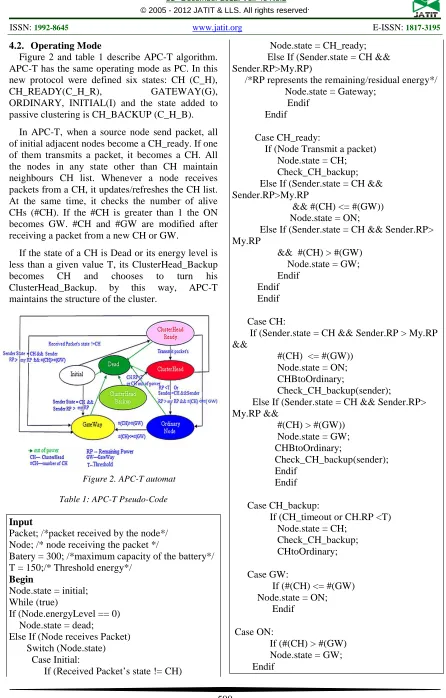
Figure 2 and table 1 describe APC-T algorithm. APC-T has the same operating mode as PC. In this new protocol were defined six states: CH (C_H), CH_READY(C_H_R), GATEWAY(G), ORDINARY, INITIAL(I) and the state added to passive clustering is CH_BACKUP (C_H_B).
In APC-T, when a source node send packet, all of initial adjacent nodes become a CH_ready. If one of them transmits a packet, it becomes a CH. All the nodes in any state other than CH maintain neighbours CH list. Whenever a node receives packets from a CH, it updates/refreshes the CH list. At the same time, it checks the number of alive CHs (#CH). If the #CH is greater than 1 the ON becomes GW. #CH and #GW are modified after receiving a packet from a new CH or GW.
[image:4.612.81.527.54.752.2]If the state of a CH is Dead or its energy level is less than a given value T, its ClusterHead_Backup becomes CH and chooses to turn his ClusterHead_Backup. by this way, APC-T maintains the structure of the cluster.
Figure 2. APC-T automat
Table 1: APC-T Pseudo-Code
Input
Packet; /*packet received by the node*/ Node; /* node receiving the packet */
Batery = 300; /*maximum capacity of the battery*/ T = 150;/* Threshold energy*/
Begin
Node.state = initial; While (true)
If (Node.energyLevel == 0) Node.state = dead;
Else If (Node receives Packet) Switch (Node.state) Case Initial:
If (Received Packet’s state != CH)
Node.state = CH_ready; Else If (Sender.state = CH && Sender.RP>My.RP)
/*RP represents the remaining/residual energy*/ Node.state = Gateway;
Endif Endif
Case CH_ready:
If (Node Transmit a packet) Node.state = CH; Check_CH_backup; Else If (Sender.state = CH && Sender.RP>My.RP
&& #(CH) <= #(GW)) Node.state = ON;
Else If (Sender.state = CH && Sender.RP> My.RP
&& #(CH) > #(GW) Node.state = GW; Endif
Endif Endif Case CH:
If (Sender.state = CH && Sender.RP > My.RP &&
#(CH) <= #(GW)) Node.state = ON; CHBtoOrdinary;
Check_CH_backup(sender);
Else If (Sender.state = CH && Sender.RP> My.RP &&
#(CH) > #(GW)) Node.state = GW; CHBtoOrdinary;
Check_CH_backup(sender); Endif
Endif
Case CH_backup:
If (CH_timeout or CH.RP <T) Node.state = CH;
Check_CH_backup; CHtoOrdinary;
Case GW:
If (#(CH) <= #(GW) Node.state = ON; Endif
Case ON:
EndSwitch Endif Endif Endwhile End
5. SIMULATIONS AND RESULTS
We conducted several simulations to assess the performance of the proposed clustering mechanism and compare it to other protocols such as PC and GRIDS. The simulation models used were implemented in the GloMoSim library [9], which is a scalable simulation environment for wireless networks based on the Parsec language [21]. The radio propagation range for each node is 150 meters and channel capacity is 2 Mbits/sec. The roaming space is 600x600 meters square. The size of the network is 300 nodes; randomly disperse in the roaming area. The node’s maximum speed is 4m/s.The distributed coordination function (DCF) of IEEE 802.11 [22] is used as the MAC layer. Each simulation is executed for 1 minute. Traffic sources are CBR. The source-destination pairs are totally randomized. Data packets are all 512 bytes long. The control packet length is 32 bytes. The random waypoint model [23] was used for node mobility. Each node sends 100 packets with an inter-arrival time of 0.5 second. We use AODV (Ad hoc On-demand Distance Vector routing) [24] because it is one of the most flooding-dependent routing protocols.
The objective of the simulations is to show that APC-T maintains the structure of the cluster even the leaving of CH and thus increases the lifetime of the network and reduces energy consumption.
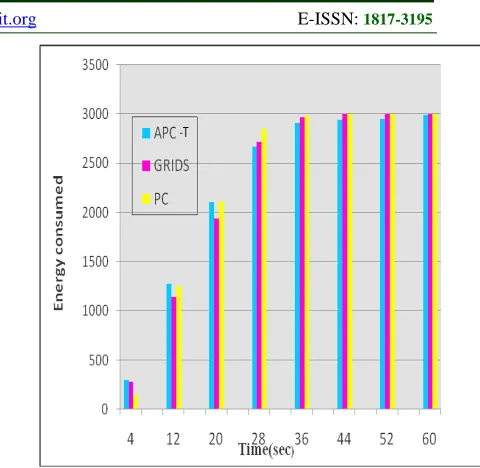
[image:5.612.81.550.67.456.2]Statistics Figure 3 shows that our algorithm uses more power than the other algorithms at the beginning of the simulation because there's an additional load due to the election of CH_backups. But after it consumes less energy than others. Thus APC-T allows balanced energy consumption among the network nodes and it maintains the cluster structure for longer than in the case of original PC or GRIDS.
[image:5.612.305.545.72.306.2]Figure 3. Comparison Of Energy Consumption
Figure 4. Percentage Of Dead Nodes
Figure 4 shows the number of dead nodes, over time, in the Network using APC-T, PC and GRIDS; let us note that until time 28s, no node is dead using APC-T. We record less than 10% death during [28s, 34s [. During this time period, 40% of nodes are dead using PC and 15% are dead using GRIDS. In 44s all nodes are dead using PC and GRIDS against 10% are alive in APC-T. This means that during this time period, APC-T keeps most of nodes alive. Thus APC-T increases the lifespan of the network.
6. CONCLUSION AND PERSPECTIVES
[image:5.612.318.539.330.507.2]to maintain cluster structure for a long time. Thus this approach generally increases the lifetime of network sensors and reduce energy consumption based on the predictions of motion of the nodes. The originality of the algorithm lies in the management of re-affiliation of nodes between clusters.
In perspective, we plan to further study detailed performance of our algorithm by introducing an energy threshold from which there will be a change of state between the CH and CH_backup and comparing the influence of this parameter on existing results.
REFERENCES
[1] G. Anastasi, M. Conti, M. Di Francesco, A. Passarella, “How to Prolong the Lifetime of
Wireless Sensor Networks”, Handbook of
Mobile Ad Hoc and Pervasive Communications, April 2012
[2] L. Dehni, Y. BEennabi and F. Krief, "LEA2C:
Une nouvelle approche de routage dans les réseaux de capteurs pour l'optimisation de la consommation d'ènergie", 2003.
[3] [3] C. Perkins and E. Royer, "Ad-Hoc
On-Demand Distance Vector (AODV) Routing", In
Proceedings of the Second IEEE Workshop on Mobile Computing Systems and Applications (WMCSA'99), pp- 90-100. (1999)
[4] X. Lin and I. Stojmenovic, "Power-Aware
Routing in Ad Hoc Wireless Networks", In
SITE University of Ottawa, TR-98-11. (1998) [5] S. Singh, M. Woo, and C.S. Raghavendra,
"Power-Aware Routing in Mobile Ad Hoc
Networks" In Proceedings of the Fourth
Annual ACM/IEEE International Conference on Mobile Computing and,Networking (MobiCom '98). (1998)
[6] S. Ghiasi et al, "Optimal Energy Aware
Clustering in Sensor Networks", SENSORS
Journal, Vol. 2, Issue 7, pp. 258-269, July 2002.
[7] network”, ACM-Baltzer Journal of Wireless Networks, Vol.1,No.3, pp.255-265, 1995. [8] Ghiasi, a. Srivastava, X. Yang, and M.
Sarrafzadeh, “Optimal Energy Aware Clustering in Sensor Networks”, Sensors
Magazine, 2002,Vol.19, No.2, pp.258-269 [9] [10] D.J Baker and A. Ephremides, “The
architetural organization of a Mobile Radio Network via a distributed algorithm”, IEEE
Transactions on Communications, COM-29, 1981.
[10] M. Gerla, and J. Tsai, “Multicluster, mobile,
multimedia radio network”, ACM-Baltzer
Journal of Wireless Networks, Vol.1, No.3, pp.255-265, 1995.
[11]P. Basu, N.Khan, D Thomas and C. Little, “A
Mobility Based Metric for Clustering in Mobile Ad Hoc Networks”, 21st
[12]International Conference on Distributed Computing Systems Workshops (ICDCSW '01), 2001.
[13]S. Basagni, “Distributed and mobility-adaptive
clustering for multimedia support in multi-hop wireless networks”, Proc. Of IEEE VTS 50th
Vehicular Technology Conference, 1999. [14]A. Siddiqui, R. Prakash, “Effect of availability
factor threshold and clustering gap on performance of clustering mechanisms for multi-cluster mobile ad hoc networks”, IEEE
International Conference on Communications, ICC 2002.
[15]G. Chen, F. Nocetti, J.S. Gonzalez, and I. Stojmenovic, “Connectivity-based K_hop clustering in wireless networks”, in Proc. of the
35th Hawaii International Conference on System Sciences (HICSS-35), Janvier 2002. [16]A. Amis, R.Prakash, T.Vuong, D. Huong, “
Max-Min Dcluster formation in wireless ad hoc networks”, in Proc. Of IEEE Infocom,
Tel Aviv, Mars 2000.
[17] M. Chatterjee, K. Das and D. Turgut, "WCA:
A Weighted Clustering Algorithm for Mobile Ad Hoc Networks," Journal of Cluster
Computing, No. 5, 2002.
[18]S. Sivavakeesar, G. Pavlou, C. Bohoris and A. Liotta, “Effective Management through Prediction-Based-Clustering Approach in the Next-Generation Ad hoc Networks”, In the
Proc. of the IEEE International Conference on Communications (ICC '04), France, June 2004. [19]W.R. Heinzelman, A. Chandrakasan, and H.
Balakrishnan. Energy-Efficient Communication Protocol for Wireless Micro Sensor Networks. In IEEE Proceedings of the Hawaii International Conference on System Sciences (HICSS ’00), 2000.
[21] M. Takai, L. Bajaj, R, Ahuja, R. Bagrodia and M. Gerla, “GloMoSim: A Scalable Network Simulation Environment,” Technical report 990027, UCLA, Computer Science Department, 1999.
[22]R. Bagrodia, R. Meyer, M. Takai, Y. Chen, X. Zeng, J. Martin, B.Park, H. Song, Parsec: A parallel simulation environment for Complex systems, Computer, Vol. 31(10), October 1998, pp. 77-85.
[23]IEEE Computer Society LAN MAN Standards Committee, Wireless LAN Medium Access Protocol (MAC) and Physical Layer (PHY) Specification, IEEE Std 802.11-1997. The Institute of Electrical and Electronics Engineers, New York, NY, 1997.