DECISION SUPPORT SYSTEM MODEL TO ASSIST
MANAGEMENT CONSULTANT IN DETERMINING THE
PHYSICAL INFRASTRUCTURE FUND
1
EVARISTUS DIDIK MADYATMADJA
1School of Information Systems, Bina Nusantara University, Jakarta, Indonesia
E-mail: [email protected]
ABSTRACT
Program Nasional Pemberdayaan Masyarakat (PNPM) Mandiri Pedesaan is a learning and development media for a development agents. Its also becomes a media to create the development community concept[1]. Program Nasional Pemberdayaan Masyarakat (PNPM) Mandiri Perdesaan is a real form action to ward off the poverty in Indonesia. One of the efforts is by giving a physical project fund, which is expected to increase productivity and efficiency of the community itself. To obtain the donation, the social groups of communities should previously submit proposal which are verified by the management of Program Nasional Pemberdayaan Masyarakat (PNPM) Mandiri Perdesaan. There are many criteria and proposals that require PNPM management to be able to take into account the benefits and risks of its decision. To support the PNPM management decision, it has been designed a system that afford helping PNPM management in allocating physical project fund. A result of this study shows that decision support system for fund allocation for physical project will help PNPM management in making, removing, or editing the existing assessment models. With an easiness of making a model, PNPM management will be able to understand the most appropriate model to be applied in physical project, so that the allocation for physical project fund is really gained by social groups that need it.
Keywords: Decision Support System, Physical, Model, Fund
1.
INTRODUCTIONIn general, the poverty rate in Indonesia since 1998 - 2013 continued to decline. The decline is not out of the government effort to reduce poverty through various pro-people programs. Although not yet be said to be the maximum, but the trend shows that the decline in poverty alleviation programs launched by the government which has a positive effect on increasing the ability of communities to develop their basic rights.
Currently poverty countermeasures in Indonesia emphasize on community empowerment approach, it becomes the commitment of the government to realize social welfare. One of the programes to counter the poverty in Indonesia is Independent Community Empowerment National Program (PNPM Mandiri). It becomes learning media and skill development for Indonesian people and a media to personify community as a development activity initiator.
Decision making is basically a sistematical approach to the core of problem, in finding facts, alternatives and in taking appropriate decision [3].
Decision making system is an interactive computer information system that can give alternate solution for the decision makers. It can be applied in various fields such as economics, laws, education, community development, etc. One of applications in the field of community development is physically tools allocation.
Based on the previous description, we propose to design integrated computerized decision making for physical tool allocation for management efficiency
and effectiveness.Because such allocations do not
always have the same variables affecting the decision then required variables can be increased or decreased. Therefore they need an appropriate model that can build an effective decision making so that the support for community will come to the right people.
Physical Infrastructure Fund as an alternative model for the existing decision model.
2.
STUDY LITERATURE2.1 A DSS Application
The decision support concept firstly stated by Scott and Morton in the beginning of 1970. They define it as a computer based interactive system that can help the decision maker using the data and model to solve the unstructured problems [2]. It enable interaction between user and computer directly and get an answer for important questions. This system made to support the idea of decision maker not to subtitute it.
A DSS is typically built to support the solution of a certain problem or to evaluate an opportunity[2]. This is a key difference between DSS and BI applications. In a very strict sense,
business intelligence (BI) systems monitor
situations and identify problems and/or
opportunities, using analytic methods. Reporting plays a major role in BI; the user generally must identify whether a particular situation warrants attention, and then analytical methods can be applied.
2.2 Decision Support System Characteristics
and Capabilities
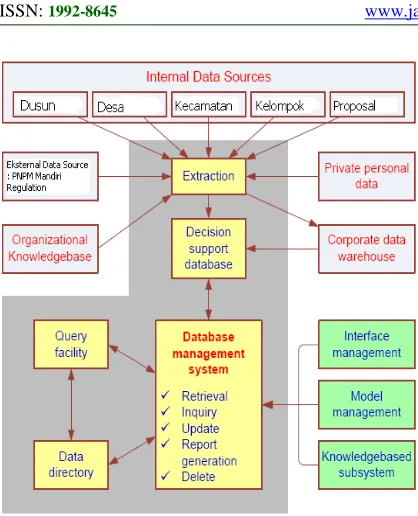
[image:2.612.91.302.498.693.2]A DSS application can be composed of a data management subsystem, a model management subsystem, a user interface subsystem, and knowledge based management sub-system [2].
Figure 1: Schematic View of DSS[2]
A database management system (DBMS) separates the user from the physical aspects
of the database structure and processing. It also provides logical dat structures (as opposed to the physical data structures) and informs the types of data that are available and how to gain access to them. A DBMS functions are creation-generation database and restructure database updating (adds, deletes, edits, changes) database, retrieving data for queries an report generation, and performing complex data manipulation task.
The data management subsystem includes a database that contains relevant data for the situation and a managed by software called the database
management system (DBMS). The data
management subsystem can be interconnected with the cororate data warehouse, a repository for corporate relevant decision-making data.
The model management subsystem is a software
package that includes financial, statistical,
management science, or other quantitative models that provide the system’s analytical capabilities and
appropriate software management. Modeling
language for building custom models are also included. This software is often called a model base management system (MBMS). This Component can be connected to corporate or external sorage of models.
The user communicates with and commands the DSS through the user interface subsystem. The user is considered part of the system. Researchers assert that some of the unique contributions of DSS are derived from the intensive interaction between the computer and the decision maker. The web browser provides a familiar, consistent graphical user interface (GUI) structure for most DSS.
The knowledge-based management subsystem can support any of the other subsystems or act as an independent component. It provides intelligence to augment the decision maker’s own. It can be interconnected with the organization’s knowledge repository, which is sometimes called the organizational knowledge base. Knowledge may be provided via web servers. Many artificial intelligence methods have been implemented in web development systems such as Java and are easy to integrate into the other DSS components.
2.3 Literature Review
based on logistic regression. With the special fitur is the simulation of finance indicator from the loan applicant which analize as a random variable. The result will used to determine mean probability of trust interval for credit applicant judgement.
Qin Sheng.,[6], propose a study about decision making in train construction choice.
Ugboma. C ,[7] conducted a research entitled “An Analytic Hierarchy Process (AHP) Approach to Port Selection Decisions –Empirical Evidence from Nigerian Ports” presents the findings of a survey to determine the service characteristics that shippers consider important when selecting a port and the way these characteristics are prioritised according to their importance. Seven criteria for the port selection decision and four ports were identified, and the decision problem was structured into a three-level hierarchy using the Analytic Hierarchy Process.
Šliogerienė, [8] conducted a research entitled “ Multiple Criteria Decision Support System for The Assessment of Energy Generation Technologies Considering the Dimension of Values” which examines how the dimension of values affects the analysis of the impact of environmental factors on the value of energy generation technologies. It presents a set of criteria for the assessment of energy generation technologies; the set, in addition to technological, economic and environmental criteria, includes criteria which reflect the values.
The research performed by Arnott, D, [9] analyze the nature and state of decision support systems research. To provide context for the analysis, a history of decision support system is presented which focuses on the evolution of a number of sub-groupings of research and practice: personal decision support system, group support systems, negotiation support systems, intelligent decision support system, knowledge
management-based decision support system, executive
information systems/business intelligence, and data warehousing.
3.
METHODOLOGYResearch methodology are stages determined before the research
The research stages are:
1) Preliminary study
The goal is to understand all the material related to decision making system and physical tools allocation.
2) Problem identification
To find general description of the real problem.
3) Literature review
Reviewing literature to determine the
appropriate stages and good methodology, which avoid us from neglected important factor or variables. Finding theory from books, journal and scientific articles are our way to perform this part.
4) Collecting the data
Direct observation and interview with related person are our focus in this area. It can also be done by collecting data from any variables that can influence the decision making of financial allocation.
5) System design
This part will devide in to some subsystem :
- Model of Subsystem design
Model formulated as a function that describe items relation coresponding to the properness of financial support.
- The Database of The Subsystem Design
All the data in this system will be accommodated in a database that is managed by database management system.
- Design of Dialoque Subsystem
The goal is to build a user friendly dialoque system and provide certain information package.
6) Implementation
The design implementation using software. 7) System trial
To test wether the proper application skill build including all the models within.
4.
RESULTSThe data management subsystem is composed of the following elements :
- DSS Database
- DBMS
- Data directory
- Query facility.
Figure 2: Decision Support System of Financial Physical Tools Allocation
4.1. The Model Of Decision Support System
In order to build this model, we will devide it into two parts, the properness of proposal and the properness of activity. Assessment will be determined based on criteria stated on the source of this study.
4.1.2. Judgement of beneficiaries amount
model
After the village society meeting about society group proposal, assessment of beneficiaries amount model set of 15% for each proposal by the management of PNPM Mandiri or National programe of Independent Community Empowering. For the judgement we use formula (1):
KP = JP : JPS………(1) where
KP = Beneficiaries properness
JP = Beneficiaries amount
JPS = Population near the project
If beneficiaries properness more than 50% we will give it 15 score, between 30% - 50% will get 8 score, less than 30% will be scored as 2.
Table 1. Table Of Beneficiaries’ Amount Model
Judgement criteria Score Assessment
level More than 50%
Between 30% - 50% Less than 30%
15 8 2
15%
Source : Program Nasional Pemberdayaan Masyarakat (PNPM) Mandiri Pedesaan
4.1.3. Assessment of Poor / Destitute
Beneficiaries’ Amount Model
Assessment of destitute beneficiaries amount model set of 15% for each proposal by the management of PNPM Mandiri or National programe of Independent Community Empowering ater the village community meeting. For the assessment we use formula (2):
KPM = JPM : JP……….………(2) where :
KPM = Destitute Beneficiaries properness JPM = the amount of Destitute Beneficiaries JP = the amount of beneficiaries
[image:4.612.316.527.362.465.2]If assessment of destitute beneficiaries properness more than 40% it will give 15 scores, if 20% - 40 % it will give 8 scores and set 2 scores if the assessment less than 20%.
Table 2. Table Of Destitute Beneficiaries’ Properness Model
Judgement of criteria Scores Assesment
level More than 40%
Between 20% - 40% Less than 20%
15 8 2
15%
Source : Program Nasional Pemberdayaan
Masyarakat (PNPM) Mandiri Perdesaan
4.1.4. Model of Self-sufficiency amount
Properness
The model of self-sufficiency assessment is set of 10% for each proposal by the management of PNPM Mandiri or National programe of Independent Community Empowering ater the village community meeting. For the judgement we use formula (3):
KS = JS : BP………..(3) where :
KS = Self-suficiency properness
JS = Amount of Self-suficiency (Rupiah)
BP = Propose project cost
If Self-suficiency properness is more than 20% level, it will be scored as 10, between 10% - 20% will be scored as 6, and less than 10% will be scored as 2.
Judgement of criteria Scores Assesment level More than 20%
Between 10% - 20% Less than dari 10%
10 6 2
10%
Source : Program Nasional Pemberdayaan Masyarakat (PNPM) Mandiri Perdesaan
4.1.5.Assessment of Activities Properness
Model
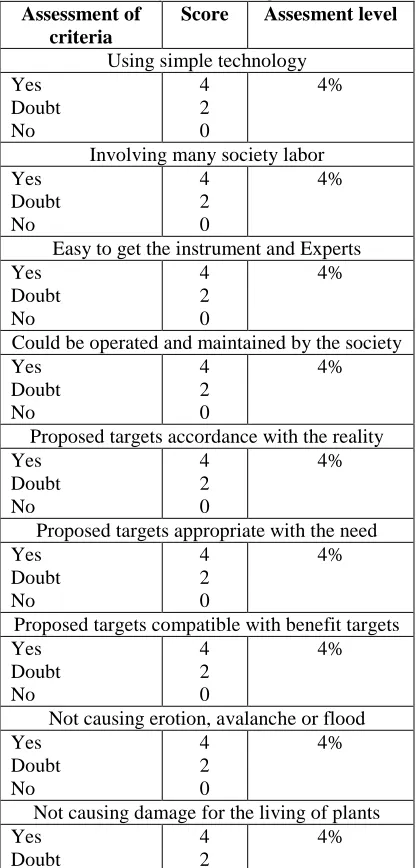
[image:5.612.90.300.289.723.2]Assessment of activities properness model with assessment level 60%, is set by the management of PNPM Mandiri. This model describes the general properness of the society. Below is the assessment level for the properness of activities.
Table 4. Table of Activities Properness Model
Assessment of criteria
Score Assesment level
Using simple technology Yes Doubt No 4 2 0 4%
Involving many society labor Yes Doubt No 4 2 0 4%
Easy to get the instrument and Experts Yes Doubt No 4 2 0 4%
Could be operated and maintained by the society Yes Doubt No 4 2 0 4%
Proposed targets accordance with the reality Yes Doubt No 4 2 0 4%
Proposed targets appropriate with the need Yes Doubt No 4 2 0 4%
Proposed targets compatible with benefit targets Yes Doubt No 4 2 0 4%
Not causing erotion, avalanche or flood Yes Doubt No 4 2 0 4%
Not causing damage for the living of plants Yes
Doubt
4 2
4%
No 0
Not causing damage for the living of animals Yes Doubt No 4 2 0 4%
No compensation need Yes Doubt No 4 2 0 4%
Compensation can be solve by the society Yes Doubt No 4 2 0 4%
Village development support Yes Doubt No 4 2 0 4%
Indreasing the work efficiency Yes Doubt No 4 2 0 4%
Appropriate gender ratio of workers Yes Doubt No 4 2 0 4%
Source : Program Nasional Pemberdayaan Masyarakat (PNPM) Mandiri Perdesaan
5.
CONCLUSIONSFrom the research result can be determined some conclusions:
1. This Decision Support System Model to
Assist Management Consultant in
Determining the Physical Infrastructure Fund design is helpfull for Management of Program Nasional Pemberdayaan Masyarakat (PNPM) Mandiri Perdesaan.) to make a significant assessment of society proposals.
2. This system Help the management to decide
physical tools allocation appropriately for empowering community through the best high quality services in financial efficiency as well as the programe continuity.
REFERENCES:
[1] Tim Pengendali PNPM Mandiri Tim Koordinasi Penanggulangan Kemiskinan, “Pemantauan,
Pengawasan, Evaluasi, dan Pelaporan”,
[2] Turban, E., Sharda, R., Delen, D., “Decision
Support and Business Intelligence Systems”. 9th
Edition. Prentice-Hall., Inc. Upper Saddle River. New Jersey, 2011
[3] Mc Leod, R Jr., Schell G. P,. “Management
Information System”. 10th edition, Prentice
Hall, New Jersey. 2007
[4] Dukic, D., Dukic, G., Kvesic, L., “A Credit Scoring Decision Support System”, IEEE Information Technology Interfaces (ITI) , vol. 33, pp 391 – 396., 2011
[5] Liu, J., “Study on Risk Evaluation Intelligent Decision Support System of Urban Gas
Pipeline”, IEEE Innovative Computing
Information and Control, 2008. ICICIC '08. 3rd International Conference on. page(s): 600, 2008.
[6] Qin Sheng., Zhou Lei-shan., Yue Yi-xiang. “A web-based distributed group decision support system for railway construction organization”, IEEE Informatics in Control, Automation and Robotics, vol. 2, pp 362-365., 2010.
[7] Ugboma. C , Ugboma. O , Ogwude. I, “An Analytic Hierarchy Process (AHP) Approach to Port Selection Decisions – Empirical Evidence from Nigerian Ports”, Maritime Economics & Logistics, vol 8, pp. 251–266., 2006.
[8] Šliogerienė. J, Kaklauskas. A, Streimikienė. D, and Bianchi. M, “Multiple Criteria Decision Support System forThe Assessment of Energy Generation Technologies Considering the Dimension of Values”, International Journal of Strategic Property Management, Volume 16(4): pp. 370–391., 2012
![Figure 1: Schematic View of DSS[2]](https://thumb-us.123doks.com/thumbv2/123dok_us/8913493.960537/2.612.91.302.498.693/figure-schematic-view-of-dss.webp)