ISSN: 1992-8645 www.jatit.org E-ISSN: 1817-3195
THE CONTINUED USE OF E-LEARNING SYSTEM: AN
EMPIRICAL INVESTIGATION USING UTAUT MODEL AT
THE UNIVERSITY OF TABUK
1DR. MOEZ BELLAAJ, 2DR. INES ZEKRI, 3DR. MOTEB ALBUGAMI
1Asstt Prof., Department of Management, Faculty of Business Administration, University of Tabuk
2Asstt. Prof., Department of Management, Faculty of Business Administration, University of Tabuk
3Asstt. Prof., Department of MIS, Faculty of Business Administration, University of Tabuk
E-mail: 1 [email protected] , [email protected] , 3 [email protected]
ABSTRACT
Despite the increase of Internet users and the development of the IT infrastructure, e-learning in developing countries is not yet largely diffused compared with the developed regions. Building on past studies related to UTAUT applications in the e-learning environment, the objective of this paper is to focus on the student continued use of a virtual learning system of the University of Tabuk in Saudi Arabia. The findings reveal that performance expectancy, and effort expectancy determine the intention of continued use of e-learning system. With stronger Internet experience, the effect of performance expectancy increases, and the influence of effort expectancy decreases. In addition, the effect of social influence on intention of continued use is seems to be stronger for women than for men. The theoretical and managerial implications of these results are discussed.
Keywords: Unified Theory Of Acceptance And Use Of Technology (UTAUT), E-Learning System, Technology Use, Performance Expectancy, Effort Expectancy, Social Influence
1. INTRODUCTION
Today, education institutions are intensifying their usage of information technology and especially the Internet to improve their learning and training programs ([24]; [28]). This evolution is well known as electronic learning (e-learning). It refers to the use of the Internet-based technology to support individual learning ([13]; [4]; [35]). Being economical, flexible, and easy to deliver with less constraints of time and distance, e-learning is presented as an attractive option for many people and students particularly in developing countries such Saudi Arabia ([3]; [5]). In the kingdom of Saudi Arabia, the government is the major contributor to the development of the country’s higher education and for the e-learning initiatives.
The authors would like to acknowledge financial support for this work, from the Deanship of Scientific Research (DSR), University of Tabuk. Saudi Arabia, under grant no. S-1435-0041
According to the report published in 2014 by the Ministry of Economy and Planning, the government spending on higher education has increased during the last years (2008 - 2012), to reach 59.9 billion riyals in 2012, which represents an increase of 27.72 percent from 2012, after it was 23.41 billion riyals in 2008. In addition, estimated to grow of 33% during 2010-2014, the size of the e-learning market in Saudi Arabia is likely to reach 670 million dollars on 2014. Also, many public and private universities in Saudi Arabia have introduced e-learning systems and have created deanships or specialized units to promote distance education. On the other hand, according to the report published by the Central Department of Statistics and Information in 2013, Saudi population is mostly composed by young people who are more prepared to use Internet for different learning purposes. The Internet penetration in Saudi Arabia is on constant rise, creating therefore a higher demand on e-learning activities from students and individuals.
the demand for Internet services such as electronic learning services will continue to increase significantly over the next few years as a result of the availability of high speed fiber-optic networks, increased Internet content, and the continued spread of handheld smart devices and applications.
Despite the increase of Internet users and the development of the learning technology and infrastructure, actually e-learning in developing countries is not yet very diffused and well used compared with other developed regions ([6]; [25]). The question of virtual learning adoption and the reasons encouraging students to use such technological innovation are still topic of debate, particularly in Saudi Arabia ([2]; [3]; [5]; [4]). In academic literature, different models are proposed to explain the adoption of e-learning systems ([13]; [25]; [30]; [31]; [35]). One of well known is the unified theory of acceptance and use of technology (UTAUT) presented by [36] which is based on synthesis of eight models of technology use.
Building on past studies related to UTAUT applications in the e-learning environment, the objective of this paper is to focus on the student continued use of a virtual learning system developed by the university of Tabuk in Saudi Arabia. This system is rapidly becoming an integral part of the teaching and learning process in the university. This virtual learning system have the objectives to improve the university brand across geographical borders and the enhancement of
distance teaching. Furthermore it enables
improvements in communication efficiency, both between student and teacher, as well as among students.
The e-learning system of the university of Tabuk represents a web-based communications platform, that allows students to use different learning tools, such as program information, course content, teacher assistance, discussion boards, document sharing systems, and other learning resources.
While other studies were applied UTAUT model to explain e-learning adoption, this research focuses on the continued use specifically. In addition, most of the past research focus on the direct effect of the UTAUT model. However, in this study, particular attention will be paid to the moderation effects.
This paper is organised as follows. First, we present an overview of the unified theory of acceptance and use of technology (UTAUT).
Next, we present our research model and the hypotheses development. Then, the method, measures, and results of the study will be exposed. Finally, we present the conclusion and future research directions in the end of the paper.
2. THEORETICAL BACKGROUND
The Unified Theory of Acceptance and Use of
Technology (UTAUT) integrates fragmented
perspectives on individual acceptance of
information technology into a unified theoretical model. Based on the examination of eight models, [36] developed the Unified Theory of Acceptance and Use of Technology (UTAUT) as a comprehensive synthesis of prior technology acceptance research. The eight models reviewed are the Theory of Reasoned Action (TRA - [14]), the Theory of Planned Behavior (TPB - [1]), the Technology Acceptance Model (TAM - [10]), the Motivational Model (MM- [11]), the hybrid model combining TAM and TPB (C-TAM-TPB, [32]), the Model of PC Utilization (MPCU- [34]), the Innovation Diffusion Theory (IDT- [22]), and the Social Cognitive Theory (SCT- [9]).
Conceptual and empirical similarities across these models were discussed by [36] to formulate the UTAUT model which was tested using original data from four organizations and then cross-validated using new data from an additional two organizations. These tests provided strong empirical support for UTAUT which was able to explain 70% of the variance in usage intention.
The UTAUT model (figure 1) posits three direct determinants of intention to use (performance expectancy, effort expectancy, and social influence) and four moderators (gender, age, experience, and voluntariness). The model has also two direct determinants of usage behavior (intention to use and facilitating conditions).
Performance expectancy is defined as the degree to which an individual believes that using the system will help him or her to attain gains in job performance. Effort expectancy is defined as the degree of ease associated with the use of the system. Social influence is defined as the degree to which an individual perceives that important others believe he or she should use the new system.
ISSN: 1992-8645 www.jatit.org E-ISSN: 1817-3195
The effect of effort expectancy on intention is moderated by gender and age and it appears to be more significant for women and older workers. The effect of social influence on intention is contingent on all four moderators. [36] found that social influence is insignificant in the absence of these moderators.
Figure1. UTAUT Model of [36]
3. RESEARCH MODEL AND HYPOTHESES DEVELOPMENT
Since its original publication in 2003, UTAUT has served as a theoretical basis to study different e-learning settings. There have been also some applications of the entire or a part of the UTAUT model ([23]; [18]; [25]; [35]; [8]).
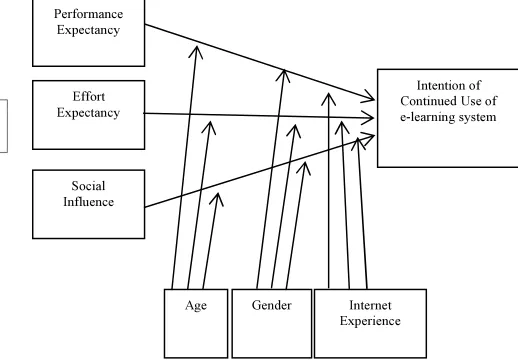
According to UTAUT, three constructs are represented as determinants of behavioral intention to use e-learning systems. Performance expectancy (PE), effort expectancy (EE), and social influence (SI). Facilitating conditions construct will not be included in our model because we will concentrate on the intention of use only, and according to UTUAT model, "Facilitating conditions" construct has no direct effect on hebavioral intention.
Regarding the moderating effects, voluntariness is not included also because no one is obliged to use the e-learning system of the university of Tabuk in our case. The usage is completely voluntary by the student. So, we will use gender, age, and Internet experience as moderating factors. Experience as presented by [36] is not considered
[image:3.595.81.302.215.401.2]here because only one moment in time is being observed in this study. However, we introduce "Internet experience" as new moderator to take into account the effect of experience in the domain of the Internet. Our research model is presented in figure 2. In the following, we define each construct of our model, and specify the hypotheses.
Figure 2. Research model
Performance expectancy (PE) is defined as the degree to which using e-learning system will provide benefits to user in performing certain learning activities ([37]; [36]). It reflects the user perception of performance improvement and is similar to the perceived usefulness of TAM and the relative advantage of IDT ([36]). According to UTAUT and past studies about e-learning adoption ([25]; [12]), we propose the following:
H1. Performance expectancy has a positive effect on the intention of continued use of
e-learning system.
Effort expectancy (EE) is defined here as the degree of ease associated with the use of
the e-learning system ([37]; [36]). It is equivalent to the perceived ease of use of TAM and the complexity of IDT ([36]). In the UTAUT model, effort expectancy is presented as a direct determinant of intention to use a technology. Others studies reported the existence of positive relationships between the effort expectancy and behavioral intention to use an e-learning system ([12]; [31]).
Age Gender
Intention of Continued Use of e-learning system
Internet Experience Performance
Expectancy
Effort Expectancy
[image:3.595.290.549.216.398.2]Thus, we propose the following:
H2. Effort expectancy has a positive effect on the intention of continued use of e-learning system.
Social influence (SI) is the extent to which an individual perceive that important others believe he or she should use the e-learning system ([37]; [36]).
Social influence reflects the effects of
environmental factors such as the opinions of user's friends, relatives, and superiors on user behavior and is similar to subjective norm of TRA ([36]). Empirically, prior studies have confirmed that social influence has a positive effect on intention to use e-learning ([25]; [20]). Thus, we propose the following:
H3. Social influence has a positive effect on the intention of continued use of e-learning system.
Regarding the moderating factors, and according the UTAUT model ([36]) and e-learning past studies ([25]; [19]), we postulate that:
H4. The influence of performance expectancy on the intention of continued use will be stronger for younger individuals.
H5. The influence of performance expectancy on the intention of continued use will be stronger for men.
H6. The influence of performance expectancy on the intention of continued use will be stronger with increasing Internet experience.
H7. The influence of effort expectancy on the intention of continued use will be stronger for older individuals.
H8. The influence of effort expectancy on the intention of continued use will be stronger for women.
H9. The influence of effort expectancy on the intention of continued use will be stronger with limited Internet experience.
H10. The influence of social influence on the intention of continued use will be stronger for older individuals.
H11. The influence of social influence on the intention of continued use will be stronger for women.
H12. The influence of social influence on the intention of continued use will be stronger with limited Internet experience.
4. RESEARCH METHOD
4.1. Data collection and Measurement
Our target population is the current users of the e-learning system of the University of Tabuk in Saudi Arabia. This system of virtual learning represents a web-based platform, that allows students to access to the courses content and to get assistance online from teachers. Other tools are also available such discussion boards, and document sharing systems.
We used a snowball sample method which is seems to be suitable to the Saudi Arabian context ([29]). A questionnaire was distributed by the researchers to students who are current users of this virtual learning system. These participants are then asked to help us for the distribution of the questionnaire to their friends and relatives. Overall, we collected 103 usable questionnaires after two months (April and May 2014).
The questionnaire was initially developed in English and the final version was translated into Arabic. In order to ensure the equivalence of measurements in the two languages, the translation was reviewed by a third party. The questionnaire was finalized after correcting a few minor differences in wording in the two languages. Table
1 shows the demographic information of
respondents in terms of gender, age, education, and current profession.
All of the scales were adopted from prior research. The measures for the UTAUT constructs (performance expectancy, effort expectancy, and social influence) were adopted from [36]. All items were measured using a seven-point Likert scale, with the anchors being “strongly disagree” and “strongly agree.” Age was measured in years. Gender was coded using a 0 or 1 dummy variable where 0 represented women. Internet Experience was measured in years.
Table1: Profile Of The Respondents
Demographics Frequency %
Gender
Female Male
68 35
66.1 33.9 Age (years)
<20 20-29 30-39 >40
8 70 23 2
7.77 67.96 22.33 1.94 Education
High school or less Diploma degree Bachelor’s degree Other
44 25 25 9
ISSN: 1992-8645 www.jatit.org E-ISSN: 1817-3195
Student Executive/senior management
General
administration/supervisory Others
59 5 28 11
57.28 4.86 27.18 10.68
Internet Experience (years) < 1
1-3 4-6 > 6
14 35 20 34
13.59 33.98 19.42 33.01
5. ANALYSES AND RESULTS
Structural equation modeling (SEM) is a statistical technique for testing and estimating causal relations with the possibilities of distinguishing between measurement and structural models and explicitly taking measurement error into account ([17]). There are two families of SEM techniques: covariance-based (CB) techniques and
variance-based techniques. PLS‑SEM is a
variance-based technique that offers vast potential for SEM researchers. PLS‑SEM is, as the name
implies, a more “regression-based” approach that minimizes the residual variances of the endogenous constructs ([15]). Compared to CB‑SEM, it is more
robust with fewer identification issues, works with much smaller as well as much larger samples, and readily incorporates formative as well as reflective constructs. The PLS-SEM algorithm first optimizes measurement model parameters and then, in a second step, estimates the path coefficients in the structural model. Because of its prediction orientation, PLS‑SEM is the preferred method
when the research objective is theory development and prediction. PLS‑SEM is also useful with the
presence of the interaction terms ([15]). For assessing interaction effects in this study, we will use the PLS product-indicator approach. This approach represents a one-step technique, requires no additional specification of parameter constraints or assumptions of multivariate normality, can be
used to estimate large complex models, and
estimates standards errors via resampling
procedures ([15]; [17]). Smart PLS 2.0 M3 ([27]) is the software used in this study.
5.1. Measure assessment
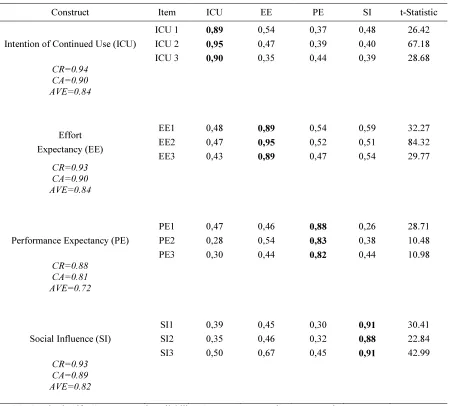
In order to analyze the indicator reliability, factor loadings should be statistically significant and greater than 0.7 ([15]; [17]). The t-statistic obtained from bootstrapping (250 iterations; Path weighting scheme) shows that all loadings are statistically significant at 1%. In addition, to evaluate the constructs’ reliability, two indicators were used – composite reliability (CR) and Cronbach’s alpha (CA) ([16]; [15]; [17]). As presented in Table 2, CR and CA for each construct are above the expected threshold of 0.7, showing evidence of internal consistency.
In order to assess convergent validity, average variance extracted (AVE) was used ([16]; [15]; [17]). The AVE is the amount of indicator variance that is accounted for by the underlying items of construct and should be greater than 0.5. As is also seen in table 2, AVE for each construct is above the expected threshold of 0.5, ensuring convergent validity.
Table 2 : Cronbach Alfa, Composite Reliability, Average Variance Extracted, Loadings And Cross Loadings
CA: Cronbach Alfa; CR = composite reliability; AVE = average variance extracted
Construct Item ICU EE PE SI t-Statistic
Intention of Continued Use (ICU)
ICU 1 0,89 0,54 0,37 0,48 26.42
ICU 2 0,95 0,47 0,39 0,40 67.18
ICU 3 0,90 0,35 0,44 0,39 28.68
CR=0.94 CA=0.90 AVE=0.84
Effort Expectancy (EE)
EE1 0,48 0,89 0,54 0,59 32.27
EE2 0,47 0,95 0,52 0,51 84.32
EE3 0,43 0,89 0,47 0,54 29.77
CR=0.93 CA=0.90 AVE=0.84
Performance Expectancy (PE)
PE1 0,47 0,46 0,88 0,26 28.71
PE2 0,28 0,54 0,83 0,38 10.48
PE3 0,30 0,44 0,82 0,44 10.98
CR=0.88 CA=0.81 AVE=0.72
Social Influence (SI)
SI1 0,39 0,45 0,30 0,91 30.41
SI2 0,35 0,46 0,32 0,88 22.84
SI3 0,50 0,67 0,45 0,91 42.99
ISSN: 1992-8645 www.jatit.org E-ISSN: 1817-3195
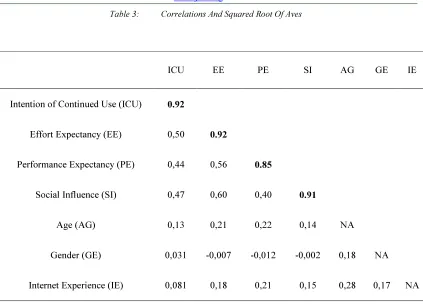
Table 3: Correlations And Squared Root Of Aves
NA: Not Applicable; Diagonal elements represent the square root of the AVE; off-diagonal elements arethe inter-construct correlations;
5.2. Structural model and hypotheses testing
Smart PLS 2.0 M3 ([27]) is the software used for the analysis, and the bootstrap resampling method (250 resamples; individual Changes algorithm) was used to determine the significance of the paths within the structural model.
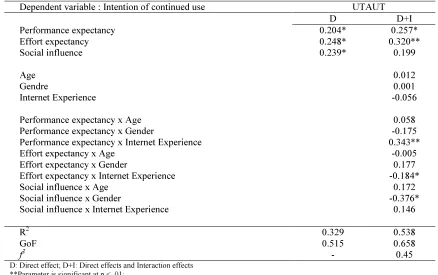
The models tested are the basic UTAUT with direct effect only (D) and the UTAUT with the interaction effects (D+I). Table 4 shows the path coefficients and R² for each model tested. Because the goal of the prediction-oriented PLS‑SEM
approach is to explain the endogenous latent variables’ variance, the R² should be high. The judgment of what R² level is high depends, however, on the specific research discipline. In general, R² values of 0.75, 0.50, or 0.25 for endogenous latent variables in the structural model can, as a rule of thumb, be described as substantial, moderate, or weak, respectively ([15]).
As shown in table 4, the models tested were UTAUT with direct effects (D), and UTAUT with direct and interaction effects (D+I). The variance explained by theses two models (R2) are respectively 0.329 to 0.538 which exceed the cut-off value of 0.25 ([15]). The comparison of the estimated models reveals that moderating effects have an impact on R2, increasing it from 0.329 to 0.538. The difference between the squared multiple correlations is used to assess the overall effect size f2for the interaction, where 0.02, 0.15, and 0.35 have been suggested as small, moderate, and large effects, respectively ([17]). We find an effect size of 0.45 which is a large effect.
In 2005, a global fit measure for PLS path modeling has been suggested ([33]). GoF (0 < GoF < 1), defined as the geometric mean of the average communality and average R2 (for endogenous constructs). According to [38], GoF values of 0.1, 0.25, and 0.36 signify small, medium, and large effects, respectively.
ICU EE PE SI AG GE IE
Intention of Continued Use (ICU) 0.92
Effort Expectancy (EE) 0,50 0.92
Performance Expectancy (PE) 0,44 0,56 0.85
Social Influence (SI) 0,47 0,60 0,40 0.91
Age (AG) 0,13 0,21 0,22 0,14 NA
Gender (GE) 0,031 -0,007 -0,012 -0,002 0,18 NA
Table 4 : Hypotheses Testing
Dependent variable : Intention of continued use UTAUT
D D+I
Performance expectancy 0.204* 0.257*
Effort expectancy 0.248* 0.320**
Social influence 0.239* 0.199
Age 0.012
Gendre 0.001
Internet Experience -0.056
Performance expectancy x Age 0.058
Performance expectancy x Gender -0.175
Performance expectancy x Internet Experience 0.343**
Effort expectancy x Age -0.005
Effort expectancy x Gender 0.177
Effort expectancy x Internet Experience -0.184*
Social influence x Age 0.172
Social influence x Gender -0.376*
Social influence x Internet Experience 0.146
R2 0.329 0.538
GoF 0.515 0.658
f2 - 0.45
D: Direct effect; D+I: Direct effects and Interaction effects **Parameter is significant at p < .01;
*Parameter is significant at p < .05; All other path coefficients are insignificant
We obtained GoF values which exceeds the cut-off value of 0.36 for large effect sizes as shown in table 5, which allows us to conclude that the two
models perform well. Additionally, if an
endogenous construct’s cross-validated redundancy measure value ( Q ²) for a certain endogenous latent variable is larger than zero, its explanatory latent constructs exhibit predictive relevance. The Q ² value is obtained by using a blindfolding procedure.
In our case, the two models tested (D and D+I) have Q ² values larger than zero which demonstrate their predictive relevance.
We calculated t-statistics derived from bootstrapping (250 iterations; individual Changes algorithm). All the direct effects are statistically significant when the main UTAUT model is tested. all Path coefficients are positive and statistically significant in the structural model. Performance expectancy (β= 0.204; p<0.05) has a positive effect on the intention of continued use of e-learning system, effort expectancy (β= 0.248; p<0.05) influence positively the intention of continued use, and social influence (β= 0.239; p<0.05) has a positive impact also.
About the interaction effects, we found that Internet Experience moderate the effect of both performance expectancy (β= 0.343; p < 0.01) and effort expectancy (β= -0.184; p < 0.05).
In addition, we found that gender moderate the effect of social influence
(β= -0.376; p < 0.05). The results show that the inclusion of the interaction terms improve the variance explained.
D+I model has the highest values of R2 and GoF compared to the basic UTAUT model (D). So, when we add interaction factors, we obtain an increase in the variance explained, and an improvement of the predictive power of the model.
ISSN: 1992-8645 www.jatit.org E-ISSN: 1817-3195
6. DISCUSSION
6.1. Theoretical implications
Theoretically, our results suggests that adding interaction factors increase the predictive power of the basic UTAUT model in explaining the intention of use of e-learning. While the UTAUT basic model explains 32.9% of the variance of behavior intention, The (D+I) model explains 53.8 % of the variance which represent an important increase of explanatory power (ΔR2 = 21%; f2 =0.45). Compared with other research exploring e-learning adoption, our study has a higher predictive power than similar studies. For instance, [7] used the expectancy-value theory to explain e-learning acceptance. Their proposed model explained 50% of e-learning usage intention. Recently, [25] test a model of usage of learning management system among postgraduate students. Their model explain 52% of the intention of behavioral intention.
On the other hand, our findings reveal that performance expectancy and effort expectancy are significant determinants of the intention of continued use of e-learning. In fact, e-learning system is perceived as a useful technology and easily to use. Its provide many benefits to students in performing their activities. This finding is consistent with the results of prior studies ([12]; Tan, 2013). However, and contrary to our expectations, the effect of social influence is not significant. Other studies found that social influence have no direct impact on behavioral intention to use a technology, especially in a voluntary context ([26]; [21]).
This means that, in general, students will not use e-learning system because their friends recommend it. They are more interested by the outcomes of the technology and its ease of use. But, we found that, the influence of social influence on Intention of continued use is stronger for women. This means that student women in Saudi Arabia are more sensitive to others when they decided to adopt or not an electronic learning system.
When we considered moderating factors, we found that the influence of performance expectancy on intention of continued use is stronger with increasing Internet experience. However, age and gender are not significant moderators for performance expectancy and effort expectancy. Which is important is how much an individual (man or woman; young or old) is familiarized with Internet technology.
Also, our results show that the effect of effort expectancy decreases when the Internet experience increases. Past studies have outlined the importance of experience as a moderator in e-learning acceptance and use context ([19]).
6.2. Managerial implications
The findings of this research show that the users of e-learning systems of the university of Tabuk are primarily a goal oriented individuals. Students are seeking mainly the advantages offered by the use of technology. They are more worried about the expected performance and effort. Thus, the University of Tabuk should take this point into account. To promote
e-learning acceptance and use in higher institutions, the attention will be turned to improve the productivity of students in performing their activities and to facilitate the use of the virtual learning systems.
The usability of the e-learning platform and the support delivered online to the students should be increased and continually enhanced. In addition,
governments, universities, and education
institutions must pay more attention to women and users with limited Internet experience. The impact of social influence on intention of use is stronger for women. Also, users with stronger Internet experience perceived more benefits and are less sensitive to the issue of ease of use. So, training programs and other activities which give more information about the e-learning can motivate the undecided people to overcome their anxiety and to be more familiarized with the technology.
7. CONCLUSION
This research intended to explain the
determinants of the continued use of e-learning system by using the UTAUT model. The findings reveal that performance expectancy, and effort expectancy determine the intention of continued use of e-learning system. With stronger Internet experience, the effect of performance expectancy increases, and the influence of effort expectancy decreases. In addition, the effect of social influence on intention of continued use is seems to be stronger for women than for men.
While this study enhance our knowledge about the acceptance and use of the technology in the domain of e-learning, some improvements can be taken in the future. For example, further research may examine the effect of other moderators such
compatibility. The intention of continued use of e-learning can vary according to these factors.
In addition, further studies are appealed to test the model used in other contexts (other countries and/or other technologies) to verify its robustness. Finally, future research can integrate other factors to UTAUT model (e.g., technological expectancy) or other model (e.g., service quality model) to enrich the conceptual framework used in this research.
REFRENCES:
[1]. Ajzen, I. (1991). The theory of planned behavior. Organizational behavior and human decision processes, 50(2), 179-211.
[2]. Al Alhareth, Y. (2014). E-learning Accessibility for Saudi Women: A Literature Review. International Journal of Emerging Technologies in Learning (iJET), 9(4), pp-65.
[3]. Al-Asmari, A. M., & Rabb Khan, M. S. (2014). E-learning in Saudi Arabia: Past, Present and Future. Near and Middle Eastern Journal of Research in Education, (2014).
[4]. Al‐Qahtani, A. A., & Higgins, S. E. (2013).
Effects of traditional, blended and e‐learning on
students' achievement in higher education. Journal of Computer Assisted Learning, 29(3), 220-234.
[5]. Al-Shehri, A. M. (2010). E-learning in Saudi Arabia:‘To E or not to E, that is the question’. Journal of family and community medicine, 17(3), 147.
[6]. Bangert, A., & Almahfud, M. (2014, March). An Exploratory Study of University Students’ Smartphone Use for Learning in the US and Saudi Arabia. In Society for Information Technology & Teacher Education International Conference (Vol. 2014, No. 1, pp. 1622-1627). [7]. Chen, J. L. (2011). The effects of education
compatibility and technological expectancy on e-learning acceptance. Computers & Education, 57(2), 1501-1511.
[8]. Chiu, C. M., & Wang, E. T. (2008). Understanding Web-based learning continuance intention: The role of subjective task value. Information & Management, 45(3), 194-201. [9]. Compeau, D. R., & Higgins, C. A. (1995).
Application of social cognitive theory to training for computer skills. Information Systems Research, 6(2), 118-143.
[10]. Davis, F. D. (1989). Perceived usefulness, perceived ease of use, and user acceptance of information technology. MIS quarterly, 319-340.
[11]. Davis, F. D., Bagozzi, R. P., & Warshaw, P. R. (1992). Extrinsic and intrinsic motivation to use computers in the workplace1. Journal of Applied Social Psychology, 22(14), 1111-1132. [12]. Escobar-Rodríguez, T., Carvajal-Trujillo,
E., & Monge-Lozano, P. (2014). Factors that influence the perceived advantages and relevance of Facebook as a learning tool: An extension of the UTAUT. Australasian Journal of Educational Technology, 30(2).
[13]. Fernández, A., Peralta, D., Benítez, J. M., & Herrera, F. (2014). E-learning and educational data mining in cloud computing: an overview. Int. J. Learning Technology, 9(1), 25. [14]. Fishbein, M., & Ajzen, I. (1975). Belief.
Attitude, Intention and Behavior: An
Introduction to Theory and Research Reading, MA: Addison-Wesley, 6.
[15]. Hair, J. F., Ringle, C. M., & Sarstedt, M. (2011). PLS-SEM: Indeed a silver bullet. The Journal of Marketing Theory and Practice, 19(2), 139-152.
[16]. Hair, J. F., Sarstedt, M., Ringle, C. M., & Mena, J. A. (2012). An assessment of the use of partial least squares structural equation modeling in marketing research. Journal of the Academy of Marketing Science, 40(3), 414-433.
[17]. Henseler, J., Ringle, C. M., & Sinkovics, R. R. (2009). The use of partial least squares path modeling in international marketing. Advances in international marketing, 20, 277-319.
[18]. Lai, I. K., & Lai, D. C. (2014). Understanding Students’ Continuance Intention toward Social Networking e-Learning. In Hybrid Learning. Theory and Practice (pp. 173-183). Springer International Publishing.
[19]. Lin, P. C., Lu, H. K., & Liu, C. H. I. A. (2013). Towards an education behavioral intention model for e-learning systems: An extension of UTAUT. Journal of Theoretical and Applied Information Technology, 47(3), 1120-1127.
ISSN: 1992-8645 www.jatit.org E-ISSN: 1817-3195
[21]. Martins, C., Oliveira, T., & Popovič, A. (2014). Understanding the Internet banking adoption: A unified theory of acceptance and
use of technology and perceived risk
application. International Journal of Information Management, 34(1), 1-13.
[22]. Moore, G. C., & Benbasat, I. (1996). Integrating diffusion of innovations and theory of reasoned action models to predict utilization of information technology by end-users. In
Diffusion and adoption of information
technology (pp. 132-146). Springer US.
[23]. Nguyen, T. D., Nguyen, T. M., Pham, Q. T., & Misra, S. (2014). Acceptance and Use of E-Learning Based on Cloud Computing: The
Role of Consumer Innovativeness. In
Computational Science and Its Applications–
ICCSA 2014 (pp. 159-174). Springer
International Publishing.
[24]. Overby, J. D., Griffin, R. B., Joyner, E. R., Schmidt, T. W., Tuck, L., & Mansfield, K. (2014). Using the internet and shareware to facilitate computer simulation in distance learning classes. Developments in Business Simulation and Experiential Learning, 27. [25]. Raman, A., Don, Y., Khalid, R., & Rizuan,
M. (2014). Usage of Learning Management System (Moodle) among Postgraduate Students: UTAUT Model. Asian Social Science, 10(14), p186.
[26]. Riffai, M. M. M. A., Grant, K., & Edgar, D. (2012). Big TAM in Oman: Exploring the promise of on-line banking, its adoption by customers and the challenges of banking in Oman. International Journal of Information Management, 32(3), 239-250.
[27]. Ringle, C. M., Wende, S., & Will, S. (2005). SmartPLS 2.0 (M3) Beta, Hamburg. [28]. Rojas, D., Kapralos, B., & Dubrowski, A.
(2014, July). Gamification for Internet Based Learning in Health Professions Education. In Advanced Learning Technologies (ICALT), 2014 IEEE 14th International Conference on (pp. 281-282). IEEE.
[29]. Sohail, M. S., & Shaikh, N. M. (2008). Internet banking and quality of service: perspectives from a developing nation in the Middle East. Online Information Review, 32(1), 58-72.
[30]. Sumak, B., Polancic, G., & Hericko, M. (2010, February). An empirical study of virtual learning environment adoption using UTAUT. In Mobile, Hybrid, and On-Line Learning,
2010. ELML'10. Second International
Conference on (pp. 17-22). IEEE.
[31]. Tan, P. J. B. (2013). Applying the UTAUT to Understand Factors Affecting the Use of English E-Learning Websites in Taiwan. SAGE Open, 3(4), 2158244013503837.
[32]. Taylor, S., & Todd, P. A. (1995). Understanding information technology usage: a test of competing models. Information Systems Research, 6(2), 144-176.
[33]. Tenenhaus, M., Vinzi, V. E., Chatelin, Y. M., & Lauro, C. (2005). PLS path modeling. Computational statistics & data analysis, 48(1), 159-205.
[34]. Thompson, R. L., Higgins, C. A., & Howell, J. M. (1991). Personal computing: toward a conceptual model of utilization. MIS quarterly, 125-143.
[35]. Van Raaij, E. M., & Schepers, J. J. (2008). The acceptance and use of a virtual learning environment in China. Computers & Education, 50(3), 838-852.
[36]. Venkatesh, V., Morris, M. G., Davis, G. B., & Davis, F. D. (2003). User acceptance of information technology: Toward a unified view. MIS quarterly, 425-478.
[37]. Venkatesh, V., Thong, J. Y., & Xu, X. (2012). Consumer acceptance and use of information technology: extending the unified theory of acceptance and use of technology. MIS quarterly, 36(1), 157-178.