Retraction: Important note from the authors
In 2014, Mridul Nandi gave chosen plaintext and ciphertext attack against the XLS scheme, invalidating Theorem 2, which is the main result of this paper. It appears our case analysis contains a bug (specifically the proof of Claim 7). This also means Theorem 3, Theorem 9, and Theorem 11 are wrong.
We are leaving the paper as it was written in 2007 for historical purposes, but please do not rely on XLS as it does not provide the level of security expected of ciphers. See Nandi’s paper for more details regarding the attack:
M. Nandi. XLS is Not a Secure Strong Pseudorandom Permutation. Advances in Cryptology –ASIACRYPT 2014, LNCS vol. 8873, Springer, pp. 478–490, 2014.
A preliminary version of this paper appears inFast Software Encryption - FSE 2007, Lecture Notes in Computer Science Vol. 4593, pp. 101–118, A. Biryukov ed., Springer-Verlag, 2007. This is the full version.
How to Enrich the Message Space of a Cipher
Thomas Ristenpart∗ Phillip Rogaway†
March 2007
Abstract
Given (deterministic) ciphersEandEthat can encipher messages oflandnbits, respectively, we construct a cipherE∗ = XLS[E, E] that can encipher messages of l+s bits for anys < n.
Enciphering such a string will take one call to E and two calls to E. We prove that E∗ is a
strong pseudorandom permutation as long as E and E are. Our construction works even in the tweakable and VIL (variable-input-length) settings. It makes use of a multipermutation (a pair of orthogonal Latin squares), a combinatorial object not previously used to get a provable-security result.
Key words: Deterministic encryption, enciphering scheme, symmetric encryption, length-preserving encryption, multipermutation.
∗
Dept. of Computer Science & Engineering 0404, University of California San Diego, 9500 Gilman Drive, La Jolla, CA 92093-0404, USA. Email: [email protected]. URL: http://www-cse.ucsd.edu/users/tristenp. Supported in part by NSF grant CNS-0524765 and a gift from Intel Corporation.
†
Dept. of Computer Science, University of California Davis, One Shields Avenue, Davis, CA 95616, USA. Email:
Contents
1 Introduction 3
2 Preliminaries 5
3 The XLS Construction 6
4 The Mixing Function 6
5 The Bit Flips 10
6 Security of XLS 10
7 Proof of Lemma 2 14
8 Supporting Tweaks 20
1
Introduction
Domain extension. Consider a cryptographic scheme with a message space M = Sl∈L{0,1} l
for some set L of permissible message lengths. The scheme can handle any message of l ∈ L bits but it can’t handle messages ofl∗ 6∈ Lbits. Often the set of permissible message lengthsLis what worked out well for the scheme’s designers—it made the scheme simple, natural, or amenable to analysis—but it might not be ideal for the scheme’s users who, all other things being equal, might prefer a scheme that works across arbitrary-length messages. To address this issue, one may wish to extend the scheme to handle more message lengths. Examples are extending CBC encryption using ciphertext stealing [21] and extending a pseudorandom function F with message space ({0,1}n)+ by appropriately padding the message and calling F.
Our work is about extending the domain of a cipher. When we speak of a cipher in this paper we mean a deterministic map E: K × M → M where M = S
l∈L{0,1}l and EK(·) = E(K,·) is a length-preserving permutation. Such an object is also called an enciphering scheme, a pseudorandom permutation, an arbitrary-input-length blockcipher, or a deterministic cipher / encryption scheme. Our goal is to extend a cipher E: K × M → M with permissible message lengths L to a cipher E∗: K∗ × M∗ → M∗ with an enlarged set L∗ ⊇ L of permissible message lengths. Being an extension of E, what E∗ does on a string of length l∈ L and key hK, K0i must be identical to whatE would do on keyK. Note that padding-based methods will not work: even if there is a point in the message space of E that one can pad a plaintext to, padding M to M∗ and then applying E would be length-increasing, and so not a cipher. Unlike signatures, MACs, pseudorandom functions, and semantically secure encryption, there is no obvious way to extend a cipher’s domain.
Our contribution. We show how, with the help of an n-bit blockcipher E, to extend a cipher’s
set of permissible message lengths fromL ⊆[n ..∞) toL∗=L+ [0.. n−1] ={`+i|`∈ Land i∈
[0.. n−1]}. In other words, we enlarge the message space from Mto M∗ =M || {0,1}<n where M ⊆ {0,1}≥n.
We call our construction XLS (eXtension by Latin Squares). Its overhead is two blockcipher calls, eight xor instructions, and two one-bit rotations. This is the work beyond enciphering (or deciphering) a single l-bit string that is needed to encipher (or decipher) an l+sbit one, where s∈ [1.. n−1]. If the message is in the original domain there is no overhead beyond determining this. As an example, if E = E is an n-bit blockcipher then it will take three blockcipher calls to encipher a 2n−1 bit string.
The XLS method is described in Figure 1. For a message M already in the domain of E, just apply it. Otherwise, suppose that M has length l+s where l ∈ L and s ∈ [1.. n−1]. To encipherM: apply the blockcipherEto the last fulln-bit block ofM; mix together the last 2s-bits; flip the immediately preceding bit; encipher under E the firstl bits; mix together the last 2s-bits; flip the immediately preceding bit; then apply E to the last full n-bit block. Our recommended instantiation of the mixing step uses three xors and a single one-bit circular rotation.
We prove that XLS works. More specifically, ifEis secure in the sense of a strong pseudorandom permutation (a strong PRP) [17] thenE∗inherits this property. This assumes that the blockcipherE
is likewise a strong PRP. The result holds even in the variable-input-length (VIL) setting [3]: if
E is VIL-secure then so is E∗. See Theorem 3. It also holds in the tweakable-enciphering-scheme setting [16]: if E is tweakable then E∗ inherits this. See Section 8. If one makes the weaker
assumption thatE and E are ordinary (not necessarily strong) PRPs, then one can conclude that
E∗ is a PRP. See Section 9.
ways of mixing do not work. We show that omitting the bit flip does not work. And attempting to get by without any mixing—say by enciphering the last n bits, the first l bits, then the last n bits—doesn’t work even if one demands that the “overlap” in what is enciphered isn/2 bits: there is an attack of complexity 2n/4.
All that said, we develop sufficient conditions on the mixing function thatare enough to guaran-tee security, and we provide a mixing function based on multipermutations (also called orthogonal Latin squares [7]). Though conceptually elegant, implementing multipermutations in this setting is slightly complicated, so we provide an alternate mixing function that approximates multipermu-tations via bit romultipermu-tations. This comes at the (insignificant) cost of a slightly larger constant in the security reduction. XLS is the first mode of operation to employ multipermutations or approximate multipermutations to yield a provable-security guarantee. Indeed, such mixing functions may prove to be useful in further provable-security contexts.
We comment that we cannot handle messages of length less than n bits (the blocklength of the blockcipher that we use)—for example, we don’t know how to encipher a 32-bit string using AES (in an efficient way and with a known and desirable security bound). This is a long open problem [6, 12].
Related work. There are several known methods for turning a blockcipher with message space
M= {0,1}n into a cipher with some message space {0,1}≥n
. Halevi does this in his EME∗ and TET constructions [12, 13]; Fluhrer and McGrew do it (without a provable-security guarantee) with XCB [20]; Wang, Feng, and Wu do it in HCTR [29]; and Chakraborty and Sarkar do it in HCH [9]. All of these constructions are somewhat complex, and their methods for dealing with “inconvenient-length” strings are non-generic. Constructions of ciphers fromn-bit blockciphers that result in a message space like ({0,1}n)+are offered by Zheng, Matsumoto, and Imai [30], Naor and Reingold [22], Halevi and Rogaway [14, 15], Patel, Ramzan, and Sundaram [24], and Chakraborty and Sarkar [8]. One can even view Luby and Rackoff [17] in this light.
Anderson and Biham [2] and Lucks [18, 19] make a wide-blocksize cipher out of a stream cipher and a hash function, and Schroeppel provides a cipher [27] that works on an arbitrary message space de novo.
WhenE=Eis ann-bit blockcipher, the XLS construction solves theelastic blockcipher problem of Cook, Yung, and Keromytis [10, 11], where one wants to extend a blockcipher from n bits to [n ..2n−1] bits. The Cooket. al solution is heuristic—there is no proof of security—but with XLS we have, for example, an “elastic AES” that provably preserves the security of AES.
When a cipher like CMC or EME [14, 15] plays the role of E in XLS, one gets a cipher with efficiency comparable to that of a mode like EME∗ [12].
Bellare and Rogaway first defined VIL ciphers [3] and built one (although it is not secure as a strong PRP). An and Bellare [1] offer the viewpoint that cryptographic constructions are often aimed at adjusting the domain of a primitive. This viewpoint is implicit in our work.
Applications. While primarily interested in the “theoretical” question of how to accomplish
two confidential database records are identical, these records having arbitrary length that should not be changed, but nothing else about the records should be leaked. Arbitrary-length enciphering enables bandwidth-efficient use of the encode-then-encipher paradigm of Bellare and Rogaway [4], where one gets authenticity by enciphering strings encoded with redundancy and semantic security by enciphering strings that rarely collide.
2
Preliminaries
Basics and notation. For stringsX, Y ∈ {0,1}∗, we useX ||Y orX Y to denote concatenation.
We write X[i] for i ∈ [1..|X|] to represent the ith bit of X (thus X = X[1]X[2]· · ·X[s]). The complement of a bitbisflip(b). For a setCand elementX we writeC ∪
←X forC ← C ∪ {X}. We require that for any set of bit stringsS ⊆ {0,1}∗, ifX ∈ S then{0,1}|X|⊆ S.
A cipher is a map E: K × M → M where K is a nonempty set, M ⊆ {0,1}∗ is a nonempty set, and EK(·) = E(K,·) is a length-preserving permutation. The set K is called the key space
and the set Mis called the message space. We can view the message space as ∪l∈L{0,1}l where L = {l| ∃X ∈ Ms.t. |X| = l}. Let D be the cipher with the same signature as E and defined by DK(Y) = X iff EK(X) = Y. A blockcipher is a cipher with message space M = {0,1}n for some n ≥ 1 (the blocksize). For M ⊆ {0,1}∗ let Perm(M) be the set of all length-preserving permutations on M. By selecting K = Perm(M) we have a cipher for which a uniformly chosen permutation on {0,1}l is selected for each l∈ L. Let Func(M) be the set of all length-preserving functions onM. Write Perm(`) and Func(`) for Perm({0,1}`) and Func({0,1}`), respectively.
LetS ⊆ {0,1}≥1. Then defineS2={XY |X, Y ∈ S ∧ |X|=|Y|}. Let f: S2→ S2 be a length-preserving function. We define theleft projection of f as the function fL: S2 → S wherefL(X) is equal to the first|X|/2 bits off(X). We define theright projectionoff as the functionfR: S2 → S wherefR(X) is equal to the last|X|/2 bits of f(X). Of coursef(X) =fL(X)||fR(X).
When we say “Replace the last ` bits of M, Last, by F(Last)” we mean (1) parse M into X||Last where|X|=|M| −` and |Last|=`; (2) let Z beF(Last); and (3) replaceM by X||Z. We define the semantics of similar uses of “Replace. . .” in the natural way.
The notation “XY Z ←M of lengths x, y, z” for any string M with |M|=x+y+z means parseMinto three strings of lengthx,y, andzand assign these values toX,Y, andZ, respectively. The notation is extended to the case of parsingM into two halves in the natural way.
Finally, an involution is a permutation gwhich is its own inverse: g(g(x)) =x.
Security notions. When an adversary A is run with an oracle O we let AO⇒1 denote the
event that A outputs the bit 1. Let E: K × M → M be a cipher. Then we define the following advantages for an adversary A:
Adv±Eprp(A) = Pr
h
K← K$ :AEK,DK ⇒1
i −Pr
h
π←$ Perm(M) :Aπ, π−1 ⇒1
i
AdvE±prf(A) = PrhK← K$ :AEK,DK ⇒1
i
−Prhρ, σ←$ Func(M) :Aρ, σ⇒1i
While the above formalization allowsvariable input length (VIL) adversaries, we can also restrict adversaries to only query messages of a single length. We call such adversaries fixed input length (FIL) adversaries.
Informally, a cipher is called a “strong pseudorandom permutation” if no reasonable adversaryA
can distinguish the enciphering and deciphering functions, randomly keyed, from a randomly se-lected permutation and its inverse: Adv±Eprp(A) is small. Our theorems make concrete statements about this and so we will not have to formalize “reasonable” or “small.” Resources we pay at-tention to are the adversary’s maximum running time (which, by convention, includes the length of the program); the number of queries it asks; and the lengths of the queries. For any cipher E
with inverseD, defineTimeE(µ) = max{Tkey, TE, TD}whereTkey is the maximum time required to
generate a key L for the scheme, TE is the maximum time to run EL on a message of at most µ
bits, andTD is the maximum time to run DL on a ciphertext of at most µbits.
3
The XLS Construction
Fix a blocksizen. Let E: KE× M → Mbe a cipher withM ⊆ {0,1}≥nand letE: KE× {0,1}n→ {0,1}n be a blockcipher. Finally, define a length-preserving permutation mix: S2 → S2 where
S ⊇ ∪n−i=11{0,1}i. Then we define a cipher E∗ = XLS[mix,E, E] with key spaceK∗ =KE× KE and
message spaceM∗ =M || {0,1}<n. For keysL∈ KE andK∈ KE we haveEL,K∗ (·) =E
∗((L, K),·).
See Figure 1 for the definition.
Enciphering a message M withE∗ = XLS[mix,E, E] is straightforward. IfM ∈ M, then simply apply E. Otherwise, apply E to the last full n-bit block of M and replace those bits with the result. Then ‘mix together’ the last 2sbits, again replacing the appropriate bits with the resulting mixture. Flip bit |M| −2s, which is the first bit from the right not affected by mix. Apply E to as many bits as possible, starting from the left. Finally, just repeat the first three steps in reverse order. Deciphering is equally simple, and in fact, if one implements mix with an involution, as we suggest, then the inverse ofE∗ is just D∗ = XLS[mix,D, D].
Why, intuitively, should XLS work? “Working” entails that each output bit strongly depends on each input bit. Since E presumably already does a good job of this we need only worry about mixing in the “leftover” sbits for M /∈ M. We mix in these bits utilizing the mixing functionmix. But since mix will be a simple combinatorial object—it is unkeyed and will have no “crypto-graphic” property—we need to “protect” its input with the blockcipher. The “symmetrizing” of the protocol—repeating the blockcipher call and the mixing step in the reverse order so that lines 03 → 09 are identical to lines 09→ 03—helps achieve strong PRP-security: each input bit must strongly depend on each output bit, as queries can be made in the forwardor backward direction. Finally, the bit-flipping step is just a symmetry-breaking technique to ensure that different-length messages are treated differently.
If mix does a “good” job of mixing, then XLS will in fact be secure, as we prove in Section 6. But what is the meaning of “good,” and how do we make a mixing function that is simultaneously good, efficient, and easy to implement? We now turn towards answering these questions.
4
The Mixing Function
AlgorithmE∗ L,K(M)
00 IfM ∈ M then returnEL(M)
01 Letl <|M|be largest number such that {0,1}l⊆ M;s← |M| −l 02 Ifs≥norl < nthen Return⊥
03 Replace the last fulln-bit block ofM, LastFull, withEK(LastFull)
04 Replace the last 2s bits ofM, Last, withmix(Last) 05 Replace the (|M| −2s)’th bit of M,b, withflip(b) 06 Replace the firstl bits ofM, First, with EL(First)
07 Replace the (|M| −2s)’th bit of M,b, withflip(b) 08 Replace the last 2s bits ofM, Last, withmix(Last)
09 Replace the last fulln-bit block ofM, LastFull, withEK(LastFull)
10 Return M
M5 EK
M2
M6
C6
C5 C4
C2
flip
M4!
C4!
nbits
lbits
nbits EK
M3 M4
flip 2sbits
M7
mix
C1
C1
C1 C3
C3 M7
mix
EL
M3
M1 M1 M1
2sbits
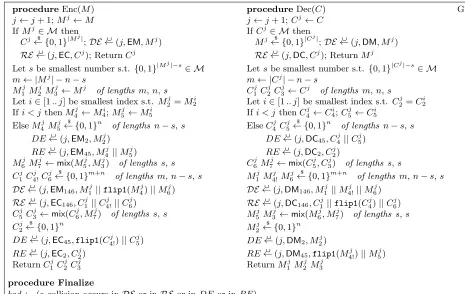
Figure 1: Top: Enciphering algorithm E∗ = XLS[mix,E, E]. Bottom: Enciphering M =M
1||M2||M3 underE∗whereMis not inM;l <|M|is the largest value such that{0,1}l
⊆ M;s=|M|−l;M1∈ {0,1} l−n
; M2∈ {0,1}
n
; andM3∈ {0,1} s
.
halves, i.e., mix(AB) means that A||B ∈ S2 and that |A|= |B|. Also we interchangeably write
mix(AB) and mix(A, B), which are equivalent.
A naive approach. Let’s start with a natural construction that, perhaps surprisingly, does
with the lastn−1 bits equal to 0n−1. This would be true of a random permutation with probability at most 1/2n−1, and so the adversary’s advantage is close to one. In factmixWrong does not do a good job of mixing: the right half of the output is only a function of the right half of the input. One can try various fixes, but ultimately it appears that using just xors is inherently inadequate.
Using orthogonal latin squares. The failure above suggests that what is needed is a mixing
function with symmetry, in the sense that both the left and right halves of the output are dependent on both the left and right halves of the input. To achieve such a goal we can turn to the classical combinatorial objects known as a pair oforthogonal Latin squares [7], also called a multipermuta-tion [26]. This is a permutation mix: S2 → S2 such that, for any C ∈ S, mix
L(C,·), mixL(·, C),
mixL(C,·), andmixR(·, C) are all permutations, wheremixL and mixR denote the projection of mix
onto its first and second component. Let us describe a concrete realization. Fix a finite fieldF2s for
each sand view eachs-bit string as an element of this field. Then we can build a mixing function
mix1by saying that
mix1(AB) = (3A+2B)||(2A+3B) = (A+2(A+B), B+2(A+B))
for equal-length strings A and B (we will assume the length to be at least 2). Here addition and multiplication are overF2s and2= 0s−210 =xand3= 0s−211 =x+ 1. Addition is bitwise xor and
multiplication by 2, which we also denote dbl, can be implemented by a shift and a conditional xor. The mixing function mix1has several nice properties. First, it is a permutation and, in fact, an involution (meaning mix = mix−1). Moreover, for any C ∈ {0,1}s we have that mix1L(C,·),
mix1R(C,·), mix1L(·, C), and mix1R(·, C) are all permutations on{0,1}s.
We show later that, when used in XLS, mixing function mix1 leads to a secure construction. Moreover, it is fast and relatively simple. But implementing it in XLS requires a table of constants corresponding to irreducible polynomials, one for eachs≤n−1. As it turns out, we can do better.
The simplified mixing function. We now simplify the mixing functionmix1. Letrol(X) repre-sent left circular bit-rotation, that is, for any stringXof lengthsletrol(X) =X[2]X[3]· · ·X[s]X[1]. Then definemix2by
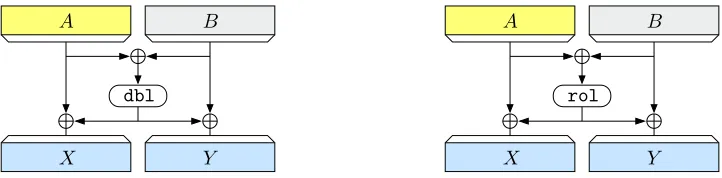
mix2(AB) = (A⊕rol(A⊕B))||(B⊕rol(A⊕B))
whereAandB are equal-length strings. See Figure 2. Notice the similarity withmix1: we replaced multiplication by two with a left circular rotation. The bit rotation “approximates” a proper multiplication, eliminating, in an implementation, the conditional xor and the table of constants. As before, mix2is an involution.
Quantifying the quality of mixing functions. We now formalize the properties of a mixing
function that are needed in the proof of XLS.
Definition 1 Fix a setS ⊆ {0,1}≥1, letmix: S2 → S2 be a length-preserving permutation, and let : N→[0,1]. We say thatmixis an(s)-good mixing functionif, for allssuch that{0,1}s⊆ S,
we have that
(1) mixL(A,·)is a permutation for all A∈ {0,1}s,
(2) mixR(·, B)is a permutation for all B ∈ {0,1}s,
(3) Pr[R← {$ 0,1}s: C=mixL(R, B)]≤(s) for allB, C ∈ {0,1}s, and
(4) Pr[R← {$ 0,1}s: C=mixR(A, R)]≤(s) for all A, C∈ {0,1} s
Y X
B A
dbl
Y X
B A
rol
Figure 2: The mixing functionsmix1(left) andmix2(right). HereA, B∈ {0,1}<nwiths=|A|=|B|. The operationdblis a multiplication by 2= 0s−210 =xin the finite field
F2s androlis a circular left rotation
by one bit.
The best one can hope for is a 2−s-good mixing function. In factmix1is such a function, while the
mix2function is just a factor of two off.
Lemma 1 The mixing function mix1is a2−s-good mixing function. The mixing function mix2is a 2−s+1-good mixing function.
Proof: Since for any s ∈ [1.. n−1] and any C ∈ {0,1}s we have that mix1L(C,·), mix1R(C,·),
mix1L(·, C), andmix1R(·, C) are all permutations, the first half of the lemma is clear. That mix2meets parts 1 and 2 of the definition is clear. For the third part, we have that
mix2L(R, B) =R⊕rol(R⊕B) =R⊕rol(R)⊕rol(B)
and so we bound the number of values R such that C⊕rol(B) = R⊕rol(R). Let C0 = C⊕rol(B), which is a constant. Then we have that
R[1]⊕R[s] = C0[1] R[2]⊕R[1] = C0[2]
.. .
R[s−1]⊕R[s−2] = C0[s−1] R[s]⊕R[s−1] = C0[s]
There only exists a string R that satisfies the above equalities ifC0[1]⊕C0[2]⊕ · · · ⊕C0[s] = 0. If there exists a solution, then pick a value for R[1]. That choice and the equations above combine to specify R[2], . . . , R[s]. This means that there are at most two possible values of R and so the probability thatC =mix2L(R, B) is at most 2/2s. The proof of the fourth part is symmetric.
We point out that the properties of circular rotations combined with xors as utilized in mix2
have been used before in different settings, such as [23].
We have introduced two mixing functions for the following reason: mix1 is conceptually more elegant, while mix2 is operationally more elegant. In addition, mix2 is in effect an approximation of mix1, making the latter an important conceptual building block. Such mixing functions might prove useful in future provable-security results.
5
The Bit Flips
In steps 05 and 07 of XLS (see Figure 1) we flip a single bit. Flipping bits in this manner is unintuitive and might seem unimportant for the security of XLS. However, the bit flips are actually crucial for the security of the scheme when in the VIL setting. Let E† be the cipher defined by running the algorithm of Figure 1 except with lines 05 and 07 omitted. Then the following VIL adversary A easily distinguishes E† from a family of random permutations. The adversary A
makes two enciphering queries on M = 0n+1 and M0 = 0n+2, getting return values C and C0 respectively. If the first n bits of C and C0 are equal, then A outputs 1 (the oracles are likely the construction) and otherwise outputs 0 (the oracles are likely a random permutation). We have that Pr[K← K$ ∗ : AE†(·),D†(·)
⇒ 1] = 1. This is so because for both queries the inputs to E are necessarily the same (as one can verify quickly by following along in the diagram in Figure 1; remember to omit the flip steps). Clearly Pr[π←$ Perm(M∗) :Aπ(·),π−1(·)
⇒1] = 2−nand soAhas large advantage.
6
Security of XLS
We are now ready to prove the security of XLS. The proof is broken into two parts: first we show that XLS is secure in an information-theoretic setting (i.e., using actual random permutations as components). Afterwards we pass to a complexity-theoretic setting to get our main result.
Theorem 2 Fixnand an(s)-good mixing function mix. LetE∗ = XLS[mix,Perm(M),Perm(n)]
forM ⊆ {0,1}≥nThen for any adversaryAthat asks at mostqqueries we have thatAdv±E∗prf(A)≤
5q2(s)/2n−s+ 3q2/2n for any s∈[1.. n−1], and so, by Lemma 1, Adv±E∗prf(A)≤
8q2
2n and Adv ±prf
E∗ (A)≤
13q2 2n formix=mix1and mix=mix2, respectively.
Proof:We first present a self-contained chunk of the proof, and sketch the intuition of how to prove the other portion. The full proof of the latter is deferred to Section 7. Fixnand letmix: S2 → S2 be an(s)-good mixing permutation. LetE: Perm(M)× M → Mbe a cipher with message space
M and let E: Perm(n)× {0,1}n → {0,1}n be a blockcipher. Note that these last two simply implement a family of random length-preserving permutations on M and a random permutation on {0,1}n, respectively. Let A be a ±prf adversary against E∗ = XLS[mix,E, E]. We therefore
must bound
Adv±E∗prf(A) = Pr h
K← K$ ∗:AEK∗,DK∗ ⇒1
i −Pr
h
ρ, σ←$ Func(M∗) :Aρ, σ⇒1
i
.
Recall that we disallow Afrom making pointless queries. We utilize a game-playing argument [5] and the first two games are G0 and G1, shown in Figure 3.
In G0 we build E and E lazily using the appropriate Choose procedures, and so E and E are partial functions in this context. Note thatDE,RE, DE, RE are initially empty and the functions
procedureChooseE(X) Y ← {$ 0,1}|X|
If Y ∈ REthenbad←true,Y ← RE$
If X∈ DE thenbad←true,Y ← E(X)
E(X)←Y;D(Y)←X
RE ∪
←Y;DE ∪
←X; ReturnY
procedureChooseD(Y) G0 G1
X← {$ 0,1}|Y|
IfX∈ DE thenbad←true,Y ← DE$
IfY ∈ RE thenbad←true,X← D(Y)
E(X)←Y;D(Y)←X
RE ∪
←Y;DE ∪
←X; ReturnX
procedureChooseE(X) Y ← {$ 0,1}|X|
If Y ∈REthenbad←true,Y ←$ RE If X∈DEthenbad←true,Y ←E(X) E(X)←Y;D(Y)←X
RE←∪Y;DE←∪X; ReturnY
procedureChooseD(Y ) X← {$ 0,1}|Y|
IfX∈DE thenbad←true,Y ←$ DE IfY ∈REthenbad←true,X ←D(Y) E(X)←Y;D(Y)←X
RE←∪Y;DE←∪ X; ReturnX
procedureEnc(M)
j←j+ 1;Mj←M; IfMj∈ Mthen ReturnCj←ChooseE(Mj)
Letsbe smallest number s.t. {0,1}|Mj|−s∈ M
m← |Mj| −n−s;M1jM
j
2 M
j
3 ←M
j
of lengths m, n, s Leti∈[1.. j] be smallest index s.t. M2j=Mi
2 If i < jthenM4j←M
i
4;M
j
5 ←M
i
5
ElseM4jM5j←ChooseE(M2j) of lengths n−s, s M6jM7j←mix(M4j, M3j) of lengthss, s
C1jC
j
4!C
j
6 ←ChooseE(M
j
1 ||flip1(M
j
4)||M
j
6) of lengths m, n−s, s C5jC3j←mix(C6j, M7j) of lengths s, s
C2j←ChooseE(flip1(C
j
4!)||C
j
5) ReturnC1jC2jC3j
procedureDec(C)
j←j+ 1;Cj←C; IfCj∈ Mthen ReturnMj←ChooseD(Cj) Letsbe smallest number s.t. {0,1}|Cj|−s∈ M
m← |Cj| −n−s;C1jC2jC3j←Cj of lengths m, n, s Leti∈[1.. j] be smallest index s.t. Cj2=C
i
2 If i < jthenC4j←C
i
4,C5j←C
i
5
ElseC4jC5j←ChooseD(C2j) of lengths n−s, s C6jM
j
7 ←mix(C
j
4, C
j
3) of lengths s, s
M1jM4!j M6j←ChooseD(C1j||flip1(C4j)||C5j) of lengths m, n−s, s M5jM
j
3 ←mix(M
j
6 M
j
7) of lengthss, s M2j←ChooseD(flip1(M4!j)||M5j) ReturnM1jM
j
2 M
j
3
domain or range point is initially selected. In G0 these points are not used (enforcing that the functions are permutations), but in G1 we use them and thus duplicate points can be added toDE,
RE,DE, andRE. A collision is just a pair of equal strings in one of the sets. Note that for DE
and RE, only strings of the same length can collide.
Game G0 exactly simulates E∗ and its inverse while G1 always returns random bits. This second
statement needs to be justified for the case of a query M /∈ M (or C /∈ M). Particularly, if the jth query is to encipher Mj ∈ M/ , then the last s bits returned are C3j = mixR(C
j
6, M
j
7). Here C6j is uniformly selected, and by the definition of an (s)-good mixing function, we have that
mixR(C j
6, M
j
7) is a permutation of C
j
6. So C
j
3 inherits its distribution. The same reasoning justifies the distribution of deciphering queriesC /∈ M. We can therefore replace the oraclesAqueries with the two described games and apply the fundamental lemma of game playing [5] to get
Adv±E∗prf(A) = Pr
AG0 ⇒1−PrAG1⇒1 ≤ PrAG1 setsbad. (1) The following lemma captures the bound on the ability ofA to setbad.
Lemma 2 Pr
AG1 setsbad
≤5q2(s)/2n−s+ 3q2/2n for any s∈[1.. n−1].
Combining Lemma 2 with Equation 1 implies the theorem statement, and a full proof of the lemma is deferred to Section 7. Here we informally sketch one of the more interesting cases for proving the lemma above. In particular, we reason about the probability that A can set bad by causing a collision in the set DE, which represents the domain of E. Note that in the full proof we go through several game transitions before reasoning about this case—here we do it in the context of game G1 and thus end up being a bit informal. For simplicity we’ll just focus on enciphering queries. Suppose that the ith and jth (with i < j) enciphering queries result in applying E to the same domain point. That is, if we let Xi and Xj be the bit strings added to DE during queriesi andj, then a collision inDE occurs ifXi =Xj andl≡ |Xi|=|Xj|. If such a collision occurs with high probability, then Awould be able to distinguish easily. There are two main cases to consider, based on the lengths of the queried messages Mi and Mj. The cases are marked by triangles.
BSuppose that|Mi|∈ M/ and|Mj|∈ M/ . The two domain points areXi =M1i ||flip1(M4i)||M6i and Xj =M1j ||flip1(M4j)||M6j. Let si =|M6i|and sj =|M6j| (necessarily we have that |Mi| −
si=|Mj| −sj). We break down the analysis into two subcases:
• IfM2i 6=M2j thenM4j ||M5jare selected uniformly and independently from any random choices made during queryi. We have then thatflip1(M4j) consists ofn−sj randomly selected bits, which will collide with the appropriaten−sj bits ofXi with probability 2−n+s. Furthermore, M6j = mixL(M
j
5, M
j
3) where M
j
5 is a string of sj random bits. We can apply the definition of an(s)-good mixing function to get that the probability thatM6j collides with some other value is at most (s). Combining the two probabilities, we see that the probability that Xi=M1j ||flip1(M4j)||M6j is at most(s)/2n−s.
si< sj. Then we have thatXi can not equalXj (recall that |Xi|=|Xj|=l) becauseflip1 ensures thatXil−sj=6 Xjl−sj. Thus, in either situation, the probability of a collision is zero.
B Now suppose that |Mi| ∈ M and |Mj| ∈ M/ . The two domain points are Mi and Xj = M1j ||flip1(M4j)||M6j. Letsj =|M6j|. We have that M4j and M5j are uniformly selected after the adversary has specified Mi (since i < j). Thus, flip1(M4j) will collide with the appropriate bits of Mi with probability 2−n+s. Since M6j = mixL(M5j, M3j) we can apply the definition of a good mixing function. This gives that the probability ofM6j colliding with the appropriate sj bits ofMi is at most (s). Therefore the probability that Mi=Xj is at most (s)/2n−s.
If on the other hand |Mi|∈ M/ while |Mj| ∈ M, then we can only apply similar reasoning if we show thatAlearns nothing about certain random choices made in the course of answering queryi. We do just that rigorously in the full proof.
So in the cases above the probability of a collision is no greater than(s)/2n−s, wheres∈[1.. n−1]. Because each query adds one string to DE, we have that |DE| =q. Thus, the total probability of bad being set due to a collision in the domain ofE is at most
q 2
(s) 2n−s ≤
q2(s) 2n−s+1.
Combining this (via a union bound) with analyses of the other ways in which badcan be set yields a sketch of the lemma.
The next theorem captures the security of XLS in a complexity-theoretic setting. It’s proof is by a standard hybrid argument, which utilizes as one step Theorem 2.
Theorem 3 Fix n and an (s)-good mixing function mix. Let E: KE × M → M be a cipher and E: KE × {0,1}n → {0,1}n be a blockcipher. Let E∗ = XLS[mix,E, E] and let A be an adversary that runs in time t and asks at most q queries, each of at most µ bits. Then there exists adversaries B and C and an absolute constant c such that AdvE±∗prp(A) ≤ Adv
±prp
E (B) + Adv±Eprp(C) + 5q2(s)/2n−s+ 4q2/2n for any s∈[1.. n−1], and so, by Lemma 1
Adv±E∗prp(A) ≤ Adv ±prp
E (B) +Adv ±prp
E (C) +
9q2 2n
whenmix=mix1, and the same expression, but with the9 replaced by14, whenmix=mix2. Here B runs in time tB=t+cµqlogq and asksqB =q queries, each of length at mostµ, and C runs in timetC ≤t+ (q+ 1)·TimeE(µ) +cµq and asksqC≤2q queries, each of length at mostn. Proof:Fix a blocklengthnand an(s)-good mixing functionmix: S2→ S2. LetE: K
E×{0,1}n→ {0,1}n be a blockcipher and E: KE × M → M be an enciphering scheme for message space M.
LetAbe a ±prp adversary attacking E∗ = XLS[mix,E, E] running in at most timetand makingq queries each of which is of length no more than µ. We use a hybrid argument consisting of five distinct settings. Imagine randomly instantiating the oraclesF and GthatA has access to with a random instance of one of the following pairs:
(1) F = XLS[mix,E, E] and G=F−1
(2) F = XLS[mix,E,Perm(n)] and G=F−1.
(4) F = Func(M∗) andG= Func(M∗)
(5) F = Perm(M∗) and G=F−1
Let pi be the probability that A returns 1 when given the ith pair of oracles above. Also, let
pij ≡pi−pj. We therefore have that p15=Adv±E∗prp(A). Further,
p15=p12+p23+p34+p45. (2) We can bound p15 by bounding each of these terms:
• p12 ≤ Adv±Eprp(C). Consider an adversary C with access to oracles f, g that behaves as follows. Adversary C begins by choosing a random L from KE. Then it runs adversary A.
When A makes a query F(X), adversary C answers this query by executing the algorithm specified by XLS[mix,E, f] on input X: running E with the chosen key L and utilizing its oraclef where appropriate. WhenAmakes a queryG(Y), adversaryCsimilarly answers this query by executing the algorithm specified by XLS[mix,D, g]. AdversaryCreturns whatever is returned byA. AdversaryCruns in timet0 ≤t+ (q+ 1)·TimeE(l) +cµq wherecis an absolute
constant. Adversary C asksq0≤2q oracle queries. The advantage of C isAdv±Eprp(C) =p12.
• p23 ≤ Adv±Eprp(B). We consider an adversary B with oracles f, g that behaves as follows.
Adversary B will lazily grow a random permutation π in the conventional way. It runs A
and answers any queryF(X) by running the algorithm specified by XLS[mix, f, π]. Similarly, when AqueriesG(Y), adversary Banswers the query by running the algorithm specified by XLS[mix, g, π−1] Adversary B returns whatever A returns. It runs in time t0 =t+cµqlogq
wherecis an absolute constant and B asksq oracle queries. (The logq factor accommodates the sampling of the random permutation in the worst-case time.) The advantage of B is
Adv±Eprp(B) =p23.
• p34≤(5q2(s)/2n−s) + (3q2/2n). Theorem 2 gives us this result.
• p45≤0.5q(q−1)/2n≤q2/2n. This is standard; see for example the proof of Lemma 6 in [15].
Combining the different portions of the hybrid argument we get that
Adv±E∗prp(A) = p15
≤ p12+p23+p34+p45
≤ Adv±Eprp(C) +Adv±Eprp(B) +5q 2(s)
2n−s +
3q2 2n +
q2 2n ≤ Adv±Eprp(C) +Adv±Eprp(B) +5q
2(s)
2n−s +
4q2 2n
which proves Theorem 3.
7
Proof of Lemma 2
procedureEnc(M) j←j+ 1;Mj←M If Mj∈ Mthen
Cj $
← {0,1}|Mj|;DE ∪
←(j,EM, Mj)
RE ∪
←(j,EC, Cj); ReturnCj
Letsbe smallest number s.t. {0,1}|Mj|−s∈ M
m← |Mj| −n−s
M1jM2jM3j←Mj of lengths m, n, s Leti∈[1.. j] be smallest index s.t. M2j=M
i
2 If i < jthenM4j←M
i
4;M5j←M
i
5 ElseM4jM
j
5
$
← {0,1}n of lengthsn−s, s DE ∪
←(j,EM2, M2j) RE ∪
←(j,EM45, M4j||M
j
5) M6jM
j
7 ←mix(M
j
5, M
j
3) of lengthss, s C1jC4!j C6j← {$ 0,1}m+n of lengths m, n−s, s
DE ∪
←(j,EM146, M1j||flip1(M
j
4)||M
j
6)
RE ∪
←(j,EC146, C1j||C
j
4!||C
j
6) C5jC
j
3 ←mix(C
j
6, M
j
7) of lengths s, s C2j
$ ← {0,1}n
DE ∪
←(j,EC45,flip1(C4!j)||C
j
5) RE←∪(j,EC2, C2j)
ReturnC1jC2jC3j
procedureDec(C) G2
j←j+ 1;Cj←C IfCj∈ Mthen
Mj $
← {0,1}|Cj|;DE ∪
←(j,DM, Mj)
RE ∪
←(j,DC, Cj); ReturnMj
Letsbe smallest number s.t. {0,1}|Cj|−s∈ M
m← |Cj| −n−s
C1jC2jC3j←Cj of lengthsm, n, s Leti∈[1.. j] be smallest index s.t. C2j=C
i
2 Ifi < jthenC4j←C
i
4;C5j←C
i
5 ElseC4jC
j
5
$
← {0,1}n of lengths n−s, s DE ∪
←(j,DC45, C4j||C
j
5) RE ∪
←(j,DC2, C2j) C6jM
j
7 ←mix(C
j
5, C
j
3) of lengths s, s
M1jM4!j M6j← {$ 0,1}m+n of lengths m, n−s, s
DE ∪
←(j,DM146, M1j||M
j
4!||M
j
6)
RE ∪
←(j,DC146, C1j||flip1(C
j
4)||C
j
6) M5jM3j←mix(M6j, M7j) of lengths s, s M2j← {$ 0,1}n
DE←∪(j,DM2, M2j)
RE←∪(j,DM45,flip1(M4!j)||M5j) ReturnM1jM2jM3j
procedure Finalize
bad←(a collision occurs inDE or inRE or inDE or inRE)
Figure 4: Game G2 used in the proof of Lemma 2. Initially the setsDE,RE, DE, RE are empty andj = 0. In this game the setting of badis deferred to the Finalize procedure, and the sets DE,RE, DE, RE record information about strings that would have been defined for the range and domain ofE andE in Game G1.
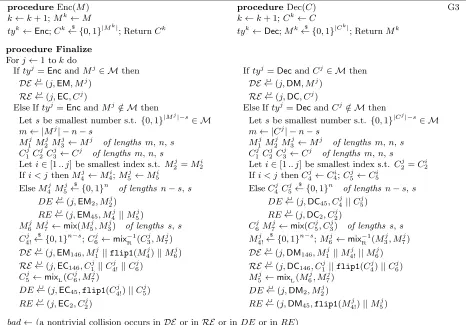
(Game G2; Fig. 4)We modify game G1 in several ways to create game G2. We dispense with the
Choose procedures. Instead, we directly sample uniformly where appropriate, and we add to the sets DE,RE, DE, RE tuples that record information about the bit strings that would have been added to the domain and range ofEandEin game G1. Each tuple added to these sets is of the form (j, L, S) wherej∈[1.. q] is the query responsible for adding the tuple;L∈ {EM2,DM2,EC45,DC45} (for tuples in DE),L∈ {EC2,DC45,EM45,DM2}(for tuples in RE),L∈ {EM,DM,EM146,DM146} (for tuples in DE), or L∈ {EC,DC,EC146,DC146} (for tuples in RE) is a label representing where in the game the tuple was added — we distinguish between enciphering and deciphering queries by the ‘E’ and ‘D’; and finally S is the bit string actually being added to the domain or range of E or E. Note that all tuples in each of the sets are distinct. Finally, we defer the setting of the flag bad until after all the queries have been handled.
We define a collision to be any pair of tuples (i, L, S) and (j, L0, S0) for whichS =S0 and both tuples are in one ofDE,RE,DE, orRE. Anytime badwould have been set in G1 we have that a tuple is added to one of the sets that collides with a tuple already in the set. Additionally, every query still returns a sequence of random bits. Therefore
Pr
AG1 setsbad
= Pr
AG2 setsbad
(3) The rest of the proof is dedicated to showing that collisions in these sets can only occur with low probability regardless of the adversary’s choices.
trivial collision is a pair of tuples
(1) (i, L, S),(j, L0, S0)∈DE forL0 ∈ {DM2,DC45}, (2) (i, L, S),(j, L0, S0)∈RE forL0 ∈ {EC2,EM45}, (3) (i, L, S),(j,EC45, S0)∈DE,
(4) (i, L, S),(j,DM45, S0)∈RE,
(5) (i, L, S),(j, L0, S0)∈ DE forL0 ∈ {DM,DM146}, or (6) (i, L, S),(j, L0, S0) in RE forL0 ∈ {EC,EC146}
wherei < j andS =S0. Trivial collisions correspond to a collision between a previously added bit string and a fresh, uniformly chosen bit string By fresh we mean that the adversary has received no information about the random choice (which is clear in these cases since the random choice occurs in the later of the two queries).
The following claim bounds the probability that A causes a trivial collision.
Claim 4 Pr
AG2 causes trivial collision
≤(4q2(s)/2n−s) +q2/2n.
Proof: We first show that the probability of any category of trivial collision is low, and then count the total number of potential trivial collisions in each set to prove the claim. For categories (1), (2), (5), and (6) the probability of a collision is clearly at most 2−n because S0 is always freshly chosen at random and |S0| ≥ n. For category (3) we have that S0 = flip1(C4!j)||C5j. Here C4!j is a uniform string of n−s bits and C5j =mixL(C6j, M7j) where C6j is a uniform s-bit string. We apply the definition of a good mixing permutation to get that the probability of C5j equaling the corresponding portion of S is at most (s). Thus the probability of S0 equaling S is at most (s)/2n−s. For category (4) a symmetric argument gives us the same bound.
Since |DE| ≤2q |RE| ≤2q, and |DE| ≤q and |RE| ≤q and using the union bound we have Pr
AG2 causes trivial collision ≤
2q 2
(s) 2n−s +
2q 2
(s) 2n−s +
q 2
1 2n +
q 2
1 2n ≤
4q2(s) 2n−s +
q2 2n.
Now we define non-trivial collisions, which encompass all other possible collisions in the game. Formally, a non-trivial collision is between a pair of tuples
(1) (i, L, S),(j,EM2, S0)∈DE, (2) (i, L, S),(j,DC2, S0)∈RE,
(3) (i, L, S),(j, L0, S0)∈ DE forL0 ∈ {EM,EM146}, or (4) (i, L, S),(j, L0, S0)∈ RE forL0 ∈ {DC,DC146}
wherei < j andS =S0. Since trivial and non-trivial collisions represent all the ways in which bad can be set we have that
PrAG2 setsbad ≤ PrAG2 causes trivial collision+ PrAG2 causes non-trivial collision
≤ 4q
2(s)
2n−s +
q2 2n + Pr
AG2 causes non-trivial collision. (4)
procedureEnc(M) k←k+ 1;Mk←M tyk←Enc;Ck← {$ 0,1}|Mk|
; ReturnCk
procedureDec(C) G3
k←k+ 1;Ck←C tyk←Dec;Mk← {$ 0,1}|Ck|
; ReturnMk
procedure Finalize
Forj←1 tokdo
If tyj=EncandMj∈ Mthen
DE ∪
←(j,EM, Mj)
RE ∪
←(j,EC, Cj)
Else Iftyj=EncandMj∈ M/ then
Letsbe smallest number s.t. {0,1}|Mj|−s∈ M
m← |Mj| −n−s
M1jM
j
2 M
j
3 ←M
j
of lengthsm, n, s C1jC2jC3j←Cj of lengthsm, n, s
Leti∈[1.. j] be smallest index s.t. M2j=M
i
2 Ifi < jthenM4j←Mi
4;M
j
5 ←M
i
5 ElseM4jM
j
5
$ ← {0,1}n
of lengths n−s, s DE←∪(j,EM2, M2j)
RE ∪
←(j,EM45, M4j||M
j
5) M6jM
j
7 ←mix(M
j
5, M
j
3) of lengths s, s C4!j ← {$ 0,1}n−s;C6j←mix
−1
R (C
j
3, M
j
7)
DE ∪
←(j,EM146, M1j||flip1(M
j
4)||M
j
6)
RE ∪
←(j,EC146, C1j||C
j
4!||C
j
6) C5j←mixL(C
j
6, M
j
7)
DE←∪ (j,EC45,flip1(C4!j)||C5j) RE←∪(j,EC2, C2j)
Iftyj=DecandCj∈ Mthen
DE ∪
←(j,DM, Mj)
RE ∪
←(j,DC, Cj)
Else Iftyj=DecandCj∈ M/ then
Letsbe smallest number s.t. {0,1}|Cj|−s∈ M
m← |Cj| −n−s
M1jM
j
2 M
j
3 ←M
j
of lengths m, n, s C1jC2jC3j←Cj of lengths m, n, s
Leti∈[1.. j] be smallest index s.t. Cj2=C
i
2 If i < jthenC4j←Ci
4;C
j
5 ←C
i
5 ElseC4jC
j
5
$ ← {0,1}n
of lengthsn−s, s DE←∪ (j,DC45, C4j||C
j
5) RE ∪
←(j,DC2, C2j) C6jM
j
7 ←mix(C
j
5, C
j
3) of lengths s, s M4!j ← {$ 0,1}n−s;M6j←mix
−1
R (M
j
3, M
j
7)
DE ∪
←(j,DM146, M1j||M
j
4!||M
j
6)
RE ∪
←(j,DC146, C1j||flip1(C
j
4)||C
j
6) M5j←mixL(M6j, M7j)
DE←∪(j,DM2, M2j)
RE←∪(j,DM45,flip1(M4!j)||M5j) bad←(a nontrivial collision occurs inDE or inRE or inDEor inRE)
Figure 5: Game G3. Lemma 2. Initially, DE,RE, DE, RE are empty and k = 0. Enciphering and deciphering queries are answered by random bits. After all queries have been asked the internal variables are determined for each query and the flagbadis set if any of DE,RE, DE, RE contains a nontrivial collision.
mixing permutation, in particular becausemixR(·, B) is a permutation for any appropriate valueB. We use the inverse ofmixR(·, B), which we write as mix
−1
R (·, B), to calculate the values as needed. (For example, we have thatmix2−R1(A, B) =B⊕ror(B⊕A) whereroris right circular rotation by one bit.) The valuesC6j andM6j therefore also inherit the distributions ofC3j andM3j, respectively. All the variables in G3 are distributed just like they were in G2, justifying that
PrAG2 causes non-trivial collision= PrAG3 setsbad. (5)
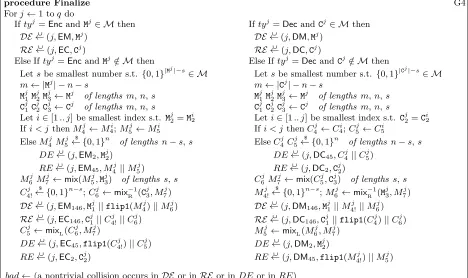
(Game G4; Fig. 6) In the last game, G4, we move to a non-interactive setting in which the adversary specifies a transcript τ = (M,C,ty) where M ={M1,M2, . . . ,Mq}, C= {C1,C2, . . . ,Cq}, andty={ty1,ty2, . . . ,tyq}. (Recall thatAis not allowed to specify pointless queries.) Otherwise, the game G4 is identical to the finalization portion of game G3. From now on we assume that A
utilizes a fixed transcriptτ that maximizes the probability of the flag badbeing set. Thus
PrAG3 setsbad≤PrAG4 setsbad. (6) Now we bound the probability of bad being set in G4 using a union bound and bounds on the probability of nontrivial collisions occurring in each of the setsDE, RE,DE,RE:
Pr
AG4 sets flag bad
procedure Finalize G4 Forj←1 toq do
If tyj=EncandMj∈ Mthen
DE ∪
←(j,EM,Mj)
RE ∪
←(j,EC,Cj)
Else Iftyj=EncandMj∈ M/ then
Letsbe smallest number s.t. {0,1}|Mj|−s∈ M
m← |Mj| −n−s
Mj1M
j
2M
j
3←M
j
of lengthsm, n, s
Cj1Cj2Cj3←Cj of lengthsm, n, s
Leti∈[1.. j] be smallest index s.t. Mj2=M
i
2 Ifi < jthenM4j←Mi
4;M
j
5 ←M
i
5 ElseM4jM
j
5
$ ← {0,1}n
of lengths n−s, s DE←∪(j,EM2,Mj2)
RE←∪(j,EM45, M4j||M
j
5) M6jM7j←mix(M5j,Mj3) of lengths s, s C4!j ← {$ 0,1}n−s;C6j←mix
−1
R (C
j
3, M
j
7)
DE ∪
←(j,EM146,Mj1||flip1(M
j
4)||M
j
6)
RE ∪
←(j,EC146,Cj1||C
j
4!||C
j
6) C5j←mixL(C
j
6, M
j
7)
DE←∪ (j,EC45,flip1(C4!j)||C5j) RE←∪(j,EC2,Cj2)
Iftyj=DecandCj∈ Mthen
DE ∪
←(j,DM,Mj)
RE ∪
←(j,DC,Cj)
Else Iftyj=DecandCj∈ M/ then
Letsbe smallest number s.t. {0,1}|Cj|−s∈ M
m← |Cj| −n−s
Mj1 M
j
2M
j
3←M
j
of lengths m, n, s
Cj1 Cj2Cj3←Cj of lengths m, n, s
Leti∈[1.. j] be smallest index s.t. Cj2=C
i
2 If i < jthenC4j←Ci
4;C
j
5 ←C
i
5 ElseC4jC
j
5
$ ← {0,1}n
of lengthsn−s, s DE←∪(j,DC45, C4j||C
j
5) RE←∪(j,DC2,Cj2)
C6jM7j←mix(C5j,Cj3) of lengths s, s M4!j ← {$ 0,1}n−s;M6j←mix
−1
R (M
j
3, M
j
7)
DE ∪
←(j,DM146,Mj1||M
j
4!||M
j
6)
RE ∪
←(j,DC146,Cj1||flip1(C
j
4)||C
j
6) M5j←mixL(M6j, M7j)
DE←∪(j,DM2,Mj2)
RE←∪(j,DM45,flip1(M4!j)||M
j
5) bad←(a nontrivial collision occurs inDE or inRE or inDEor inRE)
Figure 6: Game G4 used in the proof of Lemma 2. Initially the sets DE,RE, DE, RE are empty. This game is non-interactive: the adversary specifies a fixed transcript τ= (M,C,ty) and the game determines whether the flagbadshould be set for the transcript.
We handle each term by a separate claim. In proving the following claims we use the fact that the adversaryA has no knowledge of the random choices made in game G4 — they are all made after the transcript has been specified.
Claim 5 Pr[nontrivial collision in DE]≤q2/2n.
Proof: Nontrivial collisions within DE are pairs of tuples (i, L, S),(j,EM2,Mj2) where L is neces-sarily eitherEC45orDC45 (Lcan not beEM2 orDM2 because the structure of the game would not allow the second tuple to then be added.) We handle each case in turn, marking the arguments for each with a triangle.
BLet (i,EC45, S) and (j,EM2,Mj2) be tuples inDEand lets=|Mi3|. ThenS=flip1(C4!i)||C5i. HereC4!i is uniformly selected from{0,1}n−sand (as we show in a moment)C5i is uniformly selected from {0,1}s. Thus, the probability that S =Mj2 is at most 1/2n. Now to show that C5i is uniform. We have that
C5i =mixL(C6i, M7i) =mixL(C6i,mixR(M5i,Mi3))
In the right hand side of these equivalences, we have that M5i is uniformly chosen, and thus by Definition 1 part 2 (mixR(·, B) is a permutation) the output of mixR(M5i,Mi3) is uniform. In turn,
mixL(Ci
6,mixR(M i
5,Mi3)) =C5i is uniform, by Definition 1 part 1 (mixL(A,·) is a permutation).
B Let (i,DC45, S) and (j,EM2,Mj2) be tuples in DE. Then S =C4i ||C5i which is a string of n random bits. The probability thatS =Mj2 is therefore 1/2n.
Claim 6 Pr[nontrivial collision in RE]≤q2/2n.
Proof: Let (i, L, S),(j,DC2,Cj2) ∈ RE where necessarily L ∈ {EM45,DM45} (as in the previous claim, the game would not allow the tuples to both be added to RE ifL={EC2,DC2}).
B Let (i,EM45, S) and (j,DC2,Cj2) be tuples inRE. Then S =M4i ||M5i which is a string ofn random bits and equalsCj2 with probability at most 1/2n.
BLet (i,DM45, S) and (j,DC2,Cj2) be tuples inREand lets=|Mi3|. ThenS =flip1(M4!i)||M5i. Here M4!i is uniformly selected from {0,1}n−s and (as we justify in a moment) M5i is uniformly selected from {0,1}s. The probability that S =Cj2 is therefore at most 1/2n. Now to show that M5i is uniform. We have that
M5i=mixL(M i
6,mixR(C i
5,Ci3)).
In the right hand side of these equivalences, we have that C5i is uniformly chosen, and thus by Definition 1 part 2 (mixR(·, B) is a permutation) the output of mixR(C5i,Ci3) is uniform. In turn,
mixL(M6i,mixR(C5i,Ci3)) =C5i is uniform, by Definition 1 part 1 (mixL(A,·) is a permutation). Since there are at most q tuples (i, L, S) with L ∈ {EM45,DM45} and at most q tuples of the form (j,DC2,Cj2), the total probability of a nontrivial collision in RE is at mostq2/2n.
Claim 7 Pr[nontrivial collision in DE]≤q2(s)/2n−s+1 for any s∈[1.. n−1].
Proof: A nontrivial collision in DE can occur between two tuples (i, L, S) and (j, L0, S0) where L∈ {EM,DM,EM146,DM146}and L0∈ {EM,EM146}. There are actually only six cases to consider, since if L0 =EM, a collision with L∈ {EM,DM} would actually imply a pointless query. We now look at the six cases in turn.
BLet (i,EM,Mi) and (j,EM146, S0) be inDE and lets=|Mj3|and for ease of exposition letMi= M1||M2 ||Cwhere|M1|=|Mi|−n,|M2|=n−s, and|C|=s. We have thatS0=M1j ||flip1(M4j)||M6j. Here M4j is uniformly selected from {0,1}n−s and thus the probability that flip1(M4j) = M2 is at most 1/2n−s. We also have that M6j = mixL(M5j, M7j) where M5j is selected uniformly. By Definition 1 part 3, we have that the probability ofC=mixL(M5j, M7j) =M6j is at most(s), where s=|M6j|. Since M4j and M5j are independently chosen, we have that the probability that S0 =Mi is at most (s)/2n−s.
B Let (i,DM,Mi) and (j,EM146, S0) be in DE. This case is the same as the previous case, and so bound by(s)/2n−s.
B Let (i,EM146, S) and (j,EM146, S0) be in DE. and let si = |Mi3| and let sj = |M
j
3|. For a collision to occur we clearly must have |Mi| −si =|Mj| −sj and so we assume this to be the case. We break down the argument down further:
• First consider whenM2i 6=M2j. Then we note thatM4i,M5i,M4j, andM5j are all independently and uniformly chosen at random. LetS0 =Mj1 ||flip1(M4j)||M6j. LetS=Mi1 ||M2 ||Cwhere
|Mi1|=|Mi|−n,|M2|=n−sj, and|C|=sj (that is, we parse the lastnbits ofS according to the way it will line up against flip1(M4j) and M6j). Now the probability that M2 =flip1(M4j) is 1/2n−sj and the probability that C = M6j = mixL(M
j
5,M
j
3) is at most (sj) as given by Definition 1 part 3. The probabilities are independent and so a collision in this situation happens with probability no greater than(sj)/2n−sj
.
thatMi =Mj, which would make query j pointless and therefore we have a contradiction and this can not occur. Second, without loss of generality, assumesi < sj. Then we note that S can not equalS0 becauseflip1 ensures that S|Mi| −si−sj −16=S0|Mj| −2sj−1. So the probability of a collision between these types of tuples is at most (sj)/2n−sj.
BLet (i,DM146, S) and (j,EM146, S0) be inDE. Letsj =|Mj3|. ThenS0 =M
j
1||flip1(M
j
4)||M
j
6. where M6j =mixL(M5j,Mj3). Both M4j and M5j are uniformly selected from {0,1}n−sj and {0,1}sj, respectively. Thus the probability thatS =S0 is at most(sj)/2n−sj, where we apply Definition 1 part 3 in the usual way.
BLet (i,EM146, S) and (j,EM,Mj) be inDE. The probability thatS=Mj is at most(s)/2n−s fors=|Mj|. the usual application of Definition 1 part 3.
B Let (i,DM146, S) and (j,EM,Mj) be in DE. Let s=|Mi3|. We have that S =Mi1 ||M4!i ||M6i whereM4!i is uniformly selected from {0,1}n−s and M6i =mix−R1(M7i,Mi3) =mix−R1(mixL(C5i,Ci3),Mi3) whereC5i is uniformly selected from{0,1}s. By Definition 1 parts 1 and 2, we have thatM6i is also distributed uniformly over{0,1}s. Thus the probability of S=S0 is at most 1/2n.
In all cases the probability of a collision is at most (s)/2n−s where s∈[1.. n−1] (necessarily (s)/2n−s≥1/2n, for anys). As|DE|=q the probability of a collision inDE is at most
q 2
(s) 2n−s ≤
q2(s) 2n−s+1.
Claim 8 Pr[nontrivial collision in RE]≤q2(s)/2n−s+1 for any s∈[1.. n−1].
Proof: The proof is symmetric to the proof of Lemma 7. Combining Claims 5, 6, 7, and 8 with Equation 7 yields that
PrAG4 setsbad≤ q
2(s)
2n−s +
2q2 2n
and combining this with Equations 3, 4, 5 and 6 we get that Pr
AG1 setsbad
= Pr
AG2 setsbad
≤ Pr
AG2 causes trivial collision
+ PrAG2 causes nontrivial collision
≤ 4q
2(s)
2n−s +q
22−n+ Pr
AG3 setsbad
= 4q 2(s)
2n−s +q
22−n+ Pr
AG4 setsbad ≤ 5q
2(s)
2n−s + 3q
22−n
which completes our proof of Lemma 2.
8
Supporting Tweaks
A tweakable cipher [15, 16] is a function Ee: KE × T × M → M where KE 6= ∅ is the key space, T 6=∅is the tweak space, andMis the message space. We require thatEeKT(·) is a length-preserving
permutation for all K ∈ KE and T ∈ T. We write the inverse ofEeasDe. A tweakable blockcipher
The security of a tweakable cipher is based on indistinguishability of the scheme and a tweakable random permutation. More formally, we define the following advantages
Adv±gprp e
E (A) = Pr
h
K← K$ E :AEeK,DeK ⇒1 i
−Prheπ←$ PermT(M) :Aπ,eeπ
−1
⇒1i
Adv±prff e
E (A) = Pr h
K← K$ E :AEeK,DeK ⇒1 i
−Pr
h
ρ, σ←$ FuncT(M) :Aρ,σ ⇒1
i
where the probabilities are over the choice of K or eπ (resp. ρ, σ) and the coins used by A. Here PermT(M) is the set of all functionseπ: T × M → Mwhereπ(T,e ·) is a length-preserving permu-tation and FuncT(M) is the set of all functionsρ: T × M → Mwhereρ(T,·) is length-preserving. XLS and tweaks. The XLS construction works for tweaks. By this we mean that if the cipherE
utilized in XLS is tweakable, then the resulting cipher with the enlarged message space is also tweakable. More specifically, fix an(s)-good mixing function. If we constructEe∗ = XLS[mix,Ee, E]
whereEe: KE× T × M → Mis a tweakable cipher andE: KE× {0,1}n→ {0,1}nis a conventional
blockcipher then the resulting scheme Ee∗ is tweakable with tweak space T and enlarged message
spaceM∗=M || {0,1}<n. Here XLS is implicitly changed by adding the tweakT as a superscript to E on lines 00 and 06 of Figure 1. The following theorem statements, which are analogous to Theorem 2 and Theorem 3, establish the security of XLS with tweaks.
Theorem 9 Fixnand an(s)-good mixing functionmix. LetM ⊂ {0,1}≥n, letT be a nonempty set, and let Ee∗ = XLS[mix,PermT(M),Perm(n)]. Then for any adversary A that asks at most q queries we have that Adv±prff
e
E∗ (A) ≤ 5q
2(s)/2n−s+ 3q2/2n for any s ∈ [1.. n−1], and so, by Lemma 1
Adv±E∗prf(A)≤
8q2
2n and Adv ±prf
E∗ (A)≤
13q2 2n formix=mix1and mix=mix2, respectively.
To prove the theorem, we can modify the proofs of Theorem 2 and Lemma 2 as follows. ReplaceE
withEethroughout. Modify all the games in both proofs so that enciphering and deciphering queries
take a tweak. In games G0 and G1 lazily build separate random length-preserving functions Eefor
each tweak queried (in G0 they are permutations while in G1 they are just functions). In games G2, G3, and G4, use distinct setsDE andRE for each tweak; collisions can then only occur within a set (i.e., for the same tweak). The rest of the proof proceeds in the natural way. The case analysis bounds the probability of collisions in any of the specified sets, and the size of the setsDE andRE
will be maximized if all queries utilize the same tweak. Combining Theorem 2 with a standard hybrid argument proves the next theorem.
Theorem 10 Fixnand an(s)-good mixing functionmix. LetEe: KE×T ×M → Mbe a tweakable cipher and E: KE× {0,1}n→ {0,1}n be a blockcipher. Let E∗ = XLS[mix,Ee, E]and let A be an adversary that runs in time t and asks at most q queries, with maximal query length being µ
bits Then there exists adversaries B and C and an absolute constant c such that Adv±gprp e
E∗ (A) ≤ Adv±gprp
e
E (B) +Adv ±prp
E (C) + 5q
2(s)/2n−s+ 4q2/2n where s∈[0.. n−1], and so, by Lemma 1
Adv±prpg
E∗ (A) ≤ Adv ±prpg
e
E (B) +Adv ±prp
E (C) +
9q2 2n
when mix = mix1, and the same expression, but with the 9 replaced by 14, when mix = mix2. Here B runs in time tB =t+cµqlogq and asksqB =q queries, none longer than µ, and whereC runs in timetC ≤t+ (q+ 1)·TimeEe(µ) +cµq and asks qC ≤2q queries, each of length at most n.
The proof is a straightforward modification of the proof of Theorem 3. ReplaceE with a tweakable enciphering schemeEethroughout the proof. Replace the intermediate values of the hybrid argument
with: (1)F = XLS[mix,Ee, E] and G=F−1; (2)F = XLS[mix,Ee,Perm(n)] andG=F−1; (3) F =
XLS[mix,PermT(M),Perm(n)] and G = F−1; (4) F = FuncT(M∗) and G = FuncT(M∗); and
(5) F = PermT(M∗) and G= F−1 The bound of p23 is changed to Adv±gprp e
E (B) and justified in
the straightforward way, while the bound of p34 is given by Theorem 9.
Note that the concrete security bounds are the same in both the tweaked and untweaked settings. Intuitively this is because having a tweakable family of permutations is a stronger primitive than a normal family of permutations, and the adversary might as well just focus its attack on a single tweak.
9
XLS with Ordinary PRPs
If we apply the XLS construction to cipherEeand blockcipherE that are both secure as (ordinary)
pseudorandom permutations (i.e., adversaries are restricted to chosen-plaintext attacks), then the resulting cipher with expanded message space is also secure as a PRP. More formally, we define the following advantage
Advprpg e
E (A) = Pr h
K← K$ E :AEeK ⇒1 i
−Prheπ←$ PermT(M) :Aeπ⇒1 i
where the probability is over the random choice ofK orπ and the random coins used byA. While the theorems from Section 8 do not imply the security of XLS using ordinary (tweaked) PRPs, their proofs can be (simplified) in a straightforward manner to derive the PRP security of XLS as captured by the next theorem statement. We omit the details.
Theorem 11 Fixnand an(s)-good mixing functionmix. LetEe: KE×T ×M → Mbe a tweakable cipher and E: KE× {0,1}n→ {0,1}n be a blockcipher. Let E∗ = XLS[mix,E, E]and let A be an adversary that runs in time t and asks at most q queries, with maximal query length being µ
bits Then there exists adversaries B and C and an absolute constant c such that Advgprp e
E∗ (A) ≤ Advgprp
e
E (B) +Adv
prp
E (C) + 5q2(s)/2
n−s+ 4q2/2n wheres∈[0.. n−1], and so, by Lemma 1
Advgprp
E∗ (A) ≤ AdvEprpg(B) +AdvprpE (C) +
9q2 2n
when mix = mix1, and the same expression, but with the 9 replaced by 14, when mix = mix2. Here B runs in time tB =t+cµqlogq and asksqB =q queries, none longer than µ, and whereC runs in timetC ≤t+ (q+ 1)·TimeEe(µ) +cµq and asks qC ≤2q queries, each of length at most n.
An immediate corollary of the theorem is security of XLS for ordinary, untweaked PRPs (just set the tweak space T to a single value).
Acknowledgments
References
[1] J. An and M. Bellare. Constructing VIL-MACs from FIL-MACs: Message authentication under weakened assumptions. Advances in Cryptology – CRYPTO 1999, LNCS vol. 1666, Springer, pp. 252–269, 1999.
[2] R. Anderson and E. Biham. Two practical and provably secure block ciphers: BEAR and LION. Fast Software Encryption 1996, LNCS vol. 1039, Springer, pp. 113–120, 1996.
[3] M. Bellare, and P. Rogaway. On the construction of variable-input-length ciphers. Fast Soft-ware Encryption 1999, LNCS vol. 1636, Springer, pp. 231–244, 1999.
[4] M. Bellare and P. Rogaway. Encode-then-encipher encryption: How to exploit nonces or redundancy in plaintexts for efficient cryptography. Advances in Cryptology – ASIACRYPT 2000, LNCS vol. 1976, Springer, pp. 317–330, 2000.
[5] M. Bellare, and P. Rogaway. The security of triple encryption and a framework for code-based game-playing proofs. Advances in Cryptology – EUROCRYPT 2006, LNCS vol. 4004, Springer, pp. 409–426, 2006.
[6] J. Black and P. Rogaway. Ciphers with arbitrary finite domains. Topics in Cryptology – CT-RSA 2002, LNCS vol. 2271, Springer, pp. 114–130, 2002.
[7] A. Cayley. On Latin squares. Oxford Cambridge Dublin Messenger Math., vol. 19, pp. 135–137, 1890.
[8] D. Chakraborty and P. Sarkar. A new mode of encryption providing a strong tweakable pseudo-random permutation.Fast Software Encryption – FSE 2006, LNCS vol. 4047, Springer, pp. 293–309, 2006.
[9] D. Chakraborty and P. Sarkar. HCH: A new tweakable enciphering scheme using the Hash-Encrypt-Hash approach. Advances in Cryptology – INDOCRYPT 2006, LNCS vol. 4329, Springer, pp. 287–302, 2006.
[10] D. Cook, M. Yung, and A. Keromytis. Elastic AES. Cryptology ePrint archive, report 2004/141, 2004.
[11] D. Cook, M. Yung, and A. Keromytis. Elastic block ciphers. Cryptology ePrint archive, report 2004/128, 2004.
[12] S. Halevi. EME∗: Extending EME to handle arbitrary-length messages with associated data.
Advances in Cryptology – INDOCRYPT 2004, LNCS vol. 3348, Springer, pp. 315–327, 2004. [13] S. Halevi. TET: A wide-block tweakable mode based on Naor-Reingold. Cryptology ePrint
archive, report 20007/14, 2007.
[14] S. Halevi and P. Rogaway. A parallelizable enciphering mode. Topics in Cryptology – CT-RSA 2004, LNCS vol. 2964, Springer, pp. 292–304, 2004.
[15] S. Halevi and P. Rogaway. A tweakable enciphering mode.Advances in Cryptology – CRYPTO 2003, LNCS vol. 2729, Springer, pp. 482–499, 2003.
[16] M. Liskov, R. Rivest, and D. Wagner. Tweakable block ciphers. Advances in Cryptology – CRYPTO 2002, LNCS vol. 2442, Springer, pp. 31–46, 2002.
[17] M. Luby and C. Rackoff. How to construct pseudorandom permutations from pseudorandom functions. SIAM Journal of Computing, vol. 17, no. 2, pp. 373–386, 1988.
[18] S. Lucks. BEAST: A fast block cipher for arbitrary blocksizes.Communications and Multime-dia Security, IFIP vol. 70, Chapman & Hill, pp. 144–153, 1996.
[19] S. Lucks. Faster Luby-Rackoff ciphers. Fast Software Encryption 1996, LNCS vol. 1039, Springer, pp. 189–203, 1996.
[20] D. McGrew and S. Fluhrer. The extended codebook (XCB) mode of operation. Cryptology ePrint archive, report 2004/278, 2004.
Sons, New York, 1982.
[22] M. Naor and O. Reingold. On the construction of pseudorandom permutations: Luby-Rackoff revisited. Journal of Cryptology, vol. 12, no. 1, pp. 29–66, 1999.
[23] J. Patarin. How to construct pseudorandom and super pseudorandom permutations from one single pseudorandom function. Advances in Cryptology – EUROCRYPT 1992, LNCS vol. 658, pp. 256–266, 1992.
[24] S. Patel, Z. Ramzan, and G. Sundaram. Efficient constructions of variable-input-length block ciphers. Selected Areas in Cryptography 2004, LNCS vol. 3357, pp. 326–340, 2004.
[25] B. Schneier and J. Kelsey. Unbalanced Feistel networks and block cipher design. Fast Software Encryption 1996, LNCS vol. 1039, Springer, pp. 121–144, 1996.
[26] C. Schnorr and S. Vaudenay. Black box cryptanalysis of hash networks based on multipermu-tations.Advances in Cryptology – EUROCRYPT 1994, LNCS vol. 950, Springer, pp. 47–57, 1995.
[27] R. Schroeppel. Hasty pudding cipher specification. First AES Candidate Workshop, 1998. [28] S. Vaudenay. On the need for multipermutations: cryptanalysis of MD4 and SAFER. Fast
Software Encryption 1994, LNCS vol. 1008, Springer, pp. 286–297, 1995.
[29] P. Wang, D. Feng, and W. Wu. HCTR: a variable-input-length enciphering mode.Information Security and Cryptography, CISC 2005, LNCS vol. 3822, Springer, pp. 175–188, 2005.
![Figure 1: Top: Enciphering algorithm E∗ = XLS[mix, E, E]. Bottom: Enciphering M = M1 || M2 || M3under E∗ where M is not in M; l < |M| is the largest value such that {0, 1}l ⊆ M; s = |M|−l; M1 ∈ {0, 1}l−n;M2 ∈ {0, 1}n; and M3 ∈ {0, 1}s.](https://thumb-us.123doks.com/thumbv2/123dok_us/1857301.1241200/8.612.111.498.83.492/figure-enciphering-algorithm-xls-enciphering-under-largest-value.webp)