Research and development of an advice support system for
optimizing the back-end processes of semiconductor assembly for
Fico Trim & Form Integration Systems B.V.
A
A
D
D
V
V
I
I
C
C
E
E
S
S
U
U
P
P
P
P
O
O
R
R
T
T
S
S
Y
Y
S
S
T
T
E
E
M
M
A
A
D
D
V
V
I
I
C
C
E
E
S
S
U
U
P
P
P
P
O
O
R
R
T
T
S
S
Y
Y
S
S
T
T
E
E
M
M
Research and development of an advice support system for
optimizing the back-end processes of semiconductor assembly
for
Fico Trim & Form Integration Systems B.V.
Universiteit Twente Postbus 217
7500 AE Enschede
The Netherlands
Fico Trim & Form Integration Systems B.V. Ratio 6
6921 RW Duiven The Netherlands
Semiconductor industries
This research is initiated by:
Fico Trim & Form Integration systems B.V.
and performed by:
B.A. Mentink, Haaksbergen, 2006
Besi
- I -
MANAGEMENT ABSTRACT
The presented report describes the research that has been done to design a tool that can be used to support sales person during the advice generating process, by providing recorded knowledge outer his/her expertise. It describes why this tool is required, its required function, the expected performance, the design of the different components, maintenance issues and preconditions that need to be met with to guarantee the maintainability of the tool.
The goal of this research was to develop a concept for an “advice support system” that supports sales agents of the different divisions, with information, necessary to generate an advice about optimizing the back end assembly process of a semiconductor product, while taking the customer’s situation and preferences into account.
The initiator of this research, Fico Trim and Form, is a division of Besi Semiconductor Industries, which is a leading manufacturer of high-performance equipment and integrated systems for the semiconductor industry’s assembly process operations.
Value of the advice support system
Using an advice support system has only sense, when it is able to add a certain value, by supporting Besi in pursuing its mission, in its current organizational structure and in its current environment. The ability to pursue its mission is influenced by a company’s environment and its organizational structure. Therefore, to find out what gave rise to the development of an advice support system, research have been done into characteristic properties of Besi’s current organizational structure and the suitability of this organizational structure in relation to its mission, and environment. From this, the following can be concluded:
Because of the ongoing trend of increasing complexity and decreasing product size, a simple change of one process step in the overall assembly process could affect all the following assembly process steps. Therefore it is crucial to have insight into the “overall” assembly process when generating advice towards customers about arranging or optimizing a combination of sub processes.
The following restrictions of Besi’s current organizational structure and environment, regarding the advice generating process have being revealed:
• Some process-function groups are accommodated in more than one division of Besi, both offering alternatives, resulting in non-objective comparison between optional alternatives.
• A risk of having a divisional structure is that sales agents from one division are unaware of developments in other divisions
• Because of the wide range of different process techniques available to use in the back end industry, it is impossible for the sales departments of the various divisions, to have thoroughgoing knowledge of processes outer their specialization, and of the interrelation between these processes. This lack of knowledge-exchange and cooperation between divisions while finding an optimal solution for customers can lead to incomplete or contradictory advices
The following opportunities of Besi’s current organizational structure and environment, regarding the advice generating process have being revealed:
• A divisional structure is suitable for fast change in an unstable environment
• Normally, each product group should be accommodated in a separate division, so customers are able to directly contact the correct division, and achieve satisfaction by getting detailed advice directly form specialist of the concerning group.
- II -
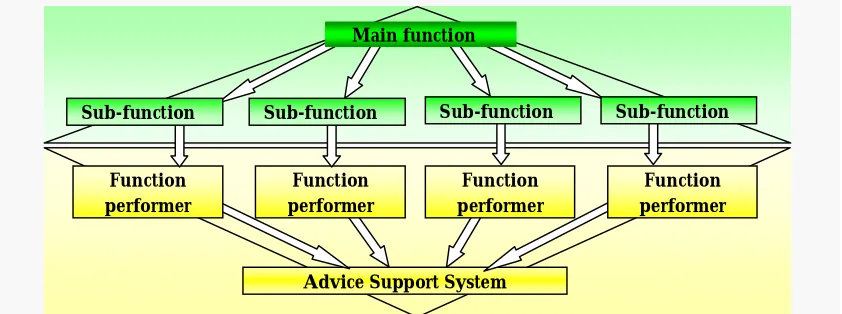
From the second and third restriction mentioned above, it can be concluded that the advice support system will be valuable when it is able to perform the following main functions:• Collecting and sharing information across the divisions.
• provides sales agents with detailed information about aspects that need to be taken into account when combining their processes with other processes outer their discipline.
• Providing insight in which product specifications indicate the necessity for certain process steps Since Besi highly values the “understanding of customer’s requirements and desires”. This requires structural analysis of the customer’s problem before generating advice. The value of the advice support system increases when it is able to perform the following functions.:
• Providing a list of questions that should be asked, to determine the customer’s current situation, his preferences and his requirements.
• Providing insight in process information about the suitability of processes in relation with customers situation and preferences.
Design of advice support system
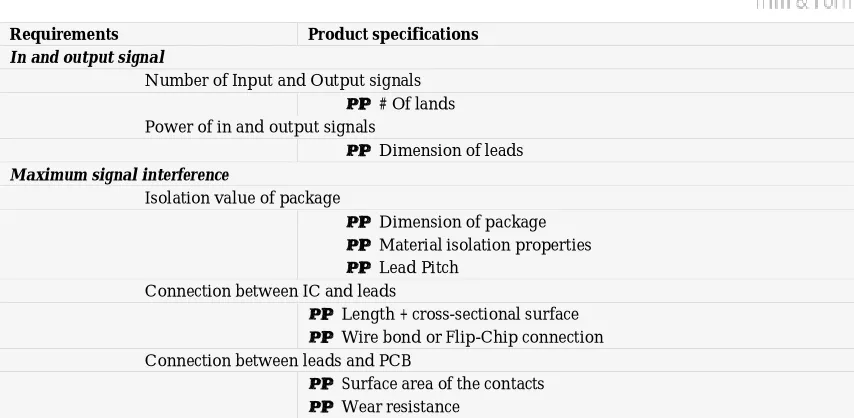
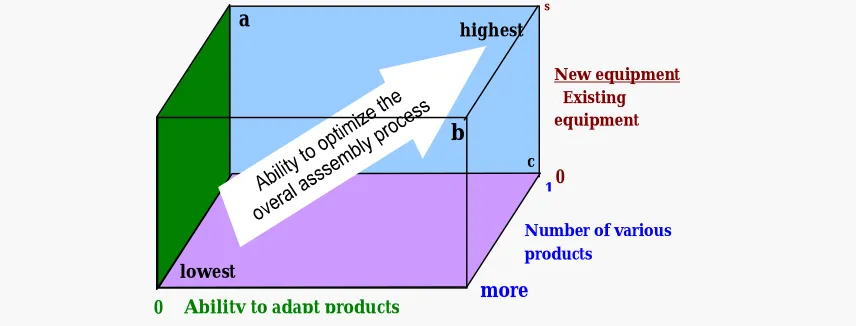
Research has been done in revealing which information is need to be provided by the advice support system. From this research it appeared that there are multiple restrictions that need to be dealt with, when generating advice about arranging and optimizing an overall assembly process of a specific semiconductor product. It has been investigated, which restrictions need to be taken into account when generating the advice. It appeared that the extent to which the overall assembly process can be optimized, is mainly limited by restrictions deriving from the following factors:
• Semiconductor product requirements
• Preconditions and characteristics of Processes and techniques • Customers situation and preferences
To find out when, which information is required when, research has been done into the current advice generating process. The advice generating process can be split up into following eight different stages which are subsequently settled:
1) Determining product group 2) Inventory of product specifications
3) Inventory of customer’s situation and preferences
4) Inventory of the process functions which are subject of the advice. 5) Determination of optional techniques for the process functions 6) Determination of optional process combinations*
7) Judging the suitability of process combinations when taking the customers’ situation and preferences into account
8*) When no optional or suitable process combination is found: Adapt the product-design, or specifications, in order to find a suitable process combination.
Databases
At each stage, the sales agent can be supported by providing him/her the for this stage required information. By studying the characteristics of the required information, six different subjects can be distinguished, namely:
• Product - related information • Customer - related information
• Product in relation with process-functions - related information • Product in relation with process - related information
• Process combination - related information
• Process in relation with customer – related information
- III -
sections in which a defined sort of data need to be stored in a consistent way. It is very important that the information, presented by the databases, is easy to read and clarifying. To secure intelligibility of databases, templates are provided for each database, showing which data, should be recorded in which format, in each field of the database.Because the users of the advice support system are operative all over the world, and the main communication language of the users is English, all information should be recorded in English.
Before the advice support system can be used for generating advice, it should be taken care of that each databases is filled with all available knowledge. All knowledge about existing processes and techniques that could lead to a more complete advice towards the customer should in some way be transferred from the heads of the experts into the databases.
Knowledge can be collected by interviewing process engineers, or can be provided by the process engineers themselves.
Because an advice has less or no value when it is based on incomplete or incorrect data, all data should be controlled by experts before it is approved.
Once a database is filled or updated and it is approved to be correctly updated, it should be marked with the date of approval, so the user can notice that data is changed since the last time he used the database.
Users guide
Next to the availability of databases, it is required to have a users guide. The main function of this user guide is to give instructions along all stages of the advice generating process about:
• Which databases should be used? • Which data need to be inventoried?
• How should the collected data be processed? • What need to be done with the result of each stage?
This users guide is designed with use of results of the research that has been done to reveal the current advice generating process.
With us of the designed databases and users guide, it is possible to generate a complete and correct advice about optimizing the back end assembly process of a semiconductor product, while taking the customer’s situation and preferences into account.
Preconditions for successful implementation
Unfortunately, there are some restrictions that need to be coped with in order to be able to implement the system in the overall organization, and to make sure that the implementation leads to a successful use of the advice support system.
Appointing a support group
For maintenance and updating of the advice support system, the same counts as for filling the databases for first use. This is, that it should be prevented to store incomplete or incorrect data. In contradiction to filling the databases for first use, maintenance and updating is a process without an end.
Directly after implementation of the advice support system, all databases are exposed to an aging process, influencing the correctness and completeness of data. This is caused be new developments and insights. The Following situations can be distinguished as a trigger for updating or maintaining the advice support system:
• Technology changes • New technology
- IV -
• New insight in process performance in relation to customers’ situation and preferencesSince maintenance is not a temporary action, Appointing a support group, dedicated to manage maintenance of the advice support system, is a requisite for correct implementation of the advice support system. This a special group should be formed by persons who are in possession of technical skills, which makes them capable to:
• Collect new knowledge
• Judge correctness and completeness of knowledge • Category knowledge
• Record knowledge in correct format in correct database
Neglecting the precondition of appointing a support group, will lead to a inconspicuous death of the advice support system. Because when the use of the advice support system leads to incomplete, or incorrect and thus unsatisfactory information, due to lack of maintenance, it is not unlikely that the tool will be degraded as a worthless and incompetent in performing its function.
Because changing the of organisational structure is not part of this research, it is recommended to spend some more research in how to realize this support group.
Create willingness to share data
The existence of the advice support system depends more than anything, on the internal cultural environment of an organization concerning the willingness of employees to share knowledge. To be able to maintain of fill the database with the most update information, it is a requisite that experts are well willing to share their knowledge. Therefore they need to be encouraged to share their knowledge. According to interviews with process engineers and sales engineers, most of them where aware of the fact that a kind of advice support system could improve communication of explicit knowledge within and between the different divisions. During the interviews with process engineers, all interviewees gave the impression that they where well willing to share their knowledge
Arrange technical infrastructure
An other requisite precondition concerns the following. In order to be able to use the advice support system throughout the organization, a technical infrastructure should provide the connection between the users of the advice support system, as well as the access to the available knowledge stored in databases.
At the time of this research, there was no suitable network available for testing the system. Therefore, before implementation of the advice support system can be performed, it is a high priority to arrange a network that is able to communicate available knowledge which is stored and provided by the advice support system. Next to this, there is little experience in working with a networked environment. It is highly recommended to perform research in how the technical infrastructure should be arranged and how the employees can be trained to be able to use the advice support system, after implementation.
Support by senior management
When implementing the advice support system, strong support from executives is a critical factor in succeeding. The types of support that are helpful include the following:
• Sending messages to the organization that knowledge management and organizational learning are critical to the organization’s success
• Providing funding and other resources for infrastructure
• Clarifying what types of knowledge are most important to the company.
- V -
Addition to the advice support systemUse of product group databases
Additional to the design of the advice support system as described above, research is done in the possibility to use the results of already generated advice, for supporting future advice generating processes.
This research lead to the use of an extra database, additional to the advice support system that is described above.
The products specifications restrict the use of certain combinations of techniques for each product. A product group is a group of products that can be processed with the same combination of techniques. With use of the advice support system, it is possible to find all optional combinations of techniques, and with this, also all product groups that can be processed with currently available techniques. The results of the advice generating process for all product groups can be recorded in corresponding product group related databases.
When a product can be classified as member of a known product group. All information about optional process combinations with their pros and cons can be presented at once.
Decision Tree
A decision tree is a visualization of all optional process combinations.
The name decision tree is chosen because of its structure. because each branch represents a process choice. Each choice leads to an other process decision, until all process functions are determined. Because this three is generated with use of the advice support system, the decision tree can be used to test the advice support system on the following aspects:
• Correctness of advice about process sequence • Correctness of advice about process combination
• Correctness of the advice about product process relation data
An example of the decision tree is provided on the to this report attached CD
Conclusion and recommendations
The advice support system can be used to provide sales agents with information outer their expertise about restrictions by product specifications, restrictions by process combination, and restrictions by customers situation and preferences. With this information, the sales agent is able to generate more complete and correct advices about arranging new or optimization of the overall semiconductor assembly back end processes. which is highly appreciated by the customer and therefore it may be assumed that the implementation of the advice support system contributes to Besi’s corporate organization in reaching its mission.
With use of the additional product group databases, marketing is able to see, which products groups are able to be produced with current technologies, and with this, also which product groups are not able to be produced. This insight increases the ability to take action on improving -or extending the number of -available techniques.
The advice support system as described in this report is should be seen as a concept, and can be used as an example in building an organizational wide advice support system. In order to create the situation that the advice support system can be implemented, it should be improved on some points. All product and process related databases need to be filled with new and perhaps corrected
- VI -
Next to this, it should be assured that all preconditions mentioned in chapter 9 of this report are settled.• The preconditions with the most impact on the business are: • Creating required technical infrastructure
• Appointing a support group • Create willingness to share data • Create a link to industry value
• Find Appreciation and support by senior management
Without arranging these preconditions, the implementation of any knowledge management system such as the advice support system, is doomed to failure.
Next to the results of this research, some recommendations are found on the organizational corporate structure, concerning an improvement of service toward the customer.
Some process-function groups are accommodated in more than one division of Besi, both offering alternatives, resulting in non-objective comparison between optional alternatives.
It can be useful to create impartial sales or advice department for each process function,
- VII -
TABLE OF CONTENTS
PREFACE ...X
1 INTRODUCTION... 1
2 RESEARCH APPROACH... 2
2.1Company profile ... 2
2.2background... 2
2.3objective ... 2
2.4Project boundary ... 3
2.5Research questions... 3
2.6Structure of The research ... 4
3 INTRODUCTION INTO SEMICONDUCTOR INDUSTRY... 5
3.1Introduction... 5
3.2Semiconductor product ... 5
3.3Back end assembly process ... 6
3.4customers ... 8
4 VALUE OF THE ADVICE SUPPORT SYSTEM... 9
4.1Introduction... 9
4.2Besi’s mission ... 9
4.3Besi’s environment... 10
4 4..33..11 CuCussttoommeerrss........................................................................................................................................................................................................................................................1010 4 4..33..22 CoCommppeettiittoorrss..................................................................................................................................................................................................................................................1111 4 4..33..33 TeTennddeennccyy ooff TTeechchnnoollooggyy..............................................................................................................................................................................................................1111 4.4Besi’s Corporate organizational structure ... 12
4 4..44..11 DiDivviissiioonnaall sstrtrucucttuurree..........................................................................................................................................................................................................................1212 4.5Suitability of Besi’s corporate organizational structure in relation with its mission and environment... 13
4.6Conclusions ... 15
4 4..66..11 ReReccoommmmeennddeedd aaddjjuussttmmeentntss ttoo tthhee ccoorrppoorraattee oorrggananiizzaattiioonnaall ssttrruuccttuurree........................................................................1515 4 4..66..22 VaValluuee ooff aann AAddvviiccee SSuuppppoorrtt SSyysstteemm ffoorr BBeessii..................................................................................................................................................1515 5 REQUIRED PERFORMANCE OF THE ADVICE SUPPORT SYSTEM... 16
5.1Introduction... 16
5.2Users ... 16
5.3Expected function of the system... 17
5 5..33..11 CoConntteenntt ooff tthhee aaddvviiccee........................................................................................................................................................................................................................1717 5.4Restrictions on the optimization that need to be dealt with ... 18
5 5..44..11 ReRessttrriiccttiioonnss bbyy sseemmiiccoonndduuccttoorr pprroodduucctt rreeqquuiirrememeennttss........................................................................................................................1818 5 5..44..22 ReRessttrriiccttiioonnss bbyy rreeqquuiirreedd pprroocceesssseess aanndd tteecchhnniiqquueess..................................................................................................................................2121 5 5..44..33 ReRessttrriiccttiioonnss bbyy ccuussttoommeerr’s’s ssiittuuaattiioonn aanndd pprreeffeerreenncceess........................................................................................................................2222 5.5Important characteristics of the advice... 23
5.6Conclusion ... 23
6 ANALYSIS OF THE ADVICE GENERATING PROCESS... 25
6.1Analysis of Current Stages in the advice generating process ... 26
6.2Summary of Required Data within the advice support system... 35
7 REQUIRED DATABASES... 37
7.1Product related database ... 37
7.2Customers situation and preferences related questionnaire... 39
7.3Product - Process function Relation Database ... 40
7.4Process - Product Relation Database... 41
7.5Process Combination Database ... 42
- VIII -
7.7Advice Database... 45
7.8Standardizing of databases... 46
7.9Conclusion ... 46
8 USERS GUIDE THROUGH THE ADVICE GENERATING PROCESS... 47
8.1Interactions ... 47
8.2Inventory of product specifications ... 48
8.3Inventory of customer’s situation and preferences ... 49
8 8..33..11 DeDetteerrmmiinnaattiioonn ooff rreeqquuiirreedd pprroocceessss ffuunnccttiioonnss..................................................................................................................................................4949 8.4Determination optional techniques for performing process functions ... 50
8.5Determination of optional process combination... 50
8.6Judging suitability of optional process combination... 51
8.7Change product specification for adapting optional process combinations. ... 52
9 MAINTENANCE OF THE ADVICE SUPPORT SYSTEM... 53
9.1Maintenance Actions ... 53
9 9..11..11 TeTecchhnnoollooggyy cchhaannggeess..........................................................................................................................................................................................................................5454 9 9..11..22 NeNeww tteecchhnnoollooggyy......................................................................................................................................................................................................................................5454 9 9..11..33 NeNeww kknnoowwlleedgdgee aabboouutt pprrococeessss ccoommbbiinnaattiioonnss..................................................................................................................................................5454 9 9..11..44 NeNeww kknnoowwlleedgdgee aabboouutt pprrododuucctt--pprroocceessss rrelelaattiioonsns......................................................................................................................................5454 9 9..11..55 NeNeww iinnssiigghhtt iinn pprroocceessss ppeerrffoorrmmaannccee iinn rreellaattiioonn ttoo ccuussttoommeerr aassppeeccttss............................................................................5555 9.2Appointing A Support group... 56
9.3Preconditions to guarantee Maintainability of advice support system ... 58
9 9..33..11 CrCreeaattee aa lliinnkk ttoo iinndduussttrry y vvaalluuee..........................................................................................................................................................................................5858 9 9..33..22 CrCreeaattee wwiilllliinnggnneessss ttoo sshhaarree ddaattaa......................................................................................................................................................................................5858 9 9..33..33 TeTecchhnniiccaall iinnffrraassttrruuccttuurree..............................................................................................................................................................................................................5959 9 9..33..44 OrOrggaanniizzatatiioonnaall iinnffrraassttrruuccttuurree............................................................................................................................................................................................6060 9 9..33..55 SeSenniioorr mmaannaaggeemmeenntt aapppprreecciiaattiioonn aanndd ssuuppppoorrtt............................................................................................................................................6060 9.4Conclusions ... 60
10 ADDITIONS TO ADVICE SUPPORT SYSTEM... 61
10.1Use of Product group databases... 61
1 100..11..11 PrProodduucctt ggrrououpp oovveerrvviieeww............................................................................................................................................................................................................6161 1 100..11..22 PrProodduucctt ggrrououpp rreellaatteedd ddaattaabbaassee........................................................................................................................................................................................6363 10.2Extension of the product group database... 64
1 100..22..11 WhWheenn aa pprroodduucctt ddooeess nnoott ccoorrrreessppoondnd wwiitthh aannyy ooff tthhee ooppttiioonnaall pprroodduucctt ggrrououppss??........................................6464 10.3Decision tree... 65
1 100..33..11 TeTessttiinngg tthhee aaddvviiccee ssupupppoorrtt ssyysstteemm wwiitthh uussee ooff tthhee ddeecciissiioonn ttrreeee........................................................................................6565 10.4Conclusion... 66
11 CONCLUSION AND RECOMMENDATIONS... 67
- IX -
APPENDIX LIST
APPENDIX A.
COMPANY PROFILEAPPENDIX B.
DESCRIPTION OF PROCESS FUNCTIONSAPPENDIX C.
INTERVIEW SCHEME FOR INTERVIEWING SALES AGENTSAPPENDIX D.
INTERVIEW SCHEME FOR INTERVIEWING PROCESS ENGINEERSAPPENDIX E.
FUNCTIONAL COMPONENTS OF A QFN SEMICONDUCTOR PRODUCTAPPENDIX F.
EXAMPLE OF: “CUSTOMERS QUESTIONNAIRE”APPENDIX G.
EXAMPLE OF: “PRODUCT PROCESS FUNCTION RELATION DATABASE”APPENDIX H.
EXAMPLE OF: “PROCESS PRODUCT RELATION DATABASE”APPENDIX I.
EXAMPLE OF: “PROCESS COMBINATION RELATED DATABASE”APPENDIX J.
EXAMPLE OF “PROCESS-CUSTOMER RELATION DATABASE”APPENDIX K.
EXAMPLE OF: “ADVICE DATABASE”APPENDIX L.
EXAMPLE OF: “PRODUCT GROUP RELATED DATABASE”APPENDIX M.
USE OF PRODUCT GROUP RELATED DATABASEAPPENDIX N.
INFORMATION FLOW BETWEEN USERS AND ADVICE SUPPORT SYSTEMAPPENDIX O.
EXAMPLE OF DECISION TREEAPPENDIX P.
INFLUENCE OF VALUE RANGE ON PROCESS CHOICE- X -
PREFACE
In September 2004, I started my final thesis for my study Business Management and Technology. For this thesis I performed a research project at Fico Trim and Form Systems in Duiven. The aim of this project was the research and development of an advice support system for optimising the back end semiconductor assembly process for Besi Semiconductor Industries.
I ended op in the Process and Technology group under supervision of Han van Egmond and Mike Krabben.
I would like to thank my supervisors at the University, prof.dr.ir. J.J. Krabbendam and dr.ir. P.C. de Weerd-Nederhof for the support during the writing of my final thesis, which was not without barriers and therefore took me longer than I hoped. Thanks for your patience and confidence.
Furthermore, I would like to thank Besi for giving me the opportunity to accomplish my thesis at their company. Mike and Han, thanks for the support in the practical part of this thesis. I would like to thank all my colleagues from Besi, for the nice time I had during those months.
1
1
INTRODUCTION
Knowledge functions as a basis of each well considered decision. The more complete and accurate the available knowledge, the easier it is to make a well considered decision, and the higher the certainty of correctness of that decision.
Knowledge is a precious resource within each company, but often not fully exploited. Gaining knowledge is often a costly and time consuming process. Knowledge can be purchased, can be gained by doing research or can be obtained by experience. Gaining knowledge is one thing, but putting all the effort in getting this knowledge has only sense, when this knowledge is being exploited as much as possible, in order to increase the return on investment on this knowledge. This can only be realized, when knowledge is stored correctly and becomes accessible for everyone who needs it.
Besi Semiconductor Industries, is a leading manufacturer of high-performance equipment and integrated systems for the semiconductor industries assembly process operations. Besi, consists multiple divisions. Each division is specialised in a one or more techniques that can be used for performing a specific process step in the customers assembly process.
Because of the ongoing trend of increasing complexity and decreasing product size, the physical boundaries of both processes as product are being challenged. The interference between the independent process steps in the overall assembly process is becoming a growing issue. An improvement of one process step could influence other process steps negatively, causing a worsening of the overall assembly process. Therefore, when determining the performance of a certain sub process, it is important to know how this process influences the product and the suitability and performance of the other sub processes. Knowledge of bilateral influences between processes, can be obtained by close cooperation and exchange of knowledge between the different divisions/ disciplines of Besi.
Unfortunately, the different divisions within Besi, operate mainly individually and the exchange of knowledge between them is moderate. Next to this, currently, there is no unambiguous method for storing knowledge about the bilateral relation between process parameters their influence on product specifications. This has lead to the situation that the quality and completeness of an advice depends mainly on the experience of the sales agent. To cope with this, an information system should be developed that can be used to collect, organize and share knowledge, necessary for generating advice towards customers for optimising their overall back end process.
2
2
RESEARCH APPROACH
2.1 COMPANY PROFILE
Besi Semiconductor Industries, is a leading manufacturer of high-performance equipment and integrated systems for the semiconductor industry’s assembly process operations. Their equipment is used principally to produce semiconductor packages. These packages provide the electronic interface and physical connection between the chip and other electronic components and protect the chip from the external environment.
Besi’s innovative systems offer customers high productivity and improved yields of defect-free devices at a low total cost of ownership.
Besi’s customers are leading US, European and Asian semiconductor manufacturers and packaging subcontractors including; Agere, Amkor, ASE, Atlantic, AVX, Conexant, IBM, Infineon, Intel, Lucent, Micron, Motorola, NSEB, On Semiconductor, Philips and STMicro-electronics. Besi’s equipment performs critical functions to their customers “semiconductor assembly operations” and in many cases represents a significant percentage of their installed base of packaging and plating equipment. Besi’s business has benefited from close long-term relationships with their customers, many of whom have been purchasing Besi equipment and services for over 30 years. These customer relationships have contributed to a leading position in each of their principal product lines.
Besi was incorporated in May 1995 and is publicly listed since December 1995. Besi shares are listed on Nasdaq and Euronext. A more detailed profile can be found in Appendix A.
2.2 BACKGROUND
Understanding the customer, and offering the customer the best solution for optimizing its process, strengthens the relationship between Besi and its customer.
The back end assembly process of a semiconductor product contains a chain of many different sub processes that have been developed and optimized mainly independently of each other. Because of the ongoing trend of increasing complexity and decreasing product size, the physical boundaries of both processes as product are being challenged and it has become more and more difficult to successfully optimize the overall assembly process. A simple change of one process step in the overall assembly process could affect all the following assembly process steps. Therefore it is no longer possible to optimize the processes individual without taking into account the effects of this change on other processes. This means that the back end assembly process needs to be optimized as one overall process. And therefore it is crucial to have insight into the “overall” assembly process
At this moment, there is no firm cooperation between the independent Besi divisions, when generating advice for selling a certain sub-process to a customer. The ability to obtain insight into the “overall” assembly process is constraint by the fact that there is no information system that provides information about and the interdependence between the sub-processes within the overall process.. 2.3 OBJECTIVE
3
2.4 PROJECT BOUNDARY
To be able to develop an advice support system that fits to the company in which it is used, research need be done in Besi’s mission, its environment and its organizational structure. With this information, the value and the eventually required functions of the advice support system can be determined.
Research need to be done, to obtain understanding of product-parameters, process parameters and the bilateral relations between these parameters. This requires thoroughly analysis of product specifications, and back end assembly processes. To limit the extent of this research, it is decided to base development of the advice support system on one specific product type. The product type that is used as pilot in this research will be a QFN (Quad Flat No-lead) type semiconductor. 1
Although this is only one product, a broad spectrum of processes is available which all can be used in the back end assembly process of a QFN type product. Therefore, these processes, the process parameters, the relations between processes and products and the mutual relations between processes, are not expected to become completely cleared during this research. With use of the obtained knowledge, a concept for a pilot system will be developed.
2.5 RESEARCH QUESTIONS
The research is divided into answering four main questions, and related sub questions.
1.
What is the motive for the need of an advice support system?
o What is the current situation?o What is the desired situation?
o What is the value of an advice support system in reaching the desired situation? 2.
What insight is required for optimizing the back end assembly process?
o What are the restrictions in optimizing the back end assembly process? o Which information is required to judge the ability to optimize?
3.
How should the advice support system look like?
o In what context will the advice support system be used?• Who uses the advice support system?
• When will the advice support system be used?
• Who provides the knowledge that is sheared by the advice support system?
o Which functional components are required in the Advice Support System? • Which steps can be distinguished when generating advice about how the back end
assembly line can be optimally arranged? • Which information is required at each step? • What is the information source?
• How can this information be grouped?
o How can the different sub-functions within the Advice Support System be linked?
4.
How can the Advice Support System be maintained?
o Who maintains the Advice support systemo When should the Advice support system be maintained.
o Which preconditions are required in order to be able keep de advice support system up to date?
4
2.6 STRUCTURE OF THE RESEARCH
This research is actually built up out of more stages. There is a certain sequence between the stages caused by the fact that the stages are based on the results of preceding stages.
The first stage of the research deals with the first research question, to find out the motive for the need of an advice support system. In order to find an indication of the motive, Besi’s corporate organizational structure is confronted with its mission and the environment in which it operates. Next to this, the corresponding analysis shows, in which context the advice support systems will operate and eventually reveal contradictions within the current relative context of organization structure, environment and mission, which could influence the advice support system. This part of the research also reveals by whom the advice support system is used, when it can be used and what value it adds to the current situation.
Information used for this stage of the research is distilled from literature, Besi’s annual report, from the Internet, Besi’s intranet and interviews with sales-agents.
The second stage of the research is to gain insight in the semiconductor product and processes. The main goal of this stage is to find relations between product parameters, processes and process parameters. Having knowledge about these relations is a requisite for developing the advice support system. Information is obtained from interviews with process engineers, internal documentation and internet research. To limit the amount of information, information is restricted to a specific product type and the for this product type available processes.
The third stage is about answering the question: “What insight is required to optimize the back end assembly process?” Therefore the most important aspects that need to be taken into account when optimizing the back end assembly line, were traced and extensive research is done in the influence factors that affect the ability to optimize the overall process line.
To find which insight should be provided by the advice support system, research is done in the way how advice towards customers is currently generated. Therefore, the advice generating process is split up into different stages which are analyzed separately. The required insight at each stage, can be regarded as the output of the different sub-functions of the advice support system. Combination of all sub-functions provides the desired performance of the advice support system. The required information for this stage of the research is collected by interviewing sales-agents and process engineers of different divisions within Besi, but also by studying process literature and browsing the Internet.
The fifth and fourth stage are concurrently performed. These stages are separated because one deals more with the contents of the system, and the other with the performance.
The fourth stage is about designing the advice support system. Research is done into preconditions of the advice support system in order to keep the system working. The different sub functions of the advice support system are analyzed and specified and an indication is given how the sub-systems could be designed in order to perform their function. All sub functions together should operate as one advice support system. With use of data flow diagrams, it is determined how data flows between the databases users and customer. This is used to develop a users guide. During this stage, information is obtained from literature about information systems, and design processes.
The fifth stage deals with the maintainability of the system and the preconditions that should be met with in order to be able to maintain the system usable. For this stage, Research is done by reading literature about structuring, implementation and maintenance of knowledge systems.
5
3
INTRODUCTION INTO SEMICONDUCTOR INDUSTRY
3.1 INTRODUCTION
The meaning of this chapter is to give an introduction into the semiconductor back end assembly equipment industry. Consecutive the semiconductor product, the back end assembly process and Besi’s customers are described. Information is obtained from interviews with sales department and from the Internet2. Appendix C shows an interview scheme used for interviewing sales agents.
3.2 SEMICONDUCTOR PRODUCT
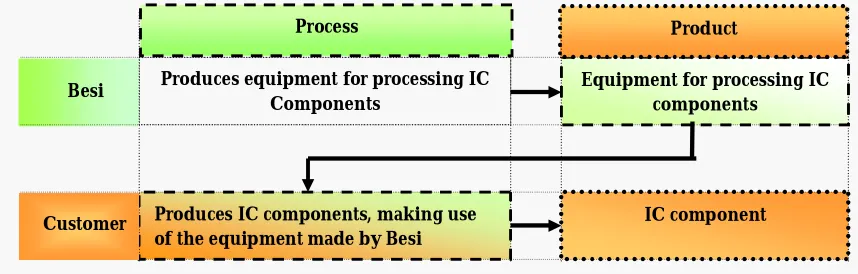
To prevent misunderstanding when reading this report, it is important to know that a strict distinction needs to be made between Besi’s product and the semiconductor products or IC’s. Therefore it will be cleared for once and for all, by a schematically overview given in figure 1. The word “product” in this research will only be used, for an integrated circuit component. The word “process” in this research will be used for the equipment and its function, required for production of IC components (products). This process equipment is manufactured by Besi, and so a product of Besi. But because this research, deals with optimizing the customers process, and therefore optimizing the use of this process equipment, Besi’s product will be considered as a process. The customer in this research is the person who buys the equipment to process a product.
Semiconductors are the basic building blocks used to create an increasing variety of electronic products and systems. Most consumers picture semiconductors as small black boxes. The small black boxes are actually the packaging that surrounds the silicon chip and both protect the chip from the external environment and provide the interface between the chip and other electronic components. A wide range of different types of semiconductor products can be distinguished, each with its own function, specifications and design. An example of a few types is shown in figure 2. Appendix E shows the different components of which an IC is build of.
2Advanced packaging ( http://ap.pennnet.com)
Produces IC components, making use of the equipment made by Besi
Equipment for processing IC components
IC component Product
Customer
Produces equipment for processing IC Components
Process
Besi
6
3.3 BACK END ASSEMBLY PROCESS
The objective of this research is to design a tool that gives insight in product and process parameters that need to be taken into account when optimizing a customers’ back end assembly process. The definition of a “back end assembly process” will be treated in this paragraph.
A process is a series of related activities designed to convert a certain input into the desired result. By definition, a process has several key characteristics:
• It has specific standards which determine how the process should perform, and which let it be repeated by others;
• it consumes resources such as time, money or energy
• It responds to control mechanisms that can help the process be done more efficiently.
A more efficient process might result in things being done faster, cheaper, or result in the creation of a better product or service3.
The back end assembly process is a collection of all activities that are required to perform the packaging of a semiconductor chip (also called “die”), resulting in an Integrated Circuit component (IC) ready for use.
3 http://www.nonprofitbasics.org/TopicAreaGlossary.aspx
Figure 3: “Front end” and “Back end” process. (The front end generates the die on wafer scale. The back end process integrates the die into a package and performs tests. )
Wafer fab
Test Assembly
Probe Silicon wafer
Silicon wafer
Semiconductor product
Front End production line
Back End Assembly line
Figure 2: Example of semiconductor products: (a and c) Sensor of a camera, ( b) DIP IC, (d) QFN product [Amkor], (e) Trans-flash Memory card [Sandisk]
d
c b
a
7
Generally known process steps in the back end assembly process of an IC are: • Die attach
• Wire bonding • Molding • Cleaning • Marking • Lead isolation • Singulation • Testing • Packaging.
An example of different process-steps in the back end assembly process line is given in figure 4. Each process step has its specific process function which can be performed by different techniques.. In this report, a group of different techniques that can all perform the same process function is called a “process function group”.
It depends on the product type, design and specifications Which process function groups are required in the overall assembly process. Which technique to choose, for each process function, depends as well on the product specifications, on the customers specification as on the techniques used for performing other process functions.
A description of the process functions and the techniques that are used to perform these process functions can be found in Appendix B. It is advised to view this appendix for better understanding of the rest of this report.
• Wafer mount • Die attach/bonding • Tape/Film attach • Wire bonding • Visual inspection • Array molding • Detach tape • Post mold cure • Laser Marking • Cleaning • Isolation • Singulation
• Visually and functionally Inspection
Application Note AN2467/D Revision 1.0
8
3.4 CUSTOMERS
The advice support system is going to be used to support the advice generating process towards customers. Besi’s customers are manufacturers of semiconductor products, and are using or are planning to make use of back end assembly equipment provided by Besi. Besi’s customers are leading US-, European- and Asian- semiconductor manufacturers and packaging subcontractors including Amkor, IBM, Intel, Micron, Motorola, NSEB and Philips4.
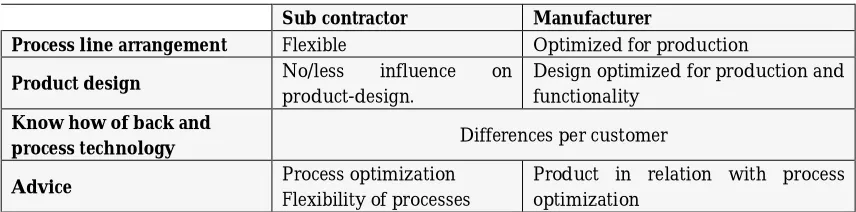
According to the interviews with sales agents, customers can be distinguishes into “subcontractors” and “manufacturers”. The definition of these two types is given below.
Subcontractors produce components, like transistors, capacitors, and other IC products to supply manufactures of electronically devices, like mobile phones, computers, audio video apparatus, and so on. Their production consists of many orders of many various products. Their market is subjected to heavy competition of other subcontractors. The product requirements and specifications are forced by their customers and leave minimal play to adapt the product for process optimizing purposes. Subcontractors need a highly flexible production process to be able to adapt to the demand.
Manufacturers produce end-products, like memory cards, phones, audio/video devices, for own distribution. Because they have more influence on product design and are less influenced by customers, their process may be less flexible.
9
4
VALUE OF THE ADVICE SUPPORT SYSTEM
4.1 INTRODUCTION
This chapter deals with the question: what gives rise to the development of an advice support system? The ability to pursue its mission is influenced by a company’s environment and its organizational structure. The advice support system should add a certain value, by supporting Besi in pursuing its mission, in its current organizational structure and in its current environment. Therefore, before developing the advice support system, it is required to do some preliminary research into Besi’s mission, its environment and its organizational structure.
By means of literature, the characteristic properties of Besi’s current organizational structure and the suitability of this structure in relation with Besi’s environment and mission are determined.
Next to this, the restrictions and opportunities of Besi’s current organizational structure and environment, regarding the advice generating process is revealed. With this information it can be concluded which function and value the advice support system should have in order to support in accomplishing Besi’s mission.
The following paragraphs subsequently treat Besi’s Mission, Besi’s environment and Besi’s corporate organizational structure. With this, the suitability of Besi’s organizational structure in relation with its mission and its environment is determined and can be concluded which adjustments to the corporate organizational structure are recommended and how the advice support system supports Besi to reach it’s mission.
4.2 BESI’S MISSION
Besi aspires to be marked leader as supplier of “Semiconductor Back End Assembly process systems” based on high tech solutions. Besi especially wants to exceed competitors on the next values: 56
• Good relation (of trust) with customer by:
o Fully understanding customers’ requirements and desires. o Advice generating and knowledge based service
o Process optimization advice o Good (After sales) service
• Without doing concessions to quality and reliability, more than ever, the Fico equipment range is focused on competitive initial investment.
Being a market leader, as supplier of “Semiconductor Back End Assembly process systems”, Besi possesses a portfolio that includes a wide spectrum of “semiconductor back end assembly process systems”.
5 Besi’s mission can be found in its annual report.
6 Besi internet site: http://www.besi.com
Advise support
10
4.3 BESI’S ENVIRONMENTA characteristic of the semiconductor industry is its dynamic environment. The rapid development of advanced semiconductor applications requires semiconductor manufacturers to continually improve their core technology and manufacturing capabilities to remain competitive7.
Besi’s environment is most influenced by semiconductor manufacturers, its competitors and the tendency of available and required technology. These influence factors will be treated in the following paragraphs.
4.3.1 Customers
Semiconductor manufacturers continually improve their core technology and manufacturing capabilities to remain competitive. Due to increased requirements for complexity, miniaturization and customization, semiconductor manufacturers demand highly sophisticated, cost-effective equipment from semiconductor manufacturing equipment suppliers, of which Besi is one. Therefore, the Besi holding and its subsidiary companies are expected to be highly innovatory.
For a semiconductor manufacturer it is important that equipment suppliers fully understand his processes and process requirements. Therefore a strong confidential bond between equipment supplier and semiconductor manufacturer is usual, and it is therefore hard to penetrate competitors market.
Due to Besi’s wide portfolio, it is common that a customer is served by multiple of Besi’s divisions. (See Figure 5) The stability of Besi’s position improves, when it has (many) different machines located at a customer’s plant, especially when this equipment influences each other in a certain way. When substituting Besi equipment, or equipment that is influenced by Besi equipment, the customer could be forced to (re)purchase Besi equipment, because the support infrastructure for the installed equipment is already in place. Next to this, good experience with Besi’s equipment, operating- and maintenance training, spare parts inventory, and familiarity of vendor technicians with the processes and procedures, may all favor the incumbent vendor.
7 http://www.Besi.nl , Industry Back ground
11
4.3.2 Competitors
Besi is a pioneer, and therefore always trying to take the lead in new developments. The threat of substitute is therefore often towards Besi’s competitors, instead of the other way round. Besi is number three in the top of worldwide assembly equipment suppliers with the highest market share8. It depends on developments of both competitors as Besi, to stay in this position.
As vendor with a large market share and market presence, Besi represents a low risk choice for new entrant customers because of its history and reputation. Competitors with relative lower market share must provide a strong argument, to overcome the inherently larger relative risk to the customer in dealing with them. On the other hand, Besi is not the market leader, and therefore needs to compete with suppliers with higher and equal market share. Besi tries to compete these competitors by differentiating, through focusing on customers that value high quality, reliability, good advice and service and are willing to pay for that. (Besi equipment is in average 20% more expensive than that of competitors.)
It has been said that the demand for capital equipment in the semiconductor industry is “inelastic” 9. That is, it is claimed that the market for semiconductor manufacturing equipment (SME) would not be markedly increased or decreased by changes in the price of such equipment. The argument behind that claim is that semiconductor manufacturing is a highly concentrated industry, with a substantial set of barriers to entry.
4.3.3 Tendency of Technology
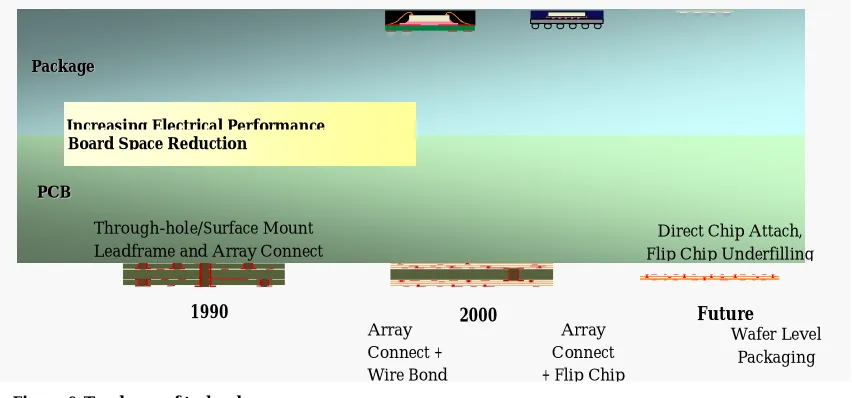
Until recently it was usual to optimize the different process steps individually, when optimizing the overall back end assembly process. But because of the growing demand for smaller and more compact and complex semiconductor components, physical boundaries of the back end processes are being challenged.
Because of the high performance that is being asked from the individual back end process steps, they become more sensitive for interferences by preliminary processes. A simple change of one sub-process in the overall assembly process could affect all the following assembly processes. Therefore it will show up more frequently that it is no longer possible to optimize a process individually without taking into account the effects of this optimization on other processes. This tendency will have big consequences for parties involved with optimizing the assembly process of a semiconductor product.
9 Joseph A.Verderber: A different view on demand elasticity for semiconductor capital equipment,( www.questteam.com)
1990 2000 Future
Chip on Board with Wire Bond Leadframe / Array
Connect + Wire Bond
P
PCCBB
P
Paacckkaaggee
Increasing Electrical Performance Board Space Reduction
Array Connect + Flip Chip Array
Connect + Wire Bond
Wafer Level Packaging Direct Chip Attach, Flip Chip Underfilling Through-hole/Surface Mount
Leadframe and Array Connect
12
4.4 BESI’S CORPORATE ORGANIZATIONAL STRUCTURE
For judging the suitability of Besi’s organizational structure to pursue its mission and to operate in its environment, the organizational structure of Besi is analyzed. Information about Besi’s organizational structure is found by studying its annual report and its homepage.
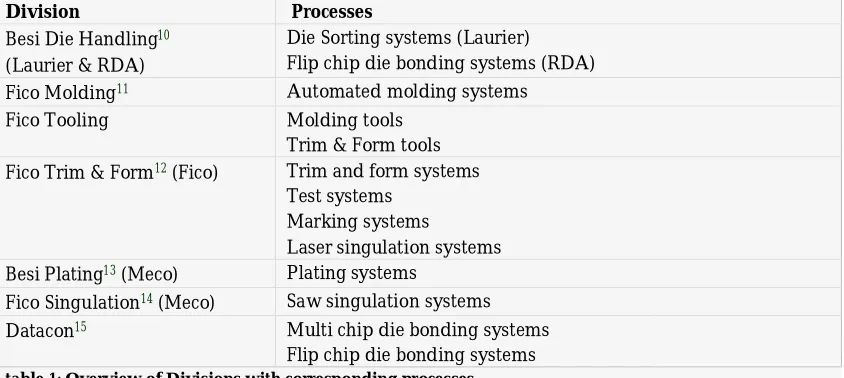
Besi is a holding company, consisting of shareholdings in a variety of separate business operations. Besi is horizontal integrating by investing in companies that are complementary to Besi’s present activities. That is, they all supply equipment for the semiconductor “back end assembly process”. Besi operates primarily through wholly owned divisions, which are summarized in table 1.
Although part of a parent company, the different businesses operate mainly independent.
4.4.1 Divisional structure
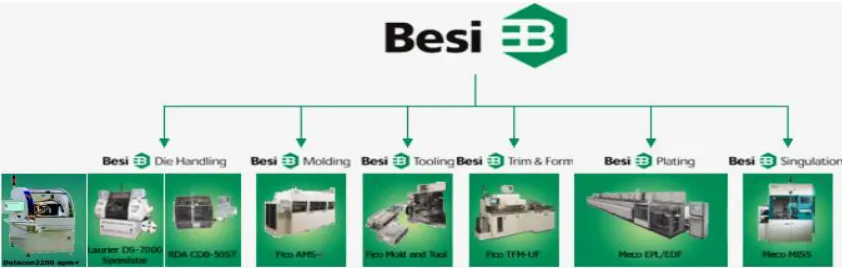
Besi can be categorized as a company with a divisional structure, in which, the divisions are organized according to product groups16 17. An overview of the different divisions is given in Figure 7. The different divisions are represented by (combinations of) independent businesses.
From literature, can be found what the characteristic properties of this concerning structure are in relation with Besi’s environment and its mission. Strengths and weaknesses of a divisional structure are summarized in Table 2. To find out if these strengths and weaknesses are also
10 http://www.besidiehandling.com
11 http://www.besimolding.com 12 http://www.besitrimform.com
13 http://www.besiplating.com
14 http://www.besisingulation.nl
15 http://www.datacon.at
16http:/ www.besi.com->company profile (http://www.besi.com/index.asp?p=11)
17 H.Mintzberg;1979;”The structuring of organizations”; Prentice Hall, Englewood Cliffs
Division Processes
Besi Die Handling10 (Laurier & RDA)
Die Sorting systems (Laurier)
Flip chip die bonding systems (RDA)
Fico Molding11 Automated molding systems
Fico Tooling Molding tools
Trim & Form tools Fico Trim & Form12 (Fico) Trim and form systems
Test systems Marking systems
Laser singulation systems Besi Plating13 (Meco) Plating systems
Fico Singulation14 (Meco) Saw singulation systems
Datacon15 Multi chip die bonding systems
Flip chip die bonding systems
13
4.5 SUITABILITY OF BESI’S CORPORATE ORGANIZATIONAL STRUCTURE IN RELATION WITH ITS MISSION AND ENVIRONMENT
After studying Besi’s organizational structure, Besi’s Mission and its environment, it can be determined to what extent, Besi’s organizational structure fits in its environment.
A divisional structure is suitable for fast change in an unstable environment 18. The rapid development of advanced semiconductor applications requires semiconductor manufacturers to continually improve their core technology and manufacturing capabilities to remain competitive19. This quick response to changes in products, also demands a quick response to change in development of assembly equipment. Therefore, Besi is expected to be highly innovatory. In this point of view, the divisional structure would fit to the environment it operates in.
Another advantage of a divisional structure is that each product group is accommodated in a separate division, so customers are able to directly contact the correct division20, and achieve satisfaction by getting detailed advice directly form specialist of the concerning group.
18 R.L. Daft, “Organization Theory and Design” 7th edition page 100
19 http://www.Besi.nl -> Industry Back ground
20 G. Johnson and K. Scholes, “Exploring Corporate Strategy” Strengths of a divisional structure
-Suited for fast change in an unstable environment -Leads to client satisfaction
-Involves high coordination across functions -Best in large organizations with several products -Decentralized decision making
Weaknesses of a divisional structure:
-Eliminates economies of scale in functional departments -Leads to poor coordination across product lines
-Eliminates in depth competence and technical specialization -Makes integration and standardization across product lines difficult
Table 2: Strengths and weaknesses of a divisional structure, according to R.L.Daft,”organizational Theory and Design” 7th edition page 100
14
When a customer needs to choose between two alternative products, it is very important to have an objective comparison between these alternatives. Unfortunately, at this point there are some problems concerning the current arrangement of Besi into different divisions. That is, that some process-function groups are accommodated in more than one division of Besi, both offering alternatives. 21 For example: Punching and Laser cutting are complementary techniques, but are both competitive for Saw singulation. Unfortunately, The punching and Laser cutting equipment is provided by Fico-Trim & Form and the Sawing equipment by Fico Singulation.
Both companies (divisions) are aiming to survive and therefore the chance of competing each other is possible. As a result, they are not objective when advising a customer about which singulation option suits best to the customers’ process preferences. A consequence of this is that, when a customer is looking for a singulation solution, he needs to visit both companies, with the possibility that he receives two contradictory advices concerning which process to choose.
To avoid this problem, it is useful to create an impartial sales- or advice department, representing all available techniques within a certain process-function. This will offer the customer a better and more objective advice, increasing customer’s satisfaction
A risk of having a divisional structure is that sales agents from one division are unaware of developments in other divisions. This could frustrate customers22, especially when process systems of different divisions are combined and interfere with each other at the customer’s plant. For Besi, this is also the case. As can be read in the in Chapter 4.3.3, it is a tendency, that sub processes in the back/end industry are more and more affecting each other, due to the higher performances that are being asked from the individual back end process steps, and so become more sensitive for interference by other processes. Because of the wide range of different process techniques available to use in the back end industry, it is impossible for the sales departments of the various divisions, to have thoroughgoing knowledge of processes outer their specialization, and of the interrelation between these processes. This lack of knowledge-exchange and cooperation between divisions while finding an optimal solution for customers can lead to incomplete or contradictory advices.
For example: The molding process influences tool wear in the punch process. The complete molding process consists of molding and post mold curing. Placing the post mold curing after the punch process decreases tool wear in the punch process, but because lack of knowledge of each others processes and lack of influences in each others advices, could lead to a solution with post mold curing before the punching process, leading to unnecessary tool wear.
To eliminate this problem, taskforces and other linkage devices are needed to coordinate information across the divisions23.
21 According to Interview with sales managers of Besi T&F, Besi Molding, Besi Singulation.
22 R.L.Daft, “Organization Theory and Design” 7th edition page 101.
15
4.6 CONCLUSIONS
The following two subsections describe the conclusions that can be distilled from the analysis results above. The first subsection describes the recommended adjustments to the corporate organizational structure. The second subsection describes in which ways the advice support system ads value to the organization in reaching its mission.
4.6.1 Recommended adjustments to the corporate organizational structure
Concluding from the previous analysis, it is useful to create impartial sales or advice department for each process function, accommodating all available alternatives within this process function. This will offer the customer a better, more objective, advice, increasing customer’s satisfaction. This may only be done under the condition that the level of detail of process information will not be affected. The next conclusion is that there is indeed a demand for taskforces and other linkage devices in order to coordinate information exchange across the separate divisions. These taskforce can be composed of representatives from divisions of which their processes affect each other. How the adjustments ,mentioned above, can be realized, will not be dealt with by this research and may therefore be considered as an recommendation for further research. In addition to the taskforces, the advice support system could function as a linkage device for sharing information across the divisions. The value of this advice support system is clarified in the following subsection.
4.6.2 Value of an Advice Support System for Besi
The rapid development of advanced semiconductor applications requires semiconductor manufacturers to continually improve their core technology and manufacturing capabilities to remain competitive24. For them it is important to get a well considered advice, containing information about all suitable processes, process combinations and their pros and cons.
The requisite of certain processes depends on the product design and corresponding product specifications. An extensive analysis of the product can reveal all required processes, and eventual restrictions on these processes. The advice support system can be used to find all required processes, by selectively inventory product information that indicates the necessity for certain process steps. According to chapter 4.3.3 (Tendency of Technology), it will show up more frequently that it is no longer possible to optimize the processes individually without taking the effects of process choice on other processes into account. Therefore, generating advice about a certain process choice, requires a wide orientated knowledge about all other processes that interfere with the process that is dealt with. Unfortunately it is not feasible for a sales agent to be acquainted with updated technical knowledge about all these processes outer their discipline, because this would only reduce the level of detail in knowledge about their own specialization. The advice support system provides sales agents with detailed information about aspects that need to be taken into account when combining their processes with other processes outer their discipline.
Besi tries to compete its competitors by differentiating, through focusing on customers who value high quality, reliability, good advice and service and are willing to pay for that. Therefore, Besi highly values the “understanding of customer’s requirements and desires”. The advice towards customers about how to optimize their process should therefore be adapted to the customer’s situation and preferences. This requires structural analysis of the customer’s problem before generating advice. The advice support system could function as guide when determining the customer’s current situation, his preferences and his requirements. Next to this, it provides insight in process information which is required to judge the suitability of processes in relation with customers situation and preferences. With use of the advice support system, the sales agent is able to generate high quality advice, which is highly appreciated by the customer and therefore it may be assumed that the advice support system contributes to Besi’s corporate organization in reaching its mission.
16
5
REQUIRED PERFORMANCE OF THE ADVICE SUPPORT
SYSTEM
5.1 INTRODUCTION
In order to assure that the advice support system can be used in an optimal way, the required performance of the complete system should be investigated.
Next to the corporate organizational structure in which the system is used, there are two other important aspects that influence the required performance of the advice support system which should be taken into account when designing the advice support system. The first aspec