493
An Efficient Method for Human Face Recognition and
Information Retrieval
Ms. Pournima D. Kinge1, Prof. Abhijeet V. Shinde2
Dept. of EXTC., Dr. Bhausaheb Nandurkar1,2 College of Engineering and Technology, Yavatmal1,2 [email protected], [email protected]
Abstract-Face recognition is the need of present time over the world. As the people started to travel throughout this world which in turn raised the threat to the world from destructive people. Face recognition can be an option to such a problem as the people with criminal history can be identified at the entry point of the country like airport, costal area, bus station, railway station and market places with such a system. Face recognition is a challenging problem. Face recognition is based on a biometric system to verify or identify a person from a digital image. The Security cameras are commonly present in offices, airports, university, ATM, bank, and over various locations. The face recognition system should be able to automatically detect a face in an image. This process involves extraction of face features and then recognizing it, regardless of expression, lighting, illumination, pose, and ageing, which is a very complex task. The MATLAB software is used for the implementation of face recognition algorithm. The AdaBoost algorithm gives different levels of accuracy in different conditions as experimentally observed. This paper deals with the face recognition system using Viola and Jones algorithm with Harris Laplacian feature extraction method. A Gaussian filter is used for normalization and noise removal purpose. The face recognition process identifies the input unknown test image when it is compared with the known trained images stored in the database, at the same time it provides information related to the recognized person.
Keywords: Biometrics, covariates, challenges, face recognition, person information, MATLAB.
1. INTRODUCTION
Biometrics is a technique for identifying a person based on the physiological features of the human body. Biometric-based techniques have emerged as the most promising option for recognizing individuals in recent years since, instead of authenticating people and granting them access to physical and virtual domains consisting of smart cards, keys, passwords, PINs, plastic cards, tokens and so forth. Biometric techniques observe physiological and/or behavioral characteristics of the person to find and determine identity of that person. An individual’s biological traits cannot be misplaced, forgotten, stolen or forged. Biometric-based methods contain identification of physiological characteristics (like fingerprints, face, finger geometry, hand geometry, palm, hand veins, retina, iris, ear and voice) and behavioral traits (like signature, gait and keystroke dynamics). Face recognition appears to offer several advantages over other biometric methods. Nearly in all these technologies user need to perform some voluntary action and have to stay in a fixed position in front of a camera. However, face recognition can be done passively without any explicit action or participation on the part of the user since face images can be acquired from a distance by a camera. Facial images can be easily obtained with a couple of inexpensive fixed cameras. For noise and small variations in
orientation, illumination, and scale we can compensate a better face recognition algorithms and suitable preprocessing method for images.
494 or denying the identity claimed by an individual. Face
identification means a 1:N matching which compares a query face image with all image templates in a face database. Identification involves recognizing an individual from a list of N individuals in the database.
To create a software package using MATLAB that can recognize people in given images under different challenges, following basic steps are needed to be included in real time face recognition system. 1) Face detection - detect a face in a complex scene 2) Face normalization/segmentation - adjust for
rotation, light and scale changes
3) Feature extraction - calculating exact co-ordinates of eyes and mouth by fitting the face structure 4) Face recognition - compare detected face to a
database of known faces
Face recognition is the process of automatically identifying people by face in an image, that is, to determine whether two faces are of the same person. A number of factors make this a challenging problem for computer. Faces in images can be captured at various lighting conditions, resolutions, etc. Also different cameras have different imaging properties. The pose and illumination variations of face images affect the performance of the face recognition methods. The need to accurately identify people is important for security. When a facial recognition system incorrectly identifies a person that can cause a number of potential problems, depending on what kind of error it is. A system that is restricting access to a particular location can wrongly admit an unsanctioned person – if, say, he is wearing a disguise or even just look alike enough to someone who should be allowed in. Or it could block the entry of an authorized person by failing to correctly identify her. Surveillance cameras may not always be able to get better images of a suspect’s face in law enforcement. That could mean identifying an innocent person as a suspect or even failing to recognize that a known criminal just ran afoul of the law again. Irrespective of how much accurate it seems to be on the TV crime tragedies, there is some area for error, although the technology is improving. The National Institute of Standards and Technology has estimated that stated error rates are declining 50 percent every two years, and are currently around 0.8 percent. It is better as compared to voice recognition, which is having error rates beyond 6 percent.
It is a challenging task to simultaneously deal with different variations in face recognition. Traditional methodologies tried to tackle unique challenge at a time. This project deals with recognition of human face images in semi-uncontrolled environment. The semi-semi-uncontrolled term is used as the uncontrolled environment can be any of the environments where pose variation may be about 45 degrees, almost invisible face with
overexposed or underexposed condition, very low resolution etc. Main contribution of this project is to handle face recognition problem in moderate conditions of pose, illumination, disguise, and occlusions termed as semi uncontrolled environment. There are some techniques present in literature where authors have targeted either one or two sources of complications but in the system established here, a comprehensive method is developed, which is capable of handling combination of various challenges generally present in most of the face recognition systems. This paper proposes a novel approach for face recognition with personal information of each person is retrieved based on the face matching result.
1.1 Problem identification
The face recognition problem can be generally stated as: we need to determine or verify the identity of the person in the input image after giving an input query face image and a database containing images of the known individuals.
Present FR systems have many shortcomings like use of a lot of processing power and precious training and testing times, which results in poor performance. Thus an evolutionary approach to solve the problem needs to be adopted.
1.2 Aim
The aim of project is to create a software package using MATLAB to implement a face recognition algorithm that can recognize an unknown test image by comparing it with the known training images stored in the database and provides information regarding the person recognized.
1.3 Objective
The objective is to propose an improved method which is suitable to handle variations in image configurations like pose, illumination, and facial expressions as well as occlusion and disguise, in order to provide high efficiency in the face recognition.
(1) Do research on face recognition algorithms
(2) To design and develop a face recognition method using MATLAB
(3) To propose an effective, accurate and efficient Face recognition technique by improving existing face recognition algorithms and tests its accuracy.
495 2. LITERATURE REVIEW
A biometric system compares the given biometric trait of an individual with stored templates in the database and computes a match scores for the comparison. These biometric modalities are briefly presented by H. Bhatt. Face recognition is much more advantageous compared to the other biometrics. Under well-controlled conditions face recognition has a high identification or recognition rate. Face detection seems to be a challenging task when various factors are present. These are the covariates that significantly affect the facial appearance which are presented in [1]. Finally, how the emerging covariates have evolved, what are its challenges, proposed techniques, and research directions in future for each of the covariates is also provided [1].
The method for acquiring face images depends upon the challenging conditions. We can broadly divide face recognition techniques into 3 categories according to the face data acquisition methodology: methods that operate on intensity images; those that deal with video sequences; and those that require other sensory data such as 3D information or infra-red imagery. It provides an overview of some of the well-known methods in [2] in each of these categories and also examines some of the benefits and drawbacks of the mentioned schemes.
Face recognition has three stages a) face location detection b) feature extraction c) facial image classification. Various face recognition algorithm exits and each has advantages and limitation. The different methods for face recognition, their advantages and disadvantages are reviewed in [3]. It has gone through PCA, LDA, neural networks, BPNN and RBF to compare the results.
An overview of face recognition is presented in [4] along with the discussion of the methodology and its functioning. Thereafter the most recent face recognition techniques are represented with listing their advantages and disadvantages. Some specified techniques improve the efficiency of face recognition under various illumination and expression condition of face images.
Face recognition system must be capable of automatically detecting a face in an image. This involves extracts its features and then recognize it, regardless of lighting, expression, illumination, ageing, transformations (translate, rotate and scale image) and pose, which is a difficult task. The further research gives the common methods like holistic matching method, feature extraction method and hybrid methods [5].
A detailed survey on 2D face recognition under such uncontrolled conditions is presented in [6]. Different techniques proposed for illumination and pose problem are explored here along with the
classifiers that in general have been successfully used for face recognition. It is presenting a survey paper that comprises as much literature study for the reader to understand that what exactly the variations are that can be caused by variation in illumination and pose, what approaches had been taken up till now to make continuous improvements in existing systems and their drawbacks etc.
Forensic science, or simply forensics, deals with the application of scientific principles to analyze data collected by law enforcement agencies. Forensic face recognition system should be capable of handling facial images captured under non-ideal conditions as compared to automated face recognition, and also has high liability for following legal procedures. Recent developments in automated face recognition that impact the forensic face recognition community are discussed in [7].
Forensic face recognition is different from typical face recognition where it needs a human examiner to carefully interpret and verify the results. The challenges in applying face-recognition technology to forensics applications are highlighted in article [8]. It addresses three specific research problems (1) Robustness to facial aging, (2) Retrieval using facial scars and marks, (3) Matching forensic (composite) sketches to face photograph databases. It gives designs of special purpose face-recognition systems for a specific matching problem.
For enhancing the performance of a FR system, a novel approach is proposed in [9], with a unique combination of Active Illumination Equalization (AIE), Image Sharpening (IS), Standard Deviation Filtering (SDF), Mirror Image Superposition (MIS) and Binary Particle Swarm Optimization (BPSO). AIE is used for removal of non-uniform illumination and MIS is used to neutralize pose variance. Discrete Wavelet Transform (DWT) and Discrete Cosine Transform (DCT) are used for efficient feature extraction and BPSO-based feature selection algorithm is used to search the feature space for the optimal feature subset. Results obtained by applying this method to the three different databases, which have variations in pose (Color FERET and Head Pose), illumination (Extended Yale B).
496 A comparative study for evaluation of face
recognition system based on face restoration is presented in [11]. It is performed in two successive steps, where in the first step, two image restoration methods called Centralized sparse representation (CSR) and adaptive sparse domain selection with adaptive regularization (ASDS-AR) are used, while in the second step the set of methods that have been used are principal component analysis (PCA), linear discriminant analysis (LDA) kernel principal component analysis (KPCA) and Kernel Fisher Analysis (KFA) in the process of face recognition and the Gabor Wavelets and Phase Congruency is associated to achieve the evaluation of the projected model.
Face recognition (principal component analysis (PCA) to assess the feasibility of real world face recognition, but the system performance are low when the image in uncontrolled poses. Active shape models (ASMs) are statistical model, which iteratively deform to fit to a new image. The shapes are constrained by the PDM (Point Distribution Model) which is statistical shape model, to vary only in training set of labeled examples. Then weighted matching is applied between the input image and database images [12]. The face is detected by the Active shape model Algorithm.
A bag of geometrical features based face recognition approaches using Support Vector Machines (SVM), Genetic Algorithm (GA) and minimum redundancy maximum relevance (mRmR) with Mutual Information Difference (MID) and Mutual Information Quotient (MIQ) is proposed in [13]. Support Vector Machine Classifier (SVM) based on linear, radial basis function and multi-layer Perceptron kernels is performed on the two benchmarks of facial databases ORL and Caltech Faces. Linear kernel based SVM classification using 10 selected distances by Genetic Algorithm (GA) ranks top the list of kernels conducted in the experimental study.
A novel method, which simulates the mechanism of fixations and saccades in human visual perception, to handle the face recognition from single image per person problem is proposed in [14]. This method is robust to the local deformations of the face (i.e., expression changes and occlusions). . Experimental results on the FRGC and the AR databases confirm the effectiveness of the method. Like Dynamic Image-to-Class Warping (DICW) Method, it doesn’t need a training phase and it can be applied to face recognition process from single image per person. In addition, this method is more robust than DICW to occlusions and expression changes.
Researchers widely used Principle component analysis (PCA) as a classical feature extraction and data representation technique. PCA is to reduce the
large dimensionality feature space, needed to describe the data economically. PCA creates a subspace (face space) where the faces in the database are represented using a reduced number of features called feature vectors. Experimental results shows that PCA based methods provide better face recognition with reasonably low error rates [15]. Recognition accuracy of PCA is measured over ATT and CSU databases for face recognition. The same algorithm is adopted for facial expression detection for both male and female.
A novel and robust skin color model and fuzzy neural network based face detection is offered in [16] for the purpose of authentication where the system will detect and recognize the persons using the face images. The different types of face detection techniques algorithms have been studied and described and is followed by what changes we will make in order to develop a new hybrid algorithm for face detection technique, which can overcome the false positive result in face detection and recognition technique. The new algorithm seems to be adaptable to various face detection based authentication systems.
An augmented reality sports broadcasting application is developed in [17] for automatic detection, recognition of players during play, followed by display of personal information of players. The system was developed for baseball game. The proposed application can be divided into four major steps. In first step, each player in the image is detected. In the second step, a face detection algorithm detects face of each player. In third step, we use a face recognition algorithm to match the faces of players with a database of players’ faces which also stores personal information of each player. In step four, personal information of each player is retrieved based on the face matching result.
Given a collection of images, where each image is associated with a few names in the corresponding caption, the goal of face naming is to infer the correct name for each face. To effectively solve this problem, two new methods are proposed in [18] by learning two discriminative affinity matrices from these weakly labeled images. Moreover, we also develop a new distance metric learning method called ambiguously supervised structural metric learning by using weakly supervised information to seek a discriminative distance metric.
497 i.e. Multi/ Hyperspectral Imagery Data in FR [19].
The IR based Imaging System can minimize several limitations arised in the existing classical FR system.
To solve the problem of robust face recognition (FR) with single sample per person (SSPP) is proposed in [20]. To tackle the problem of query images with various intra-class variations a novel model local robust sparse representation (LRSR) is presented in the scenario of FR with SSPP. FR with SSPP is a very difficult challenge due to lacking of information to predict the possible intra-class variation of the query images. The proposed method has the key idea to combine a local sparse representation model and a patch-based generic variation dictionary learning model in order to predict the possible facial intraclass variation of the query images. The experimental results on the AR database, Extended Yale B database, CMU-PIE database and LFW database.
Implementation of algorithms for face detection and recognition in color images under Matlab is given in [21]. For face detection, we trained a feedforward neural network to perform skin segmentation, followed by the eyes detection, face alignment, lips detection and face delimitation. It detected eyes by analyzing the chrominance and the angle between neighboring pixels and, after that the results were used for performing face alignment. The lips were detected based on the analysis of the Red color component intensity in the lower face region. Finally, the eyes and lips positions were used to delimit the faces.
The face recognition methods, algorithms proposed by many researchers using artificial neural networks (ANN) is given in [22] which have been used in the field of image processing and pattern recognition. How ANN will used for the face recognition system and how it is effective than another methods will also discuss in this paper. Many ANN proposed methods are present which give overview face recognition using ANN. Therefore, this research includes a general review of face detection studies and systems which based on different ANN approaches and algorithms.
A methodology is given in [23] for recognizing the human face based on the features derived from the image. It is implemented in two stages. The human face in an image is detected using viola-Jones algorithm. The detected face in the image is recognized using a fusion of Principle Component Analysis and Feed Forward Neural Network
Various face detection and recognition methods are evaluated in [24] and a complete solution is provided for image-based face detection and recognition which gives higher accuracy and better response rate to serve as an initial step for video surveillance.
3. PROPOSED TECHNIQUE
3.1 Tools used
3.1.1 MATLAB 2017a
MATLAB is used to design and develop a face recognition method MATLAB is a high-performance language for technical computing. It integrates computation, visualization, and programming in an easy-to-use environment where problems and solutions are expressed in familiar mathematical notation. It is a programming language and also a programming environment. Just as a sophisticated calculator, we can perform actions from the command line. Or we can create programs and functions that perform repetitive tasks, just as any other computer language.
3.1.2 Desktop with MATLAB 2017a software
A computer or a laptop having MATLAB software installed is necessary to create and run the whole project.
3.1.3 Computer scanner
To provide images for the detection and verification purpose are provided by scanning through the computer scanner.
General steps in our face recognition system as depicted in Fig.1 are discussed below:
3.1.4 Input image Acquisition
The face recognition system consists of an image acquisition process that loads the image in the MATLAB program, which has to be used with the new algorithm. This is actually the first faltering step. This acquisition can be carried out by using a digital scanner to scan existing photograph or by using a camera to take a picture of a subject.
3.1.5 Preprocessing
Image pre-processing takes the form of signal conditioning (such as noise removal, and normalization from the variation of pixel position or brightness). The input image is resized into 256*256 resolutions. If there is any dirt on camera, scanner lens, imperfection in the scanner lighting, this shows the noise in the scanned face image. The noise in the image can be removed with the help of filtering function, and works like a common function that replaces each pixel by its function.
498 in the restored image when a large filter size is used.
Thus, the irregular illumination variation is associated with the gray-level intensities in shading and the edge strength of the shading in a basic image. These two factors are therefore used as the criteria in the determination of the maximum filter size in order to reduce the uneven illumination variation.
3.1.6 Face Detection
The goal of face detection method is to detect all face containing regions irrespective of its position, alignment, and lighting conditions when given a single image. The techniques for face detection are categorized into four classes, namely, knowledge-based, feature invariant, template matching, and appearance-based methods. We are using a feature based method called Viola and Jones Algorithm which is based on Harr-like features obtained by computing of difference between black and white rectangles. Some stages are defined for features classification to eliminate worst candidate region of facial part. All faces detected will be cropped and resized.
3.1.7 Features extraction
Features extraction approaches can be categorized in three families. Holistic approach based on application of texture’s descriptors like Gabor filter, Local Binary Pattern (LBP) operators, SIFT, SURF features on the whole face. Features based approaches which uses geometrical distances between facial parts. Hybrid approach consists on the
application of descriptors used in holistic approach but not on the whole image. Facial parts localization is much recommended in hybrid approaches to apply descriptor PCA, LDA, Gabor and LBP. Features Selection is based on choice of most relevant features which can differentiate human faces.
The Harris affine region detector belongs to the
category of feature based approach. Feature detection is a preprocessing step of several algorithms that rely on identifying characteristic points or interest points so to make correspondences between images, recognize textures, categorize objects. The algorithm consists of two steps: multi-scale point detection and an iterative selection of the scale and the location. We first build a scale-space representation with the Harris function for pre-selected scales σn = ξnσ0, where ξ is
the scale factor between successive levels. We extract the interest points at each level of the representation by sensing the local maxima in the neighborhood of a point x. A threshold is used to reject the maxima of small corners, as they are less stable under variations in imaging conditions. With the integration scale σI =
σnand the local scale σD = sσn, the matrix µ(x, σn)is
499 provides higher accuracy in the location and the scale
of the interest points.
3.1.8 Classification
Feature categorization is conducted by a classifier, which frequently contains types of pattern distribution, coupled to a choice procedure. A wide range of classifiers, covering parametric along with non-parametric techniques, has been placed on the automatic face recognition problem.
This step is to compare the features generated
with those in a database of known faces. Just as the human perception system uses both local features and the whole face region to recognize a face, a machine recognition system should use both. AdaBoost algorithm classifier is used for classification purpose. AdaBoost, short for Adaptive Boosting, is a machine learning meta- algorithm. It can be used in conjunction with many other types of learning algorithms to improve performance. The combination of weak learners output results in a weighted sum that is nothing but the final output of the boosted classifier. The classification results in a face recognition.
3.1.9 Information retrieval
Relevant information of the recognized person is displayed in this step. It gives name, date of birth, age, occupation, address, etc. of the recognized person.
4. EXPERIMENTAL RESULTS
For the recognition system, the images are partitioned into two sets: (1) the training dataset is used to train the individual face recognition algorithms and (2) the gallery-probe dataset (the test set) is used to evaluate the performance of the recognition algorithms. The training set comprises of randomly selected images of each subject and the remaining images are used as the test data to evaluate the algorithm. AdaBoost has the potential of fast training and testing for real-time face recognition. The
algorithm is first trained with all training images in training set. After completion of the training process, when any image in the gallery is tested, the face recognition system identifies the person and provides details of the respective person.
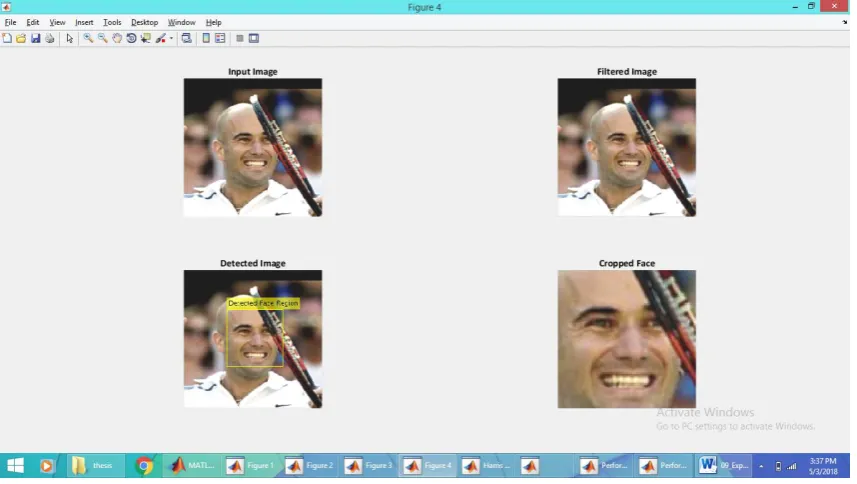
The output of the system is as shown in the Fig. 2 and 3.
[image:7.595.77.506.254.496.2]500 The accuracy is defined as the probability of
correctly identifying the face image and is given by Accuracy =
Where, True positive (TP) – correctly identified, False positive (FP) – incorrectly identified, True negative (TN) – correctly rejected, False negative (FN) – incorrectly rejected.
Sensitivity relates to the test’s ability to identify an image correctly; i.e. sensitivity is the probability of
having a positive test and is given by Sensitivity =
This is one of the best work reporting results for face recognition under pose, illumination, expression and disguise. A distinct benefit of using this method is speed and computational power, which makes it a good choice when requiring a fast identification process.
4.1 Advantages
This is one of the best work reporting results for face recognition under pose, illumination, expression and disguise.
A distinct benefit of using this method is speed and computational power, which makes it a good choice when requiring a fast identification process.
4.2 Applications
The reason for undergoing work is due to its wide range of applications which include some of the main applications as given below.
Security- Access control to airports/seaports,
border checkpoints, buildings, ATM machines and computer/ network security in multimedia workstations and email authentication comes under security. Protection systems have been implemented at many airports around the world for face recognition.
Surveillance- we can monitor some CCTVs to
search known criminals, drug offenders, etc. and
can notify authorities, when one is located.
General identity verification- For identity
verification of a person in banking, electoral registration, electronic commerce, national IDs, identifying newborns, drivers’ licenses, passports, employee IDs face recognition system is used.
Criminal justice systems- Mug-shot/booking
systems, post-event analysis, forensics comes under the term Criminal justice systems facial recognition provides law enforcement and government agencies a way to manage the records of people of interest.
Multi-media environments with adaptive
human computer interfaces- It includes part of environment aware or universal systems, recognizing a client and assessing his needs, behavior observing at childcare or old people’s centers.
Video indexing- Labeling faces in video is
termed as video indexing. It is the process of providing watchers a way to access and navigate contents easily. It is the process of automatically assigning content-based labels to video documents.
501 5. CONCLUSION
Currently, recognition of an individual face use human observers in many security applications Face recognition systems are also used in conjunction with limited human interference in some applications. It is highly desirable that the face recognition systems should be able to provide high reliability and accuracy under varying conditions. Still, many algorithms are not robust to high security applications like terrorist watch list and border crossing. This paper emphasizes the important characteristic of face recognition. The paper suggests that to develop a robust face recognition algorithm, a careful investigation is required that can fulfill the operational requirements of real world applications.
We proposed a practical solution for robust face recognition using Viola and Jones algorithm under varying pose, expressions, illumination and disguise. In this paper, we proposed a method capable of recognizing faces with increased accuracy. The paper includes selection of features for face recognition using AdaBoost algorithm.
We have tried our best to provide researchers a comprehensive review in the field of illumination and pose invariant face recognition along with the recognizers/classifiers that have been used. To improve the results, the face detection algorithms for can be further upgraded to detect multiple faces in the same image. Face recognition from video and multimodal recognition is going to have an important role in next generation smart environments.
REFERENCES
[1] Himanshu Sharad Bhatt, Dr. Richa Singh, Dr. Mayank Vatsa, Covariates of face recognition, IIITD-TR- 2015-002.
[2] Rabia Jafri, Hamid R. Arabnia, A survey of face recognition techniques, Journal of Information Processing Systems, Vol.5, No.2, June 2009, DOI: 10.3745/JIPS.2009.5.2.041.
[3] Sanjeev Kumar, Harpreet Kaur, Face recognition techniques: classification and comparisons, International Journal of Information Technology and Knowledge Management, July-December 2012, Vol. 5, No. 2, pp. 361-363.
[4] Riddhi Patel, Shruti B. Yagnik, A literature survey on face recognition techniques, International Journal of Computer Trends and Technology (IJCTT) – volume 5, number 4, Nov 2013, ISSN: 2231-2803.
[5] Divyarajsinh N. Parmar, Brijesh B. Mehta, Face recognition methods & applications, International Journal of Computer Technology & Applications, Vol. 4 (1), 84-86, IJCTA, Jan-Feb 2013, ISSN:2229-6093.
[6] Kavita. R. Singh, Mukesh. A. Zaveri, Mukesh. M. Raghuwanshi, Illumination and pose invariant face recognition: a technical review, IJCISIM, ISSN: 2150-7988, Vol.2, (2010), pp.029-038.
[7] Anil K. Jain, Brendan Klare, Unsang Park, Face recognition: some challenges in forensics, Automatic Face & Gesture Recognition and Workshops (FG 2011), IEEE International Conference, DOI: 10.1109/FG.2011.5771338.
[8] Anil K. Jain, Brendan Klare, Unsang Park, Face matching and retrieval in forensics applications, Multimedia in Forensics, Security, and Intelligence, 1070-986X, © 2012 IEEE, Published by the IEEE Computer Society.
[9] S. Hitesh Babu, Shreyas H. R., K. Manikantan, S. Ramachandran, Face recognition using active illumination equalization and mirror image superposition as pre-processing techniques, 2014 Fifth International Conference on Signals and Image Processing, 978-0-7695-5100-5/13 IEEE.
[10] Anagha A. Shinde, Sachin D. Ruikar, Face
recognition using PCA and eigen face approach, International Journal of Computer Applications, International Conf. on Recent Trends in engineering & Technology - 2013(ICRTET'2013).
[11] Hicham Mokhtari, Idir Belaidi, Said Alem,
Performance comparison of face recognition algorithms based on face image retrieval, Research Journal of Recent Sciences, ISSN 2277-2502, Vol. 2(12), 65-73, December (2013).
[12] Arulmurugan R, Laxmi Priya M.R, Face
recognition of pose and illumination changes using Extended ASM and Robust sparse coding, Journal of Dental and Medical Sciences (IOSR-JDMS), (Mar. 2014), PP 49-54.
[13] Wael Ouarda, Hanene Trichili, Adel M. Alimi, Basel Solaiman, Face recognition based on geometric features using support vector machines, Int. Conf. of Soft Computing & Pattern Recog.,978-1-4799-5934- 1, 2014 IEEE.
[14] Xingjie Wei, Chang-Tsun Li, Fixation and
saccade based face recognition from single image per person with various occlusions and expressions, (CVPRW), 2013 IEEE Conference, DOI: 10.1109/CVPRW.2013.18.
[15] Sukanya Sagarika Meher, Pallavi Maben, Face recognition and facial expression identification using PCA, 2014 IEEE International Advance Computing Conference (IACC), 978-1-4799-2572-8/14© 2014 IEEE.
502
[17] Zahid Mehmood, Tauseef Ali, Shahid Khattak, Laiq Hasan, Samee U. Khan, Automatic player detection and identification for sports entertainment applications, Springer-Verlag London, doi: 10.1007/s10044- 014-0416-4, 2014.
[18] Shijie Xiao, Dong Xu, Jianxin Wu, Automatic face naming by learning discriminative affinity matrices from weakly labeled images, IEEE Transactions on Neural Networks and Learning Systems, 2162-237X©2015.
[19] Shwetank Arya, Neeraj Pratap, Karamjeet
Bhatia, Future of face recognition: a review, Procedia Computer Science 58, 578- 585, 2nd Int. Symposium on Computer Vision and the Internet (VisionNet’15), 1877- 0509©2015, Elsevier.
[20] Jianquan Gu, Haifeng Hu, and Haoxi Li, Local Robust Sparse Representation for Face Recognition with Single Sample per Person, IEEE/CAA JOURNAL OF AUTOMATICA SINICA, IEEE/CAA J. of Autom. Sinica,pp. 1-8, 2017. DOI: 10.1109/JAS.2017.7510658.
[21] Deise Maia and Roque Trindade, Face Detection
and Recognition in Color Images under Matlab, International Journal of Signal Processing, Image Processing and Pattern Recognition Vol.9, No.2 (2016) ISSN: 2005-4254 IJSIP pp.13-24
http://dx.doi.org/10.14257/ijsip.2016.9.2.02.
[22] Manisha M. Kasar, Debnath Bhattacharyya and Tai-hoon Kim, Face Recognition Using Neural Network: A Review, International Journal of Security and Its Applications Vol. 10, No. 3 (2016)pp.81-100 http://dx.doi.org/ 10.14257/ ijsia.2016.10.3.08, ISSN: 1738-9976 IJSIA Copyright 2016 SERSC.
[23] Narayan T. Deshpande, Dr. S. Ravishankar,
Face Detection and Recognition using Viola-Jones algorithm and Fusion of PCA and ANN, Advances in Computational Sciences and Technology ISSN 0973-6107 Volume 10, Number 5 (2017) pp. 1173-1189 © Research India Publications.
[24] Saloni Dwivedi, Nitika Gupta, A new hybrid approach on face detection and recognition, International Journal of Advance Research, Ideas and Innovations in Technology,