University of South Carolina
Scholar Commons
Theses and Dissertations
2018
Teaching Social Justice With Literature Circles To
Improve Reading Discussions: An Action Research
Study
Lori Teuton
University of South Carolina - Columbia
Follow this and additional works at:https://scholarcommons.sc.edu/etd Part of theCurriculum and Instruction Commons
This Open Access Dissertation is brought to you by Scholar Commons. It has been accepted for inclusion in Theses and Dissertations by an authorized administrator of Scholar Commons. For more information, please [email protected].
Recommended Citation
TEACHING SOCIAL JUSTICE WITH LITERATURE CIRCLES TO IMPROVE READING DISCUSSIONS: AN ACTION RESEARCH STUDY
by Lori Teuton Bachelor of Arts Texas A&M-Texarkana, 1992
Master of Arts
Shippensburg University, 1994
Submitted in Partial Fulfillment of the Requirements For the Degree of Doctor of Education in
Curriculum and Instruction College of Education University of South Carolina
2018 Accepted by:
Yasha Becton, Major Professor James Kirylo, Committee Member Victoria Oglan, Committee Member Lenny Sanchez, Committee Member
DEDICATION
ACKNOWLEDGEMENTS
I could not have successfully completed this research study without the aid of my professors in Education. First, I am grateful to my dissertation chair Dr. Yasha Becton for her support, patience, and critiques at every part of the research process. I am also
ABSTRACT
This dissertation addresses a problem of practice stemming from the lack of engagement students exhibit for reading social justice texts. Students today are in more culturally and socially diverse classrooms; their curriculum needs to reflect these social changes. A review of the problem of practice led to the research question: Does
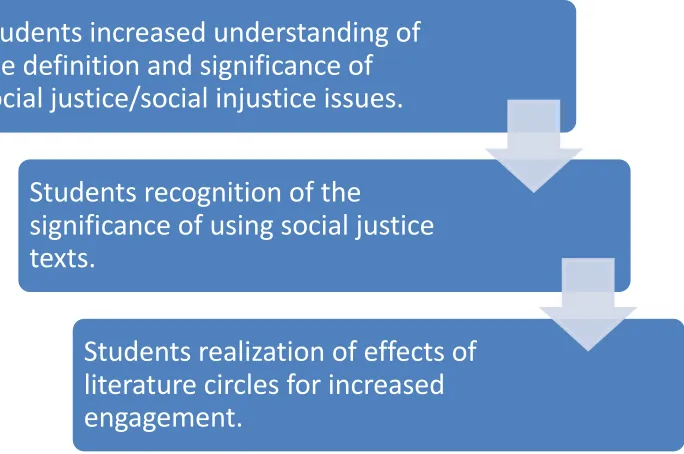
implementing literature circles with social justice texts in a secondary classroom foster engagement in reading and classroom discussions for students? The primary purpose of this proposed action research study was to examine if implementing literature circles with social justice texts leads to increased conversations and engagement in the classroom. The results showed that the students’ self-reported median scores Likert scale from the pre-survey to the post-survey regarding social justice issues and reading engagement showed no significant change. However, the qualitative coding from observations with role sheets and journal entries showed themes which emerged of (1) significance of social justice/social injustice issues; (2) using social justice texts (3) effects of literature circles for engagement.
TABLE OF CONTENTS
DEDICATION ... iii
ACKNOWLEDGEMENTS... iv
ABSTRACT ... v
LIST OF TABLES ... x
LIST OF FIGURES ... xi
LIST OF ABBREVIATIONS ... xii
CHAPTER 1: INTRODUCTION ... 1
1.1 INTRODUCTION ... 1
1.2 STATEMENT OF THE PROBLEM OF PRACTICE ... 4
1.3 RESEARCH QUESTION ... 8
1.4 PURPOSE OF THE STUDY ... 8
1.5 THEORETICAL FRAMEWORK ... 9
1.6 ACTION RESEARCH DESIGN... 11
1.7 SIGNIFICANCE OF THE STUDY ... 13
1.8 LIMITATIONS OF THE STUDY... 15
1.9 DISSERTATION OVERVIEW ... 16
1.10 DEFINITION OF TERMS ... 16
CHAPTER 2: REVIEW OF RELATED LITERATURE ... 19
2.1 INTRODUCTION ... 19
2.3 PROCEDURES FOR LITERATURE CIRCLES... 22
2.4 CHALLENGES WITH IMPLEMENTING LITERATURE CIRCLES ... 23
2.5 CREATING EFFECTIVE LITERATURE CIRCLES ... 24
2.6 BENEFITS OF LITERATURE CIRCLES ... 25
2.7 THEORETICAL FRAMEWORKS ... 26
2.8 REVIEW OF RELATED LITERATURE TO LITERATURE CIRCLES ... 32
2.9 REVIEW OF RELATED LITERATURE TO SOCIAL JUSTICE TEXTS ... 34
2.10 SIMILAR RESEARCH STUDIES ... 36
2.11 CONCLUSION ... 43
CHAPTER 3: METHODOLOGY ... 45
3.1 INTRODUCTION ... 45
3.2 RESEARCH QUESTION ... 45
3.3 CHAPTER OVERVIEW ... 46
3.4 DESCRIPTION OF INTERVENTION... 47
3.5 RATIONALE FOR MIXED METHODS RESEARCH DESIGN ... 49
3.6 ACTION RESEARCH VALIDITY ... 53
3.7 CONTEXT OF RESEARCH STUDY ... 53
3.8 ROLE OF THE RESEARCHER ... 56
3.9 PARTICIPANTS ... 57
3.10 DATA COLLECTION INSTRUMENTS ... 61
3.11 RESEARCH PROCEDURE ... 68
3.12 DATA ANALYSIS: QUANTITATIVE ... 79
3.14 SUMMARY ... 81
CHAPTER 4: PRESENTATION AND ANALYSIS OF DATA ... 83
4.1 OVERVIEW OF STUDY ... 83
4.2 GENERAL FINDINGS ... 87
4.3 ANALYSIS OF DATA ... 106
4.4 SUMMARY ... 109
CHAPTER 5: SUMMARY, CONCLUSIONS, AND RECOMMENDATIONS ... 111
5.1 INTRODUCTION ... 111
5.2 PROBLEM OF PRACTICE ... 111
5.3 RESEARCH QUESTION ... 111
5.4 PURPOSE OF STUDY... 112
5.5 OVERVIEW OF METHODOLOGY ... 112
5.6 RESULTS AND FINDINGS ... 113
5.7 ACTION RESEARCHER AS A CURRICULUM LEADER ... 114
5.8 ACTION PLAN ... 115
5.9 RECOMMENDATIONS FOR PRACTICE ... 116
5.10 IMPLICATIONS FOR FUTURE RESEARCH ... 117
5.11 SUMMARY ... 121
REFERENCES ... 124
APPENDIX A: PARENT/PARTICIPANT LETTER ... 138
APPENDIX B: LITERATURE CIRCLE MODULE SLIDES ... 139
APPENDIX C: LITERATURE CIRCLES ASSESSMENT ... 149
APPENDIX E: OBSERVATION CHECKLIST ... 152
APPENDIX F: UNSTRUCTURED INTERVIEW QUESTIONS ... 153
APPENDIX G: ROLE SHEET DISCUSSION DIRECTOR ... 154
APPENDIX H: ROLE SHEET CONNECTOR ... 155
APPENDIX I: ROLE SHEET ILLUSTRATOR ... 156
APPENDIX J: ROLE SHEET PASSAGE MASTER ... 157
APPENDIX K: ROLE SHEET SUMMARIZER ... 158
LIST OF TABLES
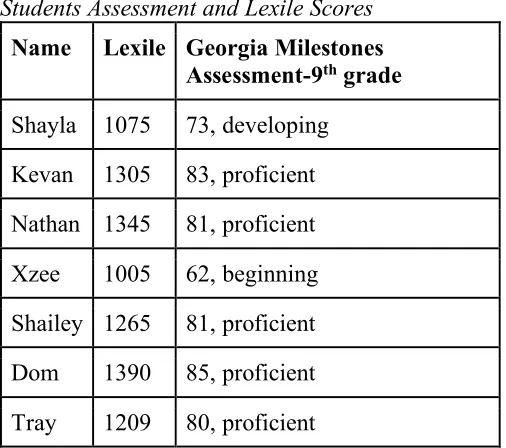
Table 3.1-StudentsAssessment and Lexile Scores ... 60
Table 3.2-Survey Questions ... 63
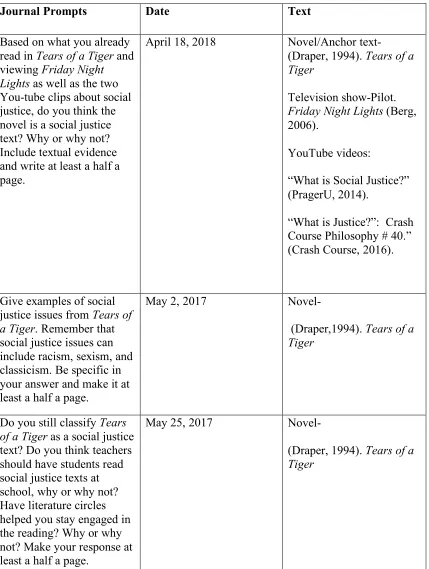
Table 3.3-Journal Prompts... 65
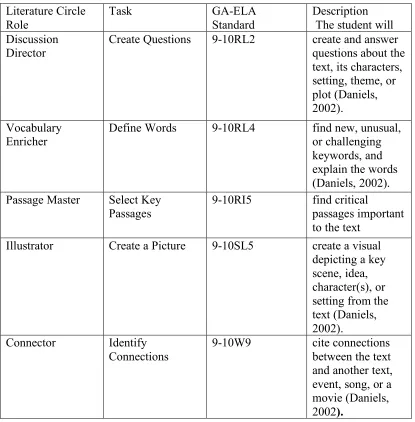
Table 3.4-Literature Circle Roles ... 67
Table 3.5-Research Steps ... 77
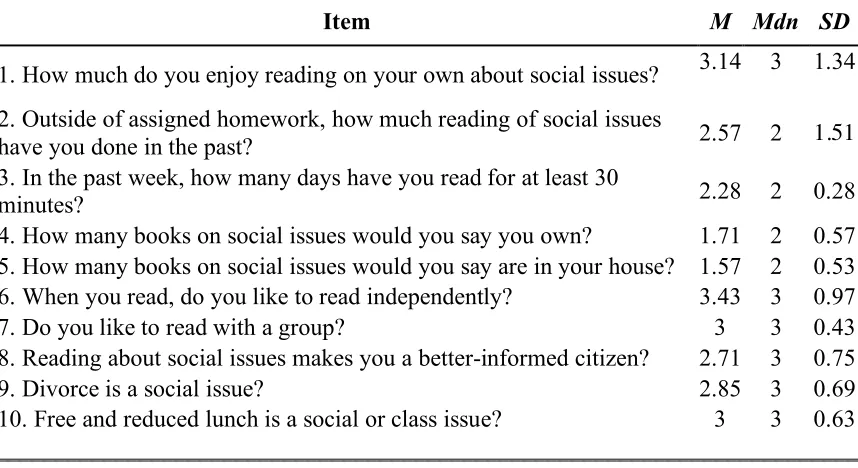
Table 4.1-Item Means, Medians, Standard Deviations Pre-Survey Likert Scale ... 88
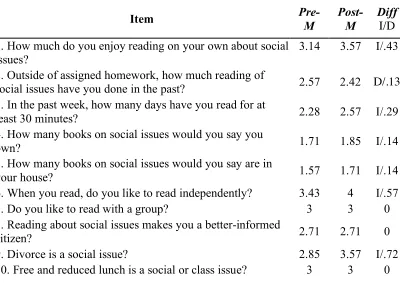
Table 4.2- Item Means, Medians, Standard Deviations Post-Survey Likert Scale ... 90
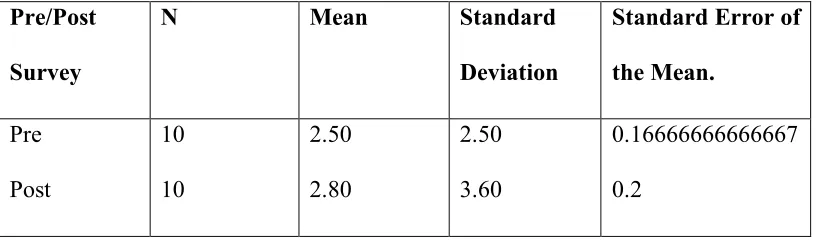
Table 4.3-T-Test Pre and Post Survey Results ... 91
LIST OF FIGURES
Figure 3.1-Project Timeline ... 56
Figure 3.2-Gender of Participants ... 58
Figure 3.3-Ethnicity/Race of Participants ... 58
Figure 3.4-Response to Question About Strategy Involving All Learners ... 74
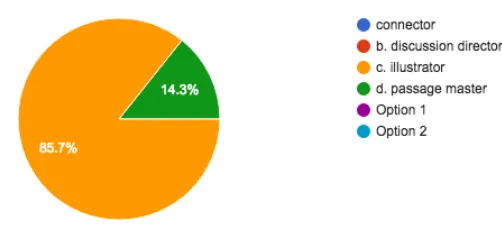
Figure 3.5-Response to Question About Identification of Illustrator ... 74
Figure 3.6-Response to Question About Identification of Connector ... 74
Figure 4.1-Percentage of Pre-survey Median Scores ... 89
Figure 4.2-Themes of Qualitative Data ... 94
Figure 4.3-Scale Observations of Tray During Literature Circles... 98
Figure 4.4-Scale Observations of Nathan During Literature Circles ... 99
Figure 4.5-Scale Observations of Shailey During Literature Circles ... 101
Figure 4.6-Scale Observations of Dom During Literature Circles ... 101
Figure 4.7-Scale Observations of Shayla During Literature Circles ... 102
Figure 4.8-Scale Observations of Kevan During Literature Circles ... 104
LIST OF ABBREVIATIONS
CHAPTER1
INTRODUCTION
1.1 Introduction
United States classrooms are more culturally and linguistically diverse today than ever before (Alsubaie, 2015; Herrera & Kidwell, 2018). The curriculum, classroom discourse, and literacy practices should match the diversity of the classroom (Herrera & Kidwell, 2018). It is critical for students to see representations of themselves in the curriculum that they are studying. Furthermore, the students should also see social justice upheld in the literature. In most secondary curriculum, the focus still remains on White Anglo literary traditions and writing tasks (Heller, 2010). Progressive educators such as Dewey (1938) and current activists such as Comber (2015) have challenged the
traditional pedagogies of schools with modern methods intended to incorporate interests and diversity of students (Williamson, 2016). Even with such educators promoting transformation, few changes in literacy instruction have occurred in the United States (Williamson, 2016).
from outside the United States, drawing on a wide reading of world literature” (Georgia Department of Education, 2015, p. 1). According to NCTE and IRA(1996), secondary students require training in sharing and creating meaning with peers of other races and cultures through language.
The NCTE and IRA (1996) as well as the NBPTS (2016) emphasize the
significance of reading about diversity, but they do not prescribe a specific approach. The NCTE and IRA advocate that multiple reading and writing strategies should be used because all students learn differently (National Council Teachers of English &
International Reading Association, 1996). They further encourage the use of research and observations to create the best materials and processes to develop language arts skills (National Council Teachers of English & International Reading Association, 1996). NBPTS (2016) implores educators to provide occasions for students to use inquiry to observe multiple aspects so that students may develop critical questions from what they are examining. One research strategy which provides a diversity of learning competencies for students is literature circles (Daniels, 2002).
readers are successful in this type of setting because they are involved with one another (Leland, Lewsion, & Hartse, 2018). Herrera and Kidwell (2018) found that these reading discussion groups grant students the opportunity to discuss works with the teacher serving as facilitator.
In the study by Madhuri, Walker, Landmann-Johnsey, and Laughter (2015), literature circles were used. Class members conversed about topics without restraint and they used role sheets to respond to different parts of the literature. When using literature circles, sometimes the responses can be online, but mostly the responses are face-to-face. In literature circles, student groups are usually, pre-selected by the teacher and composed of five to six students either homogeneously or heterogeneously mixed (Wilfong, 2009). Grouping of students can be essential to the group dynamics, as social roles and
expectations enter the discussion and members use these for power and voice at times (Madhuri, Walker, Landmann-Johnsey, & Laughter, 2015). Sometimes each group will read the same text as the rest of the class, but other times each group will read a different book (Daniels, 2002). The teacher serves as a facilitator and circulates among the groups; she or he is not usually a participant (Young & Mohr, 2018). Traditionally, students are assigned different roles within the group which change each time they meet (Barone, D. & Barone, R., 2016). Assignments in the literature circle differ, but common ones include discussion director, connector, illustrator, vocabulary enricher, connector, and passage master (Elhess & Egbert, 2015).
with their groups while they read the text (Herrera & Kidwell, 2018). Each member realizes that he or she has a part to play in the group understanding the whole book (Beers & Probst, 2013). During their group time, they present their completed role sheets to the members of their literature circle (Herrera & Kidwell, 2018; Daniels, 2001). Literature circles provide efficiency for students in that they allow their voice to be heard as they discuss the texts with their peers (Beers & Probst, 2013).
1.2 Statement of the Problem of Practice
The problem of practice is that an increasing number of secondary students, grades 7-9, become disengaged with education (Bland, Carrington, & Brady, 2009). When a student is also from a low economic background the results of this
disengagement can display itself in lack of school attendance, lack of academic success, and a failure to graduate (Bland, Carrington, & Brady, 2008). Teachers experiment with new technologies and new literacies based in research to keep students focused (Herrera & Kidwell, 2018) because being able to read is critical for securing a well-paying career and becoming a participant in society (Neugebauer, 2016). Educators analyze their instructional methods to promote student motivation for reading, and teachers need to measure their students’ degree of motivation correctly and match their instruction to that level (Neugebauer, 2016). Students disengaged in reading will have difficulty in an English class and other classes while those who are engaged will perform well
task behaviors; they justify their lack of engagement on the teacher’s pedagogy or the content of the novel (Kiddey & Robson, 2001).
When teachers desire to discuss social justice in the classroom, they may find students disengaged for several reasons, such as family situations, low self-esteem, or the inability to adapt, and they may not want to read and discuss social issues (Bland,
Teachers know that students must be motivated in order to learn and instructional frameworks help them to engage the learners (McLauglin & DeVoogd, 2004). Engaged learners create personal meanings and read for authentic purposes so the readers can respond in meaningful ways. Readers read because they are curious, need social
exchanges, and need to meet their emotional concerns (McLauglin & DeVoogd, 2004). Many teachers did not read diverse social justice texts when they were students. Research shows that high school students who learned to debate and discuss topics through reading tended to learn the material better (Yazzie, Mintz & McCormick, 2012). Sometimes whole group and individual reading did help students also engage in social justice texts, but literature circles offer a crucial strategy to address all of the concerns of engagement and discussion with social justice texts. When students talk about a text their understanding is increased because they gain multiple perspectives and interpretations (Leland, Lewison, & Hartse, 2018). Learners become excited about reading and discussing books when they collaborate with other students, and they developed their academic vocabulary while participating in literature circles (Barone, D. & Barone, R., 2016).
In the teacher-researcher’s English classes, her students looked forward to participating in group work more than any other activity. However, she often found that when assigning independent reading, many students did not read; if they did read, they could not always interpret the text. Upon asking these students to describe the reason for not completing individual reading, most of them explained that independent reading was difficult and time consuming. Teens preferred group or partner reading, and some even preferred whole class reading. Unsuccessful reading students often justified their
disinterest on the book selection by stating they had no time to read, or the instruction of the teacher did not interest them. Many students did not consider that they were distracted or lacked background knowledge on social justice. As a result, many students waited for the teacher to explain assigned material, asked a friend to describe the book, watched a movie of the book instead, or just failed. When students begin failing in the action-researcher’s school, then the students tend to drop out of school. If students do not read, they may end up failing academically (Pendergast & Bahr, 2005; Bland, Carrington & Brady, 2009). Literature circles can be a hands-on discussion group that can address the often-ignored issues of social justice (Hsiah, 2012; Madhuri, Walker, Landmaan-Johnsey & Laughter, 2015). From the teacher-researcher’s class experience, when students cared about the characters in the text and their social experiences, then they wanted to continue to read them. The students needed relatable issues to their own social justice concerns. In this particular school, poverty was a chief concern as the school was 100% free lunch and Title 1. Reading social justice texts gives students a new awareness of their own
students work their way through the material (Madhuri, Walker, Landmann-Johnsey & Laughter, 2015).
1.3 Research Question
Research indicated that students who disengaged in reading classroom texts also had infrequent school attendance and poor academic performance (Bland, Carrington & Brady, 2009). The goal of this action research was answering the following question in response to the problem of practice regarding reading engagement and discussion of social justice texts.
RQ: Does implementing literature circles with social justice texts in a secondary classroom foster engagement in reading and classroom discussions for students? 1.4 Purpose of the Study
Reading was a key component to the teacher-researcher’s English language arts class. Students were asked to read regarding other cultures and classes, but this was difficult if the students were not learning or being introduced to social justice texts. Disinterest and unawareness of multi-cultural readings on the part of students led the NCTE and IRA (1996) to suggest students must read texts to gain understanding of cultures within the United States and around the globe. Despite the complications of teaching texts that explore social justice issues, Thein, Guise, and Sloan (2012) accepted the challenge from the NCTE and IRA (1996) and utilized literature circles to enable students to analyze texts depicting cultural differences with regard to class, race, gender, and sexuality.
in a literature circle. The intended goal of this study was to discover whether teaching students with literature circles would engross them in social justice text readings and have a positive effect on their ability to discuss social justice issues. This study was in accordance with the identified Problem of Practice of addressing social justice texts engagement and discussions with literature circles.
Educators want to create life-long readers and learners. By using literature circles, the teacher-researcher endeavored to improve students’ engagement and knowledge of social justice texts. Literature circles offered a strategy based on extensive research that provided a framework to use in supporting students, and in helping them become engaged and socially cognizant readers (Daniels, 1994, 2001).
1.5 Theoretical Framework
This action research study is framed around the use of literature circles which is a teaching method drawing on both critical literacy and social-cultural theories (Leland, Lewison, & Harste, 2018; Tracey & Morrow, 2006) that sanctions students to discuss novels in groups (Daniels, 2002). Critical literacy comes from the theories of Paulo Freire (1970). According to Freire, learning involves students using language to ask questions about the power structures that consist in their environments and to use the answers they formulate to take social justice action (Lewison, Leland, & Harste, 2015).
psychological and history (Vygotsky, 1978). According to the social cultural theory, the child’s mental and educational progression develops from his or her social and cultural environment, as well as from the child’s personal history. The culture shapes the child; the child does not shape his or her culture (Vygotsky, 1978; Daniels, 2001; Panhwar, Ansari, S & Ansari, K, 2016).
Literature circles use social settings and assign roles for each group member to maintain focus (Daniels, 1994, 2001). Roles include tasks such as interrogator, group leader, artist, connector, researchers, vocabulary master, summarizer, and group leader (Daniels, 1994, 2002; Tracey & Morrow, 2006). The stratagem worked for requiring children to improve their reading habits (Avci & Yuskel, 2011). Participating readers in literature circles were said to develop a love of reading and gained improvement in reading skills and comprehension skills were reasons to use this strategy, too (Avci & Yuskel, 2011). Educators also stated that numerous readers were excited to learn with books in a group setting (Barone, D. & Barone, R., 2016).
Literature circles build on the critical literacy theory of Paulo Friere (1972). Critical literacy strategies enable learners to use their language to question their world their culture, their power relationships, and then to decide how to take action toward social justice (Lewison, Leland, & Harste, 2015). With critical literacy students learn to make decisions about social issues that will impact their lives. Students can use various means such as arts and technology to show their ideas about social justice (Lewison, Leland, & Harste, 2015). Literature circles can use both the arts and technology as
students report their findings and analyze a social justice text. The goal of critical literacy is for teachers to form a partnership with their learners as they together dive into critical analysis (Lewison, Leland, & Harste, 2015).
1.6 Action Research Design
This study uses action research instead of traditional research. In traditional research the teacher is not the guide for learning, and the researcher often comes from outside of the school or class setting. Action research, however, allows the teacher to be both teacher, researcher, and active participate within the school or classroom (Mertler, 2014). The purpose of action research is to use change to improve education (Mertler, 2014). Action research is relevant, participatory, and practical since educators work together to change their own pedagogies and strategies (Mertler, 2014). This research is reflective, critical, and a planned system of learning (Mertler, 2014).
Surveys according to Dana and Yendol-Hoppey (2014) are helpful when assessing students’ attitudes and conceptions. The surveys aid in analyzing students’ changes in attitudes and understandings over a certain time period (Dana & Yendol-Hoppey, 2014).
After the first pre-survey, the teacher-researcher guided students in a novel study of Tears of a Tiger (Draper, 1994), and with background information on social justice. The novel is a social justice texts which contains themes of racism, sexism, and
classicism. The text used with critical literacy invites the reader to look at the others and hear their voices despite their own personal experiences to gain a greater understanding of social justice issues (Lewison, Leland, & Harste, 2015). Students received information on responsibilities and roles within a literature circle. Students collaboratively worked in literature circles. Prior to literature circle meetings students read the novel, answered comprehension questions, took lecture notes, and completed role sheets. During literature circles students met and discussed the reading assignment. Three times during the study students wrote response journals to the text. The role sheets, literature circle discussions, and journals were measured with coding and qualitative themes emerged. At the
conclusion of the study, students took the survey. The results of the pre-and post-surveys were scored with the Likert scale.
circles regarding social justice discussions at the start of the study was compared with students second survey about reading attitudes and social justice issues at the conclusion of the school year; this type of narrative data was qualitative. These surveys were
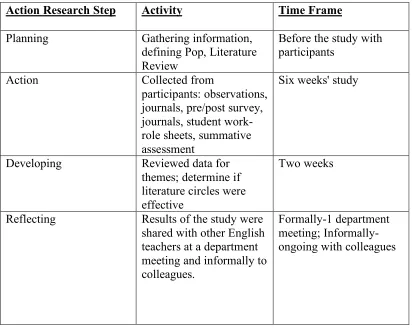
quantitative and the numbers from the Likert Scale were compared, and differences were noted. The research question was used within the six weeks of the literature circle and action research study. The phases included planning, action, developing, and reflecting. Phase one, the planning phase involved identifying the problem of practice and
developing a research plan. During phase two, the acting phase, the teacher-researcher collected and scrutinized information. Phase three, the developing phase, involved creating a plan for improvement based on the findings. Lastly, in phase four, the
reflecting phase, the research question and answers were presented to others. The goal of the action research study was to improve reading engagement and discussing social justice within a literature circle. The improvements in reading involvement and
understanding of social justice should benefit students throughout their school careers. 1.7 Significance of the Study
The importance of the study was that it directed the need for increasing reading engagement and discussion through the use of social justice texts. The study used existing research about reading discussion and reading groups as well as examining how literature circles would pertain to a secondary classroom. The results of this study have
When designing this study, the teacher-researcher was particularly interested in whether students would take leadership and ownership for their learning when discussing the texts. The teacher-researcher has taught in a number of schools for seventeen years. Most of these schools were high school and Title 1 schools. From that experience and through observations and discussions with colleagues, it was apparent that teachers struggled to help secondary students engage with and comprehend their readings. Students, however, would read when the information affected them; for example, they would read news articles and social media if the story pertained to their community. The teens would talk to one another about news and trends in the media. Research shows that when the reading relates to the student and when they have some choice in how they learn, they will engage (Bland, Carrington, & Brady, 2009; Mitra, 2003).
This study was meaningful because it focused on the social justice issues within the texts. There was research that supported the claim that students would engage with a social justice text when allowed some control with the method of pedagogy (Daniels, 2001; Bland, Carrington & Brady, 2009). The action research study was to examine if the approach of literature circles would enable teachers to guide students in a discussion group. The intention of the literature circles were to have students absorbed in
collaboration and critical thinking about the social justice texts when allowed to discuss social justice issues (Madhuri, Walker, Landmann-Johnsey & Laughter, 2015).
teens (Kozol, 2005). Implementing an awareness and preventative intervention improve school conditions when risk factors are examined. The prevention strategies need to be systematic to provide teens, their families and communities with strategies to promote social justice. Such plans need to recognize the norms, attitudes, and beliefs of teens in order for the implementation and evaluation to be effective (Ayala, Lantz, & Hage, 2011).
If students do not read and discuss social texts, they may fail to understand their increasingly multi-cultural world (National Council of Teachers of English, 1996; National Board Professional Teaching Standards, 2016). For these reasons, the focus of this action research project was on teaching students to use literature circles to engage in reading and discussing social justice texts. The goal of this action research was to assess student involvement in discussions about social justice when they used literature circles. 1.8 Limitations of the Study
1.9 Dissertation Overview
The following overview explains how the DiP was organized. Chapter One introduced the reader to the need for social justice texts in the curriculum. The chapter explained how high school students were disengaged in reading. It identified the problem of practice (PoP) in English class, together with the purpose for the action research study, and it advanced the research question that were analyzed.
Next, Chapter Two will review related theories and provide a review of relevant literature. The chapter evaluates the associated works on literature circles, reading engagement, social justice texts, and social justice discussions. Chapter Three describes the mixed method research that was used to accumulate and investigate data and report the results.
The purpose of Chapter Four was to evaluate the findings, discoveries, reflections, and analyses as they related to the PoP; the results were examined. Lastly, Chapter Five included a summary of significant points, conclusions, and suggestions for future research. This chapter presented an overview and suggestions for future research and sharing of the findings with colleagues.
1.10 Definition of Terms
Connector: In a literature circle, the connector will cite connections between the reading
assignment and either another text, world events, personal events, a song, or even a movie (Daniels, 2002).
Critical literacy: Reviews social systems that continue dominant systems of knowledge
Discussion Director: To prepare for the literature circle this student will create and
answer discussion questions about the book, its characters, setting, theme, or plot (Daniels, 2002).
Engagement: Students are involved with community and social interests that can evolve
into political issues which lead to a democratic society where social justice and injustice can be reviewed (Bland, Carrington &Brady, 2009).
Illustrator: To prepare for the literature circle, this student will create a picture, graph,
poster, cartoon, or computer graphic design depicting a key scene, idea, character(s), or setting from the reading assignment (Daniels, 2002).
Literature circles: A peer-led discussion group of six or fewer participants whose
members read the same book. The members make notes and complete a role sheet while reading either in class or out of class to help them participate in the discussion. The role sheets change each meeting, but they help the members come to the group with insights to communicate (Daniels, 2002).
Passage Master: To prepare for the literature circle, this student will find critical
passages while reading that are important to the understanding of the text (Daniels, 2002).
Sociocultural theory: The theory began with Vygotsky (1978) and involves education
Social justice education: Education that allows students to increase their critical skills in
order to comprehend aspects of oppression in their own lives (Bell, 2013).
Summarizer: To prepare for the literature circle this student will summarize what is read
by retelling the story in his or her own words (Daniels, 2002)
Vocabulary Enricher: To prepare for the literature circle this student finds new, unusual,
CHAPTER 2
REVIEW OF RELATED LITERATURE 2.1 Introduction
This research study was focused on engaging students in social justice texts with literature circles. To appreciate the focus of this action research, the review of the literature begins with the examination of the historical context detailing the origin of literature circles in Arizona classroom (Daniels, 2001). After the examination of the historical context, a summary of the significant literature for the theoretical framework that guides this study will be presented. This theoretical framework is grounded in sociocultural theory and critical literacy theory (Freire, 1970). Additionally, the review examined research related to teaching and using social justice education (Williamson, 2016). Both the historical context, theoretical framework, and social justice education underscored the problem of practice addressed in the study. Lastly, the review of literature examined research studies focusing on historical inquiry.
2.2 Historical Context
collaborative learning and book talks. Students then began self-selecting books and participating in small group discussions (Harvey & Daniels, 2009). Literature circles as they are known today can be traced back to the book talks that Hooked on Books (Fader & McNeil, 1969) first introduced.
Daniels (2001) traced the inception of literature circles to 1982 when elementary teacher Karen Smith in Phoenix, Arizona, found an old box of books and allowed her students to read them in groups and discuss them. Smith had a box of novels but had three copies of one title or four of another. Her students asked if they could read them during independent reading. After a couple of days, the students spontaneously began meeting with other students reading the same book, assigned readings, and discussed portions of the same book (Daniels, 2001). Literature circles were student led from the beginning as the students were actually the inventors (Daniels, 2002). Smith was amazed at the depth and energy of their conversations and sought to formalize their informal reading groups as part of the class.
Harvey "Smokey" Daniels, a city and suburban teacher, furthered Smith’s work with literature circles. He has conducted research using literature circles and now conducts professional development teaching other educators globally this strategy (Daniels, 2002). In 1993, Daniels, who was a city and suburban teacher worked with twenty teachers with literature circles to create “Best Practice: New Standards for Teaching and Learning in America’s Schools” (Zemelman, Daniels, & Hyde, 1993). Daniels adopted Short’s coined term of literature circles to describe book clubs as she coined it in her dissertation research (Daniels, 2002). Ralph Peterson and Maryann Eeds (1990) had the only other book, Grand Conversations about book clubs (Daniels, 2002).
as Tracey and Morrow (2006), Avci and Yuskel (2011), and Barone, D. and Barone, R. (2016) have expounded upon Daniels research and used his initial procedures for operating literature circles. Researchers such as, Herrera and Kidwell (2018) have taken literature circles digital.
2.3 Procedures for Literature Circles
In order for students' voices to be heard in literature circles, specific procedures must be followed (Daniels, 2001). First, literature circles were used for students to work independently through a text; the students share their experiences of reading and
discussing the book with their group members (Kim, 2017). Usually, the groups were pre-selected by the teacher and were composed of five to six students either
homogeneously or heterogeneously mixed (Sportsman, Certo, Bolt & Miller, 2011). The group members were responsible to one another for collaboratively interpreting the assigned text (Low & Jacobs, 2018). The teacher served as facilitator and circulated among the groups (Kim, 2017; Ehless & Egbert, 2015; Thomas, 2014). Traditionally, students were given different roles for their participation which changed each time they met; roles in the literature circle differed, but the ones listed by current researchers Elhess and Egbert (2015) were discussion director, connector, illustrator, vocabulary enricher, connector, and passage master. Students within the same group read the same text and usually created a final product that they presented to the whole class who may be reading a different text (Kim, 2017). The students completed a role sheet before meeting with their groups while they were reading the text (Avci & Yuskel, 2011; Herrera & Kidwell, 2018). During their group time, they presented their completed role sheets to the
2.4 Challenges With Implementing Literature Circles
Even with role sheets for each member literature circles are not without
challenges when they are implemented (Daniels, 2002). Students needed guidance during literature circles when they tackle material that is controversial such as social justice issues (Madhuri, Walker, Landmann-Johnsey & Laughter, 2015; Thomas, 2014). Daniels (2002) provided guidelines which included a need for role sheets, accountability, and assessment. The structure was needed for the discussion groups or literature circles to impact engagement and increase a depth of conversation regarding social class (Madhuri, Walker, Landmann-Johnsey & Laughter, 2015). This is why many educators use the role sheets to maintain structure and purpose for the discussion groups (Low & Jacobs, 2018; Elhess & Egbert, 2015).
Because educators are not always able to gauge reading motivations and shifts in motivation occur daily during reading activities, teachers need support in determining when the motivation for reading changes and they need strategies to help them capitalize on activities that do engage students (Neugebauer, 2016; Burns et al., 2015). Literature circle motivation needs structure and purpose to evaluate the motivation (Herrera & Kidwell, 2018). Role sheets have been replaced in some circles for logbooks, but the remaining goal was accountability and purpose for the students’ participation (Daniels, 2006).
should reflect students’ values and interests socially and culturally (Kim, 2017; Barone, D. & Barone, R., 2016). Students became engaged and reported that they liked reading because of the literature circles (Avci & Yuskel, 2011).
2.5 Creating Effective Literature Circles
For the circles to be productive students have to have a predictable schedule and bring writings or drawings to each meeting to aid in the preparation and implementation of the discussions with the group (Daniels, 1994). While students are independently reading, they may gain help from the teacher (Beers & Probst, 2013; Kim, 2017). The teacher needs to facilitate and observe the groups while taking notes; the lesson should provide scaffolding prior to the literature circle and sometimes while the literature circle is happening (Young & Mohr, 2018; Ehless & Egbert, 2015). The literature circles operated much like a book club, but the students have assigned roles to guide the discussion (Daniels, 1994; Herrera & Kidwell, 2018). Students want to hear what their classmates discover in the text, and they will often go back to the text for support for their contributions to the discussion (Barone, D. & Barone, R., 2016). Learners enhance their comprehension and knowledge while they discuss and write about the novels (Barone, D. & Barone, R., 2016).
Scaffolding with literature circles was necessary for implementing literature circles (Daniels, 2006; Herrera & Kidwell, 2018).
2.6 Benefits of Literature Circles
The benefits for literature circles are numerous. Literature circles encourage improvement in language, reading comprehension, and vocabulary acquisition (Elhess & Egbert, 2015). Besides promoting better reading skills, literature circles foster
engagement for students (Thomas, 2014; Hughes, 2014). The students do well because the lessons permit more than one right answer or interpretations of the readings (Kim, 2017). The teacher’s role in literature circles is as a guide, and not the direct instructor (Elhess & Egbert, 2015). The learners often are more at ease speaking with their
classmates in discussion groups than being corrected by the teacher; thus, the students are confident to share their views without fear of making an error (Elhess & Egbert, 2015).
The discussions during literature circles should resemble that of friends meeting and discussing the same topic (Daniels, 2002). Middle school students learn well from this because they enjoy peer relationships and cooperation (Yazzie-Mintz & McCormick, 2012). This is a way for students to collaborate and discuss their understandings of the book (Daniels, 2002). When the implementation of literature circles is done correctly, they create an atmosphere which promotes connections and engagement among students, which develops reading skills (Hughes, 2014; Ehless & Egbert, 2015). Learning to work with a team in a literature circle is also a transferable skill for college and career
(Marchiando, 2013).
strategy; this contentment leads to creativity, critical thinking, and better language skills (Hughes, 2014; Kim, 2017; Sanacore, 2013). The students become more empowered and responsible for their learning; collaboratively the students comprehend more (Daniels, 2002; Day & Lum, 2011; Day, Spiegel, McLellan, & Brown, 2002). Students can more easily share their critical thinking about the book in the non-threatening environment of the small group (Sanacore, 2013). In a literature circle, learners experience multicultural books, viewpoints, and positions (Coles-Ritchie, 2013; Kim, 2017; Sportsman, Certo, Bolt, & Miller, 2011; Sanacore, 2013).
Literature circles aim for equitable experiences for all; the literature circles are a means for all students to have a say in the smaller groups. Students are allowed a voice with these groups (Marchiando, 2013). The strategy is made for differentiation for the lowest reader to the highest and for those with mastery of English language to those where it is their second language (Sanacore, 2013). Literature circles encourage students to develop their connections, interests, and enthusiasm in the reading texts.
2.7 Theoretical Frameworks
Literature Circles from Sociocultural Theory. Sociocultural theory is a theory
others support the students, and (5) show the students ways to complete the assignments so learners can internalize the skills (Vygotsky, 1978). Vygotsky considered being able to teach and to learn the most significant aspect for humans (Daniels, H., 2016). The learner must interact and construct knowledge from his or her community (Vygostsky, 1978). The sociocultural theory has the capability of creating innovative language strategies to aid teachers with instructing in language and reasoning (Panhwar, Ansari, S., & Ansari, K., 2016). The theory shows that acquiring knowledge is a process which develops individually from a person’s relationships and experiences to enable the person to solve problems for his or her society (Larson & Marsh, 2015).
Vygotsky (1962) claimed that languages developed from the connection between thinking and speaking and begins with social interactions (Larson & Marsh, 2015). Vygotsky (1978) took sociocultural theories further with incorporating learning experiences with cooperative interaction from the environment in the proximal development. He writes of guided participation in world cultures and explains that it would work for classrooms (Vygotsky, 1978). The zone of proximal development builds upon the scope of a student’s ability from a starting level to where the student can solve a problem with guidance (Larson & Marsh, 2015). With the zone of proximal development in mind, Vygostsky (1978) also used More Knowledgeable Others (MKOs) which would be anyone or anything with a higher learning level than the learner for a particular task; he felt learning could not occur without an MKO. Vygotsky explains how teachers guide students to participate which leads to thinking creatively while they engage in
engaged in literature circles create a cooperative learning group to complete their tasks of reading and discussing their texts, acting as MKOs through different roles within the group (Daniels, 1994).
Learners develop knowledge from interacting with others and their environment (Vygotsky 1978). To study a student and omit his or her social or cultural communities would be to remove the most crucial parts of the child’s life (Panhwar, Ansari, S., & Ansari, K., 2016). The sociocultural theory is the basis for reading social justice texts. Activities for engagement of students should evolve around sociocultural norms of the particular content. The students work collaboratively to solve critical problems from their prior experiences and with their new information they gather (Panhwar, Ansari, S., & Ansari, K, 2016).
The theory is successful because teachers serve as guides for the learners as the learners are responsible for their learning like they are with literature circles (Thomas, 2014; Herrera & Kidwell, 2018). The classroom is student centered as they make the decisions for their learning, while the teacher is the facilitator (Thomas, 2014; Pahdwar, Ansari, S., & Ansari, K., 2016). Students learn with this theory when curriculum is guided by sociocultural theory because learners are engaged instead of passively receiving information (Pahdwar, Ansari, S. & Ansari, K., 2016).
circles, students solve their problems while they collaboratively discuss the texts and use their critical thinking (Sanacore, 2013). The literature circles are autonomous and
student-centered. The discussions are student to student and student to teacher, which is based on the theory of sociocultural theory and constructivism (Pandwhar, Ansari, S. & Ansari, K., 2016).
Additionally, the review examined research related to teaching and using social justice education (Williamson, 2016). Both the historical context, theoretical framework, and social justice education underscored the problem of practice addressed in the study. Together the review of the literature informed decisions for the problem of practice and led to the better usage of the literature circles to increase reading engagement and discussion (Hughes, 2014).
Literature Circles with Critical Literacy. Critical literacy is a theory that can be
learning (Larson & Marsh, 2015). Freire taught that problem-posing education allowed people to educate each other by thinking about the world as transformative (1970).
Critical literacy involves four dimensions according to Lewison, Flint, and Van Sluys (2002):
(1) disrupting the commonplace, (2) interrogating multiple viewpoints, (3) focusing on sociopolitical issues, and (4) taking action and promoting social justice (p. 7).
The goal is to see everyone through an equal lens, with multiple perspectives and
sociopolitical viewpoints. A key component that makes critical literacy applicable for this study is that it takes action and promotes social justice which is critical when students read a social justice text (Lewis, Flint, & Van Sluys, 2002). Freire builds on the teachings of Dewey in Pedagogy of the Oppressed (1970), he calls traditional teaching practices that Dewey identified a “banking model.” In this model students are like piggy banks that teachers fill with knowledge instead of money. Both Freire and Dewey encourage
students to partner with teachers and other students to develop new knowledge instead of being filled with knowledge like a bank. Learning then becomes social and political (Freire, 1970). Freire allows writes of the “transmission ideology” which explains how a dominant group or ideology sustains control. Exploration is not part of this model as teachers transmit knowledge and students do not construct knowledge (Freire, 1970). Background knowledge of students is not important of a transmission classroom unless it represents the dominant ideology.
1970). The theory of Freire (1970) is to critically transform the content from “speaking the word” to “names the word” (p. 69). The goal is to create democratic participation while they become critically aware citizens. This gives students the language to become more critically aware (Freire, 1970). Freire (1985) took critical social theory into education. For him like the social theorists, language would bring about social reconstruction. Sociopolitical and historical forces required examination for critical pedagogy to effect learning (Freire, 1970). Teachers know that critical literacy invites students to both question and examine power relationships between readers and authors for the purpose of reflection, action, and transformation (Freire, 1970). According to Freire (1973), the critical transformative strategy contains, “active, dialogical, critical method” which encompasses “changing the program content of education” (p. 45). When selecting curriculum sociocultural and critical dimensions become crucial (Freire, 1973). Critical literacy strategies allow students to engage with texts from a critical perspective. Students look at texts for social and power relationships within the story (McLauglin & DeVoogd, 2004). The focus on students learning to be critical thinkers is critical literacy that promotes critical questioning, collaboration towards a positive social change in the world (Early & Shagoury, 2005).
2.8 Review of Related Literature to Literature Circles
The influence of sociocultural theory (Vygotsky, 1978) and critical literacy theory (Freire, 1970) are found in the literature regarding literature circles. Daniels’ (1994, 2001, 2004, 2006) research served as the foundation for literature circles to show that the
strategy did help students grow in their reading abilities. Sociocultural theory and critical literacy theory continue to impact the literature circles of today. Literature circles work for allowing children to develop the habit of reading (Avci & Yuskel, 2011). A goal of the National Board Standards in English is for children to read for pleasure and the love of reading (2016); participating readers in literature circles are said to develop a love of reading (Thomas, 2014).
Improvement in reading skills and comprehension skills are reasons to use this strategy, too (Avci & Yuskel, 2011; Ehless & Egbert, 2015). Literature circles and book club discussions have been connected to higher reading achievement in all grade levels and social classes; reading discussion groups aided bilingual and English as second language learners, also with encouraging higher reading achievement (Daniels, 2001). Students participated in reading groups and used critical thinking and meaningful discussion as opposed to whole class group discussion (Sanacore, 2013). The groups promoted independence and interdependence as well as student choice and voice for discussion (Sanacore, 2013). Educators also state that many students learn books better in a group than when they read the books individually (Mahar, 2001; Avci & Yuskel, 2011).
Learning in literature circles occurs in collaborative communities in reading groups that aid with engagement (Hughes, 2014). The teacher assigns the task of
methods of completing their role sheets (Herrera & Kidwell, 2018). In literature circles students sketch and discuss with their members when they have the role of illustrator. The sketching and discussing leads to engagement (McLauglin & DeVoogd, 2004). The student voice and choice of these groups help students develop as independent learners and thinkers; sometimes students even choose which text they want to read (Marchiando, 2013). Literature circles aid in building community in that they can be done through blogs and family literature circles (Day & Lum, 2011). This would mean building
community beyond the classroom through literature circles. Family literature involves the student and their parents, and sometimes grandparents and siblings reading the same novel and often meeting with other members of a school community to discuss the novels (Day & Lum, 2011).
Daniels (1994, 2001, 2004, 2006) used literature circles to produce growth in the lower grades, but not as much research has been done in the middle and higher-grade levels, especially with regards to engagement in reading from the literature circles (Hughes, 2014; Daniels, E. 2011). Reluctant students toward reading engaged when they were part of the decisions about how and what they read, such as in literature circles (Sanacore, 2013).
about his observations in “Slow Down, You Move Too Fast”: Literature Circles as Reflective Practice. Sanacore (2013) stated that literature circles helped learners slow down and develop metacognitive skills about the lessons. The literature circles built confidence in students who created all their responses about social justice (Sanacore, 2013). The students gained confidence because they slowed down to complete their role sheets and study the textual evidence. Students needed time to reflect on literature regarding social justice, and literature circles helped them to do this; students needed a balance between personal and critical reflection about their readings. Sanacore (2013) researched as a participant/observer. Sanacore’s method was to “hook” the readers in a personal way to something they already showed interest in with their personal life.
Sanacore (2013) suggested students practice with literature circles before using them with multicultural and social justice texts. Also, he stressed the use of scaffolding for both literature circles and social texts (Sanacore, 2013).
2.9 Review of Related Literature to Social Justice Texts
Scaffolding (Vygotsky, 1978) is a way to ensure equity in education, but
issue of social justice in the same way they taught how to discuss other complex and controversial topics.
Social justice is often overlooked in secondary classrooms, but social justice discussions should not be ignored (Thein, Guise, & Sloan, 2012). Educators have difficulty in agreeing what social justice is because there are multiple meanings of the term (Williamson, 2016; Thein, Guise & Sloan, 2012). Often teachers have never
received lessons about what social class is nor have they received lessons on how to teach about social classes (Thein, Guise, & Sloan, 2012). Pre-service and in-service educators discovered from reading literary texts about social class that they had much to question and investigate within their societies (Thein, Guise, & Sloan, 2012). If English educators ignore social justice in the classroom, however, it will affect students’ literary
interpretation (Thein, Guise, & Sloan, 2012).
Teachers need to instruct concepts of race and other social justice issues and the vocabulary with before using literature circles or other strategies to approach the social justice text (Madhuri, Walker, Landmann-Johnsey, & Laughter, 2015). Also, teachers need to define the vocabulary of social justice issues in order for students to be able to apply them to the literature when they encounter them (Madhuri, Walker, Landmann-Johnsey, & Laughter, 2015). Class is one of the social justice issues that may be difficult to define and often uncomfortable to discuss; even so, teachers of English language arts cannot ignore discussing classism or any of the other social injustice issues such as,
Reading about social justice was invaluable to students’ global development (Price-Dennis & Carrion, 2017; National Board for Professional Teaching Standards, 2016). Educators may wonder why a discussion on social justice matters, but researchers (McLachlan Gilfillan, & Gordon, 2013; Comber, 2015) know there is a connection between economic disadvantage and academic achievement. Many students from lower socioeconomic classes struggled to compete in a secondary education system
(Neugebauer, 2016). Children in poverty statistically score lower in academic
achievement than their peers in higher economic brackets (Comber, 2015). Students need to make personal connections to topics of race and class in what they read (Madhuri, Walker, Landmann-Johnsey & Laughter, 2015). Social justice was an aim and a process; social justice’s aim was for society’s groups to equally participate in all the same
resources (Bell, 2013). Teachers should have a say in social justice curriculum as this leads to improved instruction based on the influence of students and colleagues (Williamson, 2016).
2.10 Similar Research Studies
Teachers have used literature circles as a way for them to guide students through social justice (Williamson, 2016). Several cases were examined for their effectiveness in implementing literature circles. The first case study came from Thein, Guise and Sloan’s
Exploring the Significance of Social Class Identity Performance in the English
Classroom: A Case Study Analysis of a Literature Circle Discussion (2012). The purpose of the study was to explore how social class identification and the effects it had on
socioeconomically diverse backgrounds (Thein, Guise, & Sloan, 2012). The pseudonyms of the towns are Venice and Mapleton outside of a large Rust Belt city. The class setting is a tenth grade English class in a Caucasian school (Thein, Guise, & Sloan, 2012). The instructional model they used was based on the work of Harvey Daniels’ (2002) literature circles, and the students rotated through the various roles of the connector, discussion director, and the like. Students met thirty minutes twice a week. The roles for each group member were assigned in order to maintain focus (Thein, Guise, & Sloan, 2012; Daniels, 1994; 2002; Herrera & Kidwell, 2018). Thein, Guise, and Sloan (2012) stated that their findings show the complex nature of social class identity with the relationship to textual interpretations within a literature circle. They stated, “As our case study will demonstrate, discussion of Bastard Out of Carolina in a literature circle context compelled each of these students to improvise a unique social class identity that became increasingly sedimented through social class performances related to both their participation and interpretations in this context” (Thein, Guise, & Sloan, 2012, p. 226). Teachers need to construct curriculum based on social class and with an awareness of social justice based on social class (Labadie, Pole, & Rogers 2013). Discussion regarding inequalities with income should not be a low priority with regard to categories of identities and should have priority with how social class relates to gender in race for school curriculum (Hunt & Seiver, 2018).
of her childhood (Allison, 1992). The setting of the story is the South during the fifties and is a view of the social class hierarchy of the Southern town (Allison, 1992). It is a depiction of a social class that many students in other areas of the United States and the world may not know firsthand but can learn of through reading, as the NCTE and IRA suggest (1996). Researchers wanted the students engaged in meaningful discussions concerning social justice themes in small groups. The outcomes of the collaborative discussions involved hands on, role specific activities (Thein, Guise, & Sloan, 2012).
For the methodology, the researchers used data from a larger qualitative study of ninety
tenth-grade students' literacy practices. In that study, Thein, Guise, and Sloan (2012) had
interviewed fifty-seven students from the school about their opinions of the differences
between the communities of Venice and Mapleton. The researchers used data from the
focal group in the form of transcripts from twelve digitally recorded discussions and
semi-structured interviews with the participants regarding their involvement in the
discussions. The researchers used coding for their interpretations of their observations
regarding the students’ social class identity with their family, community, and school,
their participation in the literature circle, and their primary textual interpretations. The
data showed the complications of social class identity performance with the relationship
of textual interpretation and participation in a literature circle (Thein, Sloan, & Guise,
2012). Thein, Guise, and Sloan (2012), also used the sociocultural theory of emotion and studied how emotions impacted literature learning. Emotions were a part of every lesson in every classroom.
social constructs of race and gender (Thein, Guise & Sloan, 2012). The researchers following their study encountered challenges with other teachers wanting to implement literature circles for social justice texts in their classrooms but not knowing how to do it; they discovered that English educators did not want to continue to ignore social issues that may not be in their comfort level (Thein, Guise & Sloan, 2012). Language arts teachers may not have the background in instructing in social issues and may be
uncomfortable discussing the topics in whole group discussions (Thein, Guise & Sloan, 2012). Also, they found that teachers have to collaborate with their students to learn their students social and cultural background for literary engagement to occur (Thein, Guise, & Sloan, 2012). The educators must have prior knowledge of their students and knowledge of how to instruct about social issues. Instructors had to learn how to instruct with hands on methods such as literature circles (Null, 2004; Thein, Guise, & Sloan, 2012).
Later, Thein, Guise, and Sloan (2015) wrote of the same qualitative case study further studying qualitatively literature responses from social justice texts. Their purpose in the study was to examine the sociocultural theory of emotion to see how emotion helps students with learning literature. Emotions impact classroom learning. Emotional rules that the students set for themselves were used both in a seminar circle and a literature circle while discussing literature (Thein, Guise, & Sloan, 2015).
They reviewed what Nina, a white, middle-class student said in the context of two different literature discussion methods. The sample size was Nina, but she was also part of sixteen students reviewed for participation in a month-long unit on To Kill A
participant, was part of data they collected of ninety tenth-grade students (Thein, Guise & Sloan, 2015). The tenth-grader was chosen because of her high academic achievement and her range of reading interests, engagement, and abilities (Thein, Guise & Sloan, 2015). Her responses to literature in a seminar versus the literature circle differed and caused researchers to wonder if the emotional response to the situation of the format for discussing the literature was the reason (Thein, Guise & Sloan, 2015). Nina’s social-cultural experience in how she discussed the literature impacted her learning because it was a new experience of how she talked about the works (Thein, Guise, & Sloan, 2015).
Thein, Guise, and Sloan (2015) recommend that despite the complications of teaching social justice texts, the benefits for the students outweigh any obstacles. The NCTE, IRA (1996) and NBPT (2016) stress the importance of this topic as well and lament the absence of such classroom discussions about social justice issues. In order to review how students, participate in literature circles and discussed social justice, some key concepts and methods should be clarified. The key concepts for the Thein, Guise, and Sloan study were literature circles, classism, social justice, and engagement (Hughes, 2014; Thein, Guise & Sloan, 2015). Thein, Guise, and Sloan (2015), suggested students analyzed texts through literature circles depicting cultural differences concerning class, race, gender, and sexuality. Thein, Guise, & Sloan, (2015) stated:
Our findings advance scholarship on the relationship between response and emotion by suggesting that emotion cannot simply be invited in or left out of the literature classroom in the interest of moving students toward literary
and must be noticed, interrogated, and sometimes disrupted in the interest of expanding interpretive possibilities. (p. 202)
Thein, Guise, and Sloan (2015) showed how focused curriculum about race, gender, and class impacted a classroom. These discussions cannot be ignored because social justice played into aspects of students’ lives (Thein, Guise & Sloan, 2015).
Teachers needed to be equipped to address social justice in the same way they learned to discuss other complex and controversial topics (Thein, Guise & Sloan, 2015). These researchers aimed to clarify perceptions regarding class identity including backgrounds, education, region, and family (Thein, Guise & Sloan, 2015). These studies were limited with time restraints; for example, in the Thein, Guise, and Sloan (2015) study, students only met for thirty minutes twice a week. Teachers needed to know “how to group students, what kind of discussion tasks are better to be used with students, understanding cultural differences of those involved in social interactions, and reconsidering their definition of ‘struggling’ readers” (Chen, 2008, p. 81).
Literature circles enabled teachers to instruct about social justice to students in a Title 1 school (Thein, Guise, & Sloan, 2015). Title 1 schools are a classification that developed from the No Child Left Behind Act (NCLB), and these schools came from the section of the federal Elementary and Secondary Education Act (ESEA). This act first passed in 1965 and then was revised in 2004 as Improving the Academic Achievement of the Disadvantaged (U.S. Department of Education). The purpose of this act was to have a higher quality of education for low-income and minority students with grants,
Another study examined how effective forty-six, conveniently sampled, teachers in Istanbul, Turkey, found literature circles to be as an effective strategy when they participated in the discussion groups themselves (Aytan, 2018). The study used the qualitative approach with unstructured interview (Aytan, 2018). This means that sixteen of the teachers consented to be interviewed. The interview was considered unstructured because the interviewer could use his personal opinion and judgment to move the
conversation and be spontaneous without being dependent on a set of prepared questions (Aytan, 2018; Gall, Borg, & Gall 1996). As a result of the study, the teachers stated that they would implement the practice of literature circles in their classrooms (Aytan, 2018). Educators found literature circles useful for building collaboration, teamwork, analyzing other viewpoints, building vocabulary, and displaying unknown talents in the pupils (Aytan, 2018).
In another study, the engagement of middle schoolers were examined for their enthusiasm for participating in online literature circles with college students (Thomas, 2014). Sixty-eight students and eighteen college students were the sample size for the study which lasted for four weeks (Thomas, 2014). The study was a qualitative analysis of the data consisting of surveys, interviews, and online discussion posts. The results showed the middle school students were motivated to participate in online literature circles (Thomas, 2014).
grammar and developed their language with the books and discussions as well as vocational content knowledge. The teachers worked as guides and provided scaffolding for the students who worked collaboratively in the discussion groups (Widodo, 2016; Vygotsky, 1978).
2.11 Conclusion
When teachers are guides and provide scaffolding for literature circles, students can work collaboratively (Widodo, 2016; Vygotsky, 1978). As the literature review revealed, scaffolding has long been a part of literature circle implementation (Vygotsky, 1978). In addition, the literature review looked into the history and current status of literature circles usage in English classrooms (Daniels, 1994; Thein, Guise & Sloan, 2015). Challenges teachers and students face when participating in discussions of social class texts was also reviewed in the literature review (Thein, Guise & Sloan, 2012). The literature review also covered a historical overview of what a literature circle was and how classrooms implemented them, with a focus on particular role features (Daniels, 1994, 2001). Related methodologies and cases were also reviewed (Thein, Guise & Sloan, 2012, 2015; Widodo, 2016, Thomas, 2014; Aytan, 2018).
CHAPTER 3
METHODOLOGY
3.1 Introduction
This action research study examined the challenge of engaging secondary students in reading social justice texts. The Problem of Practice (PoP) arose from secondary schools continuing to attempt to connect learners with reading, amid all the digital tools taking up students’ interests and time. In addition to the challenges connecting students with reading, students today are in more culturally and socially diverse classrooms, introducing a greater need for the readings chosen to reflect the cultural environment of the students. According to the GADOE (2015) and NBPTS (2016), students' reading and discussion of texts should reflect social justice changes, and a method for facilitating such discussion is literature circles.
3.2 Research Question
The dissertation in practice answered the following research question using the triangulation mixed-method action research design.
RQ: Does implementing literature circles with social justice texts in a secondary classroom foster engagement in reading and classroom discussions for students? Success in this context comes from engagement from reading social justice texts and improved classroom discussion.
The first purpose of this study was to consider if the use of literature circles would engage students in a social justice text. The researcher of this study was positioned with insider/outsider status within the study. In this mixed-methods, triangulation study, the researcher worked as a tenth grade English Language Arts (ELA) teacher. The class was a heterogeneous group of students. Over the course of six weeks, the researcher
3.4 Description of Intervention
Before the study began, the researcher reviewed her district standards and
curriculum to see if any current texts would meet the criteria of being a social justice text. The researcher was not allowed to stray from the assigned curriculum. Tears of A Tiger
(Draper, 1994) was required district reading. It also meets the criteria to be classified as a social justice text since it deals with issues of racism, sexism, and classism. Many books can facilitate critical literacy experiences. However, it is not the text that creates critical awareness but instead it is the critical analysis and discussion that students engage in through their questioning and examining (McLaughlin & DeVoogd, 2004). The teacher-researcher continued to investigate the best methods of using literature circles and introduced the teaching strategy early in the year, so the students were familiar with the pedagogy before the action research. First, the researcher needed administrative and district-level permission to conduct the research study. The administrator approved a consent letter as long as it met the approval of the district research review board which the study did. At the beginning of the term in which the action research occurred, the students in tenth-grade ELA received permission slips to be a part of the study. The parents or guardians signed these permission slips.