Building a multilingual parallel corpus for human users
Alexandr Rosen, Martin Vavˇr´ın
Charles University in Prague, Faculty of Arts [email protected], [email protected]
Abstract
We present the architecture and the current state ofInterCorp, a multilingual parallel corpus centered around Czech, intended primarily for human users and consisting of written texts with a focus on fiction. Following an outline of its recent development and a comparison with some other multilingual parallel corpora we give an overview of the data collection procedure that covers text selection criteria, data format, conversion, alignment, lemmatization and tagging. Finally, we discuss challenges and prospects of the project.
Keywords:parallel corpora, multilingual, Czech
1.
Introduction
Building any parallel corpus, and especially one including many languages, requires an opportunistic approach, be-cause a balanced mix of texts is hard to achieve even for written language. The balance may be a problem especially when the primary users are humans (teachers and students of foreign languages, translators or linguists), rather than applications (e.g., in machine learning). In comparison to monolingual corpora, some types of texts are rarely avail-able as translations (e.g., spontaneous non-literary writing such as personal correspondence). We try to solve this problem by including a substantial share of original and translated fiction, even though it is a more costly alterna-tive to genres freely available on the web. Additionally, languages with fewer native speakers may end up as under-represented mainly due to a smaller pool of original texts, which also results in a skewed overall balance between originals and translations. A higher share of “institutional” translations in such languages (often provided as manda-tory within an organisation or service) makes up for the quantitative loss, but does not make the corpus more bal-anced genre-wise.
An opportunistic approach is needed also because taggers and other available language-specific tools are not tailored to the needs of a multilingual environment and the develop-ment of a single consistent suite covering all our languages is not a realistic target. The issue of a heterogeneous set of linguistic tools can be ignored as long as they produce useful results, but in the long run we have to resolve their conceptual and formal incompatibility.
To produce more reliable corpus data, most of our auto-matically pre-processed texts are manually checked for ty-pos, segmentation and alignment errors within a dedicated parallel text editor/aligner. Morphosyntactic annotation is provided for languages where taggers or lemmatizers are available. The result is available for on-line searches, and options to provide entire texts in a scrambled format are available to satisfy some application-driven demand. After an overview of the corpus in the context of some other multilingual parallel corpora in§2. we present a sketch of the pre-processing workflow in§3., before going into some detail about the linguistic mark-up in§4., presenting a sam-ple query via our user interface in§5. and concluding by an outlook in§6.
2.
An overview of
InterCorp
InterCorpis a parallel synchronous corpus of written lan-guage, built since 2005 at the Faculty of Arts of Charles University in Prague. Currently, in its release 4 at the end of the project’s first phase (December 2011), it includes 92 mil. tokens in 22 languages plus 46 mil. tokens in Czech. Czech serves as the pivot: all ‘foreign’ texts have their Czech counterparts, while a foreign text may have no coun-terpart in another foreign language. More languages, more data and more sophisticated and reliable annotation, to-gether with improved user interface and export options, are previewed for the second phase of the project, due to end in 2016.1
Unlike other corpora involving many languages but built from open-source data, such as Opus(Tiedemann, 2009) andJRC-Acquis (Steinberger et al., 2006), but like some other multilingual corpora oriented primarily towards lin-guists, students and translators as direct users, such as Para-Sol(von Waldenfels, 2006),InterCorpis built around fic-tion, a genre best approximating the needs of the project participants and most of the users. For a short overview of comparable projects see Table 1 – for each corpus, the Tokens column gives the number of word tokens in Czech texts aligned with English counterparts. Other columns give the maximum number of languages in the corpus, a rough indication of the text types, the presence of mor-phosyntactic descriptions (MSD tags) or even syntactic an-notation, and the option to search the corpus on-line via a web-based user interface.
There are at least two additional projects worth mentioning but not quite fitting the pattern.Multext-Eastin its version 4 (Erjavec, 2010)2 is still primarily a corpus consisting of a
single novel (George Orwell’s 1984), but it has paved the way for multilingual corpora including some less common languages – currently it includes 17 languages together with harmonised morphosyntactic specifications and lexica, syn-tactic annotation, and a small parallel speech corpus. Al-though not multilingual, CzEng– Czech-English Parallel Corpus3currently includes a fairly balanced mix of texts of
1
See http://www.korpus.cz/intercorp/?lang=en for more de-tails about the project and a link to the corpus search interface.
2
http://nl.ijs.si/ME/
3
Name Languages Tokens Text types Annotation Web search Link
Opus 92 32,060 medical, legal, financial, syntax yes http://opus.lingfil.uu.se/ software, subtitles
Glosbe 29 6,4654 varia – yes http://glosbe.com/tmem/
JRC-Acquis 22 22,843 legal – no http://optima.jrc.it/Acquis/
EuroParl v.6 21 10,574 parliament proceedings – no http://www.statmt.org/europarl/ ParaSol 31 1,6795 fiction MSD tags yes http://parasol.unibe.ch/
InterCorp 23 7,297 fiction, journalism MSD tags yes http://korpus.cz/intercorp/
Table 1: An overview of some parallel multilingual corpora
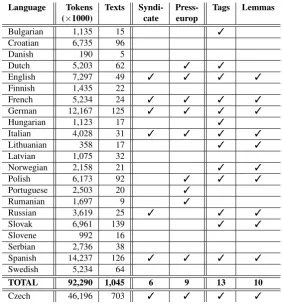
Language Tokens Texts Syndi- Press- Tags Lemmas (×1000) cate europ
Bulgarian 1,135 15 3
Croatian 6,735 96
Danish 190 5
Dutch 5,203 62 3 3
English 7,297 49 3 3 3 3
Finnish 1,435 22
French 5,234 24 3 3 3 3
German 12,167 125 3 3 3 3
Hungarian 1,123 17 3
Italian 4,028 31 3 3 3 3
Lithuanian 358 17 3 3
Latvian 1,075 32
Norwegian 2,158 21 3 3
Polish 6,173 92 3 3 3
Portuguese 2,503 20 3
Rumanian 1,697 9 3
Russian 3,619 25 3 3 3
Slovak 6,961 139 3 3
Slovene 992 16
Serbian 2,736 38
Spanish 14,237 126 3 3 3 3
Swedish 5,234 64
TOTAL 92,290 1,045 6 9 13 10
Czech 46,196 703 3 3 3 3
Table 2: Figures for the part ofInterCorpavailable on-line as of September 2011
data before entering the indexed corpus. The metadata are inserted manually at the start of pre-processing, or – for batch acquisitions – supplied by scripts directly from the source texts.
For languages where the tools are available, the texts can be morphologically tagged and/or lemmatized (see§4.). Fi-nally, the texts are indexed by the corpus manager.16 The
alignment files are processed separately to fit the parallel search interface.
The texts acquired from the web as digital files for multi-ple languages do not follow the track described above until the tagging phase; their clean-up, segmentation and align-ment is fully automatic. Although the result is not manually checked, an evaluation of the tools shows that it is reliable enough to be included in the corpus (see§6. below). Any-way the user can alAny-ways exclude such texts from searches.
4.
Linguistic mark-up
Both human users and applications benefit even from a min-imal linguistic analysis of the corpus data, although it is not
16
Manatee, see (Rychl´y, 2007).
without problems and may even complicate access to the raw text.
At the time of writing, word forms in 14 languages (includ-ing Czech) are assigned morphosyntactic tags while 11 of them are also lemmatized (see Table 2 again). The numbers are due to rise in near future.
The application of language-specific tools (tokenizers, mor-phological analyzers, taggers, lemmatizers) can be seen as an additional example of our opportunistic approach – all of them have been acquired ready-made, trained elsewhere on monolingual data using a language-specific tagset.17 Each of the language-specific tools may thus represent a different conceptual and practical solution to a number of issues: to-kenization, lemmatization, patterning of word classes and morphological categories. While some of the decisions reflect real contrasts between individual languages, other show differences in theoretical backgrounds and formal ap-proaches. Even closely related languages, such as Polish and Czech, may have very different tagsets and
tokeniza-17See http://www.korpus.cz/intercorp/?lang=en, the section on
cru-Figure 1: Selecting languages and texts
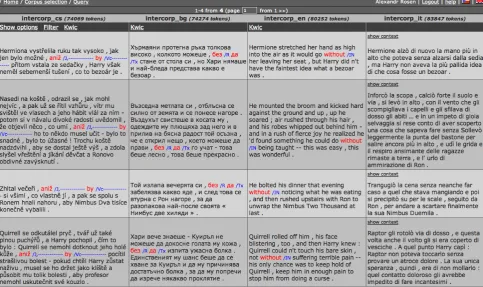
Figure 2: A query