Joost Peters
February 2008, Den Haag
Graduation Committee: prof. dr. ir. J.J. Krabbendam ir. C.P. Katsma
Performance Measurement for All IP Developing a performance measurement instrument
for a local roll out project of the All IP Network
Thesis to conclude the Master Industrial Engineering & Management School of Management and Governance, University of Twente
University
University of Twente
School of Management and Governance Drienerlolaan 5
7522 NB Enschede www.smg.utwente.nl
Supervisors prof. dr. ir. J.J. (Koos) Krabbendam ir. C.P. (Christiaan) Katsma
Company
KPN, Royal Dutch Telecom
Wholesale & Operations, All IP Program Maanplein 55
2516 CK Den Haag www.kpn.com
Supervisor ing. L.W. (Leo) Helgers
Author
Management Summary
In November 2005 KPN started the All IP Program, the migration from their copper network to a Next Generation Network based on fibre. This innovation was brought into action for three reasons: capacity expansion of the network, cost reduction and market share win-back. The nationwide migration to All IP is split up in local projects; from mid 2008 these local roll out projects will run at 20 to 30 locations simultaneously across the Netherlands.
KPN wanted an instrument for performance measurement developed to support a local roll out organisation in controlling the realisation stage, for communication on project performance to All IP Program Management in Den Haag and to support continuous improvement of the local roll out concept. The realisation stage comprehends all necessary activities from marketing and sales to in the end deliver and install a triple play (internet, television and voice) service at the customer. The objective of this research was formulated as follows:
‘The definition and implementation of key performance indicators for the realisation stage of a local roll out project of the All IP Network’
Since there was no clear insight into the coherence of processes of a local roll out project, this coherence was analysed at KPN Glasnet Enschede. The processes of marketing and sales, order registration, order processing and provisioning, the construction of infrastructure and installation are presented in cross-functional flow charts. These may serve as foundation for a manual for local roll out projects in the future. The Balanced Scorecard by Kaplan and Norton [24] was selected as framework to define and implement performance measures. This framework was chosen since it is applicable at project level, clear guidelines and case studies for implementation are available, KPN is familiar with the concept and it is a useful tool in benchmarking (to support continuous improvement). The implementation roadmap by Assiri et al. [2] was used as guideline for development of the instrument for performance measurement.
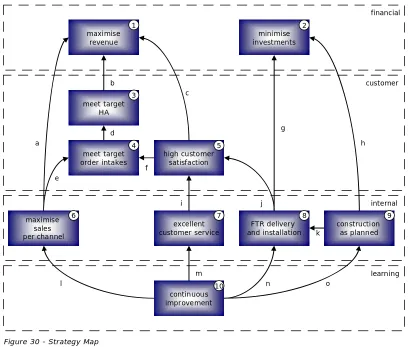
Based on extensive interviews with All IP Program Management and studying relevant literature the strategy map was drawn up, the foundation of the Balanced Scorecard. The strategy map shows the objectives of All IP during the realisation stage of a local roll out project, through cause-and-effect linkages. The most important objectives are: reaching the financial targets stated in the business case, gaining market share, high customer satisfaction, first time right delivery and installation and excellent customer service. All IP Program Management strives for continuous improvement of the local roll out concept.
Based on the objectives defined in the strategy map the performance measures were defined. A total of 25 measures is defined covering the four perspectives of the Balanced Scorecard. They provide a complete overview of project performance during the realisation stage, presenting a complete mix of performance drivers and outcome measures. MS Excel was selected to implement the performance measures; for its flexibility, it enables fast implementation and is easy to understand. For the development a prototyping approach was used; an iterative process which led to a satisfactorily final version of the instrument through interaction with future users. Since the information systems which are going to be used during the nationwide migration were still being developed during this research, it was impossible to define the data sources. However, this did not jeopardise the research objective. The functioning of the instrument was proven by filling it with fictitious but representative data; this was confirmed by the future users.
stated in the business case and by All IP Program Management. It provides communication on project performance to All IP Program Management in Den Haag. The instrument allows for benchmarking local roll out projects through presenting the performance measures of several projects in one overview. Through analysing differences regarding performance it serves as foundation for continuous improvement of the local roll out concept.
The most important recommendations are:
Weekly updating the Balanced Scorecard, except from financial figures being reported monthly. Make one person responsible to ensure completeness of BSC and define standard procedures for data gathering. The instrument must be accessible online, for example by MS Share Point. For using the instrument during the nationwide migration it is essential that data sources are identified within the new information systems. One database should be used in which all information on a customer is available (order data, customer service, progress of construction activities). Further research should be executed regarding improvement and further automation of supporting information systems during a local roll out project.
Table of Contents
List of Definitions... 1
Preface ... 3
1 Introduction ... 5
1.1 KPN ...5
1.1.1 Profile ...5
1.1.2 Strategy ...5
1.1.3 Competition ...6
1.2 All IP Program ...6
1.2.1 Description...6
1.2.2 Migration & Roll Out ...8
1.3 Research Motivation and Objective ...8
1.4 Research Questions ... 10
2 Research Approach ... 11
2.1 Literature study ...11
2.2 Process Analysis of a local roll out project ... 11
2.3 Defining performance measures ...11
2.4 Implementation ...12
2.5 Structure ... 12
3 Theoretical Background ... 15
3.1 Project Management ... 15
3.2 Performance Measurement ...17
3.2.1 Definition ... 17
3.2.2 Performance Measurement Systems ... 18
3.2.3 Developing a performance measurement system ...19
3.3 Performance Measurement Frameworks ... 21
3.3.1 The Balanced Scorecard... 21
3.3.2 Alternative performance measurement frameworks...23
3.3.3 Framework Selection ... 25
3.4 Implementation Roadmap ... 25
3.5 Conclusion... 27
4 Process Analysis - KPN Glasnet Enschede ... 29
4.1 Introduction ...29
4.2 KPN Glasnet Organisation...30
4.3 Project processes ...30
4.3.1 Preparation Stage ... 31
4.3.2 Planning ... 31
4.3.3 Realisation stage ...33
4.4 Process description... 33
4.4.1 Marketing & Sales ... 34
4.4.3 Construction of Infrastructure... 36
4.4.4 Order Processing and Provisioning...38
4.4.5 Installation...38
4.5 Conclusion... 40
5 Creating the Strategy Map... 41
5.1 Interview results ...41
5.1.1 Mission & Strategy ... 41
5.1.2 Financial objectives ...42
5.1.3 Acquisition of customers ...42
5.1.4 Customer satisfaction ... 43
5.1.5 Planning & Execution... 45
5.1.6 Continuous improvement ...46
5.1.7 Summary...47
5.2 The Strategy Map... 48
5.2.1 Financial Perspective ...48
5.2.2 Customer Perspective ...49
5.2.3 Internal Business Process Perspective...49
5.2.4 Learning and Growth Perspective ...50
5.3 Conclusion... 50
6 Defining Performance Measures... 53
6.1 Financial Perspective ...53
6.2 Customer Perspective ...54
6.2.1 Meet target of homes activated ... 54
6.2.2 Meet target of order intakes ...55
6.2.3 High customer satisfaction ... 55
6.3 Internal Business Process Perspective ... 55
6.3.1 Maximise the sales per marketing channel ...56
6.3.2 Excellent customer service ...56
6.3.3 First time right delivery and installation ... 57
6.3.4 Construction as planned ...58
6.4 Learning and Growth Perspective ...59
6.5 Balanced Scorecard ...60
6.6 Conclusion... 60
7 Implementation ... 63
7.1 Software ... 63
7.2 Balanced Scorecard ...63
7.2.1 Financial Perspective ...64
7.2.2 Customer Perspective ...65
7.2.3 Internal Business Process Perspective...66
7.2.4 Learning and Growth Perspective ...68
7.2.5 Required data...68
7.3 Benefits realisation...69
7.4 Continuous improvement ...70
8 Conclusion & Recommendations ... 73
8.1 Conclusion... 73
8.2 Recommendations ...74
9 References ... 77
List of Definitions
ARPU Average Revenue Per User Capex Capital Expenditure CO Central Office CSF Critical Success Factor
xDSL Variants of DSL – Digital Subscriber Line DSLAM Digital Subscriber Line Access Multiplexer FttC Fibre-to-the-Curb
FttH Fibre-to-the-Home FTR First Time Right FTU Fibre Termination Unit GSP Green Service Provider LSG Local Support Group
HA Homes Activated
HC Homes Connected
HP Homes Passed
IP Internet Protocol
KPI Key Performance Indicator NGN Next Generation Network
NT Network Terminator
Opex Operational Expenditure QoS Quality of Service POC Process Operations Centre POTS Plain Old Telephone System RG Residential Gateway RSP Red Service Provider
SC Street Cabinet
SP Service Provider
Preface
This report is the result of the research executed to conclude the Master Industrial Engineering and Management at the School of Management and Governance, University of Twente. The research project was executed within the context of the All IP Program, at the department of Wholesale and Operations of KPN, Royal Dutch Telecom in Den Haag. The All IP Program comprehends the transformation of KPN’s legacy copper network towards an IP based network on fibre. It has been interesting working in the dynamic environment of the All IP Program.
‘Meten is weten!’ an old Dutch expression used by carpenters. Word for word translated it means ‘to measure is to know’: very true when it comes to performance measurement. But measuring everything could lead to an information overload, it is impossible to manage projects based on too much information. Therefore it is very important to know with what objective to measure, what to measure and how to present the outcomes. Measuring performance is not the objective but the means to reach the objective! In this report the development of an instrument for performance measurement for a local roll out project of the All IP Network is described.
Hereby, I would like to thank my direct supervisor at KPN, Leo Helgers, for offering me the opportunity to execute my research at KPN and his guidance during the research. Second, the project manager of KPN Glasnet Enschede, Jan Willem ter Steege, and his team have been of great help in bringing this project to an end, thanks! Also I would like to thank my university supervisors, Koos Krabbendam and Christiaan Katsma.
Joost Peters
1
Introduction
This first chapter comprises an introduction to the thesis. Section 1.1 describes the graduation organisation KPN, at which the master thesis was executed. In section 1.2 the reason for initiation of the All IP Program and the nationwide migration approach is explained. The research motivation and objective are defined in section 1.3. In the final section the research questions are elaborated.
1.1 KPN
In this section the organisation KPN is described: the profile, strategy and competition of KPN are explained. The information was acquired through interviews with KPN employees and studying the KPN annual report 2006 [30].
1.1.1 Profile
Since its privatisation in 1989 KPN has developed from a traditional telephone operator to the leading multimedia company of the Netherlands. The company provides consumers and consumer households with fixed and mobile telephony, internet and television services. To business customers, KPN delivers voice, internet and data services as well as fully managed outsourced ICT solutions. Besides that, KPN provides wholesale network services to third parties (including operators and service providers) nationally and internationally. At the German and Belgium market KPN provides mobile telephone services, serving multiple customer segments through a multi-brand strategy. In the Netherlands KPN serves 6.3 million fixed line voice subscribers, 8.6 million mobile customers, 2.1 million Internet customers and 300,000 TV-customers. In Germany and Belgium KPN serves another 15.0 million mobile TV-customers.
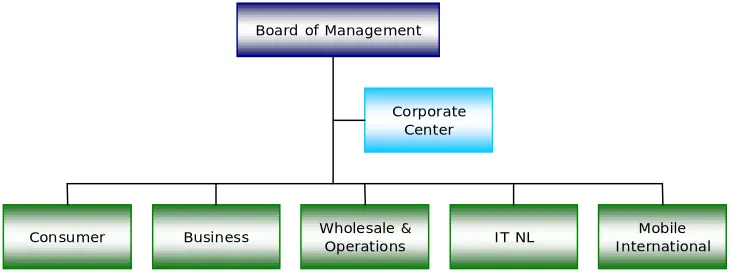
KPN has a divisional structure to enable an integral customer approach, before the focus was on technology and the mobile and fixed telephone activities were separated. The divisions of KPN in the Netherlands are: consumer, business, wholesale & operations, IT Netherlands and Corporate Centre. The organisation structure is presented below.
Board of Management
Corporate Center
Wholesale & Operations Business
Consumer IT NL InternationalMobile
Figure 1 - Organisation structure KPN
1.1.2 Strategy
KPN is still developing from a traditional telephone operator, technology and product oriented, towards a multimedia company focused on the behaviour and needs of their customers. In March 2005 KPN introduced its new threefold strategy ‘Attack, Defend and Exploit’.
to provide these services KPN migrates its network to a Next Generation Network based on IP (Internet Protocol), this development is called the All IP Program;
Defend - KPN keeps defending its market share on traditional services, although this market size is decreasing. Where possible, KPN even tries to increase market share; also by providing wholesale services, in this case the economies of scale are of advantage;
Exploit - KPN uses its leadership on the market of traditional and new services to develop a cost structure which is better than its competitors, this will give KPN a continuing lead.
KPN serves its market through a so-called multi-brand strategy; this means that the same product is marketed through several brands. This enables the customer to choose a brand that fits his needs and budget; ranging from the high-end KPN brand to for example Hi, a brand created specifically for young people.
1.1.3 Competition
KPN’s most important market, the Dutch market, is one of the most competitive markets in Europe. KPN’s fixed network is losing market share since the number of consumer households calling with an analogue fixed line is decreasing. This is due to an increase in consumer households using only mobile phones. Besides that, cable operators (e.g. UPC, Casema) nowadays offer internet and telephone services next to television; they have a 97% nationwide coverage. According to Banerjee & Sirbu [3] competition in the telecommunications services industry can be facilities based or non-facilities based.
1) Facilities based: each service provider serves the market using its own physical network;
2) Non-facilities based: each service provider shares the resources of a common network to provide service to its customers, two models are considered:
- Unbundled Network Elements (UNE): the network owner rents out unbundled network elements (like a copper loop) to service providers.
- Open Access: each service provider has to share the common data-link layer in order to provide voice, video or data services (e.g. ISPs providing internet over the same cable). KPN experiences competition on all presented levels. The cable operators are an example of facilities based competition since they provide services via their own network. Due to the liberalisation of the telecom market in the mid-nineties non-facilities based competition (UNE) was born and Open Access competition exists since broadband providers deliver services to different service providers.
1.2 All IP Program
In this section the All IP Program is elaborated. The first part gives a general description of the program and the reason for initiation, the second part goes into the migration and roll out.
1.2.1 Description
KPN is convinced that IP (Internet Protocol) technology is the future basis for all communications; in November 2005 the All IP Program was launched through a press release1. The program comprehends the migration of the legacy (current copper) network towards a Next Generation Network, a network based on IP and Ethernet, an infrastructure of fibre to 24.000 street cabinets. This innovation is brought into action for three reasons:
Capacity expansion: the increasing need of customers for new IP-based, broadband services calls for more capacity (bandwidth) on the network.
Cost reduction: the rationalisation of the network enables KPN to reduce its staff by around 8000 FTE’s, the sale of real estate currently used for operating centres accounts for a large part of the costs of the All IP Program.
Market share win-back: win-back of the lost market share in previous years.
The technical specifications of the legacy network and the All IP network, or Next Generation Network; and the evolution towards a Next Generation Network are explained in the appendix.
Currently KPN’s network in the Netherlands consists of 1381 Central Offices, around 28.000 street cabinets and around 6 million customer connections. All intelligent network equipment is placed in the Central Offices; the only function of the street cabinets is cable distributor. The current situation is presented simplified in figure 2.
Figure 2 - Current network configuration
In the new situation of the All IP Network the intelligent network equipment is moved from the Central Offices to the street cabinets. Copper lines between the COs and street cabinets are replaced by fibre; the street cabinets are connected to a fibre ring. The copper connection between the street cabinets and the customer is also replaced by fibre, this new situation is presented simplified in figure 3, it is called Fibre-to-the-Home.
KPN
ALL IP
Figure 3 - FttH network configuration
Besides FttH there is also Fibre-to-the-Curb (FttC), in this network configuration the copper wireline between the customer and the street cabinet is preserved. VDSL technique is used for data transmission on the copper wireline between the end-user connection and the street cabinet. Since fibre is closer to the end-user connection in the new situation, the bandwidth of the network increases to a theoretical maximum of 50 Mbps. The bandwidth depends on the distance between customer and street cabinet and the quality of the copper line. Obviously this is a much cheaper option regarding the costs of rolling out the new network; for a FttH network digging is necessary to every customer.
The choice for rolling out FttC or FttH in a specified area falls outside the scope of this research. At this moment FttH is rolled out in new residential areas in any case and the first roll out project of All IP: KPN
KPN
PSTN
Copper Copper
ISRA point SC
Glasnet Enschede is a FttH roll out. Next to the wired variants of a Next Generation Network, there are also wireless solutions; then a wireless access point is placed at the Street Cabinet.
1.2.2 Migration & Roll Out
The migration towards the new network configuration is a radical operation for KPN. The All IP Program is one of the most radical transformations anywhere in the world being planned by a telecoms operator [8]. KPN has chosen a phased approach for the nationwide roll out of the All IP network through local roll out projects. A local roll out project comprehends the migration towards All IP for a city or part of a city during a predefined period of time.
Besides the physical network changing, there are also changes considering the services KPN offers its customers. Since the new network configuration is based on the Internet Protocol, only services that work IP-based can be offered. This means that some current services have to be phased out or there must be searched for an alternative, church telephony is an example (a service which enables people to listen to a church service at home based on analogue telephone technology). Changes to the services that KPN offers its customers fall outside the scope of this research.
The initial migration strategy towards All IP was technology driven. The goal was to first migrate customers to IP services on the current network, then roll out the All IP network and subsequently physically connect customers to the All IP network. This approach would require contact with customers on several points in time and too much service interruption, obviously not an approach that increases customer satisfaction. Since this approach does not fit KPN’s new customer oriented strategy, it was decided to alter the migration strategy towards All IP.
KPN has chosen a local approach for the roll out, based on several successful local fibre initiatives which will be discussed in section 4.1. At the moment a city or neighbourhood is pointed out for migration a planning is designed to roll out the new network. During a predefined period of time a marketing campaign is active to persuade customers to register for connecting to the new network. Service employees of KPN take care of installation of the services at the customer. There is an ongoing discussion at KPN if customers that did not register and buy service on the All IP Network do get a new Network Terminator which makes it possible to connect to the All IP network in the future.
KPN headquarters in Den Haag decides when and where to start a local project to roll out the All IP Network; this is based on extensive cost analysis. Although the roll out on operational level is a complex process with a lot of dependencies, there is no instrument in place yet to measure the performance of the roll out on this level. Since millions of connections have to be migrated All IP management wants an instrument designed to measure the performance of the local roll out which supports the local roll out organisation. This instrument should also enable All IP Program Management in Den Haag to overlook the performance of the local roll out projects running at that time. This will be further explained in the next section.
1.3 Research Motivation and Objective
new network when the construction activities are finished at that address and services are activated on the concerning line. This implicates that the planning of marketing activities must be linked to the planning of construction activities to ensure a limited period of time between the moment of sales and connection. All IP Program Management wants an instrument based on performance measures designed which supports a local project team in managing and controlling the roll out project. This instrument should support the local project team during the realisation stage of the project. The realisation stage comprehends all necessary activities from sales and construction activities to in the end deliver up the service to the customer. The local project team must be provided with information on the performance of the roll out, information on which they can steer and control the project. The local roll out projects should be carried out according to the business case, strategy and objectives set by All IP Program Management; it is important to measure to what extent these objectives are reached.
The instrument should enable All IP Program Management in Den Haag to quickly overview the status of a local roll out project. Since from mid 2008 several roll out projects will be running simultaneously, the instrument must provide a way to benchmark local roll out projects. Daft [11] defines benchmarking as the continuous process of measuring products, services, and practices against major competitors or industry leaders. In this case benchmarking aims at the comparison of the performance of local roll out projects with each other to come to a best practice of managing the realisation stage of a local roll out project. Summarising, the instrument to be designed must fulfil the following conditions:
Performance measurement to support a local project team in controlling the realisation stage of a local roll out project;
Provide information communication on performance of a local roll out project to All IP Program Management in Den Haag;
Support in continuous improvement of the realisation stage of the local roll out concept in general.
To be able to define and implement this instrument insights into the main processes and dependencies during the realisation stage of a local roll out project is inevitable. Since the nationwide roll out of the All IP network is planned to start mid 2008 the exact processes are not designed yet. However, in Enschede KPN rolls out KPN Glasnet, a first local roll out project which is part of the All IP Program. People get the opportunity to connect to the All IP Network through Fibre-to-the-Home. KPN Glasnet Enschede can be analysed to map the processes, record main activities, dependencies and cause-and-effect relationships during the realisation stage of a local roll out project.
Problem Definition:
‘The interdependencies of processes in a local roll out project are unclear. This information is inevitable to be able to manage a local roll out project.’
‘For the roll out of the All IP Network there is no instrument in place to support a local project team in adequately managing the project;
key performance indicators must be defined an implemented.’
Research Objective:
‘The definition and implementation of key performance indicators for the realisation stage of a local roll out project of the All IP Network’
1.4 Research Questions
To reach the defined research objective the main research question is presented; this question must be answered by the research.
Main Research Question:
‘What are key performance indicators for the realisation stage of a local roll out project of All IP; and how can these be implemented?’.
In order to make the main research question more concrete it is split up in sub-questions:
1) What are the main processes during the realisation stage of a local roll out process?
a. What model available in literature can be used to bound the realisation stage within the scope of a project environment?
b. What are the main activities and dependencies during the realisation stage?
2) What steps must be undertaken to define key performance indicators for the realisation stage of a local roll out project?
a. What is performance measurement?
b. What models are available in literature for defining and implementing performance indicators? c. What are KPN’s strategy and objectives regarding a local roll out project of the All IP Network? d. What are key performance indicators regarding the defined strategy and objectives?
3) What is an instrument to implement the defined performance indicators?
4) What recommendations can be made for using the developed instrument during the nationwide migration?
2
Research Approach
In this chapter the research approach is explained. The research aims at designing an instrument for performance measurement for the realisation stage of a local roll out project. A structured research approach ensures the right results being delivered when the research is finished. It defines the approach per phase of the research and which sources of information are used. The research is divided into four phases, each of which is explained in a section below.
2.1 Literature study
Literature on performance measurement and project management is studied to build the theoretical foundation of the research. Project management literature is studied to understand and determine the scope of the instrument for performance measurement to be developed. The scope of this research is the realisation stage of a local roll out project. By explaining the phasing and activities within the phases of projects the purpose and application of the instrument is clarified.
Literature on performance measurement is studied to gain insight into the field of performance measurement. Performance measurement is defined and the development of performance measurement in literature is explained. Several frameworks are available to develop a performance measurement system, the application of those frameworks is elaborated. One framework is selected to serve as foundation to design the performance measurement instrument for the realisation stage of a local roll out project of All IP. This phase of the research aims at answering research questions 1a, 2a and 2b:
1a)
2a) 2b)
What model available in literature can be used to bound the realisation stage within the scope of a project environment?
What is performance measurement?
What models are available in literature for defining and implementing performance indicators?
2.2 Process Analysis of a local roll out project
Since All IP Program Management has no clear insight into the coherence of processes during the realisation stage of a local roll out project, this coherence is analysed. The processes for the nationwide migration starting mid 2008 were not indisputably determined at the time this research started. Therefore KPN Glasnet Enschede, the first local roll out project of All IP, was analysed. The coherence and the content of processes is explained and visually supported by cross-functional flow charts. To acquire the necessary information, members of the local project team and members of All IP Program Management are interviewed. Also internal documents are studied and several weekly operational meetings of the project team are attended in Enschede. To be able to define key performance indicators knowledge of the processes on which the performance indicators report is inevitable. The drawn up flow charts may serve as foundation for creating a manual for local roll out projects of the All IP Network. This phase of the research aims at answering research question 1b:
1b) What are the main activities and dependencies during the realisation stage?
2.3 Defining performance measures
extensively consulted. It is important to involve the stakeholders in the process of developing the performance measurement instrument since they are the future users. The interview results are underpinned by internal documents about the All IP Program and relevant scientific literature about strategy, customer satisfaction and continuous improvement, all related to the defined objectives. At the moment the stakeholders agree on the composition of the strategy map the performance measures can be defined. The performance measures present the performance of a local roll out project of All IP during the realisation stage, regarding the formulated objectives. Performance measures are selected in discussion with the people involved: members of the project team KPN Glasnet Enschede including the project manager and the customer processes manager of All IP Program Management. This phase of the research aims at answering research question 2c and 2d:
2c) 2d)
What are KPN’s strategy and objectives regarding a local roll out project of the All IP Network? What are key performance indicators regarding the defined strategy and objectives?
2.4 Implementation
After the complete set of performance measures is defined, the supporting software to develop the instrument is chosen. To design the instrument a prototyping approach [33] is used. A first relatively simple instrument is built aimed at short term fulfilment. Through interaction with the future users, members of the project team of KPN Glasnet including the project manager and the customer processes manager of All IP Program Management, the prototype is adjusted until the result is satisfactorily. This is an iterative process, improvements to the instrument are made step by step. Since not all necessary data is yet available the instrument is filled with fictitious data aiming at a proof of concept.
Besides the development of the performance measurement instrument making recommendations for application of the instrument during the nationwide migration is also part of the implementation phase. Based on the objectives defined in the strategy map, during the phase defining performance measures, and relevant scientific literature recommendations are made regarding the frequency of reporting and continuous improvement of the local roll out concept. This phase of the research aims at answering research question 3 and 4:
3 4
What is an instrument to implement the defined performance indicators?
What recommendations can be made for using the developed instrument during the nationwide migration?
2.5 Structure
Based on Verschuren en Doorewaard [48] the research structure is presented in figure 4; the green circles identify the chapters in which the phases are elaborated.
3
Theoretical Background
In this chapter the theoretical background for the research is presented. A local roll out project of the All IP Network is a project environment, therefore project management literature was studied. It helped to determine and understand the scope of the instrument to be developed within a project environment. The project management method PRINCE2 is discussed in the first section, the method is scalable and adjustable to specific circumstances of a project environment [22] and KPN project managers are familiar with the method.
The objective of the second part of this chapter is to gain insight into the field of performance measurement. A short introduction of the historical development is presented after which the definition, performance measurement systems and the development of these systems is explained. A framework for developing the instrument for performance measurement for the realisation stage of a local roll out project is selected from literature. The chapter is concluded with a roadmap for design and implementation of the performance measurement instrument.
3.1 Project Management
A project is a temporary management environment that is created for the purpose of delivering one or more business products according to a specified business case [41]. In case of a local roll out project of All IP the business products to be delivered are well functioning services (internet, telephone and/or television) at new customers over the All IP Network. The local roll out projects are part of the All IP Program, a program is defined as a set of projects and activities in a temporary organisation to realise one or more predefined strategic company objectives [22]. In case of the All IP Program the strategic company objective is to increase market share; KPN believes this will lead to attractive financial returns on the long term [30], this was explained in section 1.1.2 and 1.2.1.
The project management method that will be applied is PRINCE2. This method is chosen since it is useful for all kinds of projects; the method is scalable and adjustable to specific circumstances of a project environment [22]. Besides that, KPN project managers are familiar and educated in the PRINCE2 method. PRINCE2 distinguishes eight main processes based on the stages and responsibilities in a project, as can be seen in figure 5. The PRINCE2 process model shows four management levels:
Corporate or program management, not part of project management, but it sets the business context for one or more projects;
Project board, responsible for directing the project, this level is for key decision making and direction setting;
Project Management, most effort goes into day-to-day planning and control; Managing project delivery is the lowest level, handled by team managers.
At KPN the role of program management and project board to some extent overlap, they are both executed by All IP Program Management in Den Haag. This implicates that program management, as defined by PRINCE2, actually is part of the project organisation. Project Management is the responsibility of the local project manager; and the lowest level is handled by members of the local project team, which PRINCE2 calls team managers.
Corporate or Program Management
Directing a Project
Starting Up
a Project Initiating a Project Controlling a Stage
Managing
Figure 5 - PRINCE2 process model, adapted from [41]
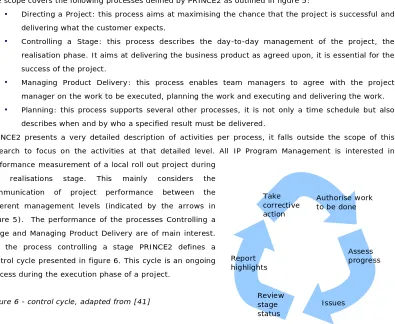
The scope covers the following processes defined by PRINCE2 as outlined in figure 5:
Directing a Project: this process aims at maximising the chance that the project is successful and delivering what the customer expects.
Controlling a Stage: this process describes the day-to-day management of the project, the realisation phase. It aims at delivering the business product as agreed upon, it is essential for the success of the project.
Managing Product Delivery: this process enables team managers to agree with the project manager on the work to be executed, planning the work and executing and delivering the work. Planning: this process supports several other processes, it is not only a time schedule but also describes when and by who a specified result must be delivered.
PRINCE2 presents a very detailed description of activities per process, it falls outside the scope of this research to focus on the activities at that detailed level. All IP Program Management is interested in performance measurement of a local roll out project during
the realisations stage. This mainly considers the communication of project performance between the different management levels (indicated by the arrows in figure 5). The performance of the processes Controlling a Stage and Managing Product Delivery are of main interest. For the process controlling a stage PRINCE2 defines a control cycle presented in figure 6. This cycle is an ongoing process during the execution phase of a project.
Figure 6 - control cycle, adapted from [41]
The process Controlling a Stage aims at executing the
necessary activities in accordance with the defined quality and within the agreed costs, resources and time. The process Controlling a Stage drives the process Managing Product Delivery; the interfaces being the authorisation of work to be done, any specified reports, and the return confirmation that the work has
been completed satisfactorily [41]. Managing Product Delivery is the responsibility of team managers, in case of a local roll out organisation members of the project team.
In this research the processes Controlling a Stage and Managing Product Delivery are referred to as the execution phase of a project. Two stages are defined within the execution phase: the preparation stage and the realisation stage. The preparation stage aims at providing the necessary facilities such that the realisation stage can start. The realisation stage comprehends all activities from marketing and sales, construction of connections, to in the end deliver a well functioning service at the customer. This is further elaborated in section 4.3. The scope of the instrument for performance measurement to be developed is the realisation stage of a local roll out project. The instrument must measure performance regarding defined quality, costs, use of resources and time which supports a local roll out organisation in controlling the realisation stage.
3.2 Performance Measurement
Performance measurement is an important topic both in the operational research literature and the management accounting literature [33]; in broad outline two phases can be distinguished. During the first phase from 1880 till about 1980 performance measurement was primarily financially oriented. Solely financial performance measures like profit and revenue growth were used to measure the performance of an organisation based on management accounting. In the second phase starting in the late 1980s it became clear that the traditional financial performance measures had their limitations. There was a shift in focus towards quality, flexibility, lead time reduction; and new production management philosophies were introduced [20]. This was the start of treating financial measures as one among a broader set of measures [15]. Recent publications move towards performance management, a broader concept also related to process management [16]. This means not solely measuring the results of actions taken, but measuring the drivers of future success and management based on this information.
3.2.1 Definition
Neely et al. [38] describe performance measurement as the process of quantifying the efficiency and effectiveness of action. Effectiveness refers to the extent to which requirements are met, while efficiency is a measure of how economically the firm’s resources are utilized when providing a given level of customer satisfaction. This definition takes in consideration the internal as well as the external aspect of performance measurement. An organisation might for instance increase its product reliability, a quality-related dimension of performance. This could lead to higher customer satisfaction (the effectiveness of action, an external measure) and lower the costs of warranty claims (the efficiency of action, an internal measure).
Nowadays there is a shift towards performance management. According to Lebas [31] performance is, especially in the case of management, not to much about past achievements; but about the future, about the capability of the unit being evaluated. The purpose of management is about creating and shaping the future of the organisation, as well as that of society. Regarding this definition performance management goes beyond performance measurement. Amaratunga and Baldry [1] define performance management as the use of performance measurement data to effect positive change in organisational systems, culture and processes. In this way performance measurement and performance management follow one another in an iterative process; management precedes and follows measurement, in a virtuous spiral and management creates the context for measurement.
performance to strategy. Companies use the balanced scorecard as the central, organizing framework for their management process [25]. This is presented in the figure below.
Balanced Scorecard Clarifying and Translating the Vision and Strategy
Planning and Target Setting
Strategic Feedback and Learning Communicating and
Linking
Figure 7 - Using the BSC as strategic framework for action, adapted from [26]
In the context of this research performance measurement must not solely measure the results of actions taken but also measure to what extent a local roll out organisation is able to deliver the desired results in the future. In this way All IP Program Management should be able to assess the impact of the chosen strategy on future performance of a local roll out project.
3.2.2 Performance Measurement Systems
A performance measurement system contains a set of individual performance measures, metrics to quantify the efficiency and/or effectiveness of action, as is presented in the figure below. In the figure the three levels of a performance measurement system are presented: the individual measures, the set of performance measures (the system as entity) and the relationship between the performance measurement system and the environment within which it operates [38].
Individual
measures Individual measures Individual measures
Individual measures Performance
measurement system Environment
Figure 8 - Performance Measurement System [38]
Traditional performance measures Non-traditional performance measures Not applicable for JIT, TQM, CIM, FMS, RPR etc. Hinder continuous improvement Have no fixed format (depends on needs) Vary between locations
Change over time as they need change Intended to improve performance Applicable
Help in achieving continuous improvement Table 1 - Comparison between traditional and non-traditional performance measures [20]
Neely et al. [38] stress that the individual measures should be positioned in a strategic context, since they influence what people do. A company’s strategy is the plan of action that prescribes resource allocation and other activities for dealing with the environment and helping the organisation attain its goals [11]. The objective of performance measurement is to stimulate action, to realise strategy; this can not be done based on solely financial measures. Performance measurement yields a fundamental type of management information needed for controlling operations, in this case the realisation stage of a local roll out project. It creates focus, triggers corrective action, is the basis for evaluating performance, and may help challenging and improving strategic choices [33]. This corresponds to the defined control cycle for the process Controlling a Stage in section 3.1.
3.2.3 Developing a performance measurement system
According to Bourne et al. [6] the development of a performance measurement system may conceptually be separated into stages of design, implementation and use. The design stage is about identifying key objectives and designing measures. In the implementation stage, systems and procedures are put in place to collect and process the data that enable measurements to be made regularly. In the use stage, managers review the measurement results to assess whether operations are efficient and effective, and the strategy is successfully implemented. Neely et al. [38] describe a typical development process of
Identify the firm’s strategic objectives using the mission statement as a guide (profitability, market share, quality, cost, flexibility, dependability and innovation)
Develop an understanding of each functional area’s role in achieving the various strategic objectives
For each functional area, develop global performance measures capable of defining the firm’s overall competitive position to top management
Communicate strategic objectives and performance goals to lower levels in the organisation. Establish more specific performance criteria at each level.
7 8 9
Assure the compatibility of performance measures used in all functional areas Use the PMS
Periodically re-evaluate the appropriateness of the established PMS is view of the current competitive environment
Table 2 - Nine steps to develop a performance measurement system [38]
To make the mission and objective concrete they can be translated into critical success factors. Bullen and Rockart [7] describe CSFs as the limited number of areas in which satisfactory results will ensure successful competitive performance for the individual, department or organisation. CSFs are the few key areas where ‘things must go right’ for the business to flourish and for the manager's goals to be attained. CSFs help to define success, to understand the key areas in which to invest resources.
Mission and objectives
Critical Success Factors
Analysis
Performance Indicators
External Sources Internal
Processes Steering
Figure 9 - Internal Reporting [46]
The difference between performance indicators and success factors is important, CSFs are largely qualitative identified, and they provide value through giving focus on critical areas. Performance indicators provide the necessary information to analyse the critical success factors, they present the performance of the organisation, related to the critical success factors and placed within the context of relevant information from the environment. This means the input for performance indicators is acquired by the execution of internal processes and information supplied by external sources. Analysis of the performance indicators within the framework of critical success factors may lead to the need to steer on internal processes or the mission and objectives. This coherence is presented in the model of internal reporting [46].
Neely et al. [39] reviewed the literature on performance measurement and came up with a list of 22 characteristics of performance measures. This was further reduced to the list below by Hudson, Smart and Bourne [23]. They propose the following set of critical characteristics of performance measures:
Derived from strategy
Folan and Browne [16] distinguish procedural and structural frameworks. Procedural frameworks assists in developing a performance measurement system by outlining procedures, like the steps presented in table 2 by Neely [38] and the coherence of Stegwee [46]. However, we prefer a structural framework, which specifies a typology for performance measure management [16] since it offers more support in defining boundaries of the performance measurement system. In the next section several structural frameworks are presented of which one is selected to form the basis for a performance measurement instrument for the local roll out of the All IP Network.
3.3 Performance Measurement Frameworks
In this section the balanced scorecard and other performance measurement frameworks are elaborated. The section is concluded with the selection of a framework to be applied in this research.
3.3.1 The Balanced Scorecard
Probably the most well-known performance measurement model is the Balanced Scorecard, introduced in 1992 by Kaplan and Norton [24]. The balanced scorecard complements the financial measures which inform on the actions already taken, by operational measures on customer satisfaction, internal processes and the organisation’s innovation and improvement activities. These operational measures are the drivers of future financial performance; the balanced scorecard puts strategy and vision, not control, at the centre [24]. The balanced scorecard is the key for driving performance in organisations; it transforms strategic management paradigms by placing the emphasis on enablers instead of on results [37].
The balanced scorecard is based on the principle that a performance measurement system should provide managers with sufficient information to address the following questions:
How do we look to our shareholders (financial perspective)? What must we excel at (internal business perspective)? How do our customers see us (customer perspective)?
How can we continue to improve and create value (learning and growth perspective)?
Figure 10 - The Balanced Scorecard [24]
The measures on a Balanced Scorecard are directed toward achieving an integrated strategy. As stated above these measures are grouped into four perspectives [25]:
2) Customer perspective - identifies the customer and market segments in which the organisation will compete and the measures of the organisation’s performance in these targeted segments.
3) Internal-business-process perspective - identifies the critical internal processes in which the organisation must excel, the focus should be on the processes that will have the greatest impact on customer satisfaction and achieving the organisation’s financial objectives.
4) Learning and Growth perspective - identifies the infrastructure that the organisation must build to measures and objectives are linked through cause-and-effect relationships and mixtures of outcome measures and performance drivers [25], to create the trajectory of the strategy.
Daft defines a company’s strategy as the plan of action that prescribes resource allocation and other activities for dealing with the environment and helping the organisation attain its goals [11]. Kaplan and Norton [25] translate strategy into a set of hypotheses about cause and effect. In a strategy map of which a simplified example is presented in figure 11, the strategy (chain of cause and effect) should cover the four perspectives of the Balanced Scorecard.
In the example the return on capital expenditure is used as measure in the financial perspective. The driver of this measure could be sales from existing customers, based on loyalty of customers. On-time delivery is in turn expected to be a driver for customer loyalty; both are incorporated in the customer perspective. Regarding the internal-business-process perspective process quality and process cycle time are presented as measures in the third perspective, both processes to excel at to realise on-time delivery. Finally, to improve the process quality and cycle time, the skills of operating employees should be trained; the objective in the learning and growth perspective. Obviously this is a simplified example of a strategy map.
Objective Measurement
Lag indicator Lead indicator Financial
Reduce cost structure Deposit service cost change Revenue mix
Customer
Increase customer satisfaction Customer retention Satisfaction survey
Internal
Understand our customers New product revenue Product development cycle
Learning
Develop strategic skills Employee satisfaction Strategic job coverage ratio Table 3 - Lead and lag indicators
The Balanced Scorecard must retain a strong emphasis on outcomes, especially financial ones such as return on capital expenditure or economic value added. Ultimately, causal paths from all the measures on a scorecard should be linked to financial objectives [25].
Summarised: The Balanced Scorecard tells the knowledge, skills, and systems that the employees will need (their learning and growth) to innovate and build the right capabilities and efficiencies (the internal processes) that deliver specific value to the market (the customers), which will eventually lead to higher shareholder value (the financials).
3.3.2 Alternative performance measurement frameworks
In this subsection alternative structural frameworks to the Balanced Scorecard of Kaplan and Norton [24] are elaborated. Relevant alternatives are:
The HR Balanced Scorecard by Maisel [34] The SMART system by Cross and Lynch [10]
The Performance Prism by Neely, Adams and Kennerly [40]
HR Balanced Scorecard
Maisel [34] exchanged the learning and growth perspective from the Balanced Scorecard from Kaplan and Norton [24] for a human resource perspective.
Instead of asking ‘how can we continue to improve and create value (learning and growth perspective)?’ the question ‘to achieve our strategies, how must our organisation function?’ is asked. In this new perspective the effectiveness of the organisation and its people should be measured. Besides the exchanged perspective the scorecard corresponds largely to the Balanced Scorecard by Kaplan and Norton.
SMART system
The strategic measurement analysis and reporting technique (SMART) system was developed by Wang Laboratories, Inc. since they were dissatisfied with traditional performance measures like utilization, efficiency, productivity and other financial variances [10]. The performance measures define and sustain success. The system can be visualized by a four-level pyramid of objectives and measures as presented below. The vision of the organisation is translated into performance measures through the organisation.
Figure 13 - the SMART system [10]
Performance Prism
Neely, Adams and Kennerly developed a three dimensional model called the Performance Prism [40]. The Performance Prism has five facets; the top and bottom are stakeholder satisfaction and stakeholder contribution, the three sides are strategies, processes and capabilities.
The writers identify five distinct perspectives on performance together with five key questions [40]: 1) Stakeholder satisfaction: who are the key stakeholders and what do they want and need?
2) Strategies: what strategies do we have to put in place to satisfy the wants and needs of these key stakeholders?
3) Processes: what critical processes do we require if we are to execute these strategies? 4) Capabilities: what capabilities do we need to operate and enhance these processes?
5) Stakeholder contribution: what contributions do we require from our stakeholders if we are to maintain and develop these capabilities?
3.3.3 Framework Selection
The four performance measurement frameworks treated in this section share the concept of defining performance measures covering several perspectives. The Balanced Scorecard by Kaplan and Norton, the Balanced Scorecard by Maisel, and the SMART system by Cross and Lynch define performance measures focusing on strategy of the organisation. The performance prism by Neely uses the stakeholder perspective as point of departure. Many case studies of the BSC by Kaplan and Norton can be found in literature; the framework receives much attention in professional as well as in academic literature. It is placed alongside approaches such as Activity Based Costing/Management and Total Quality Management in terms of industry and literary attention [37].
Kaplan and Norton provide a very useful way to make the strategy of an organisation concrete, the strategy map. The strategy map is a helpful tool in translating a chosen strategy into operational performance measures. In this way current actions are linked to goals of tomorrow. A clear roadmap for designing and implementing the Balanced Scorecard is available [2].
Regarding the Balanced Scorecard by Maisel, the SMART system and the Performance Prism, few implementation studies are known and no clear guidelines for design and implementation are presented. The Performance Prism is designed to support strategic management on the long term while the Balanced Scorecard by Kaplan and Norton can be applied at different levels: total organisation, strategic business unit, individual operational units or even to individuals [2], this makes the BSC better applicable for the realisation stage of a local roll out project.
All IP Program Management is familiar with the Balanced Scorecard concept which makes it easier to design and implement the instrument, since basic understanding of the framework is present. The Balanced Scorecard may very well be used as benchmarking tool; very useful in case of the local roll out concept since projects will be running simultaneously starting mid 2008.
The Balanced Scorecard by Kaplan and Norton is used as foundation to develop an instrument for performance measurement for the realisation stage of a local roll out project due to the following reasons:
Many case studies and much attention in scientific & professional literature; Clear guidelines for design and implementation are available;
Applicable at concerning organisational level;
All IP Program Management is familiar with the concept; Useful tool in benchmarking local roll out projects.
3.4 Implementation Roadmap
The dominant factors play a significant role in the implementation, without these factors the BSC can hardly be implemented. In the research of Assiri et al. [2] these factors represent a considerable level of criticality. The main factors are important in each step of a Balanced Scorecard project; they are subdivided into six categories: learning and innovation, planning, development, implementation, sustainability and benefits realisation. Supporting factors are less critical than dominant and main factors, but significant to support the development and implementation of the Balanced Scorecard.
The objective of the Balanced Scorecard that will be developed is to support a local project team during the realisation stage of a local roll out project of the All IP Network. Since this does not comprehend an implementation throughout the whole organisation, some critical success factors that fall outside the scope of this research can be left out. These success factors are:
Training
The complete implementation roadmap developed by Assiri et al. can be found in the appendix. Below the critical success factors for defining and implementing the Balanced Scorecard for the realisation stage of a local roll out project are presented; a short description per factor is given.
Dominant Factors
Identify BSC perspectives Identifying adequate BSC perspectives is crucial for success of the implementation. Kaplan and Norton’s four perspectives are appropriate for most companies and industries. Choose between 3-5 perspectives.
BSC Team Create a team of which members have various skills, knowledge and are from different departments.
Executives’ and senior managers’ commitment
Managers should give necessary priority to BSC implementation to gain internal commitment during the full implementation of the BSC. Table 4 - Dominant Factors
Main Factors - Development Stage
Mission, values, vision, strategy A clear mission, values, vision and strategy have to be in place and understood by the workforce.
Set objectives and measures Identify key objectives derived from strategy. Between 3 and 5 measures per perspective and between 20-30 for the whole BSC. KPIs Establish the relative importance of KPIs, relative weights and
balance among KPIs.
Cause-and-effect linkage The chosen measures should be linked together in a chain of cause-end-effect relationships.
Main Factors - Sustainability Stage
Automating BSC BSC automation enables a quicker culture change, provides visibility to the process and facilitates participation by a wider audience. Updating BSC with measures and
Linking with rewards
tied with the results of BSC measures.
Corporate alignment Key strategic initiatives should be aligned with the strategic objectives of the organisation.
Benchmarking Comparing performance with competitors leads to identifying best practices for improvements and opportunities.
Main Factors - Implementation Stage
Information system design Managers need to able to access underlying data to explore the cause of any problem or analyse trend and correlations. The information system designs considerably affect the effectiveness of the Balanced Scorecard.
Main Factors - Benefits realisation Stage
Regular reporting The result of BSC measures should be incorporated into regular reporting system. Information must be delivered to top management and employees regularly.
Measurement assessment Review measures frequently and identify the right combination of measures.
Problem solving and action planning
BSC measures can enhance problem-solving and team-communication processes in numerous ways.
Main Factors - Planning Stage
Initial Plan Create an initial plan for development and implementation of the BSC. Identify sources of performance data and critical processes.
Main Factors - Learning and innovation Stage
Learning and innovation Strategic feedback system in place. Performance appraisal system encourages learning and innovation. Existence of learning environment encourages people to innovate and share best practice and knowledge. Encouraging employees to voice opinions, criticisms and feedback on organisational functioning and performance. Table 5 - Main Factors
Supporting Factors
Integration The BSC must be integrated in the management system, it can not stand alone.
Finalise measures Review and finalise measures. Narrow the measures and choose those that may help the organisation to execute its strategy. Fine tuning and refining The BSC should be communicated to every level of the organisation
and compares current performance with past results.
Finalise BSC plan The BSC comprehensive plan has to be finalised by the top management and the BSC team to ensure that all BSC requirements exist in the plan.
Table 6 – Supporting Factors
3.5 Conclusion
defined quality, costs, use of resources and time. This answers research question 1a) ‘What model available in literature can be used to bound the realisation stage within the scope of a project environment?’.
The second part of this chapter elaborated the field of performance measurement. The importance of a balanced set of measures is recognized in literature. Performance measurement in the context of this research aims at defining a balanced set of measures which not solely measure the results of actions taken but also measure to what extent a local roll out organisation is able to deliver the desired results in the future. This answers research question 2a) ‘What is performance measurement?’.
It was concluded that a structural framework should be selected to facilitate the definition and implementation of performance measures since it offers more support in defining boundaries of the instrument to be designed. The Balanced Scorecard by Kaplan and Norton [25] is chosen to serve as foundation for developing the instrument for performance measurement during the realisation stage. The BSC was selected since it is applicable at the organisational level, All IP Program Management is familiar with the concept, case studies and guidelines for definition and implementation are available and it is a useful tool in benchmarking the local roll out projects. The latter is important regarding continuous improvement of the local roll out concept. This covers research question 2b) ‘What models are available in literature for defining and implementing performance indicators?’.
4
Process Analysis - KPN Glasnet Enschede
The objective of this chapter is to gain insight into a local roll out project and its processes. The first local roll out project of All IP, KPN Glasnet Enschede, was studied. This chapter describes the KPN Glasnet Enschede organisation and its main processes; it presents insight into main activities and dependencies of a local roll out project of the All IP network. The information was acquired through interviews with members of the local project management team and All IP Program management; studying internal documents and attending several weekly operational meetings in Enschede.
The first section gives an introduction on KPN Glasnet and the project in Enschede; it describes the background, characteristics and objectives of the project. Section 4.2 treats the KPN Glasnet Enschede project organisation. In section 4.3 the relevant project processes as defined by the PRINCE2 project management method are applied to the roll out of KPN Glasnet, the main focus is on the realisation stage. During this stage the activities are executed from sales to in the end deliver the triple play service to the customer. Section 4.4 goes into the processes during the realisation stage of a local roll out project, the processes are presented in cross-functional flow charts and an explanation is given.
4.1 Introduction
KPN Glasnet is an important part of the All IP Program; it is the brand though which Fibre-to-the-Home and fibre only are marketed. KPN’s vision for the future is that Glasnet enables an interactive and modern society. Because of the fibre network people can expect more interactive and better services. The Glasnet concept is based on several successful local fibre initiatives2 with the following characteristics:
Local visibility and approachability;
Appealing to a feeling of solidarity through the local approach; Specific characteristics of fibre infrastructure, as described before.
KPN Glasnet Enschede is a cooperation of the municipality of Enschede, several housing associations and KPN; it has three important characteristics:
Large capacity - enables new services;
Open network - customer has freedom of choice;
Future readiness - prepares the customer for the future at once.
KPN Glasnet will lead to a radical fusion of internet and (interactive) television. The open network model facilitates service providers to supply their services to customers. KPN supplies a WBA (Wholesale Broadband Access) service on which the service providers can supply their own services. KPN Glasnet can be seen as the highway where the
service providers deliver the cars. Service providers next to KPN itself in Enschede are Solcon, Unet, Introweb and Hertzinger. The first three are triple play providers just like KPN, Hertzinger supplies analogue television on fibre.
Figure 15 - Enschede roll out area, autumn 2007
![Figure 11 - Strategy Map [25]](https://thumb-us.123doks.com/thumbv2/123dok_us/1027013.1127669/32.595.108.355.199.412/figure-strategy-map.webp)
![Figure 14 - the Performance Prism [40]](https://thumb-us.123doks.com/thumbv2/123dok_us/1027013.1127669/34.595.114.335.265.440/figure-the-performance-prism.webp)