The COST 249 SpeechDat Multilingual Reference Recogniser
Finn Tore Johansen, Narada Warakagoda (1), Børge Lindberg (2),
Gunnar Lehtinen (3), Zdravko Kaˇciˇc, Andrej ˇ
Zgank (4), Kjell Elenius, Giampiero Salvi (5)
(1) Telenor R&D, Kjeller, Norway,
(2) Center for PersonKommunikation (CPK), Aalborg, Denmark, (3) Swiss Federal Institute of Technology (ETH), Zurich, Switzerland,
(4) University of Maribor, Slovenia,
(5) Kungliga Tekniska H¨ogskolan (KTH), Stockholm, Sweden,
Abstract
The COST 249 SpeechDat reference recogniser is a fully automatic, language-independent training procedure for building a phonetic recogniser. It relies on the HTK toolkit and a SpeechDat(II) compatible database. The recogniser is designed to serve as a reference system in multilingual recognition research. This paper documents version 0.95 of the reference recogniser and presents results on small and medium vocabulary recognition for five languages.
1.
Introduction
Within the EU supported COST 249 action “Continu-ous speech recognition over the telephone”, collaborative efforts have been devoted to the promotion and dissemina-tion of speech recognidissemina-tion research results in a multilingual environment. The aim is to cooperate across tasks and lan-guages to improve the state-of-the-art, and to focus on what are considered to be major research problems within speech recognition: robustness and multilinguality.
The first step in this work has been to set up proce-dures for reference recogniser training and benchmark test-ing, with a minimal dependency on the language, task and application. The procedures rely on databases in a stan-dardised format being commonly available for a number of languages. With such a reference recogniser, large develop-ment efforts to build a state-of-the-art speech recognition system for each new language can be avoided. It is also possible to indirectly compare error rates between different tasks and languages.
The SpeechDat(II) databases and standards (H ¨oge et al., 1999) were chosen as the source of multilingual speech data and as a standard regarding speech files, label files, annota-tion convenannota-tions, lexica, et cetera, since a significant num-ber of SpeechDat(II) compatible databases are now avail-able world-wide.
Previous work on reference recogniser development in-cludes the now concluded projects COST 232, CAVE and PICASSO as well as the COST 250 project on ”Speaker Recognition in Telephony”. Also in (Schultz and Waibel, 1998) efforts towards handling of multiple languages are being presented. However, with the present SpeechDat-based reference recogniser, it is possible to make compa-rable results on a to this date unseen number of languages.
The automated procedure applied in this project creates a set of acoustic phoneme models directly from the Speech-Dat(II) CD-ROMs using the language-dependent knowl-edge embedded in the database. It is based on a boot-strapping procedure that works without pre-segmented data. The procedure is based on the HTK toolkit (Young et al., 1997) and accounts for differences between
lan-guages and imperfections in database design. A test suite representing different typical applications is also included, along with a public web site for exchange of software and results.
In the following sections the SpeechDat(II) database de-sign is briefly presented, followed by a description of the reference recogniser design and the benchmark test proce-dures. Finally results are presented and discussed.
2.
The SpeechDat(II) databases
Within the SpeechDat(II) project (H¨oge et al., 1999) a total of 28 databases have been collected covering eleven European languages as well as some major dialec-tal variants and minority languages. 20 databases have been recorded over the fixed telephone network (FDB), 5 databases over the mobile network (MDB), and 3 databases have been designed for speaker verification via telephone (SDB). The recordings of the FDB and MDB databases cover between 500 and 5000 calls by different speakers being recorded in a single session (except for two MDBs using multiple sessions). The duration of each recording session was 4-8 minutes.
The databases are intended to be used for developing a number of applications such as information services (e.g. timetable information), transaction services (e.g. home shopping, home banking) and other call processing ser-vices.
The three different types of SpeechDat(II) databases (FDB, MDB and SDB) share a core of roughly 40 utterance types as shown in Table 1.
SpeechDat(II) compatible databases have been or are being recorded in SpeechDat(E) (FDBs for five cen-tral and eastern European languages), SALA (Speech-Dat across Latin America), Speech(Speech-Dat-Car (Speech(Speech-Dat databases recorded in a car environment) and for Australian English (H¨oge et al., 1999).
3.
Recogniser design
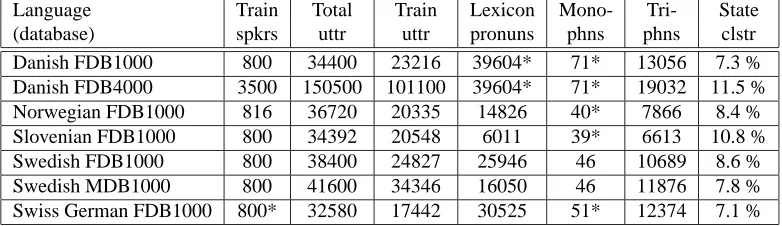
Language Train Total Train Lexicon Mono- Tri- State (database) spkrs uttr uttr pronuns phns phns clstr Danish FDB1000 800 34400 23216 39604* 71* 13056 7.3 % Danish FDB4000 3500 150500 101100 39604* 71* 19032 11.5 % Norwegian FDB1000 816 36720 20335 14826 40* 7866 8.4 % Slovenian FDB1000 800 34392 20548 6011 39* 6613 10.8 % Swedish FDB1000 800 38400 24827 25946 46 10689 8.6 % Swedish MDB1000 800 41600 34346 16050 46 11876 7.8 % Swiss German FDB1000 800* 32580 17442 30525 51* 12374 7.1 %
Table 3: Training statistics. A star (*) next to a number indicates that information external to the official SpeechDat database was used. This is either a session list, a pronunciation lexicon, or a phoneme mapping.
and since the decision tree will automatically select the best questions for the data, it makes sense to use the union of broad class definitions for new languages.
As a final training stage, both the fresh monophones and the tied state triphone models are once again improved by Gaussian mixture splitting and reestimation up to 32 com-ponents.
4.
Test design
The models trained by the procedure above can be used to provide benchmark results for a number of different applications, in different languages. However, in order to analyse the general behaviour of the models between languages and to improve the general design, it is useful to have a commonly defined test suite based only on the SpeechDat(II) database itself.
For this purpose, the official SpeechDat(II) test sessions (Chollet et al., 1998) are used, with different subcorpora representing typical test applications. Five common tests have so far been designed, for some of the sub-corpora in Table 1:
I-test: Isolated digit recognition (SVIP)
Q-test: Yes/no recognition (SVIP)
A-test: Recognition of 30 isolated application words
(SVIP)
BC-test: Unknown length connected digit string
recognition (SVWL)
O-test: City name recognition (MVIP)
For all these tests, common test procedures are used, ensuring identical rules of test design across databases and languages. Currently, there are three such procedures, de-noted SVIP (Small Vocabulary Isolated Phrase), SVWL (Small Vocabulary Word Loop) and MVIP (Medium Vo-cabulary Isolated Phrase). Utterances with OOV, mis-pronunciation, unintelligible speech or truncations are ex-cluded in all procedures, since these are difficult to score without a particular application dialogue in mind. Noise markers are also ignored. The standard US NIST algo-rithm (Young et al., 1997) is used when string alignment is needed for scoring, currently only in the SVWL test pro-cedure.
To completely specify the details of a test, the test pro-cedure, test corpus codes and test vocabulary must be lected for every database. The vocabulary may contain se-mantic mappings, to specify that synonym confusions (e.g. zero/oh in English) should not be counted as errors. In the MVIP test procedure, the vocabulary can also be generated automatically, from all (training and test) utterances in the database. If this is done, no utterances will be considered OOV.
In order to have a completely open experiment set-ting, both the training and test procedures and detailed test results are available on the public web site (COST 249 SpeechDat SIG, 2000). The intention of this site is to en-able all researchers with access to a SpeechDat(II) database and the HTK toolkit to repeat the experiments reported and contribute to an improved common recogniser design.
5.
Current results
Six different labs within the COST 249 community have successfully completed the training procedure (version 0.93) for SpeechDat(II) compliant 1000-speaker databases (Johansen et al., 1999). Here we present results for ver-sion 0.95, obtained for five languages. First, we summarise some training statistics in Table 3. More details are avail-able on the web (COST 249 SpeechDat SIG, 2000).
We can see that the number of utterances actually used during training is significantly lower than the total number of utterances by the training speakers. Most of this reduc-tion is due to the content filtering, and especially the re-moval of utterances with intermittent noise. The high num-ber of monophone models for Danish is due to the fact that a large number of diphthongs are treated as phonemes in the lexicon. The rightmost column in Table 3 is the reduc-tion in effective number of states obtained by the state tying procedure.
correspond-0 5 10 15 20 25 30 35
mini_1_4 mini_1_6 mini_2_1 mini_4_1 mini_8_1 mini_16_1 mini_32_1
mono_1_4 mono_1_6 mono_2_1 mono_4_1 mono_8_1 mono_16_1 mono_32_1
tri_1_1
tied_1_1 tied_2_1 tied_4_1 tied_8_1 tied_16_1 tied_32_1
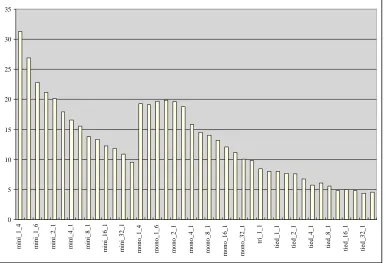
Figure 1: Typical performance evolution during training (Norwegian, A-test)
Language Test corpus
(database) I Q A BC O
Danish FDB1000 1.04 1.14 2.36 2.30 15.82 Danish FDB4000 0.62 1.05 2.41 2.70 14.03 Norwegian FDB1000 2.31 0.53 4.43 5.87 17.31 Slovenian FDB1000 4.15 0.87 4.86 6.14 9.33 Swedish FDB1000 1.03 0.00 1.18 2.52 12.37 Swedish MDB1000 10.50 1.13 4.04 14.22 18.59 Swiss German FDB1000 0.51 0.27 1.06 3.10 6.29
Table 4: Word error rates (in %) with refrec 0.95
ing models trained in the initial pass, although the high-complexity monophones don’t seem to suffer from poor ini-tial segmentation.
A summary of test results for the different databases tried so far is given in Table 4.
It is worth noting that there is considerable variation be-tween languages. Some of this can be related to the dif-ferent noise levels in the telephone networks (as is illus-trated by the difference between then Swedish FDB and MDB), while differences in vocabulary and phoneme sets obviously contribute significantly as well. In Table 5 and Table 6, average word lengths for the different tests are presented. For the O-test, the difference in test vocabulary seems to have a significant impact on the test results. The observed differences for the small vocabulary tests are how-ever harder to explain by these numbers only.
When comparing the results in Table 4 to state-of-the-art recognisers, one should remember that whole-word modelling is not used. This will be a typical choice at least for digit recognisers. Cross-word context dependencies are not modelled either, and the degree of tying has not been
Language I/BC Q A Danish 2.64 2.00 4.57 Norwegian 2.85 2.00 4.60 Slovenian 3.85 2.00 6.52 Swedish 3.33 2.50 6.23 Swiss German 3.70 2.50 6.67
Table 5: Average number of phonemes in test vocabularies
Database #Words Phonemes/word Danish FDB1000/FDB4000 495 6.52 Norwegian FDB1000 1182 7.34 Slovenian FDB1000 597 10.36
Swedish FDB1000 905 9.29
Swedish MDB1000 869 8.96
Swiss German FDB1000 684 12.64
optimised. Furthermore, a lot of training data containing noise has been removed. Thus, the silence modelling is probably not good enough. There are still no models for speaker noise or filled pauses either.
6.
Conclusion
The reference training and test procedures presented have shown to provide a solution to the practical/logistic problems for the languages involved so far. The web page set up to coordinate experiments will hopefully con-tribute to significant progress in research on SpeechDat(II) databases, by disseminating benchmark procedures and re-sults obtained for different databases.
Future work will include the improvement of language and database coverage. So far mainly the smaller Speech-Dat(II) databases have been applied for training and testing (1000 speaker databases) with the exception of the Danish 4000 speaker database.
Also the number of standardised tests will be extended to cover some of the more challenging tasks represented within the SpeechDat(II) databases. This includes large vo-cabulary tasks such as name recognition (company and/or person names).
With the standardised description of speaker demo-graphics it is also possible to develop common error analy-ses on existing tests and thus to correlate performance fig-ures with demographic information.
Finally, the aim is to find a more general approach to broad class partitioning and phoneme mapping, as this is currently the only linguistic information needed by the training procedure that can not be found in the database. This would make the reference recogniser more universal and ease the inclusion of new languages in the covered set of languages.
7.
Acknowledgements
The COST 249 action and all its participants are ac-knowledged for their support and encouragement in rela-tion to the work presented.
8.
References
Chollet, G., F.T. Johansen, B. Lindberg, and F. Senia, 1998. Test set definition and specification. Technical Report Deliverable SD 1.3.4, SpeechDat project LE2-4001. COST 249 SpeechDat SIG, 2000. The Refrec homepage.
http://www.telenor.no/fou/prosjekter/taletek/refrec. H¨oge, H., C. Draxler, H. van den Heuvel, F.T. Johansen,
E. Sanders, and H.S. Tropf, 1999. SpeechDat multilin-gual speech databases for teleservices: Across the fin-ish line. In Proc. Europ. Conf. Speech Proc. and Techn.
(EUROSPEECH).
Johansen, F.T., 1998. Phoneme-based recognition for the Norwegian SpeechDat(II) database. In Proc. Int. Conf.
Spoken Language Processing (ICSLP). Sydney.
Johansen, F.T., B. Lindberg, G. Lehtinen, Z. Kaˇciˇc, B. Im-perl, B. Milner, D. Chaplin, K. Elenius, G. Salvi, E. Sanders, and F. de Wet, 1999. The COST 249 Speech-Dat multilingual reference recogniser. COST 249 MCM, Technical Annex, Budapest.
Schultz, T. and A. Waibel, 1998. Language independent and language adaptive large vocabulary speech recogni-tion. In Proc. Int. Conf. Spoken Language Processing
(ICSLP). Sydney.
Young, S., D. Ollason, V. Valtchev, and P. Woodland, 1997.
The HTK book (for HTK Version 2.1). Entropic