On Bandwidth Efficient Modulation for High-Data-Rate
Wireless LAN Systems
John D. Terry
Nokia Research Center, 6000 Connection Drive, Irving, TX 75039, USA Email: [email protected]
Juha Heiskala
Nokia Research Center, 6000 Connection Drive, Irving, TX 75039, USA Email: [email protected]
Victor Stolpman
Southern Methodist University, 3145 Dyer Street, Dallas, TX 75275-0338, USA Email: [email protected]
Majid Fozunbal
Georgia Institute of Technology, Atlanta, GA 30332, USA Email: [email protected]
Received 3 October 2001 and in revised form 25 March 2002
We address the problem of high-data-rate orthogonal frequency division multiplexed (OFDM) systems under restrictive band-width constraints. Based on recent theoretic results, multiple-input multiple-output (MIMO) configurations are best suited for this problem. In this paper, we examine several MIMO configurations suitable for high rate transmission. In all scenarios con-sidered, perfect channel state information (CSI) is assumed at the receiver. In constrast, availability of CSI at the transmitter is addressed separately. We show that powerful space-time codes can be developed by combining some simple well-known tech-niques. In fact, we show that for certain configurations, these space-time MIMO configurations are near optimum in terms of outage capacity as compared to previously published codes. Performance evaluation of these techniques is demonstrated within the IEEE 802.11a framework via Monte Carlo simulations.
Keywords and phrases:OFDM, WLAN, MIMO, antenna diversity, space-time block codes, TCM.
1. INTRODUCTION
Currently, the IEEE 802.11a standard offers data rates rang-ing from 6 Mbit/s to 54 Mbit/s. However, there is a grow-ing interest for a 100 Mbit/s mode of operation for the IEEE standard. Unfortunately, to achieve such a rate within the IEEE 802.11a framework requires the system to operate at a spectral efficiency better than 6 bit/s/Hz. The spectral effi -ciency problem is further complicated by the fact that 20% of the available bandwidth is used for the cyclic prefix to mit-igate the effects of frequency selective fading. From a sys-tem design perspective, the complexity associated with this mode of operation should not be much greater than that for the 54 Mbit/s mode of the standard. These stringent require-ments constitute a very interesting research problem.
Recent information theoretic results [1] suggest that there is a tremendous capacity potential for wireless com-munication systems using antenna diversity. Foschini and
Gans [1] and others [2, 3] noted that orthogonal frequency division multiplexed (OFDM) systems are particularly well suited for antenna diversity techniques. Hence, it is expected that multiple element antenna arrays will play an increasingly important role in emerging wireless LAN networks. Indeed, when used in conjunction with appropriately designed signal processing algorithms, these arrays can dramatically enhance performance.
at the receiver. It was shown that for a quasi-static Rayleigh or Rician channels, performance is determined by the diver-sity advantage quantified by the rank of certain matrices and by the coding advantage, that is, quantified by the determi-nants of these matrices.
In contrast, when the temporal and spatial channel gain is available in transmitter, there is no need to use space-time codes. Because of the availability of channel gains in both transmitter and receiver, spatial processing can be per-formed at both transmitter and receiver to change the statis-tic of multiple-input multiple-output (MIMO) channel at the receiver into a parallel bank of single-input single-output (SISO) channels [2]. When the channel has severe nulls in its frequency response or there is a powerful narrowband noise, the signal frequency components are completely canceled out in those frequencies. It is obvious that transmitting energy in these frequencies is a waste of power. Therefore, to ap-proach the capacity of these channels, a kind of spectral shap-ing should be applied to the transmitted signal. Correspond-ingly, new coding schemes, which are adapted to the fre-quency response of the channel, are required. In other words, the power and rate should be optimally distributed over fre-quency components of the transmitted signal by an algo-rithm calledwater-filling. It has long been known that multi-carrier modulation [5] could in principle be used to achieve the power and rate allocations prescribed by water-filling. However, practical realizations of multicarrier modulation in combination with powerful codes have been achieved only in recent years. Goldsmith in [6, 7] was one of the first re-searchers to develop powerful codes for the wireless channel. The remainder of this paper is organized as follows. Section 2 describes the basic channel model used for MIMO systems, which is the basis for later development in the paper. Section 3 is dedicated to the design criteria for STC. It briefly summarizes the popular work by Tarokh in [4], but also in-cludes the work of Ionescu [8], who developed a new crite-rion for the coding gain for STC. Section 4 leverages heav-ily on the work presented in Section 3 to derive simple con-struction techniques for near-optimum STC. Section 5 re-views the previous work in adaptive modulation and intro-duces novel extensions to this work. Finally, we summarize the work presented and salient points for future research.
2. CHANNEL MODEL FOR MIMO SYSTEMS
We provide sufficient details to generally characterize the channel for any multiple-input multiple-output (MIMO) systems employing an OFDM modulation. The final form for the channel model is denoted in matrix/vector for notational convenience. Now, we consider a communication link com-prisingNtransmitter antennas andMreceiver antennas that operates in an OFDM MIMO channel. Each receiver antenna responds to each transmitter antenna through a statistically independent fading path. The received signals are corrupted by additive noise, that is, statistically independent among the
M receiver antennas and the transmission periods. For ease of presentation, discrete baseband notation is used, that is, at sample time indexl,the complex symbols, si(l),sent by
theNtransmit antennas and, subsequently, detected by the
kth receive antenna, is denoted by yk(l). Then yk(l) can be
where hik(l) is the complex scalar associated with path
be-tween the ith transmitter antenna and the kth receive an-tenna at time indexl. The noise samples at time indexi,vk(l),
are complex zero-mean spatially and temporally white Gaus-sian random variable with varianceN0/2 per dimension. It
is further assumed that the transmitted signalssi(l) are
nor-malized such that the average energy for the signal constel-lation is unity. Recall that, for OFDM signal, the channel is made circulant by prepending a cyclic prefix (CP) to the data sequence prior to transmission. This simple mechanism al-lows us to replace the linear convolution in (1) with a circu-lar one. Hence, the frequency selective channel given in (1) is transformed into a parallel bank of flat fading channels via anL-point FFT, that is,
quency domain representations of themth subcarrier of the received signal for thekth antenna, complex channel gains between theith transmitter antenna and thekth receive an-tenna, transmitted signal for theith antenna, and noise sig-nal for the kth receive antenna, respectively. If the channel gains are slowly fading, then it can be assumed that, during a period ofTtime indexes, the gains are constant and we can approximate the channel as a block fading channel. Thus, the received signal vector for themth subcarrier using matrix no-tation is given by
Y(m)=
3. REVIEW OF STC DESIGN CRITERIA
We briefly review STC design criteria for quasi-static chan-nels. In general, a wireless communication system is com-prised ofNtransmit antennas andMreceive antennas. The information data is encoded using a channel code to protect it against imperfections caused by the channel. The encoded data stream is split into N parallel streams each of which is modulated and then transmitted using separate antennas. Each path for the separate antennas is assumed i.i.d. and quasi-static, that is, the complex gains of the paths are con-stant over each data frame but change from frame to frame.
To develop codes that perform well over fading channels, we choose to minimize the pairwise error probability. That is, the probability that the code word cis transmitted over the channel and a maximum-likelihood (ML) receiver de-cides in favor of a different code word e. The ML receiver makes decoding decisions based on a performance metric
m(Y,c,H) provided that estimates of the fading amplitudes, H, are available at the receiver. Formally, the maximum like-lihood criterion for the optimum decoder requires the con-ditional probability of receivingYgiven that the code wordc was transmitted to be greater than the probability of receiv-ingYassuming any other code wordewas transmitted, that is,
Ykis again the received signal for thekth antenna;Hk and
ekare the complex path gains and transmitted symbols,
re-spectively, from theNtransmit antennas to thekth received antenna, and| · |2 represents the squared Euclidean norm.
The pairwise error probability is found by taking the sta-tistical expectation of (5). Rather than solving for the ex-act pairwise error probability, which can only be evaluated numerically, an upper bound can be found for (5) using the Chernoffbound techniques. Evaluation of the Chernoff bound for Rician and Rayleigh channels leads to the follow-ing two design criteria.
First, we define the quantity referred to thecode word dif-ference matrixD(c,e) defined as
wherelrepresents the length of an error event path. In (7), the columns ofD(c,e) index the transmit antennas and the rows index the symbol epochs1of the codescande. The rank
1For this case, the symbol epochs corresponds to subcarriers of the
OFDM symbol.
of D(c,e) determines the diversity advantage of the code. That is, in order to achieve a diversity of pMin a rapid fad-ing environment for any two code wordscandethe strings
c1(l)c2(l)· · ·cN(l) ande1(l)e2(l)· · ·eN(l) must be different
at least for pvalues of 1≤l≤N. The coding advantaged2 P
is determined from the geometric mean of the eigenvaluesλi
of the matrix ofD(e,c)†D(e, c), that is,
Typically, the minimum coding advantaged2
P(r) amongst all
code word pairs is the dominate factor in the performance of STC. Further, the minimum Euclidean distancedminbetween
any two code wordscandedetermines the minimum coding advantage. Hence, codes with largerdminhave better coding
advantages.
3.1. Improvement of design criterion
Ionescu [8] demonstrated that the determinant crite-rion can be strengthened by requiring the eigenvalues of D(e,c)†D(e,c) to be as close as possible, for any pair of code wordsc,e. Formally, the criterion was expressed as follows.
Theorem 1 (new determinant criterion). The equal eigen-value criterion: for N-transmit antenna system operating in i.i.d. Rayleigh fading with perfect channel state information (CSI), an upper bound to the pairwise error probability is made as small as possible if and only if, for all pair of code wordsc,e, the squared Euclidean distancetr[D(e,c)†D(e,c)] is made as large as possible. Further, the nonsquare ma-trices D(e,c) are semiunitary—up to a scale factor—, that is,D(e,c)†D(e,c)=(tr[D(e,c)†D(e,c)]/N)∗IN. Essentially,
maximizingminc,edet[D(e,c)†D(e,c)], as specified by the
de-terminant criterion, requires maximizing the minimum eigen-value product over allD(e,c)†D(e,c).
Proof. By Hadamard’s theorem, the eigenvalue product for a square, positive definite matrix A, with elements ai, j
as-sumes its maximum valueΠiai,i,if and only if Ais diagonal.
OnceD(e,c)†D(e,c) is diagonalized, the product of its diag-onal elements is maximizedif and only if they are rendered equal and their sum, tr[D(e,c)†D(e,c)], is maximized. Con-sider the arithmetric-mean geometric mean inequality, that is,
Hence, the product distance d2
P(r) given in (8) is
up-per bounded by the arithmetic mean of eigenvalues of D(e,c)†D(e,c) with equality achieved when all eigenvalues are equal.
a suboptimal solution to enforce the condition of the code words corresponding to the shortest error event paths in the code trellis. In the next section, we demonstrate a simple method for constructing near optimal space-time trellis code (STTC) using the equal eigenvalue criterion.
4. SIMPLE STTC CONSTRUCTION FOR EQUAL EIGENVALUE DESIGNS
Here, we postulate that concatenation of an orthogonal space-time block code (STBC) with bandwidth-efficient codes designed for additive white Gaussian noise (AWGN) channels yield near optimum codes in terms of coding gain. It is well known that the STBC [9, 10] are spectrally less ef-ficient than STTC. To compensate for the poor spectral effi -ciency of STBC, the input symbolss1, s2, . . . , skof the STBC
can be generated from a spectrally efficient modulation such as trellis-coded modulation (TCM) or block-coded modu-lation (BCM). Note that the use of an orthogonal STBC guarantees satisfaction of the equal eigenvalue criterion by Ionescu [8]. Furthermore, the symbols s1, s2, . . . , sk should
be chosen to maximize the Euclidean distance for all pair of code words c,e. Since STTC assumes flat fading chan-nels in its development, consider space-time block coding of an OFDM system using the Radon-Hurwitz (R-H) uni-tary transform, popularized by Alamouti [11], defined over OFDM symbols as
where the rows in (10) index transmit antennas and the columns index symbol epochs. If two consecutive OFDM symbols are referred to as Xo andXe, then at the first
an-tenna,Xe is transmitted in the first time epoch followed by
Xoin the second time epoch while, at the second transmitter,
X∗o is transmitted in the first time epoch followed by−X∗e in the second time epoch. The appeal of the R-H transform and other orthogonal transmit diversity schemes is because they allow the individual symbols at the receiver to be sepa-rated. Denote the diagonal matrices containing the channel frequency response vectors,H1andH2, for a two transmitter
and one receiver configuration by Λ1 andΛ2, respectively.
Assuming the channel is constant over the two consecutive symbol epochs, the baseband received signals (Y1,Y2) in the
respective symbol periods are given by
Y1=Λ1Xo+Λ2Xe+V1,
Y2= −Λ1X∗e +Λ2X∗o +V2.
(11)
Using simple substitution methods, the noise corrupted esti-mates of the consecutive OFDM symbols are
Xo=Λ∗1Y1+Λ2Y∗2,
Xe= −Λ1Y∗2 +Λ∗2Y1.
(12)
Substituting (11) into (12) yields
The question that remains is what values ofXoandXe
max-imize the coding advantage for the system. Recall that, it was noted that the performances of STC are dominated by min-imum distance for the code. Also, recall that for any coset code, the minimum distance for the code [12, page 113] is determined by
where dfree is the free distance of the code used to select a
coset anddcosetis the minimum distance within a coset. Now
consider the code difference matrixD(e,c) of our concate-nated code for themth subcarrier of an OFDM system with two transmit antennas,
Clearly, (16) satisfies the equal eigenvalue criterion and thus its coding gain is guaranteed to achieve its upper bound. Hence near-optimum performance is achievable provided that the eigenvalues are made as large as possible. Other researchers [13, 14] have arrived to this same conclusion based on different arguments. The main restriction on the code words c,e is that the channel must be static over the two symbol epochs defining the Radon-Hurwitz trans-form. Hence, we can construct a space-time block coset code (STBCC) by simply selecting a well-known coset code with the desired Euclidean distance, dfree, and
complex-ity. One limitation to these codes is that there is no full rate complex orthogonal STBC for more than two antennas [9, 10].
We construct a few simple STBCCs using Ungerboeck codes and compare them to some previously published STTCs [4] of similar complexity.
δ2
Figure1: Distance between constellation points for 4-PSK and 8-PSK.
00 01 02 03
10 11 12 13
20 21 22 23
30 31 32 33
Figure 2: Tarokh et al. [4]: a fully connected 4-state STC using quadrature phase shift keying (QPSK).
matrix is given by
D(e,c)†D(e,c)=
2 bit/s/Hz Ungerboeck code with 4 state, defined by the octal generator polynomialsg1 =2 andg2=5, in [12, page 120],
withδ2
3 =4 for 8-PSK. Hence, the coding advantage using
this simple construction is 3 dB better than the 4-state STC of the same rate.
Example2. Now consider the 2-space-time code, 4-PSK, 8 states, 2 bit/s/Hz shown in Figure 3. The code word different matrix is equal to
D(e,c)=
states, with octal generator polynomialsg1=04,g2=04, and g3 =11. The minimum free distance for this code isdfree2 =
4.586, which is 1.15 dB better than the equivalent STC code by Tarokh [4].
Figure3: Tarokh et al. [4]: trellises for 8 states and 16 states with diversity order 2.
Example3. The final example of this section considers a 2-space-time code, with 16 states, 2 bit/s/Hz. The trellis for this code is given in Figure 3. The code word difference matrix for this code is The geometric mean of the eigenvalues equals 5.29. An Ungerboeck code—g1 =16,g2 = 04,g3 = 23 octal
gener-ator polynomials—with 16 states and rate of 2 bit/s/Hz has a minimum distance of 5.17, which is slightly less than the STTC. However, the performance of this code should be bet-ter than the STTC since half of the data is transmitted over a channel whose eigenvalue is 3.17 and it should dominant the performance for the overall code while, for our construction, each path to the receiver has eigenvalues of 5.17 associated with it.
Perhaps, the most attractive property of these STBCCs is their simpler decoder complexity compared to their STTC counterparts. When multiple receive antennas are used, max-imal ratio combining of each estimate of the transmitted symbols in (12) can be performed for all the receive anten-nas.
4.1. Improving diversity gain
In Section 3, the design criterion is optimum in terms of Eu-clidean distance. However, for fast fading channels, the Ham-ming distance rather than the Euclidean distance is the ap-propriate design metric. Recall (see [15]) that the design of a TCM scheme that achieves diversity of order prequires all pairs of possible encoded sequences to differ in at least p
desired minimum Euclidean distancedfreeamongst all signal
points. The authors in [16] show that rotation of well-known constellations, rather than designing such a constellation, can achieve the same purpose. Once each symbol has distinct co-ordinates over the whole signal constellation or within a sub-constellation, then the bound on the pairwise error probabil-ity is computed over coordinates, that is,
Ps−→s≤ 1
SNRc/4 pcΠ
pc k=1
1
sk−sk2, (20)
wherepcis the number of distinct coordinates between pairs
of code sequences, and SNRc=SNR/2 for 2D constellations
(SNR stands for signal-to-noise ratio). In other words, if each coordinate experiences independent fading, then we antici-pate atwo-foldimprovement in diversity level at moderate-to-high SNR. To ensure independent fading, we interleave over coordinates rather than symbols.
We revisit Example 1 with respect to Hamming distance. For Example 1, the symbol Hamming distance for the STC and STBCC are both two. However, if this coordinate inter-leaving technique was employed, then the coordinate Ham-ming distance for the STBCC would increase to 4. Similar arguments can be made for Examples 2 and 3. The remain-ing sections in this paper consider cases when CSI is available at the transmitter.
5. POWER OPTIMIZATION AND BIT ALLOCATION ALGORITHM
In this section, power optimization and bit allocation algo-rithm for MIMO systems are considered. Information theory determines the theoretical maximum informational data rate through parallel channels via a water-filling power allocation scheme. This theoretic solution relies on a channel-coding scheme that achieves Shannon’s channel capacity for each subcarrier. For the past fifty years, designing, coding, and modulation schemes with practical implementation com-plexity that achieve this theoretic upper bound are still an open research topic. In Section 6, we outline the problem.
Let the singular value decomposition ofHbeH=UΣVH, whereUandVare unitary matrices andΣis a diagonal ma-trix with positive real values on diagonal elements standing for the singular values of the channel. If the transmitted vec-tor is premultiplied byVin transmitter, and received vector be postmultiplied byUHin receiver, then (3) could be
rewrit-ten as
˜y=Σs+η,˜ (21)
where ˜y andη˜ denote the received vector and noise vector after postmultiplication byU. Note that becauseUis a uni-tary matrix, there is no noise amplification and the noise vectors remain spatially white. Thus, the error rate of max-imum likelihood decoder remains the same as it was for decoding (3), but its complexity is completely reduced be-cause the entries ofsare decoded separately. Ifrdenotes the rank ofΣ, then this MIMO channel is a set of parallel SISO
channels,
˜
yk=σksk+ ˜ηk, k=1, . . . , r, (22)
whereσkis the gain ofkth channel and ˜ηkis white Gaussian
noise. For an OFDM framework, (22) becomes
˜
Yk(m)=σkSk(m) + ˜Vk(m), k=1, . . . , r;m=1, . . . , L.
(23) The total capacity of the MIMO channel is equal to the aggregate capacity of all these SISO channels. If spatial water-filling is applied for this MIMO channel, then the capacity of this MIMO channel is the sum of the individual capacities per subcarrier.
For practical implementation, designers must choose a baseband modulation scheme such as MPSK or QAM for bit assignments. Thus, the symbol error rate (SER) is bounded strictly away from zero for finite transmission power in the presence of random noise. This still leaves us the question on how to maximize the total data rateR,
max[R]= L
m=1
bm, (24)
subject to a total power constraint,
L
m=1 r
k=1
ESkm2
≤Ptotal, (25)
as well as to an upper bound on the symbol error rate per subcarrierρm
ρm≤ς, m=1, . . . , L, (26)
wherebm is the number of bits per subcarrier,ςis the
up-per bound on the SER across subcarrier, andPtotalis the total
power allocated for the system. Our proposed power opti-mization and bit-loading algorithms for MIMO configura-tions are derived in Section 6.
Throughout this section, we have only consideredM-ary QAM constellations for subcarrier bit mappings with two or more bits, bm ≥ 2, and BPSK signaling for single bit
sub-carrier allocation. In addition, the analysis presented herein is for the kth path and the dependence onk is suppressed. Thus, we are able to upper bound the SER per subcarrier [17] as
ρm≤4Q
3HmPm
2bm−1N0
, m=1, . . . , L, (27)
whereN0 is the noise power density andQis
SNRs, any solution derived from the equality approximation will be suboptimal, but from existing literature, the loss in performance is small (∼ 0.1 dB) and still one of the better techniques.
To maximize the total rate with a constraint on to-tal power, we rewrite (24) using the Lagrange multiplier method, that is,
which can be solved relatively straightforward for a power allocation and bit allocation as
Pm=Ptotal
where the channel-to-noise-ratio (CNR) is
CNRm= Hm2
N0 .
(30)
During implementation, we must take the necessary care that we also satisfy positive power constraints and finite granular-ity (i.e., integer number of bits per subcarrier). Obviously, for unused subcarriers determined by the bit allocation ex-pression above, the transmitter cannot apply power to the subcarriers with no bits assigned, thus in practice we set
Pm=0 ∀m,wherebm=0. (31)
Furthermore, we do not use the subcarriers with poor gain characteristics which are identified by negative solutions due to the equality constraint in our Lagrange multiplier formu-lation. Thus, we remove these subcarriers by not allocating power to those subcarriers,
Pm=max
0, Pm
, (32)
and due to logarithm of one (in any base) in our bit expres-sion, we do not allocate any rate to the poorly operating sub-carrier. Although through creative means fractional rates are achievable for QAM mapping, we consider here only an inte-ger number of bits per subcarrier, so we floor the result from the above bit allocation equation,
bm=max
0,bm
. (33)
By flooring the bit assignment value, we ensure that the SER for each subcarrier meets the upper bound requirement in the problem formulation. Similar expressions can be derived for minimization of the average SER and transmission power under rate constraints. In Section 6, bit allocation concate-nated with coding and modulation, referred to as adaptive modulation, is considered.
Figure4: Goldsmith [6] proposed adaptive TCM scheme.
6. REVIEW OF ADAPTIVE MODULATION
Recall that, as mentioned in previous sections, when channel state information (CSI) is not available in transmitter, space-time codes should be used to get diversity and coding gain. Likewise for the SISO systems, when CSI is available in trans-mitter, we can increase the efficiency of the system optimal power and rate adaptation in transmitter. Provided that the fading channel gains are available in transmitter, codes can be constructed such that it adapts its output power and data rate to channel variation. Such codes can potentially achieve maximum channel capacity and are termed adaptive modu-lation. With adaptive modulation, rather than transmitting the same information rate for good channel and degraded channel, power optimization and bit allocation [6, 18, 19] are adapted to transmit more information when channel is good, and less information when channel is degraded. Thus, without sacrificing bit error rate (BER), these schemes pro-vide high average spectral efficiency by transmitting at high speeds under favorable channel conditions, and reducing the throughput as the channel degrades. Adaptive coded mod-ulation does not require interleaving since error bursts are eliminated by adjusting the power, size, and duration of the transmitted signal constellation relative to the channel fad-ing. However, adaptive modulation does require accurate channel estimates at the receiver which are fed back to the transmitter with minimal latency.
The general structure of an adaptive coded modulation, which was introduced by Goldsmith and Chua [6] is shown in Figure 4. Specifically, a binary encoder operates onk un-coded data bits to produce (k+r) coded bits, and the coset selector uses these coded bits to select one of the 2k+rcosets
from a partition of the signal constellation. For the nonadap-tive modulation, (n−k) additional bits are used to select one of the 2n−k signal points in the selected coset, while in the
adaptive modulator (n(γ)−k) additional bits are used to se-lect one of the 2n(γ)−kpreselected signal points out of the 2n−k
available signal points in the selected coset. The preselection is done in such a way that maximizes the minimum distance between signals.
of the signal constellation relative to γ, subject to an aver-age transmit power constraintP. Therefore, maintaining a constant minimum distancedmin, the adaptive coded
mod-ulation exhibits the same coding gain as coded modmod-ulation designed for an AWGN channel with minimum coded dis-tancedmin.
6.1. Improved adaptive modulation
We outline methods for improving the adaptive TCM modu-lation proposed by Goldsmith [6, 18], and others [14] when used in an OFDM framework. Goldsmith [6, 18] argues that burst error events are eliminated when power optimization is used. In constrast, we found that adaptive interleaving based on CSI can considerably improve the channel statistics such that greater throughputs are achievable. Goldsmith [6, 18] implemented adaptive modulation in a time-varying channel environment. OFDM systems, on the other hand, are typi-cally deployed in very slowly varying fading environments.
In these scenarios, it is possible to benefit from inter-leaving. Typically, interleavers are designed to convert slowly varying channels into rapidly changing channel to exploit time diversity. For OFDM systems, the interleavers should exploit the frequency selective of the channel to benefit from frequency diversity. Normal block or convolutional inter-leaver can be used for this purpose. However, the fullest ben-efit from interleaving is achieved when the CSI is used to de-sign it. Such interleaving is referred to asadaptive interleav-ing.
6.1.1 Adaptive interleaving
We outline a simple interleaver based on CSI at the trans-mitter, which improves the performance of an adaptive TCM scheme such that more uncoded bits per subcarrier can be supported than without interleaving. Our adaptive coordi-nate interleaver algorithm is outlined as follows:
(i) given an estimate ofH(m); (ii) defineZ(m)= |H(m)|;
(iii) [f f , kk]=Sort{Z(m)}, wherekk are indexes associ-ated with the weakest to strongest amplitudes; (iv) let j j=[1, . . . , L];
(v) map real[S(j j)]−→H(kk);
(vi) map imag[S(j j)] −→ H(reverse(kk)), where reverse(1 2 3 4)=4 3 2 1;
(vii) combine coordinators as order transmit over channel.
The resulting channel statistics after de-interleaving at the receiver has fewer deep null. A comparison of the chan-nel statistic with and without our new interleaver is shown in Figure 5. Based on this figure, the number of supportable uncoded bits per subcarrier improves considerably. An alter-native interleaving scheme based on CSI at the transmitter takes advantage of the pad bits used to generate integer num-ber of OFDM symbol within a packet. The frame format for an OFDM packet for the IEEE 802.11a standard is shown in Figure 6. On average, the number of pad bits required is half an OFDM symbol, which is quite significant. Consid-ering that the pad bits are discarded at the receiver, a better
50 45 40 35 30 25 20 15 10 5 0
Subcarrier number in OFDM symbol 0
0.2 0.4 0.6 0.8 1 1.2 1.4
Channel
amplitudes
After interleaving Before interleaving
Figure 5: Virtual channel statistics at the decoder after de-interleaving.
Data # of OFDM symbols Signal
one OFDM symbol Preamble
12 symbols Rate
(4 bits) Reserved
(1 bit)
Length (12 bits)
Parity (1 bit)
Tail (6 bits)
Service (16 bits)PSDU
Tail (6 bits)PadBits Header
Figure6: Physical layer protocol data unit (PPDU) in 802.11a, in-cluding the preamble, header, and PSDU.
utilization of the power and channel allocation for those pad bits would be to interchange data symbols on weak subcar-riers for pad bits on strong subcarsubcar-riers. To achieve the best performance, the adaptive interleaving should be performed in conjunction with a power optimization and bit allocation algorithm. Our proposed algorithm is outlined as follows:
(i) sort the channel amplitudes for all the OFDM data subcarriers in the packet in order of weakest to strongest;
(ii) reverse the order of the bits in data portion of the packet, for example, pad bits, tail bits, and physical layer service data unit (PSDU);
(iii) map the modulation symbols onto the subcarriers by filling the set of weakest subcarriers for each OFDM symbol first;
(v) continue in this fashion until the packet is filled; (vi) using a power optimization algorithm, water-fill the
packet.
This algorithm guarantees that the data symbols are mapped onto the most reliable subcarriers; the pad bits, the least reliable subcarriers. The subcarriers, which are allo-cated no power, are assigned to the pad bits first. Depend-ing on channel conditions, some of the data subcarriers may still not be allocated any power; however, there are fewer of those data subcarriers than if the adaptive interleaver was not used. A better choice for adaptive modulation for this pro-posed adaptive interleaving is to use a block-coded modula-tion scheme. In particular, a Reed-Solomon (RS) constituent encoder provides great flexibility in error protection, code word size, and code rate, which is well suited for this ap-plication. The adaptive TCM scheme discussed thus far in this paper has been designed to minimize error probability and maximize average data rate. It is desirable to maintain a fixed number of bits per symbol to facilitate the need for multiple demodulators at the receiver. In this scenario, the data rate is guaranteed for each packet, and the error rate is driven as small as possible for any instance of the chan-nel. That is, these codes minimize the outage probability for a given rate.
6.1.2 Adaptive error correction coding
A code that minimizes the outage capacity for a given rate should be able to easily adjust its coding gain to the chan-nel statistics. The adaptive TCM scheme outlined in this pa-per assumes a certain number of coded bits pa-per subcarrier, and the number of uncoded bits per subcarrier is adapted. We allow both numbers of uncoded bits per subcarrier and coded bits per subcarriers to varying, under the restriction that the number of bits per symbol per subcarrier is fixed. This is a very interesting problem that stems from practi-cal considerations. For an OFDM system perspective, it is desirable to set the rate for the system prior to transmis-sion. Furthermore, the packet error rate, not the bit error rate, must be minimized. Hence, each packet must meet the rate requirement first and the error requirement sec-ond. Since, there are a fixed number of parity symbols avail-able determined by the rate, it is wise to use the adap-tive interleaver scheme described in this section to spec-ify erasures for the code. Consider a shortened RS linear block code. Adding erasures, up to the length of the orig-inal code, does not reduce the parity symbols available for random symbol errors. The caveat to this statement is that there need to be available sufficient pad bits for the specified erasures.
Now, we focus on applying bit and power allocation ideas to improve error correction codes. If hard erasure decoding is implemented, RS codes can correct up to (NN−KK) era-sures or(NN −KK)/2 random errors, whereKK is the number of information symbols andNNis the length of the RS code. Thus for an AWGN channel (spectrally flat chan-nel), the word error rate (WER) is upper bounded by the
expression
WER≤
NN
k=(NN−KK+1)
NN
k
ρk(1−ρ)NN−k, (34)
which assumes that the erasure locations are known or can be predicted. Note that for a spectrally shaped system such as an OFDM system, the SERρmvaries from subcarrier to
subcar-rier. Hence, the average SER over theNN−χbest subcarriers ¯
ρχis defined by
¯
ρχ=
1
NN−χ NN
m=χ+1
ρm, (35)
and (34) becomes
min
χ[0,...,(NN−KK+1)](WER), (36)
where
WER≤
NN−χ k=(NN−χ−KK+1)
NN−χ
k ρ¯kχ
1−ρ¯χ NN−χ−k
. (37)
Although the erasures are not actually transmitted across the channel, there need to be enough “empty” or “unmodulated” subcarriers to account for those symbols. Power saved by not transmitting the erasures should be reallocated amongst the data bearing subcarriers in a manner that minimizes (37). An outline for the algorithm is given as follows:
(1) given an estimate of H(m), sort the channel ampli-tudes for all the OFDM data subcarriers in the packet in order of weakest to strongest;
(2) determine the zero power locations from power and bit allocation algorithms and specify them as erasures for the shortened RS code;
(3) determine WERifrom (37);
(4) specify the next weakest subcarrier as an erasure and reallocate power;
(5) recalculate WERi+1;
(6) if WERi>WERi+1, repeat steps 4 and 5 until this is no
longer true;
(7) using targeted SER bound ς, compute the SER per subcarrierρmusing (27), determine the location and
number of symbols, which can be unprotected; (8) finally, determine the number of bits needed to meet
the total data rateRand allocate bits using the adaptive coded modulation structure introduced by Goldsmith and Chua [6], under the restriction of a fixed constel-lation size.
250 200
150 100
50 0
Ordered subcarriers 0
0.5 1 1.5 2 2.5 3 3.5 4
Bits
in
er
ro
r
p
er
sy
mb
ol
Erasures region
Random error region – 4 coded 2 bits uncoded
Uncoded error region
Figure 7: An adaptive bit allocation per subchannel for BCM scheme with 6 bits per symbol.
over the packet. The first 48 subcarriers of the 240 subcarri-ers in the packet are specified as erasures. The overall rate for the system is 2/3 not including the erasures specified by the stuffbits. When the power is re-distributed, the single error in the uncoded region is corrected. A summary of steps for performing adaptive error.
In the next section, we validate some of the algorithms presented in this document within the IEEE 802.11a frame-work. Note, that the IEEE 802.11a framework assumes quasi-static channels. That is, the channel is constant over a packet but changes from packet to packet. Hence, this is akin or sim-ilar to the environment used for outage probability.
7. SIMULATION RESULTS
We present a performance evaluation of several MIMO figurations within the IEEE 802.11a framework. The con-stituent TCM scheme uses a 128-state, rate 2/3 convolutional encoder for all the data rates considered. The IEEE 802.11a baseline system parameters are
(i) 64 pt. FFT: 48 data carrier and 4 pilot carriers, (ii) 20 MHz sampling frequency,
(iii) 3.2 microsecond FFT period and 0.8 microsecond cyclic prefix,
(iv) symbol rate of 12 Msymbols/s.
First, we examined the packet error rate performance (PER) of STBCC schemes, 128 states, 4 bit/s/Hz over a five-tap Rayleigh channel. The channel five-taps were spaced 50nsec apart with an exponential channel delay profile, which is less than the cyclic prefix. The first observation concerning Fig-ures 8 and 9 is that the diversity order of the STBCC with no interleaving is two not one. Considering that this code has two parallel transitions per state; this simulation validates that STBCCs are guaranteed to have a diversity order of at least two, which was determined from their code word dif-ference matrices. A second observation is that coordinating
25 24 23 22 21 20 19 18 17 16 15
SNR 10−6
10−5
10−4
10−3
10−2
10−1
100
BER
No interleaver Coordinate interleaving STBC+CC
Figure8: Diversity improvement for STBCC using coordinate in-terleaving in a Rayleigh fading channel.
25 24 23 22 21 20 19 18 17 16 15
SNR 10−4
10−3
10−2
10−1
100
PE
R
No interleaver Coordinate interleaving STBC+CC
Figure9: PER performance improved with coordinate interleaving for TCM 48 Mbit/s.
30 28 26
24 22 20 18
SNR 10−3
10−2
10−1
100
PE
R
Adaptive PER R.S. 128 Stage TCM PER rate
Figure 10: Adaptive modulation PER comparison: BCM versus TCM for five-tap Rayleigh fading and 48 Mbit/s mode.
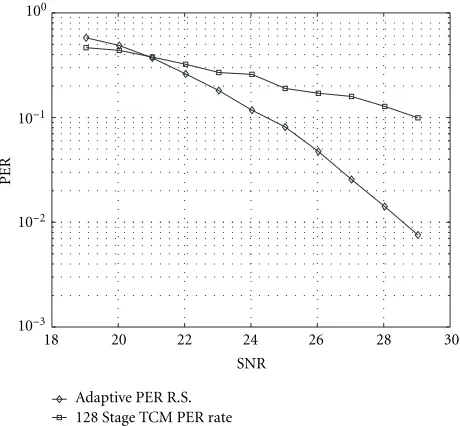
To illustrate our proposed adaptive BCM, we consider the same TCM scheme with two parallel transitions per state. Both schemes are adaptively interleaved according to the algorithms specified in Section 6.1.1. The adaptive BCM scheme uses shortened versions of RS(63,31) and uncoded symbols across the packet in a similar fashion, as depicted in Figure 7. The power optimization algorithm specified 48 erasures, of which 43 were pad symbols to fill the packet. Also, ninety-four of the subcarriers had four coded bits and two coded bits. The remaining subcarriers were uncoded. The power from the 48 erasures were distributed in a water-filling fashion across the data bearing subcarriers, for exam-ple, the uncoded symbol were placed on the strongest subcar-riers and distributed a greater percentage of the power. The adaptive BCM performs significantly better in terms of PER as shown in Figure 10, although the adaptive TCM scheme performs better in terms of BER performance as shown in Figure 11. This validate our assertion that an adaptive BCM is better suited for environments where the outage probabil-ity is the appropriate capacprobabil-ity measure.
Our final example illustrates STBCC with coordinate in-terleaving using the TCM scheme described earlier and 6 uncoded bits per symbol. The overall rate is 96 Mbit/s in a 20 MHz band, which has a spectral efficiency of 4.8 bit/s/Hz. For comparison, the 54 Mbit/s mode of the IEEE 802.11a is shown in Figure 12, which has a spectral efficiency of 2.7 bit/s/Hz. At high SNR, the STBCC would eventually out-performs the 54 Mbit/s although it carries, on average, an additional 2.1 bit/s/Hz capacity. If receive diversity is avail-able, power saving of the order of 10 dB is possible with only two-receive antennas. Further, because of the structure of the STBCC, the additional signal processing required for multi-ple receiver is greatly diminished when compared to the max-imum likelihood decoders need for STTC.
30 28 26
24 22 20 18
SNR 10−4
10−3
10−2
10−1
BER
Adaptive BER R.S. 128 state TCM
Figure 11: Adaptive modulation BER comparison: BCM versus TCM for five-tap Rayleigh fading and 48 Mbit/s mode.
35 30 25 20 15 10 5 0
Eb/N0
10−3
10−2
10−1
100
PE
R
TCM 96Mb, base
TCM 96Mb, symbol interleaver TCM 96Mb, rotation, coord interleaver IEEE 54Mbits
Figure12: Comparison of STBCC with symbol interleaving to a STBCC with coordinate interleaving, and constellation rotations and 54 Mbit/s mode of the IEEE 802.11a in five-tap Rayleigh fad-ing.
8. CONCLUSIONS
the STTC found from computer search. Although STBCCs are guaranteed a minimum diversity level of 2, we showed that 2D constellation rotation and coordinate interleaving can double that diversity order. Performance evaluation over a frequency selective fading channel was demonstrated us-ing Monte Carlo simulations, which showed substantial im-provements in PER performances. Our final example showed a STBCC configuration for 96 Mbit/s in 20 MHz bandwidth, which performed comparably to the 54 Mbit/s mode of the IEEE 802.11a in terms ofEb/N0.
REFERENCES
[1] G. J. Foschini and M. J. Gans, “On limits of wireless commu-nications in a fading environment when using multiple an-tennas,” Wireless Personal Communications, vol. 6, no. 3, pp. 311–335, 1998.
[2] G. G. Raleigh and J. M. Cioffi, “Spatio-temporal coding for wireless communication,” IEEE Trans. Communications, vol. 46, no. 3, pp. 357–366, 1998.
[3] E. Teletar, “Capacity of multi-antenna Gaussian channels,” Tech. Rep., AT&T-Bell Labs, June 1995.
[4] V. Tarokh, N. Seshadri, and A. Calderbank, “Space-time codes for high data rate wireless communication: Performance cri-terion and code construction,”IEEE Transactions on Informa-tion Theory, vol. 44, no. 2, pp. 744–765, 1998.
[5] J. Bingham, “Multicarrier modulation for data transmission: an idea whose time has come,” IEEE Communications Maga-zine, vol. 28, no. 5, pp. 5–14, 1990.
[6] A. J. Goldsmith and S. Chua, “Adaptive coded modulation for fading channels,”IEEE Trans. Communications, vol. 46, no. 5, pp. 595–602, 1998.
[7] A. J. Goldsmith and P. Varaiya, “Capacity of fading channels with channel side information,” IEEE Transactions on Infor-mation Theory, vol. 43, no. 6, pp. 1218–1230, 1997.
[8] D. M. Ionescu, “New results on space-time code design crite-ria,” inProc. IEEE Wireless Communications and Networking Conference, pp. 684–687, September 1999.
[9] V. Tarokh, H. Jafarkhani, and A. R. Calderbank, “Space-time block coding for high data rate wireless communications: per-formance results,”IEEE Journal on Selected Areas in Commu-nications, vol. 17, no. 3, pp. 451–460, 1999.
[10] V. Tarokh, H. Jafarkhani, and A. R. Calderbank, “Space-time block codes from orthogonal designs,” IEEE Transactions on Information Theory, vol. 45, no. 5, pp. 1456–1467, 1999. [11] S. M. Alamouti, “A simple transmit diversity scheme for
wire-less communications,”IEEE Journal on Selected Areas in Com-munications, vol. 16, no. 8, pp. 1451–1458, 1998.
[12] S. H. Jamali and T. Le-Ngoc, Coded-Modulation Techniques for Fading Channels, Kluwer Academic, Boston, Mass, USA, 1994.
[13] S. M. Alamouti, V. Tarokh, and P. Poon, “Trellis coded modu-lation and transmit diversity: design criteria and performance evaluation,” inProc. IEEE ICUPC ’98, vol. 1, pp. 703–707, Florence, Italy, October 1998.
[14] Y. Gong and K. B. Letaief, “Analysis and design of trellis coded modulation with transmit diversity for wireless communica-tions,” inProc. IEEE Wireless Communications and Networking Conference, vol. 3, pp. 1356–1361, Chicago, Ill, USA, Septem-ber 2000.
[15] E. Biglieri, D. Divsalar, P. McLane, and M. K. Simon, Introduc-tion to Trellis-Coded ModulaIntroduc-tion with ApplicaIntroduc-tions, Macmil-lan, New York, NY, USA, 1991.
[16] B. Jeliˇci´c and S. Roy, “Design of trellis coded QAM for flat
fad-ing and AWGN channels,” IEEE Trans. Vehicular Technology, vol. 44, no. 1, pp. 192–201, 1994.
[17] J. G. Proakis, Digital Communications, McGraw-Hill, New York, NY, USA, 3rd edition, 1995.
[18] A. J. Goldsmith and S. Chua, “Variable-rate variable-power MQAM for fading channels,” IEEE Trans. Communications, vol. 45, no. 10, pp. 1218–1230, 1997.
[19] K.-K. Wong, S.-K. Lai, R. S.-K. Cheng, K. B. Letaief, and R. D. Murch, “Adaptive spatial-subcarrier trellis coded MQAM and power optimization for OFDM transmission,” inProc. IEEE International Conference on Vehicular Technology, pp. 2049– 2053, Tokyo, Japan, May 2000.
John D. Terrywas born on September 29, 1966 in Norfolk, Virginia. He received his B.S. in electrical engineering from Old Do-minion University and M.S. in the same field from Cleveland State University, in 1988 and 1993, respectively. In the spring of 1999, he received his Ph.D. degree in elec-trical and computer engineering from the Georgia Institute of Technology. Dr. Terry joined Nokia Research Center (NRC) in
Dallas in January of 1999 as a senior research engineer. Currently, he manages the OFDM modulation and coding project in the Wireless Data Group at NRC Dallas. His IEEE activities include technical reviews for several conferences and journal publications related to wireless communications, and serving as vice-chair of IEEE 802.11g task group. He is the coauthor of the book entitled, “OFDM WLANs: A Theoretical and Practical Guide.” In 2002, Dr. Terry was honored with a national award as the Black Engineer of the Year for Outstanding Technical Contributions in Industry. His research interests include array processing, space-time coding, WLAN technology, diversity techniques, and error correction cod-ing.
Juha Heiskalareceived his M.S. in electri-cal engineering in 1996 from Helsinki Uni-versity of Technology. He is in the electri-cal engineering Ph.D. program at Southern Methodist University. He joined Nokia Re-search Center 1995, where he has worked on several different areas of digital communi-cations, for example, digital audio broad-casting, satellite radios, and wireless LAN technology. His current research interests
include multiple transmitter and receiver antenna technologies, and error correcting code systems. He is the coauthor of the book entitled, “OFDM WLANs: A Theoretical and Practical Guide.” Victor Stolpmanreceived his B.S. degree
in electrical engineering with honors from Texas A&M University, College Station, Tex, in 1995, and his M.S. degree from Southern Methodist University, Dallas, Tex in 1999. Currently at Southern Methodist Univer-sity, he is working on a Ph.D. degree in elec-trical engineering. From 1992 to 1998, he worked as a design engineer for Dresser In-dustries, and since 1998 he has held research
and signal processing applications for wireless data communica-tions systems. His current research includes incorporating adap-tive modulation techniques for multicarrier systems with error cor-rection coding for improved performance for high-speed wireless LAN applications.
Majid Fozunbalwas born in Tehran, Iran, in 1974. He received his B.S. and M.S. both in electrical engineering in 1996 and 1998, respectively. He is currently pursing his Ph.D. studies in electrical engineering at Georgia Institute of Technology. From 1998 to 2000 he was with Mobile Telecommuni-cation Technology Inc., Tehran, Iran, work-ing in the area of GSM technology. Durwork-ing the summer of 2001, he was with Nokia Inc.,