2016 International Conference on Wireless Communication and Network Engineering (WCNE 2016) ISBN: 978-1-60595-403-5
Energy Saving in Ultra Dense Network via Dynamic Base Station
Sleeping Combined with Interference Mitigation
Nai-jie LIU, Hai-lun XIA and Cai-li GUO
Beijing University of Posts and Telecommunications, Beijing, 100876, China
Keywords: Energy saving, Base station sleeping, Interference management.
Abstract. Ultra dense network is envisioned as a promising solution to meet the exponential growth of mobile data traffic. However, with the increasing density of small cells, the strength of inter-cell interference increases as well, which generates negative influence on the network performance. Since access networks are designed to support peak load, the utilization of base station can be inefficient most of the time which will result in a huge waste of energy. In this paper, we combine the base station sleeping with interference mitigation to address these issues. In our algorithm, we take advantage of the characteristic that the data traffic can tolerate a certain delay to mitigate interference. Therefore, base stations can be in sleep mode for a longer time while guaranteeing users’ minimal average transmission rate requirements. We also adopt the base station clustering to reduce the computational complexity of the proposed algorithm. The simulation results show that our proposed scheme can greatly reduce the energy consumption.
Introduction
The explosive popularity of smart mobile device has ignited a tremendous growth demand for data traffic. To improve the network capacity, one promising approach is increasing the density of small cells. By deploying more small cells, spatial reuse can be improved and more uniform coverage can be provided [1]. Cellular networks are designed to support peak time traffic, the utilization of base stations can be inefficient during off-peak time since the traffic is time varying. And base stations consume the largest proportion of energy in mobile cellular network [2]. Therefore, it will cause a huge waste of energy as the number of base stations increases. Since all cells use the same frequency band, inter-cell interference (ICI) will significantly affect spectral efficiency as the density of base stations increases. Therefore, the interference between small cells becomes a non-neglected issue in ultra dense network.
The total power consumption of base station consists of both the circuit and traffic dependent part. The base station consumes a lot of energy even if the traffic load is light [3]. Therefore, sleeping the underutilized base station is recognized as a promising approach to reduce energy consumption while guaranteeing users’ minimal service requirements. In [4], the state of base station is determined by the traffic load. If the traffic load is less than threshold, the base station will be switched off. When a base station is turned off, its users are served by the remaining active base stations. To guarantee the coverage, the remaining active base stations should increase their transmission power to increase the propagation distance [5]. It will cause additional energy consumption. Data applications can tolerate a certain delay. Therefore, [6] take advantage of the tolerable delay of data traffic to reduce the energy consumption. Instead of being served by the remaining active base station, the users can wait for a tolerable delay until the base stations which can provide good service for them are activated. As the network gets denser, inter-cell interference coordination becomes more and more important. In [7], the dynamic coordinated muting is applied to improve the energy efficiency of the network. The author applies the greedy search algorithm to determine the muting pattern of base stations which can effectively reduce the inter-cell interference. However, the base stations in muting mode still consume a lot of energy which limits the energy saving to a certain extent.
The users’ quality of service (QoS) can be guaranteed as long as the minimal service requirements can be finished in the tolerable delay. Our proposed algorithm combines the base station sleeping with the interference mitigation. We divide the tolerable delay into several sub-periods. At every sub-period, the on/off state of base station can be determined according to the interference between base stations and traffic load. The energy efficiency at every sub-period can be enhanced by careful selecting the sleeping base stations. Therefore, the base stations can be in sleep mode for a longer time while guaranteeing users’ QoS.
The remainder of this paper is organized as follows. Section II describes the system model and formulates the energy saving problem. In Section III, we propose our dynamic base station sleeping algorithm. Section IV presents simulation results and analysis. Conclusions are drawn in Section V.
System Model and Problem Formulation
System Model
This paper considers an ultra dense cellular network which consists of macros and picos. The picos are deployed in macro’s coverage area and share the same spectrum. For a pico user, it suffers strong cross-tier interference from the macros as well as co-tier interference from the surrounding picos. Thus, the interference problem becomes extremely complicated and the interference strength will become extremely fierce when deploying more picos. The macros are always in active mode to guarantee the coverage of network. And signaling messages and real time traffic are transmitted by the macros.
In our system model, there is one macro which consists of three sectors. The sectors are denoted as
1 2 3
{ , , }
M M M M . The number of picos is NP. Let { ,1 2, , }
P
N
S S S S be the set of picos. The
users are denoted as U {U U1, 2,,UN}. Let PM and PS denote the transmit power of macro and pico, respectively. The channel gain between cell b and user i is
, , ,
b i b i b i i i G PL A SH PE
(1) where PLb i, and Ab i, represent the large scale fading and antenna gain between b and i, respectively.
i
SH and PEi are the position related shadow fading and penetration loss of i. The received power of user i from cell b is
, ,
b i b b i RSRP P G
(2) It will be the main metrics for user to select the serving base station. In our system model, there are two things worth noting. The first one is each user can only be connected to one serving base station. The second one is each pico can only be occupied by one user at any given sub-frame. Then the signal to interference plus noise ratio (SINR) of user i at sub-frame t can be represented as follows:
, ,
1
, 3
, , , , 0
1 1
(1 )
P
j j
P
m j j
N
S S i i S j
i t N
M M i S S i i j S t
m j
P G Z SINR
P G P G Z O N
(3) where ,
j
i S
Z represents the connectivity of i and Sj. If , 1
j
i S
Z , it means the user iis served by base
station Sj. The constraint of Zi j, is
, 1
1
P
N i j j
Z
The on/off state of pico Sj at sub-frame t is denoted as OS tj, . If the base station Sj is in active
mode at sub-frame t, OS tj, is equal to 1. Let Vi t, 1 represent that user i is being served at sub-frame
t. N0 is the noise power spectral density. The base station power consumption model proposed in [8] is adopted. It can be denoted as
0 t
pico
SL
P P active
P
P sleep
(5)
Where P0 and Pt are the circuit dissipation and output power, respectively. The efficiency factor of
power amplifier is denoted as . The power consumption in sleep mode is PSL which is much less
than P0.
Problem Formulation
Our target is to minimize the total energy consumption while guaranteeing users’ minimal service requirements. Therefore, the energy saving problem can be formulated as follows:
0
1
min ( ) ( )
P
j j
N
S t S SL
j
A P P T A P t
(6)
, ,
1 1
. .
j j
N T
i t i S S j i t
s t V Z A S S
(7)
2 ,
1
log (1 )
T
i t t
B SINR D T i U
(8)
,, , j, j, 0,1 , ,
i t i S S t
V Z O i j t
(9)
, , j j,
N
i t i S S t i
V Z O
(10) where D represent the minimal average transmission rate for each user. The number of sub-frame in active mode for Sj is denoted as
j
S
A . The total number of sub-frame for each pico is T . The duration
of sub-frame is denoted as t. And let B be the system bandwidth.
Proposed Algorithm
Base Station Clustering Algorithm
The closer the distance between base stations, the greater the interference between them. In other words, if a base station is far away from another, they will have small effect on each other. Therefore, we classify the base stations in proximity of distance into a cluster. For a cluster, first of all, we select a base station and put it into the cluster. Then find the adjacent base stations of this base station and put them into the cluster too. For the newly joined base stations, repeat this process until there is no new base station to join the cluster. The state of base stations is determined according to the interference relationship between base stations which belong to same cluster. It can reduce the computational complexity when determining the state of base stations. The cluster identifier of pico
j
S is denoted as Bc S( j). We use Cclusterto traverse all the clusters.The proposed base station clustering
algorithm works as follows:
Dynamic Base Station Sleeping Algorithm
Data traffic can tolerate a certain time delay. Therefore, we can take advantage of this characteristic to mitigate the inter-cell interference. In this way, the base stations can stay sleep mode for a longer time while guaranteeing the minimal service requirements.
In our algorithm, we assume the maximum tolerable delay is Tt. It means the quality of service can be guaranteed as long as the minimal service requirements can be finished in this period. We divide this period into several sub-periods.
strongest total I DIR I (11) where Istrongest and Itotal are the strongest and total interference power respectively. At every
sub-period, the DIR based algorithm consists of two stages. The first stage is the initialization process. If the base station can finish the transmission task in the rest of time, even if the base station stay sleep mode in this sub-period, the state of base station will be initialized to uncertain mode. Otherwise, the state of base station will be initialized to active mode. The task of second stage is to further determine the state of the base stations in uncertain mode. First of all, we sort the base stations in ascending order according to the DIR. Then we sleep their strongest interference base station in this order as much as possible. By eliminating the strongest interference of the base station with large DIR, the energy efficiency can be greatly improved. We assume the pico set in cluster k denoted as SCk. Let
Nc be the total number of clusters. For a pico b, the state of b is denoted as ST b( ). And the strongest interference base station of b is denoted as Imax( )b .
Simulation Results and Analysis
System level simulation is used for evaluating the performance of our algorithm. The performance of our proposed algorithm can be influenced by traffic load and tolerable delay. Therefore we study the energy consumption of the system as the load and tolerable delay varies. We compare our scheme with existing schemes: No-Sleep scheme, Traditional-Sleep scheme and Greedy Scheme.
100 150 200 250 300 350 400
250 300 350 400 450 500 550 600 650
Number of users
T o ta l P o w e r C o n s u m p ti o n ( W ) proposed scheme Greedy algorithm Traditional-sleep No-sleep
100 150 200 250 300 350 400
1 1.5 2 2.5 3 3.5 4 4.5 5
Number of users
[image:5.595.94.501.379.520.2]P o w e r C o n s u m p ti o n P e r U s e r (W ) proposed scheme Greedy algorithm Traditional-sleep No-sleep
Figure 1. The total energy consumption of different schemes. Figure 2. The average energy consumption per user.
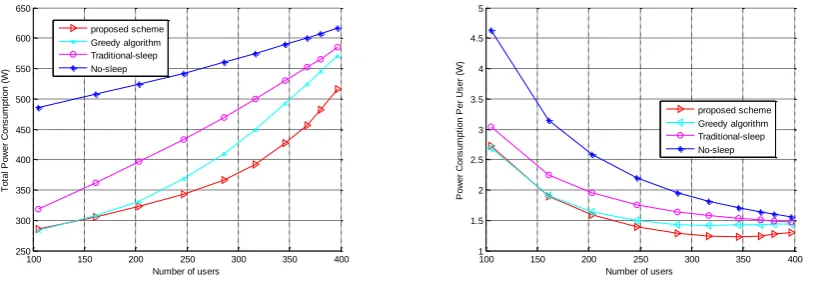
Figure 1 shows the variation trend of total energy consumption with the number of users increase. With the increasing of traffic load, the total energy consumption will increase. The consumption of pico in sleep state is less than idle state. Therefore, when the traffic load is light, the total energy consumption can be greatly reduced by sleep scheme. When the traffic load is light, the transmission time of base station can be more flexible in Greedy scheme compared with our scheme. Therefore, the Greedy scheme can achieve a better performance in energy saving. But with the increasing of traffic load, the flexibility of base station transmission will suffer from more constraints in Greedy scheme. In our scheme, the sleep pattern is determined according to the DIR of base station. Therefore, the traffic load has less effect on the determination of sleep pattern in our scheme compared with Greedy scheme. When the strongest interference of base station which has high DIR is eliminated, the transmission performance can be greatly improved. Therefore, our scheme is better than Greedy scheme in energy saving.
0 1 2 3 4 5 6 7 8 9 10 300
350 400 450 500 550
Tolerable delay (s)
M
e
a
n
P
o
w
e
r
C
o
n
s
u
m
p
ti
o
n
(
W
)
[image:6.595.210.388.75.204.2]proposed scheme Greedy algorithm Traditional-sleep No-sleep
Figure 3. The relationship between energy consumption and tolerable delay.
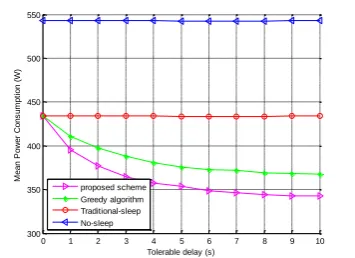
Figure 3 shows the relationship between energy consumption and tolerable delay. As mentioned above, the tolerable delay can be divided into several sub-periods. And the number of sub-periods increases with the increase of tolerable delay. With the number of sub-periods increase, the on/off state of base station can be determined more flexible. And the inter-cell interference can be better mitigated. Just as the simulation result shows, the energy consumption decreases with the increase of tolerable delay. However, the larger the time delay, the greater the response time. And the user’s quality of experience (QoE) becomes worse. To guarantee the quality of experience, the tolerable delay should be set properly. It’s a tradeoff between energy saving and QoE.
Conclusion
In this paper, we proposed a dynamic base station sleeping algorithm. The proposed algorithm takes advantage of characteristic that the data traffic can tolerate a certain delay to adjust the transmission time of base stations. Therefore, the inter-cell interference can be effectively mitigated. And the base stations can be in sleep mode for a longer time while guaranteeing users’ minimal service requirements. Compared with other algorithms, the proposed scheme can greatly improve the performance in energy saving. What’s more, this paper also studies the relationship between energy consumption and tolerable delay. The simulation result shows the energy consumption can be reduced by increasing the tolerable delay in our scheme.
Acknowledgement
This work is supported by Chinese National Nature Science Foundation (61571062).
References
[1]C. Li, J. Zhang, M. Haenggi and K. B. Letaief, “User-Centric Intercell Interference Nulling for Downlink Small Cell Networks,” IEEE Transitions on Communications, vol. 63, no. 4, pp. 1419-1431, April 2015.
[2]F. Richter, A. J. Fehske and G. P. Fettweis, “Energy Efficiency Aspects of Base Station Deployment Strategies for Cellular Networks,” Vehicular Technology Conference Fall, 2009, pp. 1-5.
[3]G. Auer et al., “How much energy is needed to run a wireless network?,” IEEE Wireless Communications, vol. 18, no. 5, pp. 40-49, October 2011.
[4]Y. Zhu, Y. Chen, W. Li and P. Yu, “A Novel Energy-Saving Cell Selection Mechanism for Cellular Access Networks,” Wireless Communications, Networking and Mobile Computing, 2011 7th International Conference on, Wuhan, 2011, pp. 1-4.
[6]H. C¸elebi, N. Maxemchuk, Y. Li and I Gvenc¸, “Energy reduction in small cell networks by a random on/off strategy,” IEEE Globecom Workshops, 2013, pp. 176-181.
[7]X. Wang, B. Mondal, E. Visotsky and A. Ghosh, “Coordinated scheduling and network architecture for LTE Macro and small cell deployments,” IEEE International Conference on Communications Workshops 2014, pp. 604-609.
[8]H. B. Ren, M. Zhao, J. K. Zhu and W. Y. Zhou, “Energy-efficient resource allocation for OFDMA networks with sleep mode,” Electronics Letters, vol. 49, no. 2, pp. 111-113, January 17 2013.