Zodiacal Cloud Complexes
Ingrid Mann
MPI f¨ur Aeronomie, D-37191 Katlenburg-Lindau, Germany
(Received October 7, 1997; Revised March 17, 1998; Accepted March 17, 1998)
We discuss some aspects of the study of the Zodiacal cloud based on brightness observations. The discussion of optical properties as well as the spatial distribution of the dust cloud show that the description of the dust cloud as a homogeneous cloud is reasonable for the regions near the Earth orbit, but fails in the description of the dust in the inner solar system. The reasons for this are that different components of the dust cloud may have different types of orbital evolution depending on the parameters of their initial orbits. Also the collisional evolution of dust in the inner solar system may have some influence. As far as perspectives for future observations are concerned, the study of Doppler shifts of the Fraunhofer lines in the Zodiacal light will provide further knowledge about the orbital distribution of dust particles, as well as advanced infrared observations will help towards a better understanding of the outer solar system dust cloud beyond the asteroid belt.
1.
Introduction
Small bodies in our solar system cover a broad size range from asteroids and comets to dust particles of micrometer size and below. Brightness observations do mainly cover a range of particles of 1 to 100 micron in size, i.e. the so-called Zodiacal dust particles, first observed in the brightness of the Zodiacal light. The dust particles mainly originate from the collisional evolution of bigger, meteoritic particles that are produced by the activity of comets and the collisional evolution of asteroids. As opposed to the bigger particles, the lifetime of the dust particles is limited not only by their collisional evolution but also by the Poynting-Robertson ef-fect which causes their slow drift towards the Sun. We will discuss previous results about the optical properties and the spatial distribution of the Zodiacal dust and show the limits of these dust cloud models. Then we will shortly discuss attempts of a multi-component description of the Zodiacal dust cloud. As perspectives for future investigations, we will mention the Doppler shift of Fraunhofer lines in the Zodiacal light as well as the observational investigation of the outer solar system dust cloud.
2.
Brightness Inversion and Optical Properties
Brightness observations yield a good data set of the visi-ble Zodiacal light brightness from about 30◦elongation from the Sun out to the Gegenschein (see Dumont, 1976; Leinert
et al., 1977; Levasseur-Regourd and Dumont, 1980) as well as infrared observations, usually at elongations larger than 60◦ from the Sun (Hauseret al., 1984; Reachet al., 1996; Matsumoto et al., 1996). The observed brightness of the Zodiacal light results from the integrated signal from the volume elements in space along the line of sight (LOS). The brightness depends on the spatial distribution of the dust in the solar system and on the scattering (or thermal emission)
Copy right cThe Society of Geomagnetism and Earth, Planetary and Space Sciences (SGEPSS); The Seismological Society of Japan; The Volcanological Society of Japan; The Geodetic Society of Japan; The Japanese Society for Planetary Sciences.
properties per volume element. A common method of data analysis applies forward calculations of the line of sight inte-gral under reasonable assumptions about particle properties and spatial distribution. Detailed descriptions of the line of sight integrals have been given before (see Dumont, 1973; R¨oser and Staude, 1978; Gieseet al., 1986). Also the average scattering properties of particles have been directly inverted from the brightness integral in some cases (see for instance Levasseur-Regourd and Dumont, 1980; Lamy and Perrin, 1986). At this point we want to concentrate on the aver-age optical properties that can be derived from the observed brightness.
The brightness integral includes a volume scattering func-tion VSF(θ,r), which describes the brightness component that is seen of a given spatial volume along the line of sight at a given solar distancer(cf. Dumont, 1973; Hong, 1985; Perrin and Lamy, 1989); in the case of thermal emission the VSF is replaced with a volume emission function, VEF (see below). Both the VSF and the VEF denote the average differ-ential cross sectiondσ/dof particles per volume element for the process in question and include the spatial variation of particle number density. The VSF includes a spatial variation of number density as well as a spectral variation of scatter-ing properties and a change of the size distribution with solar distancer. It is defined as:
VSF(r, θ)= particle size and λ the wavelength of scattered light. The discussion of average optical properties implies the simplifi-cation of Eq. (1) to the product
VSF(r, θ)=n(r)GAp(r, θ). (2)
In this relationn(r)is the number density of optical efficient particles andGis the geometric cross section of the particles. The geometric albedoApis usually defined at back scattering
global properties:
VEF(r)= n(r)GE(r). (5)
This combination of geometric cross-sectionG, number den-sitynand albedoAp(r), respectively emissivityE(r)in the VSF and in the VEF causes an ambiguity in the brightness in-version. A discussion of particle properties based on bright-ness observations reduces Eq. (1) to the product of average values given in Eq. (2). It should also be noted that the in-versions are based on the assumption that the dust cloud is homogeneous.
Whereas the description of the dust properties at about 1 AU distance from the Sun that are based on the assump-tion of a homogeneous dust cloud yields reasonable results, the view changes for a description of the dust near the Sun. When assuming for instance an increase of the dust albedo with solar distancer according to a radial power law with exponent 0.25, as was suggested from Zodiacal light analysis (Kneißel and Mann, 1991) the values get very high for the near solar dust. Even more, the polarization of dust in the inner solar system is still puzzling. As far as the polarization models are concerned, there is certainly need for better data in the near solar region (see Kimura and Mann, this issue), which are hopefully provided with the measurements of the LASCO coronagraph on SOHO (see Brueckneret al., 1995). However, the fact that the extrapolation of optical properties in the inner solar system gives unreasonable results, ques-tions the application of a homogeneous dust cloud model. This leads to a further consideration of the spatial and orbital distribution of the particles.
3.
Models of the Spatial Distribution
As mentioned before, the spatial distribution of the dust cloud can be derived from brightness data. In a further step the inversion of the number density distribution (first intro-duced by Haug, 1958) leads to the distribution of orbital elements. The Zodiacal dust is concentrated towards the in-variable plane of the solar system, however observers report that the symmetry plane is slightly tilted (see for instance Leinertet al., 1980; Jameset al., 1997; Ishiguroet al., this issue). Although local structures are observed, the rotational symmetry of the overall dust cloud with respect to an axis through the Sun is confirmed by observations. In terms of the orbital evolution it can be explained by the randomization of the orbital parameters argument of the pericenter and of
The spatial distribution of dust was derived from bright-ness data by several authors (see for instance Leinertet al., 1977; Lumme and Bowell, 1985; Murdock and Price, 1985; Gieseet al., 1986; Goodet al., 1986) and later on the dis-tribution of orbital elements was given for several Zodiacal cloud models (see Kneißel, 1988). The concentration of the dust cloud towards the ecliptic plane yields a maximum in the distribution of orbital elements at small inclinations. Some models of the Zodiacal cloud point to the existence of dust in retrograde motion around the Sun, however a direct infor-mation of whether the particles are in prograde or retrograde motion around the Sun cannot be derived from brightness observations.
The radial distribution of the number density is connected to the deceleration of particles due to the Poynting-Robertson effect. The spatial distribution of dust particles is often de-scribed with an exponentνclose to 1. This radial slope of the number density distribution can be explained with parti-cles in orbits with low eccentricity. However this approach depends on a constant size distribution and assumes that the same dust population contributes to the scattering at different solar distances, as mentioned above.
4.
Sources of the Dust Cloud
There are different estimates for the contribution of comets, respectively asteroids to the interplanetary dust cloud. Based on the calculation of collisional effects, Dermottet al.(1994) give a value of about 30% of the dust at 1 AU to result from asteroids. According to Fechtig (1989), the near ecliptic dust cloud consists of about 1/3 of cometary dust and 2/3 of asteroidal dust. The latter estimate is mainly based on the analysis of the impact directions of particles and the material bulk density derived from Helios in situ measurements. However, both estimates are given for the region close to the Earth orbit.
The dust cloud composition varies in space and may also vary with particle size. The study of near solar dust proper-ties, for instance indicates properties that are better explained with a predominant component of cometary material rather than asteroidal material (see Mannet al., 1994). For the case of the outer solar system, the ULYSSES measurements show the existence of a large component of interstellar dust (Grun¨
compo-Fig. 1. Average polarization (left hand side) and average geometric albedo at 90◦scattering angle (right hand side) of interplanetary dust close to the ecliptic plane derived from Zodiacal light andF-corona data (from Mann, 1997).
nent of Kuiper belt dust particles in the outer solar system (see for instance Backman and Paresce, 1993).
5.
Two Component Description of the Dust Cloud
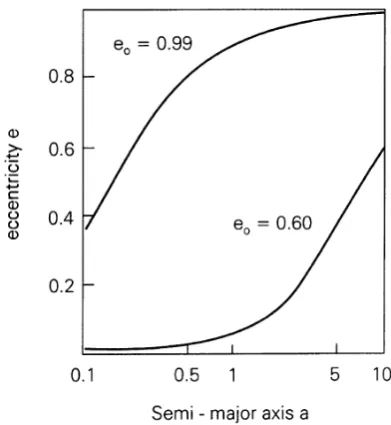
The application of a homogeneous dust cloud model has several limitations, as comes clear in the previous discussion. The comparison of different models of the Zodiacal cloud had led to the suggestion of a two component dust cloud (Kneißel and Mann, 1991), which consists of asteroidal particles in re-gions near the ecliptic and particles from long period comets in an isotropic distribution. The alteration of the cometary component was assumed to cause an increase of the average brightness of the particles in the dust cloud. However, the resulting change of the particles properties that wouldfit the observed brightness results (see Fig. 1), would be especially drastic near the Sun and could not be explained withfindings about single particle scattering properties.A more recent attempt assumes that the difference between the two components in the dust cloud is rather explained by a different type of spatial distribution (due to the fact that par-ticles that are produced by long period comets are on orbits with high eccentricity and produce a steep increase of the number density when decelerated from Poynting-Robertson effect) than by different particle properties (see Mann, 1995). As shown in Fig. 2, the deceleration of particles due to the Poynting-Robertson effect causes a decrease of the orbital eccentricity. Assuming the deceleration of parti-cles with an initial eccentricity of 0.99, these will stay in an elliptic orbit for most of their lifetime. Particles which start with an eccentricity of 0.60 will be in circular orbits for a sig-nificant amount of their lifetime. Although the assumption of the initial semi major axis of the orbits is a little artificial thefigure shows the tendency that particles from short period comets may reach almost circular orbits, whereas the frag-ments from long period comets may stay in high eccentricity orbits. The resulting radial slope of the number density dis-tribution would ben∝r−1for the case of the circular orbits
andr−2.5for the case of unbound orbits. This indicates that
the variation of the dust cloud composition due to the dif-ferent orbital dynamics is possible, if not to say probable.
Fig. 2. The eccentricityeof orbits with an initial eccentricityeo=0.99, respectivelyeo=0.60 under deceleration from the Poynting-Robertson effect (see Wyatt and Whipple, 1950), given as a function of semimajor axes. The initial semimajor axis is 10 AU (from Mann and Grun, 1995).¨
In addition to this effect, a further collisional evolution of particles inside the Earth’s orbit can change the dust cloud composition as well as the size distribution (see Ishimoto, this issue).
Dust particles released from an asteroidal collision form a dust swarm of similar semi major axes, eccentricities and inclinations. The arguments of perihelia and ascending nodes are randomized from gravitational perturbations and the swarm forms a doughnut-shapes dust torus of the inner extension a(1−e)and the outer extensiona(1+e). As seen in observations from the Earth’s orbit, the integrated signal has a small enhancement at the elongation beta, where the line of sight crosses the edges of this dust torus (right hand side).
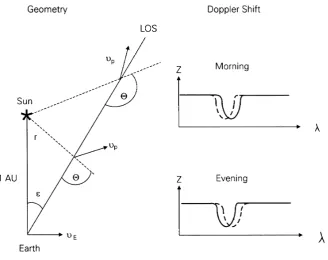
Fig. 4. Doppler shift of Fraunhofer lines in the Zodiacal light: the Fraunhofer lines of the solar spectrum are shifted due to 1. the relative velocity between the Sun and the dust particles moving withvprelative to the Sun and 2. due to the relative velocity between the dust particles and the observer on Earth
moving withvErelative to the Sun.
6.
Brightness vs. in-situ Results
We will briefly discuss the IRAS dust bands as an ex-ample for observational results and their comparison to in-situ results. The dust bands (see Fig. 3) werefirst noticed in the IRAS infrared Zodiacal emission data as symmetri-cally placed enhancements of the brightness and later on explained by an enhanced number density of grains with certain orbital parameters (Dermottet al., 1984; Sykes and Greenberg, 1986). An opportunity for impact measurements was given with the dust measurements on the Ulysses and
Fig. 5. Thermal emission and scattered light intensities of Zodiacal light at 90◦elongation, of the solarF-corona at 1◦elongation and of theβPictoris dust shell.
belt (see Mannet al., 1996). Based on the assumption that the dust bands are produced from the single destruction of a 100 km sized object, the production rate would amount to 1010 g/year, which is small compared to a required dust
production in the order of 1014 g/year, which would be
re-quired keep the mass budget of the Zodiacal dust cloud in a steady state. At this point a further study of the formation and the evolution of dust bands would be worthwhile. This comparison shows, however how a dust feature that has no-ticeable effect on the thermal emission brightness, may not be significant in the size range, that is covered with in-situ ex-periments (and vice versa local dust streams, observed with in-situ experiments are not detected with observations).
7.
Future Perspectives
7.1 Doppler shift measurements
As was mentioned before, brightness observations give a good overview of the structure of the overall dust cloud, but do only partly reveal its orbital distribution. The compar-ison of brightness observations and impact experiments on the other hand, yields the problem that usually the latter do not describe the size range that is covered with the brightness observations. Impact experiments also yield the problem of correct extrapolation from the localflux to overall orbital dis-tributions. At this point Doppler shift measurements could help to understand the dust dynamics of particles in the same size range as the size of the particles that produce the Zodi-acal light brightness is and also could cover a wider spatial range in the dust cloud. The Fraunhofer lines of the solar spectrum are shifted due to 1. the relative velocity between the Sun and the moving dust particles and 2. due to the
rel-ative velocity between the dust particles and the observer on Earth (see Fig. 4). Thefinal Doppler shift is given from the different velocity directions of the particles in a given vol-ume in space and the integration along the line of sight of the observer (see Mukai and Mann, 1993). Several attempts have been made to determine the Doppler shifts in the Zodi-acal light (Fried, 1978; East and Reay, 1984), however the results are partly contradictory so far, presumably due to ob-servational problems. As was pointed out by Clarke (1996) the analysis of the Doppler shift measurements would benefit from polarization measurements performed at the same time.
7.2 Measurements of the outer solar system cloud
Figure 5 shows the thermal emission and scattered light intensities of Zodiacal light at 90◦elongation, of the solarF -corona at 1◦elongation and of theβPictoris dust shell. This indicates that the detection of dust components in the outer solar system would especially benefit from observations in the infrared regime, since the cool dust in the outer solar sys-tem would have its peak brightness at larger wavelength (see Mann, 1996). Thefigure also indicates that the thermal emis-sion aroundβPictoris is observed at longer wavelength than the Zodiacal dust thermal emission and hence corresponds to a cooler dust cloud that is more comparable to regions of the Kuiper belt in our solar system. Hence the study of the outer solar system dust cloud yields interesting opportunities for a comparison to other circumstellar systems. The outer solar system dust cloud may consist of fragments from long period comets (see Mann and Grun, 1995), particles from interstellar¨
observa-reasons will also cause a different view of the inner solar sys-tem as well as the outer solar syssys-tem dust cloud. This means that the Zodiacal cloud models that are derived from bright-ness observations and that describe especially the dust close to the Earth orbit, only partly tell us the truth about the so-lar system dust cloud. Further knowledge will be provided by infrared observations from space, but also ground based observations will still yield further progress. Doppler shift measurements of dust near the Earth’s orbit may yield a bet-ter understanding of the orbital distribution and hence the dynamics evolution in the dust cloud. Further observations of polarization and colour may draw limits about the size distribution of dust and its possible variation within the dust cloud, which indicates the collisional evolution. Finally, ob-servations of the outer solar system dust cloud may enable better comparisons with the dust clouds around other stars.
References
Backman, D. E. and F. Paresce, Main sequence stars with circumstellar solid material: The Vega phenomenon, inProtostars and Planets III, edited by E. H. Levy and J. I. Lunine, pp. 1253–1304, The University of Arizona Press, Tuscon & London, 1993.
Brueckner, G., R. A. Howard, M. J. Koomen, C. M. Korendyke, D. J. Michels, J. D. Moses, D. G. Socker, K. P. Dere, P. L. Lamy, A. Llebaria, M. V. Bout, R. Schwenn, G. M. Simmnet, D. K. Bedford, and C. J. Eyles, The large angle spectroscopic coronagraph (LASCO),Solar Phys.,162, 357–402, 1995.
Clarke, D., Zodiacal light-scattered Fraunhofer line profiles, inPhysics, Chemistry, and Dynamics of Interplanetary Dust ASP Conference Series, 104, edited by BoA. S. Gustafson and Martha S. Hanner, pp. 337˚ –340, 1996.
Dermott, S. F., P. Nicholson, J. Burns, and J. Houck, Origin of solar system dust bands discovered by IRAS,Nature,312, 505–509, 1984. Dermott, S. F., D. D. Durda, B.A. S. Gustafson, S. Jayaraman, J. C. Liou,˚
and Y. L. Xu, Zodiacal dust bands, inAsteroids, Comets, Meteors 1993, edited by A. Milani, M. DiMartino, and A. Cellino, pp. 127–142, Kluwer Academic Publishers, 1994.
Divine, N., Five populations of interplanetary meteoroids,J. Geophys. Res.,
98, 17029–17048, 1993.
Dumont, R., Phase function and polarization curve of interplanetary scatter-ers from zodiacal light photopolarimetry,Planet. Space Sci.,21, 2149– 2155, 1973.
Dumont, R., Ground-based observations of the Zodiacal light, in Interplan-etary Dust and Zodiacal Light, edited by H. Elsasser and H. Fechtig,¨ pp. 85–100, Lecture Notes in Physics, 48, Springer, Berlin, 1976. East, I. R. and N. K. Reay, The motion of interplanetary dust particles, I.
radial velocity measurements on Fraunhofer line profiles in the Zodiacal light spectrum,Astron. Astrophys.,139, 512–516, 1984.
Fechtig, H., Dust in the solar system,Z. Naturforsch.,44a, 877–882, 1989. Fried, J. W., Doppler shifts in the Zodiacal light spectrum,Astron.
Astro-phys.,68, 259–264, 1978.
Giese, R. H., Zodiacal light and local interstellar dust: predictions for an out-of-ecliptic spacecraft,Astron. Astrophys.,77, 223–226, 1979.
Neugebauer, H. H. Aumann, B. Baud, N. Boggess, J. P. Emerson, J. R. Houck, B. T. Soifer, and R. G. Walker, IRAS observations of the diffuse infrared background,Astrophys. J.,278, L15–L18, 1984.
Hong, S. S., Henyey-Greenstein representation of the mean volume scat-tering phase function for zodiacal dust,Astron. Astrophys.,146, 67–75, 1985.
Ishiguro, M., H. Fukushima, D. Kinoshita, T. Mukai, R. Nakamura, J. Watanabe, T. Watanabe, and J. F. James, The isophote maps of the Gegen-schein obtained by CCD observations,Earth Planets Space,50, this issue, 477–480, 1998.
Ishimoto, H., Collisional evolution and the resulting mass distribution of interplanetary dust,Earth Planets Space,50, this issue, 521–529, 1998. James, J. F., T. Mukai, T. Watanabe, M. Ishiguro, and R. Nakamura, The morphology and brightness of the zodiacal light and gegenschein,Mon. Not. R. Astron. Soc.,288, 1022, 1997.
Kimura, H. and I. Mann, Brightness of the solarF-corona,Earth Planets Space,50, this issue, 493–499, 1998.
Kneißel, B., Die Unterscheidung dreidimensionaler Modelle der zodiakalen Staubwolke im Hinblick auf Experimente mit Raumfahrzeuggestutzten¨ Mikrometeoriten-Einschlagdetektoren, Dissertation, Universitat¨ Bochum, 1988.
Kneißel, B. and I. Mann, Spatial distribution and orbital properties of Zo-diacal dust, inOrigin and Evolution of Interplanetary Dust, edited A. C. Levasseur-Regourd and H. Hasegawa, pp. 131–138, Kluwer, Dordrecht, 1991.
Lamy, P. L. and J.-M. Perrin, Volume scattering function and space distribu-tion of the interplanetary dust cloud,Astron. Astrophys.,163, 269–286, 1986.
Leinert, C., E. Pitz, M. Hanner, and H. Link, Observations of Zodiacal light from Helios 1 and 2,J. Geophys. Res.,42, 699–704. 1977.
Leinert, C., M. Hanner, I. Richter, and E. Pitz, The plane of symmetry of interplanetary dust in the inner solar system,Astron. Astrophys.,82, 328–336, 1980.
Levasseur-Regourd, A. C. and R. Dumont, Absolute photometry of the Zodiacal light,Astron. Astrophys.,84, 277–279, 1980.
Lumme, K. and E. Bowell, Photometric properties of Zodiacal light parti-cles,Icarus,62, 54–71, 1985.
Mann, I., Spatial distribution and orbital properties of interplanetary dust at high latitudes,Space Sci. Rev.,72, 477–482, 1995.
Mann, I., Interstellar grains in the solar system, requirements for an analysis, inThe Heliosphere in the Local Interstellar Medium, edited by R. von Steiger, R. Lallement, and M. Lee, Space Sci. Series of ISSI, Vol. 1, Kluwer, Dordrecht, Space Sci. Rev.,78, 259–264, 1996.
Mann, I., Eigenschaften und Verteilung kosmischer Staubteilchen als Kom-ponente der kleinen Korper im Sonnensystem, Habilitationsschrift, Uni-¨ versit¨at Braunschweig, 1997.
Mann, I. and E. Grun, Dust particles beyond the asteroid belt¨ —a study based on recent results of the Ulysses dust experiment,Planet. Space Sci.,43, 827–832, 1995.
Mann, I., H. Okamoto, T. Mukai, H. Kimura, and Y. Kitada, Fractal ag-gregate analogues for near solar dust properties,Astron. Astrophys.,291, 1011–1018, 1994.
Mann, I., E. Grun, and M. Wilck, The contribution of asteroid dust to the¨ interplanetary dust cloud: the impact of Ulysses results on the under-standing of the IRAS dust bands,Icarus,120, 399–407, 1996. Matsumoto, T., M. Kawada, H. Murakami, M. Noda, S. Matsuura, M.
of the zodiacal light,Publ. Astron. Soc. Japan,48, L47–L51, 1996. Mukai, M. and I. Mann, Analysis of Doppler shifts in the Zodiacal light,
Astron. Astrophys.,271, 530–534, 1993.
Murdock, T. L. and S. D. Price, Infrared measurements of the Zodiacal light, Astron. J.,90, 375–386, 1985.
Perrin, J.-M. and P. L. Lamy, The color of the zodiacal light and the size distribution and composition of interplanetary dust,Astron. Astrophys.,
226, 288–296, 1989.
Reach, W. T., A. Abergel, F. Boulanger, F.-X. Desert, M. Perault, J.-P. Bernard, J. Blommaert, C. Cesarsky, D. Cesarsky, L. Metcalfe, J.-L. Puget, F. Sibille, and L. Vigroux, Mid-infrared spectrum of the zodiacal light,Astron. Astrophys.,315, L381–L384, 1996.
Roser, S. and H. J. Staude, The Zodiacal light from 1500¨ A to 60 micron,˚ Astron. Astrophys.,67, 381–394, 1978.
Scherer, K. and H.-J. Fahr, Drag forces in the near and distant solar system, Earth Planets Space,50, this issue, 545–550, 1998.
Sykes, M. V. and R. Greenberg, The formation of the IRAS Zodiacal dust bands as a consequence of single collisions between asteroids,Icarus,
65, 51–69, 1986.
Wyatt, S. P. and F. L. Whipple, The Poynting-Robertson effect on meteor orbits,Astrophys. J.,111, 134–141, 1950.