
Article
1
Formation of Deformation-Induced Products in a
2
Metastable
β
-titanium Alloy during High
3
Temperature Compression
4
Alireza Samiee 1*, Gilberto Casillas 2, Mansur Ahmed 1,3, Dmytro G. Savvakin 4, Ryan Naseri 1,2,5
5
and Elena Pereloma 1,2,6
6
1 School of Mechanical, Materials & Mechatronic Engineering, University of Wollongong, NSW
7
2522, Australia; [email protected]
8
2 Electron Microscopy Centre, University of Wollongong, NSW 2519, Australia; [email protected]
9
3 Department of Mechanical Engineering, Kyushu University, Fukuoka 819-0395, Japan;
10
11
4 Institute for Metal Physics, National Academy of Sciences of Ukraine, UA-03142 Kiev,
12
Ukraine; [email protected]
13
14
15
* Correspondence: [email protected]; Tel.: +61 2 4221 5507
16
Abstract: A metastable β-Ti alloy, Ti–10V–3Fe–3Al (wt.%), was subjected to thermos-mechanical
17
processing including the compression test at 725°C, which is below the β transus temperature
18
(780°C), and at strain rate of 10-3s-1. The presence of phases was determined using transmission
19
electron microscopy and X-ray diffraction. Although the dynamic recovery took place together with
20
slip, both deformation-induced α˝ martensite and ω were detected as other operating mechanisms
21
for the first time in metastable-β Ti alloys deformed in α+β region. The volume fraction of
stress-22
induced α˝ was higher than that of the same alloy deformed at room temperature due to higher
23
strain applied. Stress-induced twinning was not operational, which could be related to the priority
24
of slip mechanism at high temperature resulted from thermally-assisted nucleation and lateral
25
migration of kink-pairs.
26
Keywords: metastable Ti alloy; high temperature deformation; stress-induced ω; stress-induced α˝
27
martensite; transmission electron microscopy; slip; X-ray diffraction.
28
29
1. Introduction
30
Owing to the fact that metastable-β titanium alloys have shown excellent mechanical properties
31
such as high strength to weight ratio, a good merger of toughness and fatigue resistance [1, 2], they
32
are widely used in aerospace industry, such as landing gear, air frame and thick section parts which
33
should be forged for the application [3-5].
34
Production of thick section parts from metastable-β titanium alloys is one of the main challenges
35
of the aerospace industry [3]. Near-net-shape hot forging is an economic manufacturing method for
36
producing large components which results in coveted mechanical properties [6]. Nonetheless,
37
metastable-β titanium alloys, such as Ti-10V-2Fe-3Al (wt. %) (hereafter designed as Ti-10-2-3) utilised
38
in landing gear of Boeing 777, are generally easily affected by small variation in both temperature
39
and strain rate [7]. Therefore, studies have been focused on the hot deformation mechanisms and
40
microstructural evolution under different deformation conditions in order to optimise processing
41
parameters and mechanical properties of metastable-β titanium alloys [8-12].
42
The studies have shown that the main hot deformation mechanisms in Ti-10-2-3 deformed at
43
above β transus temperature and strain rates from 0.001 to 10 s-1 are both dynamic recovery (DRV)
44
and dynamic recrystallisation (DRX) [13-16]. Akanuma et al. [17] studied the effect of hot deformation
45
on athermal α" formation for Ti-10-2-3 alloy. After hot compression at 900°C and 1000°C, and at strain
46
rates exceeding 0.1 s-1, athermal α" appeared in the microstructure of the alloy. The contribution of
47
the dislocation stored energy to the chemical potential gave rise to the transformation of β matrix to
48
the athermal α". Lei et al. [11] similarly concluded that the higher the mechanical instability of β phase
49
that resulted from the deformation above β transus temperature, the more athermal α" martensite
50
forms. However, limited studies have been conducted on hot deformation of metastable titanium
51
alloys below the β transus temperature. Balasubrahmanyam and Prasad [16] reported that the
stress-52
strain curves of Ti-10-2-3 with fine duplex α+β microstructure at temperature lower than β transus
53
temperature and low strain rates (10-3 s-1) exhibited steady state behaviour, while at higher strain rate
54
(10 and 100 s-1) the alloy exhibited continuous flow softening behaviour. Jackson et al. [7] revealed
55
that at forging temperature of 750°C, dynamic recrystallisation is the main process in Ti-10-2-3 with
56
coarse β grains containing a large amount of Widmanstätten α plates.
57
In the last decade attention has been focused on the operation of separately or simultaneously
58
of twinning and phase transformation mechanisms during deformation at room temperature of
59
metastable β Ti alloys, such as Ti-10-2-3 [18, 19], Ti-10V-3Fe-3Al-0.27O (wt.%) [20], Ti-8.0 Mo-3.9
Nb-60
2.0 V-3.1 Al (wt.%) [21], β-Cez alloy [22] and Ti-12 Mo (wt.%) [23, 24]. Depending on the beta phase
61
stability and stress conditions (strain rate, strain path, etc.), the operation of {332}⟨113⟩β and
62
{112}⟨111⟩β twinning systems and/or phase transformations of β → α′′ martensite and β → ω phase
63
could be activated. The majority of research on transformation-induced plasticity and
twinning-64
induced plasticity in metastable β Ti alloys was carried out at room temperature. Only a limited
65
amount of mechanical testing was conducted at elevated temperatures. Duerig et al. [19] have shown
66
that with decreasing the tensile test temperature from 250°C to 20°C, the triggering stress required to
67
initiate α′′ martensite formation in Ti-10-2-3 alloy was continuously decreasing in correlation with
68
the beta phase stability decrease followed by a sharp increase at the temperature below 20°C.
69
In this study, a metastable-β Ti–10V–3Fe–3Al (wt.%) alloy (Ti-10-3-3), produced by the
cost-70
effective blended elemental powder metallurgy technique, as described in [25], is investigated after
71
hot deformation at the temperature below the β transus temperature (753°C ≤ Tβ≤ 806°C [26]) and at
72
low strain rate followed by water quenching. Owing to the fact that Fe has the fastest diffusivity
73
among the elements used in Ti-10-3-3, and thus improves the powder compact density during
74
sintering [25], the percentage of Fe in the studied alloy is intentionally risen by 1 wt.%. Furthermore,
75
increasing the weight percentage of Fe increases the β stability by rising the Mo equivalent [27], which
76
can affect the formation of stress-induced products. This study reports on the concurrent formation
77
of deformation-induced α'' martensite and ω, and discusses the reason for this.
78
2. Materials and Methods
79
Vacuum arc remelting was used for producing the master alloy whose chemical composition is
80
Ti-62.5V-18.75Fe-18.75Al (wt. %) after which the produced master alloy was milled to reach the
81
powder with less than 40 µm particle size. Then the master alloy in powder state was blended with
82
base titanium powder which had fine particle size (r<100 µm) and contained 3.5 wt.% hydrogen to
83
produce Ti1033 alloy. In the next step, the powders were die-pressed under 640 MPa pressure at room
84
temperature to make the green compact with 10 × 10 × 70 mm3 dimensions. The green compact
85
was sintered under vacuum for four hours at 1250oC. At the end of this process, the samples were
86
cooled down in the furnace.
87
After sintering, 10 mm in length by 8 mm in diameter samples were machined and
thermo-88
mechanically processed using a 3500 Gleeble thermo-mechanical simulator. In the first, the samples
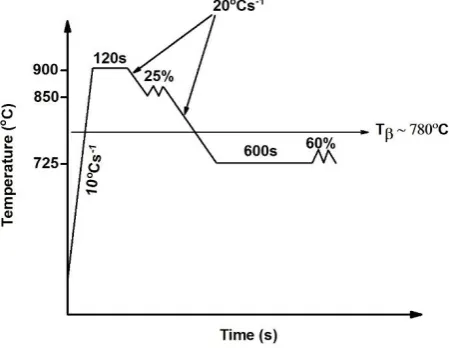
89
were heated at 10°Cs-1 to 900°C, held for 120s, then cooled down to 850°C at 20°Cs-1 where 25%
90
reduction in length was applied to reduce the porosity. Then, the samples were cooled at 20°Cs-1 to
91
725°C and held for 600s to form α phase. Finally, the samples were compressed at a constant rate of
92
10-3s-1 to 60% length reduction and immediately water quenched to room temperature (Figure 1).
93
Microstructure observation was performed at the centre of the sample cross-section (NDxCD
94
plane) using a JEOL-JSM 7001F Field Emission Gun-Scanning Electron Microscope (FEG-SEM)
95
operating at 15 kV voltage and 10 mm working distance. Thin 0.3 mm slices were cut perpendicular
96
to the compression direction using electric discharge machine. They were mechanically thinned
down to ~0.12 mm thickness. 3 mm diameter discs were punched out. By using twin jet
98
electropolishing method with an electrolyte containing 5–7% of perchloric acid and methanol, thin
99
foils for transmission electron microscopy (TEM) were prepared at ˗40°C. TEM was performed on a
100
probe-corrected scanning transmission electron microscope JEOL ARM200F operated at 200 kV,
101
equipped with a cold field emission gun.
102
103
104
Figure 1. A schematic diagram of the thermo-mechanical processing used in this study.
105
106
To identify the present phases, a PANalytical X
׳
Pert PRO Multipurpose diffractometer (MPD)107
with Cu Kα radiation (λ = 0.154 nm) filtered with Ni-monochromator was used. The diffraction
108
pattern from a disc sample (~14 mm diameter and 3 mm thickness) was obtained over the 2θ range
109
of 30°-90° under a continuous scanning mode. The step size and the acquisition time were 0.01° and
110
490 s, respectively. The XRD profile was used to calculate the volume fraction of phases by means of
111
direct comparison method [28].
112
3. Results
113
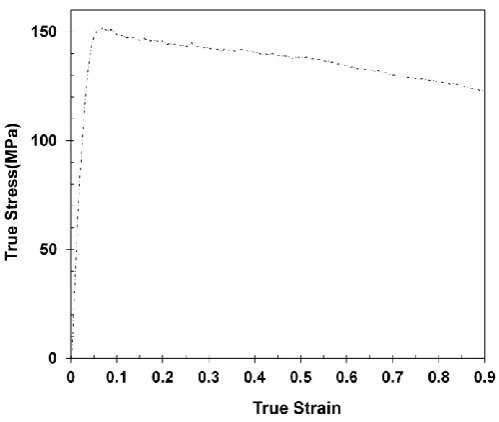
The response of compression test at 725°C (below the β transus temperature of ~780°C) and at
114
strain rate of 10-3 s-1 is shown in Figure 2. A typical true stress-true strain curve shows continuous
115
flow softening after rapid increase up to a maximum stress of ~150 ± 0.4 MPa at 0.07 strain, which is
116
usual response for β titanium alloys deformed at a temperature slightly below β transus (nearly 100°C
117
) [6, 11, 29, 30]. Although flow softening has been reported for Ti-10-2-3 alloy deformed above the β
118
transus temperature [11, 13], the tendency of β titanium alloys deformed below the transus
119
temperature towards flow softening is stronger [11, 30].
120
122
123
Figure 2. Stress-strain curve for Ti-10-3-3 alloy deformed at 725°C.
124
The continuous and uniform reduction of stress flow after the maximum value of the stress
125
demonstrates that the effect of softening was higher than that of hardening. Hot deformed alloys are
126
usually softened by dynamic recovery (DRV) and/or by dynamic recrystallization (DRX). During the
127
former, the dislocations formed during deformation are easily annihilated and readily rearranged as
128
arrays, leading to the formation of subgrains with low angle boundaries, whereas new strain-free
129
grains are formed during DRX [24]. It has been reported that since at low strain rate, such as 10-3s-1,
130
the time required for DRV and DRX is adequate, the softening mechanism is predominant [11].
131
The microstructure consists of elongated β grains decorated with α formed during 600s holding
132
at 725°C before deformation at grain boundaries (Figure 3). Some of grain boundary α are fragmented
133
as a result of deformation, and finer intergranular α is also present.
134
135
136
137
Figure 3. Secondary electron FE-SEM image showing a general view of the microstructure.
138
139
Due to the breaking up the lamellar α acting as barriers to the dislocations, flow softening occurs
140
in Ti alloys [31, 32]. Fine scale bright contrast β (sub)grains within elongated ones are also visible in
Figure 3. Similar formation of equiaxed β subgrains of ~5µm size was reported after compression
142
deformation of 1023 alloy at 760°C and 10-2 s-1 strain rate [31].
143
The XRD profile (Figure 4) shows the presence of β, α, ω and α'' peaks. The volume fractions of
144
β, α, ω and α'' were calculated to be 0.760, 0.107, 0.056 and 0.073, respectively.
145
146
147
148
Figure 4. XRD profile obtained from Ti-10-3-3 alloy deformed at 725°C followed by water quenching
149
to room temperature.
150
The lattice parameters of the β matrix (a = 0.328nm, base centred cubic, bcc), α precipitates
151
(hexagonal close packed, a = 0.295nm, c = 0.468nm), ω phase (hexagonal close packed, a = 0.287nm, c
152
= 0.425nm) and α" (orthorhombic, a = 0.326nm, b = 0.499nm, c = 0.392nm) calculated from XRD results,
153
are in good agreement with those reported in the literature [27-29].
154
As a result of heavy deformation (60% reduction in the length of the sample) at 725°C, coarse
155
slip bands, which are one of the forms of localized deformation [33], were produced in the β matrix
156
(Figure 5a). To the best of our knowledge, we report for the first time the formation of stress-induced
157
α'' martensite (Figure 5b) and stress-induced ω (Figure 5c) during hot deformation in β+α region. The
158
inset in Figure 5b depicts a selected area diffraction pattern (SADP) along the [1̅13]β zone axis. (1̅1̅0)
159
spot of stress-induced α'' appear near to that from (1̅1̅0) of β. The orientation relationship between
160
α'' martensite and β matrix follow the typical relationship, (1̅1̅0)𝛽‖(1̅1̅0)𝛼˝ and [1̅13]𝛽‖[002]α'' [34,
161
35]. Thin lamellar-like morphology of deformation-induced ω is depicted in Figure 5c. Figure 5d is a
162
dark field (DF) image showing the presence of athermal ω (ωath) with ellipsoidal/spherical
163
morphology, which presumably formed on cooling to room temperature of the deformed sample.
164
The SADP shown in the (inset of Figure 5d) demonstrates the sharp β reflections which are consistent
165
with a bcc structure, and the faint reflections at 1/3 and 2/3 {112}βpositions which are features of ωath
166
[36]. Both types of ω (insets in Figures 5c and 5d) illustrate the typical (111)β//(0001)ω and
167
[011]β//[112̅0]ω orientation relationship with β matrix [37, 38].
170
Figure 5. (a) Bright field image revealing continuous slip bands in the β matrix. (b) Dark field (DF)
171
image showing the presence of stress-induced α'' martensite obtained using the reflection in dashed
172
yellow circle in the inset (Zone axis: [1̅13]β‖[002]α''). (c) DF image revealing stress-induced ω taken
173
using the reflection in dashed blue circle in the inset (Zone axis: [110]βǁ[112̅0]ω). (d) DF image
174
displaying ωath precipitation, which is taken using dashed blue circle in the inset (Zone axis:
175
[113]βǁ[1̅100]ω).
176
4. Discussion
177
While the true stress-true strain curve (Figure 2) does not show stress plateau characteristics of
178
the stress-induced α˝ formation [19, 39], the observed α˝ (Figure 5b) can be a stress-induced one for
179
the following reasons. Firstly, it has been revealed for Ti-10-2-3 alloy [7, 40] that when the alloy
180
solution treated below β-transus temperature and quenched in water or He gas, the athermal α˝ was
181
not formed. The main reason is related to the presence of α phase in the β at below the β-transus
182
temperature, which decreases the size of metastable β regions, increases the stability of the β phase
183
and inhibits the formation of athermal α˝, compared to the Ti-10-2-3 alloy quenched from the above
184
β-transus temperature [40]. As a result, due to the deformation temperature utilised in this study
185
(below the β-transus temperature), the probability of athermal α˝ formation is very low. Secondly, as
186
the foils were electropolished and the observations were carried out in 200-400 nm thick regions, the
187
deformed surfaces formed during the earlier preparation step of fine grinding were removed.
188
Thirdly, the observed morphology of stress-induced omega (Figure 5c) clearly indicates its
189
induced origin, and points to the possibility that observed martensite is
deformation-190
induced one.
191
The amount of α˝ martensite formed in this study is nearly 2% higher than that formed after
192
room temperature compression to 0.4 strain of the same Ti-10-3-3 alloy quenched from 725°C [33,34].
This is despite the stability of β matrix deformed at 725°C (near β-transus temperature) being higher
194
than that of β parent at room temperature [41]. This difference can be related to the higher amount of
195
true strain (0.9 compared to 0.4) which has been applied in this study.
196
Liu et al. [42] proposed the following Eq. (1) for the free energy change of ΔGβ→α'' (the
197
transformation of β parent to the stress-induced α''):
198
ΔG
β→α''= (ΔH
β→α''-TΔS
β→α'') + ΔE
el
+ δE
irr–
1𝜌
𝜎ε
tr– (
1 2𝜌) [(σ
2
/E
α''
) – (σ
2/E
β)]
, (1)where, ΔHβ→α'' is the difference in enthalpy, T is the test temperature and ΔSβ→α'' represents the change
199
in entropy. (ΔHβ→α''-TΔSβ→α'') is widely introduced as the chemical free energy change during the
200
phase transformation. Owing to the fact that both ΔHβ→α''<0 and ΔSβ→α''<0 [42], increasing the test
201
temperature from room temperature to 725°C raises the chemical free energy change, so it makes the
202
β→α'' transformation more difficult. Atoms are located at (0,0,0), (a/2,b/2,0), (0,2b/3,c/2), (a/2,b/6,c/2)
203
in orthorhombic stress-induced α'', while the β parent has a bcc structure [19]. According to the lattice
204
parameters mentioned earlier for β matrix and stress-induced α", the volume change resulted from
205
transformation of β to stress-induced α'' is nearly 80%, so the internal elastic energy term ΔEel is an
206
important factor and it increases the free energy. The term 1
𝜌
𝜎
ε
tr (σ: uniaxial stress, εtr:207
transformation strain and 𝜌: phase density) which is the force-displacement work related to the
208
transformation owing to the lattice distortion of α", which does not alter notably with temperature.
209
Although both Eα''(Young’s modulus of stress-induced α˝) and Eβ(Young’s modulus of β) decrease
210
with raising the temperature, the elastic term (1/2𝜌) [(σ2/Eα'') –(σ2/Eβ)] contributes to the formation of
211
the stress-induced α'' because it has been assumed that Eα'' is significantly different from Eβ [43]. Thus
212
the energy which is released due to the difference in Eα'' and Eβdecreases ΔGβ→α'' and assists in the
213
formation of stress-induced α''. The term δEirr is the irreversible energy required for overcoming the
214
internal friction to phase boundary movement. Furthermore, at high temperature (725°C) the stability
215
of β matrix is far higher than that of β matrix at the room temperature. Consequently, increasing
216
the temperature of transformation from room temperature to 725°C raises the amount of δEirr leading
217
to the increase of ΔGβ→α''. As a result, the transformation of β matrix to stress-induced α˝ martensite
218
at 725°C is more difficult than that of β matrix deformed at room temperature, so the higher amount
219
of deformation (0.9 compared to 0.4) is required at high temperature to obtain a deformation-induced
220
α˝.221
In this study, two kinds of ω phase were noticed: (1) nanosized spherical or ellipsoidal particles
222
(ωath) (Figure 5d) that have been observed to occur on accelerated cooling in metastable-β titanium
223
alloys [18, 20, 38] and (2) lamellae ω (stress-induced ω) (Figure 5c) which has been reported in
224
titanium alloys after plastic deformation [23, 44, 45]. Shuffle of atoms in {112}β planes in the direction
225
of 〈111〉 has been suggested as the formation mechanism for both ω types [44]. However, Hsiung et
226
al. [45] reported the glide of partial dislocations of 1/3〈111〉, 1/6〈111〉 and 1/12〈111〉, which are formed
227
from 1/2〈111〉 perfect dislocation, as the formation mechanism of stress-induced ω.
228
Besides, due to the stability of β matrix at 725°C, slip of dislocations (Figure 5a) is one of the
229
major deformation mechanisms detected in Ti-10-3-3 alloy, while twinning mechanism reported by
230
Ahmed et al. [18, 20] for Ti-10-3-3 deformed at room temperature was not observed. In materials with
231
bcc crystal structures, a/2<111> dislocation is split into three fractional a/6<111> dislocations, which
232
initially glide along their individual {112}β planes under the resolved shear stress and then cross-slip
233
onto the most stressed {112}β plane to form a twin nucleus [46, 47]. As at low temperatures, the
234
mobility of dislocations is reduced, the twinning is favoured contrarily to the high temperature where
235
the mobility of dislocations is high favouring their slip; which proceeds by the thermally-assisted
236
nucleation and lateral migration of kink-pairs [48, 49]. As a result, in this study, the high temperature
237
of deformation can be the main reason of the absence of twinning as the deformation mechanism.
238
5. Conclusions
239
To summarise, while the main deformation mechanisms for the Ti-10-3-3 alloy deformed (ε=0.9)
240
deformation-induced α˝ martensite and ω were detected for the first time in metastable-β Ti alloys
242
deformed in α+β region. Twinning was not observed in this study, which could be associated with
243
the proceeding of slip at high temperature through nucleation and lateral movement of kink-pairs.
244
Acknowledgments: This work was supported by the Australian Research Council (ARC, DP170100836). The use
245
of UOW Electron Microscopy Centre facilities, in particular JEOL 7001F, which was purchased with ARC
246
support (LE0882613) and JEM-ARM 200F (LE120100104) is being acknowledged.
247
Author Contributions: Dmytro G. Savvakin and Mansur Ahmed prepared the samples through BEPM and
248
Gleeble thermo-mechanical simulator. Ryan Naseri contributed in doing XRD test and analysing data of
249
compression test. All TEM images were taken by Gilberto Casillas, and he also contributed in analyzing the TEM
250
images. Both Alireza Samiee and Elena Pereloma designed the experiments, analysed various data gained at
251
each step of the study and wrote the paper.
252
Conflicts of Interest: The authors declare no conflict of interest.
253
References
255
1. Peters, J.; Lütjering, G.; Nalla, R.; Altenberger, I.; Ritchie, R. In High cycle fatigue of beta-titanium alloys,
256
Fatigue, Stockholm Sweden, 2002.
257
2. Jha, S. K.; Ravichandran, K. S., High-cycle fatigue resistance in beta-titanium alloys. JOM 2000, 52, 30-35;
258
https://doi.org/10.1007/s11837-000-0097-x.
259
3. Coakley, J.; Vorontsov, V. A.; Jones, N. G.; Radecka, A.; Bagot, P. A.; Littrell, K. C.; Heenan, R. K.; Hu, F.;
260
Magyar, A. P.; Bell, D. C., Precipitation processes in the Beta-Titanium alloy Ti–5Al–5Mo–5V–3Cr. J. Alloys
261
Compd. 2015, 646, 946-953; https://doi.org/10.1016/j.jallcom.2015.05.251.
262
4. Kent, D.; Wang, G.; Wang, W.; Dargusch, M., Influence of ageing temperature and heating rate on the
263
properties and microstructure of β Ti alloy, Ti–6Cr–5Mo–5V–4Al. Mater. Sci. Eng., A 2012, 531, 98-106;
264
https://doi.org/10.1016/j.msea.2011.10.040.
265
5. Nag, S.; Banerjee, R.; Srinivasan, R.; Hwang, J.; Harper, M.; Fraser, H., ω-Assisted nucleation and growth
266
of α precipitates in the Ti–5Al–5Mo–5V–3Cr–0.5 Fe β titanium alloy. Acta Mater. 2009, 57, 2136-2147;
267
https://doi.org/10.1016/j.actamat.2009.01.007.
268
6. Fan, J.; Kou, H.; Lai, M.-J.; Tang, B.; Chang, H.; Li, J., Characterization of hot deformation behavior of a new
269
near beta titanium alloy: Ti-7333. Mater. Des. 2013, 49, 945-952; https://doi.org/10.1016/j.matdes.2013.02.044.
270
7. Jackson, M.; Dashwood, R.; Flower, H.; Christodoulou, L., The microstructural evolution of near beta alloy
271
Ti-10V-2Fe-3Al during subtransus forging. Metall. Mater. Trans. A 2005, 36, 1317-1327;
272
http://dx.doi.org/10.1007/s11661-005-0282-1.
273
8. Fan, J.; Kou, H.; Lai, M.; Tang, B.; Chang, H.; Li, J., Hot deformation mechanism and microstructure
274
evolution of a new near β titanium alloy. Mater. Sci. Eng., A 2013, 584, 121-132;
275
https://doi.org/10.1016/j.msea.2013.07.019.
276
9. Jones, N.; Jackson, M., On mechanism of flow softening in Ti–5Al–5Mo–5V–3Cr. Mater. Sci. Technol. 2011,
277
27, 1025-1032; https://doi.org/10.1179/026708310X12668415533720.
278
10. Warchomicka, F.; Poletti, C.; Stockinger, M., Study of the hot deformation behaviour in Ti–5Al–5Mo–5V–
279
3Cr–1Zr. Mater. Sci. Eng., A 2011, 528, 8277-8285; https://doi.org/10.1016/j.msea.2011.07.068.
280
11. Lei, L.; Huang, X.; Wang, M.; Wang, L.; Qin, J.; Li, H.; Lu, S., Effect of hot compressive deformation on the
281
martensite transformation of Ti–10V–2Fe–3Al titanium alloy. Mater. Sci. Eng., A 2011, 530, 591-601;
282
https://doi.org/10.1016/j.msea.2011.10.028.
283
12. Jones, N.; Dashwood, R.; Dye, D.; Jackson, M., The flow behavior and microstructural evolution of
Ti-5Al-284
5Mo-5V-3Cr during subtransus isothermal forging. Metall. Mater. Trans. A 2009, 40, 1944-1954;
285
https://doi.org/10.1007/s11661-009-9866-5.
286
13. Zhao, J.; Zhong, J.; Yan, F.; Chai, F.; Dargusch, M., Deformation behaviour and mechanisms during hot
287
compression at supertransus temperatures in Ti-10V-2Fe-3Al. J. Alloys Compd. 2017, 710, 616-627;
288
https://doi.org/10.1016/j.jallcom.2017.03.219.
289
14. Furuhara, T.; Poorganji, B.; Abe, H.; Maki, T., Dynamic recovery and recrystallization in titanium alloys by
290
hot deformation. JOM 2007, 59, 64-67; https://doi.org/10.1007/s11837-007-0013-8.
291
15. Quan, G.-Z.; Lv, W.-Q.; Liang, J.-T.; Pu, S.-A.; Luo, G.-C.; Liu, Q., Evaluation of the hot workability
292
corresponding to complex deformation mechanism evolution for Ti–10V–2Fe–3Al alloy in a wide condition
293
range. J. Mater. Process. Technol. 2015, 221, 66-79; https://doi.org/10.1016/j.jmatprotec.2015.02.002.
294
16. Balasubrahmanyam, V.; Prasad, Y., Hot deformation mechanisms in metastable beta titanium alloy Ti–
295
10V–2Fe–3Al. Mater. Sci. Technol. 2001, 17, 1222-1228; https://doi.org/10.1179/026708301101509296.
296
17. Akanuma, T.; Matsumoto, H.; Sato, S.; Chiba, A.; Inagaki, I.; Shirai, Y.; Maeda, T., Enhancement of athermal
297
α ″martensitic transformation in Ti–10V–2Fe–3Al alloy due to high-speed hot deformation. Scripta Mater.
298
2012, 67, 21-24; https://doi.org/10.1016/j.scriptamat.2012.03.011.
299
18. Ahmed, M.; Wexler, D.; Casillas, G.; Ivasishin, O. M.; Pereloma, E. V., The influence of β phase stability on
300
deformation mode and compressive mechanical properties of Ti–10V–3Fe–3Al alloy. Acta Mater. 2015, 84,
301
124-135; https://doi.org/10.1016/j.actamat.2014.10.043.
302
19. Duerig, T.; Albrecht, J.; Richter, D.; Fischer, P., Formation and reversion of stress induced martensite in
Ti-303
10V-2Fe-3Al. Acta Metall. 1982, 30, 2161-2172; https://doi.org/10.1016/0001-6160(82)90137-7.
304
20. Ahmed, M.; Wexler, D.; Casillas, G.; Savvakin, D. G.; Pereloma, E. V., Strain rate dependence of
305
deformation-induced transformation and twinning in a metastable titanium alloy. Acta Mater. 2016, 104,
306
21. Zhang, L. C.; Zhou, T.; Aindow, M.; Alpay, S. P.; Blackburn, M. J.; Wu, M. H., Nucleation of stress-induced
308
martensites in a Ti/Mo-based alloy. J. Mater. Sci. 2005, 40, 2833-2836; 10.1007/s10853-005-2426-5.
309
22. Grosdidier, T.; Philippe, M.-J., Deformation induced martensite and superelasticity in a β-metastable
310
titanium alloy. Mater. Sci. Eng., A 2000, 291, 218-223; https://doi.org/10.1016/S0921-5093(00)00921-7.
311
23. Sun, F.; Zhang, J.; Marteleur, M.; Gloriant, T.; Vermaut, P.; Laillé, D.; Castany, P.; Curfs, C.; Jacques, P.;
312
Prima, F., Investigation of early stage deformation mechanisms in a metastable β titanium alloy showing
313
combined twinning-induced plasticity and transformation-induced plasticity effects. Acta Mater. 2013, 61,
314
6406-6417; https://doi.org/10.1016/j.actamat.2013.07.019.
315
24. Marteleur, M.; Sun, F.; Gloriant, T.; Vermaut, P.; Jacques, P. J.; Prima, F., On the design of new β-metastable
316
titanium alloys with improved work hardening rate thanks to simultaneous TRIP and TWIP effects. Scripta
317
Mater. 2012, 66, 749-752; https://doi.org/10.1016/j.scriptamat.2012.01.049.
318
25. Savvakin, D. G.; Carman, A.; Ivasishin, O. M.; Matviychuk, M. V.; Gazder, A. A.; Pereloma, E. V., Effect of
319
iron content on sintering behavior of Ti-V-Fe-Al near-β titanium alloy. Metall. Mater. Trans. A 2012, 43,
320
716-723; https://doi.org/10.1007/s11661-011-0875-9.
321
26. Guo, Z.; Malinov, S.; Sha, W., Modelling beta transus temperature of titanium alloys using artificial neural
322
network. Comput. Mater. Sci. 2005, 32, 1-12; https://doi.org/10.1016/j.commatsci.2004.05.004.
323
27. Polmear, I., Light metals: from traditional alloys to nanocrystals. 4th ed.; Elsevier's Science and Technology:
324
Oxford, UK, 2006; pp. 299-335; 0750663715.
325
28. Cullity, B. D.; Stock, S., Elements of X-ray Diffraction. Pearson Education Limited: Essex, England, 2014;
326
ISBN 13: 9781292040547.
327
29. Wang, Z.-j.; Qiang, H.-f.; Wang, X.-r.; Guang, W., Constitutive model for a new kind of metastable β
328
titanium alloy during hot deformation. Trans. Nonferrous Met. Soc. China 2012, 22, 634-641;
329
https://doi.org/10.1016/S1003-6326(11)61225-9.
330
30. Balasubrahmanyam, V.; Prasad, Y., Deformation behaviour of beta titanium alloy Ti–10V–4.5 Fe–1.5 Al in
331
hot upset forging. Mater. Sci. Eng., A 2002, 336, 150-158; https://doi.org/10.1016/S0921-5093(01)01982-7.
332
31. Jackson, M.; Jones, N.; Dye, D.; Dashwood, R., Effect of initial microstructure on plastic flow behaviour
333
during isothermal forging of Ti–10V–2Fe–3Al. Mater. Sci. Eng., A 2009, 501, 248-254;
334
https://doi.org/10.1016/j.msea.2008.09.071.
335
32. Zhao, J.; Zhong, J.; Zhou, M.; Chai, F.; Yan, F., The effect of alpha phase on flow softening and deformation
336
of Ti–10V–2Fe–3Al. Mater. Sci. Technol. 2017, 33, 1993-2003; https://doi.org/10.1080/02670836.2017.1342028.
337
33. Warner, C. P. Mechanisms of strain localization in plane strain compression of aluminum and aluminum
338
alloys. University of Pennsylvania, Philadelphia, PA 19104, USA, 1997.
339
34. Barriobero-Vila, P.; Requena, G.; Warchomicka, F.; Stark, A.; Schell, N.; Buslaps, T., Phase transformation
340
kinetics during continuous heating of a β-quenched Ti–10V–2Fe–3Al alloy. J. Mater. Sci. 2015, 50,
1412-341
1426; 10.1007/s10853-014-8701-6.
342
35. Cai, M.-H.; Lee, C.-Y.; Kang, S.; Lee, Y.-K., Fine-grained structure fabricated by strain-induced martensite
343
and its reverse transformations in a metastable β titanium alloy. Scripta Mater. 2011, 64, 1098-1101;
344
https://doi.org/10.1016/j.scriptamat.2011.02.030.
345
36. De Fontaine, D.; Paton, N.; Williams, J., The omega phase transformation in titanium alloys as an example
346
of displacement controlled reactions. Acta Metall. 1971, 19, 1153-1162;
https://doi.org/10.1016/0001-347
6160(71)90047-2.
348
37. Furuhara, T.; Maki, T.; Makino, T., Microstructure control by thermomechanical processing in β-Ti–15–3
349
alloy. J. Mater. Process. Technol. 2001, 117, 318-323; https://doi.org/10.1016/S0924-0136(01)00790-7.
350
38. Ahmed, M.; Li, T.; Casillas, G.; Cairney, J. M.; Wexler, D.; Pereloma, E. V., The evolution of microstructure
351
and mechanical properties of Ti–5Al–5Mo–5V–2Cr–1Fe during ageing. J. Alloys Compd. 2015, 629, 260-273;
352
https://doi.org/10.1016/j.jallcom.2015.01.005.
353
39. Grosdidier, T.; Roubaud, C.; Philippe, M.-J.; Combres, Y., The deformation mechanisms in the β-metastable
354
β-Cez titanium alloy. Scripta Mater. 1997, 36, 21-28; https://doi.org/10.1016/S1359-6462(96)00341-7.
355
40. Neelakantan, S.; San Martin, D.; Rivera-Diaz-del-Castillo, P.; Van der Zwaag, S., Plasticity induced
356
transformation in a metastable β Ti-1023 alloy by controlled heat treatments. Mater. Sci. Technol. 2009, 25,
357
1351-1358; https://doi.org/10.1179/174328408X385773.
358
41. Joshi, V. A., Titanium alloys: an atlas of structures and fracture features. Taylor & Francis: 6000 Broken
359
42. Liu, Y.; Yang, H., The concern of elasticity in stress-induced martensitic transformation in NiTi. Mater. Sci.
361
Eng., A 1999, 260, 240-245; https://doi.org/10.1016/S0921-5093(98)00959-9.
362
43. Bhattacharjee, A.; Bhargava, S.; Varma, V.; Kamat, S.; Gogia, A., Effect of β grain size on stress induced
363
martensitic transformation in β solution treated Ti–10V–2Fe–3Al alloy. Scripta Mater. 2005, 53, 195-200;
364
https://doi.org/10.1016/j.scriptamat.2005.03.039.
365
44. Cheng, G.; Yuan, H.; Jian, W.; Xu, W.; Millett, P.; Zhu, Y., Deformation-induced ω phase in nanocrystalline
366
Mo. Scripta Mater. 2013, 68, 130-133; https://doi.org/10.1016/j.scriptamat.2012.09.033.
367
45. Hsiung, L.; Lassila, D., Shock-induced deformation twinning and omega transformation in tantalum and
368
tantalum–tungsten alloys. Acta Mater. 2000, 48, 4851-4865; https://doi.org/10.1016/S1359-6454(00)00287-1.
369
46. Sleeswyk, A., ½ Screw dislocations and the nucleation of {112} twins in the Bcc Lattice. Philos. Mag. 1963,
370
8, 1467-1486; 10.1080/14786436308207311.
371
47. Lagerlof, K., On deformation twinning in bcc metals. Acta Metall. et Mater. 1993, 41, 2143-2151;
372
https://doi.org/10.1016/0956-7151(93)90384-5.
373
48. Seeger, A.; Schiller, P., The formation and diffusion of kinks as the fundamental process of dislocation
374
movement in internal friction measurements. Acta Metall. 1962, 10, 348-357;
https://doi.org/10.1016/0001-375
6160(62)90013-5.
376
49. Ogawa, K., Edge dislocations dissociated in {112} planes and twinning mechanism of bcc metals. Philos.
377
Mag. 1965, 11, 217-233; https://doi.org/10.1080/14786436508221852.
![Figure 3. Similar formation of equiaxed β subgrains of ~5µm size was reported after compression deformation of 1023 alloy at 760°C and 10-2 s-1 strain rate [31]](https://thumb-us.123doks.com/thumbv2/123dok_us/8002132.1329314/5.595.162.462.144.342/figure-similar-formation-equiaxed-subgrains-reported-compression-deformation.webp)
![Figure 5. (a) Bright field image revealing continuous slip bands in the β matrix. (b) Dark field (DF) image showing the presence of stress-induced α'' martensite obtained using the reflection in dashed yellow circle in the inset (Zone axis: [1̅13]β‖[002]α'](https://thumb-us.123doks.com/thumbv2/123dok_us/8002132.1329314/6.595.308.492.65.428/revealing-continuous-showing-presence-induced-martensite-obtained-reflection.webp)
