Shallow Semantics in Fast Textual Entailment Rule Learners
Fabio Massimo Zanzotto DISP
University of Rome “Tor Vergata” Roma, Italy
Marco Pennacchiotti Computerlinguistik Universit¨at des Saarlandes,
Saarbr¨ucken, Germany [email protected]
Alessandro Moschitti DIT
University of Trento Povo di Trento, Italy [email protected]
Abstract
In this paper, we briefly describe two enhancements of the cross-pair similarity model for learning textual entailment rules: 1) the typed anchors and 2) a faster compu-tation of the similarity. We will report and comment on the preliminary experiments and on the submission results.
1 Introduction
Results of the second RTE challenge (Bar Haim et al., 2006) have suggested that both deep semantic models and machine learning approaches can suc-cessfully be applied to solve textual entailment. The only problem seems to be the size of the knowledge bases. The two best systems (Tatu et al., 2005; Hickl et al., 2005), which are significantly above all the others (more than +10% accuracy), use implicit or explicit knowledge bases larger than all the other systems. In (Tatu et al., 2005), a deep semantic representation is paired with a large amount of gen-eral and task specific semantic rules (explicit knowl-edge). In (Hickl et al., 2005), the machine learning model is trained over a large amounts of examples (implicit knowledge).
In contrast, Zanzotto&Moschitti (2006) proposed a machine-learning based approach which reaches a high accuracy by only using the available RTE data. The key idea is the cross-pair similarity, i.e. a simi-larity applied to two text and hypothesis pairs which considers the relations between the words in the two texts and between the words in the two hypotheses. This is obtained by using placeholders to link the re-lated words. Results in (Bar Haim et al., 2006) are
comparable with the best machine learning system when this latter is trained only on the RTE exam-ples.
Given the high potential of the cross-pair similar-ity model, for the RTE3 challenge, we built on it by including some features of the two best systems: 1) we go towards a deeper semantic representation of learning pairs including shallow semantic informa-tion in the syntactic trees using typed placeholders; 2) we reduce the computational cost of the cross-pair similarity computation algorithm to allow the learn-ing over larger trainlearn-ing sets.
The paper is organized as follows: in Sec. 2 we review the cross-pair similarity model and its limits; in Sec. 3, we introduce our model for typed anchors; in Sec. 4 we describe how we limit the computa-tional cost of the similarity; in Sec. 5 we present the two submission experiments, and in Sec. 6 we draw some conclusions.
2 Cross-pair similarity and its limits
2.1 Learning entailment rules with syntactic
cross-pair similarity
The cross-pair similarity model (Zanzotto and Moschitti, 2006) proposes a similarity measure aiming at capturing rewrite rules from train-ing examples, computtrain-ing a cross-pair similarity
KS((T0, H0),(T00, H00)). The rationale is that if two
pairs are similar, it is extremely likely that they have the same entailment value. The key point is the use of placeholders to mark the relations between the sentence words. A placeholder co-indexes two sub-structures in the parse trees of text and hypothesis,
indicating that such substructures are related. For example, the sentence pair, “All companies file an-nual reports” implies “All insurance companies file annual reports”, is represented as follows:
T1 (S (NP:1 (DT All) (NNS:1 compa-nies)) (VP:2 (VBP:2 file) (NP:3 (JJ:3 annual) (NNS:3 reports))))
H1 (S (NP:1 (DT All) (NNP Fortune) (CD 50) (NNS:1 companies)) (VP:2 (VBP:2 file) (NP:3 (JJ:3 annual) (NNS:3 reports))))
(E1)
where the placeholders 1, 2, and 3 indicate the
rela-tions between the structures ofT and ofH.
Placeholders help to determine if two pairs share the same rewriting rule by looking at the subtrees that they have in common. For example, suppose we have to determine if “In autumn, all leaves fall” implies “In autumn, all maple leaves fall”. The re-lated co-indexed representation is:
T2 (S (PP (IN In) (NP (NN:a automn))) (, ,) (NP:b (DT all) (NNS:b leaves)) (VP:c (VBP:cfall)))
H2 (S (PP (IN In) (NP:a (NN:a automn))) (, ,) (NP:b (DT all) (NN maple) (NNS:aleaves)) (VP:c(VBP:cfall)))
(E2)
E1andE2share the following subtrees:
T3 (S (NP:x (DT all) (NNS:x)) (VP:y (VBP:y)))
H3 (S (NP:x (DT all) (NN) (NNS:x)) (VP:x (VBP:x)))
(R3)
This is the rewrite rule they have in common. Then,
E2 can be likely classified as a valid entailment, as
it shares the rule with the valid entailmentE1.
The cross-pair similarity model uses: (1) a tree similarity measure KT(τ1, τ2) (Collins and Duffy,
2002) that counts the subtrees that τ1 and τ2 have
in common; (2) a substitution function t(·, c) that changes names of the placeholders in a tree accord-ing to a set of correspondences between placehold-ers c. Given C as the collection of all correspon-dences between the placeholders of (T0, H0
) and
(T00, H00), the cross-pair similarity is computed as:
KS((T
0
, H0),(T00, H00)) = maxc∈C(KT(t(T
0
, c), t(T00, c)) +KT(t(H
0
, c), t(H00, c)))
(1)
The cross-pair similarityKS, used in a kernel-based
learning model as the support vector machines, al-lows the exploitation of implicit true and false en-tailment rewrite rules described in the examples.
2.2 Limits of the syntactic cross-pair similarity
Learning from examples using cross-pair similarity is an attractive and effective approach. However, the cross-pair strategy, as any machine learning ap-proach, is highly sensitive on how the examples are represented in the feature space, as this can strongly bias the performance of the classifier.
Consider for example the following text-hypothesis pair, which can lead to an incorrect rule, if misused.
T4 “For my younger readers, Chapman
killed John Lennon more than twenty years ago.”
H4 “John Lennon died more than twenty
years ago.”
(E4)
In the basic cross-pair similarity model, the learnt rule would be the following:
T5 (S (NP:x) (VP:y (VBD:y) (NP:z) (ADVP:k )))
H5 (S (NP:z) (VP:y (VBD:y) (ADVP:k)))
(R5)
where the verbs kill and die are connected by the y
placeholder. This rule is useful to classify examples like:
T6 “Cows are vegetarian but, to save
money on mass-production, farmers fed cows animal extracts.”
H6 “Cows have eaten animal extracts.”
(E6)
but it will clearly fail when used for:
T7 “FDA warns migraine medicine makers
that they are illegally selling migraine medicines without federal approval.”
H7 “Migraine medicine makers declared
that their medicines have been ap-proved.”
(E7)
where warn and declare are connected as generically similar verbs.
The problem of the basic cross-pair similarity measure is that placeholders do not convey the semantic knowledge needed in cases such as the above, where the semantic relation between con-nected verbs is essential.
2.3 Computational cost of the cross-similarity
measure
Let us go back to the computational cost ofKS(eq.
1). It heavily depends on the size of C. We de-finep0
and p00
as the placeholders of, respectively,
number. For example, in the RTE data the number of placeholders hardly goes beyond 7, as hypothe-ses are generally short sentences. But, even in these cases, the number ofKT computations grows. As
the trees t(Γ, c) are obtained from a single tree Γ
(containing placeholder) applying different c ∈ C, it is reasonable to think that they will share com-mon subparts. Then, during the iterations of c ∈ C,KT(t(Γ0, c), t(Γ00, c))will compute the similarity
between subtrees that have already been evaluated. The reformulation of the cross-pair similarity func-tion we present takes advantage of this.
3 Adding semantic information to cross-pair similarity
The examples in the previous section show that the cross-pairs approach lacks the lexical-semantic knowledge connecting the words in a placeholder. In the examples, the missed knowledge is the type of semantic relation between the main verbs. The relation that links kill and die is not a generic sim-ilarity, as a WordNet based similarity measure can suggest, but a more specific causal relation. The learnt rewrite ruleR5 holds only for verbs in such
relation. In facts, it is correctly applied in example
E6, as feed causes eat, but it gives a wrong
sugges-tion in exampleE7, since warn and declare are only
related by a generic similarity relation.
We then need to encode this information in the syntactic trees in order to learn correct rules.
3.1 Defining anchor types
The idea of introducing anchor types should be in principle very simple and effective. Yet, this may be not the case: simpler attempts to introduce semantic information in RTE systems have often failed. To investigate the validity of our idea, we then need to focus on a small set of relevant relation types, and to carefully control ambiguity for each type.
A valuable source of relation types among words is WordNet. We choose to integrate in our system three important relation standing at the word level: part-of, antinomy, and verb entailment. We also de-fine two more general anchor types: similarity and the surface matching. The first type links words which are similar according to some WordNet simi-larity measure. Specifically, this type is intended to
Rank Relation Type Symbol
1. antinomy ↔
2. part-of ⊂
3. verb entailment ←
4. similarity ≈
5. surface matching =
Table 1: Ranked anchor types
capture the semantic relations of synonymy and hy-peronymy. The second type is activated when words or lemmas match: then, it captures cases in which words are semantically equivalent. The complete set of relation types used in the experiments is given in Table 1.
3.2 Type anchors in the syntactic tree
To learn more correct rewrite rules by using the an-chor types defined in the previous section, we need to add this information to syntactic trees. The best position would be in the same nodes of the anchors. Also, to be more effective, this information should be inserted in as many subtrees as possible. Thus we define the typed-anchor climbing-up rules. We then implement in our model the following climbing up rule:
if two typed anchors climb up to the same node, give precedence to that with the high-est ranking in Tab. 1.
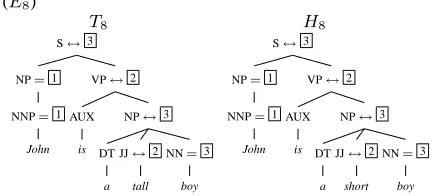
This rule can be easily showed to be consistent with common sense intuitions. For an example like “John is a tall boy” that does not entail “John is a short boy”, our strategy will produce these trees:
(E8)
T8 H8
S↔3
NP= 1
NNP=1
John
VP↔2
AUX
is
NP↔3
DT
a
JJ↔2
tall
NN=3
boy
S↔3
NP= 1
NNP=1
John
VP↔2
AUX
is
NP↔3
DT
a
JJ↔2
short
NN=3
boy
This representation can be used to derive a correct rewrite rule, such as:
if two fragments have the same syntactic
struc-ture S(N P1, V P(AU X, N P2)), and there is an
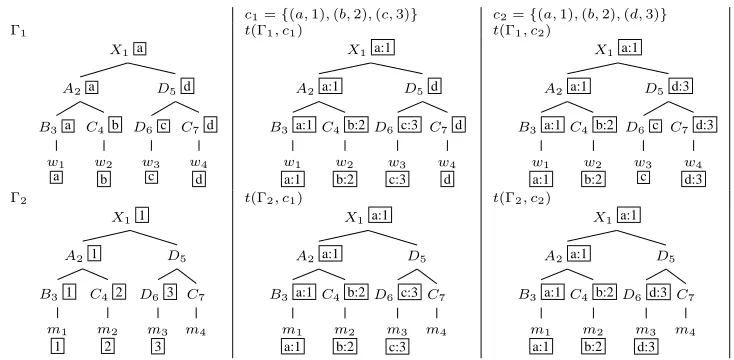
c1={(a,1),(b,2),(c,3)} c2={(a,1),(b,2),(d,3)}
Figure 1:Tree pairs with placeholders andt(T, c)transformation
entailment does not hold.
4 Reducing computational cost of the cross-pair similarity computation
4.1 The original kernel function
In this section, we describe more in detail the simi-larity functionKS(Eq. 1). To simplify, we focus on
the computation of only oneKT of the kernel sum.
KS(Γ0,Γ00) = max are interested in optimizing the evaluation of the
KT with respect to different sets of correspondences
c∈ C.
To better explainKS, we need to analyze the role
of the substitution functiont(Γ, c)and to review the tree kernel functionKT.
The aim oft(Γ, c)is to coherently replace place-holders in two treesΓ0
andΓ00
so that these two trees can be compared. The substitution is carried out according to the set of correspondences c. Let p0
and p00 be placeholders of Γ0
the substitution function replaces each placeholder
a of the tree Γ1with the new placeholder a:1 by
t(·, c) obtaining the transformed treet(Γ1, c1), and
each placeholder 1 ofΓ2with a:1. After these
sub-stitutions, the labels of the two trees can be matched and the similarity functionKT is applicable.
KT(τ0, τ00), as defined in (Collins and Duffy,
2002), computes the number of common subtrees betweenτ0 andτ00.
4.2 An observation to reduce the
computational cost
The above section has shown that the similarity functionKSfirstly applies the transformationt(·, c)
and then computes the tree kernelKT. The overall
process can be optimized by factorizing redundant
KT computations.
Indeed, two trees, t(Γ, c0) and t(Γ, c00), obtained by applying two sets of correspondences c0, c00
∈ C, may partially overlap sincec0andc00can share a non-empty set of common elements. Let us consider the subtree set S shared by t(Γ, c0
are invariant with respect toc0andc00. There-fore,KT(t(γ0, c), t(γ00, c))=KT(t(γ0, c0), t(γ00, c0))
= KT(t(γ0, c00), t(γ00, c00)). This implies that it is
com-puting the kernelKS(Γ0,Γ00).
To better explain this idea let us consider Fig. 1 that represents two trees, Γ1 and Γ2,
and the application of two different transforma-tions c1 = {(a,1),(b,2),(c,3)} and c2 =
{(a,1),(b,2),(d,3)}. Nodes are generally in the formXiz whereX is the original node label, z is
the placeholder, andiis used to index nodes of the tree. Two nodes are equal if they have the same node label and the same placeholder. The first column of the figure represents the original trees Γ1 and Γ2.
The second and third columns contain respectively the transformed treest(Γ, c1)andt(Γ, c2)
Since the subtree of Γ1 starting from A2a
con-tains only placeholders that are in c, in the trans-formed trees, t(Γ1, c1) and t(Γ1, c2), the subtrees
rooted in A2a:1 are identical. The same happens
forΓ2with the subtree rooted inA21 . In the
trans-formed trees,t(Γ2, c1)andt(Γ2, c2), subtrees rooted
in A2a:1 are identical. The computation of KT
applied to the above subtrees gives an identical re-sult. Then, this computation can be avoided. If cor-rectly used in a dynamic programming algorithm, the above observation can produce an interesting crease in the time computational cost. More de-tails on the algorithm and the decrease in computa-tional cost may be found in (Moschitti and Zanzotto, 2007).
5 Experimental Results
5.1 Experimental Setup
We implemented the novel cross-similarity kernel in the SVM-light-TK (Moschitti, 2006) that en-codes the basic syntactic kernel KT in SVM-light
(Joachims, 1999).
To assess the validity of the typed anchor model (tap), we evaluated two sets of systems: the plain and lexical-boosted systems. The plain systems are: -tap: our tree-kernel approach using typed place-holders with climbing in the syntactic tree;
-tree: the cross-similarity model described in Sec.2. Its comparison with tap indicates the effectiveness of our approaches;
The lexical-boosted systems are:
-lex: a standard approach based on lexical over-lap. The classifier uses as the only feature the lexi-cal overlap similarity score described in (Corley and
Mihalcea, 2005);
-lex+tap: these configurations mix lexical overlap and our typed anchor approaches;
-lex+tree: the comparison of this configuration with lex+tap should further support the validity of our in-tuition on typed anchors;
Preliminary experiments have been performed us-ing two datasets: RTE2 (the 1600 entailment pairs from the RTE-2 challenge) and RTE3d (the devel-opment dataset of this challenge). We randomly divided this latter in two halves: RT E3d0 and
RT E3d1.
5.2 Investigatory Results Analysis and
Submission Results
Table 2 reports the results of the experiments. The first column indicates the training set whereas the second one specifies the used test set. The third and the forth columns represent the accuracy of basic models: the original tree model and the enhanced tap model. The latter three columns report the basic lex model and the two combined models, lex+tree and lex+tap. The second and the third rows repre-sent the accuracy of the models with respect to the first randomly selected half of RT E3d whilst the last two rows are related to the second half.
The experimental results show some interesting facts. In the case of the plain systems (tree and tap), we have the following observations:
- The use of the typed anchors in the model seems to be effective. All the tap model results are higher than the corresponding tree model results. This sug-gests that the method used to integrate this kind of information in the syntactic tree is effective.
- The claim that using more training material helps seems not to be supported by these experiments. The gap between tree and tap is higher when learn-ing with RT E2 + RT E3d0 than when learning
with RT E30. This supports the claim.
How-ever, the result is not kept when learning with
RT E2 + RT E3d1 with respect to when learning
with RT E31. This suggests that adding not very
specific information, i.e. derived from corpora dif-ferent from the target one (RTE3), may not help the learning of accurate rules.
On the other hand, in the case of the
lexical-boosted systems (lex, lex+tree, and lex+tap), we
Train Test tree tap lex lex+tree lex+tap RT E3d0 RT E3d1 62.97 64.23 69.02 68.26 69.02
RT E2 +RT E3d0 RT E3d1 62.22 62.47 71.03 71.28 71.79
RT E3d1 RT E3d0 62.03 62.78 70.22 70.22 71.22
RT E2 +RT E3d0 RT E3d0 63.77 64.76 71.46 71.22 72.95
Table 2: Accuracy of the systems on two folds of RTE3 development
- There is an extremely high accuracy result for the pure lex model. This result is counterintuitive. A model like lex has been likely used by QA or IE systems to extract examples for the RTE3d set. If this is the case we may expect that positive and negative examples should have similar values for this lex distance indicator. It is then not clear why this model results in so high accuracy.
- Given the high results of the lex model, the model lex+tree does not increase the performances. - On the contrary, the model lex+tap is always better (or equal) than the lex model. This suggests that for this particular set of examples the typed anchors are necessary to effectively use the rewriting rules implicitly encoded in the examples.
- When the tap model is used in combination with the lex model, it seems that the claim “the more training examples the better” is valid. The gaps between lex and lex+tap are higher when theRT E2
is used in combination with theRT E3drelated set.
Given this analysis we submitted two systems both based on the lex+tap model. We did two differ-ent training: one usingRT E3dand the other using
RT E2 +RT E3d. Results are reported in the Table below:
Train Accuracy
RT E3d 66.75%
RT E2 +RT E3d 65.75%
Such results seem too low to be statistically consis-tent with our development outcome. This suggests that there is a clear difference between the content of RT E3d and the RT E3 test set. Moreover, in contrast with what expected, the system trained with only theRT E3ddata is more accurate than the oth-ers. Again, this suggests that the RTE corpora (from all the challenges) are most probably very different.
6 Conclusions and final remarks
This paper demonstrates that it is possible to ef-fectively include shallow semantics in syntax-based learning approaches. Moreover, as it happened in RTE2, it is not always true that more learning ex-amples increase the accuracy of RTE systems. This claim is still under investigation.
References
Roy Bar Haim, Ido Dagan, Bill Dolan, Lisa Ferro, Danilo Gi-ampiccolo, Bernardo Magnini, and Idan Szpektor. 2006. The II PASCAL RTE challenge. In PASCAL Challenges
Workshop, Venice, Italy.
Michael Collins and Nigel Duffy. 2002. New ranking algo-rithms for parsing and tagging: Kernels over discrete struc-tures, and the voted perceptron. In Proceedings of ACL02.
Courtney Corley and Rada Mihalcea. 2005. Measuring the se-mantic similarity of texts. In Proc. of the ACL Workshop
on Empirical Modeling of Semantic Equivalence and Entail-ment, pages 13–18, Ann Arbor, Michigan, June. Association
for Computational Linguistics.
Andrew Hickl, John Williams, Jeremy Bensley, Kirk Roberts, Bryan Rink, and Ying Shi. 2005. Recognizing textual en-tailment with LCCs GROUNDHOG system. In Proceedings
of the Second PASCAL Challenges Workshop on Recognis-ing Textual Entailment, Venice, Italy.
Thorsten Joachims. 1999. Making large-scale svm learning practical. In B. Schlkopf, C. Burges, and A. Smola, editors,
Advances in Kernel Methods-Support Vector Learning. MIT
Press.
Alessandro Moschitti and Fabio Massimo Zanzotto. 2007. Fast and effective kernels for relational learning from texts. In Proceedings of the International Conference of Machine
Learning (ICML), Corvallis, Oregon.
Alessandro Moschitti. 2006. Making tree kernels practical for natural language learning. In Proceedings of EACL’06, Trento, Italy.
Marta Tatu, Brandon Iles, John Slavick, Adrian Novischi, and Dan Moldovan. 2005. COGEX at the second recognizing textual entailment challenge. In Proceedings of the Second
PASCAL Challenges Workshop on Recognising Textual En-tailment, Venice, Italy.